Iranian Journal of Chemical Engineering Vol. 11, No. 2 (Spring 2014), IAChE
Effect of Polymer Concentration on the Structure and
Performance of Polysulfone Flat Membrane for CO
2Absorption in Membrane Contactor
N. Nabian1, A.A. Ghoreyshi1*, A. Rahimpour1, M. Shakeri2
1- Chemical Engineering Department, Babol University of Technology, Babol, Iran 2- Mechanical Engineering Department, Babol University of Technology, Babol, Iran
Abstract
In this study, polysulfone (PSF) flat membrane prepared via non-solvent phase inversion method was employed in gas-liquid membrane contactor module to absorb CO2. Two polymer concentrations of 16 wt% and 18 wt% were used in the dope solution of fabricated membranes. The membranes were characterized in terms of morphological structure and contact angle. Scanning electron microscopy (SEM) analysis demonstrated that PSF membrane with polymer concentration of 16 wt% in the dope solution has a porous layer with a combination of finger-like, sponge-like and macrovoid structures, but the other membrane has a sponge-like structure. Also, characterization results through atomic force microscopy (AFM) and contact angle measurement demonstrated that the porosity, surface roughness and hydrophobicity of the PSF membranes decreased with an increase in polymer concentration. Evaluation of mass transfer resistance displayed that the resistance of the PSF membrane with polymer concentration of 18wt% in the dope solution is higher than that of the other membrane. In addition, decreasing the polymer concentration significantly improved CO2 absorption flux. At the absorbent flow rate of 9.7 ml/min, the CO2 absorption flux of PSF membrane with 16 wt% polymer concentration was 2.17 times higher than the absorption flux of the PSF with 18 wt% polymer concentration.
Keywords: CO2 Absorption, Polysulfone, Polymer Concentration, Flat Membrane Contactor
1. Introduction∗
Over recent decades, there has been an increase of greenhouse gases concentration in the atmosphere due to the growth of human activities. The largest source of greenhouse gas emissions comes from burning fossil fuels such as coal, fuel oil and natural gas for electricity production in thermal power plants as well as heat generation in industrial,
∗Corresponding author: [email protected]
commercial and residential sectors. Other fundamental sources of greenhouse gas generation are petroleum processing and use of petroleum based fossil fuels such as gasoline and diesel in transportation systems [1-3].
incidents and rising sea levels. Among greenhouse gases such as water vapor, carbon dioxide, methane, nitrous oxide, ozone and CFCs, CO2 is regarded as the most serious component considering its concentration in the atmosphere and its function in enhanced greenhouse effect [4, 5]. Therefore, it is essential to develop efficient separation processes to remove CO2 from industrial off gas mixtures.
Nowadays, molecular sieve based adsorption, cryogenic distillation systems, physical or chemical absorption and membrane applications are common approaches applied for CO2 removal [6-8]. The conventional processes extensively used in this field are CO2 capturing by absorption into aqueous solutions using gas/liquid contacting devices such as packed towers, bubble columns, venturi scrubbers and tray columns [9-11]. However, the most commercial one is packed column using alkanolamines as absorbent solutions. Some operational problems associated with these contacting devices such as flooding, channeling, entrainment, foaming and also some drawbacks such as large size, low specific gas-liquid interfacial area, high capital and operating cost restrict their applications [12].
Application of membrane-based gas separation is another technique for the recovery of CO2. Despite the development achieved by decreasing the thickness and increasing the selectivity of membranes used for this purpose, their low permeability and low mass transfer rate have limited their commercialization [13-15].Thus, by taking advantage of both membrane separation and gas-liquid absorption, a novel approach has recently emerged as membrane contactor to
overcome the aforementioned problems. In this way, the role of the membrane is just a stationary interface between gas and liquid phases and offers no selectivity between the species of gas streams [16]. Hence, a membrane contactor serves as a modular system with high interfacial area per unit volume, easy scale-up with independent control of gas and liquid streams and high selectivity with high mass transfer flux provided by liquid absorbent [17, 18]. On the other hand, in addition to the gas phase and liquid phase mass transfer resistances, the membrane contactor module has the drawback of extra membrane mass transfer resistance, which reduces its performance. However, as the diffusivity of gas phase is higher than the liquid phase, completely gas-filled membrane pores ensured by hydrophobic membranes with optimized pore size can minimize the membrane resistance[19-21].
Recently, CO2 removal using this technology has been extensively investigated by different membrane configurations, but most of them were devoted to hollow fiber membrane contactors [22-24] with a few exceptions of flat sheet ones [25-27]. Khaisri et al. [28]
which restricts its application. Lu et al. [29]
evaluated CO2 absorption using amino-acid salt solution through PP hollow fiber membrane contactor. Their results demonstrated that the overall mass transfer coefficient with the composite solution is evidently higher than that of the single solution. Lv et al. [30] assessed the
efficiency of super hydrophobic PP hollow fiber membrane contactors for CO2 absorption with MEA solution. In addition to the membrane material, its structure is an important factor in the success of membrane contactor technology. Therefore, some researches have focused on the fabrication of new membranes with modified structures using other types of membrane materials such as polyetherimide and polysulfone [31, 32]. They found that the structure of membrane depends on the phase inversion process where the fingerlike macrovoid in the membrane structure enhances the membrane porosity and reduces the membrane tortuosity. Simons et al. [33]
investigated the separation of CO2 from CH4 in two hollow fiber membrane contactors using PP and polyphenylene oxide (PPO) membranes and amine absorbent. They concluded that performance of PP membranes outperforms the performance of PPO membranes in terms of productivity and selectivity. Ghasem et al. fabricated
polyethersulfone hollow fiber membranes with a good hydrophobicity for the separation of CO2 from a gas mixture using the membrane contactor module [34]. Polysulfone (PSF) membrane has been employed in different membrane separation processes and is a good candidate for membrane gas absorption due to its relatively strong hydrophobicity, good chemical
resistance and high heat resistance. Rahbari
et al. fabricated a PSF membrane with high
permeability and low mass transfer resistance and applied it to CO2 absorption in a hollow fiber contactor[35].
To the best of our knowledge, no research has been done on the absorption of CO2 using PSF flat sheet membrane contactors. Also, the effect of polymer concentration in the dope solution on the performance of PSF flat membrane contactors for CO2 absorption has not yet been reported in the literature. Therefore, the present work focuses on the CO2 absorption rates in the synthesized PSF flat sheet membranes using distilled water as absorbent. Also, the effects of liquid flow rates on CO2 absorption fluxes and the contribution of mass transfer resistance of separate phases in overall mass transfer resistance is investigated.
2. Theory
2-1. Mass transfer equations
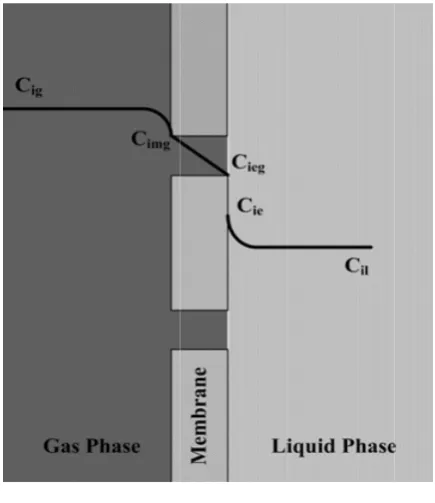
According to film theory, overall mass transfer in membrane contactor module has been considered as resistance in series model, which takes place in three steps including mass transfer from the bulk gas phase into membrane surface, mass transfer through the membrane pores and mass transfer from the membrane–liquid interface into bulk liquid phase. Fig. 1 shows schematically the concentration profile across the hydrophobic microporous membrane, and the following equation can be used to express CO2 flux (mol/m2.s) through a flat sheet membrane [36]:
where coeffici and (m/s) in phases f and the gas an gas-mem interfac respecti the liqu its conc Figure hydropho
Based o overall ( ) ca equation
1⁄
is an ent of the li are the m n the gas,
for the spec are CO2 c and liquid nd are C
mbrane in e and th ively; and uid phase id centration in
1. Concen
obic micropor
on the resis liquid phas an be desc
n[36]:
1⁄ 1⁄
n overall iquid phase mass transf
membrane cies CO2, re concentratio
phase, resp CO2 concen nterface, t
he is CO2 c deally in eq n the gas ph
ntration pro ous membran
stance in se se mass tran cribed by
⁄
mass tran (m/s); , fer coeffici
and the li espectively; ons (mol/m3 pectively; ntrations at the gas-li -gas interf concentratio quilibrium ase. file across ne. eries model nsfer coeffic the follow 1⁄ nsfer ients iquid ; 3) in
, t the iquid face, on in with the , the cient wing (2) w c c m b th 2 A m [ c f m r th v s m e r 3 3 P a p d th p d th m 3 T u d c w a where constant for coefficients membrane a by equation he literature 2-2. Applicat An alternat membrane 40].The ga can be negl feed gas membrane s resistance of
he liquid v versus 1/
straight line membrane empirical α
result in the
3. Experime
3-1. Materia
Polysulfone as the mem purchased dimethylform
han 99.5% purchased f dodecyl sul he precip membranes.
3-2. Synthesi
The non-sol used to fabr dope sol concentratio wt% PSF) b at room te
is dimens r CO2. Ind
of the and the gas ns which ha
e [37-39].
tion of Wils
tive techni resistance as phase ma
lected if pu in physi systems [37]
f the liquid velocity( ).T
, known as e with an
mass tran value of th best straigh ental als beads (PS mbrane subs from S mamide(DM %, used a
from Dae lfate (SDS, pitation b
is of PSF fla
lvent phase ricate flat P lutions c ons of poly balanced wit emperature.
sionless He dividual ma liquid p phasecan b ave been p
on plot
ique to ev is the W ass transfer ure CO2 is u
ical gas ] and the m
phase is de Thus, a gra s Wilson pl intercept sfer coeffi he graph is ht line.
Mn: 22,000 strates poly igma-Aldri MF) with p as the sol Jung, Kore Merck) w bath of
at sheet mem
inversion m PSF membr containing ymer (16 w
th DMF we The solu enry’s law ass transfer phase, the be predicted resented in valuate the Wilson plot r resistance used as the absorption mass transfer ependent on aph of 1/
lot, yields a giving the icient. The a constant
0 Da), used ymer, were ch. N,N-purity more lvent, was ea. Sodium was used in fabricated
mbranes
allowed to mix for at least 8 h until the homogeneous polymer dope solutions were completely formed and then degassed at room temperature for 12 h. The polyester non-woven fabric with a thickness of about 100 µm was attached to a clean glass plate, and the dope solution was then spread onto the polyester fabric using a casting knife. The precipitation bath for initiating the phase inversion contained distilled water, 0.1 wt% SDS and 2 wt% DMF. The prepared membranes were immediately immersed in the precipitation bath for 30 min and then washed. After that, the membranes were stored in water bath for at least 1 day to leach out the residual solvents and additives completely. Finally, in order to dry the membranes, two sheets of filter paper were placed on both sides of the fabricated membranes for 24 h at room temperature.
3-3. Membrane characterizations 3-3-1. SEM and AFM observation
Surface and cross-section observation of fabricated flat membranes was carried out by scanning electron microscopy (SEM model: KYKY-EM3200) operating at 24 KV. The samples were coated with a gold layer before the surface scanning. Also, the membranes were fractured in liquid nitrogen for the cross-section microscopy.
Atomic force microscopy (AFM model: Easyscan2 Flex) was used to determine the surface morphologies and the roughness of the PSF membranes. The scan size of
5 5 was selected for imaging the membrane surfaces at atmospheric pressure. For each membrane, the reported roughness value is the average of roughness values of three scanned images. The mean roughness
value (Sa) measured by an AFM is defined as
[41]:
1
| , | (3)
where f(x,y) is the surface relative to the
center plane, L and W are the surface
dimensions. Based on the pore size distribution function (Fr) obtained by AFM data, the mean pore size of the membranes (rave) can be estimated through Eq. 4 [41]:
(4)
3-3-2. Measurement of membrane porosity and contact angle
The volume of pores divided by the total membrane volume is defined as the membrane porosity (ε) which can be calculated by measuring the dry mass (mdry) and wet mass (mwet) of membranes and using Eq. 5 [42]:
100 (5)
to mea water o For eac water d was 4 µ measure of conta
3-4. CO
Fig. 2 the exp CO2 u contacto consiste membra study, t on the f liquid s the chan feed ga membra absorbe membra obtain t were co operatio of the s pressure (MFC), At the transfer allowed
asure the c on fabricate ch sample, drop created
µl. After re ement three act angles w
2 absorption
shows a sc perimental s using a or.The mem ed of two ane interpos the serpenti flow field p streams. Th nnels were as was us ane, and di ent was use ane in the the best per onducted in on. The equ
etup consis e regulator a pressure
start-up s rred to the m d to flow t
Figure
contact ang ed flat she the volum d on the me
epeating the e times, the was calculate n experimen chematic re setup emplo flat she mbrane con flow field sed betwee ine channel plates for di he width an 1.0 mm. P sed on on stilled wate d on the ot constructe rformance, n a counter uipment used
ts of a CO2 r, a mass gauge and stage, the module and
o the modu
e 2. Experime
gle of dist eet membra me of a si embrane sur e contact a e average v
ed.
nt
epresentatio oyed to cap eet memb
ntactor mo d plates an en them. In ls were for irecting gas nd the dept Pure CO2 as ne side of
er as the li ther side of ed module. all experim r current m d in the gas 2 gas cylind flow contr a needle va
gas was liquid was ule in orde
ental setup of C
tilled anes. ingle rface angle value n of pture brane odule nd a this rmed s and th of s the the iquid f the . To ments mode s line der, a oller alve. first then er to p w m U A w a l b e n d s 2 v l o c C l t h p T c th
CO2 absorptio
prevent th wetting. Ga mass flow USA) at 298 A peristaltic with variabl applied for
iquid line. A between the employed u needle valv dispersion o steady state 20 min of value of ma
oaded sam operating co calculation CO2, its co
iquid was itrimetric hydroxide s phenolphtha Therefore, coefficient hrough Eq.
on using mem
he phenom s flow rates controller 8.15 K and c pump (Tho le flow rate
directing A differenti e gas and using a pr e in the liq of gas bubb
condition, each run o ass transfer mples take onditions, w of the over ontent in s measured method olution was alein as the ove of liquid p
6 [44]:
mbrane contact
mena of s were cont
(Dwyer atmospheri omas SR25 es of 3-12 m
distilled w ial pressure
the liquid ressure gau quid line to bles into the reached af operation, t r fluxes for en under were calcula
rall absorpt the outlet d by the
in which s used as a an indica erall mass phase was
or module.
where QL is liquid volumetric flow rate (m3/s); Am is membrane mass transfer surface area (m2); Cil,out and Cil,in are CO2 concentrations in the outlet and inlet liquid respectively (mol/m3). Two fabricated PSF membranes were separately placed in the contactor module and their results were compared.
4. Results and discussions
4-1. Characterization results of PSF mem-branes
The membranes were characterized in terms of mean pore size, porosity, roughness and water contact angle measurement. These results for both samples are listed in Table 1. The cross-section and surface SEM images of PSF flat sheet membranes with various polymer concentrations (samples PSF-16 and PSF-18) are shown in Fig. 3. As it is clear in Figs. 3a and 3c, PSF-16 membrane showed a thin skin layer and a porous supported layer with finger-like, sponge-like and macrovoid structures. This can be attributed to different starting conditions for phase separation at layers far from the surface in solvent-non solvent exchange. The membrane transport properties are dependent on both skin and support layers. This structure is expected to provide lower mass transfer resistance and higher gas permeability, favorable for gas
absorption application. Also, the lower polymer concentration can be regarded as the other reason for the macrovoid formation in PSF-16 membrane due to faster precipitation in the phase inversion process [45]. In contrast, the PSF-18 membrane displayed a sponge-like structure due to the high polymer concentration which increased the viscosity of polymer, leading to a phase separation delay and the formation of smaller pore size. Kimmerle et al. reported that high viscosity
of the polymer dopes generated the membranes with sponge-like structure [46]. According to Figs. 3b and 3d, it seems that by increasing the polymer concentration in the dope solution from 16 wt% to 18 wt%, the porosity and mean pore size of the membrane decreased which is also confirmed by the data represented in Table 1.
The 3D AFM images of PSF-16 and PSF-18 membranes were displayed in Fig. 4. In these pictures, the dark sections represent the depressions (membrane pores) and the bright ones are representatives of nodules. Besides, the roughness of the substrate is assigned to the height of the surface’s lumps [47]. It is obvious that there was a change in surface morphology of the membranes and the surface roughness of PSF-16 membrane was higher than that of PSF-18 membrane as presented in Table1.
Table 1. Characteristics of fabricated PSF flat membranes.
Membrane Mean Pore Size rave (nm)
Porosity (%)
Roughness Sa (nm)
Water Contact Angle
°
PSF-16 155.46 69.64 14.26 73.5
Figuree 3. SEM imag
Figure 4.
ges of fabricat PSF (c) cros
(a)
AFM images
ted PSF flat m ss section of 1
s of fabricated
membranes (a) 8 wt% PSF an
PSF flat mem
cross section nd (d) surface
mbranes (a) 16
n of 16 wt% PS e of 18 wt% PS
(b)
6 wt% PSF (b)
SF (b) surface SF.
) 18 wt% PSF
e of 16 wt%
According effect of membrane evaluated. angle of with a de hence le hydrophob the hydr increased, wetting te favorable efficiency. membrane absorbent, through th pores and resistance enhanceme 4-2. Analys
The CO2 ab PSF memb liquid flow dependenc performanc transfer res of 1000 m shown in F increasing to 0.1 m/s, PSF-16 an This can thickness o flow rates transfer co reported water as a PTFE mem found th rate led
to the data polymer
surface c It was ob fabricated ecrease in p
eading to bicity of the rophobicity the prob ended to parameter It is due to
is not w CO2 is n he membr hence the m
decrease ent of absor
sis of CO2 ab
bsorption fl branes were w rates in cy of the
ce on the sistance. Th
l/min was s Fig. 5, it ca the liquid v , the CO2 ab nd PSF-18 be attribut of the liquid s leading to oefficient. S
for CO2 absorbent i mbrane con at an incr to the en
reported in concentrati contact an served that membrane polymer co o an in e PSF-16 m
of the bability of
decrease w r for CO o the fact th wetted by not forced rane with membrane m s, leading rption flux. bsorption pe
fluxes of bo e determine
order to membran e liquid p he constant g selected for an be conclu
velocity fro bsorption fl membrane ted to the d boundary
o an incre Similar trend
absorption in commer ntactor [35, rease in the nhancement
n Table 1, th ion on th ngle can b t the contac es increase
oncentration ncrease i membrane. A membran f membran which is O2 remova
hat when th the liqui d to diffus liquid-fille mass transfe
g to th
erformance
th fabricate ed at variou evaluate th ne contacto phase mas gas flow rat this test. A uded that b om 0.025 m/
luxes of bot es increased
decrease i layer at hig ase in mas ds were als n flux usin rcial PP an 48]. It wa e liquid flow
t of the CO he he be ct ed n, in As ne ne a al he id se ed er he ed us he or ss te As by /s th d. in gh ss so ng nd as w O2 mas Refe decr solu CO2 tran grea the abso 2.17 the be a PSF mea in t resu high pref disc the high also for C Figu rates 4-3. Acc pres tran JCO 2 (m ol/m 2.S) x10 5
ss transfer ra ferring to F
reasing the ution has co
2 absorption nsfer rate ater than tha absorbent orption flux 7 times high
PSF-18 me ascribed to F-16 memb
an pore size the porosit ulted in high
her permea ferred facto cussed befor PSF-16 me her contact o improved CO2 absorp
ure 5. CO2 abs
s using PSF-16
Analysis of
cording to sented in nsfer can be
3.5 2 13 11 9 7 5 3 1 JCO 2 (m ol/m .S) 10 PS PS ate.
Fig. 5, the r polymer co ontributed n flux. It m
of PSF-16 at of PSF-18 flow rate o x of the PSF her than the embrane.Th
the modifi rane; i.e. t e and the po ty of the her gas-liqu ability, b ors in memb
re, the wett embrane wa
angle value d the memb ption.
sorption fluxe 6 and PSF-18
f membrane
resistance Eq. 2, the e determine 6.5 5 LiquidFlow Rat SF-16 SF-18 results show oncentration to improve means that C 6 membra 8. As an ex of 9.7 ml/m F-16 membr e absorption is phenome ied structur the increase orosity.The PSF-16 me uid contact
oth of wh brane conta ability resis as higher du e. Indeed, th mbrane perfo
es at various li membranes.
resistance
e in series e membran d using the
11 9.5 8 te (ml/min)
wed that n in dope ement in CO2 mass
plot be resistan used as evaluati been rep
al. [50]
relation fluid ve mass tra fiber m Wilson transfer alkanola membra Fig. 6 fabricat straight was ob contribu overall obtained resistan plot. M regressi membra Table 2. by Wilso Membra PSF-1 PSF-1 Accordi transfer decrease when t solution
ecause the nce can be the feed g ion of mas
ported in th used the W nship of 1/
elocity to e ansfer coeff membrane c plot for r resistance amine abso ane contacto shows th ted PSF m
line to the btained by ution of
mass tran d using the nce calculate Membrane r
ion coef anes are rep
Equation and n plot.
ane Equat
6 20753
88837
8 249
465
ing to these r resistance ed to appro the polyme n decreased
gas phase neglected gas. Using W
ss transfer he literature Wilson plot
/ with th evaluate the ficient in de ontactors. L
determina during CO orbents in ors [51]. he Wilson membranes
data of 1/ α equal membrane nsfer resis e membrane ed from the resistances, fficients ported in Tab
d membrane r
tion R-squa Val 3 7 0.99 929 948 0.96
e data, the m e of the P oximately 1
er concentr d from 18 w
mass tran if pure CO Wilson plot resistance e [49]. Yan and report he reciproca e liquid str esigning ho Lin et al. u
ation of m O2 absorption
PVDF and
plot for and the
/ versus 1
to 0.93. resistance stance can e mass tran
intercept o equations of diffe ble 2. resistance obt -ared ue Membr Resista (s/m) 951 8883 655 46594 membrane m PSF memb
9% of its v ration in d wt% to 16 w
nsfer O2 is
t for has ng et
ted a al of ream ollow used mass n by d PP two best 1/u The e in n be nsfer f the and erent tained rane ance ) 7 48 mass brane value dope wt%. T P th p a 0 w o th r a m in o c m o 1 in 0 r ( th l F d 5 T c This recon PVP-16 mem he contact proved by absorption 0.025 m/s, n was attribut of the
PSF-he gas pha resistance of as 84% of th membrane.
ncreasing t overall m consequentl membrane r overall mas 16 membr
ncreasing t 0.1 m/s, the resistance d (from 84% t he disturba iquid phase
Figure 6. Wil
distilled water 5. Conclusio The porous concentratio 7 14 12 10 8 6 4 2 0 1/ K1 (s/m) x10 -5 P P firms supe mbrane aga tor module y the me
flux. At th nearly 16% ed to the m -16 membr ase resistan f the liquid he total resi As it can the liquid v mass trans
y the c resistance in s transfer r rane also the liquid v e contributio
decreased t to 58%).Th ance of the e with an inc
lson plot for p .
ons
PSF mem ons of 16 w
17 12 1 PSF-18 PSF-16 erior perfo ainst the PSF e which w
easurement he liquid v
of the tota mass transfer
rane.So, by nce, the ma phase can b istance for n be seen
velocity dec fer resist contribution ncreased.Th esistance fo revealed velocity from
on of the li to 69% of his can be a boundary l crease in the
pure CO2 abs
mbranes wit wt% and 18
22 /u0.93
fabricated via phase inversion method.The CO2 absorption performance of membranes was investigated in a flat membrane contactor module. As the polymer concentration in the dope solution increased, the mean pore size, porosity and contact angle of the membrane decreased.The PSF-16 membrane showed a combination of finger-like, sponge-like and macrovoid struc-tures while the structure of PSF-18 membrane was sponge-like. An increase in the liquid flow rate resulted in an increase of CO2 flux for both membranes. The CO2 absorption flux of the PSF-16 membrane was higher than that of the PSF-18 membrane due to its higher porosity and hydrophobicity.On the other hand, the mass transfer resistance of the PSF-16 membrane was lower than that of the PSF-18 membrane. Therefore, it can be concluded that increasing the polymer concentration in the dope solution has a negative effect on the mass transfer flux of CO2. All of these results suggest that polysulfone is an appropriate material with the potential to fulfill the demands of carbon dioxide absorption and can be used in membrane contactor applications.
References
[1] Gabelman, A. and Hwang, S.T., "Hollow fiber membrane contactors", J. Membr. Sci., 159(1-2), 61, (1999). [2] Rufford, T.E., Smart, S., Watson,
G.C.Y., Graham, B.F., Boxall, J., Diniz da Costa, J.C. and May, E.F., "The removal of CO2 and N2 from natural gas: A review of conventional and emerging process technologies", J. Petro. Sci. Eng.,94–95,123, (2012).
[3] Lampert, K., Ziebik, A. and Stanek, W., "Thermoeconomical analysis of CO2 removal from the Corex export gas and its integration with the blast-furnace assembly and metallurgical combined heat and power (CHP) plant", Energy,35(2), 1188, (2010). [4] Yeon, S.H., Lee, K.S., Sea, B., Park,
Y.I. and Lee, K.H.,"Application of pilot-scalemembrane contactor hybrid system for removal of carbon dioxide from flue gas", J. Membr. Sci., 257(1-2), 156, (2005).
[5] Dunne, J.A., Jackson, S.C. and Harte, J., Greenhouse Effect, in: Encyclopedia of Biodiversity (2nd Edition), S.A. Levin Ed., Academic Press, (2013). [6] Guo, W., Feng, F., Song, G., Xiao, J.
and Shen, L., "Simulation and energy performance assessment of CO2 removal from crude synthetic natural gas via physical absorption process", J. Nat. Gas. Chem.,21(6), 633, (2012). [7] Naim, R. and Ismail, A.F.,"Effect of
fiber packing density on physical CO2 absorption performance in gas–liquid membrane contactor", Sep. Purif. Technol., 115, 152, (2013).
[8] Zhang, Y., Sunarso, J., Liu, S. and Wang, R., "Current status and development of membranes for CO2/CH4 separation: A review", Int. J. Greenh. Gas. Con.,12, 84, (2013). [9] Pineda, I.T., Lee, J.W., Jung, I. and
Kang, Y.T., "CO2 absorption enhancement by methanol-based Al2O3 and SiO2 nanofluids in a tray column absorber", Int. J. Refrig., 35(5), 1402, (2012).
dioxide absorption in a cross-flow rotating packed bed", Chem. Eng. Res. Des.,89(9), 1722, (2011).
[11] Yi, F.,Zou, H.K., Chu, G.W., Shao, L., and Chen, J.F., "Modeling and experimental studies on absorption of CO2 by Benfield solution in rotating packed bed", Chem. Eng. J., 145(3), 377, (2009).
[12] Cheng, H.H., and Tan, C.S., "Removal of CO2 from indoor air by alkanolamine in a rotating packed bed", Sep. Purif. Technol.,82, 156, (2011). [13] Favre, E., "Membrane processes and
postcombustion carbon dioxide capture: Challenges and prospects", Chem. Eng. J., 171(1-2), 782, (2011).
[14] Ismail, A.F., Kusworo, T.D. and Mustafa, A., "Enhanced gas permeation performance of polyethersulfone mixed matrix hollow fiber membranes using novel Dynasylan Ameo silane agent", J. Membr. Sci., 319, 306, (2008).
[15] Favre, E., "Carbon dioxide recovery from post-combustion processes: Can gas permeation membranes compete with absorption?", J. Membr. Sci., 294(1-2), 50, (2007).
[16] Bottino, A., Capannelli, G., Comite, A., Di Felice, R. and Firpo, R., "CO2 removal from a gas stream by membrane contactor, separation and purification technology", Sep. Purif. Technol., 59(1), 85, (2008).
[17] Khaisri, S., deMontigny, D., Tontiwachwuthikul, P. and Jiraratananon, R., "CO2 stripping from monoethanolamine using a membrane contactor", J. Membr. Sci., 376(1-2), 110, (2011).
[18] Scholes, C.A., Simioni, M., Qader, A., Stevens, G.W. and Kentish, S.E., "Membrane gas–solvent contactor trials of CO2 absorption from syngas", Chem. Eng. J., 195–196, 188, (2012).
[19] Modigell, M., Schumacher, M., Teplyakov, V.V. and Zenkevich, V.B., "A membrane contactor for efficient CO2 removal in biohydrogen production", Desalination, 224(1-3), 186, (2008).
[20] Zhang, H.Y., Wang, R., Liang, D.T. and Tay, J.H., "Modeling and experimental study of CO2 absorption in a hollow fiber membrane contactor", J. Membr. Sci., 279(1-2), 301, (2006). [21] Nguyen, P.T., Lasseuguette, E.,
Medina-Gonzalez, Y., Remigy, J. C., Roizard, D. and Favre, E., "A dense membrane contactor for intensified CO2 gas/liquid absorption in post-combustion capture", J. Membr. Sci., 377(1-2), 261, (2011).
[22] Marzouk, S.A.M., Al-Marzouqi, M.H., El-Naas, M.H., Abdullatif, N. and Ismail, Z.M., "Removal of carbon dioxide from pressurized CO2–CH4 gas mixture using hollow fiber membrane contactors", J. Membr. Sci., 351(1-2), 21, (2010).
[23] Cai, J.J., Hawboldt, K. and Abdi, M.A., "Contaminant removal from natural gas using dual hollow fiber membrane contactors", J. Membr. Sci., 397–398, 9, (2012).
contactor", J. Membr. Sci., 452, 379, (2014).
[25] Lin, S.H., Tung, K.L., Chang, H.W. and Lee, K.R. "Influence of fluorocarbon flat-membrane hydro-phobicity on carbon dioxide recovery", Chemosphere, 75(10), 1410, (2009). [26] Franco, J.A., Kentish, S.E., Perera, J.M.
and Stevens, G.W., "Poly (tetrafluoroethylene) sputtered polypropylene membranes for carbon
dioxide separation in membrane gas absorption", Ind. Eng. Chem. Res., 50(7), 4011, (2011).
[27] Paul, S., Ghoshal, A.K. and Mand, B., "Theoretical studies on separation of CO2 by single and blended aqueous alkanolamine solvents in flat sheet membrane contactor (FSMC)", Chem. Eng. J., 144(3), 352, (2008).
[28] Khaisri, S., de Montigny, D., Tontiwachwuthikul, P., and Jiraratananon, R., "Comparing membrane resistance and absorption performance of three different membranes in a gas absorption membrane contactor", Sep. Purif. Technol.,65(3), 290, (2009).
[29] Lu, J.G., Zheng, Y.F. and Cheng, M.D., "Membrane contactor for CO2 absorption applying amino-acid salt solutions", Desalination, 249(2), 498, (2009).
[30] Lv, Y., Yu, X., Jia, J., Tu, S.T., Yan, J. and Dahlquist, E., "Fabrication and characterization of superhydrophobic polypropylene hollow fiber membranes for carbon dioxide absorption", Appl. Energy., 90(1), 167, (2012).
[31] Mansourizadeh, A. and Ismail, A.F.,
"Effect of additives on the structure and performance of polysulfone hollow fiber membranes for CO2 absorption", J. Membr. Sci., 348(1-2), 260 ,(2010). [32] Bakeri, Gh., Matsuura, T., Ismail, A.F.
and Rana, D., "A novel surface modified polyetherimide hollow fiber membrane for gas-liquid contacting processes", Sep. Purif. Technol., 89, 160, (2012).
[33] Simons, K., Nijmeijer, K. and Wessling, M., "Gas–liquid membrane contactors for CO2 removal", J. Membr. Sci., 340(1-2), 214, (2009).
[34] Ghasem, N., Al-Marzouqi, M. and Zhu, L., "Preparation and properties of polyethersulfone hollow fiber membranes with o-xylene as an additive used in membrane contactors for CO2 absorption", Sep. Purif. Technol., 92, 1, (2012).
[35] Rahbari-Sisakht, M., Ismail, A.F. and Matsuura, T., "Development of asymmetric polysulfone hollow fiber membrane contactor for CO2 absorption", Sep. Purif. Technol., 86, 215, (2012).
[36] Drioli, E., Criscuoli, A. and Curcio, E., Membrane contactors: Fundamentals, applications and potentialities, Elsevier, p. 516, (2006).
[37] Rangwala, H.A., "Absorption of carbon dioxide into aqueous solutions using hollow fiber membrane contactors", J. Membr. Sci.,112(2), 229, (1996).
[38] Gilliland, E.R. and Sherwood, T.K., "Diffusion of vapors into air streams", Ind. Eng. Chem., 26(5), 516, (1934). [39] Mavroudi, M., Kaldis, S.P. and
mass transfer resistance in membrane gas–liquid contacting processes", J. Membr. Sci., 272(1-2), 103, (2006). [40] Wilson, E.E., "A basis for rational
design of heat transfer apparatus", Trans. Am. Soc. Mech. Eng., 37, 47, (1915).
[41] Singh, S., Khulbe, K.C., Matsuura, T. and Ramamurthy, P., "Membrane characterization by solute transport and atomic force microscopy", J. Membr. Sci.,142(1), 111, (1998).
[42] Amini, M., Jahanshahi, M. and Rahimpour, A., "Synthesis of novel thin film nanocomposite (TFN) forward osmosis membranes using functionalized multi-walled carbon nanotubes", J. Membr. Sci., 435, 233, (2013).
[43] Li, N.N., Fane, A.G., Ho, W.S.W. and Matsuura, T., (Eds.), Advanced membrane technology and applications, John Wiley & Sons Inc., New York, NY, (2008).
[44] Dindore, V.Y., Brilman, D.W., F., Feron, P.H.M. and Versteeg, G.F., "CO2 absorption at elevated pressures using a hollow fiber membrane contactor", J. Membr. Sci., 235(1-2), 99, (2004).
[45] Fontananovaa, E., Jansen, J.C., Cristiano, A., Curcio, E. and Drioli, E., "Effect of additives in the casting solution on the formation of PVDF membranes", Desalination, 192 (1-3), 190, (2006).
[46] Kimmerle, K. and Strathmann, H., "Analysis of the structure-determining process of phase inversion membranes", Desalination, 79(2-3), 283, (1990).
[47] Mansourpanah, Y., Alizadeh, K., Madaeni, S., Rahimpour, A. and Soltani Afarani, H., "Using different surfactants for changing the properties of poly(piperazineamide) TFC nanofiltration membranes", Desalina-tion, 271(1-3), 169, (2011).
[48] Xu, A., Yang, A., Young, S., de Montigny, D. and Tontiwachwuthikul, P., "Effect of internal coagulant on effectiveness of polyvinylidene fluoride membrane for carbon dioxide separation and absorption", J. Membr. Sci., 311 (1-2), 153, (2008).
[49] Mansourizadeh, A. and Ismail, A.F., "A developed asymmetric PVDF hollow fiber membrane structure for CO2 absorption", Int. J. Greenh. Gas. Con., 5 (2), 374, (2011).
[50] Yang, M.C. and Cussler, E.L., "Designing hollow-fiber contactors", AIChE J., 32(11), 1910, (1986).