Research Journal
Volume 10, No. 30, June 2016, pages 159–163
DOI: 10.12913/22998624/62772 Research Article
IMPACT OF COMPRESSED AIR PRESSURE ON GEOMETRIC STRUCTURE
OF AISI 1045 STEEL SURFACE AFTER TURNING WITH THE USE OF MQCL
METHOD
Radosław Wojciech Maruda1
1 Faculty of Mechanical Engineering, University of Zielona Gora, 4 Prof. Z. Szafrana Street, 65-516 Zielona Gora, Poland, e-mail: [email protected]
ABSTRACT
MQL (Minimum Quantity Lubrication) and MQCL (Minimum Quantity Cooling Lu-brication) methods become alternative solutions for dry machining and deluge cool-ing conditions. Due to a growcool-ing interest in MQCL method, this article discusses the impact of compressed air pressure, which is one of the basic parameters of generating emulsion mist used in MQCL method, on the geometric structure of the surface after turning AISI 1045 carbon steel. This paper presents the results of measurements of machined surface roughness parameters Ra, Rz, RSm as well as roughness profiles and Abbot-Firestone curves. It was found that the increase in the compressed air pres-sure from 1 to 7 MPa causes an increase in the roughness of the machined surface (the lowest values were obtained at a pressure of 1 MPa). An increase of emulsion mass flow rate also causes an increase in the value of selected parameters of roughness of the machined surface.
Keywords: compressed air pressure, emulsion flow, geometric structure, MQCL, near dry cutting.
INTRODUCTION
Sustainable and economic manufacturing has become a very important process in the automo-tive and aviation industries [9, 24]. Despite nu-merous advantages of cooling lubricants in ma-chining, there are many concerns as to the envi-ronmental and economic problems related to their use. Thus, in recent years, many scientists have conducted research associated with a reduction in the use of cooling lubricants or their complete elimination [7, 11, 17, 21].
In the case when completely dry machining is impossible, lubricating systems based on MQL (minimum quantity lubrication) and MQCL (min-imum quantity cooling lubrication) methods are good alternatives [14, 20]. For cooling the cut-ting zone using these methods, a small amount
of cooling lubricants is used (5-100 ml/h, i.e. approx. 1000 times less than when using deluge cooling) [14, 18]. Therefore, the consumption of oil and emulsion as well as costs related to their use are significantly reduced. When applying MQL and MQCL methods, the chips, the material to undergo the process of machining and the tools are practically dry, and the costs related to the re-cycling of coolants are reduced. A small amount of cooling lubricants is sufficient to decrease the friction in machining by reducing the tendency of adhesion in materials with such characteristics [16]. In MQCL method, emulsion mist is supplied to the cutting zone in a form of emulsion spray and compressed air.
Eco-cooling methods have been applied in a number of machining operations, including grind-ing [5, 6], millgrind-ing [8], drillgrind-ing [2] as well as turn-ing [4, 10, 13, 14]. It was found that compared to Received: 2016.04.15
dry machining, MQCL and MQL methods reduce the roughness of the machined surface [4, 13], the wear of the cutting blade [1, 3, 4] and the tem-perature in the cutting zone [3] as well as have a positive effect on the chip shape [14].
Research on the conditions of oil mist gen-eration (MQL) and emulsion mist gengen-eration (MQCL) shows that the most significant factors affecting the conditions of generating oil or emul -sion mist, and, consequently, its effective use, include the setting of the nozzle (angle and dis-tance) [12, 20, 22], emulsion mass flow rate [22], air pressure and volumetric air flow rate [12, 15, 19]. Shiva Sai et al. [19] demonstrated that com-pressed air pressure in MQL method affects the diameter of droplets supplied to the cutting zone. It was also proven that an increase in air pressure causes an increase in the wettability of the cutting zone. During their research, Park et al. [15] ob-served that as compressed air pressure increases, the number of droplets falling on the contact sur-face of the blade with the machined material is increased as well and their diameter is reduced.
The aim of this article is to analyze the impact of compressed air pressure as one of the basic parameters of generating emulsion mist used in MQCL method, on the geometric structure of the surface. The knowledge of air pressure parameter is vital for the application of MQCL method in machining processes on an industrial scale.
MATERIALS AND METHODS
The study was conducted on a lathe with SDBM2020M12 holder and SNUN104008 plate made of P25 cemented carbide coated with TiN (coating thickness 4 µm, applied using CVD method). The material to undergo the process of machining was AISI 1045 carbon steel (C45 steel according to EN 10083-2: 2006).
A concentrated emulsion WEDOLIT K910 served as the active medium for the emulsion mist. This is a semi-synthetic, water-miscible product based on boric acid H3BO3 and amines which contains a small amount of mineral oil and polar lubricant additives. The active medi-um was prepared using type ES21H electromag-netic stirrer to give a 5% concentrate in water solution.
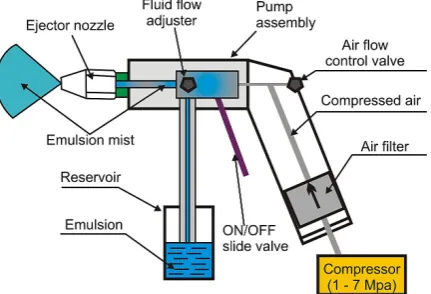
The apparatus generating emulsion mist is presented in Figure 1. The aerosol in GAV1500 is created in a special chamber, where the emul-sion is sucked due to negative pressure. Then, compressed air ensures transportation of the fin -ished aerosol to a discharge nozzle with a diam-eter of 0.9 mm.
Fig. 1. GAV1500 device that generates emulsion mist
During the turning process, constant machin-ing parameters were applied: feed rate f = 0.15 mm/rev; cutting speed vc= 300 m/min and depth of cutting ap = 0.5 mm, as well as variable pa-rameters of emulsion mist generation:
• mass flow of emulsion E = 1.5 ÷ 3.2 g/min;
• compressed air pressure P = 1 ÷ 7 MPa;
• distance of the nozzle from the cutting zone l = 0.3 m [12].
The roughness measurement was made on TR-200 device in compliance with ISO 4287:1998. The following values were mea-sured: the arithmetic mean value of the profile ordinates Ra, the maximum height of the profile Rz as well as the root mean square value of the profile ordinates Rq.
RESULTS AND DISCUSSION
The charts showing changes in the selected roughness parameters of the machined surface of AISI 1045 carbon steel elements after turning, according to variable compressed air pressure P and emulsion mass flow rate E are presented in Figure 2.
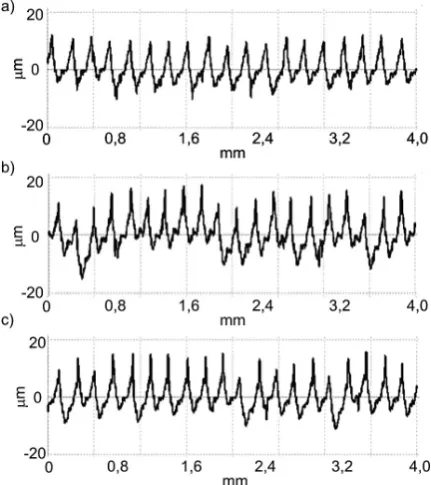
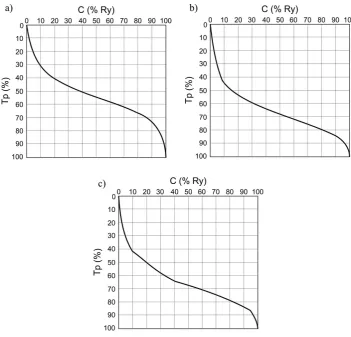
Figure 3 shows typical roughness profiles and Figure 4 – Abbot-Firestone curves for AISI 1045 steel after turning with the use of MQCL method for E = 2.5 g/min and three different compressed air pressure values.
As can be seen in Fig. 3, the correct selec-tion of condiselec-tions for the generaselec-tion of emulsion mist with the use of MQCL method (compressed air pressure) affects the shape of the roughness profiles of machined surfaces. A significant re -duction of the height of unevenness (Fig. 3a) can significantly affect the operating properties of this surface, including the friction coefficient and wear rate [23].
Fig. 3. Roughness profiles of 1045 carbon steel sur -face after turning with the use of MQCL method with
different compressed air pressure values for vc = 300 m/min, f = 0.15 mm/rev, E = 2.5 g/min: a) P = 1 MPa;
b) P = 4 MPa; c) P = 7 MPa
From the Abbot-Firestone curves (Fig. 4), it is visible that for 1 MPa of compressed air pres-sure, the shape of the curve is most S-like (first, it falls steeply, then it becomes more flat, and the end-section falls steeply again). The shape of this curve (Fig. 4a) proves that the upper part of the surface will be worn quickly after the initiation of friction between two surfaces. The long straight section after the run-in period shows good load bearing capacity of the surface as well as good operating resistance under high stress [23]. causes an increase of the roughness parameters.
At relatively high emulsion flow rates (E = 3.2 g/min) (Figure 2a), an increase in air pressure by 1 MPa caused the Ra parameter to increase by 6%, and after exceeding the value of 2 MPa, the change is within the scope of ±2%. The greatest percentage differences for Ra and Rz parameters were observed at variable emulsion mass flow rates and low compressed air pressure values (<2.5 MPa). This increase in the selected param-eters with the increase of compressed air pres-sure might be caused by the fact that droplets are ejected from the nozzle at a higher speed, which may lead to turbulence and change in the direc-tion of movement of these droplets, thus reduc-ing their quantity supplied to the cuttreduc-ing zone.
Fig. 2. Impact of compressed air pressure on the roughness of machined AISI 1045 carbon steel sur-face after turning at various emulsion mass flow rates:
CONCLUSIONS
The parameters of generating emulsion mist greatly affect the geometric structure of the sur -face. The lowest values of selected roughness parameters were obtained for low compressed air pressure (P = 1 MPa) and emulsion mass flow rate (E = 1.5 g/min). An increase in pressure by 1 MPa in GAV1500 device causes an increase in the values of selected roughness parameters from 2% to 20%. The chosen roughness profiles and Abbot-Firestone curves demonstrate that the best efficiency of generating emulsion mist with the use of MQCL method in terms of quality of the machined surface can be obtained for low emul-sion flow and low pressure of the compressed air.
REFERENCES
1. Chinchanikar S., Choudhury S.K. Hard turning using HiPIMS-coated carbide tools: Wear behav -ior under dry and minimum quantity lubrication
(MQL). Measurement, 55, 2014, 536–548.
2. Davim J.P., Sreejith P.S., Gomes R., Peixoto C. Experimental studies on drilling of aluminum (AA1050) under dry, minimum quantity of lubri-cant, and flood-lubricated conditions. Proceedings of the Institution of Mechanical Engineers, Part B: Journal of Engineering Manufacture, 220 (10), 2006, 1605–1611.
3. Debnath S., Reddy M.M., Yi Q.S. Environmental friendly cutting fluids and cooling techniques in machining: a review. Journal of Cleaner Produc-tion, 83, 2014, 33–47.
4. Dhar N.R., Kamruzzaman M., Ahmed M. Effect of minimum quantity lubrication (MQL) on tool wear and surface roughness in turning AISI-4340 steel. Journal of Materials Processing Technology, 172 (2), 2006, 299–304.
5. Hadad M.J., Tawakoli T., Sadeghi M.H., Sadeghi B. Temperature and energy partition in minimum quantity lubrication-MQL grinding process. Inter-national Journal of Machine Tools and Manufac-ture, 54-55, 2012, 10–17.
6. Hafenbraedl D., Malkin S. Technology environ-mentally correct for intern cylindrical grinding.
Fig. 4. Abbot-Firestone curves for 1045 carbon steel after turning with the use of MQCL method with different compressed air pressure values for vc = 300 m/min, f = 0.15 mm/rev, E = 2.5 g/min: a) P = 1 MPa; b) P = 4 MPa;
Machines and Metals Magazine, 426, 2001, 40–55. 7. Jozwik J., Mika D. Diagnostics of workpiece sur-face condition based on cutting tool vibrations dur-ing machindur-ing. Advances in Science and Technolo-gy-Research Journal, 9 (26), 2015, 57–65.
8. Kedare S.B., Borse D.R., Shahane P.T. Effect of minimum quantity lubrication (MQL) on surface roughness of mild steel of 15HRC on universal milling machine. Procedia Materials Science, 6, 2014, 150–153.
9. Krolczyk J., Krolczyk G., Legutko S., Napiorkows -ki J., Hloch S., Foltys J., Tama E. Material flow optimization – a case study in automotive industry. Tehnicki Vjesnik - Technical Gazette, 22 (6), 2015, 1447–1456.
10. Leppert T. Effect of cooling and lubrication condi -tions on surface topography and turning process of C45 steel. International Journal of Machine Tools and Manufacture, 51 (2), 2011, 120–126.
11. Marinescu I.D., Rowe W.B., Dimitrov B., Inasaki I. in: Tribology of Abrasive Machining Processes. William Andrew, USA, 2004.
12. Maruda R.W., Feldshtein E., Legutko S, Królczyk G.M. Research on emulsion mist generation in the conditions of Minimum Quantity Cooling Lubri-cation (MQCL). Tehnicki Vjesnik - Technical Ga-zette, 22 (5), 2015, 1213–1218.
13. Maruda R.W., Legutko S., Krolczyk G.M., Hloch S. Michalski M. An influence of active additives on the formation of selected indicators of the condition of the X10CrNi18-8 stainless steel surface layer in MQCL conditions. International Journal of Surface Science and Engineering. 9 (5), 2015, 452–465. 14. Maruda R.W., Legutko S., Krolczyk G.M., Raos
P. Influence of cooling conditions on the machin -ing process under MQCL and MQL conditions. Tehnicki Vjesnik - Technical Gazette. 22 (4), 2015, 965–970.
15. Park K.H., Olortegui-Yume J., Yoon M.C., Kwon P. A study on droplets and their distribution for minimum quantity lubrication (MQL). Internation-al JournInternation-al of Machine Tools and Manufacture, 50 (9), 2010, 824v833.
16. Pusavec F., Krajnik P., Kopac J. Transitioning to
sustainable production – part I: application on ma-chining technologies. Journal of Cleaner Produc-tion, 18 (2), 2010, 174–184.
17. Pusavec F., Kramar D., Krajnik P., Kopac J. Transi -tioning to sustainable production – part II: evalua-tion of sustainable machining technologies. Journal of Cleaner Production. 18 (12), 2010, 1211–1221. 18. Sadeghi M.H., Hadad M.J., Tawakoli T., Vesali A.,
Emami M. An investigation on surface grinding of AISI 4140 hardened steel using minimum quantity lubrication-MQL technique. International Journal of Material Forming, 3 (4), 2010, 241–251. 19. Shiva Sai S., Manoj Kumar K., Ghosh A. Assess
-ment of spray quality from an external mix nozzle and its impact on SQL grinding performance. In-ternational Journal of Machine Tools and Manu-facture, 89, 2015, 132–141.
20. Silva L.R., Bianchi E.C., Catai R.E., Fusse R.Y., Franca T.V., Aguiar P.R. Study on the behavior of the minimum quantity lubricant – MQL technique under different lubrication and cooling conditions when grinding ABNT 4340 steel. Journal of the Brazilian Society of Mechanical Sciences and En-gineering, 27 (2), 2005, 192–199.
21. Tawakoli T., Azarhoushang B. Influence of ultra -sonic vibrations on dry grinding of soft steel. Inter-national Journal of Machine Tools and Manufac-ture, 48 (14), 2008, 1585–1591.
22. Tawakoli T., Hadad M.J., Sadeghi M.H. Influ -ence of oil mist parameters on minimum quantity lubrication–MQL grinding process. International Journal of Machine Tools and Manufacture. 50 (6), 2010, 521–531.
23. Tomasik J., Haratym R. Attempt to apply the pa-rameters in the Abbot-Firestone curve to the de-scription of the microgeometry of precision cast-ing surfaces. Archiwum Odlewnictwa, 4, 2004, 532–537.