ISSN: 2394-2231 http://www.ijctjournal.org Page 50
GRAPHICAL CODE WORD-AUTHENTICATION USING NET BANKING
S.Sujith1, E.Dilipkumar2
1PG Student, 2Associate Professor
Email id: [email protected]
1, 2,
Department of MCA, Dhanalakshmi Srinivasan College of Engineering and Technology
ABSTRACT- Multimedia data has become a
major data type in the Big Data era. The
explosive volume of such data and the
increasing real-time requirement to retrieve
useful information from it have put significant
pressure in processing such data in a timely
fashion. Secret Word is an attempt by an
individual or a group to thieve personal
confidential information such as passwords for
identity theft, financial gain and other fraudulent
activities. In this paper we have proposed a new
approach named as "GRAPHICAL CODE
WORD-AUTHENTICATION USING NET
Graphical Password (CaRP). Herein, we propose
generating CAPTCHAs through random field
simulation and give a novel, effective and
efficient algorithm to do so. This results in a
CAPTCHA, which is unrecognizable to modern
optical character recognition but is recognized
about 95% of the time in a human readability
study.
Keyword - Image processing, Captcha,
Usability, Markov random field, security,
simulation, statistical information compression.
I. INTRODUCTION
Multimedia data, such as images and videos,
have become one of the major types. A
CAPTCHA is a “Completely Automated Public
Turing test to tell Computers and Humans
Apart”. [1], The text-based captcha is the most
commonly deployed type in websites, such as
Gmail, eBay, and Facebook, to date, with many
advantages. [2], widely used to protect online
resources from abuse by automated agents. Von
Ahn et al. A common CAPTCHA is an image of
(usually alphanumeric) characters to that are
easy to identify by English-reading humans yet
translate into the hard AI problem of optical
character recognition (OCR). Segmentation of BANKING" to solve the problem of sensitive
information. Users often create memorable
passwords that are easy for attackers to guess,
but strong system-assigned passwords are
difficult for users to remember. So researcher of
modern days has gone for alternative methods
wherein graphical pictures are used as
passwords. Graphical passwords essentially use
images or representation
Human brain of
is
images
good as
in passwords.
remembering picture than textual character.Here
an image based authentication using in visual
view is used. The use of visual is explored to
preserve the privacy of image Captcha as
ISSN: 2394-2231 http://www.ijctjournal.org Page 51
characters within a word image is error prone
and continues to be difficult for contemporary.
[3] That the hard artificial intelligence (AI)
problems form the test basis and defines a (α, β,
η)-CAPTCHA as a test that 1 can be solved by
at least α proportion of humans (e.g., the
English-speaking adult portion) with a
probability of success greater than β; 2) if a
computer program can solve it with probability
greater than η in fixed time, then the program
can be used to solve the hard AI problem (see
[3] for details). Therefore, segmentation should
be hard to ensure an OCR-algorithm based
CAPTCHA is resistant to computer programs.
[4] The random fields with given pixel arginal
probabilities and pixel-pixel correlations, which
are estimated from a priori samples with random
variations in the fonts and placement of letters.
[5] An effective (α, β, η)-CAPTCHA, β should
be high aη should be low. The target population for our KNWCAPTCHAs is English-readers
with better than 20/60 vision. We establish high
β via a readability study and endorse low η via
experiments with modern OCR programs.
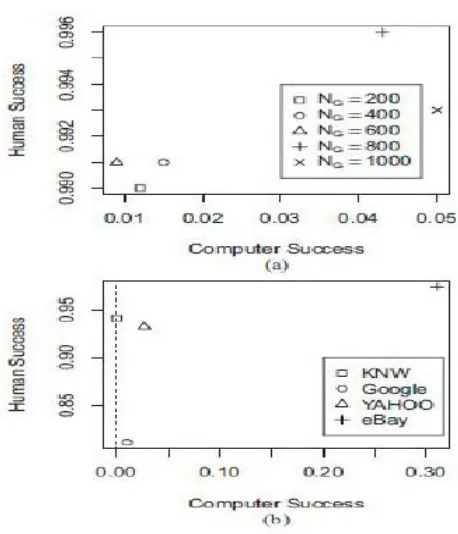
number of Gibbs iterations, NG) affect the attack
resistance of the resulting CAPTCH.
Figure 2a shows both the attack resistance and
human readability of the KNW-CAPTCHAE for
various values of NG, where computer success is
the proportion of CAPTCHAs where either of
the OCR programs Tesseract or ABBYY Fine
Reader successfully recognized it, and human
success is the proportion of CAPTCHAs where a
human successfully recognized it. [6] The
KNW-CAPTCHAH would be used in practice
as the background noise provides additional
security but the CAPTCHA remains highly
(c) (d) readable to humans. Figure 2b compares the
human readability and attack resistance of the
KNW-CAPTCHAH with several CAPTCHAs
deployed by major corporations. As the correct Fig. 1 Few Examples for CAPTCHA . (a) Scatter Type. (b)
The KNW-CAPTCHA is used to investigate
ISSN: 2394-2231 http://www.ijctjournal.org Page 52
answers for the comparison CAPTCHAs are
unknown, we use optimistic solving accuracy
(see Section IV-D) to determine human success;
similarly, an OCR program is considered correct
if it matches any of the human responses.
from Southwest Normal University, Chongqing,
China, and the M.S. degree in economics from
Renmin University of China, Beijing, China, in
1994 and 1997, respectively, and the Ph.D.
degree in probability and stochastic processes
with Carleton University, Ottawa, ON, Canada,
II. LITERATURE SURVEY
Design is the first step in the development
phase for any engineered product or system. The
designer’s goal is to produce a model or
representation of an entity that will later be built.
Beginning, once system requirement has been
specified and analyzed, system design is the first
of the three technical activities -design, code and
test that is required to build and verify software.
It is a process of converting a relation to a
standard form. [7] The process is used to handle
the problems that can arise due to data
redundancy, i.e. repetition of data in the
database, maintain data integrity as well as
handling problems that can arise due to
insertion, updating, deletion anomalies. [8]
Fraser Newton received the B.Sc. degree in
computing science and the M.Sc. University of
Alberta, Edmonton, AB, Canada, in 2005 and
2012, respectively. He is currently a Senior
Software Developer with Clio, where he is
involved in research on software and statistics of
Web development. He was a Developer with
Random Knowledge Inc., Edmonton, from 2005
to 2008, where he had developed a passion for
probability, estimation, and prediction. [9] Biao
Wu received the B.A. degree in mathematics
in 2005. He is currently the Manager of
Parameter Validation, Group Risk Management,
Royal Bank of Canada. He was a Post-Doctoral
Fellow with the Department of Mathematical
and Statistical Sciences, University of Alberta,
Edmonton, AB, Canada, from 2007 to 2009.
[10] In existing is the concept of image
processing is improved visual image is used.
Image processing is a technique of processing an
input image and to get the output as either
improved form of the same image and/or
characteristics of the input image
Disadvantages Of Existing System
• Analyses on Captcha security were
mostly case by case or used an
approximate
•
process. No theoretic
security model has been established yet.
Even though, those passwords
traditionally considered strong with
combination of letters, numbers and
ISSN: 2394-2231 http://www.ijctjournal.org Page 53
III. PROPOSED SYSTEM
CaRP is click-based graphical passwords,
where a sequence of clicks on an image
password Innovative safety proposes the
IV. SYSTEM ARCHITECTURE
IMAGE Based Authentication System, which is
designed to avoid the problems that are faced by
the existing password authentication systems.
Graphical passwords essentially use images or
representation of images as passwords. . The
major goal of this work is to reduce the guessing
attacks as well as encouraging users to select
more random, and difficult passwords to guess.
This is because humans are far better at
recognizing images that they have previously
seen than they are at remembering passwords.
Human brain is good in remembering picture
than textual character.
Advantages Of Proposed System
• CaRP also offers protection against
relay attacks, an increasing threat to
bypass Captchas protection.
• Captcha can be circumvented through
relay attacks
are
whereby
relayed to
Captcha
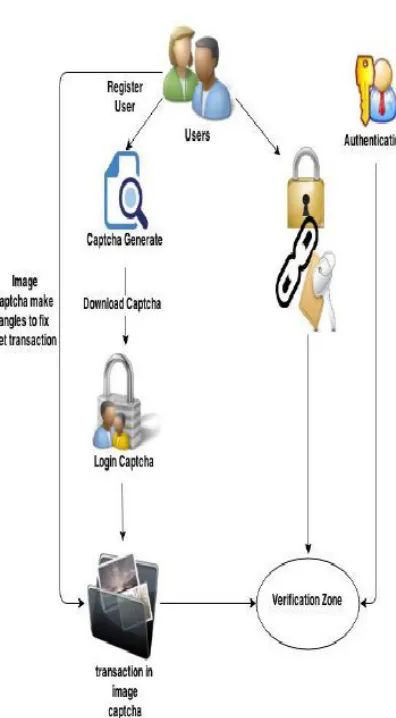
human Fig 3. Overall System Architecture challenges
solvers, whose answers are fed back to
the targeted application. The modules involved in this system are:
•
•
•
•
Login Page
Graphical Password
Captcha in Authentication
Transaction Security
•
The users are directed to Cued Clickpoint selection only if they choose
correct Coordinates. Hence it cannot be
ISSN: 2394-2231 http://www.ijctjournal.org Page 54
Login page:
Existing analyses on Captcha security were
mostly case by case or used an approximate
process. No theoretic security model has been
established yet. Object segmentation is
Transaction security:
Image captcha ,in which the images that are
generated to fix security purpose,where click to
fix axis for(angles) transaction in security
primitive .
considered as a computationally expensive,
combinatorially-hard problem, which modern
text Captcha schemes rely on to generate
captcha.
Graphical Password:
In this module, Users are having
V. RESULT
ADO.NET is an evolution of the ADO
data access model that directly addresses user
requirements for developing scalable
applications. It was designed specifically for the
web with scalability, statelessness, and XML in
mind. The Microsoft .NET Platform currently
offers built-in support for three languages: C#,
Visual Basic, and Java Script. authentication and security to access the detail
which is presented in the Image system. Before
accessing or searching the details user should
have the account in that otherwise they should
register first.
Captcha in Authentication:
It was introduced in use both Captcha and
password in a user authentication protocol,
which we call Captcha-as graphical Password
(CaPA) protocol, to counter online dictionary
attacks. The CaRA-protocol in requires solving a
Captcha challenge after inputting a valid pair of
user ID and password unless a valid browser
cookie is received. For an invalid pair of user ID
and password, the user has a certain probability
to solve a Captcha challenge before being denied
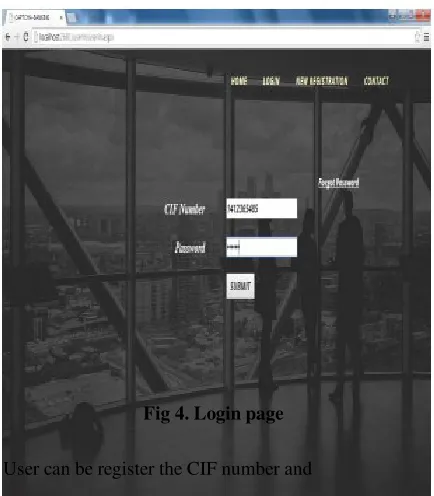
access. Fig 4. Login page
User can be register the CIF number and
ISSN: 2394-2231 http://www.ijctjournal.org Page 55
Fig 5. Graphical Password
Graphical password are enter to the user
registration.
user can set the password and transaction time to
use the security.
Fig 7. Transaction security
VI. CONCLUSION AND FUTURE
ENHANCEMENT
We developed and implemented a new
method of generating random CAPTCHAs,
called KNW-CAPTCHAs, using random field
simulation that outperforms popular
CAPTCHAs in use today. And established that
the KNW CAPTCHA is an effective separator of
computer programs and humans. The colors
used for the background noise and the
CAPTCHA could change from left to right; or
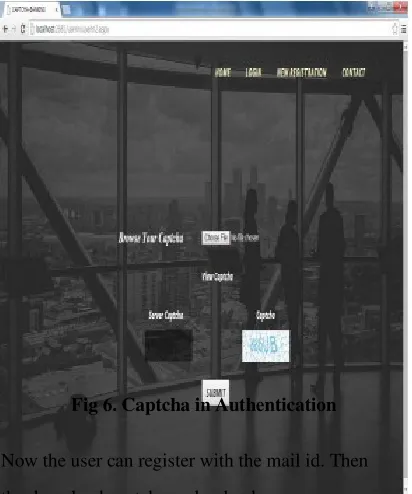
the amount of noise could be increased or Fig 6. Captcha in Authentication
Now the user can register with the mail id. Then
the download captcha and upload.
ISSN: 2394-2231 http://www.ijctjournal.org Page 56
REFERENCE
[1] Reference by [8] [9] Fraser Newton received
the B.Sc. degree in computing science and the
M.Sc. University of Alberta, Edmonton, AB,
Canada, in 2005 and 2012, respectively. He is
currently a Senior Software Developer with
Clio, where he is involved in research on
software and statistics of Web development. He
was a Developer with Random Knowledge Inc.,
Edmonton, from 2005 to 2008, where he had
developed a passion for probability, estimation,
and prediction.
[2] Biao Wu received the B.A. degree in
mathematics from Southwest Normal
Conf. Comput. Commun. Security, 2008, pp.
543–554.
[5] R. Datta, J. Li, and J.Wang, “Imagination: A
robust image-based captcha generation system,”
in Proc. 13th Annu. ACM Int. Conf. Multimedia,
2005, pp. 331–334.
[6] E. Bursztein, S. Bethard, C. Fabry, J.
Mitchell, and D. Jurafsky, “How good are
humans at solving captchas? A large scale
evaluation,” in Proc. 2010 IEEE Symp. Security
Privacy, May 2010, pp. 399–413.
[7] J. Ross, L. Irani, M. Silberman, A. Zaldivar,
and B. Tomlinson,
Shifting
“Who are the
in crowdworkers?: demographics
mechanical turk,” in Proc. 28th Int. Conf.
Extended Abstracts Human Factors Comput.
Syst., 2010, pp. 2863–2872.
[8] C. Kozyrakis, A. Kansal, S. Sankar, and K.
Vaid, “Server engineering insights for
large-scale online services,” in Proc. Int. Symp.
Microarchitecture, 2010, pp. 8–19.
[9] P. Lotfi-Kamran, B. Grot, M. Ferdman, S.
Volos, O. Kocberber, J. Picorel, A. Adileh, D.
Jevdjic, S. Idgunji, E. Ozer, and B. Falsafi,
“Scale-out processors,” in Proc. Int. Symp.
Comput. Archit., 2012, pp. 500–511. University, Chongqing, China, and the M.S.
degree in economics from Renmin University of
China, Beijing, China, in 1994 and 1997,
respectively, and the Ph.D. degree in probability
and stochastic processes with Carleton
University, Ottawa, ON, Canada, in 2005.
[3] R. Casey and E. Lecolinet, “A survey of
methods and strategies in character
segmentation,” IEEE Trans. Pattern Anal.
Mach. Intell., vol. 18, no. 7, pp. 690–706, Jul.
1996.
[4] J. Yan and A. El Ahmad, “A Low-cost attack