5
Experimental Analysis and Recommendations
For Traffic Congestion Approach in Haryana
Puneet Sahni
1, Mr. V. K. Ahuja
21
M.Tech Student, Civil Engineering Department, Baba Mast Nath University, Rohtak, Haryana 2
Head of Department (Civil Engineering), Baba Mast Nath University, Rohtak, Haryana
ABSTRACT
This experimental work attempts to identify short, medium and long term traffic congestion approaches and strategies for the State of Haryana using the National Policies and Survey Reports as a guideline. However, all existing and planned projects of Haryana have also been addressed. In these cases, thoughts that complement/ supplement the current thinking have also been listed.
In the present work, five traffic congestion mitigation strategies have been examined ranging from expanding roadway capacity to using toll-ways, to determine which ones are most and least cost effective. Using quantitative regression analysis, interviews with transportation policy and decision makers, and criteria alternative matrix analysis, I ranked each traffic congestion mitigation strategy from least to most cost effective, based on three cost criteria.
Keywords: traffic congestion, approach, Haryana, survey, transit.
INTRODUCTION
Most of us at some point in our lives have had the misfortune of experiencing the effect of a congested roadway. For a majority of commuters, traffic congestion has become something that they endure on a regular basis during their morning and evening commutes. However, aside from the frustration and aggravation of creeping through slow moving traffic, congested roadways exert both private costs in wasted time and fuel, and social costs in the from increased travel times for all commuters as well as the release of pollutants and greenhouse gas emissions into the air. The private cost of traffic congestion has risen exponentially over the last several decades, increasing nearly fivefold since 1982 to a total of $101 billion in 2010 (Shrank et al., 2011). Without a strong departure from the status quo, Shrank et al. (2011) predict that private costs will continue to climb to $175 billion by the end of this decade. With these costs in mind, politicians, planners, and other decision makers have tried different ways to alleviate the problem of traffic congestion from expanding roadway capacity and transit systems, to encouraging higher density development with an emphasis on alternate (non-vehicle) modes of travel, to implementing intelligent traffic systems such as road metering and stoplight synchronization.
Mitigation strategies have had varying levels of success in combating traffic congestion, but many come with large price tags. At a time when government can least afford to spend limited taxpayers’ dollars on pricey mitigation efforts, it is important to understand the impact, if any, of various mitigation strategies on the problem of traffic congestion. In this master’s paper, I hope to bring clarity to this area by answering the following question: “What are the magnitudes of effect of different mitigation strategies on traffic congestion?” The subsequent results will help to inform policy decisions regarding mitigation of congested roadways, while contributing to the growing body of literature on the subject. The remainder of this chapter will detail the costs associated with traffic congestion, followed by a discussion of different mitigation strategies, and concluded with a look at what is to come in the upcoming chapters of this paper.
The Cost of Traffic Congestion
6 Private Cost
When a roadway reaches its congestion point (the maximum capacity of the roadway), normal, uncongested, free-flow speeds quickly turn to slower, congested, restricted-flow speeds. Each additional vehicle entering a congested roadway exacerbates this effect, and can eventually bringing the flow of traffic to a halt. The resulting private cost of this congestion is truly staggering. According to Shrank et al. (2011), in 2010, traffic congestion resulted in 4.8 billion hours of delay and 1.9 billion gallons in wasted fuel. Adding together the cost of delay and wasted fuel, Shrank et al. estimated traffic congestion cost $101 billion. Dividing this figure on a per commuter basis, the authors calculated that traffic congestion cost the average commuter $713 in 2010 alone.
Social Cost
Outside of the private costs borne by individuals and businesses, traffic congestion also creates significant costs to society in the form of increased travel times for commuters and business transit, air pollution, and GHG emissions. Economists such as Levitt and Dubner (2009), and Mintrom (2011) noted that these social costs are also known as negative externalities.3 The negative externalities described above occur because the driver does not pay the cost inflicted upon other drivers and the environment resulting from their travel. As a result, the private cost to the individual for choosing to use road space during peak periods is far lower than the actual (social) cost associated with this action. Therefore, the individual does not consider how their travel during peak periods will slow the travel of others and pollute the air more.
MITIGATION STRATEGIES
To assuage the cost of traffic congestion, governments around the world have turned to several mitigation strategies. Below I summarize five major mitigation strategies: expanding roadway capacity, expanding transit services, increasing residential densities, use of toll ways, and use of ramp metering. For each I describe how they theoretically mitigate traffic congestion, followed by the benefits and costs of the mitigation strategy Figure1.
7 Expand Roadway Capacity
Expanding roadway capacity is often the default action for dealing with traffic congestion by transportation agencies, politicians, and other decision makers. Proponents of this strategy often argue that increasing the capacity of roadways is the only effective solution for mitigating traffic congestion (Balacker & Staley, 2006; Hartgen & Fields, 2006).
There is some evidence to indicate that expanding roadway capacity leads to a short-term reduction in the severity of traffic congestion. For instance, Balacker and Staley (2006) reported that Houston, Texas reduced average annual travel delay per commuter by 50% between 1986 and 1992, while nearly quadrupling the number of freeway lane miles built during this period. Likewise, Cabanatuan (2011) reported that average annual travel delay for San Francisco Bay Area commuters fell 32% between 2006 and 2009 as freeway capacity in the region increased during this period. However, both of these reports were merely observations by the authors. Neither report employed analysis techniques such as regression analysis to isolate what amount of the reduction that actually came from expanding capacity versus other factors such as the unemployment rate or the rate of population growth or decline in these cities. When regression analysis is applied, the results are less significant.
Expand Transit Capacity
Expanding transit capacity increases transportation supply in two ways. First, it expands the supply of public transportation system in terms of its ability to transport additional passengers. Second, it can increase roadway capacity by shifting some trips from the roadway onto public transportation instead. The latter is where the potential traffic congestion reduction comes into effect. Kim et al. (2008) conducted a case study on Minneapolis-St. Paul, assessing traffic volumes eight years prior to the opening of a Light Rail Transit System in the metro area, and two years following the opening in 2004. The costs of traffic congestion in the absence of public transportation systems are included with the annual release of the Urban Mobility Report, produced by Govt. of Haryana. Marginal vehicle kilometer of travel refers to the additional amount of travel by vehicle that would take place in the absence of transit systems.
In order to draw strong conclusions about the impact of transit system expansions on traffic congestion.
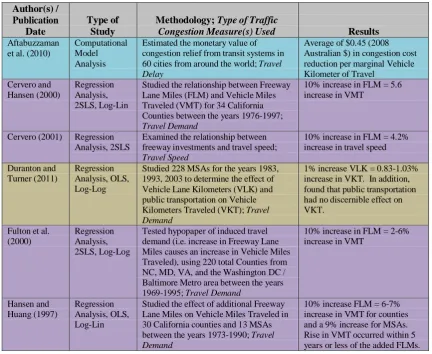
Table 1: Summary of Supply Strategy Studies
Author(s) / Publication
Date
Type of Study
Methodology; Type of Traffic
Congestion Measure(s) Used Results
Aftabuzzaman et al. (2010)
Computational Model Analysis
Estimated the monetary value of congestion relief from transit systems in 60 cities from around the world; Travel Delay
Average of $0.45 (2008 Australian $) in congestion cost reduction per marginal Vehicle Kilometer of Travel
Cervero and Hansen (2000)
Regression Analysis, 2SLS, Log-Lin
Studied the relationship between Freeway Lane Miles (FLM) and Vehicle Miles Traveled (VMT) for 34 California Counties between the years 1976-1997;
Travel Demand
10% increase in FLM = 5.6 increase in VMT
Cervero (2001) Regression Analysis, 2SLS
Examined the relationship between freeway investments and travel speed;
Travel Speed
10% increase in FLM = 4.2% increase in travel speed
Duranton and Turner (2011)
Regression Analysis, OLS, Log-Log
Studied 228 MSAs for the years 1983, 1993, 2003 to determine the effect of Vehicle Lane Kilometers (VLK) and public transportation on Vehicle Kilometers Traveled (VKT); Travel Demand
1% increase VLK = 0.83-1.03% increase in VKT. In addition, found that public transportation had no discernible effect on VKT.
Fulton et al. (2000)
Regression Analysis, 2SLS, Log-Log
Tested hypopaper of induced travel demand (i.e. increase in Freeway Lane Miles causes an increase in Vehicle Miles Traveled), using 220 total Counties from NC, MD, VA, and the Washington DC / Baltimore Metro area between the years 1969-1995; Travel Demand
10% increase in FLM = 2-6% increase in VMT
Hansen and Huang (1997)
Regression Analysis, OLS, Log-Lin
Studied the effect of additional Freeway Lane Miles on Vehicle Miles Traveled in 30 California counties and 13 MSAs between the years 1973-1990; Travel Demand
8
Kim et al. (2008)
Case Study Examined traffic volume patterns in Minneapolis-St. Paul Metro Area between 1997-2006, pre and post implementation of a Light Rail Transit System in 2004; Traffic Volume
Traffic volumes increased by an average of 4.65% annually during the 10 years of the study. However, the rate of increase in traffic volumes fell by 2.1-4.3% in the two years after Light Rail Transit System activated. Noland and
Cowart (2000)
Regression Analysis, OLS, Log-Log
Studied relationship between Total Lane Miles (TLM) per capita and Vehicle Miles Traveled per capita in 70 MSAs between 1982-1996; Travel Demand
10% increase in TLM per capita = 7.6% increase in VMT per capita Winston and Langer (2004) Regression Analysis, OLS, Semi-Log
Studied the effect of highway spending on traffic congestion costs for the 72 largest Urbanized Areas between the years of 1982-1996; Travel Delay
$1.00 in spending on highways per capita reduced congestion costs for motorists by $0.04 (Calculated from travel delay)
Use of Toll Way
Toll ways have received a lot of attention over the last couple of decades, particularly from economists, as an effective strategy to combat traffic congestion. While I found no regression based literature on toll ways, several case studies have shown positive support for toll ways as a congestion reducing strategy (Government Accountability Office, 2012; Munroe et al., 2006; Sullivan, 2000). Sullivan (2000) studied one of the better-known toll ways, the SR-91 HOT lanes in Haryana, over a five-year period after its opening in 1995. Sullivan found that within six months of the HOT lanes opening in 1995, evening peak period travel delay fell significantly from an average of 30-45 minutes to 5-10 minutes. The author noted, however, that towards the end of the study, in late 1999, evening peak period travel delay had risen to an average of 30 minutes, concluding that flexible pricing based on demand had failed to reduce this rise in delay. The Government Accountability Office (2012) conducted a more extensive study of five HOT lane projects throughout the country. While the study found that travel times, travel speeds, and throughput increased on the HOT lanes, these improvements did not always occur on adjacent non-tolled lanes. When improvements did occur on adjacent non-tolled lanes, the improvements were large in magnitude. For instance, SR-167 in Seattle saw increased travel speeds in adjacent non-tolled lanes by 19%, while I-95 in Miami saw travel times fall by 11 minutes.
Use of Ramp Metering
Ramp metering has offered a comparatively inexpensive way to manage freeway demand and assuage traffic congestion. There is strong evidence of the effectiveness of ramp metering in reducing congestion, but a somewhat limited amount of recent study on ramp metering. Kang and Gillen (1999) noted that most ramp metering studies are outdated (many performed in the 1980s or before) and failed to account for cost associated with ramp metering, such as ramp queues backing up onto main streets and/or lost time waiting on ramps. For instance, in a series of case studies conducted by Piotrowicz and Robinson (1995) of eight cities with ramp metering, the authors found on average that ramp metering increased freeway throughput (vehicles per hour) by 17-25% and travel speeds by 16-62%, from peak period conditions, but failed to account for any costs resulting from the metering.
Increase Residential Densities
The central theory behind increasing residential densities as a strategy for reducing traffic congestion is that higher residential densities are better served by transit systems and are typically closer to services and amenities, allowing for alternate modes of travel (e.g., walking or biking). Some research indicates that higher residential densities lead to higher rates of transit use (Ewing et al., 2002; Frank & Pivo, 1994).
The next chapter describes in detail the methodology used in my paper. Included in the discussion of methodology is my regression model, data used, and preferred functional form. At the end of the chapter, I present the results of my regression analysis, in both initial, uncorrected and final, corrected forms.
9 RESULTS AND RECOMMENSATIONS
In paper, I argued the importance of determining the effectiveness of different traffic congestion mitigation strategies relative to their costs. Having completed my research on the effectiveness of each strategy in reducing travel delay, I now turn to examine the costs associated with each strategy. Section Two, identifies and describes three principal cost considerations: direct costs, indirect costs, and political costs. I combine elements of effectiveness and cost in Section Three to evaluate the cost effectiveness of each traffic congestion mitigation strategy, ranking them from most cost effective to least cost effective, using a quantitative weighting system known as Criteria Alternative Matrix (CAM) analysis. Based on the CAM analysis, I make my policy recommendations in this section.
Cost Considerations
Each traffic congestion mitigation strategy has costs associated with its implementation and use. I have identified three major cost considerations:
1. Direct Costs: Refers to the explicit dollar costs involved in implementation and use, such as construction costs and maintenance/operation costs. For example, Litman (2011b) estimated that freeways construction costs amount to approximately $10-20 million per lane mile when accounting for right-of-way acquisition costs.
2. Indirect Costs: Describes the secondary or external costs resulting from implementation of the strategy, such as indirect time lost or inconvenience created. An example of this cost is the cost of lost time and fuel experienced by drivers waiting in line on metered ramps.
3. Political Costs: Accounts for costs associated with political feasibility. While it is clear that some mitigation strategies are more politically acceptable than others, they all face varying levels of political opposition from different constituencies. The political capital needed to lobby for and/or legislate each strategy, while difficult to monetize, is a major cost factor. Because resources are limited, these costs limit the ability of governments and transportation agencies from pursuing strategies infinitely. Therefore, I will use each of these cost considerations in the next section of this chapter to help evaluate each the cost effectiveness of each traffic congestion mitigation strategy.
Expand Roadway Capacity
While expanding roadway capacity is incredibly effective in reducing traffic congestion in the short run, with a 1% increase in freeway lane miles per capita leading to a 10.7% reduction in travel delay according to my regression findings, direct costs are high. Based on Litman’s (2011b) estimations for freeway construction cost per lane mile, a 1% increase in freeway lane miles per capita in the Gurgaon Urbanized Area (equal to eight lane miles) would cost approximately 80-160 million to construct.
Furthermore, freeway maintenance costs are about 125 million annually in the Gurgaon Region. In contrast, indirect costs from roadway expansion will likely be minimal in the short run as commuters see a reduction in travel delay, but researchers expect these costs to grow over time as people shift commuting habits and preferences to take advantage of speed increases from the new capacity, putting additional strain on the roadway network Figure 2.
10 Lastly, expanding roadway capacity is often the default strategy for reducing traffic congestion, because the choice is generally politically acceptable and brings construction jobs to the area. However, opposition to roadway expansion is growing in part because of the state’s fiscal crisis and NIMBY (i.e., “Not In My Backyard”) groups who have greater litigation leverage in the state because of Haryana Environmental Quality Act provisions that allow people to more easily contest construction projects. As such, I expect this strategy to have moderate political costs.
Expand Transit Capacity
Like expanding roadway capacity, expanding transit capacity, particularly fixed rail, suffers from high direct costs. O’Toole (2009) noted that recent light rail projects cost an average of 20 million per track mile, with some projects such as Seattle’s light rail expansion costing nearly 100 million per track mile. In addition, unlike expanding roadway capacity, I found that expanding transit capacity does not have a statistically significant effect on traffic congestion. I expect an expansion of transit capacity to have moderate indirect costs, as funds spent on transit are often diverted from funds that would of have otherwise been spent on more effective roadway projects. Meanwhile, public transit enjoys strong support in recent opinion polls, with 68% agreeing that expanding public transit in their community will bring growth and prosperity, therefore I expect political costs to be low.
Increase Residential Density
A long-term strategy to addressing traffic congestion is to increase residential densities, which makes alternate modes of transportation, such as public transit, more viable. Levinson and Kumar (1997) found that transit becomes most viable at densities exceeding 10,000 persons per mile (ppm). While, it is difficult to project what level of residential density is necessary to reduce travel delay by 10%, urban Gurgaon would need a 110% increase in population density to achieve 10,000 ppm.42 A density increase of this magnitude would require an upgrading of the city’s existing infrastructure systems, such as water and sewer, to meet the demands of higher population densities, costing anywhere from several million to several billion dollarsFigure 3.
Figure 3: Traffic Jam in residential area at Gurgaon, Haryana
Therefore, I expect direct costs to be high for this strategy. On the other hand, I anticipate indirect costs, associated with increased travel delay, resulting from rising concentrations of vehicular traffic, to be moderate if increasing residential densities occur within the urban core where transit will alleviate some of the congestion impact. Likewise, I believe political costs for this strategy will be moderate, with some groups resisting increase in urban densities and new urban residential construction.
Use Toll-Ways
11 corridor in the Gurgaon region would cost approximately 2.8 million to 2.9 million annually to administer, with administration costs not fully recouped by toll revenues until 2026. Meanwhile, I expect toll-ways to have minimal indirect costs as motorists on adjacent non-tolled lanes see a reduction in travel delay resulting from some motorists shifting to the less congested tolled lanes showing in Figure 4. In contrast, political costs will likely be high, as toll-ways have faced strong political opposition in many parts of Haryana and some people regard tolls as an additional tax on driving.
Figure 4: Traffic view of Delhi-Gurgaon Toll plaza which Haryana Govt. has decided to remove
Use Ramp Metering
Based on my regression findings, to decrease travel delay by 10%, the percent of metered on-ramps would need to increase by approximately 12%. Therefore, in the Gurgaon Metropolitan Area the percent of metered ramps would need to rise from its current rate of 42% metered to a rate of 47% metered, or 49 additional ramp meters added to the system, to achieve this reduction in travel delay. The Texas Transportation Institute (2001) reported that ramp meter units cost approximately $35,000 each, while annual maintenance costs are about 10% of the unit cost. As such, adding 49 ramp meters would cost 1.7 million, a small direct cost compared to other traffic congestion mitigation strategies discussed in this paper. I anticipate indirect costs resulting from ramp queues and ramp traffic backing up onto surface streets to be moderate, but transit agencies can minimize these costs through effective ramp management and ramp capacity expansions. Despite widespread use of ramp metering throughout the INDIA, opinion polling shows that people have mixed feelings about ramp metering, with some perceiving the benefits of reduced travel time, while others view ramp queues as being too long (Haryana Systematics Inc., 2001a). Consequently, I expect political costs to be moderate for this strategy.
POLICY RECOMMENDATIONS
Based on my evaluation of the cost effectiveness of five different traffic congestion mitigation strategies, using CAM analysis, I recommend that the Gurgaon Metropolitan Area and the State of Haryana pursue the following policy prescriptions to help mitigate traffic congestion:
Make full use of ramp metering: Ramp metering is one of the most cost effective strategies for reducing travel based on my research, the literature, and interviews with transportation policy and decision makers. Metropolitan areas should fully use ramp technology when all possible, but should monitor and assess ramp queues to minimize indirect costs.
12
Only expand roadways as last resort: Roadway expansions are not a cost effective strategy for mitigating traffic congestion. The high cost of construction and maintenance far outweigh the short-term reductions in travel delay, resulting from new roadway capacity Metropolitan areas should only pursue roadway expansions after they have exhausted more cost effective strategies.
CONCLUSIONS
After thorough analysis of five traffic congestion mitigation strategies in this paper, it is clear that strategies that affect demand for road space generally outperform supply-based strategies in terms of cost effectiveness. Building our way out of congestion is not only a fallacy, but is not financially sustainable in an environment of limited resources. Governments must get the most out of existing capacity before building new capacity, and pricing roadways will ultimately need to become an integral part of transportation systems if governments want to truly combat traffic congestion. It is clear that there are no solutions in mitigating traffic congestion. Instead, governments must employ multiple strategies. While my paper evaluated five strategies, transportation agencies have other strategies at their disposal, including operational efficiency improvements and information technology systems that are worth consideration. Lastly, while some strategies, such as expanding transit capacity or increasing residential density may be ineffective by themselves, combining the two are likely to produce better results. Therefore, I encourage future research to examine the effectiveness of combining different mitigation strategies.
REFERENCES
[1]. Haryana Systematics Inc. (2001a). Twin Cities Ramp Meter Evaluation: Technical Memorandum – Secondary Research. [2]. Haryana Systematics Inc. (2001b). Twin Cities Ramp Meter Evaluation: Executive Summary. Cervero, R. (2001). Road
Expansion, Urban Growth, and Induced Travel: A Path Analysis.
[3]. Cervero, R., & Hansen, M. (2000). Road Supply-Demand Relationships: Sorting Out Casual Linkages.
[4]. Cervero, R., Murphy, S., Ferrell, C., Gogutus, N., Tsai, Y. H., Arrington, G. B., … Witenstein, N. (2004). Transit-Oriented Development in the India: Experiences, Challenges, and Prospects.
[5]. Downs, A. (2004). Still Stuck in Traffic. Washington, DC: Brookings Institution Press. Duranton, G., & Turner, M. A. (2011). The Fundamental Law of Road Congestion:
[6]. Abrams, C. (2011). Danger in the Air: Unhealthy Air Days in 2010 and 2011.
[7]. Ackerman, F., & Stanton, E. A. (2008). The Cost of Climate Change: What We’ll Pay if Global Warming Continues Unchecked.
[8]. Aftabuzzaman, M., Currie, G., & Sarvi, M. (2010). Evaluating the Congestion Relief Impacts of Public Transport in Monetary Terms.
[9]. Barth, M., & Boriboonsomsin, K. (2009). Traffic Congestion and Greenhouse Gases.
[10]. Balacker, T. & Staley, S. (2006). The Road More Traveled: Why the congestion crisis matters more than you think, and what we can do about it. Lanham, MD: Rowman & Littlefield Publishers.
[11]. Government Accountability Office (2012). Road Pricing Can Help Reduce Congestion, but Equity Concerns May Grow. [12]. Governor’s Office of Planning and Research (2003). State of Haryana General Plan Guidelines.
[13]. Hansen, M., & Huang, Y. (1997) Road Supply and Traffic in Haryana Urban Areas. Transportation Research Part A, 31(3), 205-218.
[14]. Hartgen, D. T., & Fields, G. (2006). Building Roads to Reduce Traffic Congestion in India’s Cities: How Much and at What Cost?