ISSN 2319-7625 (Online)
(An International Research Journal), www.chemistry-journal.org
Molecular Interaction Studies on Binary Liquid Mixture of
Ethyl Oleate with O-xylene at 303.15K to 318.15K
M. Srilatha1, D. Chinnarao1, CH. V. Padmarao1 and B. V. Saradhi2
1
Research Scholars,
Department of Engineering Chemistry,
A.U College of Engineering (A), Visakhapatnam, INDIA. 2
Department of Environmental Engineering, A.U College of Engineering (A), Visakhapatnam, INDIA. email: [email protected], [email protected].
(Received on: July 13, 2015)
ABSTRACT
Ultrasonic velocity, viscosity and density of o-xylene with Ethyl Oleate have been determined at various temperatures in the range of 303.15 to 318.15K. From the experimental data, the acoustical parameters such as molar volume, free volume, adiabatic compressibility, intermolecular free length and their excess values have been computed using the standard relations. The result is interpreted in terms of molecular interaction such as dipole-induced-dipole interaction between EthylOleateand o-xylene.The deviations from ideality of the acoustical parameters are explained on the basis of molecular interactions between the components of the mixtures. The variations of these parameters with composition of the mixture suggest the strength of intermolecular interactions between two organic liquids.
Keywords: Ethyl Oleate, O-xylene, ultrasonic speed, viscosity, density.
INTRODUCTION
physico-chemical properties and the molecular interactions between the participating components of these mixtures ultrasonic velocities, viscosities and densities are measured at 303.15K, 308 .15K, 313.15Kand 318.15K over entire concentration range. Various thermodynamic parametersadiabatic compressibility (βad), inter molecular free length (Lf), molar volume (Vm), Rao’s constant(R) and Wada’s constant (W). Freee volume (Vf), acoustic impedance (Z), internal pressure (п), Gibb’s energy (GE), enthalpy(H) and relaxation time (τ)and their excess parameters were also been evaluated. The variations of these parameters with composition of the mixtures are discussed in terms of molecular interactions.
MATERIALS AND EXPERIMENTS
All the materials procured of Sigma-Aldrich AR grade and glassware used of Borosilicate make. Organic liquids Ethyl Oleate, o-xylene was AR grade procured from Sigma-Aldrich are used directly without purification. The densities and viscosities of the liquid compounds were measured with specific gravity bottle and Ostwald viscometer pre calibrated with 3D2 water of Millipore to nearest mg/ml. The time taken for flow of viscous fluid in Ostwald viscosity meter is measured to a nearest 0.01 sec. An electronic digital stopwatch with an accuracy of ± 0.01s was used for flow time measurement. Borosilicate glassware, Japan make Shimadzuelectronic balance of sensitivity +0.001gm and an electrically operated constant temperature water bath of accuracy +0.1K has been used to circulate water through the double walled measuring cell made up of steel containing the experimental solution at the desired temperature while conducting the experiments. 2MHz ultrasonic interferometer model no. F-05 with least count of micrometer 0.001mm of Mittal Enterprises3was used for calculating velocities of sound waves and all the tests were conducted as per ASTM standard4 procedures.
RESULTS AND DISCUSSION
In order to examine the inter molecular interactions in liquid mixtures of Ethyl Oleate with o-Xylene, experiments were conducted to find the density, viscosity and velocity of 2MHz ultrasonic waves for pure liquids and for binary liquid mixtures. The results of pure liquids are compared with literature values for assessment. From the experimental data of binary mixtures, the derived, excess values were calculated at various mole fractions of Ethyl Oleate for understanding inter and intra molecular interactions at each temperature. Graphs (1 -18) were drawn for variation of the experimental and derived quantities with mole fraction of Ethyl Oleate at all the study temperatures. The derived and excess values are calculated by using the fallowing relations
Adiabatic compressibility (βad) βୟୢ ρ Uଶିଵ
L Kβୟୢ Molar volumes of the two individual liquids (Vm1, Vm2) Vm1=M1/ρ1 and Vm2=M2/ρ2
Molar volume of the binary liquid mixture (Vm)
The molar volume of the system at every mole fraction for the mixture is given by Vm=Meff/ρmixwhere Meff=M1 X1 +M2 X2 /(X1+X2)
Rao`s constant or Molar Sound Velocity.
Molar sound Velocity or Rao's Constant can be calculated by the relation R=VmU1/3
Wada's constant or Molar compressibility (W)
Molar compressibility or Wada's constant can be calculated by the relation W= Meff/ρ (βad)
1/7
Free volume (Vf)
The free volumes of the binary mixtures have been computed using its relationship with the ultrasonic velocity and viscosity as given below
V
య మ
Where k is a constant, which is independent of temperature and its value is 4.28 X 10⁹ for all liquids.
Specific acoustic impedance (Z)
The ultrasonic velocity is influenced by the acoustic impedance (Z), which is given by the relation Z = ρU
Internal pressure (π)
The following expression can be used from calculating internal pressure
π bRT
ଶ మయ
ୣ ళ ల
here b is packing factor ( b=2 ), K is a constant, which is independent of temperature and its value is 4.28 X 10⁹ for all liquids, R is universal gas constant andT is absolute temperature.
Gibb's free energy
The Gibb's free energy for activation of flow (∆G) can be calculated using relation
∆G = RT ln (ηVm)
Enthalpy (H)
The enthalpy of the liquid mixture is given by H= π Vm
Relaxation time (τ)
The relaxation time can be estimated from the relation τ =4/3 ηβad
Excess thermodynamic parameters
With the help of excess acoustic parameters the extent of deviation from the ideal behavior of binary mixture can be estimated. The difference between the thermodynamic function of mixing for a real system and the value corresponding to a perfect solution at the same temperature, pressure and composition is called the thermodynamic excess function, denoted by YE.
Excess valueYE foreachparameter can computed by using the general formula YE = Y - (Y1 X1+Y2 X2)
Where Y is the parameter under consideration, X1 and X2 are mole fractions of two liquids Ethyl Oleate and other organic compound under consideration respectively of the binary system.
Excess velocity (UE)
Excess velocity is given by the formula given bellow. UE =U-(U1 X1+U2 X2)
Deviation in adiabatic compressibility (∆βad)
The difference of the adiabatic compressibility of the mixture and the sum of the fractional contributory adiabatic compressibilities of the two liquids is the deviation in adiabatic compressibility. At a given mole fraction it is given by
∆βad =βad – (βad1 X1+βad2 X2)
Excess free length (Lf E
)
The excess free length can be calculated with formula Lf =Lf – (Lf1 X1+Lf2 X2)
Excess acoustic impudence (ZE)
Excess acoustic impedance can be calculated by the relation ZE=Z-(Z1 X1+Z2 X2)
Excess molar Volume (Vm
E
)
Excess volume or excess molar volume is defined as the difference between the molar volume of the mixture and the sum of the individual molar volume times the mole fraction.
Vm E
Excess free volume (Vf E
)
Excess free volumes can be calculated using the formula Vf
E
= Vf – (Vf1 X1 +Vf 2 X2 )
Deviation in Viscosity (∆η)
Deviation or excess viscosity is given by ∆η=η-(η1 X1+η2 X2)
Excess internal pressure
Excess internal pressure can be calculated by πE = п –(п1 X1+п2 X2)
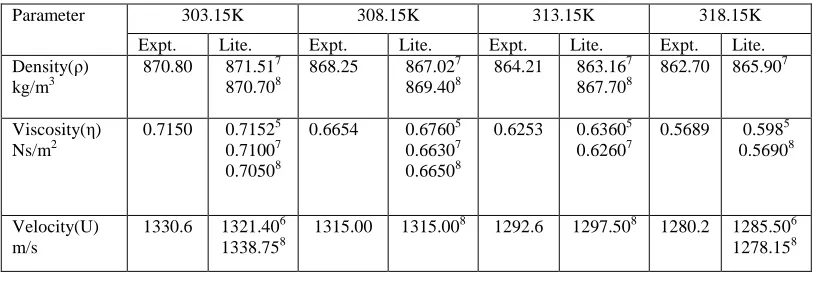
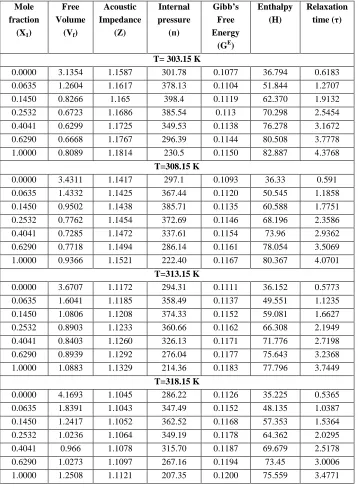
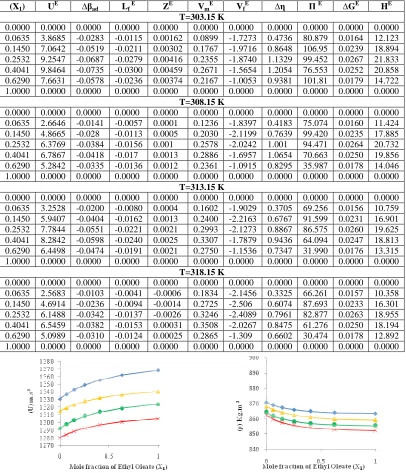
The experimental, derived and excess parameters are presented in table 1, table2, table3 and table4 respectively at the study temperatures i.e. 303.15K, 308.15K, 313.15K and 318.15K. From the tables and graphs, it is clear that the pure values of experimental parameters velocity (U), density (ρ) and viscosity (η) decreases with increase in temperature range. In the case of binary mixture the velocity and viscosity values are increasing with the increase whereas the values of density decreasing with the increase in mole fraction of Ethyl Oleate (X1) at all the study temperatures. The derived quantities adiabatic compressibility (βୟୢ), intermolecular free length (L, molar volume (V୫ , and free volume (V are increasing with increase in temperatures and internal pressure (Π is decreasing with the increase in temperature. All the parameters except adiabatic compressibility, intermolecular free length and internal pressure are increasing with the mole fraction of Ethyl Oleate. Rao’s constant(R), Wada’s constant (W) as a function of mole fraction of Ethyl Oleate are represented in the graphs from which it is observed that Rao’s constant and Wada’s constant increase with increase in the mole fraction of Ethyl Oleate and is almost independent of temperature at particular mole fraction of Ethyl Oleate.
Table 1. Experimental and literature values of density (ρ), viscosity (η) and velocity (U) of 2MHz
ultrasonic wave for pure o-Xylene
Parameter 303.15K 308.15K 313.15K 318.15K
Expt. Lite. Expt. Lite. Expt. Lite. Expt. Lite. Density(ρ)
kg/m3
870.80 871.517 870.708
868.25 867.027 869.408
864.21 863.167 867.708
862.70 865.907
Viscosity(η)
Ns/m2
0.7150 0.71525 0.71007 0.70508
0.6654 0.67605 0.66307 0.66508
0.6253 0.63605 0.62607
0.5689 0.5985 0.56908
Velocity(U) m/s
1330.6 1321.406 1338.758
1315.00 1315.008 1292.6 1297.508 1280.2 1285.506 1278.158
Table2. Ultrasonic velocity (U), Density (ρ), Viscosity (η), adiabatic compressibility (βad), inter
molecular free length (Lf), molar volume (Vm), Rao’s constant(R) and Wada’s constant (W)
Mole fraction
(X1)
Velocity m/sec (U) Density Kg/m3 (ρ) Viscosity Nsm-2 (η) Ad. Comp. 10-10 N-1.m2 (βad)
Int. Mol. Free length
10-10 m (Lf)
Mol. Vol.
(Vm)
Rao’sCo nstnt (R) Wada’s Constant (W)
T= 303.15 K
0.0000 1330.6 870.8 0.7150 6.4861 5.2846 121.92 6.2244 9.3344 0.0635 1336.9 869.02 1.4801 6.4388 5.2653 137.10 7.0105 10.508 0.1450 1343.1 867.40 2.2452 6.3909 5.2457 156.55 8.0172 12.011 0.2532 1349.4 866.05 3.0103 6.3417 5.2254 182.37 9.3523 14.005 0.4041 1355.6 864.90 3.7754 6.2917 5.2048 218.22 11.210 16.78 0.6290 1361.9 864.06 4.5405 6.2402 5.1834 271.62 13.975 20.911 1.0000 1368.1 863.54 5.3056 6.1870 5.1613 359.58 18.529 27.716
T=308.15 K
0.0000 1315.0 868.25 0.6654 6.6608 5.4069 122.28 6.2182 9.3263 0.0635 1319.3 865.98 1.3404 6.6348 5.3963 137.55 7.0027 10.4970 0.1450 1323.6 864.15 2.0154 6.6057 5.3845 157.08 8.0052 11.9950 0.2532 1327.9 862.56 2.6904 6.5751 5.372 182.98 9.3354 13.9820 0.4041 1332.2 861.15 3.3654 6.5434 5.3591 219.06 11.188 16.7510 0.6290 1336.5 860.05 4.0404 6.5097 5.3452 272.78 13.947 20.8740 1.0000 1340.8 859.3 4.7154 6.4736 5.3304 361.36 18.495 27.6730
T=313.15 K
0.0000 1292.6 864.31 0.6253 6.9247 5.5656 122.83 6.2109 9.3169 0.0635 1297.9 861.86 1.2233 6.8883 5.5510 138.21 6.9981 10.491 0.1450 1303.1 860.1 1.8213 6.8469 5.5342 157.82 8.0016 11.990 0.2532 1308.4 858.56 2.4193 6.8043 5.517 183.84 9.3333 13.979 0.4041 1313.6 857.22 3.0173 6.7605 5.4992 220.08 11.188 16.750 0.6290 1318.9 856.2 3.6153 6.7148 5.4806 274.02 13.9480 20.875 1.0000 1324.1 855.61 4.2133 6.6663 5.4607 362.92 18.4980 27.676
T=318.15 K
0.0000 1280.2 862.7 0.5689 7.0724 5.6778 123.06 6.2026 9.3063 0.0635 1284.4 859.8 1.1049 7.0505 5.669 138.52 6.9889 10.4790 0.1450 1288.5 857.7 1.6409 7.0225 5.6577 158.20 7.9906 11.9750 0.2532 1292.7 855.91 2.1769 6.9921 5.6455 184.31 9.3196 13.9610 0.4041 1296.8 854.3 2.7129 6.9607 5.6328 220.71 11.1720 16.7280 0.6290 1300.9 853.01 3.2489 6.9269 5.6191 274.92 13.9310 20.8520 1.0000 1305.1 852.14 3.7849 6.8900 5.6041 364.40 18.4840 27.6590
Table 3.Freee volume (Vf), acoustic impedance (Z), internal pressure (п), Gibb’s energy (GE),
enthalpy(H) and relaxation time (τ)
Mole fraction
(X1)
Free Volume
(Vf)
Acoustic Impedance
(Z)
Internal pressure
(п)
Gibb’s Free Energy
(GE)
Enthalpy (H)
Relaxation time (τ)
T= 303.15 K
0.0000 3.1354 1.1587 301.78 0.1077 36.794 0.6183
0.0635 1.2604 1.1617 378.13 0.1104 51.844 1.2707
0.1450 0.8266 1.165 398.4 0.1119 62.370 1.9132
0.2532 0.6723 1.1686 385.54 0.113 70.298 2.5454
0.4041 0.6299 1.1725 349.53 0.1138 76.278 3.1672
0.6290 0.6668 1.1767 296.39 0.1144 80.508 3.7778
1.0000 0.8089 1.1814 230.5 0.1150 82.887 4.3768
T=308.15 K
0.0000 3.4311 1.1417 297.1 0.1093 36.33 0.591
0.0635 1.4332 1.1425 367.44 0.1120 50.545 1.1858
0.1450 0.9502 1.1438 385.71 0.1135 60.588 1.7751
0.2532 0.7762 1.1454 372.69 0.1146 68.196 2.3586
0.4041 0.7285 1.1472 337.61 0.1154 73.96 2.9362
0.6290 0.7718 1.1494 286.14 0.1161 78.054 3.5069
1.0000 0.9366 1.1521 222.40 0.1167 80.367 4.0701
T=313.15 K
0.0000 3.6707 1.1172 294.31 0.1111 36.152 0.5773
0.0635 1.6041 1.1185 358.49 0.1137 49.551 1.1235
0.1450 1.0806 1.1208 374.33 0.1152 59.081 1.6627
0.2532 0.8903 1.1233 360.66 0.1162 66.308 2.1949
0.4041 0.8403 1.1260 326.13 0.1171 71.776 2.7198
0.6290 0.8939 1.1292 276.04 0.1177 75.643 3.2368
1.0000 1.0883 1.1329 214.36 0.1183 77.796 3.7449
T=318.15 K
0.0000 4.1693 1.1045 286.22 0.1126 35.225 0.5365
0.0635 1.8391 1.1043 347.49 0.1152 48.135 1.0387
0.1450 1.2417 1.1052 362.52 0.1168 57.353 1.5364
0.2532 1.0236 1.1064 349.19 0.1178 64.362 2.0295
0.4041 0.966 1.1078 315.70 0.1187 69.679 2.5178
0.6290 1.0273 1.1097 267.16 0.1194 73.45 3.0006
1.0000 1.2508 1.1121 207.35 0.1200 75.559 3.4771
Table 4. Excess velocity(UE), excess adiabatic compressibility(∆βad), excess inter molecular free
length(Lf E
), excess impedance(ZE), excess molar volume(Vm
E
),excess free volume(Vf E
),excess viscosity(∆η), excess internal pressure(ПE), excess Gibb’s free energy (∆GE) and excess enthalpy (HE)
1.Ultrasonic Velocity Vs Mole fraction of Ethyl Oleate( X1) 2.Density Vs Mole fraction of EthylOleate ( X1)
(X1) UE ∆βad Lf E ZE VmE VfE ∆η ПE ∆GE HE
T=303.15 K
0.0000 0.0000 0.0000 0.0000 0.0000 0.0000 0.0000 0.0000 0.0000 0.0000 0.0000 0.0635 3.8685 -0.0283 -0.0115 0.00162 0.0899 -1.7273 0.4736 80.879 0.0164 12.123 0.1450 7.0642 -0.0519 -0.0211 0.00302 0.1767 -1.9716 0.8648 106.95 0.0239 18.894 0.2532 9.2547 -0.0687 -0.0279 0.00416 0.2355 -1.8740 1.1329 99.452 0.0267 21.833 0.4041 9.8464 -0.0735 -0.0300 0.00459 0.2671 -1.5654 1.2054 76.553 0.0252 20.858 0.6290 7.6631 -0.0578 -0.0236 0.00374 0.2167 -1.0053 0.9381 101.81 0.0179 14.722 1.0000 0.0000 0.0000 0.0000 0.0000 0.0000 0.0000 0.0000 0.0000 0.0000 0.0000
T=308.15 K
0.0000 0.0000 0.0000 0.0000 0.0000 0.0000 0.0000 0.0000 0.0000 0.0000 0.0000 0.0635 2.6646 -0.0141 -0.0057 0.0001 0.1236 -1.8397 0.4183 75.074 0.0160 11.424 0.1450 4.8665 -0.028 -0.0113 0.0005 0.2030 -2.1199 0.7639 99.420 0.0235 17.885 0.2532 6.3769 -0.0384 -0.0156 0.001 0.2578 -2.0242 1.001 94.471 0.0264 20.732 0.4041 6.7867 -0.0418 -0.017 0.0013 0.2886 -1.6957 1.0654 70.663 0.0250 19.856 0.6290 5.2842 -0.0335 -0.0136 0.0012 0.2361 -1.0915 0.8295 35.987 0.0178 14.046 1.0000 0.0000 0.0000 0.0000 0.0000 0.0000 0.0000 0.0000 0.0000 0.0000 0.0000
T=313.15 K
0.0000 0.0000 0.0000 0.0000 0.0000 0.0000 0.0000 0.0000 0.0000 0.0000 0.0000 0.0635 3.2528 -0.0200 -0.0080 0.0004 0.1602 -1.9029 0.3705 69.256 0.0156 10.759 0.1450 5.9407 -0.0404 -0.0162 0.0013 0.2400 -2.2163 0.6767 91.599 0.0231 16.901 0.2532 7.7844 -0.0551 -0.0221 0.0021 0.2993 -2.1273 0.8867 86.575 0.0260 19.625 0.4041 8.2842 -0.0598 -0.0240 0.0025 0.3307 -1.7879 0.9436 64.094 0.0247 18.813 0.6290 6.4498 -0.0474 -0.0191 0.0021 0.2750 -1.1536 0.7347 31.990 0.0176 13.315 1.0000 0.0000 0.0000 0.0000 0.0000 0.0000 0.0000 0.0000 0.0000 0.0000 0.0000
T=318.15 K
3.ViscocityVs Mole fraction of Ethyl Oleate( X1) 4. Add. Compressibility Vs Mole fraction of
Ethyl Oleate ( X1)
5.Int.mol. Free Length Vs Mole fraction of Ethyl Oleate( X1) 6. Molar volume Vs Mole fraction of
Ethyl Oleate( X1)
7. Rao’s constant Vs Mole fraction of Ethyl Oleate) ( X1) 8. Wada’s constant Vs Mole fraction of
9.Free volume Vs Mole fraction of Ethyl Oleate 10. Internal pressure Vs Mole fraction of Ethyl Oleate (X1)
11. Excess velocity Vs Mole fraction of Ethyl Oleate ( X1) 12. Add. Compressibility Vs Mole fraction of
EthylOleate(X1)
13. Excessint.mol.freelenthVs Mole fraction of Ethyl Oleate ( X1) 14. Excess acoustic impedance Vs Mole
15.Excessmol.volumeVs Mole fraction of Ethyl Ole
17. Deviation in viscosity Vs Mole fraction of Ethyl Oleate ( X
FT-IR STUDIES
There is a characteristic absorption at 1737 cm
frequency of the C=O bond of the ester. The band at 3016cm frequencies of aromatic ═C-H bond. The strong band at 737cm ring having ortho substitution
FTIR spectrum of pure Ethyl Oleate
15.Excessmol.volumeVs Mole fraction of Ethyl Ole 16. Excess free volume Vs Mole fraction of Ethyl Oleate ( X1)
Deviation in viscosity Vs Mole fraction of Ethyl Oleate ( X1) 18. Excess int.pressureVs Mole fraction
of Ethyl Oleate ( X1)
There is a characteristic absorption at 1737 cm–1, which is attributed to the stretching of the C=O bond of the ester. The band at 3016cm–1 referred to the stretching H bond. The strong band at 737cm–1confirmed that the aromatic ring having ortho substitution9.
FTIR spectrum of pure Ethyl Oleate and pure o-Xylene
16. Excess free volume Vs Mole fraction of Ethyl
18. Excess int.pressureVs Mole fraction
The absorption band at 1736cm
the C=O bond of the ester. The band at 2923cm aromatic ═C-H bond. The strong band at 741cm ortho substitution.
The excess adiabatic compressibility( and excess free volume(Vf
E
) shows negative magnitude in entire the mole fraction range of Ethyl Oleate which represents the
14
. When methyl groupsare presented in benzene nucleus the electron density of π cloud increases, thus dipole-induced
more negative ∆βad valuessuggested by Fort and Moore
observed experimentally. It may be probably due to steric hindrance between the two methyl groups of xyleneand the alkyl group of ethyl oleate, which confines the proper orientation of these molecules and obstruct the ester toward the aromatic ring thus making attractive interactions slightly weaker.
CONCLUSIONS
The ultrasonic velocity, density, viscosity and other related experimental, derived and their excess parameters were
Ethyl Oleate and o-xylene are shows negative values of (Lf
E
), deviation in adiabatic compressibility (∆β
give an information about the considerable interactions among the molecules of the between this binary mixture. So we concluded that interactions are may be dipole
interactions.
The absorption band at 1736cm–1, which is attributed to the stretching frequency of the C=O bond of the ester. The band at 2923cm–1 referred to the stretching frequencies of H bond. The strong band at 741cm–1confirmed that the aromatic ring having
The excess adiabatic compressibility(∆βad), excess inter molecular free length(L ) shows negative magnitude in entire the mole fraction range of Ethyl Oleate which represents the specificinteraction between Ethyl Oleate with o
. When methyl groupsare presented in benzene nucleus the electron density of π
induced-dipole interactions becomes much stronger, leading to valuessuggested by Fort and Moore15-20. However, it is indeed not observed experimentally. It may be probably due to steric hindrance between the two methyl groups of xyleneand the alkyl group of ethyl oleate, which confines the proper orientation of ese molecules and obstruct the ester toward the aromatic ring thus making attractive
The ultrasonic velocity, density, viscosity and other related experimental, derived and their excess parameters were calculated.The miscible organic binary liquid mixture of xylene are shows negative values of Excess intermolecular free length ), deviation in adiabatic compressibility (∆βad) and Excess free volume (V
give an information about the considerable interactions among the molecules of the between this binary mixture. So we concluded that interactions are may be dipole-induced
, which is attributed to the stretching frequency of referred to the stretching frequencies of e aromatic ring having
), excess inter molecular free length(LfE) ) shows negative magnitude in entire the mole fraction range of specificinteraction between Ethyl Oleate with o-Xylene 10-. When methyl groupsare presented in benzene nucleus the electron density of π-electron
dipole interactions becomes much stronger, leading to . However, it is indeed not observed experimentally. It may be probably due to steric hindrance between the two methyl groups of xyleneand the alkyl group of ethyl oleate, which confines the proper orientation of ese molecules and obstruct the ester toward the aromatic ring thus making attractive
The ultrasonic velocity, density, viscosity and other related experimental, derived The miscible organic binary liquid mixture of Excess intermolecular free length ) and Excess free volume (Vf
E
AKNOWLEDGEMENTS
The author is very much thankful to UGC for sanctioning fellowship which financially helped for procuring instruments and chemicals, Andhra University for providing infrastructure facilities.
REFERENCES
1. P.J. Singh and K.S. Shrama. Pramana. 46, 259 (1996).
2. Joseph Kestin, MordechaiSokolov, Willium A. Wakeham, J. Phys. Chem. Ref. Data, 7(3), 941 (1978).
3. Instruction manuals for ultrasonic interferometer model F-05, Constant temperature water bath Mittal Enterprises.
4. American Society for Testing and Materials (ASTM) Standard D6751. ASTM: West Conshohocken, PA, (2009).
5. Anwar Ali, Anil Kumar Nain, Dinesh Chand, Rizwan Ahmad. Journal of the Chinese Chemical Society, 53, 531 (2006).
6. Anil Kumar Nain. Physics and Chemistry of Liquids, 45(4), 371 (2007).
7. Bal Raj Deshwal, Anu Sharma and Krishan Chander Singh. Chinese Journal of Chemical Engineering, 16(4) 599 (2008).
8. OanaCiocirlan Olga iulian. J. Serb. Chem. Soc., 74 (3) 317 (2009).
9. C.N.R. Rao, Chemical Applications of Infra-Red Spectroscopy, Academic Press, London, (1963).
10. VardhanaSyamala, PonneriVenkateswarlu,Kasibhatta Siva Kumar. J. Chem. Eng. Data, 51 (3), 928 (2006).
11. L.Venkatramana, R.L. Gardas, K. Sivakumar, K. Dayananda Reddy. Fluid Phase Equilibria, 367, 7 (2014).
12. V.K.Sharma, R. Dua. J. Chem. Thermodynamics, 71, 182 (2014).
13. Sreenivasulu Karlapudi, R.L. Gardas, P. Venkateswarlu and K. Sivakumar. J. Chem. Thermodynamics, 67, 203. (10) (2013).
14. Shantilal Oswal, Manapragavda V. Rathnam, Can. J. Chem. 62, 2851 (1984). 15. R.J. Fort and M.W.R. Moore, Trans Faraday Soc. 61, 2102 (1965).
16. Vasiledumitrescu, Octavpântea. J. Serb. Chem. Soc., 70 (11), 1313 (2005).
17. Reta Mehra, Meenakshi Pancholi. Indian Journal of Pure and Applied Physics. 45,580 (2007).
18. Sangita Sharma, Madhuresh Makavana. Fluid Phase Equilibria, 375,219 (2014).
19. Dianne J. LuningPrak , Jim S. Cowart, Andrew M. Mc Daniel, Paul C. Trulove. J. Chem. Eng. Data, 59 (11), 3571 (2014).