Doctor of Business Administration (DBA) Theses and Dissertations
1-2020
Can Trait Emotional Intelligence Variables of Well-Being,
Can Trait Emotional Intelligence Variables of Well-Being,
Self-Control, Emotionality, and Sociability Individually or Collectively
Control, Emotionality, and Sociability Individually or Collectively
Predict a Software Development Engineer's Creativity?
Predict a Software Development Engineer's Creativity?
Mwoyondishe Jonathan Mvududu
Follow this and additional works at: https://digitalcommons.georgefox.edu/dbadmin
Part of the Business Commons
Recommended Citation Recommended Citation
Mvududu, Mwoyondishe Jonathan, "Can Trait Emotional Intelligence Variables of Well-Being, Self-Control, Emotionality, and Sociability Individually or Collectively Predict a Software Development Engineer's Creativity?" (2020). Doctor of Business Administration (DBA). 29.
https://digitalcommons.georgefox.edu/dbadmin/29
This Paper is brought to you for free and open access by the Theses and Dissertations at Digital Commons @ George Fox University. It has been accepted for inclusion in Doctor of Business Administration (DBA) by an authorized administrator of Digital Commons @ George Fox University. For more information, please contact
Can trait emotional intelligence variables of well-being, self-control, emotionality, and sociability individually or collectively predict a software development engineer’s creativity?
Mwoyondishe Jonathan Mvududu George Fox University Dr. Paul Shelton-Chair
Dr. James Steele-First reader Dr. Brad Jensen- Second reader
Author Note
Copyright page
Dedication
This dissertation is dedicated to my parents, Taylor John Chatsauka and Norah Mvududu
Acknowledgement
While I cannot name every single person that made it possible for me to embark on this study, it is my humble wish to acknowledge the inspirational support that shaped my dissertation research. First, I would like to thank my wife Nyaradzo Hope Mvududu who was a constant
source of wisdom-filled encouragement. I would also like to thank my sons Fungai, Tomudashe, Lemai, and Tino for their patience and accommodation of my absence while I worked on this
study. Special thanks go to my grandson Quincy-Tafara Mvududu who at age five, had complete confidence in me even when I doubted myself. Well, Quincy you were right that I could pull this off!
Finally, I am deeply indebted to members of my dissertation committee, Drs. Paul Shelton, James Steele, and Brad Jensen, for their wisdom-rich guidance during the development
Table of Contents
Abstract ... 9
Chapter 1 – Introduction ... 10
Statement of the research problem ... 10
Need for significance of the study ... 12
Research question. ... 14
The research hypotheses ... 14
Definitions of the terms ... 15
Delimitations ... 16
Assumptions ... 17
Researcher’s perspective ... 19
Chapter 2 – Literature review ... 21
Introduction ... 21
Emotional Intelligence ... 21
Trait emotional intelligence ... 26
Creativity theory ... 29
Chapter 3- Methods... 34
Introduction ... 34
Research Hypotheses ... 34
Participants ... 35
Measuring participant demographics ... 36
Measuring instruments ... 36
Data collection ... 41
Statistical design ... 42
Summary ... 44
Chapter 4- Results ... 48
Introduction ... 48
The Pearson correlation analysis ... 48
Multiple regression ... 50
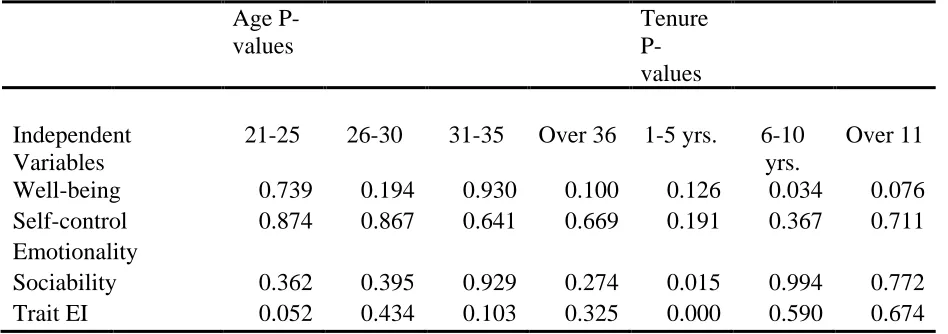
Demographics analysis of race, gender, age, and tenure effect ... 53
Summary of results ... 55
Chapter 5-Discussion ... 58
Summary and Discussion ... 58
Summary of Research Purposes and Methodology ... 59
Discussion of the Results ... 60
Implications of the findings ... 63
Limitations of the study ... 65
Conclusion ... 66
References ... 67
Appendix ... 81
Trait Emotional Intelligence Questionnaire-Short Form (TEIQue-SF) ... 81
The Kaufman Domains of Creativity Scale (K-DOCS) ... 83
Permission for the TEIque-SF ... 86
Permission for the K-DOCS ... 87
Informed consent survey monkey form ... 88
Abstract
This quantitative research study was carried out as a partial requirement for earning a Doctor of Business Administration degree from George Fox University. The main goal of the research
study was to investigate whether trait emotional intelligence variables of well-being, self-control, emotionality, and sociability can individually or collectively predict a software development engineer’s creativity or creativeness potential. Employee innovativeness is the primary focus of many organizations in today’s turbulent business environment whereby employees are
increasingly gaining autonomy in self-managed teams. The study discusses the theoretical
frameworks of creativity and trait emotional intelligence (Trait EI), an extension of the emotional intelligence (EI) construct that focuses on personality behaviors and abilities. Trait EI attributes
such as well-being, self-control, emotionality, and sociability are growing in importance given the trend towards self-managed teams, especially in high-tech firms that rely on agility for creative innovation. Participants in the study were drawn from software engineers in the greater
Seattle region in Washington state, USA. The Trait Emotional Intelligence Questionnaire-Short Form (TEIque-SF) was used to measure Trait EI perception of participants and the Kaufman
Domain of Creativity Scale (K-DOCS) was used to measure creativity perception of participants. Data analysis procedures are highlighted and include use of multiple regression to investigate the predictability of an engineer’s creativity using trait emotional intelligence variables of
well-being, self-control, emotionality, and sociability. Central to this study was the desire to add empirical understanding of the relationship of trait emotional intelligence influence on
creativity.
Chapter 1 – Introduction
Statement of the research problem. People who possess emotional intelligence can
understand emotions of other people and such competency enhances productive engagement at work (Goleman, 1997). The fast-paced business environment in the high-tech industry has tipped
organizations towards agility to stay ahead of competition. According to Hern (2018), Amazon’s success in the cloud business via its Amazon Web Services (AWS) division is credited to their
agility approach to innovation. Self-managed teams should be lean under the Amazon two-pizza rule that subscribes to the notion that teams should not be too big to be fed from more than two pizzas.
Since taking over as the chief executive officer in 2014, Satya Nadella’s secret of the positive transformation at Microsoft is credited to his cultivation of agility. Agility requires
heightened employee autonomy and, according to Satya Nadella, agile teams thrive when team members are emotionally intelligent to build consensus and cooperative creativity. According to writer Chris Matyszczyk (2019), “Microsoft was a nasty company in the past. Externally, it
bullied businesses into buying its software, and internally, employees would ceaselessly work against each other to get ahead” (p. 1). The realization and acceptance of the importance of trait
emotional intelligence (Trait EI) at workplaces in building agile teams, especially among
software development engineers, motivated this research. Trait emotional intelligence refers to a group of emotion-related self-perceptions that share common attributes with lower level
personality attributes. Trait EI involves one’s well-being, self-control, emotionality, and sociability in a social environment. In this regard, trait emotional intelligence is not distinct to
Of primary interest to this study is the emotional connection construct and how trait emotional intelligence is related to the outcome variable of creativity. This study investigated the
predictability of a software engineer’s creativity from an analysis of one’s trait emotional
intelligence variables of well-being, self-control, emotionality, and sociability within the Seattle, Washington region of the United States. Trait EI refers to a group of emotion-related
self-perceptions that share common attributes with lower level personality attributes. Trait EI
measures personality-based behaviors that influence one’s creativity process construct (Cropley,
2015). Employee creativity, defined as the generation of novel and useful ideas (Amabile, 1988; Zhou & Shalley, 2003), is critical to organizational survival and effectiveness. Research to date has mostly focused on the assumption that an employee’s creative effectiveness is thought to be
related to the development of conducive climate factors that boost employee engagement (Macey & Schneider, 2008; Saks, 2006). As such, employee creativity has traditionally been linked to
climate factors, such as the leadership style, organizational structure, and organizational culture. Prior to 1987, research on emotional intelligence concentrated on emotions and behavior or emotions and thought. Ever since John Mayer and Peter Salovey defined and developed the
theory of emotional intelligence as a stand-alone intelligence 25 years ago, emotional
intelligence has evolved to be pivotal factor to human capital development (Boyatzis, 2018).
Organizations, in response to increasing competition, are focusing on employee engagement as a strategy to increase retention and improve productivity via the enhancement of soft skills
(Lockwood, 2007). Emotional intelligence is the lens employees use to understand their
emotions and draw meaning relative to soft skills required to enhance creativity. (O’Neil & Arendt, 2008). This research is in response to the growing need for empirical evidence that back
assessing one’s productivity potential. According to the leadership coach Hill (2015), emotional intelligence is key to the success of engineering creativity. The fundamental criticism of the
emotional intelligence construct is that its definition is too broad and that its measurement is too fuzzy to be conclusive (Matthews, Zeidner, & Roberts, 2007).
Need for significance of the study. The purpose of this study was to investigate the
hypothesized predictability of creativeness of software development engineers from their individual or collective Trait EI variable scores of well-being, self-control, emotionality, and
sociability. The employee engagement theory has gained considerable popularity in the last 25 years (Macey & Schneider, 2008; Schneider, Yost, Kropp, Kind, & Lam, 2018) but its linkage to emotional intelligence remains in need of more empirical research (Saks, 2006; Ackley, 2016;
Bliese, Edwards, & Sonnentag, 2017). The study resides on content theories of trait emotional intelligence (Petrides, 2000), theories of emotional intelligence (Goleman, 1997; Ackley, 2016 &
Byrne, 2014), and theories of creativity (Federman, 2009; Kaufman, & Baer, 2012;Truss,
Delbridge, & Soane, 2013; Hicks, & Knies, 2015 & Schneider, Yost, Kropp, Kind, & Lam, 2018) with a goal of examining the link of trait emotional intelligence to creativity for software
development engineers. While, “there is no one consensual definition of what EI is and what it should encompass” (Murphy, 2006, p6), this study finds the trait emotional intelligence focus on
personality traits ripe with opportunities to demonstrate within the self-efficacy theory
framework the link of emotional intelligence traits to creativity. More evidence of the impact of emotional intelligence on outcome variables like creativity is needed within the business world
given the growing reliance on agile teams. Traditionally, organizations have relied on testing the big five personality traits in selecting engineering teams that fit to external factors like leadership
emotionally intelligent to create as a team with little or no supervision. Central to this study was the issue of whether a software engineer’s perception of their Trait EI correlates to their
perception of their creativity potential. For good reasons, the maturity of any science is gauged by predictive power, not just explanatory utility, hence the motivation in this research study to demonstrate the link of trait emotional intelligence to creativity. Silvia, Wigert, Reiter-Palmon,
Kaufman, Smith, and Smith’s (2012) study demonstrates the strength of measuring creativity from self-reports. Brackett, Rivers, and Salovey’s (2011) study concluded that emotions are
functional in how one processes information and uses that information in critical thinking that can lead to creative thinking. Beghetto, and Corazza, (2019) most recently analyzed the link of emotions to the creative process and they advanced the notion that emotions are indeed the spinal
cord of creative thinking. The emotional phenomena are usually intended as strong (intrinsic or extrinsic) forces able to influence the creative thinking process, which leads to idea generation.
Creativity is one of the psychological constructs most highly valued in social terms, as it is the basis of technological and social innovation (Amabile, 1988). Joseph, Jin, Newman, and O’Boyle (2015) looked at the predictability of job performance from Trait EI and EI and they
concluded that EI can robustly predict job performance. Their study however focused on job performance of both subjective and objective ratings such as sales increases or number of
products produced. Such broad definitions of job performance come with contaminated factors external to the individual. This research strived to focus on emotional factors that are individual-focused in relation to the creativity outcome variable of software development engineers. The
Research question. Can trait emotional intelligence variables of well-being, self-control, emotionality, and sociability individually or collectively predict a software development
engineer’s creativity?
The research hypotheses.
Ho1: Well-being is not a significant predictor of software development engineers’
creativeness or innovativeness.
Ha1: Well-being is a significant predictor of software development engineers’
creativeness or innovativeness.
Ho2: Self-control is not a significant predictor of software development engineers’ creativeness or innovativeness.
Ha2: Self-control is a significant predictor of software development engineers’ creativeness or innovativeness.
Ho3: Emotionality is not a significant predictor of software development engineers’ creativeness or innovativeness.
Ha3: Emotionality is a significant predictor of software development engineers’
creativeness or innovativeness.
Ha4: Sociability is a significant predictor of software development engineers’
creativeness or innovativeness.
Ho4: Sociability is not a significant predictor of software development engineers’ creativeness or innovativeness.
Ha5: Trait EI variables of well-being, self-control, emotionality, and sociability collectively can predict a software development engineer’s creativeness.
Definitions of the terms.
Emotional intelligence (EI refers to an individual’s ability or capacity to be self-aware, to self-manage, self-motivate, and be socially aware of the emotions of others as well. EQ reflects
one’s ability to manage emotions, navigate responsibly in consideration of other people’s emotions, and one’s ability to adapt to the environment. Briefly, EQ refers to the ability to
acknowledge one’s emotions, recognize others’ emotions, understand, and utilize, emotions effectively (Goleman, 1997).
Trait emotional intelligence refers to a group of emotion-related self-perceptions that
share common attributes with lower level personality attributes. In this regard, trait emotional intelligence is not distinct to the personality construct as it is part of the personality traits
(Zampetakis, 2011). The growth of trait emotional intelligence came out of the assumption that emotional intelligence falls outside of the cognitive ability.
Employee creativity is defined as the generation of novel and useful ideas (Amabile,
1988; Zhou & Shalley, 2003)
Employee creativeness is defined as having the quality or power to create viable business
solutions (Byrne, 2014). In this study creativity or creativeness refer to the potential of software engineers’ ability to create novel viable solutions.
Well-being is defined as one’s self-esteem or self-confidence that is accompanied with
Self-control is defined as a deep-rooted and internalized ability to control one’s emotions in ways that equip one to withstand pressure and manage stress, as well as refrain from
impulsiveness (Gökçen et al, 2014).
Emotionality is defined as the competence to accurately perceive self and others’ feelings, ability to communicate one’s feelings to others, ability to empathize other people’s feelings, and
ability to have fulfilling personal relationships (Gökçen et al, 2014).
Sociability is defined as the ability to recognize, acknowledge, and understand the
viewpoints or emotional expressions of others, ability to influence other people’s feelings, and assertiveness in being forthright and frank, and willingness to stand up for what is right (Gökçen et al, 2014).
A software development engineer is a person concerned with all or any of the facets of software development for use according to Stack Overflow (2019) the largest organization of
software developers.
Empathy is defined as “an observer’s emotional response to the affective state of another.” (Baron-Cohen, & Wheelwright, 2004, p164).
The high-tech firms refer to firms that engage in software development operating within the greater Seattle, Washington region of the United States.
Delimitations. The major delimitation was the challenge of collecting a large enough sample to be representative of the population of the software developing engineers in
Washington state. According to the Washington Technology Industry Association there were
90,000 software engineers in 2015 in the Seattle area (Stewart, 2015). The other significant delimitation was the fact that this research had no control over other climate factors such as
from creativity. Also, personality-related variables can come into play in how the target sample may perceive creativity. Personality-related variables such as self-efficacy or self-esteem can
influence the responses of participants. The use of the trait emotional intelligence instrument, instead of the standard emotional intelligence questionnaires that are silent on personality traits, aimed at mitigation against personality-related bias. (Macey & Schneider, 2008; Saks, 2006)
Assumptions. The major underlying assumption in this study is that personality traits are relatively stable. Damian, Spengler, Sutu, and Roberts (2018) looked at a large sample that
tracked changes in personality trait changes of participants over a 50-year span from 16 to 66 years and they observed that the change in personality trait was more malleable over shorter spans and generally stable over longer spans. The issue of whether personality traits are stable or
malleable as acknowledged in the US Fed News (2018) remains open to empirical theoretical resolution. The academic jury is still in session on the issue of personality trait stability or
malleability, just like with the issue of the link of genius to madness per Kaufman and Silva (2010) or Kaufman (2014) observations. Damian, and Simonton (2015), in their study that accessed the psychopathology impact of adversity and personality traits of African Americans on
creativity, observed that the introvert personality trait is a defensive learned trait that is stable among African Americans. Proponents of the argument that personality traits are malleable tend
to emphasize the impact of mood swings in relation to one’s perception on esteem or self-confidence. The Harris, Brett, Johnson, and Deary (2016) study on self-confidence,
perseverance, stability of moods, conscientiousness, originality, and desire to excel observed that
personality traits show little to no stability over extended periods of time. However, as Damian et al (2018) observed, such malleability does not impede an individual to establish one’s
The Anusic and Schimmack (2016) study that looked at factors that influence personality traits such as extraversion and neuroticism noted that while these factors influence an individual’s
mood, such influence stabilizes with age. “ Specifically, personality traits in adulthood appear to be highly stable” (Anusic & Schimmack, 2016, p775).
The use of the Trait EI construct that focuses on traits located at the lower levels of the
personality hierarchies limits the impact of the malleability of personality traits. Petrides (2011) in a study that looked at the impact of mood with regards to trait emotional intelligence from the
belief-importance theory perspective, observed the general understanding that view “personality traits as deterministic due to their high temporal stabilities after 30” (p166). This study therefore assumes that personality traits are stable and that from self-reporting one can observe personality
traits as stable. The weakness of the stable construct of personality traits emanates from the fact that the longitudinal studies done to date are plagued with methodological drawbacks driven by
the reliance on self-reporting measuring. While the primary limitation in the use of self-report measures is real, this study subscribes to the major assumption that (a) every individual is capable of perceiving one’s personality traits; (b) people gravitate towards positive experiences
at work or life in general and that emotional intelligence drives the perception of such positive experiences that can lead to creativity; (c) that emotions can be managed; (d) that employee
creativity is a personal experience; and (e) that where emotional intelligence is perceived to exist, employees exhibit creativeness.. While self-report scales are cost-effective, they come with potential errors of inflated correlations especially if the sample pulled lacks heterogeneity
Researcher’s perspective. The credo “follow your heart” is propagated on the belief that the truth lies in the property of one’s feelings and intuition and less so on one’s reasoning or
cognitive orientation (Reddy, 2001). My name—Mwoyondishe—literally translates to the “follow your heart” credo whereby your heart is your conscience. Conscience here is taken to be the inner feeling or voice that guides one’s moral judgement of what is right or wrong behavior.
Conscience is the manifestation of one’s emotional intelligence competence. As posited by Kahn (1990), employee engagement manifests the expression of one’s preferred self and the quest to
connect to others at work or teams. I believe that in today’s business world, especially within the high-tech industry, selecting team members of the growing self-managed teams requires going beyond personality traits testing. I grew up in a communal-based culture that is anchored on
consensus building. Emotional intelligence is centered on one’s ability to be aware, self-regulating, self-motivating, empathetic, and socially aware. Trait emotional intelligence is
particularly interesting to me given the focus on emotional intelligence traits in relation to personality trait behaviors. I believe that emotional intelligence can be taught to anyone regardless of one’s personality traits. I believe that a deeper understanding of one’s trait
emotional intelligence can lead to shaping one’s Trait EI training.
While environmental factors such as structure, leadership style, resource allocation, and
so forth play a critical role in shaping one’s creativity, I find emotional intelligence competency to be the driving force in one’s creativity realization. In line with the Zimbabwean culture that values recognition of every member of the society, I approached this research with the bias that
heightened emotional intelligence can lead to enhanced creativity when team members feel valued. Self-awareness, self-motivation, self-regulation. empathy, and social awareness enhance
Kahn, (1990/92) advanced the notion that individuals are more effective when they are fully present emotionally. Kakar (2017) further reinforced that organizations that cultivate
self-organization (agility) achieve higher employee creativity and productivity of quality solutions. Agility stimulates greater team member involvement and participation, resulting in higher commitment and motivation. “Team members of self-organizing groups demonstrate greater
creativity and problem-solving skills.” (Kakar, 2017, p1). Chiang, Hsu, and Shih’s (2017) study found that openness to experience (p=.38, p<.01) and general self-efficacy (p=41, p<.01) are
Chapter 2 – Literature review
Introduction. This chapter covers in detail the three main theoretical constructs of Trait
EI, Emotional Intelligence and Creativity.
Emotional Intelligence. Darwin (1872/1965) is regarded as the founding father of the
research on emotional intelligence, but it was Thorndike (1931) who started to expand on what
he called social intelligence in the 1920s. Social intelligence was summarized as the skill to understand and manage others. Gardner (2006) around 1983 introduced the concept of multiple
intelligence, broken down into interpersonal intelligence (ability to understand the motivations, desires, and intentions of others) and intrapersonal intelligence (ability to understand one’s feelings, and express and manage those feelings). Leuner (1966) is credited for the first use of
the term emotional intelligence followed by Payne (1984) and Greenspan (1992) around 1989. The effort to define and develop the measurement of emotional intelligence is credited to
Salovey and Mayer (1990) but it was Goleman (1995) who popularized the interest on emotional intelligence within the business world given his claim that abilities such as being able to
motivate oneself, to control impulse and delay gratification, to empathize and hope mattered
most in workplace productivity.
According to the Encyclopedia of Applied Psychology (Spielberger, 2004), there are
three major emotional intelligence models: (a) the Mayer and Salovey model (1997); (b) the Goleman model (1998) that evolved into the Goleman-Boyatzis model (Goleman, Boyatzis, & McKee, 2013); and (c) the Bar-On model (1997a).
“Emotional intelligence concerns the ability to carry out accurate reasoning about
emotions and the ability to use emotions and emotional knowledge to enhance thought” (Mayer,
emotional intelligence (EI) is “a learned ability to identify experience, understand, and express human emotions in healthy and productive ways” (p. 9). Emotional intelligence in general falls
into two major theories: (a) ability emotional intelligence construct, that includes the integrative emotional intelligence construct; and (b) the mixed-model construct. The ability construct as first conceptualized by Mayer, Salovey, and Caruso (2000) assumes that emotional intelligence is an
intelligence or aptitude that overlaps with the cognitive intelligence in the drawing of meaning from the perceived emotions.
This construct focuses on one’s capacity to perceive emotions, interpret the perceived emotions and the utilization of the perception in decision making (Joseph & Newman, 2010). This ability-based construct assumes one has capacity to accurately perceive one’s emotions.
This assumption is open-ended especially from the accuracy perspective orientation, and critics of this model like Murphy (2006) point to the challenge of measuring the ability-based models.
The second critical attribute of the ability-based construct is the assumption that one has the capacity to use emotions to promote thinking. Using emotions to promote thinking is the central element of the overlap of emotional intelligence with cognitive intelligence (Conte, 2005). The
third attribute of the ability-based construct is the assumption that one has the capacity to understand emotions. The fourth attribute of the ability-based construct involves one’s ability to
manage one’s emotions and emotions of others (Mayer, Roberts, & Barsade, 2008). To this regard emotional intelligence is viewed as a broad global ability that integrates the emotional and cognitive intelligence.
While the definitions of emotional intelligence are multiple, the common theme in these definitions is that the ability to regulate and manage emotions makes people more emotionally
advanced the foundational viewpoint that emotions reflect the mental responses to experienced events. The mental responses manifest into one’s emotional perception driven by one’s
emotional reasoning and emotion management (Mayer et al., 2008). This common attribute in the current definitions of emotional intelligence links the ability construct to one’s abilities to problem-solve, manage stress, and develop productive relationships (Bar-On, 2006). Sternberg
(1997) further refined his definition of intelligence as a deliberate development of mental road maps that guide one’s interaction with the real world in ways that make sense.
With regards to emotional intelligence, this leads to what Izard (1997) coined as the development of emotional knowledge. Emotional knowledge reflects one’s ability to understand, label, and express emotions. Emotional motivation and arousal, according to the emotional
knowledge construct, can shape one’s ability to adapt to the environment. Izard (1997) further posits that the perception of emotions is a cognitive function that gains relevance when one can
use that cognitive function to label and make meaning of the emotions within the social context. This underlying assumption forms the basis of the primary emotional intelligence assumption that a person with high emotional knowledge would be able to accurately perceive, label, and
utilize the emotions of himself/herself and others (Izard, 1997). Kong (2014) looked at the assumption that emotional knowledge of verbal or non-verbal components is correlated to the
labeling and reasoning of emotions.
The other integrative emotional intelligence model is the four-branch ability construct that was developed around 2001 by Mayer, Salovey, and Caruso (2008). This model focuses on
emotions and how one can utilize one’s emotional understanding and ability in dealing with other people. The first level of the four-branch model is the ability to perceive emotions and
involves the process of utilizing the emotional knowledge gathered during level one (Mayer, Salovey, Caruso, & Sitarenios, 2003). This level-based hierarchical growth and utilization of
emotional knowledge leads to the level three, where one can not only understand one’s emotions but emotions of other people. The ability to understand emotions facilitates ability to empathize with others (Mayer, Salovey, & Caruso, 2008). The final level in the four-branch model involves
the development of competency to manage emotions. This involves the ability to control one’s emotions and ability to interpret others’ emotions in ways that facilitates positive group
interaction. Such high emotional management competency enables one to perceive, facilitate, and understand the emotions within oneself and within the group, without letting those emotions control the situation (Mayer et al., 2008).
Wang, Young, Wilhite, and Marczyk (2011) consolidated the convergence of the
integrative emotional intelligence construct into the four emotional intelligence variables of
self-awareness, empathy, self-management, and interpersonal relationship skills. The starting point of these variables is the development of self-awareness: the ability to observe one’s own behavior and be aware of how one’s emotions influence one’s behavior. Growth in self-awareness leads to
competency in empathy, the ability to understand another’s emotions. The third level is self-management, where the abilities of self-awareness and empathy are used collectively to actively
manage one’s emotions both personally and in social interactions. This allows one to develop interpersonal relationship skills as an extension to the self-management competency. Schutte, et al (1998) supported this general view that emotional intelligence involves the competence to
environment. This ability to manage emotions constitutes the final level of the integrative emotional intelligence construct.
Schutte et al (1998) developed the Emotional Intelligence Scale (EIS) to validate their assumption that emotional intelligence can be measured as a personality trait and this gave birth to the mixed-model emotional intelligence construct. The mixed model construct broadened the
definition of emotional intelligence by including social behavior and aspects of the personality theory (Mayer et al, 2008). Petrides and Furnham (2001) followed up on Schutte et al’s (1998)
categorization of emotional intelligence into (a) the ability-based information processing, and (b) trait influenced behaviors such as empathy, assertiveness, and optimism. Bar-On (2004)
consolidated this viewpoint in his expanded definition of emotional intelligence as an
inter-related cross-section of emotional and social intelligence that equips individuals with the ability to not just effectively understand and express one’s emotions but also the emotions of others.
Bar-On (2004) argues that one’s emotional intelligence score should incorporate the five
competencies of intrapersonal, interpersonal, adaptability, general mood, and stress management. The intrapersonal competency involves one’s ability to understand oneself within the
context of strengths and weaknesses as well as one’s ability to effectively express such emotions accurately. The interpersonal competency involves one’s ability to understand others’ emotions
and work cooperatively in a group. The third competency is the ability to manage one’s stress level in ways that do not allow emotions to influence decisions and relationships. The fourth competency of adaptability involves the ability to adapt to each situation and social group. “The
first major concern raised by critics of emotional intelligence is that the definition of EI is too broad and too fuzzy to be useful” (Murphy, 2006, p1). The second major criticism is that the
Intelligence Scale (MEIS) by Mayer, Caruso, and Salovey (2000); the Mayer-Salovey-Caruso Emotional Intelligence Test (MSCEIT) by Salovey, Mayer, Caruso, and Lopes (2003); the
Emotional Competence Inventory (ECI) by Boyatzis, Goleman, and Rhee (2002); the Bar-On Emotional Quotient Inventory (EQ-i) by Bar-On (2004); The Wong and Law Emotional Intelligence Scale (WLEIS) by Law, Wong, and Song (2004); and the Emotional Intelligence
Scale (EIS) by Schutte (1998)—all rely on self-reporting of broad range individual differences that are mostly personality-based or a combination of the cognitive and personality dimensions.
According to Barchard and Hakstian (2004), self-report emotional intelligence measures correlate with personality dimensions and less so with cognitive ability. The MEIS and the MSCEIT are the only emotional intelligence scales that are more distinct from the big five
personality dimensions (Murphy, 2006). Mayer, Caruso, and Salovey’s (1998) ability-based four branch model clearly distinguish emotional intelligence from other types of intelligence such as
IQ (Murphy, 2006). Murphy (2006) further argues that the Goleman (1995) model or the Bar-On (1997) models “are not strictly speaking, just types of intelligence, but rather are a mix of
abilities, interests, and personality characteristics.” (p329). The Mayer-Caruso-Salovey
abilities-based model is foundational to the integrative emotional intelligence construct (Boyatzis & Sala, 2004). The Goleman (1995) and the Bar-On (1997) models launched the mixed-model of the
emotional intelligence construct (Conte, 2005).The recognition that self-report emotional
intelligence measures are more about the measures of self-perception of one’s emotional abilities than about the measures of one’s actual emotional intelligence abilities led to the growth of trait
emotional intelligence.
Trait emotional intelligence. “People strive to exercise control over events that affect
defines self-efficacy as the belief in one’s ability to control one’s behavior, emotions, and
motivations, the trait emotional intelligence (Trait EI) construct grew as an offshoot of the mixed
model emotional intelligence construct. The focus of the trait emotional intelligence on one’s perceptions of one’s personality world makes it distinct from the ability-based emotional intelligence constructs. Trait emotional intelligence lies wholly outside the realm of cognitive
ability (Petrides, 2011). Also known as the trait emotional self-efficacy, trait EI is both interrelated and integrated to the big five hierarchical personality models. The broad big five
personality attributes are (a) conscientiousness: high levels of thoughtfulness, and goal-directed behavior; (b) agreeableness: trust, kindness, and affection; (c) neuroticism: negative emotions such as anger, anxiety, or depression; (d) openness: being creative, curious, insightful, and
informed; and (e) extraversion: positive energy and emotions, excitability, sociability, and assertiveness (Raad, 2000).
The Trait EI was first developed by Konstantin Vasily Petrides as a departure from the earlier ability-based emotional intelligence models. Petrides and Furnham (2000) expanded on Mayer-Salovey’s (1990) four branch model by advancing the argument that emotional
intelligence involves two categories of (a) ability-based cognitive information processing and (b) trait-based emotional ability. Trait EI is concerned with the development of emotional behaviors
such as empathy, assertiveness, and optimism, that are related to the big five personality factors. Trait EI considers emotional intelligence as a personality trait that fits within the Five-Factor Model of Personality (Petrides, 2011). Some of the personality traits that are directly related to
emotional intelligence include adaptability, assertiveness, emotional appraisal and expression, self-esteem, and stress management. Petrides and Furnham (2001) place emotional intelligence
pragmatic and focuses on outward results, the Trait Model is geared more toward emotional self-perception. Specifically, Trait EI evaluates how one perceives one’s emotional abilities. The
emotional abilities that grow out of one’s perception affect one’s behaviors and personality traits. Given the consensus that Trait EI resides wholly in the perceptions of the individual, it aligns better with self-reporting measurement instruments (Petrides, 2007).
This heavy reliance of the Trait EI construct on the big five personality factors creates challenges on its validity as a measurement of emotional intelligence especially among
ability-based theorists like Mayer, Salovey, and Caruso (2008) or Boyatzis (2008). However, this criticism constitutes the very incentive that motivated Petrides(2000) to develop the Trait EI theory. Theorists of the Trait EI argue that one cannot fully measure one’s emotional intelligence
without simultaneously evaluating one’s personality. Measuring one’s EI solely within the framework of cognitive-emotional ability negates personality characteristics that are at play in
the molding of one’s emotional intelligence. Facets of personalities that relate directly to
emotional intelligence are adaptability, assertiveness, emotion expression-emotion management of others, emotion perception of self and others, emotion regulation, impulsiveness,
self-esteem, trait empathy, trait happiness, and trait optimism. Petrides (2000) argues that the trait model of emotional intelligence should be conducted within a framework of understanding an
individual's personality. Petrides (2000) advanced Goleman’s (1995) thinking that EI
measurement should incorporate one’s moral qualities. Gardner and Qualter (2009) concluded that the Trait Emotional Intelligence Questionnaire (TEIQue) has been shown to have sound
Martins, Ramalho, and Morin (2010) also observed and further advanced the notion that considering emotional intelligence outside the realm of personality traits misses critical factors
that mold one’s emotional intelligence. They found the TEIque to have stronger significant association to one’s well-being compared to the ability-based measures of EI like the MSCEIT for example. Van Der Linden and Petrides (2012) concluded that high trait EI individuals tend to
describe themselves as empathetic, optimistic, and well-adapted in general. They also further found that the overlap between Trait EI and the big five personality factors to be significantly
strong. Catalino, Arenander, Epel, and Puterman, (2017) observed in their research that individuals with high well-being defined as being receptive to one’s emotions and personality traits tend to express little negative emotions. According to Sinclair and Feigenbaum (2012) Trait
EI is related to life satisfaction, happiness, well-being, and positive mental health. Further, Trait EI is useful in understanding the multiple factors that shape emotional information processing, a
key attribute of the Trait EI theory. The link of emotional intelligence to creativity, according to Beghetto and Corazza (2019), is “that emotional phenomena are not simple influencers of the process, but that they are the spinal cord of the creative thinking process” (p48).
Creativity theory. While Darwin (1860/1952) planted the seeds of psychology focused
on creativity in his theories of evolution, it was Galton (1869) who used his mathematics skills to
bring science into the study of human behavioral differences. Terman (1925) refined Galton’s 1869/83) assessment tool by introducing the psychometric analysis of one’s natural ability. This gave birth to the intelligence (IQ) assessment that mostly focused on the cognitive natural ability
that drives creativity. Freud (1908/1959) felt and believed that creativity involves more than just the cognitive element and he introduced the argument that equates creativity to daydreaming.
their creative genius. Skinner’s (1956) earlier works at the start of the 20th century brought in the behavioral approach to the psychology of creativity. Skinner’s works on behavioral attributes
ushered in the emphasis on behavior as an indicator of competency (García, Ferrando, Soto, & Sainz, 2017). The growth in appreciation of creativity is credited to the incorporation of the systems theory approach in the evaluation of factors that contribute and drive creativity
(Csikszentmihalyi, 2014). Beghetto (2016) concurred that “as our understanding of the phenomenon of creativity continues to grow, it is becoming more and more evident that
researchers need new ways of conceptualizing, identifying and studying creativity in the midst of social practices” (p. 270). This realization—that to understand creativity requires evaluating a person’s behavior—gave rise to the focus on personality trait assessment, especially after the
second world war (Amabile, 1996).
After the second world war the focus on human creativity in psychology emerged again
under the leadership of Joy Paul Guilford, who is regarded as the founder of the modern-day psychology of creativity (Hunt, 1992). Guilford (1967) introduced the link of divergent thinking to creativity. “Creativity is one of the psychological constructs most highly valued in social
terms, as it is considered to be the basis of technological and social innovation” (García, Ferrando, Soto, & Sainz, 2017, p40). Creativity can be defined as an idea or product that is
original, valued, and implemented. Traditionally, creativity has been viewed as a mental process that sheds light on one’s genius. “The location of genius is not in any particular individual’s mind, but in a virtual space, or system, where an individual interacts with a cultural domain and
The creativity construct has three main branches of (a) creativity cognition, (b) creativity traits, and (c) creativity behavior (Kaufman, Cole, & Baer, 2009). The creativity construct is hard
to measure given that it is more about a way of thinking than about a quantifiable disposition of the created outcome. Guilford (1967) expanded on Henri Poincare’s earlier works that brought about the understanding that the human mind problem solves issues on either divergent or
convergent thinking. Convergent thinking is premised on the reductionistic approach of focusing a solution to one specific problem. Divergent thinking on the other hand is the process of
generating multiple solutions from diverse perspectives. “Divergent thinking is the ability to elaborate and to think of novel and diverse ideas. Ideation or idea generation is an example of divergent thinking” (Harris, 2014, Chapter 7, p1). Montag-Smit and Maertz (2017) most recently
also supported the notion that “idea generation is the process in which individuals use divergent thinking to develop ideas intended to solve non-algorithmic problems” (p2). While the debate of
whether creativity is specific or general remains center stage to researchers, there is consensus that creativity “encompasses multiple factors internal and external to the individual” (García, Ferrando, Soto, & Sainz, 2017, p40). Navarrete’s (2013) case study revealed that an individual’s
creative thinking process is interdependent to divergent thinking and emotional well-being and that such everyday domain skills are central to creativity enhancement.
Guilford (1950), using the systems approach theory, argued that creativity involves both cognitive and non-cognitive processes. While he appreciated the importance of the cognitive processes such as comprehension, memory, knowledge, and assessment, Guilford (1950) ushered
the notion that the main feature of creative thinking is the ability to do so differently and
originally (divergent thinking). Csikszentmihalyi and Sawyer (1995) and later Csikszentmihalyi
and social aspect. “Creativity is a process that can be observed only at the intersection where individuals, domains, and field’s interact” (Csikszentmihalyi, 2014, p103). Based on this
approach, one cannot be a genius in the absence of a symbolic system nor can an idea be original in a vacuum. Creativity occurs when one makes a change in a domain within acceptable rules, norms and values of the field’s culture. Kaufman, Pumaccahua, and Holt (2013) in their study
further reinforce the importance of going beyond the domain level in understanding individual differences in creativity. Most self-reporting-based creativity scales do not focus on single
specific domains but take a generalist perspective that emphasize personality traits and creative activities (Silvia, Wigert, Reiter-Palmon, Kaufman, Smith, Jeffrey, & Smith, 2012). Schaefer’s (1969) behavior-based scale for creativity prediction marked the movement to develop general
domain focused measurement tools.
The Creative Behavior Inventory (CBI) developed by Dennis Hocevar around 1979
focused on six domains for measuring creativity. Carson, Peterson, and Higgins’ (2005) Creativity Achievement Questionnaire (CAQ) expanded measures to ten domains. Batey’s (2007) Biographical Inventory of Creative Behaviors (BICB) expanded on Schaefer’s (1969)
initiative (Batey, Furnham, & Safiullina, 2010). Kaufman, Cole, and Baer (2009) developed the Creativity Domain Questionnaire (CDQ), which consisted of 56 different creative domains.
Earlier, Kaufman and Baer (2005) had developed the Creativity Scale for Diverse Domains (CSDD) that found openness to experience significant to creativity. The Kaufman Domains of Creativity Scale (K-DOCS) is a recent development in the creation of a self-report,
behavior-based creativity rating scale that reflects a domain-specific perspective of everyday creativity (Kaufman, & Baer, 2012). The K-DOCS measures five factors of self-assessed creative
writing and music), mechanical/scientific creativity, and artistic creativity domains. The K-DOSC past research revealed correlations between the five creativity domains and the five
Chapter 3- Methods
Introduction. This chapter outlines the research aims and methodology, the hypotheses
tested, the sample investigated, the description of the instruments used to measure Trait EI and Creativity, and how the data was collected and analyzed.
Aims and Methodology. The overall purpose of this study was to investigate the
predictability of a software engineer’s creativity from an analysis of one’s trait emotional
intelligence variables of well-being, self-control, emotionality, and sociability within the Seattle, Washington region of the United States. The study addressed hypotheses that relate to the individual and collective relationship among variables, hence the correlational approach.
Research Hypotheses. Hypothesis one evaluated whether the Trait EI variable of
well-being is statistically significant in predicting creativity of software engineers. To establish the
well-being variable scores of participants, the actual scores of the TEIque responses to questions 5, 9, 12, 20, 24, and 27 were used. Hypothesis two extended the investigation to examine if the Trait EI variable of self-control is statistically significant in the prediction of creativity for
software engineers. For the self-control variable, actual response scores to questions 4, 7, 15, 19, 22, and 30 were used.
Hypothesis three examined if the Trait EI variable of emotionality is statistically
significant in predicting the creativity of software engineers. For the emotionality variable, actual responses to questions 1, 2, 8, 13, 16, 17, 23, and 28 were used. Hypothesis four investigated
whether sociability is a statistically significant predictor of creativity in software engineers. For the sociability variable, the actual response scores of questions 6, 10, 11, 21, 25, and 26 were
predict the creativity of software engineers. For the Trait EI variable all response scores of the 30 TEIque questions (Petrides, 2009) were used collectively to establish the Trait EI variable scores
for each participant. The independent variable of creativity was taken to be the sum of the K-DOCS subscales.
Participants. Participants in the study met all the following criteria: (1) software
engineers; (2) current involvement in software design development, software coding, or software analysis; and (3) at least one year of working experience in software engineering. The target
region was software engineers working in the greater Seattle region of Washington state. The greater Seattle region includes cities such as Renton, Issaquah, Redmond, Bellevue, Woodinville, Everett, Bothell, Lynnwood, Shoreline, and Edmonds. Posters inviting participation in this
research study were displayed at restaurants, coffee shops, and bars in these cities at facilities that approved such a display. The selection of the facilities was random and subject to approval
and willingness of the owners of these facilities. All in all, 150 posters were displayed in the greater Seattle area of Washington state as defined above.
The random selection of the participants was further extended via the outreach efforts of
the researcher at meetups. The researcher joined software engineering meetup groups around greater Seattle. The researcher would then attend the events organized to pitch the participation
of software development engineers in this research study. At the meetup meetings, the researcher distributed invitation business cards or flyers. The most successful meetups were held at libraries whereby participants would complete surveys right away. The other primary outreach method to
invite survey completion was via Lyft rides. The Lyft rides the researcher gave to participants to or from the target high-tech hubs within greater Seattle area generated not just immediate
participation was also dependent on the willingness of the software engineers to participate, as well as other factors like the duration of the Lyft rides and convenience to take the survey on a
smartphone or personal computer.
Measuring participant demographics. Through business cards distributed at meetups;
or posters left at coffee shops, bars, restaurants; and Lyft rides, participants received the
SurveyMonkey link address or QR code with the link to the survey questions. The first seven questions addressed the characteristics of the participants in terms of their age range, tenure
range, race, gender, software engineering category, the high-tech industry category, and how long the company they worked for has been in business. Participants first completed these
demographic questions, then the 30 questions on Trait EI and 50 questions on K-DOCS
creativity scale. All 294 participants completed the first seven demographics questions, and 279 out of 294 of the participants completed all seven demographics questions and all 30 Trait EI
questions. 260 out of 294 respondents completed all 87 questions hence the sample size of 260 that was used for the data analysis.
Table 1 (Age demographics)
Age range Number Percentage of Sample total
21-25-year-old 76 29%
26-30-year-old 80 31%
31-35-year-old 73 28%
Over 36-year-old 31 12%
Of the 260 participants that completed all 87 survey questions, 29% of the sample were
software engineers within the 21 to 25 year age group, 31% of the software engineers were within the 26 to 30 year age group, 28% of the software engineers were within the 31 to 35 year
Table 2 (Software category)
Engineering Category Number Percentage of sample total
Software developing 125 48%
Software coder 120 46%
Software analyst 15 6%
48% of the 260-sample respondents identified themselves as design software developing
engineers. 46% identified themselves as software developing coders, and 6% identified themselves as software systems analysts.
Table 3 (Software tenure)
Software tenure Number Percentage of sample total
1-5 years 122 47%
6-10 years 86 33%
Over 11 years 52 20%
47% of the 260-sample had worked as software engineers for 1 to 5 years. 33% had worked as software engineers for 6 to 10 years, and 20% had worked for over 11 years.
Table 4 (Software gender)
Gender Number Percentage of sample total
Female 83 32%
Male 161 62%
Other 16 6%
32% of the 260-sample identified as females. 62% of the sample identified as males, and 16 or 6% of the sample identified as other which represented gay, lesbian, or transgender
Table 5 (High-tech category)
Industry category Number Percentage of sample total
Service 169 65%
Retailing 60 23%
Manufacturing 31 12%
65% of the 260-sample worked in the high-tech service industry. 23% worked in the high-tech retailing industry, and 12% worked in the high-tech manufacturing industry.
Table 6 (Race identity)
Race identity Number Percentage of sample total
Asian 130 50%
White 86 33%
Black/African American 23 9%
Hispanic/Latino 18 7%
Native Hawaiian/PI 1 0.05%
American Indian/Alaska N 1 0.05%
50% of the 260- sample identified as Asian, 33% identified as White, 9% identified as Black/African American, 7% identified as Hispanic/Latino, 0.05% identified as Native Hawaiian
or Pacific Islander, and 0.05% identified as American Indian or Alaska Native.
Table 7 (Years in business)
Years in business Number Percentage of sample total
1-5 years 44 17%
6-10 years 39 15%
11-15 years 39 15%
53% of the 260-sample worked in high-tech firms that have been in business for more than 16 years, 17% worked in high-tech firms that have been in business for 1 to 5 years, 15% worked in firms that have been in business for 6 to 10 years, and 15% worked in firms that have
Measuring instruments. The instruments used in the study were the Trait Emotional Intelligence Questionnaire-Short-Form (TEIque-SF) for Trait EI assessment, and the Kaufman
Domains of Creativity Scale (K-DOCS) for creativity. The TEIque-SF has 30 questions that measure the 15 facets of a person’s perception of their trait emotional intelligence. The 15 facets are (1) adaptability: flexibility and willingness to adapt to new conditions; (2) assertiveness:
forthrightness, frankness, and willingness to stand up for one’s rights; (3) emotion perception:
(self and others) clarity about one’s own and other people’s feelings; (4) emotion expression:
capability to communicate one’s feelings to others; (5) emotion management (others):
capability to influence other people’s feelings; (6) emotion regulation: capability to control one’s emotions; (7) impulsiveness (low): reflective and less likely to give in to one’s urges; (8)
relationships: capable of having fulfilling personal relationships; (9) self-esteem:
successful and self-confident; (10) self-motivation: driven and unlikely to give up in the face of
adversity; (11) social awareness: accomplished networkers with excellent social skills; (12)
stress management: capable of withstanding pressure and regulating stress; (13) trait empathy: capable of taking someone else’s perspective; (14) trait happiness: cheerful and satisfied with
their lives; and (15) trait optimism: confident and likely to look on the bright side of life (Cooper, & Petrides, 2010). The 15 facets measured by two questions each aggregate to the four primary
Diagram 1 (Developed from Petrides (2009) scoring instructions)
Using a Likert scale of 1 to 7, participants indicated how they perceived themselves in
relation to the above Trait EI variables measured out of the 26 questions.
The K-DOCS has 50 questions that measure one’s perception of their creativity within the primary domains of (a) self/everyday creativity (questions 1 to 11), (b) scholarly creativity
(questions 12-22), (c) performance creativity (questions 23-32), (d) mechanical/scientific creativity (questions 33 to 41), and artistic creativity, (questions 42 to 50).
Diagram 2 (Developed from Kaufman, Reiter-Palmon and Tinio (2012) scoring)
Using a Likert scale of 1 to 5, participants indicated their perceptions of how creative
they regard themselves in relation to the above creative subscales constructed out of the 50 questions.
TRAIT EI VARIABLE
WELL-BEING
SELF-CONTROL
EMOTIONALITY
SOCIABILITY
CODED TRAIT EI QUESTIONS RECODED TRAIT EI QUESTIONS
5 & 12
4, 7 & 22
2, 8,13,16 & 28
10, 25 & 26 9, 20, 24 & 27
15, 19 & 30
1, 17 & 23
6, 11 & 21
K-DOCS QUESTIONS CREATIVITY SUBSCALE
QUESTIONS 1 TO 11 SELF/EVERYDAY
QUESTIONS 12 TO 22 SCHOLARLY
QUESTIONS 23 TO 32 PERFORMANCE OVERALL CREATIVITY
QUESTIONS 33 TO 41 MECH/SCIENTIFIC
Data collection. All the data was collected via the SurveyMonkey platform that had easy-to-follow instructions. First, the respondents had to give consent for the data collection and
then they had to complete the seven demographic questions before moving on to the 30 questions on the Trait EI questionnaire and the 50 K-DOCS questions. Upon completing all the 87
questions, the SurveyMonkey platform would then offer the “done” button to indicate survey
completion and submission.
One hundred and fifty posters inviting software engineers to complete the survey were
posted at coffee shops, restaurants, bars, and workout gyms around the main high-tech hubs in Seattle, Renton, Issaquah, Redmond, Bellevue, Woodinville, Bothell, Lynnwood, Everett, Edmonds, and Shoreline in Washington state. The posters, like the business cards distributed to
software engineers that took Lyft rides from the researcher or attended the meetup sessions at libraries, had the SurveyMonkey website link address and a QR code of the survey link. The Lyft
rides did not only offer opportunities to capture data real time but also led to most of the meetup leads. The Lyft rides option also allowed random selection of participants. The 88% success rate of getting 260 out of 294 fully completed surveys is mainly attributed to the Lyft rides strategy
that allowed the researcher to introduce himself to participants before they completed the surveys. The researcher gave 720 Lyft rides to software engineers during the six weeks of data
collection as well as attended more than eight meetups per week during the same period. This attracted 294 software engineers to respond and 260 of the 294 respondents completed all 87 questions on the survey monkey platform. Participants during Lyft rides or at library meetups
Statistical design. The goal of the study was not to establish causation; the focus was to explore the correlational prediction of the dependent variable of creativity from the Trait EI
variables. The research design had several underlying assumptions. The eight assumptions are (a) the dependent variable must be measured on continuous scales which the K-DOCS did on
creativity; (b) two or more independent variables must be under review and such independent
variables must be either continuous or categorical-attributes the trait emotional intelligence variables demonstrated to have; (c) independence of observation must be achievable; (d) linear
relationship between the dependent variable and each of the independent variables or
independent variables collectively must be established using scatterplots to establish creativity relationship to well-being, self-control, emotionality, and sociability; (e) the collected data using
the scales must show homoscedasticity such that the variances along the line of best fit remain similar as you move along the line which turned out to be the case; (f) the data collected must not
show multicollinearity caused by independent variables that are highly correlated (the trait emotional intelligence independent variable of emotionality turned to be highly correlated to the other Trait EI variables hence the SPSS analysis excluded it); (g) the collected data must not
have significant outliers or high leverage points that might skew the regression line (the box plot analysis found no outliers); and finally, (h) the residuals (errors) must normally distribute as was
demonstrated in the analysis.
Given the above satisfaction of the critical assumptions and the intention of exploring correlational relationships between the dependent variable of creativity and multiple predictor
independent variables of Trait EI, this study found the multiple regression statistical process more conducive to estimate the relationships among the independent variables to the dependent
greatest advantage of using the multiple regression analysis was that it allowed the testing of the influence of well-being, self-control, emotionality, and sociability on the dependent (outcome)
variable of creativity individually and collectively as the Trait EI variable. Questions from the TEIque instrument such as “I often find it difficult to see things from another person’s viewpoint or on the whole, I’m able to deal with stress” exemplify how this instrument mitigates against
malleability of personality traits perception. The 30 questions in the TEIque instrument draw out one’s perceptions on the four Trait EI variables to be used as the independent variables in this
study.
Multiple regression allows for an assessment of the unique contribution of each
independent variable in predicting the stated outcome thus providing a means to determine the
relative importance of each predictor. Simple linear regression would miss potential blind spots of how the multiple independent variables of trait emotional intelligence collectively influence
creativity. The K-DOCS scale has 50 questions such as “maintaining a good balance between my work and personal life” or “figuring out how to integrate critiques and suggestions while revising a work,” for example, focus on the individual perception of the outcome variable of creativity.
The K-DOCS instrument measures five subscales of (a) self/everyday creativity, (b) scholarly creativity, (c) performance creativity, (d) mechanical/scientific creativity, and (e) artistic
creativity.
The TEIque short form Cronbach’s alpha score from the sample of 260 was .96 and this was higher than the .86 previously recorded (Petrides, & Furnham, 2003). The K-DOSC
Cronbach alpha score from the sample of 260 was .98 and it was higher than the .74 (Batey, Furnham, & Safiullina, 2010) recorded. The reliability of the TEIque-SF and the K-DOCS
such self-reporting instruments come with the primary disadvantage of social desirability bias. Social desirability bias is the tendency of respondents wanting to seem good. However, the
instruments allowed the capturing of direct responses of what respondents think and the closed questions format was easily quantifiable. Large amounts of data can be easily captured using surveys (Cooper, & Schindler, 2014). The use of fixed closed questions however comes with the
disadvantage of forcing respondents to choose from limited set options. Regardless of good Cronbach alpha reliability scores, survey questions may still be misunderstood (Leedy, &
Ormrod, 2016).
Summary. Prior to the data analysis, the sample data of the 260 respondents was tested for normal distribution and linearity from the TEIque-SF and the K-DOCS scores. The Trait EI
independent variable was calculated from the sum of the well-being, self-control, emotionality, and sociability scores from the TEIque-SF. The dependent variable of creativity was calculated
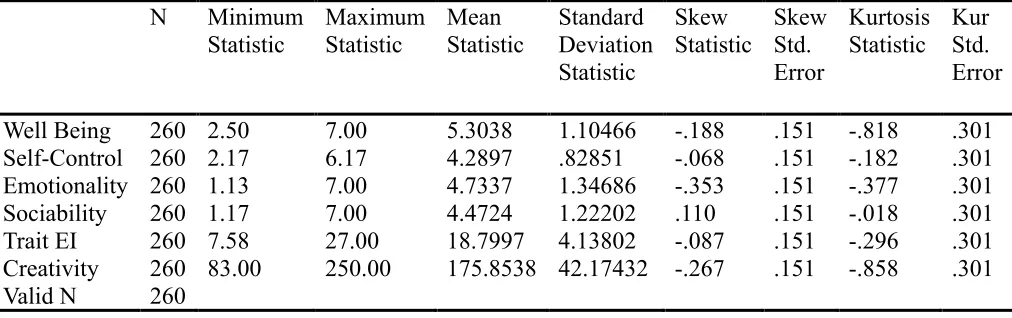
from the sum of the K-DOCS scores of self/everyday, scholarly, performance, artistic, and mechanical/scientific subscales. The descriptive statistics in Table 8 below reflected normal distribution. . Since the data was parametric, they were first analyzed for normality using
skewness and kurtosis. A skewness value that is greater than 1 indicates positive distribution from normal and the skewness below 1 indicates negative normal distribution (see Table 8). The
Table 8 (Normal distribution)
N Minimum Statistic Maximum Statistic Mean Statistic Standard Deviation Statistic Skew Statistic Skew Std. Error Kurtosis Statistic Kur Std. Error
Well Being 260 2.50 7.00 5.3038 1.10466 -.188 .151 -.818 .301 Self-Control 260 2.17 6.17 4.2897 .82851 -.068 .151 -.182 .301 Emotionality 260 1.13 7.00 4.7337 1.34686 -.353 .151 -.377 .301 Sociability 260 1.17 7.00 4.4724 1.22202 .110 .151 -.018 .301 Trait EI 260 7.58 27.00 18.7997 4.13802 -.087 .151 -.296 .301 Creativity 260 83.00 250.00 175.8538 42.17432 -.267 .151 -.858 .301 Valid N 260
The test for linearity was conducted in relation of the independent variables of well-being, self-control, emotionality, sociability, and overall Trait EI to creativity. Diagram 2
indicated linear relationship.
Diagram 4 (Outliers test on the dependent variable of creativity)
As indicated in the boxplot (Diagram 4) above, no outliers were found on the dependent variable of creativity in relation to the Trait EI median score.
Diagram 5 (Outliers test on the independent variables
Creat
iv
it
y
0 5 10 15 20
25 30
T
rai
t E
While outliers for emotionality, sociability, and trait emotional intelligence were dictated, as indicated in (Diagram 5) above, such indication shows low significance of the outliers in
Chapter 4- Results
Introduction. This chapter covers the findings of the statistical analyses. First, I discuss
the psychometric properties of the TEIque-SF and the K-DOCS instruments and then the statistical procedures used and report on the findings for each of the hypothesis examined. To further understand the descriptive statistics, the Pearson correlation and multiple regression
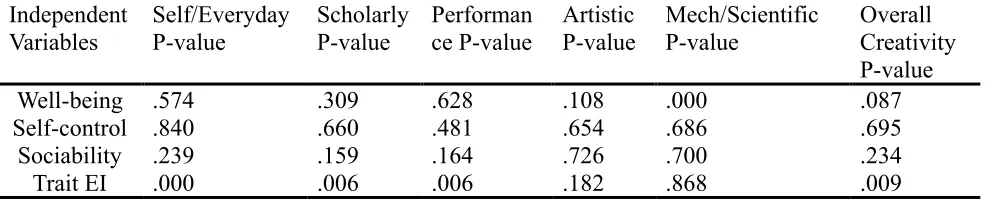
analysis were repeated to observe between the effects of the demographic’s categories of race, gender, tenure, and age groups.
The reliability statistics for the TEIque-SF was rounded to 97% (see Table 9).
Table 9 (TEIque Cronbach’ Alpha)
Cronbach’s Alpha N of Items
.966 30
The reliability statistics for the K-DOCS was rounded to 99% (see Table 10).
Table 10 (K-DOCS Cronbach’s Alpha)
Cronbach’s Alpha N of Items
.987 50
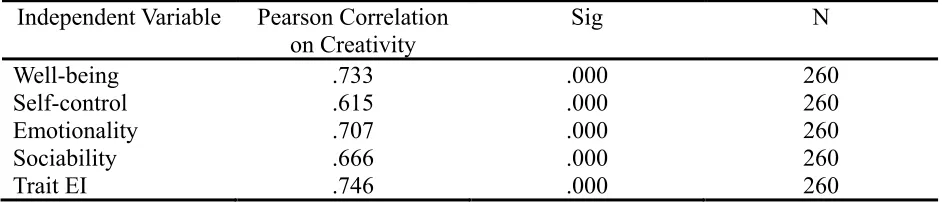
The Pearson correlation analysis. Prior to conducting the multiple regression analysis
of the predictability of the dependent variable of creativity from the independent variables of well-being, self-control, emotionality, sociability, (individually) and Trait EI variables (collectively), the Pearson correlation analysis was conducted and the correlation of the
independent variables to the dependent variable of creativity ranged from .62 to .75 as indicated in Table 11. The results indicate that the Trait EI perception scores of 260 software engineers