20th International Conference on Structural Mechanics in Reactor Technology (SMiRT 20) Espoo, Finland, August 9-14, 2009 SMiRT 20-Division 3, Paper 1920
Fluid Structure Interaction models for the dynamic behaviour of tube bundles,
Application to nuclear structures
Broc Daniel
a, Duclercq Marion
ba
CEA Saclay, DEN/DANS/DM2S/SEMT/EMSI 91 191 Gif/Yvette Cedex France, [email protected]
Keywords: Fluid Structure Interaction, Tubes bundles, Seismic behaviour, Nuclear Structures.
1
ABSTRACT
It is well known that a fluid may strongly influence the dynamic behaviour of a structure. Many different physical phenomena may take place, depending on the conditions: fluid flow, fluid at rest, little or high displacements of the structure. Inertial effects can take place, with lower vibration frequencies, dissipative effects also, with damping, instabilities due to the fluid flow (Fluid Induced Vibration). In this last case the structure is excited by the fluid.
The paper deals with the vibration of tube bundles under a seismic excitation or an impact. Such structures are very common in the nuclear industry, for example in the reactor cores and the steam generators. In this case the structure moves under an external excitation, and the movement is influenced by the fluid. The main point in such system is that the geometry is complex, and could lead to very huge sizes for a numerical analysis.
The development of homogenization methods for the dynamic behaviour of tubes bundles is presented, with the aim to limit the size of the problem. The limits of the methods are discussed, and current researches are presented.
2
INTRODUCTION
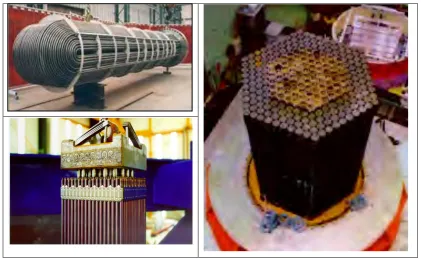
The dynamic behaviour of many industrial structures is strongly influenced by the presence of a fluid. It is the case for tubes bundles immersed in a fluid (at rest or not). This kind of system is very common in the nuclear industry (figure 1). We consider here the case where the structure is submitted to an external excitation. The presence of a fluid leads to inertial (lower frequencies) and dissipative (damping) effects for the vibration of the tubes.
Analysis of FSI (Fluid Structure Interaction) problems can be made using computer codes. The more general way is to solve a system of coupled equations for the structure and for the fluid. The more general equations for the fluid are the Navier Stokes equations.
In the case of the vibration of tubes bundles, simplifications can be made. For a fluid at rest, and for “little displacements”, the Euler equations (more simple than the Navier Stokes equations) can be used. The geometry is complex, but repetitive and homogenization techniques can be applied.
It is well known that dissipative effects due to the fluid may take place, for example if the fluid is not still, or, even for still fluid, if the hypothesis of “little displacements” is no more valid (§ 4) (Sarpkaya 2001 and 2005, Melot). The most important key points are pointed out to build such homogenized model for the dynamic behaviour of tubes bundles in a fluid, with inertial and dissipative effects.
Figure 1. Example of tube bundles
3
HOMOGENIZATION OF THE FSI PROBLEM FOR A TUBES BUNDLE, WITH THE
EULER EQUATIONS FOR THE FLUID
3.1 General presentation
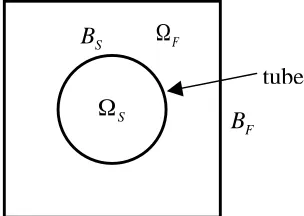
In the case of tube bundles immersed in a fluid at rest, homogenisation techniques can be developed for the FSI problem for tubes bundles, with the Euler equations for the fluid. A scheme of a 2D tube bundle is presented on the figure 1. We define a local scale (the elementary cell corresponding to one tube) and a global scale (the whole bundle). The variations of the parameters of the FSI problem (the pressures, the velocities) are high at the local scale, but lower at the global scale. The aim of the homogenization is to write equations which only take into account explicitly the global scale variations (Hammami, Broc 2006, Sigrist 2007, 2008).
Figure 2. Scheme of a tube bundle
Elementary cell
The homogenization is based on the analysis of the behaviour of an elementary cell (§ 3.2). An expression of the force applied by the fluid on one tube is derived from this analysis. This force is used to write an equation for the fluid in the whole bundle (§ 3.3). A global homogenized system can then be built, with the coupled fluid and solid equations (§ 3.4).
3.2 Analysis on an elementary cell
We consider an elementary 2D cell corresponding to one tube (figure 3):
Figure 3.Scheme of an elementary cell
S
! is the structure volume,
F
!
is the fluid volume,BS is the structure boundary,
BF
is the fluid boundary,F S T
=
!
+
!
!
is the total volume of the cell.The fluid velocity in the cell is:
V
F. The fluid acceleration is:!
F. The structure velocity and acceleration areV
S and!
S. We define the mean pressure, the mean velocity and the mean acceleration of the fluid in the cell:P
defined by:P
n
dB
TP
BF S
=
"
!
#
r
r
!
""
=
F
F F F
V
d
V
!
""
#
=
#
F
F F
F
d
We also define a “total” fluid velocity VT defined as:
!
TV
T=
!
SV
S+
!
FV
F. This “total fluidvelocity” will allow to take into account the interaction between the different cells of the problem. This velocity is related to the fluid flow exchanges between two adjacent cells, on the
B
F boundary.For the x direction:
x
V
d
B
SV
Ti
BFF T
r
.
1
=
!
"
For the y direction: BFy
V
d
B
SV
Tj
F T
r
.
1
=
!
"
S!
S B
F
B
tube
FThe Euler equations considered here are a simplification of the general Navier Stokes equations for the fluid:
P t
VF F ="!
#
# r
$
anddiv
V
F=
0
at the interface with the structure (tube): VS.nr =VF.nrThe Euler equations can be solved on an elementary cell, with the hypothesis of low variations, from a cell to the adjacent cells, of VF and VS.
In this case, it can be demonstrated that the cell is a 2 degrees of freedom system. The only assumption is that there are only small changes between two adjacent cells. The fluid acceleration
!
F only depends on the ”total” fluid acceleration !T and the structure acceleration !S. In the first case!
S=
1
and
!
T=
0
, theforce applied on the structure by the fluid is:
F
=
"
m
a!
S. In the second case!
S=
0
and
!
T=
1
, the forceapplied on the structure by the fluid is:
F
=
(
m
a+
m
d)
!
SThe fluid flow is linearly obtained from the 2 elementary fluid flows presented in figure 4. The Euler equations are linear, and, in the general case, the force applied on the structure by the fluid is :
T d a S
a
m
m
m
F
=
"
!
+
(
+
)
!
a
m is the “added mass”, mdis the displaced mass of fluid:md =
"
F!S. If "S ="T =!
, theArchimedes force md
!
is applied to the tube.
Figure 4 Fluid accelerations in an elementary cell
3.3 Global equations for the fluid
From this analysis on an elementary cell can be derived homogenized equations for the fluid in the whole tubes bundle. The dynamic equation for the fluid inside the cell is:
F
P
T FF
F
#
$
=
!
#
"
!
r
%
T d a S a T F FF
$
!
=
"
$
#
P
+
m
!
"
(
m
+
m
)
!
r
%
The fluid acceleration !Fmay be replaced by !T:
T d a S a S F T S S F F F F T T F
m
m
m
P
+
#
+
!
"
+
!
$
#
"
=
#
!
=
(
%
#
!
+
)
#
!
(
)
%
%
%
r
Or: S d a T F S F a d a T F T F Tm
m
m
P
m
m
""
#
!
$
%%
&
'
+
+
(
(
+
+
)
""
#
$
%%
&
'
+
+
(
(
*
=
!
+
+
+
+
r
If we define:
This last equation will leads to:
$
F!
T=
#
(
1
#
J
)
"
r
P
+
$
J
!
S,This equation only contains global scale parameters (the structure acceleration !S, the pressure P and
the mean acceleration !T). So, this equation can be applied to the whole bundle.
3.4 Global homogenized system and numerical resolution
It is now possible to build a global homogenized system, with the fluid and the structure equation. Let’s assume that the structure (tubes) dynamic equation is:
without fluid:
$
S#
S"
S=
!
K
X
S, where!
Sis the density of the tube, andK
the stiffness.and, with fluid:
$
S#
S"
S=
!
K
X
S+
F
,or, by using the previous established expression for the force applied by the fluid on the structure:
F d a S a S S
S
S
#
!
=
"
K
X
"
m
!
+
(
m
+
m
)
!
$
We get the following homogenized fluid structure equations system:
S T
=
#
#
J
"
P
+
J
!
!
(
1
)
r
$
for the fluid,F d a S a S
S
=
"
K
X
"
m
!
+
m
+
m
!
!
(
)
#
for the structure.This system can be solved in a fully coupled way, for example by using the so called (
u
,
P
,
!
) symmetric formulation. It is important to notice that the equation can be written for a domain containing a tube bundle and free water: in this case, the parameter J will be equal to 0 in the free water.Another way to write the system is to consider the 3 following equations:
F
P
F S ST T
T
F
#
"
=
!
#
$
+
%
#
"
!
%
r
F
X
K
SS S
S
#
"
=
!
+
$
T d a S
a
m
m
m
F
=
"
!
+
(
+
)
!
In this system, the coupling between the fluid and structure equation is made by the force applied by the fluid to the structure (In the previous system, this force was eliminated). The form of this system is more general, and can be used for more complex coupled models.
3.5 Examples
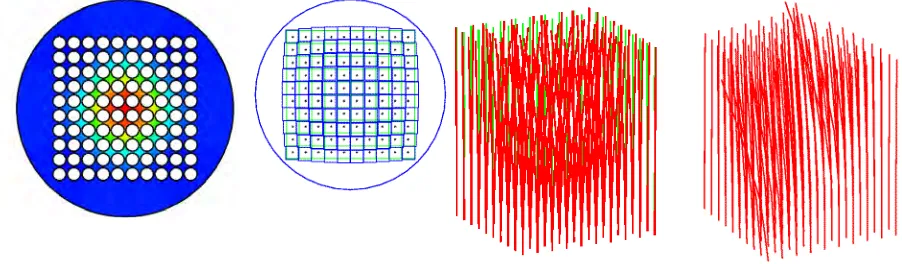
The figure 5 presents 2D and 3D results for the vibration modes of a tubes bundle, with pressure fields and tubes displacements
Figure 6 Pressure and displacements of the tubes
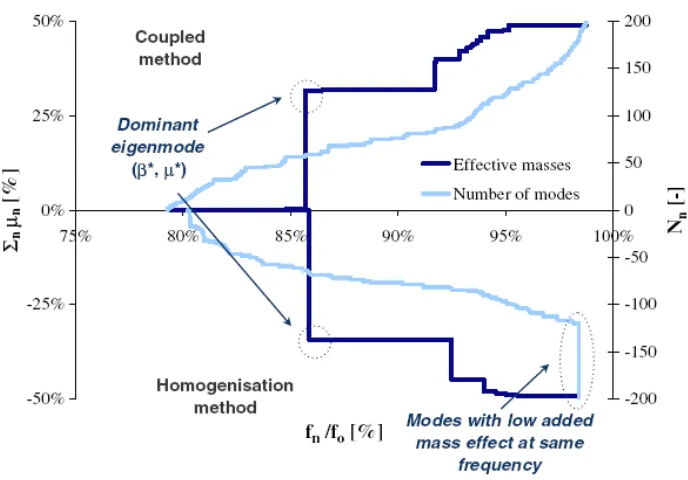
Figure 6 compares the cumulated effective masses (for the 2D 10 by 10 tubes array) and the number of modes versus the frequency ratio for the coupled and homogenisation calculations (the positive scale refers to the coupled method, the negative scale to the homogenisation method). The frequency ratio is defined as:
fluid)
thout
equency wi
fluid)/(fr
with
(frequency
=
!
: The homogenisation approach gives satisfactoryresults when compared to the coupled method: the maximum and minimum frequency ratios
!
min and!
maxare correctly evaluated with the homogenisation approach, as well as the significant eigen-mode, both in term of frequency ratio and effective mass.
4
LIMITATIONS OF THE MODEL, HOMOGENIZATION WITH THE NAVIER
STOKES EQUATIONS FOR THE FLUID
4.1 Dissipative effects
This equations system is, theoretically, only valid for little displacements in a fluid at rest. In the general case, if the displacements of the tubes are high, or in the case of a fluid flow, the Euler equations are no more valid. We present here some elements on the vibration, in a fluid at rest, of one single tube or a tube bundles. The movement of the fluid is assumed to be described by the Navier Stokes equations (Chassaing).
We consider a tube (diameter d) submitted to a sine wave movement in a fluid at rest,. with a maximum velocity V and a maximum displacement D. The movement is characterized by 2 dimension less numbers (Sarpkaya 2001 and 2005, Melot):
- the Reynolds number
µ
!
FV
L
- the Keulegan Carpenter number KC: D/d
A high KC number means that the displacement of the tube is higher than the diameter: the hypothesis of the “little displacements” is no more valid.
Some dissipative effects may take place, even for low displacement: If KC<1, the Stokes equations can used. As this equation is linear, it is possible to get theoretical equations for the force applied by the fluid to the tube, like: F =!ma"S !cVS
The dissipative effects can be important in the analysis of the behaviour of an industrial structure, even if they are lower tan the inertial effects.
For the high values of KC, the Navier Stokes equations have to be used.
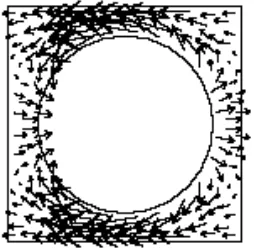
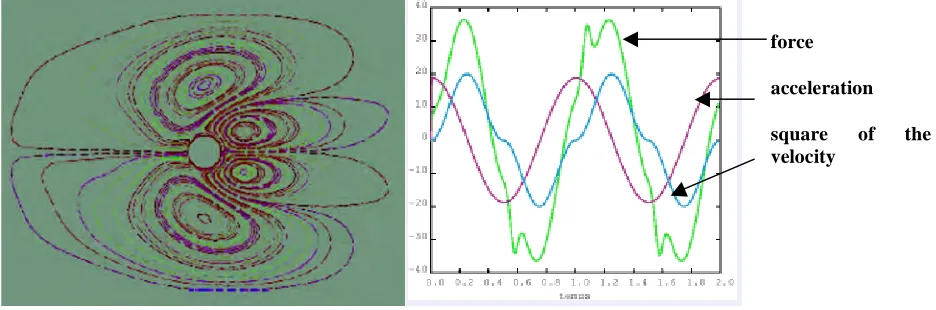
Figure 6 presents an example of the streamlines and the forces versus time applied by the fluid to the tube. It is clear that, in this case, analytical expressions don’t exist. A research program is under progress on FSI for tubes bundles, for different values of KC or Re (Duclercq 2008 and 2009).
Figure 6 Fluid flow around a cylinder: streamlines and forces versus time
4.2 Homogenization with the Navier Stokes equations for the fluid
As, in many cases, the Euler equations don’t describe completely the physical phenomena of tube bundles vibrations, it appear interesting to try to build a homogenized model, based on the Navier Stokes equations for the fluid instead of the Euler ones.
The Euler equations are relatively easy to solve, and linear. Thanks to these 2 points, homogenization methods could be easily derived. In the general case, with the Navier Stokes equations, the building of a homogenized equation system is more complex.
We only present some aspects on the form of a coupled fluid structure homogenized equations system. The way to build a homogenized system with the Navier Stokes equations will be similar to the case of the Euler equations.
- An analysis will be done at the scale of an elementary cell, by solving the Navier Stokes equations.
- A general expression will be derived from this analysis, for the force applied by the fluid on the tube.
- This expression of the force applied by the fluid on the tube (or by the tube to the fluid) is used to build an equation for the fluid on the whole tubes bundle. This equation only contains global scale parameters.
Two important tools may be used from the homogenization with the Euler equations:
- In the analysis of the physical behaviour at a local scale, it is interesting to consider that the changes are very low between two adjacent cells.
- The use of the “total” fluid velocity VT (§ 3.2) allows to describe in a simple and efficient way the interface between two adjacent cells.
force
acceleration
5
CONCLUSION
Homogenization methods have been developed to describe the Fluid Structure Interaction phenomena for tubes bundles submitted to an external excitation (earthquake or impact). This method is integrated in a general fluid and structure computer code (Cast3m). The finite elements of the homogenization method may be coupled with all the other elements of the code, for example the elements for the non linear behaviour of the structures. Industrial applications may be performed, in many different configurations.
The method is based on the homogenization of the Euler equations for the fluid. In this case, only “inertial effects” will theoretically take place, with globally lower frequencies. In the frame of this method, it is possible to build a first model to take into account dissipative effects, by using a Rayleigh damping.
A research program is in progress to build a new generation of homogenization methods, based on the Navier Stokes equations for the fluid. The first step is to perform analysis at the local scale of an elementary cell. The building of a homogenized model will use elements from the homogenization with the Euler equations, mainly the basic ideas to link the local scale studies and the global scale ones, by an expression of the force applied by the fluid on the tubes..
REFERENCES
Broc J.F. Sigrist. Une méthode d’homogénéisation pour l’analyse modale d’un problème d’interaction fluide/structure. Revue Européenne de Mécanique Numérique, 15 (7-8), 867-889, 2006.
Chassaing P. :Mécanique des fluides à l’usage de l’ingénieur. Institut pour la promotion des Sciences de l’Ingénieur, 2005.
Duclercq M. Broc D., Physical and numerical study of the interaction between a fluid and an oscillating cylinder. ASME PVP Chicago 2008.
Duclercq M., Broc D., An energetic approach of the fluid-structure interaction governing, the dynamic behaviour of tubes immersed in a fluid, SMIRT 2009 Helsinki.
Fritz, The Effect of Liquids on the Dynamic Motion of Immersed Solids. Journal of Engineering for Industry, 167-173, 1972.
Hammami L., Etude de l’interaction fluide structure dans les faisceaux de tubes par une méthode d’hoemogénisation. PhD Thesis University PAris VI 1990.
Melot V., Hydrodynamique instationnaire d’un cylindrer sous choc. PhD Thesis, Ecole Polytechnique de l’Université de Nantes, 2006.
Sarpkaya T., Hydrodynamic damping and quasi-coherent structures at large Stokes numbers. Journal of Fluids and Structures, 909-928, 2001.
Sarpkaya T, n the force decomposition of Lighthill and Morison. Journal of Fluids and Structures, 227-233, 2001.
Sigrist J.F. Broc D.:.Dynamic analysis of a tube bundle with fluid structure interaction modelling using a homogenization method. Computer methods in applied mechanics and engineering 2008
Sigrist J.F., Broc D., Homogenisation Method for the modal analysis of a nuclear reactor with internal structures modelling and fluid structure interaction coupling. Nuclear Engineering and Design 237 (4), 431-440, 2007.