University of Kentucky
UKnowledge
Theses and Dissertations--Accountancy Accountancy
2017
The Effect of Control Source and Control Framing
on Employee Effort
Pinky Rusli
University of Kentucky, [email protected]
Digital Object Identifier: https://doi.org/10.13023/ETD.2017.199
Right click to open a feedback form in a new tab to let us know how this document benefits you.
This Doctoral Dissertation is brought to you for free and open access by the Accountancy at UKnowledge. It has been accepted for inclusion in Theses and Dissertations--Accountancy by an authorized administrator of UKnowledge. For more information, please [email protected]. Recommended Citation
STUDENT AGREEMENT:
I represent that my thesis or dissertation and abstract are my original work. Proper attribution has been given to all outside sources. I understand that I am solely responsible for obtaining any needed copyright permissions. I have obtained needed written permission statement(s) from the owner(s) of each third-party copyrighted matter to be included in my work, allowing electronic distribution (if such use is not permitted by the fair use doctrine) which will be submitted to UKnowledge as Additional File.
I hereby grant to The University of Kentucky and its agents the irrevocable, non-exclusive, and royalty-free license to archive and make accessible my work in whole or in part in all forms of media, now or hereafter known. I agree that the document mentioned above may be made available immediately for worldwide access unless an embargo applies.
I retain all other ownership rights to the copyright of my work. I also retain the right to use in future works (such as articles or books) all or part of my work. I understand that I am free to register the copyright to my work.
REVIEW, APPROVAL AND ACCEPTANCE
The document mentioned above has been reviewed and accepted by the student’s advisor, on behalf of the advisory committee, and by the Director of Graduate Studies (DGS), on behalf of the program; we verify that this is the final, approved version of the student’s thesis including all changes required by the advisory committee. The undersigned agree to abide by the statements above.
THE EFFECT OF CONTROL SOURCE
AND CONTROL FRAMING ON EMPLOYEE EFFORT
DISSERTATION
A dissertation submitted in partial fulfillment of requirements for the degree of Doctor or Philosophy in the
College of Business and Economics at the University of Kentucky
By
Pinky Rusli
Lexington, Kentucky
Director: Dr. Sean A. Peffer, Associate Professor of
Accounting, Lexington, Kentucky
2017
ABSTRACT OF DISSERTATION
THE EFFECT OF CONTROL SOURCE
AND CONTROL FRAMING ON EMPLOYEE EFFORT
Prior research suggests that controls can negatively impact the motivation of employees to exert effort and that the detrimental effects of controls depend on control source. That is, controls cause more adverse behavior when employees attribute the source of control implementation to their manager’s decision than when the source of control implementation is beyond their manager’s authority. This study uses experiments to investigate whether the behavioral effects of controls depend not only on control source, but also on control framing, by which managers can frame the control implementation either for monitoring or coordinating purposes. The study also suggests that the interaction of control source and control framing impacts the strength of vertical collective identity, i.e. the shared identity between managers and employees, which in turn explains the differences in employee effort. While this study documents that the interaction of control source and control framing has no effect on vertical collective identity or employee effort, it finds a surprising result: employees respond more positively to the monitoring-framed controls than to the coordinating-framed controls, particularly when the controls are imposed by the manager. This finding suggests that persuasive messages can backfire if the employees are aware of the manager’s potentially self-serving motives behind the control implementation.
Keywords: control source, control framing, social identity theory, employee effort, superior-subordinate relationships, collective identity
Pinky Rusli Author
THE EFFECT OF CONTROL SOURCE
AND CONTROL FRAMING ON EMPLOYEE EFFORT
By
Pinky Rusli
Dr. Sean A. Peffer . Director of Dissertation
Dr. Dan Stone . Director of Graduate Studies
ACKNOWLEDGEMENTS
I would like to express my immense gratitude to my dissertation chair, Sean
Peffer, as well as the reference writers and the members of my dissertation committee,
Dave Ziebart, Urton Anderson, Sean Dennis, Alan Webb, and Xin Ma for their ongoing
support and encouragement of my efforts over the years which at times must have
seemed a lost cause. I would like to thank the Von Allmen School of Accountancy, the
Gatton College of Business and Economics, and the University of Kentucky for the
opportunity and resources to pursue my doctoral degree. I also would like to thank my
colleagues, the former and current doctoral students in accounting at UK, who I have had
the incredible pleasure of collaborating with over the course of my graduate education.
Finally, I would like to thank my family in Indonesia and Singapore for their unceasing
support and prayers.
This manuscript and its previous iterations has benefitted from the insightful
feedback of the workshop participants at the University of Kentucky, SUNY Brockport,
Western Kentucky University, Valparaiso University, and Eastern Kentucky University.
TABLE OF CONTENTS
ACKNOWLEDGEMENT ... iii
LIST OF TABLES ... vii
LIST OF FIGURES ... ix
1. INTRODUCTION ... 1
2. THEORETICAL FRAMEWORK ... 6
2.1. Social Identity Theory and Vertical Collective Identity in Organizational Settings ... 6
2.2. Comparison between Leader-Member Exchange Theory and Social Identity Theory ... 11
2.3. Control Framing ... 13
2.4. Control Source ... 16
3. HYPOTHESIS DEVELOPMENT ... 18
3.1. Main Predictions ... 18
3.1.1. Interactive Effects of Control Source and Control Framing on Vertical Collective Identity and Employee Effort ... 18
3.2. Additional Predictions ... 21
3.2.1. Similarities between Controls without Stated Purposes and Controls with a Monitoring Frame ... 21
4. RESEARCH METHOD AND DESIGN ... 24
4.1.2. Participants ... 26
4.1.3. Independent Variables ... 28
4.1.4. Dependent and Mediating Variables ... 30
4.2. Pilot Testing ... 33
5. RESULTS ... 35
5.1. Descriptive Statistics ... 35
5.1.1. Descriptive Statistics of Employee Effort and Vertical Collective Identity Across Conditions ... 35
5.1.2. Descriptive Statistics of Covariates ... 38
5.2. Tests of Main Hypotheses: H1 and H2 ... 41
5.2.1. Tests of H1A and H2A ... 41
5.2.2. Tests of H1B and H2B ... 44
5.2.3. Mediation Analysis: Tests of H1C and H2C ... 47
5.3. Tests of Additional Hypothesis: H3 ... 49
5.4. Supplementary Analyses ... 51
5.4.1. Statistical Tests Based on Participants' Perceived Control Source and Control Framing ... 51
5.4.2. Statistical Tests after Excluding Participants Who Failed Manipulation Checks. ... 59
6. CONCLUSION AND FUTURE DIRECTIONS ... 63
6.1. Potential Explanations for Non-Significant Findings ... 63
6.2. Opportunities for Future Research ... 65
APPENDIX: EXPERIMENTAL MATERIALS ... 69
REFERENCES ... 89
LIST OF TABLES
Table 1, Descriptive Statistics of Employee Effort (All Conditions) ... 35
Table 2, Descriptive Statistics of Vertical Collective Identity (All Conditions) ... 37
Table 3, Descriptive Statistics of Social Orientation (All Conditions) ... 39
Table 4, One-Way ANOVA Test: Social Orientation Means Across Conditions ... 39
Table 5, Descriptive Statistics of Intrinsic Motivation (All Conditions) ... 40
Table 6, One-Way ANOVA Test: Intrinsic Motivation Means Across Conditions ... 40
Table 7, ANCOVA Model of Employee Effort ... 42
Table 8, ANCOVA Model of Employee Effort (Excluding Intrinsic Motivation as Covariate ... 42
Table 9, Simple Effect Tests, Employee Effort ... 43
Table 10, ANCOVA Model of Vertical Collective Identity ... 44
Table 11, Simple Effect Tests, Vertical Collective Identity ... 45
Table 13, Mediation Analysis ... 47
Table 14, Test of Indirect Effect ... 48
Table 15, Test of Indirect Effect (Bootstrapping) ... 48
Table 16, Path Analysis ... 49
Table 18, Descriptive Statistics of Vertical Collective Identity Based on Perceived
Control Purpose in the Absence of Control Framing ... 51
Table 19, Descriptive Statistics of Employee Effort on Perceived Conditions ... 52
Table 20, ANCOVA Model of Employee Effort Based on Perceived Conditions ... 53
Table 21, Descriptive Statistics of Vertical Collective Identity on Perceived Conditions ... 55
Table 22, ANCOVA Model of Vertical Collective Identity Based on Perceived Conditions ... 56
Table 23, Mediation Analysis Based on Perceived Conditions ... 58
Table 24, Test of Indirect Effect Based on Perceived Conditions ... 58
Table 25, Test of Indirect Effect Based on Perceived Conditions (Bootstrapping) ... 59
Table 26, Descriptive Statistics of Employee Effort Based on Responses that Passed Manipulation Checks ... 59
Table 27, Descriptive Statistics of Vertical Collective Identity Based on Responses that Passed Manipulation Checks ... 60
Table 28, ANCOVA Model of Employee Effort Based on Responses that Passed Manipulation Checks ... 60
Table 29, ANCOVA Model of Vertical Collective Identity Based on Responses that Passed Manipulation Checks ... 61
LIST OF FIGURES
Figure 1, Theoretical Framework ... 19
Figure 2, Illustration of the Predicted Interaction Effect (H1 and H2) ... 20
Figure 3, Complete Experimental Design ... 24
Figure 4, Means Plot of Employee Effort (All Conditions) ... 35
Figure 5, Means Plot of Vertical Collective Identity (All Conditions) ... 38
Figure 6, Predictive Margins Plot, Employee Effort ... 43
Figure 7, Predictive Margins Plot, Vertical Collective Identity ... 46
Figure 8, Predictive Margins Plot, Employee Effort ... 53
Figure 9, Predictive Margins Plot, Employee Effort (Perceived Main Treatments) ... 54
Figure 10, Predictive Margins Plot, Vertical Collective Identity ... 55
1. INTRODUCTION
Formal control systems are crucial to an organization’s success as controls serve a
vital role in both directing employees’ effort to achieve organizational goals (Bowles &
Polanía-Reyes, 2012; Christ, Emett, Summers, & Wood, 2012; Coletti, Sedatole, &
Towry, 2005) and safeguarding organizational resources (Merchant & Van der Stede,
2007). When implementing formal control systems, organizations relay on various
mechanisms, such as sanctioning, monitoring, and rewarding (Bowles & Polanía-Reyes,
2012; Puranam & Vanneste, 2009; Schweitzer, Ho, & Zhang, 2014). The implementation
of formal controls may be endogenous, i.e. when managers make a choice to put controls
in place, or exogenous, i.e. the source of controls is uncertain or beyond the authority of
the managers (Christ, 2013; Falk & Kosfeld, 2006).1 Endogenous controls have more
unfavorable effects than exogenous controls because employees interpret their managers’
active choice to implement controls as a signal of distrust. This interpretation leads to
employees’ negative responses to the presence of controls (Belot & Schröder, 2016;
Christ, 2013; Christ, Sedatole, & Towry, 2012; Falk & Kosfeld, 2006). However, prior
studies do not examine how managers communicate the purpose of their choice to
implement controls on employees.
My study investigates how the interaction of control source and control framing
employees’ willingness to exert discretionary effort. Managers can frame the control
implementation either for monitoring or coordinating purposes. A monitoring frame
presents controls as a way to limit employees’ self-interested behavior, while a
coordinating frame presents controls as a means to facilitate coordination and resource
allocation between managers and employees (Liu, Wright, & Wu, 2015; Malhotra &
Lumineau, 2011; Schepker, Oh, Martynov, & Poppo, 2014). Since framing provides
social contexts by setting the expectations that people have about each other’s behavior in
a relationship (Dreber, Ellingsen, Johannesson, & Rand, 2013; Ellingsen, Johannesson,
Mollerstrom, & Munkhammar, 2012), I hypothesize that the employees’ perception of the
manager’s choice to put controls in place depends on control framing. My study predicts
that when managers implement controls framed for monitoring purposes, employees
exert less effort compared to situations in which controls are exogenously imposed. I also
predict that the results reverse if controls are framed for coordinating purposes.
I offer a social identity-based explanation for these expected interaction effects. A
monitoring frame increases the salience of the conflict between the interests of managers
and employees, preventing the development of a collective identity between them. When
managers decide to implement the monitoring-framed controls, it reinforces the signal of
managers protecting their self-interests. Hence, it is even harder for employees to
transform their self-categorization from a personal identity to a collective identity
(Brewer & Kramer, 1986; Kramer, 2006; Kramer & Brewer, 1984; Wit & Kerr, 2002).
When employees’ personal identity is salient, they focus on maximizing their own
interests by exerting low effort (Kramer & Brewer, 1984). In contrast, a coordinating
frame emphasizes a concern for the shared interest between managers and employees
(Kramer, 2006; Wit & Kerr, 2002). Essentially, a coordinating frame “collectivizes”
group boundaries and promotes common gains (McGinn, Milkman, & Nöth, 2012;
McGinn & Nöth, 2012). Furthermore, employees interpret managers’ choice for
sense of collective, rather than merely personal, interests. As a result, managers’ choice
for controls with a coordinating frame sends the contextual cues that build the collective
identity between managers and employees. Accordingly, employees are more willing to
engage in collective behavior by contributing more effort.
Existing studies have extensively investigated the relationship between controls
and horizontal collective identity, the term that I use in this paper to describe the social
ties among team members in an organization (see, e.g. Cardinaels & Yin, 2015; Tayler &
Bloomfield, 2011; Towry, 2003). However, few have investigated the role of controls in
building verticalcollective identity, the term in my paper that characterizes the social ties
between leaders and followers.
My study attains null results, which suggest that the interaction of control source
and control framing has no effect on employee effort. Consistent with these null results,
my study also provides no evidence of vertical collective identity taking a mediating role
in this relationship. Supplementary analyses do provide the possible indication of
interaction and mediating effects; even so, these suggestive hints must be interpreted with
caution. However, I find surprising evidence: employees who infer that the manager’s
reason of implementing monitoring-framed controls is for coordinating purposes exert
more effort than employees in the coordinating-framed, endogenous controls, who share
the same belief that the controls are indeed implemented for coordinating purposes. This
surprising finding suggests how persuasive messages concerning the control
implementation can backfire. Being aware that the manager has chosen to implement
controls and that the controls improve the manager’s financial welfare, employees are
effort aversion (Ert, Creary, & Bazerman, 2014). Interestingly, employees seem to agree
that it is sometimes necessary for a manager to send stern messages in order to combat
opportunistic behavior. This finding is consistent with Hardin (2004), who argue that
showing distrust is welcomed in circumstances where opportunistic behavior is prevalent.
Therefore, many employees view the monitoring frame of controls imposed by the
manager as a means to facilitate coordination, thereby increasing the employees’
willingness to exert effort.
The null results of my study actually support Dreber et al. (2013), who argue that
social framing effects do not exist in dictator games, which share the same nature of the
social dilemma presented in this study: participants face a tension between maximizing
self-interests or others’ benefit. The study of Dreber et al. (2013) ran an online
experiment with an unusually large sample size (around 200 participants per treatment).
Yet, their study still documents null results, leading them to conclude the absence of
framing effects in dictator games.
However, I speculate another feasible explanation: both the study of Dreber et al.
(2013) and mine recruited Amazon Mechanical Turk (AMT) workers as the participants
of our experiments. AMT workers tend to exhibit social desirability bias (Antin & Shaw,
2012), making them less sensitive to negative social frames. I suspect that AMT workers
with high reputation, who are perceived as attentive participants, suffer from a higher
level of social desirability bias due to their fear of getting their work rejected by the
experimenter. In general, high social desirability bias drives participants to respond to
questions in a manner that will presumably be viewed favorably by others. In this study,
coordinating, not monitoring, implying that participants are reluctant to acknowledge that
the control, albeit benefiting both managers and employees, is framed with a negative
valence. Another problematic factor associated with AMT workers is that most of them
have a lot of managerial or supervisory experience, making it hard to manipulate their
perceptions of control framing. It is plausible that at their workplaces, those workers are
responsible for framing control mechanisms and thereby can ‘detect’ the real purpose
control. In summary, these null findings may warn future studies about the unintended
drawbacks of recruiting AMT workers.
The rest of this paper is organized as follows: Section II develops the theoretical
framework, whereas Section III delineates the hypothesis development. Section IV
presents the research design. Section V presents the analysis and results. Section VI
2. THEORETICAL FRAMEWORK
2.1. Social Identity Theory and Vertical Collective Identity in Organizational Settings
Social identity theory posits that individuals categorize themselves as having
either a personal identity or a social identity. A personal identity defines one as a unique
and distinct self, whereas a social identity categorizes one as in terms of relations to
others (Hogg, 2003). When one’s sense of a personal identity is strong, the person’s
choice is likely to serve self-interests (Kramer, 2006). In contrast, when individuals
situate themselves in a social identity, they are more likely to make decisions in favor of
collective interests (Y. Chen & Li, 2009; Kramer, 2006). A person may have multiple,
co-occurring identities; the activation of a particular identity depends on social cues
(Brewer, 1991; Brewer & Kramer, 1986; Kramer, 2006). A social identity can be made
salient on the basis of perceived similar traits or common fate (Kramer & Brewer, 1984;
Wit & Kerr, 2002).
Prior research refines the distinctions above by describing two levels of social
identities: relational and collective identities. A relational identity views oneself as an
interconnected partner in interpersonal and interdependent relationships (Brewer &
Gardner, 1996; Lord, Brown, & Freiberg, 1999). A relational identity also defines roles
within those relationships; for example, the relationship between child-parent,
student-teacher, and subordinate-leader. A collective identity, in contrast, identifies one as a
member of a group. A collective identity is also a basis for differentiating in-group
Social identity theory is particularly relevant to organizational settings because
organizations often face social dilemmas in which there is a conflict between individual
and collective interests. In addition, social identity can also dramatically shape people’s
economic behavior beyond financial incentives (Akerlof & Kranton, 2000). Since leaders
of organizations strive to mobilize their employees to pursue collective goals, it is crucial
for leaders to instill collective mindsets in their employees. Leaders could achieve this
objective by cultivating the sense of shared social identity between themselves and
employees (Ellemers, De Gilder, & Haslam, 2004; Hogg, 2001; Steffens, Haslam,
Reicher, et al., 2014). In this paper, I term shared social identity between leaders and
employees as vertical collective identity.
Prior studies suggest that vertical collective identity is stronger when employees
believe that leaders share similar attributes with them or when they stand up for
employees’ interests (Hogg, 2001; Steffens, Haslam, Reicher, et al., 2014; Steffens,
Mols, Haslam, & Okimoto, 2016). The strength of vertical collective identity is also
enhanced when leaders express confidence in the capabilities of their team (Fransen et
al., 2015). Importantly, the key mechanism that cultivates a vertical collective identity is
communication strategies that emphasize inclusive language or collective pronouns
(Seyranian, 2014; Steffens & Haslam, 2013). The strength of vertical collective identity
has a significant effect on employees’ perception of leader charisma and their experience
in sharing not only social, but also personal connections with their leaders (Molenberghs,
Prochilo, Steffens, Zacher, & Haslam, 2015; Steffens, Haslam, & Reicher, 2014).
Specifically, strong vertical collective identity increases employees’ trust in and
Steffens et al., 2016). Accordingly, when employees share strong vertical collective
identity with their leaders, the employees are more willing to engage in behaviors that
benefit collective interests, such as contributing more to common resources (Kramer &
Brewer, 1984; Wit & Kerr, 2002) or demonstrating more altruistic actions (Y. Chen & Li,
2009). Collectively, prior work suggests that, when vertical collective identity is strong,
employees exert more effort that increases the welfare of their leaders as well as their
in-group members.
Research in accounting has increasingly explored the relationship between
management control systems and social identities, particularly horizontal collective
identity, i.e. the term I use to describe social ties among group members. Towry (2003)
finds that the effectiveness of control structures depends on the strength of horizontal
collective identity. In addition, formal controls in the form of reward system designs
could also affect the formation of horizontal collective identity (C. X. Chen, Williamson,
& Zhou, 2012). However, few studies have addressed the relationship between controls
and vertical collective identity. Since theories and findings in horizontal relations may
not extend to vertical relations (Luft, 2016), it would be valuable to further investigate
how controls shape and are shaped by vertical collective identity.
Prior literature suggests various factors that determine the development and
reinforcement of vertical collective identity. The first factor is prototypicality, which
means that a leader is viewed as a prototypical (or representative) of a shared identity
within a group (Hogg, 2003; Steffens, Haslam, & Reicher, 2014; Steffens, Haslam,
Reicher, et al., 2014; D. van Knippenberg, 2011). In other words, a leader is seen either
Haslam, Reicher, et al., 2014). A high prototypical leader is viewed as the person who
embodies core attributes that other, less prototypical members are expected to conform
(Fransen et al., 2015; Giessner et al., 2013; Steffens, Haslam, Reicher, et al., 2014). The
prototypicality of a leader can be enhanced when the leader is elected by the group rather
than externally appointed (Hogg & van Knippenberg, 2003).
The second factor that influences the strength of vertical collective identity is the
salience of social boundary (Kramer, 2006; Steffens, Haslam, Reicher, et al., 2014). A
leader should develop structures, practices, rituals, and core values as well as norms that
set the boundary of group membership and create a sense of “us” (Steffens, Haslam,
Reicher, et al., 2014). Another way for leaders to enhance the sense of “us” is by showing
confidence in the group’s success when performing group-oriented behavior (Fransen et
al., 2015). In addition, social attraction is another important factor that promotes vertical
collective identity because socially attractive leaders can make their subordinates readily
comply with their requests and commands (Hogg, 2003). Social attraction might be
derived from charismatic leadership (Shamir, Zakay, Breinin, & Popper, 1998); however,
personal characteristics are not the sole determinant of a leader’s social attraction.
Instead, leaders can become “socialized charismatic” by demonstrating behavior that
promotes group interests (Steffens et al., 2016). In other words, leaders are perceived to
be “in-group champions” by prioritizing the group-oriented goals over personal or
out-group interests (Steffens, Haslam, Reicher, et al., 2014).
Finally, when a leader wishes to redefine or realign vertical collective identity,
the leader should engage in social identity framing (Seyranian, 2014). Seyranian (2014)
intend to immerse subordinates into three framing phases. The first phase (“social
identity unfreezing”) is to de-link subordinates from the current social identity. The
second phase (“social identity moving”) presents the vision of the new identity, whereas
the third phase (“social identity freezing”) reaffirms the new identity (Seyranian, 2014).
All three phases can be accomplished by using inclusive language that emphasizes the
intergroup bias (Perdue, Dovidio, Gurtman, & Tyler, 1990; Seyranian, 2014).
Specifically, inclusive language draws a distinction between the in-group and the
out-group membership status (Brewer & Gardner, 1996; Perdue et al., 1990), which can be
done by using different collective pronouns, such as “we” versus “they” (Gustafsson
Sendén, Lindholm, & Sikström, 2013; Perdue et al., 1990). During the first phase, i.e.
social identity unfreezing, inclusive language promotes similarity and commonality
between leaders and their subordinates. During the second phase, i.e. social identity
moving, inclusive language negates the previous framing of social identity (Brewer &
Gardner, 1996; Seyranian, 2014). Essentially, using the language that emphasizes the
out-group membership status can evoke a negative impression toward the previous framing of
social identity (Gustafsson Sendén et al., 2013; Lee, Adair, Mannix, & Kim, 2012;
Perdue et al., 1990). Finally, during the third phase, i.e. social identity freezing, leaders
use inclusive language that stresses the positive attributes of the newly framed social
identity (Fransen et al., 2015; Seyranian, 2014). Overall, these studies highlight the
power of communication strategies that leaders can harness to promote vertical collective
2.2. Comparison between Leader-Member Exchange Theory and Social Identity Theory
Besides social identity theory, another significant theory that focuses on vertical
relations is Leader-Member Exchange (LMX) theory. LMX theory examines the
leader-subordinate relationships at interpersonal levels (Lord et al., 1999). Hence, the theory
emphasizes the role of relational self in leader-subordinate relationships (Gaertner et al.,
2012; Lord, Gatti, & Chui, 2016). LMX theory argues that leaders and subordinates can
build their relationships based on mutual trust and respect (high-quality LMX
relationships) or rely on formal employment contracts (low-quality LMX relationships).
High-quality LMX relationships are more likely to increase subordinates’ motivation
(Graen, Novak, & Sommerkamp, 1982). Prior work shows that imposing control on high
LMX relationships will hurt subordinates’ perception of the relationship quality; thereby
leading subordinates to exert less effort. While high-quality LMX relationships are
usually sought after in organizational settings, prior literature also finds that subordinates
who perceive higher-quality relationships with their leader are more willing to undermine
control system by complying to their manager’s request for submitting biased accounting
estimates (Jollineau, Vance, & Webb, 2012). In short, studies that rely on LMX theory
suggest that the quality of LMX relationships affects the effectiveness of control systems
in organizations.
However, the main weakness of LMX theory is that because it focuses on dyadic
relationships; it offers limited predictions at the group or social-network levels (Hogg et
al., 2005). LMX theory argues that leaders can cultivate high-quality dyadic relationships
2005). In other words, leaders are encouraged to personalize their dyadic relationships
that can cater to each subordinate’ distinct and individual characteristics. Since LMX
theory assumes that subordinates perceive the relationship quality in an absolute sense,
LMX theory does not take into account how subordinates evaluate their relationships
with their leader relative to the relationship quality of other subordinates with the same
leader.
Social identity theory addresses the limitation of LMX theory by shifting the
focus of leadership from interpersonal levels to group and collective levels (Hogg & van
Knippenberg, 2003; Lord et al., 2016). By exploring leader-subordinate relationships
with a broader lens, social identity theory argues that fairness and justice concerns
influence leader-subordinate relationships (Hogg et al., 2005). For example, LMX theory
cannot clearly predict whether showing favoritism will hurt leader-subordinate
relationships. With regard to the relationship between the leader and the favored
subordinate, LMX theory view it as an example of a high-quality LMX relationship.
However, social identity theory argues that playing favorites undermines the
development of the social identity shared between leaders and subordinates. Overall
social identity theory suggests that favoritism results in low-quality relationships.
In addition, social identity theory points out that effective leadership depends on
how leaders strongly identify with their subordinates as a group (Hogg, 2001). Prior
literature (Hogg, 2001; Hogg et al., 2005) compares LMX theory with social identity
theory and finds that personalized leader-subordinate relationships matter when group
membership is weak or not salient. In contrast, high salience groups prefer a
social identity theory argues that leader group prototypicality is essential to build strong
relationships between leaders and subordinates, the theory predicts that the source of
leader selection (i.e. in-group versus out-group leaders) matters in building strong
relationships between leaders and subordinates (Hogg & van Knippenberg, 2003). LMX
theory, in contrast, is silent concerning the importance of the source of leader selection.
Collectively, leadership research provides evidence that social identity theory
complements LMX theory by broadening the definition of high-quality
leader-subordinate relationships.
2.3. Control Framing
Controls play multiple functions in organizational settings. First, controls can
monitor and mitigate threats of opportunistic behavior from organizational members (Liu
et al., 2015; Malhotra & Lumineau, 2011; Patterson & Smith, 2007). In other words,
controls related to monitoring purposes are designed to safeguard assets and limit
potential self-interested actions that are detrimental to the organization. Alternatively,
controls can serve as a coordination mechanism; they make it easier for organizational
members to understand each other’s role when working together (Gulati, Lawrence, &
Puranam, 2005; Malhotra & Lumineau, 2011). Hence, controls help members understand
that their actions are interdependent (Dekker, 2004; Gulati et al., 2005; Nicolaou,
Sedatole, & Lankton, 2011). In essence, controls for coordinating purposes could
improve resource allocation and facilitate collaboration (Liu et al., 2015; Malhotra &
While controls for monitoring purposes could promote compliance (Schweitzer et
al., 2014), monitoring controls also signal distrust of other party’s intention. Hence,
monitoring controls hurt trust development among members (Malhotra & Lumineau,
2011; Malhotra & Murnighan, 2002). Accordingly, monitoring controls could erode
cooperative behavior (Falk & Kosfeld, 2006; Malhotra & Murnighan, 2002). In addition,
monitoring controls implemented as penalty contracts increase employees’ effort
(Hannan, Hoffman, & Moser, 2005); however, the effect diminishes in the situations that
call for discretionary effort (Christ, Sedatole, et al., 2012; Falk & Kosfeld, 2006).
Employees also respond strategically to monitoring controls. When they anticipate that
they will not be monitored, they behave opportunistically (Schweitzer et al., 2014). The
favorable impact of monitoring controls is that the controls promote the employees’
perception of fairness (Niehoff & Moorman, 1993). Specifically, employees view
monitoring controls as an unbiased tool in performance appraisal systems (Long,
Bendersky, & Morrill, 2011; Niehoff & Moorman, 1993).
Since controls for coordinating purposes facilitate collaboration, coordinating
controls build trust (Malhotra & Lumineau, 2011; Nicolaou et al., 2011) and cooperative
behavior (Coletti et al., 2005; Malhotra & Lumineau, 2011). Coordinating controls also
foster joint learning (Dekker, 2004) and the mutual adaptability for coping with
fluctuations in business pressures or technology (Gulati et al., 2005). Nonetheless, a
heavy-handed implementation of coordinating controls could backfire because it sends
conflicting signals. The reason is that coordinating controls promote collaboration
their employees. As a result, the conflicting signals in such controls could provoke
employees to retaliate by increasing dishonest behavior (Liu et al., 2015).
Prior studies suggest that both monitoring and coordinating functions of controls
are necessary to organizational success (Cao & Lumineau, 2015; Dekker, 2004; Gulati et
al., 2005; Nicolaou et al., 2011). Some studies argue that the control mechanisms for
monitoring purposes differ from the mechanisms for coordinating purposes in design
(Lumineau & Malhotra, 2011) or timing (Naranjo‐Gil & Hartmann, 2006). However,
other studies suggest that control framing allows for the same control policies to work as
either monitoring or coordinating controls (Liu et al., 2015; Malhotra, 2012; McGinn &
Nöth, 2012).
Note that prior work does not suggest that organizations should always prefer
controls with a coordinating frame to controls with a monitoring frame. Monitoring and
coordinating functions play complementary roles in ensuring the effectiveness of controls
(see, e.g., Malhotra & Lumineau, 2011; Messick & McClintock, 1968; Van Lange &
Kuhlman, 1994). In addition, controls with a coordinating frame can result in negative
consequences; for instance, when the implementation of coordinating controls is
stringent, the controls invoke an increase in employees’ unethical behavior (Liu et al.,
2015). Similarly, a strong bond between managers and employees may persuade
employees to condone managers’ misreporting (Jollineau et al., 2012).
Framing activities also demonstrate the power of communication (Entman, 1993;
McGinn & Nöth, 2012); framing essentially shapes one’s interpretation of a situation by
“selecting certain aspects of perceived reality and making them more salient in a
parties involved in interactive economic activities (McGinn et al., 2012). Indeed, in
control settings, managers could frame controls by communicating the purpose of
controls to employees. Therefore, managers’ use of framing plays a critical role in the
effectiveness of control mechanisms because the framing affects employees’ responses to
the presence of controls (Liu et al., 2015; Malhotra, 2012; Malhotra & Lumineau, 2011).
2.4. Control Source
Prior studies argue that in manager-employee relationships, employees display
control aversion because controls restrict their autonomy (Christ, Sedatole, et al., 2012;
Falk & Kosfeld, 2006). In addition, employees perceive their manager’s decision to
implement controls as a signal of distrust (Christ, 2013; Falk & Kosfeld, 2006).
Accordingly, they retaliate by either exerting low effort (Belot & Schröder, 2016; Christ,
2013; Christ, Sedatole, et al., 2012; Malhotra & Murnighan, 2002) or conducting
opportunistic behavior (Schweitzer et al., 2014). In contrast, employees exhibit less
dysfunctional behavior when no formal control mechanism is present (Belot & Schröder,
2016; Malhotra & Murnighan, 2002; Schweitzer et al., 2014) or when the controls are
imposed exogenously, i.e. the source of control implementation does not come from the
managers’ authority. In other words, endogenous controls – i.e. controls that come from
the managers’ authority to implement them – would cause detrimental effects. The issues
of endogenous controls have important practical implications because the implementation
of exogenous controls is more costly in real-world settings (Charness & Ellman, 2016).
The negative effects of endogenous controls are heightened when managers
Sedatole, et al., 2012). Investigating the settings that demand honest reporting, Cardinaels
and Yin (2015) argue that when managers decide to use truth-telling incentive contracts
instead of fixed-wage contracts, they could signal distrust to their employees.
Furthermore, if managers decide to implement truth-telling incentive contracts after
observing employees’ reporting behavior, an employee could infer that other employees,
in general, report dishonestly. Accordingly, the employee may conform to this
self-interested norm (Cardinaels & Yin, 2015). Collectively, these studies suggest adverse
consequences of endogenous controls.
Interestingly, prior studies also find that the moral legitimacy, or the interpreted
purpose, of endogenous controls determines whether the controls result in adverse
consequences or not. In social settings that involve public goods and thereby punishing
“free-riders” is considered morally legitimate, endogenous controls do not backfire (Fehr
& Rockenbach, 2003). Likewise, endogenous controls do not trigger negative reactions
when distrust is a rational and expected behavior (Hardin, 2004). When opportunism is a
norm and thereby the presence of endogenous controls is perceived necessary to foster
reciprocity, endogenous controls are welcomed (Bicchieri, Xiao, & Muldoon, 2011).
Collectively, these studies indicate that the behavioral impacts of control source depend
3. HYPOTHESIS DEVELOPMENT 3.1. Main Predictions
3.1.1. Interactive Effects of Control Source and Control Framing on Vertical Collective Identity and Employee Effort
Managers can use control framing to communicate their intent of implementing
controls either for monitoring or coordinating purposes (Liu et al., 2015). At the same
time, the managers’ choice to implement controls also implies their intent (Christ, 2013;
Falk & Kosfeld, 2006). Since the prior literature suggests that the manager’s both stated
and implied intent to implement controls influence the development of vertical collective
identity, I propose that the interaction of control source and control framing can serve a
role for building or destroying vertical collective identity. Specifically, I argue that that
control framing might work as the mechanism of social identity framing in
manager-employee relationships.
When controls are framed for monitoring purposes, the controls communicate the
threat of employees’ self-interests to managers’ self-interests (Liu et al., 2015; Lumineau
& Malhotra, 2011). Importantly, controls with a monitoring frame imply that managers
and employees share distinct self-identities, making each other’s personal identity salient
(Kramer, 2006; Wit & Kerr, 2002). Accordingly, controls with a monitoring frame
influence employees to construe themselves in their personal identities rather than in a
shared social identity with their managers, hindering the development of vertical
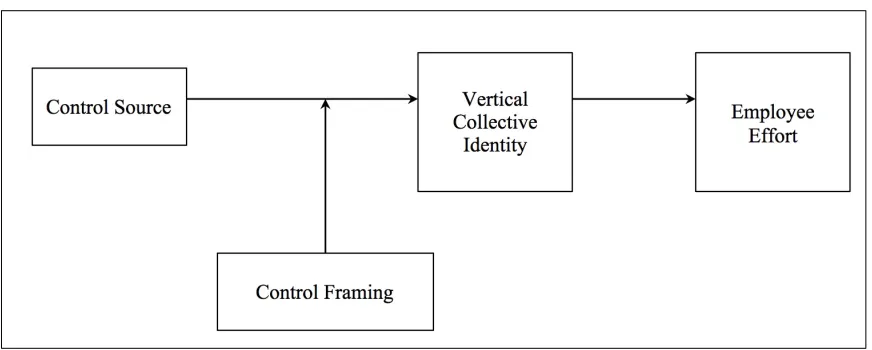
Figure 1: Theoretical Framework
I predict that when the implementation of controls with a monitoring frame comes
from the managers’ active choice, it makes the managers’ intent to protect their
self-interests more salient (Christ, 2013; Falk & Kosfeld, 2006). As a result, the endogenous
controls with a monitoring frame exacerbate the perceived division of interests between
managers and employees. In contrast, considering that employees react to exogenous
controls less negatively (Christ, 2013; Falk & Kosfeld, 2006), I predict that the salience
of the conflict lessens when controls with a monitoring frame are imposed exogenously.
When a person’s personal identity is salient, the person is less willing to engage in
behavior that promotes collective interest (Brewer & Kramer, 1986; Kramer & Brewer,
1984). In organizational settings, this phenomenon translates to employees’ willingness
to exert discretionary effort. Therefore, I summarize my predictions as follows:
H1A: When controls are framed for monitoring purposes, employees exert lower effort in endogenous controls than in exogenous controls.
H1C: Vertical collective identity mediates the effect of controls on employees’ effort. Specifically, a strong (weak) vertical collective identity leads to high (low) effort.
I predict that controls with a coordinating frame generate opposite outcomes.
Essentially, a coordinating frame “collectivizes” group boundaries and promotes common
gains (McGinn et al., 2012; McGinn & Nöth, 2012). When controls are framed for
coordinating purposes, the controls communicate shared interests between managers and
employees (Gulati et al., 2005; Malhotra & Lumineau, 2011). Prior research also finds
that controls with a coordinating frame are unlikely to hurt trust (Lumineau & Malhotra,
2011; Malhotra & Lumineau, 2011). Hence, controls with a coordinating frame activate
the development of vertical collective identity (Kramer, 2006; Wit & Kerr, 2002).
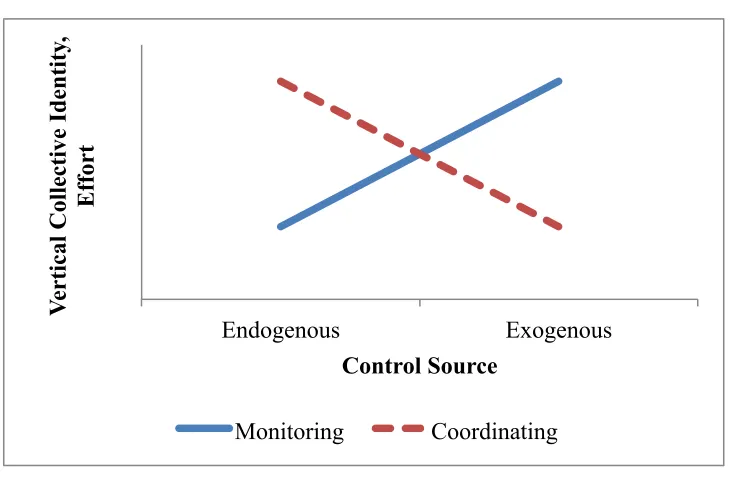
Figure 2: Illustration of the Predicted Interaction Effect (H1 and H2)
In addition, when controls with a coordinating frame are imposed endogenously, 0 0.5 1 1.5 2 2.5 3 3.5
Endogenous Exogenous
V er ti cal C ol le cti ve I d en ti ty , Effor t Control Source
research suggests that collective-oriented messages would be more persuasive to
followers when the messages come from an in-group, rather than out-group, leader
(Molenberghs et al., 2015). In my setting, I predict that the managers’ active choice to
implement controls with a coordinating frame heightens vertical collective identity.
Hence, employees are more willing to exert effort. In contrast, when controls are imposed
exogenously, the controls do not demonstrate managers’ attempt to advance common
interests, weakening vertical collective identity and employee effort. Therefore, I predict
that:
H2A: When controls are framed for coordinating purposes, employees exert higher effort in endogenous controls than in exogenous controls.
H2B: When controls are framed for coordinating purposes, endogenous controls lead to a stronger vertical collective identity than exogenous controls.
H2C: Vertical collective identity mediates the effect of controls on employees’ effort. Specifically, a strong (weak) vertical collective identity leads to high (low) effort.2
3.2. Additional Predictions
3.2.1. Similarities between Controls without Stated Purposes and Controls with a Monitoring Frame
When investigating the effects of controls on employee behavior, some prior
studies use parsimonious designs that do not allow managers to communicate the reason
of control implementation (see, e.g. Christ, 2013; Falk & Kosfeld, 2006).3 The findings
of those studies conclude adverse effects of controls. However, I argue that the absence
of reasoning for control implementation, rather than a mere presence of controls, might
explain those negative results.
The literature in psychology suggests that when the reason of control
implementation is unstated, individuals view the presence of controls suspiciously,
thinking that the person responsible for the control implementation does not trust them
(Enzle & Anderson, 1993). In addition, the absence of vertical communication in general
hurts the quality of manager-employee relationships because the vertical communication
is crucial for managers to foster attachment and cohesiveness (Postmes, Tanis, & de Wit,
2001). Accordingly, the existence of vertical communication is a necessary condition to
build vertical collective identity (Postmes et al., 2001; Seyranian, 2014; Steffens &
Haslam, 2013).
Since employees suspect their managers’ intention in response to the presence of
controls without managers’ explanation about the control purposes, I argue that
employees would perceive the reason behind the presence of controls is for monitoring
purposes. Building on my earlier predictions above, I further argue that the interaction
between controls without reasoning for implementation and control source would lead to
the similar effects as in the interaction between controls with a monitoring frame and
control source. Specifically, I predict the following:
H3A: When controls are present without stating the reasoning for implementation (controls without a frame, hereafter), employees are more likely to infer that the controls are intended for monitoring rather than for coordinating purposes.
4. RESEARCH METHOD AND DESIGN 4.1. Main Experiment
4.1.1. Experimental Design
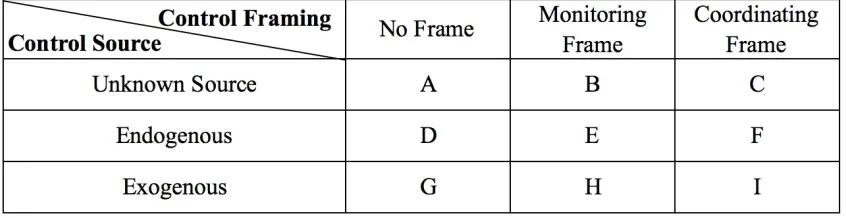
In this study, I run an experiment with a 3 × 3 between-participants design, in
which I manipulate control source (unknown source, endogenous, or exogenous) and
control framing (no frame, monitoring frame, or coordinating frame). The presence of
cells that interact with unknown source or no frame conditions allows me to detect the
incremental effects of my main treatments.
Figure 3: Complete Experimental Design
My experiment structure resembles the design by Falk and Kosfeld (2006), which
is a one-shot principal-agent game. A one-shot game allows studying the effects of
controls in a parsimonious fashion because this design mitigates potential confounds,
such as reputation building or reciprocity, that might occur in a multiple-rounds design
(Falk & Kosfeld, 2006; Tayler & Bloomfield, 2011).
I randomly assign participants to one of the nine treatments. Each participant
PQR; hence, each condition has one manager that supervises multiple employees.4 In the
beginning of the experiment, each participant receives an endowment of 65 points.5 The
endowment is worth 65 cents. Participants can transfer partial or all points to their
managers; the transfer represents employee effort. Participants are informed that the
welfare of themselves, their division, as well as their manager may improve if they exert
more effort. Participants answer several comprehension checks to ensure that they have
understood the compensation scheme. They cannot proceed to the next session prior to
answering all questions correctly.
After completing the comprehension checks, participants are informed that every
condition has a control in place that requires participants to transfer at least 5 points to the
manager. Transferring mere five points can be considered a weak control, which is a
powerful condition to detect the variability in the participants’ effort (Falk & Kosfeld,
2006). When a control is strong, participants are forced to exert high effort, making it
difficult to observe negative consequences (if any) of control implementation on effort
(Belot & Schröder, 2016; Falk & Kosfeld, 2006; Tyran & Feld, 2006).
Before making a transfer, depending on the condition, participants are informed
whether the control is present either because of their manager’s decision or because of
their company’s policy, which is beyond the manager’s authority. Participants are also
informed that the reasoning behind control implementation is for monitoring or
coordinating purposes (details are explained below). After making a transfer, participants
fill out a series of post-experimental questions related to manipulation checks, their
perceptions of vertical collective identity, intrinsic motivation, social value orientation,
and demographic information.
4.1.2. Participants
I recruit all participants using the Amazon Mechanical Turk (AMT) online
platform. For each condition, I recruit around 30 workers as employees, so the total
number of participants is 271 workers; 55% of participants are male. On average, the
participants have 16 years of work experience and are 37 years old. Sixty-one percent of
participants have supervisory or managerial experience and the average length of
supervisory experience is 6 years.
I recruit the AMT workers who are located in the United States and consider
English as their native language. The minimum age of participants is 18 years old. Each
participant earns a show-up fee of $1.50. Participants are also told that they can earn a
possible bonus pay up to $1.45.6 In addition, I employ a doctoral student, who is also an
AMT user, as a confederate who assumes the manager role. Employing a real confederate
allows me to avoid having a fictitious manager and enables me to tell the participants that
their transfer decisions have real economic consequences to their manager. The
confederate earns 10% of the total points transferred by participants from all nine
conditions. The total number of points transferred by all participants is 10,675 points
(equivalent to $106.75). Hence, the confederate earns $10.68 from this study. Again, to
mitigate the risk of fairness perceptions (see footnote 6), the experimental materials do
tell participants about the details of this arrangement. Participants are only told that
transferring more points allows their manager to earn higher bonus pay.
Qualifications and Quality Control of AMT Workers
The AMT site has been increasingly popular among accounting studies because it
provides behavioral researchers convenient access to a large participant pool at a low
cost. However, data quality is one of the major concerns facing experimental studies that
capitalize on the AMT site to recruit participants. The biggest issue is that AMT workers
may not be attentive respondents given the fact that internet-based studies lose some
experimental controls provided by the traditional laboratory settings. Prior studies
suggest two measures to improve data quality: approval ratings and instructional
manipulation checks. First, restricting participation to AMT workers with high reputation
(above 95% approval rating) is effective to combat the data quality issues (Peer,
Vosgerau, & Acquisti, 2014). Workers with high reputation are motivated to pay close
attention to the experiment’s instructions due to their fear of having their work
submission rejected, thereby hurting their approval ratings. Second, instructional
manipulation checks allow researchers to filter out participants who fail to follow
instructions. Instruction manipulation checks, often called as “trap questions”, are special
attention checks that instruct participants to ignore the standard response format and
submit a non-intuitive response instead (Oppenheimer, Meyvis, & Davidenko, 2009).
This special command is hidden in a large block of instruction; hence, it is likely that
I include both strategies in my experimental design in order to obtain quality data.
First, participants of this study have to meet the following eligibility criteria: (1) their
approval rates of prior tasks should be above 98% and (2) the number of prior tasks
completed in the AMT platform is above than 10,000 tasks. The AMT platform makes it
possible for me to impose these qualifications before the workers begin my task. Second,
I place one instructional manipulation check as the second to last question of my
experimental tasks. The instructional manipulation check tells participants that failure to
follow the special instruction embedded in this check will make them lose their bonus
pay. Consistent with the expectation that workers with high reputation complete tasks
attentively, only one out of 271 workers failed the instructional manipulation.7
4.1.3. Independent Variables
Control Source
To manipulate the level of control source, I develop scripts that tell participants
about who is responsible for the control implementation. The script for the
endogenous-source condition prescribes that the manager has the authority to implement a control that
requires employees to transfer at least five points, and that the manager has decided to do
so. In contrast, the script for the exogenous-source condition tells participants that the
company’s executive management has decided to implement the control, and this
decision is beyond the manager’s authority. The unknown-source condition does not
provide participants the information about the responsible party.
The scripts also use linguistic variations to emphasize different control sources.
Specifically, prior findings suggest that pronouns reinforce and perpetuate perceptions
about relationships (see, e.g., Fitzsimons & Kay, 2004; Gustafsson Sendén et al., 2013;
Perdue et al., 1990; Sela, Wheeler, & Sarial-Abi, 2012; Tu, Shaw, & Fishbach, 2016). On
the one hand, the pronoun “I” or “my” acknowledges ownership (Newman, Pennebaker,
Berry, & Richards, 2003); therefore, these pronouns reinforce the message that the source
of control is endogenous. On the other hand, since the pronoun “they” or “their” shifts
ownership to another party, these pronouns can be used to emphasize the exogenous
source of controls (Gustafsson Sendén et al., 2013; Perdue et al., 1990). Hence, I include
10 words of “I” or “my” and 10 words of “they” or “their” in the endogenous-control and
the exogenous-control” conditions, respectively.
Control Framing
Similar to the study of Liu et al. (2015), I manipulate the level of control framing
by informing participants about the reasoning behind control implementation. In the
monitoring-frame condition, participants are told that the purpose of control
implementation is “to prevent employees from producing transferring fewer resources
than the division needs.” Essentially, participants are informed that the control is
designed to restrict the employees’ opportunities to keep all resources for themselves. In
contrast, the script for the coordinating-frame condition tells participants that the purpose
of control implementation is “to optimize resource allocation and coordinate resources
more efficiently.” The script for the no-frame condition” does not inform participants
In addition, I rely on pronoun variations again to enhance the perceived purposes
of control implementation. Specifically, the pronoun “you” or “your” reinforces the
perception of distant relationships and the assignment of blame (Olekalns, Brett, &
Donohue, 2010; Seider, Hirschberger, Nelson, & Levenson, 2009). Essentially, the
pronoun “you” or “your” perpetuates the need for monitoring others’ behavior.
Therefore, I include 10 words of the pronoun “you” or “your” in the script for the
monitoring-frame condition. In contrast, because the pronoun “we”, “us”, or “our”
perpetuates the perception of close relationships and togetherness (Fitzsimons & Kay,
2004; Perdue et al., 1990), these pronouns emphasize the message of collaboration. In the
monitoring-frame condition, I include 10 words of the pronoun “we”, “us”, or “our.” The
overview of the experimental instrument is provided in Appendix.
4.1.4. Dependent and Mediating Variables
Baiman (1982) defines that the operationalization of effort has to meet the
following criteria: (a) effort is costly to the agent; (b) the cost of effort increases with the
level of effort; (c) an increase in agent’s effort results in a gain of welfare for both the
principal and the agent; and (d) the agent experiences disutility from choosing a higher
effort level. To ensure that I follow the criteria above, I measure effort as my dependent
variable (Employee Effort) based on the number of points transferred. As mentioned
earlier, participants are told that they can demonstrate their effort level by contributing
partial or all points of their endowment to their division (the total points of initial
endowment: 65 points, which is worth $0.65). Specifically, participants can choose their
increments of 5 points. The remaining points of endowment after contribution is
converted to be real dollars and paid as a bonus pay. Consequently, contributing more
points is costly for participants because it will reduce the amount of their bonus pay.
At the same time, participants are also informed that exerting more effort will
allow them to achieve a high outcome. Adapting from the study of Hannan et al. (2005), I
link the cost of effort to the probability of achieving the high outcome. Participants are
told that increasing their level of effort by 5 points will raise their chance by 5% to earn
an extra bonus pay of $0.80. A lottery will be drawn based on the probability
corresponding to one’s effort level choice. Before choosing their effort levels,
participants review a table that shows the probability of winning the extra bonus of $0.80
for each of the 13 possible effort level choices. The table is the part of the experimental
materials provided in Appendix.
After measuring the dependent variable, I also measure the mediating variable,
Vertical Collective Identity in post-experimental questions. I use the Inclusion of Other in
the Self (IOS) scale (Aron et al., 2004) as the main indicator of Vertical Collective
Identity. The IOS Scale is a widely used measure for gauging the closeness of a
relationship and appears to be robust in terms of reliability, as well as the predictive
validity (Aron, Aron, Tudor, & Nelson, 1991; Aron et al., 2004).
I also develop the supporting indicator of Vertical Collective Identity based on
eight questions adapted from prior literature (Steffens, Haslam, Reicher, et al., 2014; B.
van Knippenberg & van Knippenberg, 2005). The questionnaire uses a 7-point Likert
scale ranging from 1 (strongly disagree) to 7 (strongly agree). The Cronbach’s alpha of
divergent validity of this supporting measure. The factor analysis generates only one
factor with eigenvalues greater than 1 (6.31), which explain around 78.87% of the overall
variance. The Kaiser-Meyer-Olkin measured of sampling adequacy is high (0.96).
Overall, the results indicate that the items are capable of measuring vertical collective
identity as a distinct construct.
Potential Covariates
I measure two potential covariates in this study. First, as prior literature suggests
that intrinsic motivation is the main driver of effort (Ryan & Deci, 2000), I measure the
participants’ levels of their overall intrinsic motivation (Intrinsic Motivation). Adapting
from the study of Elliot and Harackiewicz (1994), I develop five question items as the
measure of intrinsic motivation. The Cronbach’s alpha of these five items is 0.83,
indicating high internal consistency. The factor analysis supports the divergent and
convergent validity of the construct: it generates only one factor with an eigenvalue
greater than 1 (3.05) and explains 61% of the variance. The Kaiser-Meyer-Olkin measure
of sampling adequacy is high (0.83).
Second, I measure the participants’ social value orientation (Social Orientation).
Individuals with a high prosocial orientation likely develop close relationships and shared
identities with others (De Cremer, Van Knippenberg, Van Dijk, & Van Leeuwen, 2008);
consequently, the degree of social orientation affects the strength of vertical collective
identity. To measure Social Orientation, I utilize nine items of decomposed games
developed by Van Lange, Otten, De Bruin, and Joireman (1997). These measures are
& Kuhlman, 1994). Each item asks participants to choose one among three options; each
option gives participants the different proportion of a hypothetical payoff for oneself and
another person. These options represent three groups of social value orientations (in the
order of prosocial degree): competitive, individualistic, and prosocial orientations. An
individual is categorized as competitive, individualistic, or prosocial if this person selects
at least six choices out of nine items that belong to a particular social orientation group.
Additional Measures
I evaluate the participants’ perceptions of control source and control framing in
the post-experimental questions. Both Perceived Control Source and Perceived Control
Frame serve as attention checks of the main conditions of this study. In addition,
Perceived Control Frame is used to test Hypothesis 3A. Participants respond to one item
that measures Perceived Control Frame. Participants are invited to choose between
Option A (“I think the policy is designed to monitor and restrict employees’ behavior”)
and Option B (“I think the policy is designed to facilitate the coordination of employees’
effort”). Similarly, participants respond to one item that measures Perceived Control
Source. I elicit participants’ interpretation regarding the source of control by asking them
to indicate who is responsible for the implementation of control: (a) their manager; (b)
executive management; or (c) “the text does not provide information”.
4.2. Pilot Testing
I ran multiple rounds of pilot testing to refine the experimental task, manipulation
First, 50 Masters of Accounting (MAcc) students reviewed and completed the pilot test.
Ninety percent of students have work experience (average: 5 years of experience;
median: 4 years) and 42% of students have experience in supervising subordinates
(average: 1.4 years of experience). The first pilot test covered six conditions: Endogenous
Source/Monitoring Frame, Exogenous Source/Monitoring Frame, Endogenous
Source/Coordinating Frame, Exogenous Source/Coordinating Frame, Endogenous
Source/No Frame, and Exogenous Source/No Frame.
I conducted the second and the final pilot tests with nine and six AMT workers,
respectively. Based on their responses, I adjusted the compensation amount and refined
the clarity of case materials in order to increase the salience manipulation of independent