IPS-WASEDA system at CoNLL–SIGMORPHON 2018 Shared Task on
morphological inflection
Rashel Fam Yves Lepage
Graduate School of Information, Production, and Systems Waseda University
2-7 Hibikino, Wakamatsu-ku, Kitakyushu-shi, 808-0135 Fukuoka-ken, Japan {fam.rashel@fuji., yves.lepage@}waseda.jp
Abstract
This paper presents the system submitted by IPS-WASEDA University for CoNLL– SIGMORPHON 2018 Shared Task 1: Type level inflection. We develop a system based on a holistic approach which considers whole-word form as a unit, instead of breaking them into smaller pieces (e,g. morphemes) like the baseline systems does. We also implement an encoder-decoder model which has recently be-come the new standard in many natural lan-guage processing (NLP) tasks. The results show that the neural approach outperforms the baseline and our holistic approach on bigger resources settings. The use of data augmenta-tion helps to improve the performance of the model in lower resources settings, although it still cannot beat the other systems. In the end, for the low resources setting, our holistic approach performs best in comparison to the baseline and the neural approach (even with data augmentation).
1 Introduction
Lemma: illustrate
Target MSDs: V;V.PTCP;PRS
Target form: illustrating
Figure 1: An example of inflection task in English: given the lemma illustrate, we are asked to generate the present participle formillustrating.
We address the problem of inflection task: given alemma(e.g. the dictionary form of a word) and the target form’s morphosyntactic descriptions (MSD), generate a target inflected form. Figure1 shows an example of inflection task in English.
Many NLP tasks, like machine translation, re-quire analysis and generation of morphological word forms, even previously unseen ones. Dif-ferent languages exhibit difDif-ferent richness of mor-phology. This makes the task an interesting
prob-lem. Dreyer and Eisner (2011) show that data sparsity is a common issue for language with rich morphology which usually leads to poor generali-sations in machine learning.
There are three main approaches at the problem: • The hand-engineered rule-based approach offers a high accuracy but costs time during construction. It usually faces the world cov-erage problem and is language-dependent.
• The supervised approachautomatically in-duces the rules from a given training data and applies the best rules to generate the tar-get forms by using some classification tech-niques (Ahlberg et al.,2015). It is practically language independent and relatively easier to build. However, the data sparsity is an issue.
• The neural approach is the model which triumphed in the task recently, especially the RNN encoder-decoder model (Kann and Schütze,2016;Makarov et al.,2017). Some drawbacks of this approach are very long training times and the need for a large amount of training data.
This paper describes the systems we developed for the CoNLL–SIGMORPHON 2018 Shared Task 1 (Cotterell et al.,2018). The recent success of neural approach encouraged us to implement a sequence-to-sequence (seq2seq) model to solve the task. Knowing that the neural approach tends to need a large amount of training data, we also consider another approach as a back-off, which is a holistic approach. We treat the task of generat-ing target forms as the task of solvgenerat-ing analogical equations between words.
2 Languages and data
Task 1 consists of 93 different languages. 10 addi-tional surprise languages are given in the middle of
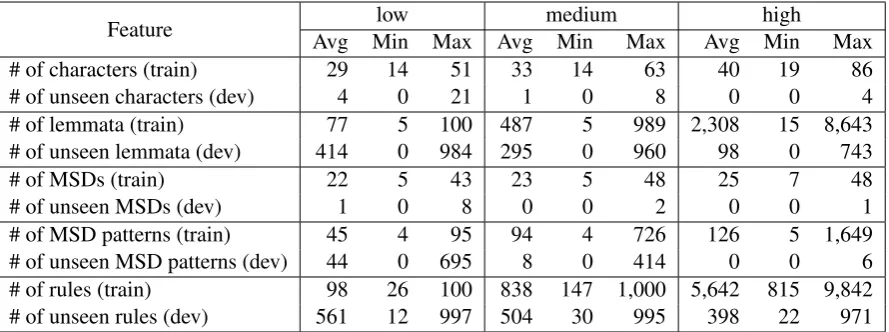
Feature Avg Min Max Avg Minlow medium Max Avg Minhigh Max # of characters (train) 29 14 51 33 14 63 40 19 86 # of unseen characters (dev) 4 0 21 1 0 8 0 0 4 # of lemmata (train) 77 5 100 487 5 989 2,308 15 8,643 # of unseen lemmata (dev) 414 0 984 295 0 960 98 0 743
# of MSDs (train) 22 5 43 23 5 48 25 7 48
# of unseen MSDs (dev) 1 0 8 0 0 2 0 0 1
# of MSD patterns (train) 45 4 95 94 4 726 126 5 1,649 # of unseen MSD patterns (dev) 44 0 695 8 0 414 0 0 6 # of rules (train) 98 26 100 838 147 1,000 5,642 815 9,842 # of unseen rules (dev) 561 12 997 504 30 995 398 22 971
Table 1: Statistics on the dataset given. Number of rules and unseen rules are based on rule extraction method explained in Section5.3.1.
the development phase. The languages vary from Germanic, Celtic and Slavic languages, which are mainly used in Europe, to Indo-Aryan, Iranian, etc. The dataset consists of lines of triplet. A triplet consists of a lemma, a target form, and a tar-get MSD pattern separated by tabulation charac-ters. The MSDs are morphological tags presented in Unimorph Schema (Kirov et al.,2018).
The provided resources are categorized into:
• train: this dataset is the dataset which can be manipulated by the participant to solve the task. It consists of three different sizes:
low : 100 word forms medium: 1,000 word forms high : 10,000 word forms
Telugu has only the low training dataset. Some languages have onlylowand medium training datasets: Cornish, Greenlandic, Inggrian, Karelian, Kashubian, Kazakh, Khakas, Mapudungun, Middle-Low-German, Middle-High-Middle-Low-German, Murrinh-patha, Norman, Old-Irish, Scottish-Gaelic, Tibetan, Turkmen.
• dev: this dataset is given to evaluate the per-formance of our system during the develop-ment phase. It consists of 1,000 word forms.
• test: this dataset is given at the test phase. This dataset does not contain the target forms. It consists of 1,000 word forms, similar todev dataset.
For some languages, the size of the dataset is smaller than the one mentioned above.
Let us now look at some statistics on the given dataset shown in Table1. Overall, we can observe a non-decreasing phenomenon from low to high for all of the number of pieces of information (fea-tures) found in the training dataset. On the oppo-site, we found a non-increasing pattern for the un-seen information contained in the dev dataset rel-atively to training dataset. This shows that bigger resources gradually cover the unseen data encoun-tered in the smaller ones.
Norman, Telugu, Cornish, and Uzbek are lan-guages with a smaller number of lemmata in the training dataset. However, these languages tend to have less, even zero for some languages, un-seen lemmata relatively to the dev dataset. They also have a smaller number of unseen charac-ters. On the other hand, languages like Finnish, Russian, English, French, and German have the biggest number of unseen lemmata despite hav-ing the biggest number of lemmata in the trainhav-ing dataset compared to other languages.
[image:2.595.78.523.62.228.2](substring, replacement, #_of_occurrences)
’-ε’ ’-ing’ 1,121
’-e’ ’-ing’ 832
’-ize’ ’-izing’ 162
... ... ...
’show’ ’showing’ 1
[image:3.595.78.288.61.168.2]... ... ...
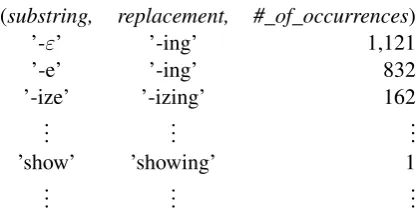
Figure 2: Excerpt of affixes remembered by the base-line system from the training data. It memorizes all changes from lemma into target form in various char-acter length.
We also count the number of rules found in the dataset (see the last two rows in Table 1). These rules are not the morphological rules defined by linguists but the one extracted from the method explained in Section5.3.1. For all languages and all datasets, we count how many unique rules can be extracted and relatively unseen to the respec-tive dev dataset. Telugu, Tatar, and Swahili are the languages with the lowest number of unseen rules. We expect to have good performance in these lan-guages because it means that most of the trans-formations from lemma into the target form are present in the training data.
3 Baseline system: morpheme-based
The CoNLL–SIGMORPHON 2018 organizers provide a baseline system which is a morpheme-based approach. For each language, it determines whether the language is biased towards prefixing or suffixing. The string will be reversed if the lan-guage is biased to prefixing.
For each instance in the training data, it aligns the lemma and target form using Levenshtein dis-tance to cut the word into three categories of can-didate: prefix, stem, and suffix. Prefixing and suffixing rules are then extracted and grouped ac-cording to the given MSD pattern. The rules are stored as a knowledge in a list of triplets: sub-string to replace, sub-string replacement, and the num-ber of occurrences. Figure 2 illustrates how the baseline system stores the suffixing rules for En-glish present participle.
In the generation step, it filters the candidate rules by the given target MSD pattern. First, the longest common suffixing rule with the highest number of occurrences is applied. Then the most frequent prefixing rule is applied in the succession to generate the predicted target form.
4 Holistic approach
Another view on the problem is to see that word forms are connected with other word forms sys-tematically. Based on this observation, we can treat the inflection task as the task of solving ana-logical equation on words1:
lemmat:formt::lemmaq:x ⇒ x=formq 4.1 Proportional analogy
Analogy is a relationship between four objects:A, B,C, andDusually noted as A:B::C:D . It
states thatAis toB asCis toDwhere the ratio betweenAandBis the same as the ratio between C andD. Here, we consider analogy as a possi-ble way to explain derivation between words as it is already used from the ancient Greek and Latin grammatical tradition up to recent works on com-putational linguistics, like (Hathout,2008,2009).
Various formalisations of analogy have been proposed in (Yvon,2003;Lepage,2004;Stroppa and Yvon,2005). In this work, we select the fol-lowing definition2.
A:B ::C :D⇒
d(A, B) =d(C, D)
d(A, C) =d(B, D)
|A|a+|D|a=|B|a+|C|a,
∀a
(1) We can construct analogical grids (Fam and Lepage, 2017b,2018) to give a compact view of different analogies that emerge from a set of words contained in a corpus. An analogical grid is a MxN matrix of words. The special property of this ma-trix is that any four words from two rows and two columns is an analogy (see Formula2).
P11:P12:· · ·:P1m P21:P22:· · ·:P2m ... ... ... Pn1:Pn2:· · ·:Pnm
∆
⇐⇒
∀(i, k)∈ {1, . . . , n}2, ∀(j, l)∈ {1, . . . , m}2,
Pij :Pl
i ::Pkj :Pkl
(2)
4.2 Solving analogical equation to generate word form
In contrast to the baseline system which uses a morpheme-based approach, our holistic approach 1Both lemmatand formtare a pair of lemma and target form found in the training data; lemmaqis the lemma given in the question; and formqis the predicted target form.
Training data
lemma inflected morph. features show showed V;PST
show showing V;V.PTCP;PRS release released V;PST release releasing V;V.PTCP;PRS schmear schmeared V;PST ..
. ... ...
Question
Lemma: illustrate Target MSDs: V;V.PTCP;PRS
LEMMA : V;V.PTCP;PRS : V;PST
release:releasing::illustrate:x
⇒
x=illustrating
release : releasing : released revise : revising : revised
age : aging : aged
bake : baking :
show:showing::illustrate:x
⇒
x=illustrateing
show : showing : showed
enter : : entered
reason : reasoning : reasoned
schmear : : schmeared
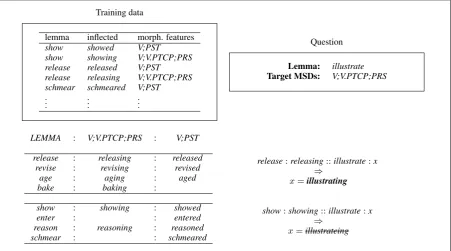
Figure 3: How to generate target form (present participle) of the given lemmaillustrateas solving analogical equation. Different analogical grids may generate different target forms.
does not break words in pieces (Singh, 2000; Singh and Ford, 2000;Neuvel and Singh,2001). We generate the target form by solving analogi-cal equation based on the evidence observed in the given training data.
First, the relevant analogical grid is selected ac-cording to the given target MSD pattern. If sev-eral candidates of analogical equation exist, we use some heuristic features to select the analog-ical equation. These heuristics are edit distance, longest common subsequence, longest common suffix, and longest common prefix, between the given lemma and lemmata existed in the training dataset. If there are still several candidates after using heuristic features, we solve all of the ble analogical equations to generate all the possi-ble predicted target form. The most frequent an-swer is chosen as the predicted target form.
For example, Figure3illustrates how to gener-ate the target form for the example given in Fig-ure1. Let us say that we are able to get two ana-logical grids according to the given MSD pattern. We construct the analogical equation as follows:
lemmat:formt::illustrate:formq
taken from the first and second column of the ana-logical grids according to the given MSD pattern. Based on longest common suffix, we choose to use the one in thetopwhich produces the word form
illustratinginstead of thebottom one which pro-ducesillustrateing.
5 Neural approach
Following the recent success of neural approach in previous evaluation campaign, we implement a common architecture of seq2seq model. We treat the inflection task as the problem of translating the given target MSDs and lemma into target form. Thus, the input string for the example given in Fig-ure1will be as follows.
V V.PTCP PRS i l l u s t r a t e
5.1 Seq2seq model
Our model is a standard seq2seq model with at-tention mechanism inspired from the one which is used for machine translation (Luong et al.,2015). The difference is that we consider a character or MSD as one token, instead of a word. Each token (character) is represented by a continuous vector representation learned in the embedding layer.
[image:4.595.74.526.63.314.2]im-plementations of attention mechanism like ( Bah-danau et al., 2015; Luong et al., 2015). In this work, we use the one that has the weight normal-ization (Salimans and Kingma,2016) to help the model converges faster.
To handle the unseen tokens, we remember them in a First-In-First-Out (FIFO) list and replace them with a special token<UNK>before feeding them into our model. These special tokens are re-verted back to the character contained in the list after the decoding phase.
5.2 Hyperparameters
We fixed our hyperparameters for all languages and amounts of resources after doing some prelim-inary experiments. The number of hidden units is fixed to 100 for each layer in the encoder and de-coder. The size of the embedding is 300. We op-timize the model using ADAM (Kingma and Ba, 2015) with learning rate of5×104 during
train-ing. To make the training process faster, we use mini-batch size of 20.
We trained the model using early-stop mecha-nism of 30 epochs without improvement on valida-tion data which is a set of lines randomly selected from the original training data.
5.3 Simple data augmentation
Preliminary results show that the neural approach suffers from the lack of data. To tackle this problem, we perform a simple data augmenta-tion which artificially creates addiaugmenta-tional training data from evidences seen in the original train-ing data. Additional traintrain-ing data is expected to bring improvement to the performance of our model, especially onlowdata situation (Kann and Schütze,2017;Bergmanis et al.,2017;Silfverberg et al.,2017;Zhou and Neubig,2017;Nicolai et al., 2017).
5.3.1 Rule extraction
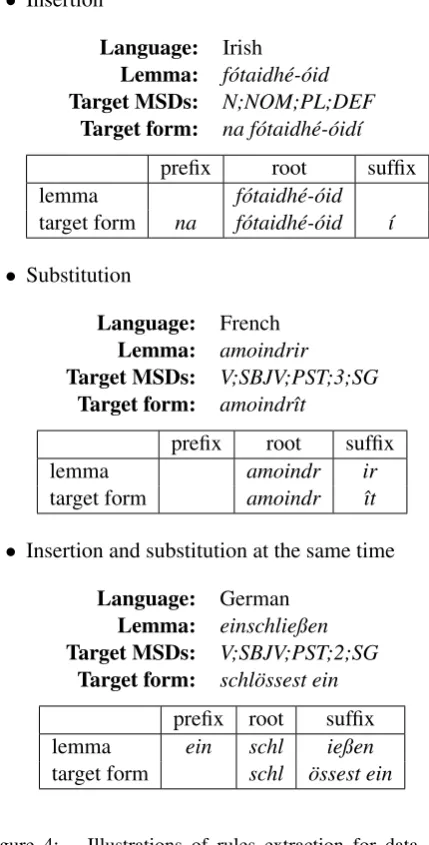
We find the longest common substring between lemma and target form. The left part is assumed as prefix candidate, while the right part is assumed as suffix candidate. Figure4shows several examples of rules extracted from the training data in three different languages.
To capture situational affixing where the next or previous character influences the changes, we added the first character from the longest common substring to the extracted prefix candidate and the last character for the suffix candidate. This, for
• Insertion
Language: Irish
Lemma: fótaidhé-óid
Target MSDs: N;NOM;PL;DEF
Target form: na fótaidhé-óidí prefix root suffix lemma fótaidhé-óid
target form na fótaidhé-óid í
• Substitution
Language: French
Lemma: amoindrir
Target MSDs: V;SBJV;PST;3;SG
Target form: amoindrît
prefix root suffix
lemma amoindr ir
target form amoindr ît
• Insertion and substitution at the same time
Language: German
Lemma: einschließen
Target MSDs: V;SBJV;PST;2;SG
[image:5.595.316.531.67.490.2]Target form: schlössest ein prefix root suffix lemma ein schl ießen target form schl össest ein
Figure 4: Illustrations of rules extraction for data augmentation: simple insertion (Irish); substitution (French); insertion and substitution at the same time (German).
example, happens for regular past form in English where you add only-das suffix for lemmata ended withe, instead of adding-ed
At a glance, it looks similar to how the base-line system extracts the affix rules. However, we only memorize the left (prefix candidate) and right part (suffix candidate), not all of the possible affix combinations with the stem as the baseline sys-tem does. It simplifies the rules extraction, and thus, gives us a smaller number of extracted rules in comparison to the baseline system.
5.3.2 Creating additional training data
Method Accuracy
low medium high Baseline 39.3 63.4 77.1 Holistic 39.6 64.5 77.3 Seq2seq 13.1 71.3 90.9
[image:6.595.76.290.61.147.2]Seq2seq+Aug 36.9 78.5 89.1 Table 2: Average accuracy scores ondevdataset.
data is constructed by using a random string with the length of random integer between 1 to 4. Here, we do not employ any language model to asses the probability of the character sequence like the one described in (Silfverberg et al.,2017). For exam-ple, we can create the following additional training instance for the examples given in Figure4. Char-acters written in boldface are patterns from the ex-tracted rules.
Irish: fbsód=⇒na fbsódí
French: aifrir=⇒aifrît
German: einsraftließen=⇒sraftlössest ein 6 Experiment Protocol
We evaluate the performance of the systems using average on accuracy. Accuracy is the ratio of cor-rectly predicted target forms by the total number of questions. Please refer to Formula3for the ex-act definition3.
Accuracy= PN
i=1δ(predictedi=correcti)
N ×100
(3) We carry experiments using training dataset and measure the accuracies on dev dataset for all the languages for all training dataset sizes. The sys-tem which has the highest score will be picked as our representative system in the test phase for that particular language and dataset size.
7 Results
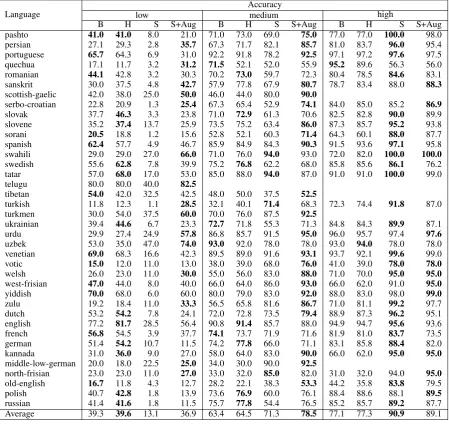
Table 2 shows the average accuracy in all lan-guages for each of the systems. Our holistic ap-proach is able to perform as good as the base-line system, even slightly better under all of the three dataset sizes. This is the same observation found in (Fam and Lepage, 2017a) on previous year dataset.
The results show that the neural approach us-ing seq2seq model left behind both the baseline 3Nis the total number of questions.δ(A=B)equals to 1 if the two stringsAandBare same, or else it is 0.
system and the holistic approach onmedium and high data situation. The gap is around 15 accu-racy points. However, the lack of training data exhibits the drawback of the neural approach as it performs poorly underlowdata situation. Fur-thermore, the use of data augmentation improves the performance in most cases. We can see an im-provement of around 3 times better accuracy on lowdataset although it still cannot overcome the performance of either the baseline nor the holistic approach.
The baseline system and the holistic approach shine over the neural approach particularly for lan-guages like Albanian, Czech, Haida, Neapolitan, Norwegian-Bokmaal, and Uzbek. Our seq2seq model seems to struggle even on high data sit-uation for some of these languages. On the other hand, our seq2seq model gets better accu-racy than the baseline system or holistic approach even on low data situation in some languages like Azeri, Basque, Breton, Cornish, Greenlandic, Hindi, Karelian, Khaling, Maltese, Middle-Low-German, Middle-High-Middle-Low-German, Murrinhpatha, Norman, North-Frisian, Persian, Swahili, Turkish, Turkmen, Welsh, Zulu.
The same trend can be seen on the results for similar languages, like Romance (Catalan, Gali-cian, Portuguese, and Spanish), Semitic (Arabic and Hebrew), and Baltic (Latvian and Lithuanian) languages. The baseline system leads the score on lowdataset size before started to be outperformed by our seq2seq model on the dataset with big-ger sizes. For other language families like Indo-Aryan (Bengali, Hindi, Urdu), Finnic (Estonian and Finnish), and Turkic (Turkish and Turkmen) languages, our seq2seq model steadily leads the score for all dataset sizes. Please refer to Table3 for detail results per language.
8 Discussion
Accuracy
Language low medium high
B H S S+Aug B H S S+Aug B H S S+Aug
adyghe 59.8 71.6 35.5 73.8 85.5 88.1 88.0 89.5 94.8 93.6 95.6 95.2
albanian 22.7 24.5 0.6 11.6 60.2 71.5 44.8 65.2 77.2 86.4 81.1 80.5
arabic 22.9 24.7 0.1 21.0 37.0 46.2 61.1 67.9 42.8 59.1 93.0 91.7
armenian 37.9 35.7 1.2 34.2 72.4 76.9 76.5 83.7 88.6 89.6 94.1 90.9 asturian 59.8 58.6 19.7 53.1 87.9 88.0 87.4 89.7 95.5 95.4 97.8 97.2
azeri 21.0 28.0 13.0 37.0 48.0 57.0 69.0 67.0 69.0 72.0 81.0 82.0
bashkir 38.8 38.6 11.5 35.9 73.8 71.8 87.0 81.0 89.1 86.7 94.1 92.6
basque 0.1 0.2 1.9 8.6 1.9 2.5 67.0 79.2 8.4 9.8 97.4 96.9
belarusian 7.2 10.7 4.6 5.7 22.5 25.3 44.6 55.4 41.4 42.3 85.3 80.9 bengali 44.0 43.0 14.0 49.0 75.0 74.0 94.0 96.0 84.0 84.0 98.0 99.0
breton 20.0 17.0 18.0 61.0 51.0 59.0 83.0 88.0 55.0 61.0 91.0 92.0
bulgarian 32.7 33.0 4.3 49.8 74.4 76.9 70.6 82.1 90.6 89.5 95.4 94.3
catalan 54.3 51.2 4.6 32.6 82.2 81.2 85.0 92.3 94.3 94.2 98.1 95.9
classical-syriac 89.0 87.0 41.0 72.0 98.0 98.0 94.0 98.0 98.0 97.0 98.0 100.0
cornish 2.0 0.0 7.5 22.5 4.0 2.0 47.5 57.5
crimean-tatar 53.0 66.0 16.0 63.0 74.0 76.0 95.0 89.0 93.0 92.0 99.0 98.0
czech 38.1 38.4 1.6 26.1 78.8 79.4 51.1 76.6 89.0 89.5 85.5 86.3
danish 57.4 65.2 30.2 53.0 78.1 79.7 74.3 69.8 88.9 88.8 91.3 85.8
estonian 22.6 21.7 0.7 28.4 62.4 60.6 60.0 70.3 76.2 77.0 90.6 88.0
faroese 35.6 38.3 3.3 16.6 61.0 63.0 51.0 60.6 74.2 74.5 79.8 74.5
finnish 15.4 15.4 0.7 18.7 43.5 43.3 42.6 69.9 79.3 77.2 84.1 82.0
friulian 51.0 48.0 25.0 49.0 86.0 85.0 89.0 94.0 94.0 93.0 98.0 99.0 galician 52.5 51.9 9.1 30.7 82.3 81.2 77.9 88.9 93.7 93.2 98.4 97.4 georgian 71.8 70.5 17.2 58.9 89.7 90.0 82.9 92.5 93.8 94.0 98.5 98.4
greek 27.7 27.0 2.0 12.0 61.0 63.0 44.3 56.6 77.4 77.6 81.7 83.3
greenlandic 36.0 42.0 27.5 57.5 74.0 60.0 75.0 85.0
haida 43.0 28.0 5.0 23.0 59.0 59.0 50.0 52.0 71.0 68.0 53.0 52.0
hebrew 27.9 29.8 4.1 13.8 40.0 49.0 76.3 76.3 55.9 60.7 98.1 97.2
hindi 34.9 31.8 23.9 65.6 86.1 83.9 94.3 95.1 93.6 93.5 98.6 97.5
hungarian 14.9 22.0 0.9 12.1 39.9 46.7 47.3 53.1 68.7 69.7 77.5 63.5 icelandic 35.8 38.1 6.5 14.9 60.4 63.6 52.3 61.3 77.2 77.1 84.3 78.7
ingrian 20.0 12.0 27.5 20.0 46.0 42.0 80.0 75.0
irish 31.8 35.7 3.7 20.9 44.7 49.2 42.6 57.7 54.3 58.1 83.0 77.2
italian 43.3 44.4 3.3 41.3 70.5 83.1 81.3 91.1 77.2 93.1 97.9 95.4
kabardian 78.0 74.0 51.0 83.0 90.0 87.0 95.0 95.0 90.0 86.0 96.0 96.0 karelian 40.0 34.0 20.0 67.5 48.0 48.0 95.0 97.5
kashubian 56.0 64.0 12.5 57.5 74.0 68.0 85.0 92.5
kazakh 44.0 50.0 52.5 47.5 64.0 62.0 72.5 77.5
khakas 36.0 48.0 27.5 65.0 92.0 92.0 85.0 92.5
khaling 3.9 1.6 4.6 11.2 18.4 17.8 77.3 86.4 53.8 48.0 99.6 98.4
kurmanji 82.1 85.8 0.0 58.4 84.7 88.9 83.7 88.2 91.9 91.4 92.8 91.4
ladin 59.0 53.0 30.0 52.0 85.0 86.0 88.0 95.0 92.0 91.0 98.0 98.0
latin 16.0 12.6 0.8 5.4 36.8 28.5 25.2 36.2 45.6 37.1 70.1 55.5
latvian 53.4 50.9 4.1 18.3 85.8 86.6 60.5 82.4 92.0 91.2 94.8 94.8
lithuanian 23.5 19.4 0.8 5.6 53.0 50.3 33.7 51.6 64.7 63.6 86.2 84.1 livonian 25.0 27.0 1.0 27.0 47.0 47.0 69.0 77.0 58.0 59.0 92.0 92.0 lower-sorbian 30.7 35.8 2.9 19.3 70.4 79.3 64.1 81.4 88.1 87.9 95.2 94.8 macedonian 51.4 47.4 5.1 37.7 83.8 88.2 75.7 89.8 93.2 93.5 96.4 95.3
maltese 11.0 19.0 0.0 23.0 21.0 29.0 87.0 93.0 25.0 29.0 97.0 98.0
mapudungun 62.0 60.0 57.5 95.0 80.0 88.0 97.5 97.5
middle-french 78.7 76.1 10.1 67.2 90.8 91.3 89.2 93.0 95.8 95.1 98.8 96.3 middle-high-german 44.0 48.0 35.0 67.5 54.0 60.0 97.5 97.5
murrinhpatha 2.0 4.0 25.0 35.0 14.0 10.0 95.0 90.0
navajo 14.3 14.6 2.0 13.8 31.8 31.2 35.8 41.5 40.0 40.5 82.5 76.0
neapolitan 83.0 81.0 25.0 65.0 94.0 93.0 91.0 95.0 99.0 98.0 95.0 95.0
norman 38.0 34.0 45.0 60.0 60.0 52.0 77.5 80.0
northern-sami 17.8 13.1 2.1 11.6 38.8 35.0 43.2 60.7 64.5 62.4 93.4 88.0 norwegian-bokmaal 69.0 73.2 13.8 54.8 79.8 81.0 78.0 76.5 90.6 90.3 88.9 77.0 norwegian-nynorsk 51.4 53.7 11.9 37.6 61.6 61.1 52.5 57.0 74.7 75.1 84.0 75.8 occitan 79.0 77.0 15.0 55.0 87.0 87.0 94.0 98.0 94.0 92.0 100.0 100.0 old-armenian 27.6 28.8 1.5 14.8 64.9 68.0 48.9 69.3 76.7 79.3 86.0 85.1 old-church-slavonic 34.0 32.0 11.0 29.0 65.0 65.0 74.0 78.0 64.0 57.0 92.0 96.0 old-french 30.4 27.6 4.9 35.4 61.3 65.2 65.0 68.9 79.7 79.5 87.5 84.8
old-irish 12.0 12.0 5.0 5.0 20.0 18.0 20.0 32.5
Accuracy
Language low medium high
B H S S+Aug B H S S+Aug B H S S+Aug
pashto 41.0 41.0 8.0 21.0 71.0 73.0 69.0 75.0 77.0 77.0 100.0 98.0
persian 27.1 29.3 2.8 35.7 67.3 71.7 82.1 85.7 81.0 83.7 96.0 95.4
portuguese 65.7 64.3 6.9 31.0 92.2 91.8 78.2 92.5 97.1 97.2 97.6 97.5
quechua 17.1 11.7 3.2 31.2 71.5 52.1 52.0 55.9 95.2 89.6 56.3 56.0
romanian 44.1 42.8 3.2 30.3 70.2 73.0 59.7 72.3 80.4 78.5 84.6 83.1 sanskrit 30.0 37.5 4.8 42.7 57.9 77.8 67.9 80.7 78.7 83.4 88.0 88.3 scottish-gaelic 42.0 38.0 25.0 50.0 46.0 44.0 80.0 90.0
serbo-croatian 22.8 20.9 1.3 25.4 67.3 65.4 52.9 74.1 84.0 85.0 85.2 86.9
slovak 37.7 46.3 3.3 23.8 71.0 72.9 61.3 70.6 82.5 82.8 90.0 89.9
slovene 35.2 37.4 13.7 25.9 73.5 75.2 63.4 86.0 87.3 85.7 95.2 93.8
sorani 20.5 18.8 1.2 15.6 52.8 52.1 60.3 71.4 64.3 60.1 88.0 87.7
spanish 62.4 57.7 4.9 46.7 85.9 84.9 84.3 90.3 91.5 93.6 97.1 95.8
swahili 29.0 29.0 27.0 66.0 71.0 76.0 94.0 93.0 72.0 82.0 100.0 100.0
swedish 55.6 62.8 7.8 39.9 75.2 76.8 62.2 68.0 85.8 85.6 86.1 76.2
tatar 57.0 68.0 17.0 53.0 85.0 88.0 94.0 87.0 91.0 91.0 100.0 99.0
telugu 80.0 80.0 40.0 82.5
tibetan 54.0 42.0 32.5 42.5 48.0 50.0 37.5 52.5
turkish 11.8 12.3 1.1 28.5 32.1 40.1 71.4 68.3 72.3 74.4 91.8 87.0
turkmen 30.0 54.0 37.5 60.0 70.0 76.0 87.5 92.5
ukrainian 39.4 44.6 6.7 23.3 72.7 71.8 55.3 71.3 84.8 84.3 89.9 87.1
urdu 29.9 27.4 24.9 57.8 86.8 85.7 91.5 95.0 96.0 95.7 97.4 97.6
uzbek 53.0 35.0 47.0 74.0 93.0 92.0 78.0 78.0 93.0 94.0 78.0 78.0
venetian 69.0 68.3 16.6 42.3 89.5 89.0 91.6 93.1 93.7 92.1 99.6 99.0
votic 15.0 12.0 11.0 13.0 38.0 39.0 68.0 76.0 41.0 39.0 78.0 78.0
welsh 26.0 23.0 11.0 30.0 55.0 56.0 83.0 88.0 71.0 70.0 95.0 95.0
west-frisian 47.0 44.0 8.0 40.0 66.0 64.0 86.0 93.0 66.0 62.0 91.0 95.0
yiddish 70.0 68.0 6.0 60.0 80.0 79.0 83.0 92.0 88.0 83.0 98.0 99.0
zulu 19.2 18.4 11.0 33.3 56.5 65.8 81.6 86.7 71.0 81.1 99.2 97.7
dutch 53.2 54.2 7.8 24.1 72.0 72.8 73.5 79.4 88.9 87.3 96.2 95.1
english 77.2 81.7 28.5 56.4 90.8 91.4 85.7 88.0 94.9 94.7 95.6 93.6
french 56.8 54.5 3.9 37.7 74.1 73.7 71.9 71.6 81.9 81.0 83.7 73.5
german 51.4 54.2 10.7 11.5 74.2 77.8 66.0 71.1 83.1 85.8 88.4 82.0
kannada 31.0 36.0 9.0 27.0 58.0 64.0 83.0 90.0 66.0 62.0 95.0 95.0
middle-low-german 20.0 18.0 22.5 25.0 34.0 30.0 90.0 92.5
north-frisian 23.0 23.0 11.0 27.0 33.0 32.0 85.0 82.0 31.0 32.0 94.0 95.0 old-english 16.7 11.8 4.3 12.7 28.2 22.1 38.3 53.3 44.2 35.8 83.8 79.5
polish 40.7 42.8 1.8 13.9 73.6 76.9 60.0 76.1 88.4 88.6 88.1 89.5
russian 41.4 41.6 1.8 11.5 75.7 77.8 54.4 76.5 85.2 85.7 89.2 87.7
[image:8.595.75.525.63.487.2]Average 39.3 39.6 13.1 36.9 63.4 64.5 71.3 78.5 77.1 77.3 90.9 89.1 Table 3: Accuracy scores on development set (dev) in each language for baseline system (B), holistic approach(H), our seq2seq model without data augmentation (S) and with data augmentation (S+Aug).
The improvement shown by using data augmen-tation seems promising. One may think to in-crease the amount of the artificially created ad-ditional training data. However, there is a trade-off between performance and training time. An-other thing to consider is how many more addi-tional training data should be created. We can see that the data augmentation seems not to improve the performance onhigh data situation anymore. In addition, the current method to extract the affix rules is very simple. Although it may capture cir-cumfixes, it is still strongly biased to prefixing and suffixing only. A better method is expected to also capture other phenomena, such as parallel infix-ing (Arabic), repetition (Greek), and reduplication (Malay, Indonesian).
9 Conclusion
We developed several systems for morphological inflection task. The first one is based on a holistic approach. We generate the target forms by solving analogical equations on words. The second one is a seq2seq neural network model. A simple data augmentation is also implemented to help on low data situation. We evaluated their performance on the development dataset and choose the best sys-tem on each language and dataset size as our rep-resentative system for the submission.
References
Malin Ahlberg, Markus Forsberg, and Mans Hulden. 2015. Paradigm classification in supervised learn-ing of morphology. InProceedings of the 2015 Con-ference of the North American Chapter of the Asso-ciation for Computational Linguistics: Human Lan-guage Technologies, pages 1024–1029, Denver, Col-orado. Association for Computational Linguistics.
Dzmitry Bahdanau, Kyunghyun Cho, and Yoshua Ben-gio. 2015. Neural machine translation by jointly learning to align and translate. In Proceedings of the 3rd International Conference for Learning Rep-resentations (ICLR-15), San Diego.
Toms Bergmanis, Katharina Kann, Hinrich Schütze, and Sharon Goldwater. 2017. Training data aug-mentation for low-resource morphological inflec-tion. InProceedings of the CoNLL SIGMORPHON 2017 Shared Task: Universal Morphological Rein-flection, pages 31–39, Vancouver. Association for Computational Linguistics.
Kyunghyun Cho, Bart van Merrienboer, Caglar Gul-cehre, Dzmitry Bahdanau, Fethi Bougares, Holger Schwenk, and Yoshua Bengio. 2014. Learning phrase representations using rnn encoder–decoder for statistical machine translation. InProceedings of the 2014 Conference on Empirical Methods in Nat-ural Language Processing (EMNLP), pages 1724– 1734, Doha, Qatar. Association for Computational Linguistics.
Ryan Cotterell, Christo Kirov, John Sylak-Glassman, Géraldine Walther, Ekaterina Vylomova, Arya D. McCarthy, Katharina Kann, Sebastian Mielke, Gar-rett Nicolai, Miikka Silfverberg, David Yarowsky, Jason Eisner, and Mans Hulden. 2018. The CoNLL– SIGMORPHON 2018 shared task: Universal mor-phological reinflection. In Proceedings of the CoNLL–SIGMORPHON 2018 Shared Task: Univer-sal Morphological Reinflection, Brussels, Belgium. Association for Computational Linguistics.
Markus Dreyer and Jason Eisner. 2011. Discovering morphological paradigms from plain text using a dirichlet process mixture model. InProceedings of the 2011 Conference on Empirical Methods in Nat-ural Language Processing (EMNLP’2011), pages 616–627, Edinburgh, Scotland, UK. Association for Computational Linguistics.
Rashel Fam and Yves Lepage. 2017a. A holistic ap-proach at a morphological inflection task. In Pro-ceedings of the 8th Language and Technology Con-ference (LTC-17), pages 88–92, Pozna´n, Poland. Fundacja uniwersytetu im. Adama Mickiewicza.
Rashel Fam and Yves Lepage. 2017b. A study of the saturation of analogical grids agnostically extracted from texts. In Proceedings of the Computational Analogy Workshop at the 25th International Con-ference on Case-Based Reasoning (ICCBR-CA-17), pages 11–20, Trondheim, Norway.
Rashel Fam and Yves Lepage. 2018. Tools for the pro-duction of analogical grids and a resource of n-gram analogical grids in 11 languages. In Proceedings of the 11th edition of the Language Resources and Evaluation Conference (LREC-18), pages 1060– 1066, Miyazaki, Japan. ELRA.
Bernhard Ganter and Rudolf Wille. 1999. For-mal Concept Analysis: Mathematical Foundations. Springer-Verlag Berlin Heidelberg.
Nabil Hathout. 2008. Acquistion of the morpholog-ical structure of the lexicon based on lexmorpholog-ical sim-ilarity and formal analogy. In Proceedings of the 3rd Textgraphs workshop on Graph-based Algo-rithms for Natural Language Processing, pages 1–8, Manchester, UK. Coling 2008 Organizing Commit-tee.
Nabil Hathout. 2009. Acquisition of morphologi-cal families and derivational series from a machine readable dictionary.CoRR, abs/0905.1609.
Sepp Hochreiter and Jürgen Schmidhuber. 1997. Long short-term memory. Neural Computation, 9(8):1735–1780.
Katharina Kann and Hinrich Schütze. 2016. Med: The LMU system for the SIGMORPHON 2016 Shared Task on morphological reinflection. InProceedings of the 2016 Meeting of SIGMORPHON, Berlin, Ger-many. Association for Computational Linguistics.
Katharina Kann and Hinrich Schütze. 2017. The LMU system for the CoNLL-SIGMORPHON 2017 Shared Task on universal morphological reinflec-tion. InProceedings of the CoNLL SIGMORPHON 2017 Shared Task: Universal Morphological Rein-flection, pages 40–48, Vancouver. Association for Computational Linguistics.
Diederik P. Kingma and Jimmy Ba. 2015. Adam: A method for stochastic optimization. InProceedings of the 3rd International Conference for Learning Representations (ICLR-15), San Diego.
Christo Kirov, Ryan Cotterell, John Sylak-Glassman, Géraldine Walther, Ekaterina Vylomova, Patrick Xia, Manaal Faruqui, Sebastian Mielke, Arya D. McCarthy, Sandra Kübler, David Yarowsky, Ja-son Eisner, and Mans Hulden. 2018. UniMorph 2.0: Universal Morphology. InProceedings of the Eleventh International Conference on Language Re-sources and Evaluation (LREC 2018), Miyazaki, Japan. European Language Resources Association (ELRA).
Yves Lepage. 2004. Analogy and formal languages.
Electronic notes in theoretical computer science, 53:180–191.
2015 Conference on Empirical Methods in Natu-ral Language Processing, pages 1412–1421, Lis-bon, Portugal. Association for Computational Lin-guistics.
Peter Makarov, Tatiana Ruzsics, and Simon Clematide. 2017. Align and copy: UZH at SIGMORPHON 2017 Shared Task for morphological reinflection. InProceedings of the CoNLL SIGMORPHON 2017 Shared Task: Universal Morphological Reinflection, pages 49–57, Vancouver. Association for Computa-tional Linguistics.
Sylvain Neuvel and Rajendra Singh. 2001. Vive la dif-férence ! what morphology is about. Folia Linguis-tica, 35(3-4):313–320.
Garrett Nicolai, Bradley Hauer, Mohammad Motallebi, Saeed Najafi, and Grzegorz Kondrak. 2017. If you can’t beat them, join them: the University of Alberta system description. In Proceedings of the CoNLL SIGMORPHON 2017 Shared Task: Universal Mor-phological Reinflection, pages 79–84, Vancouver. Association for Computational Linguistics.
Tim Salimans and Diederik P Kingma. 2016. Weight normalization: A simple reparameterization to ac-celerate training of deep neural networks. In D. D. Lee, M. Sugiyama, U. V. Luxburg, I. Guyon, and R. Garnett, editors,Advances in Neural Information Processing Systems 29, pages 901–909. Curran As-sociates, Inc.
Miikka Silfverberg, Adam Wiemerslage, Ling Liu, and Lingshuang Jack Mao. 2017. Data augmentation for morphological reinflection. In Proceedings of the CoNLL SIGMORPHON 2017 Shared Task: Univer-sal Morphological Reinflection, pages 90–99, Van-couver. Association for Computational Linguistics. Rajendra Singh, editor. 2000. The Yearbook of South
Asian Languages and Linguistics-200. Sage, Thou-sand Oaks.
Rajendra Singh and Alan Ford. 2000. In praise of Sakatayana: some remarks on whole word morphol-ogy. In Rajendra Singh, editor, The Yearbook of South Asian Languages and Linguistics-200. Sage, Thousand Oaks.
Nicolas Stroppa and François Yvon. 2005. An analog-ical learner for morphologanalog-ical analysis. In Proceed-ings of the Ninth Conference on Computational Nat-ural Language Learning (CoNLL-2005), pages 120– 127, Ann Arbor, Michigan. Association for Compu-tational Linguistics.
François Yvon. 2003. Finite-state machines solving analogies on words. Technical report, ENST. Chunting Zhou and Graham Neubig. 2017.