ISSN 2319-7625 (Online) (An International Research Journal), www.chemistry-journal.org
Preconcentration of Eosin Dye using
β
-Cyclodextrin
Epichlorohydrin Polymer as the
Solid Phase Extractant
Amandeep Kaur and Usha Gupta
Department of Chemistry, Punjabi University, Patiala, INDIA.
(Received on: March 25, 2015)
ABSTRACT
The β-Cyclodextrin cross-linked polymer (β-CDP) was synthesized and used as a solid phase extraction material to preconcentrate eosin dye with UV-Vis spectrophotometer. This method is based upon the adsorption of eosin dye on β -CDP. The effects of pH, shaking time, amount of adsorbent, sample volume etc. on the β-CDP including eosin dye were determined Spectrophotometrically. The optimum conditions were obtained (pH, 4.0; sample volume 25.0ml; amount of adsorbent 250.0mg; shaking time, 120.0 min).The recovery% of eosin dye was found to be ≥ 95%. The proposed method has been applied for the determination of eosin dye in different food samples.
Keywords: β-cyclodextrinepichlorohydrin polymer (β-CDP), eosin dye,
preconcentration, solid phase extraction, spectrophotometry.
1. INTRODUCTION
purposes etc. But this dye causes severe symptoms if ingested. Eosin causes irritation to eyes, skin, and may affect respiratory tract. Symptoms may include coughing, sore throat, labored breathing, chest pain, nausea, vomiting and diarrhea and thus proves lethal. Eosin hazardous effects include eczema and severe respiratory problems. So, it is necessary to remove dye from water samples containing eosin. Eosin can cause allergic reactions in sensitive individuals and may cause other medical conditions, including cancer. Eosin may also cause photosensitivity. The major problems associated with excessive use of this dye in food thus threatens life and therefore remains persistent toxicants within an ecosystem or food chain. Some analytical methods such as spectrophotometry1-3 have been reported to find content of these dyes in food.
An analysis which require sample preparation and in most cases extraction using organic solvents, most of which are highly toxic are found to be carcinogenic4 and has been banned by U.S Environment Protection Agency (EPA) for uses in drugs, cosmetics, food products etc. So there is a need for development of methods which do not require the use of organic solvents for extraction. Thus solid phase spectrophotometry using β-Cyclodextrin polymer as a support has been developed. Solid phase spectrophotometry seems to be environmental friendly, sensitive and cheap technique for the determination of trace quantity of constituents. The as sensitivity and selectivity of this method are much higher than those of the conventional spectrophotometry and the interference levels are quite low.
Self-assembling phenomena attract considerable attention as they are basic issues for supramolecular chemistry like formation of host-guest molecules5-10. Complexation of hydrophobic guest by macromolecular hosts is a widely found phenomenon in chemistry. Beta-Cyclodextrins (β-CDs)11-12 well known host molecules that consists of glucose units that are joined by α-(1, 4) glycosidic linkages at C1 and C4 to form cyclic structure13-15.
β-Cyclodextrin polymer (β-CDP) is a new type of sorbent useful for the preconcentration of dyes, organic pollutants, heavy metals, acids, alcohols etc.16 in water. These substrates form stable complexes with CD’s17-19. Synthesis of water insoluble β-CDP was done by cross linking the hydroxyl group with various cross-linkers such as epichlorohydrin20-24, glutaraldehydes, diisocyanates, succinyl chloride etc.25-29. Epichlorohydrin is widely used in chemistry and industry because of its high reaction activity and it is the most popular Crosslinking agent for β –CDP synthesis.
2. EXPERIMENTAL
Materials and Methods
Apparatus
Reagents
All the reagents used were of anaIR grade unless otherwise stated. Double distilled water was used throughout the experimental work.
40gm of beta-Cyclodextrin, 10gm of soluble starch and 100ml of 20% sodium hydroxide were added in a beaker. The mixture was vigorously stirred at 50-60°C for an appropriate period until the reactants were dissolved. A total of 60ml of Epichlorohydrin was added drop wise into the solution and β-CDP was formed in 30min. After washing with double distilled water 5-6 times, the obtained polymer was dried at 100°C and then stored at room temperature in dessicator for experimental work.
A stock solution of eosin was prepared by dissolving 0.624gm in 100.0ml of double distilled water to give 0.01M standard stock solution and further dilutions were made as per required.
Buffer solution of pH range 1.0- 3.0 was made by mixing different amounts of 0.2M hydrochloric acid/0.2M acetic acid and buffer solutions of pH 3.0-6.0 were made mixing different amounts of 0.2M sodium acetate/0.2M acetic acid . Buffers of pH range 7.0-10.0 were made mixing different amounts of 0.5M ammonia/0.5M ammonium chloride.
Procedure
An aliquot of 86.6µg/ml of eosin was taken in 50.0ml stoppered flask and 2.5ml of buffer solution(pH=4.0) and 0.25gm of β-CDP was added to above solution. The mixture was allowed to stand for 5min to equilibrate and was then made up to 25ml with double distilled water. The mixture was shaken in thermostatic water bath for 120min at a rotation rate of 140rpm at room temperature. Then a definite volume of supernatant was extracted and determined spectrophotometrically at 410nm.
3. RESULTS AND DISCUSSION
Optimization of Various parameters
Effect of pH
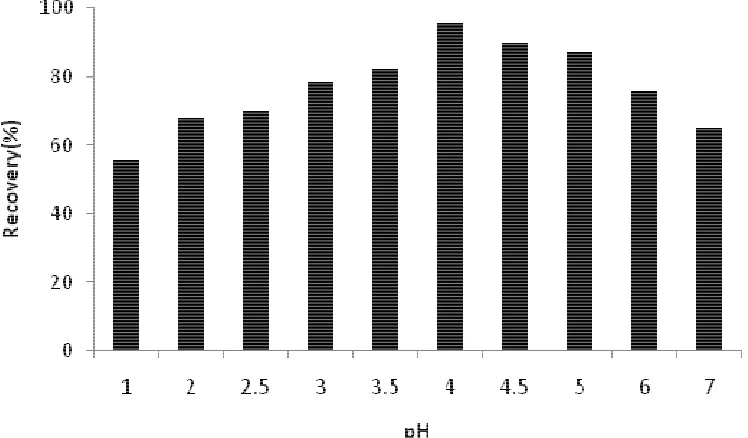
The effect of pH on the complexation of dye with polymer was studied over a wide pH range 1.0-7.0. The preconcentration procedure was applied as described above and results are shown in fig. 1. Recovery% was maximum at pH 4.0. Hence experimental work was carried out at pH 4.0.
Effect of sample volume
resulted spectra that recovery% remains constant up to 35.0ml and then decreases (fig. 2). Therefore, 25.0ml sample volume was selected for preconcentration of analyte from sample solutions.
Effect of amount of β-CD polymer
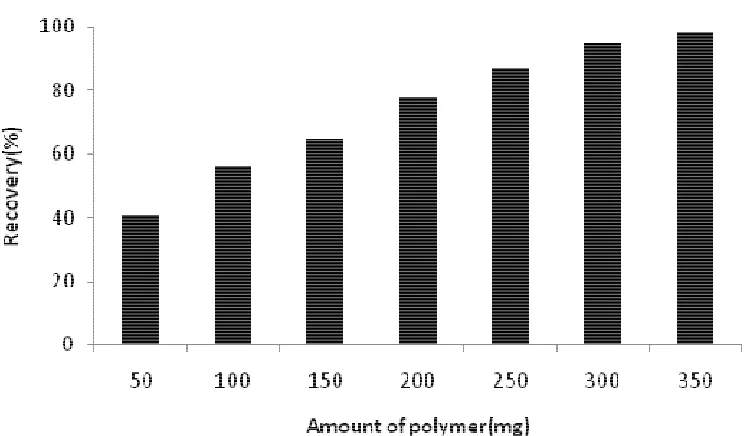
The amount of β-CDP is another parameter that affects recovery% of eosin and was studied keeping all other conditions constant, and varying the polymer amount from 50.0mg-350.0mg (fig.3). The results of recovery% of eosin vs. amount of polymer show that recovery% was maximum for 250.0mg and further becomes constant. Hence 250.0mg of β-CDP was selected for working experiment.
Effect of shaking time
Shaking time affects the possibility of application of β-CDP for the recovery% of eosin dye. Effect of shaking time on recovery% of eosin using β-CDP extractant was done from 10-140min (fig. 4). The recovery% from resulted spectra shows that recovery% increases as the time of shaking increases from 10.0min–120min and then becomes constant for higher shaking times at room temperature. Based on these results shaking time of 120.0min was adopted for further experiments
Figure 2.Effect of sample volume on recovery% of Eosin
Figure 4.Effect of shaking time on recover% of Eosin
4. APPLICATIONS
Determination of samples
The developed procedure has been applied for the determination of eosin dye in food samples containing known amount of dye and then recovery % was determined by indirect measurement of eosin in the supernatant. Results are shown below in the table:
Table1: Results of determination of eosin in food samples
Sample Added (µg/ml) Found (µg/ml) Recovery (%)
Appy Fizz*
Candy**
0.00 1.30 0.00 1.90
0.87 1.20 0.98 1.83
--- 92% --- 96%
*Appy Fizz- Locally available in the market. **Parle G orange candy- Locally available in the market.
5. CONCLUSION
polymer has a unique stability. In addition, the used colored polymer could be regenerated with 0.1% HCl with more than 95.0% regenerated yield. Thus, solid phase extraction combined spectrophotometry is more useful method of determination of eosin dye.
REFERENCES
1. Weisburger E, 1978. Cancer-Causing Chemicals. American Chemical Society. Pp 73-86 (1978).
2. Coelho TM, Vidotti EC, Rollemberg MCE, Baesso ML, Bento AC. J Phys IV, 125, 829-832 (2005).
3. Vidotti EC, Cancino JC, Oliveira CC, Rollemmberg MDC Anal Sci., 21, 49-153 (2005). 4. Kara D. Asian J Chem., 17:743-754 (2005).
5. M. Sherod, in: J.E.D. Davies (Ed.), Spectroscopic and Computational Studies of
Supramolecular Systems, Kluwer Academic Publishers, Dordrecht, 1992.
6. K.A. Connors. Chem. Rev. 1997, 97, 1325.
7. G. Grabner, K. Rechthaler, B. Mayer, G. Koehler, K. Rotkieweiz. J. Chem. Phys. A, 104,1365 (2000).
8. G. Grabner, S. Monti, G. Marconi, B. Mayer. Ch. Klein, G. Koehler. J. Chem. Phys. A, 100, 68 (1996).
9. G. Marconi, S. Monti, B. Mayer, G. Koehler. J. Chem.Phys. A., 99, 3943 (1995). 10. G. Li, L.B. McGown. Science, 264, 249 (1994).
11. Horikoshi, K. Process Biochemistry, 14, 26-30 (1979).
12. Nakamura, N., & Horikoshi, K. Bioengineering Advances, 2002, 20, 341-359 (1977). 13. Jh, Wang. & Ca., Z. Carbohydr. Polym., 72, 255-260 (2008).
14. Bender, M.L., & Komiyana, M. Cyclodextrin Chemistry. Berlin: Springer (1978). 15. Teranishi K, & Nishiquchi T. Anal. Biochem., 325, 185-195 (2004).
Szeijtli, J. Chem. Rev., 98, 1743 (1998).
16. Liu, D.K., Dong. Dye Dyeing., 3, 155-157 (2004).
17. Choppinet, P, Jullien, L., &Valeur, B. Chem. Eur. J., 5, 3666-3678 (1999). 18. Buss, V., Angew. Chem. Int Ed. Engl., 30, 869-890 (1991).
19. Gunaratne A. & Corke H. Food Chem., 108, 14-22 (2008).
20. Kitaoka, M., Hayashi, K. J. Incl. Phenom. Macrocycl. Chem., 44(1), 429-431 (2002). 21. Shao, Y., Martel, B., Morcelet, M. J. Incl. Phenom. Macrocycl. Chem., 25(1-3), 209-212
(1996).
22. Crini. G., Britini, S., Torri, G’J. Appl. Polym. Sci., 68(12), 1973-1978 (1998).
23. Gu. T., Tsai, G., Tsao, G. T. J. Incl. Phenom.Macrocycl. Chem., 56(3), 375-379 (2006). 24. Werner, T. C., Iannacomne, J. L., Amoo, M. N. J. Incl. Phenom. Macrocycl., 25(1),
77-80 (1996).
25. Wenz G., Angewandte. Chemie.International edition in English., 33(8), 803-822 (1994). 26. Crini. G., Bertini, S., Torri, G., Naggi, A., Sforzini, D., &Vecchil.Journal of Applied
27. Harada, A., Hashidzume, A., Headley, J, V., & Peru, K, M. Advances in Polymer
Science, 87, 1747-1756 (2009).
28. Mohamed, M, H., Wilson, L, D., Headley, J, V., & Peru, K, M. Canadian Journal of
Chemistry, 87, 1747-1756 (2009).
29. Mohamed, M, H., Wilson, L, D., Headley, J, V., & Peru, K, M. Process Safety and