Izvirni znanstveni članek - Original scientific paper (1.01)
Boljše izluščevanje informacij s pomočjo metode verjetnosti
Improving Information Extraction Using a Probability-Based Approach
Sanghee Kim 1 - Saeema Ahmed2 - Ken Wallace1
(‘University o f Cambridge, United Kingdom; te c h n ic a l University o f Denmark)
Informacije imajo ključen pomen v celotnem trajanju izdelka. Rezultati raziskav kažejo, da se inženirji pogosto posvetujejo med seboj, da pridobijo informacije, potrebne za reševanje težav. Zaradi prehajanja ključnih kadrov v druga podjetja in upokojitev postaja vse bolj pomembna zmožnost izluščiti manjkajoče informacije iz tehnične dokumentacije, seveda, če le-ta obstaja. Zanimanje za različne načine izluščevanja tovrstnih informacij tako postaja vse večje. Iskanje po ključnih besedah je ustaljen način, vendar raziskave kažejo, da j e ta način mnogokrat nezadovoljiv. Iskanje je mogoče izboljšati s standardiziranim načinom poimenovanja eie, itov in njihovih povezav v posameznih domenah, vendar je zaradi obilice sedanje dokumentacije, ki i rablja različna poimenovanja, izkoristek iskanja slab. Tako uporaba učenja, ki temelji
du, obeta boljši izkoristek iskanja informacij ob enaki natančnosti, kakor ga omogočajo alna pravila. Prispevek predstavlja rezultate iskanja informacij, ki temeljijo na ku. Preizkusi kažejo, da opisan postopek poveča izkoristek iskanja informacij s 53 <tkov, ob primerljivi natančnosti.
tnik. Vse pravice pridržane.
iščevanje informacij, identifikacija dokumentov, iskalne strategije, klasifikacija,
)
na verjetnostnem n vnaprej določena verjetnostnem pos odstotkov na 80 ot © 2007 Strojniški
(Ključne besede: verjetnostne met
Informatioi ays a crucial role during the entire life-cycle o f a product. It has been shown that engineers frequently consult colleagues to obtain the information they require to solve problems. However, the industrial world is now more transient and key personnel move to other companies or retire. It is becoming essential to retrieve vital information from archived product documents, i f it is available. There is, therefore, great interest in ways o f extracting relevant and sharable information from documents. A keyword-based search is commonly used, but studies have shown that these searches often prove unsuccessful. Searches can be improved i f domain entities o f interest, e.g., 'gas turbine', are explicitly associated with their types, Le., gas turbine is a type o f engine, thus reducing the ambiguity o f referring to the entities using various different ways o f expressing them. It would be helpful to compile a fu ll list o f entities associated with the relevant tvves before identifying them in texts. However, due to the various ways o f referring entities in the texts
In order to increi identification deci pre-defined variai based entity-identi from 53% to 80% © 2007 Journal ol
(Keywords: infor probability mcth
anually defined identification rules tend to produce high precision but with low recall, the recall, while maintaining the high precision, a learning approach that makes is based on a probability model, rather than simply looking up the presence o f the
9, looks promising. This paper presents the results o f developing such a probability-ition approach. Tests show that the proposed approach achieves improved recall, i.e., th comparable precision.
echanical Engineering. All rights reserved.
tion searches, name entity identification, natural language processing, taxonomy,
')
0 r IODUCTION
Engineers frequently seek the information they need from colleagues. However, the time spent on acq u irin g and p ro v id in g such in fo rm atio n detracts from the time available to carry out their
text-based documents [1], A computer-text-based document- m a n a g e m e n t sy ste m can im p ro v e ac c e ss to information contained in documents. Therefore, o rg a n isa tio n s are p la c in g g re a t e m p h asis on identifying reusable information in documents in order to improve access.
It has been reported that 35% o f users find it d ifficu lt to access inform ation co ntained in documents and at least 60% o f the information that is critical to these organizations is not accessible using typical search tools [2]. T here are three reasons for this problem. Firstly, there is simply too much information. Secondly, the keywords used by those searching for information might not be the same as those used to index the information. Thirdly, due to the nature o f unstructured texts, it is a c h a lle n g e to a u to m a tic a lly in d e x the information.
To address this problem, there have been m any attempts to convert unstructured texts into more accessible formats. Recent research suggests the use o f corporate taxonomies. As a hierarchical classification o f entities, e.g., engineering products, a taxonomy supports the indexing and retrieval of information by annotating the content o f a document with taxonomy entities, and then mapping a user’s query onto those entities. In this way it is feasible to share and refer to the entities with less ambiguity. However, manually annotating texts with taxonomy entities can lead to time-consuming and error-prone indexing. Automatic annotating is thus preferred and this is one o f the goals o f Information Extraction (IE), w hich is a sub-field o f N atural Language Processing (NLP). IE aims to extract entities that have pre-defined types, i.e., Named Entities (NE), using shallow NLP techniques.
The application o f IE to engineering design document needs to pay particular attention to the difficulty o f identifying engineering NEs, i.e., product names, due to their com positional features. This contrasts with typical IE systems that focus on NEs, which are usually identified using lexicon-syntactic grammar rules, i.e., people’s names, dates, times. No previous research on developing IE systems for engineering design documents has been identified.
This p ap er presents a p ro b ab ility -b ased approach that achieves a good balance between precision and recall by autom atically identifying NEs in engineering documents. Such an approach im p ro v e s on the p e rfo rm a n c e o f th e N E identification rules that simply enumerate pre-fixed
variations and identify variations. A softw are p ro to ty p e has b e e n d e v e lo p e d to te s t the performance o f the proposed approach.
The overall aim o f our research group is to understand how to make more information available in a readily useable form to engineering designers. The specific aim o f the research described in this paper is to improve the IE from documents using a probability-based approach that is able to identify entities whose variations are not pre-defined.
1 LITERATURE REVIEW
Observations o f engineering designers found that approximately 24% o f a designer’s time is spent acquiring and providing information [3]. This study also re p o rte d th a t in the a e ro sp ace industry, approxim ately 40,000 docum ents are produced during the design o f a single aero-engine. Time could be saved if designers were able to retrieve the information they need from these documents rather than asking colleagues. However, this is only p o ssib le i f d esig n ers are aw are th a t relev an t d o c u m e n ts e x is t and th e y can re trie v e the inform ation contained in them easily. A further problem was identified by an empirical study that analysed 633 queries directed by novice designers to more experienced designers, which found that the novice designers w ere aw are o f w hat they needed to know in only 35% o f all queries, i.e., they asked a sp ecific q u estio n to w hich they received a specific reply [4]. These findings suggest that novice designers require support in identifying w hat they need to know. Such support could be provided through an explicit indexing structure that prompts the relevant queries.
know ledge does not remain static, so a dynamic knowledge-acquisition process is needed [6],
The second approach is to use collaborative filtering, which relies on the interactions between users to identify common task experiences and to recom m end useful information [7], It is easier to reuse information from the knowledge repository, b u t effort is required from the users to enter the inform ation. Sharing through collaborative filtering does not impose such a burden on the users, but th ey do need to have a greater understanding o f the context in order to retrieve the information they r e q u ir e . W h ereas b o th a p p ro a c h e s fo cu s on capturing information, IE is more concerned with th e in d ex in g and r :val o f inform ation. An is et al. [8] confirmed the associating entities with eded inform ation. They hoose the same keywords than 20% o f the time. In ndustry experience, four or each entity [9].
■ystems use p re-d efin ed deh NEs are to be extracted ', templates can be too rigid to accom m odate new types o f entities and the re la tio n s h ip s b etw e e n th e m , so o n to lo g y or ta x o n o m y -b a s e d IE sy ste m s are b e c o m in g increasingly popular ([12] to [14]). Ontologies and tax o n o m ies m ake possible an inferen ce-b ased approach that IE systems can use when the level o f ambiguity is high.
One o f the barriers to developing IE systems is their reliance on language experts for creating dictionaries o f NEs g with extraction rules. The
I techniques to reduce the lerts has therefore become dng technique is supervised rules from manually tagged og’ [15] and ‘LTG’ [16]. In ction rule is defined by a id a constraint in order to nbiguity. For example, the ies ‘aircraft engine’ as the event in the sentence: ‘The em pirical study by
im portance o f expli ty p e s fo r retrievin revealed that two us fo r a single entity 1 addition, according synonym s are requi
T raditional tem plates that specif ([10] and [11]). How
exploitation o f lea' reliance on human popular. One such 1 learning, which der examples, e.g., ‘An A utoSlog, each e: trigger, a conditio reduce the level c follow ing rule ide entity o f the ‘start
aircraft engine was started by the pilot’:
Trigger: verb should be ‘started’
Condition: voice o f sentence should be ‘passive’ Constraint: subject should be a type o f physical entity
The constraints are generally based on the syntax, im plying th at i f the entities appear in different syntaxes, i.e., either as a subject or as an object, then two distinct rules need to be created to cover both cases [ 17]. LTG first identifies those text fragments that can be determined easily and delays the identification o f the rem ainder until more evidence has em erged. This evidence includes ‘position in a sentence’ and ‘whether the fragment is in lower case in a text’. It then uses a machine learning m ethod to identify the remaining text fragments.
The ap p ro a c h d e sc rib e d in this p a p e r incrementally creates the extraction rules from a limited number of examples o f NE variations. In addition, the approach exploits the hierarchical classifications o f NEs in order to recognize the more complex ones.
2 UNDERLYING CONCEPTS
2.1 Example
The following three unlinked extracts from R o lls-R o y ce’s w e b site 1 are used as exam ples throughout this paper.
<Extract 1> Like the motor car engine, the gas turbine is an internal combustion engine. In both, air is compressed, fu el added, the mixture ignited, and the rapid expansion o f the resultant hot gas produces the power. However, combustion in a motor car engine is intermittent and the expanding gas produces shaft power through a piston and crank, whereas in a j e t engine combustion is continuous and its power results from expanding gas being forced out o f the rear o f the engine.
<Extract 2> The intermediate case is a fabricated, spoked structure housing the thrust bearings fo r all shafts, and forming the air path between the IP and HP compressors. Externally it carries the A-frame support arms which brace the fan case (Module 7), and its internal hollow struts provide access fo r services such as oil tubes, cooling air, and the radial drive-shaft to the accessory gearbox.
<Extract 3> Largest o f the modules, this is an assembly o f forward and rear cylindrical casings and the fan outlet guide vane (OGV) ring. It is often referred to as the fan case. The titanium rear casing carries the fancase-mounted accessories and also contains acoustic linings. At their inner ends, the
fa n OGVs are secured to the torsion ring which locates the IP compressor module, whilst the outer ends are bolted to the front mounting ring. This assembly is welded to the titanium rear casing and bolted to the front casing.
Finding information using a keyword-based search is not always successful. For example, it may not be easy to find answers to the question: ‘What material is used for the fan rear case’. For example, Google returns approximately 325,000 hits when it searches using the keywords ‘fan rear case’. The first-ranked return is about improving the cooling system in a PC by adding a ‘rear fan case’. Extract 3 above contains the answer to the query and it is available online. However, G oogle is unable to identify Extract 3 as it does not recognise that ‘fan rear case’ is the name o f a product and that one of its variations is ‘rear casing’. The search could be improved if Extract 3 had been indexed with NEs that identify product names and materials. I f this had been done, Titanium could then be identified as the answer. Figure 1 shows the identification o f the relevant NEs.
2.2 IE and Named Entity Identification
Using shallow N LP techniques, e.g., Part- Of-Speech (POS), IE can process a large number o f docum ents effectively. It has dem onstrated a sig n ifican t im provem ent in re trie v in g relevant information compared to keyword searches.
IE s tru c tu re s in fo rm a tio n in to e a sily accessible form ats by id en tify in g N E s and the relationships between them. N Es are pre-defm ed lists o f dom ain entities. G enerally, N Es are the p ro p e r n am es o f o rg a n iz a tio n s , p e o p le and
locations. However, in this paper, NEs are text fragments referring to product names. For example, in the sentence ‘Like the motor car engine, the gas turbine is an internal combustion engine.’, ‘turbine’, ‘gas turbine’, ‘engine’ and ‘car engine’ could all be defined as product names. Highlighted texts, such as the one shown in Figure 1, help users to visually scan a large number o f documents.
T he th re e m a jo r ta sk s o f IE are NE identification, co-reference resolution and scenario filling. NE identification involves the recognition
o f defined NEs and their variations. Co-reference is the referent shared by different entities. Its scope is broad, ranging from people (e.g., Joan and she) to objects (e.g., engine and it). Scenario filling integrates the extracted individual NEs into stories o r new facts. T h is p a p e r o n ly a d d resses N E identification.
N E id en tificatio n u sually relies on tw o resources: (1) a dictionary o f pre-defined NEs; and (2) extraction m les. The extraction rules are based on linguistic grammars specifying conditions under w hich the N Es are identified. For exam ple, the following rule:
<Product> is an assembly o f <Product>
states that if the left entity is identified as a type o f ‘Product’, and then the right entity should also be tagged as ‘Product’.
IE system s ad o p t differen t approaches. S ystem s w ith a com plete list o f N Es are less dependent on extraction rules, whereas systems w ith pattern-learning techniques need fewer pre d e fin e d N E s. W h en an a p p lic a tio n d o m ain generates new N Es frequently, it is difficult to manually maintain the NE dictionary, so a
machine-L a r g e s t o f th e m o d u le s , th is is a n a s s e m b ly o f « P r o d u c t N E ty p e = F r o n t C a s in g > fo r w a r d < /P r o d u c t> a n d « P r o d u c t N E ty p e = F a n R e a r C a s e > r e a r c y lin d ric a l c a s in g s « /P r o d u c t> a n d th e « P r o d u c t N E ty p e = O u tle t G u id e V a n In n e r R in g > fa n o u tle t g u id e v a n e (O G V ) r in g « /P ro d u c t> . It is o fte n re fe rre d to a s th e « P ro d u c t N E ty p e = F a n C o n t a in m e n t C a s in g > fa n - c a s e « / P r o d u c t > . T h e « M a te r ia l T y p e = T it a n iu m > tita n iu m < / M a t e r i a l « P r o d u c t N E ty p e = F a n R e a r C a s e > r e a r c a s in g « /P r o d u c t> c a r r ie s th e « P r o d u c t N E ty p e = F a n C o n ta in m e n t C a s in g > fa n c a s e « /P r o d u c t> -m o u n te d a c c e s s o r ie s a n d a ls o c o n ta in s a c o u s tic lin in g s . A t th e ir in n e r e n d s , th e « P r o d u c t N E ty p e = O u tle t G u id e V a n In n e r R in g > fa n O G V s « /P ro d u c t> a re s e c u re d to th e to r s io n rin g w h ic h lo c a te s t h e « P r o d u c t N E ty p e = IP C o m p r e s s o r > IP c o m p r e s s o r « /P r o d u c t> m o d u le , w h ils t t h e o u te r e n d s a r e b o lte d to t h e f r o n t m o u n tin g rin g . T h is a s s e m b ly is w e ld e d to th e « M a te r ia l T y p e = T ita n iu m > tita n iu m « / M a t e r ia i> « P r o d u c t N E ty p e = F a n R e a r C a s e > r e a r c a s in g « /P r o d u c t> a n d b o lte d to th e « P r o d u c t N E ty p e = F r o n t C a s in g > fr o n t c a s in g « /P ro d u c t> .
le a rn in g technique is required. H ow ever, it is im portant to take into account the potential risk o f r e ly in g e n tirely on th e d ictio n ary due to the possibility o f polysemy. Polysemy is when an entity can be used in different contexts to express two or m ore meanings. For example, the entity ‘bearing’ h a s m ultiple m eanings, e.g., (1) the ‘b e a rin g ’ supporting a rotating shaft and (2) the ‘bearing’ a ship is sailing on.
In engineering domains, NEs focus mostly on product and m aterial nam es. The nam es o f products and theii components are relatively fixed, but have a large m nber o f variations. For example, ‘Fan Outlet Guide Vane Ring’, can be shortened to ‘Fan OGV Ring’, md if the Ring is only used for the ‘Fan’ compone it, then the ‘Fan’ can be dropped, i.e. OGV Ring. In rder to reflect this compositional structure, it is co /enient to organise the product nam es in a hierar liical structure.
2.3 Taxonomy - iE Dictionary
The taxonom y em ployed as part o f this r e s e a r c h is E n g in e e rin g D esig n In te g ra te d Taxonomy (EDIT) [18]. One o f the motivations for developing EDIT was to provide a visible indexing structure to help users search for information. There are two main advantages in having such a structure. Firstly, it helps designers focus their queries by brow sing or navigating using the index; secondly, it provides the opportunity for search engines to recognise the coni ext o f a query. However, even if a search engine v as able to recognise the context o f a query, its res1 Its could only be as good as the original query. EE IT was developed by conducting in te rv ie w s in tr o a e ro sp a c e c o m p an ies and analysing the tra scripts o f designers describing their design processes. EDIT consists o f four root concepts:
1. The design p r cess itself, namely, the different tasks underta1 en at each stage o f the design process. For e; ample, conceptual design, detail design, brainstorming.
2. The function that must be fulfilled by all or part o f a particular com ponent or assembly. For e x a m p le , one o f th e m ain fu n c tio n s o f a compressor in a gas turbine is to ‘compress air’. 3. The issue that the designer must consider while
carrying out a stage o f the design process. For e x a m p le , c o n sid e rin g th e u n it c o s t or manufacturing requirements.
4. The product itself, namely, component, sub- assem bly and assembly. For example, outlet guide vane ring, fan case.
In this paper, NE identification is centred on the ‘Product’ root concept o f EDIT, which currently has 220 entities defined. The ‘Product’ NEs are defined by both the ‘Part-of’ relation, e.g., TP compressor’ is a part o f ‘Engine’; and ‘Type- o f ’ relation, e.g., TP com pressor’ is a type o f ‘Com pressor’. One o f the authors examined the ‘Product’ root concept from the perspective o f NE identification and observed that:
• The names o f ‘P ro d u ct’ NEs in EDIT were larg e ly d e te rm in e d from in terv iew s w ith practising engineers and were the names they tended to prefer. However, texts contain an even wider range o f names and many variations. • As sub-classes are not always extended with the
nam es o f su p er-classes in EDIT, it can be difficult to correctly identify all the names simply through the taxonomy.
3 A PROPOSED APPROACH TO NE IDENFITICATION
3.1 Analysis of Product NEs in a Text
identified, e.g., ‘Forward C asing’. Each NE was then compared with the associated NE in EDIT, i.e., ‘Front C asing’, in order to identify any differences and how these differences could be defined.
Table 1 shows the results o f the comparisons, which are split into seven categories: (1) singular or plural, (2) acronym, (3) compounds, (4) syntactic variation, (5) synonym, (6) separate reusable suffix, and (7) se p arate re u sa b le m o d ifier. Id en tical m atch es w ere in clu d ed in the sin g u la r/p lu ra l variation. A total o f 54% o f the text fragments in the sample documents were matched with EDIT’s P ro d u ct N E s u sing one or m ore o f the seven variations in Table 1. These seven variations are referred to as Exact Rules in this paper.
T he firs t an d se c o n d v a ria tio n s w ere id en tified frequently, sin g u lar/p lu ral 24% and A cronym 13%, respectively. For exam ple, the fragment ‘HP Compressors’ is matched with EDIT’s ‘HP Com pressor’ NE by identifying the plural form o f ‘Com pressor’. Acronyms, e.g., ‘O G V ’ for ‘Outlet Guide Vane’ can easily be matched from a list o f definitions.
Compounds, e.g., ‘Fancase’ for ‘Fan Case’, are easy to m atch and syntactic variations, e.g., ‘Starter D uct’ and ‘Starter D ucting’, can be matched using POS tagging. However, the identification o f sy nonym s, e.g., ‘F o rw ard C a sin g ’ and ‘F ront Casing’ is more difficult since it requires appropriate definitions o f the meanings o f words. Synonyms can be matched by querying the lexical database WordNet [20],
Single and multiple terms are used for the names o f Product NEs and it is difficult to identify the v ariatio n s o f N E s w ith m u ltip le term s. In
Table
general, a multiple-term NE consists o f a headword, the categorical part that contains the basic meaning, and a modifier that restricts the meaning. In the example ‘Fan C ase’, the headword, ‘Case’ defines that it is a case for the fan. It is common practice to place the headw ord as the last o f the terms. A separate reusable suffix, e.g., ‘System’ in ‘Casing Cooling S ystem ’, is part o f an NE that can be rem oved w ithout changing the overall meaning. Separate reusable m odifiers, e.g. ‘E lectrical’ in ‘Electrical Harness’, are often omitted because their purpose is to em phasise the headword and their meaning can be inferred.
It is n e c e s s a ry to co m b in e m u ltip le v ariatio n s in o rd er to co rrectly identify som e frag m en ts. F o r ex am p le, the frag m en t ‘C ase Cooling’ is matched w ith ‘Casing Cooling System’ by id e n tify in g th a t ‘C a s e ’ and ‘C a s in g ’ are synonyms and ‘System ’ is a removable suffix.
F irs t, th e E x a c t R u le s are a p p lie d to determine if a fragment matches only one o f EDIT’s NEs. I f m ore than one N E is m atched, then the matching is ambiguous and the fragment remains untagged.
The remaining 46% o f the text fragments in the sample documents were not uniquely matched with any o f ED IT’s Product NEs using the Exact R ules. T herefore, m atching w as based on the engineering judgm ent o f the author who manually identified the NEs in the sample documents. Some exam ples are shown in Table 2. These NEs are difficult to extract automatically and a probability- based approach is necessary. Such an approach is the focus o f this paper and is referred to as the application o f Inexact Rules.
1. Exact Rules
V a r ia tio n s
E x a m p le
O c c u r r e n c e s (% ) T e x t fr a g m e n t E D I T P r o d u c t N E
Singular/plural HP Compressors HP Compressor 24%
Acronym OGV Outlet Guide Vane 13%
Compounds Rear Fancase Rear Fan Case 5%
Syntactic variation Starter Duct Starter Ducting 4%
Synonym Forward Casing Front Casing 3%
Separate reusable suffix Case Cooling Casing Cooling System 3%
Separate reusable m odifier Harness Electrical Harness 2%
Table 2. Examples o f partial matching
T ext fragment EDIT Product NEs LP Compressor Titanium Fan Containment Casing Containment Case
Combustor Outer Casings Combustion Outer Case Fan Case Containment (1) Fan Containment Casing
(2) Rear Fan Case
m atched with ED N E b y recognisi C asin g ’ is a part c the ‘Product’ root The secorj C asin g s’ is not e; O u te r C a s e ’ r ‘C o m b u sto r’ are b e c a u s e ‘Combi fragm ent, is definì
T he firs t fra g m e n t in T able 2, ‘LP C o m p re s s o r Tifi m C o n tain m en t C a se ’, is ‘Fan Containment Casing’ hat the ‘Fan C ontainm ent P Compressor’ according to cept in EDIT.
agm ent ‘C om bustor O uter matched with ‘Combustion )ugh ‘C o m b u s tio n ’ and ined as synonym s. This is r ’, w h ich is a p art o f the a single NE in EDIT. In order to achieve a correct identification, longer-length f ra g m e n ts sh o u ld be c lu s te re d and a m atch a tte m p te d b e fo re sin g le -w o rd frag m en ts are m atched.
The third fragment ‘Fan Case Containment’ is m atched with EDIT’s ‘Fan Containment Casing’ N E if the number o f shared terms is considered. However, if the sequence o f terms is considered to be m ore important, then EDIT’s ‘Rear Fan Case’ N E would be ide ed.
■ing the text fragments above, ake into account hierarchical criptions o f the NEs in EDIT, erefore, does not rely entirely rom the dictionary. Instead, it icial attention to the fragments atched with multiple N Es in the following three guidelines ; which o f EDIT’s NEs should ch o f the exam ples above. Preference should be given to the NE:
1. whose hierarchical descriptions match 2. w ith a ‘maximum-length’ match
3. composing terms preserve the partial ordering. W hen ide
it w as necessary or compositional N E identificatioi on the informati is essential to pa; that are partiall EDIT, ln summ: are used to deter be se le c te d fo
3.2 A Probability-based NE Identification
The proposed approach uses both the Exact and Inexact Rules. The Exact Rules contain a total
o f 1160 variations o f the 220 Product NEs in EDIT, i.e., approximately five variations for each NE.
The In ex act R ules are based on n aive Bayesian probability. They are based on a simplified theorem that assumes variables to be independent in each class. In order to take into account the compositional descriptions o f the NEs in EDIT, each fragm ent is encoded w ith the follow ing attributes: (1) the two adjacent words; (2) POS tags; (3) the NE assigned to the previous text fragment; (4) the headword; and (5) all possible partial orders o f the composing words o f the fragment, with their orders preserved. Some o f these encodings are described in the literature [16] and [21].
Given a text fragment, e , represented as a set o f attributes, t = extracted from a text,
P(c. I e. ), that represents the probability that Product NE, c , will be the NE against w hich w ill be matched [22]. This probability is defined as:
with:
P{ct
Pit.
e)= p{c,)
rp*.K)
ne positions
CJ = ;---z---[N + \vocabulary^j
where is the num ber o f times the attribute occurs in the NE ; N is the total number o f attributes in the N E ; vocabulary is the set o f all the d istin ct attributes for all the NEs; \vocabulary\ is the total num ber o f d istin ct attributes for all the N Es;
positions is the set o f attributes that appear in both the text fragment and vocabulary, and with:
values o f the attributes, the conditional probability o f each attrib u te value, P(t„ | c ) , is com puted instead based on the ‘independence’ assumption. Specifically, this means that the occurrence o f a particular value o f a specific attribute is statistically independent o f the occurrence o f any other attribute w hen predicting the Product N E o f the fragment. T h e fin a l p ro b a b ility is th e p ro d u c t o f the p r o b a b ilitie s o f all th e a ttrib u te v a lu e s in
t = (ti,tij,). This conditional probability, p(c. \ e ), called the posterior probability, is then used to predict the Product NE for the next text fragment.
3 .3 S o f t w a r e P r o t o t y p e
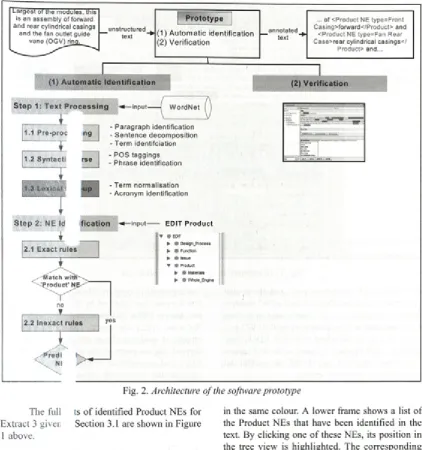
To dem onstrate the proposed approach, a software prototype was developed. Figure 2 shows the overall architecture o f the prototype. It consists o f two components: (1) automatic identification; and (2) v erification. The first com ponent w as program m ed using the Perl programming language, and the second component was programmed in Java and Protégé API2. The Protégé API was used for loading and displaying the ED IT Product NEs, which are specified in RDFS format. Extract 3 in Section 3.1 is used as an example.
3.3.1 Automatic identification
Step 1: Text Processing
The Text Processing step analyses a text with the following shallow N LP techniques.
1.1 Pre-processing
One paragraph is identified in Extract 3, w hich is then decomposed into five sentences. The first sentence is:
Largest o f the modules, this is an assembly o f forward and rear cylindrical casings and the fan
outlet guide vane (OGV) ring.
Terms are identified as words lying between two spaces including the full stop.
1.2 Syntactic parse
The A pple Pie P arser [23] is used for a syntactic parse that tags Parts o f Speech (POS) and identifies phrases. The A pple Pie Parser refers to the gram m ars defined in the Penn Treebank to determ ine the POSs [24], For exam ple, the first 2 http://protege.stanford.edu/doc/pdk/kb-api.html
w ord ‘Largest’ is tagged as JJS, i.e., a superlative adjective. The rem aining POSs for the sentence above are shown below:
POS taggings: Largest/JJS of/IN the/DT modules/ NNS, this/D T is/VB an/D T assembly/NN of/IN forward/JJ and/CC rear/JJ cylindrical/JJ casings/ NNS and/CC the/DT fan/N N outlet/NN guide/NN vane/NN (OGV)ZNNPX ring/NN.
P h ra se id e n tif ic a tio n g ro u p s w ords grammatically, e.g., into N oun Phrases (NPs) such as {Largest o f the modules} and {an assembly of forward and rear cylindrical casings}.
1.3 Lexical look-up
Each PO S-tagged word is compared with WordNet definitions to achieve term normalisation. Acronym identification extends an acronym found in a tex t fragm ent w ith its full definition. An example o f term normalisation is:
modules —4 module, casings —4 casing
and o f acronym identification is:
OGV —4 Outlet Guide Vane.
Step 2: NE Identification
The NE Identification step takes the text fragm ents processed by Step 1 as an input and applies the Exact and Inexact Rules in turn.
2.1 Exact Rules
If the text fragment is identified as having a pre-defined variation, then the NE is identified and the process for that fragment is complete.
An example o f a Product NE identified by the Exact Rules is:
Forward Casings -4 Front Casing (NE).
2.2 Inexact Rules
A probabilistic matching is required for those fragments that are not covered by the variations and that have multiple occurrences in the variations.
An example o f a product NE identified by the Inexact Rules is:
Fig. 2. Architecture o f the software prototype
The full ts o f identified Product NEs for Extract 3 given Section 3.1 are shown in Figure
1 above.
3.3.2 Verificati
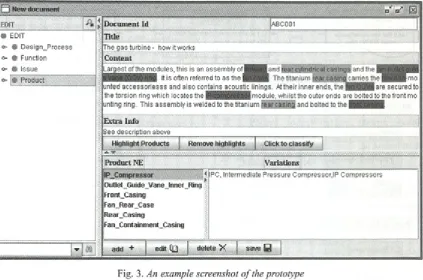
A graphical interface has been developed for the prototype software with two specific objectives: (1) to assist the manual annotation process; and (2) to help v isu alize the resu lts o f autom atic NE id en tificatio n . Figure 3 is a screenshot o f the interface showing Extract 3 as a sample text.
A user can click the ‘Highlight Products’ button, and all the text fragments that have been matched with Product NEs, shown as tree view in the left-hand fram e, are highlighted in the text frame. Fragments that have the same NEs are shown
in the same colour. A lower frame shows a list o f the Product NEs that have been identified in the text. By clicking one o f these NEs, its position in the tree view is highlighted. The corresponding variations are also shown in the adjacent frame. For NEs that have been incorrectly identified, the user can click the ‘edit’ button and make corrections. Similarly, missing NEs can be added by pressing the ‘add’ button. Each time the user presses the ‘save’ button, the text is identified as a new example and used by the naive B ayesian approach for training.
4 TESTING THE PROTOTYPE
[ □ N e w d o c u m e n t :
EDIT
• EDIT
o- 9 D esignJTocess *■ • Function
o- • Issue o- - Product
— ; : P H?
ABC001
D ocum ent Id
Title
The gas turbine - howitw orks
C ontent
Laraestofthem odules, this is an assembly o fJ H B h ih d ra w i rmr* cat ca tng and the
H M H It is often referred to as the BtW É The titanium {eat casa ti carries the fehfras&mo
unted accessoriesss and also contains acoustic linings. At their inner ends, ths K M ffilM K arfi secured to the torsion ring which locates the M H IM B S f module whilst the outer ends are bolted to the front mo unting ring. This assembly is welded to the titanium ^ s a rc a s m i and bolted to the
Extra Info
See description above _________
H ig h lig h t P r o d u c t s R e m o v e h ig h lig h ts C lic k t o c la s s i f y
Product NE Variations
IP _ C o m p r e s s o r
O u t le t _ G u id e _ V a n e J m ie r _ R in g
F r o n t _ C a s in g
F a n _ R e a r _ C a s e
F le a r _ C a s in g
F a n _ C o r r ta im n e n t_ C a s in g
IPC, Intermediate Pressure Compressor.lP Compressors
a d d + e d it f j j d e le t e X save Q
Fig. 3. An example screenshot o f the prototype
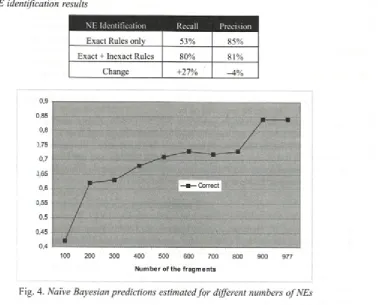
the Product N E extraction over and above that achieved by the Exact Rules. A total o f 267 problem reports, including the 137 reports used in Section 4.1, were used for the testing. A total o f 977 text fragm ents w ere identified w ith 977 ED IT NEs. EDIT has 220 Product N Es and in the 267 reports 101 o f them appeared, i.e., 119 N Es from EDIT did not appear in any o f the reports.
From the 977 fragments and their assigned N Es, 50% were randomly selected for training the prototype and the remaining fragments were used for the testing. Precision and recall were used for m easuring the p ro to ty p e’s perform ance. In this paper, recall is defined as the percentage o f the test fragm ents that were m atched w ith E D IT ’s NEs, w hether these w ere correct or not. Precision is defined as the percentage o f the recalled fragments that w ere correctly m atched. Table 3 shows the results o f the evaluation.
Overall, the prototype, using both the Exact and Inexact Rules, achieved a good balance o f recall and precision, i.e., 80% recall and 81% precision. Using the Exact Rules on their own, the recall was 53% and the precision was 85%. The addition o f the Inexact Rules therefore significantly increased the recall while maintaining the precision. The Exact Rules also failed to identify 20 o f the 101 EDIT NEs
that appeared in the reports. However, it is surprising that the precision achieved by the Exact Rules was not closer to 100%. This means that some of the Exact Rules are, in fact, not ‘exact’. The reason is that the em pirical evidence, from w hich the rules were derived, did not cover all the possible variations in EDIT and examples o f ambiguity remained. For example, the Exact Rules included ‘Stubshaft’ as a variation o f EDIT’s ‘Stub Shaft’ NE, which is a part o f ‘Turbine’. However, the ‘Stub Shaft’ component is also a part o f ‘Compressor’ and this variation was not included in the rules.
Table 3. NE identification results
NE Identification Recall Precision
Exact Rules only 53% 85%
Exact + Inexact Rules 80% 81%
Change +27% -4 %
0,85
0,8
0,75
0,7
0,65
0,6
0,55
0,5
0,45
0,4
100 200 300 4 0 0 50 0 600 7 00 800 9 00 977
N u m b e r o f th e fra g m e n ts C orrect
Fig. 4. Naive Bayesian predictions estimated fq r different numbers ofN Es
5 CONCLUSIONS AND FUTURE WORK
It is well established that when engineers need information they tend to ask colleagues in the first instance. However, the industrial world is now m ore transient anH key personnel are retiring and fr e q u e n tly m o t g, e ith e r w ith in th e ir ow n o rg a n is a tio n s o co o th er o rg a n isatio n s. It is becom ing necess / to retrieve more information from archived do ments. There is, therefore, great interest in ways ' extracting such information. Inform ation coni led in a document is easier to retrieve if domair itities are explicitly tagged with their types so th can be more easily identified using keyword s ches.
H ow ever t is p a rtic u la rly d iffic u lt to autom atically ia itify engineering entities, i.e., P ro d u c t N E s, due to the h ie ra rc h ic a l and compositional nature o f their descriptions. Two IE approaches for achieving this are described in this paper: Exact Rules and Inexact Rules, the latter being based on naive Bayesian probability. When using the Exact Rules on their own the recall was 53% and the precision was 85%. By adding the Inexact Rules the recall increased significantly to
80% and the precision remained good at 81%. State- of-the-art IE systems are known to demonstrate comparable recall and precision to the proposed approach. However, those systems have mainly been applied to limited types o f NEs that do not use a hierarchy to classify them. This research has focused on a wider range o f engineering Product NEs that use a hierarchical taxonomy to classify them.
The main contributions o f this research are: (1) the observation that Product NEs are more com plex than o th er types o f N E; and (2) the d ev e lo p m e n t o f a p ro b a b ility -b a se d NE identification approach to! identify correctly these com p lex N E s in te x ts. T he im p ro v ed re c a ll achieved, i.e., from 53% to 80%, is believed to be due to the reliable and robust probability estimates based on how the various com binations o f the attributes in a given fragm ent are related to the correct Product NE.
has n o t ap p eared in any exam ples. In current practice, the identification is made incrementally, i.e., w ith each example the probability distribution is computed and revised, so that the existence o f a new example is only recognised manually after the identification is evaluated incorrectly. Since the probability model might need a certain number o f exam ples in order to learn a correct probability distribution, it might take some time to predict a Product NE correctly. This can be improved on by first clustering similar examples into groups without considering the potential NEs. In this way, it is easy to identify the list o f Product N Es that m ight need further examples.
W hen the hierarchy o f the Product root concept in ED IT changes, i.e., a new concept is
added or an existing one is deleted, the existing probability model has to be revised. In doing so, it is necessary to check whether this change affects the existing model. Currently, the probability model is re-computed when such a change occurs. This can be improved by revising only the part o f model where the change needs to be reflected.
A cknow ledgem ents
This research was funded by the University Technology Partnership for D esign, w hich is a c o lla b o ra tio n b e tw e e n R o lls-R o y c e , BAE SYSTEM S and the U niversities o f Cambridge, Sheffield and Southampton.
6 REFERENCES
[1] Rosner, D., Grote, B., Hartman, K., and Höfling, B., (1998), From natural language documents to sharable product knowledge: a know ledge engineering approach, In Inform ation Technology for Knowledge Management, 8, Springer, New York., p p .151-182.
[2] 80-20 software., (2003), 80-20 retriever enterprise edition, http://www.80-20.com/brochures/Personal Email Search Solution.pdf
[3] M arsh, J.R., and Wallace, K., (1997), Observations on the role o f design experience, WDK Annual Workshop, Switzerland.
[4] Ahmed, S., and Wallace, K. M., (2004), Understanding the knowledge needs o f novice designers in the aerospace industry, Design Studies, Voi. 25, No. 2, pp. 155-173.
[5] Donnellan, B., and Fitzgerald, B., (2003), A KMS application to support knowledge sharing in a design engineering community, Proceedings o f the Eleventh European Conference on Information Systems,
Italy.
[6] Otto, K., and Abecker, A., ( 1998), Corporate memories for knowledge management in industrial practice: prospects and challenges, In Information Technology for Knowledge M anagement, 8, Springer, New York, pp. 183-206.
[7] Herlocker, J. L., Konstan, J. A., Borchers, A., and Riedl, J., (1999), A n algorithmic framework for perform ing collaborative filtering, Proceedings o f the 22nd Conference on Research and Development in Information Retrieval, U.S.A., pp.230-237.
[8] Furnas, G., Landauer, T., Gomez, L., and Dumais, T., (1986), Statistical semantics: analysis o f the potential performance o f keyw ord information systems, Bell System, Technical Journal, Voi. 62, No. 6, p p .1753-1806.
[9] Gilchrist, A, (2001 ), Taxonomies for business: knowledge representation, Proceedings o f the 11th Nordic Conference on Information and Documentation, Iceland
[10] Collier, R., (1996), Autom atic template creation for information extraction, an overview, PhD thesis,
University o f Sheffield.
[11] Grishman, R., (1997), Information extraction: techniques and challenges, In Lecture Notes in Artificial Intelligence, Voi. 1299.
[12] K im , S., Lewis, R, M artinez, K., and Goodall, S., (2004), Question answering towards automatic augmentations o f ontology instances, Proceedings o f the first European Semantic Web Symposium, pp.
152-166.
[14] Staab, S. Maedche, A., and Handschuh, S., (2003), Creating metadata for the semantic web, an annotation environment and the human factor, Computer Networks, Voi. 42, pp.579-598.
[15] Riloff, E., (1993), Automatically constructing a dictionary for information extraction tasks. Proceedings o f the I I th National Conference on Artificial Intelligence (AAAI-93), pp. 811-816.
[16] Mikheev, A., Grover, C., and Moens, M., (1998), Description o f the LTG system used for MUC-7,
Proceedings o f the Seventh Message Understanding Conference, Virginia.
[17] M uslea, I., (1999), Extraction patterns for information extraction tasks: a survey, Proceedings o f the AAAI Workshop on Machine Learning fo r Information Extraction, Florida.
[18] Ahm ed, S., (2005), Encouraging reuse o f design knowledge: a method to index knowledge, Design Studies, Voi. 26, No. 6, pp.565-592.
[19] M arsh, E., and Perzanowski, D., (1997), MUC-7 evaluation o f IE technology: overview o f results,
Proceedings o f the Seventh Message Understanding Conference.
[20] Miller, G.A., Beckwith, R.W., Fellbaum, C., Gross, D., and Miller, K., (1993), Introduction to wordnet: A n on-line lexical database, International Journal o f Lexicography, Voi. 3, No. 4, pp.235-312. [21 ] Paliouras, G., Karkaletsis, V , Petasis, G., and Spyropoulos, (2004), Learning decision trees for named-
entity recognition and classification, Proceedings on the Workshop on Machine Learning fo r Information Extraction, ECAI, Germany.
[22] M itchell, T., (1997) Machine learning, McGraw Hill.
[23] Sekine, S., and Grishman, R., (2001), A corpus-based probabilistic grammar with only two non-terminals,
Proceedings o f the P' International Workshop on Multimedia annotation.
[24] Macus, M.P., B. Santorini, M., and Marcinkiewicz, A. M.. (1994) Building a large annotated corpus o f English: the penn treebank. Computational Linguistics 19 (2), 313-330.
Authors’ Addresses: Dr. Sanghee Kim Prof. Dr. Ken Wallace University o f Cambridge Department o f Engineering Trumpington Street Cambridge, CB2 1PZ, U.K. [email protected] [email protected]
Prof. Dr. Saeema Ahmed
Technical University o f Denmark Department o f Mechanical Engineering Building 404
DK-2800 Lyngby, Denmark [email protected]
Sprejeto:
Accepted: 27.6.2007