in the population sciences published by the Max Planck Institute for Demographic Research Konrad-Zuse Str. 1, D-18057 Rostock · GERMANY www.demographic-research.org
DEMOGRAPHIC RESEARCH
VOLUME 23, ARTICLE 1, PAGES 1-40
PUBLISHED 02 JULY 2010
http://www.demographic-research.org/Volumes/Vol23/1/ DOI: 10.4054/DemRes.2010.23.1
Research Article
Multi-residence in France and Australia:
Why count them? What is at stake?
Double counting and actual family situations
Laurent Toulemon
Sophie Pennec
© 2010 Laurent Toulemon & Sophie Pennec.
This open-access work is published under the terms of the Creative Commons Attribution NonCommercial License 2.0 Germany, which permits use, reproduction & distribution in any medium for non-commercial purposes, provided the original author(s) and source are given credit.
1 Introduction 2
2 Background 3
2.1 Previous studies 3
2.2 Definitions of multi-residence 5 2.3 Family situations and multi-residence 7
3 Data 9
3.1 The French EU-SILC 9
3.2 The Australian HILDA survey 11 3.3 Weighting households and individuals 14 4 Estimating the prevalence of multi-residence status by age and sex 16 4.1 France: 3.7% of inhabitants living in two dwellings 16 4.2 Australia: 1.5% to 1.7% of inhabitants live in two dwellings 18 5 Family situations of adults and children: What difference does it
make when multi-residence is considered?
21 5.1 No effect on distribution by the conjugal situation of adults 21 5.2 An effect on the family situation of children in France… 23
5.3 … but not in Australia 26
6 Taking multi-residence explicitly into account 28 6.1 Dwellings, households, and individuals 28 6.2 Multi-residence as a specific category 29
7 Conclusion 32
8 Acknowledgements 34
References 35
Multi-residence in France and Australia:
Why count them? What is at stake?
Double counting and actual family situations
Laurent Toulemon1
Sophie Pennec2
Abstract
With the increasing diversity of family situations, growing numbers of people, including children, have more than one home. In France, nearly 4% of inhabitants are likely to be counted twice in surveys; while in Australia, the proportion is less than 2%. Taking into account the possibility that a single individual could have multiple residences is necessary not only to avoid double counting, but also to accurately describe the family situations of adults and children. In this paper, we first estimate the proportion of people living in two dwellings and then describe the consequences of these two-home situations for basic estimates of family situations. Our analysis is based on two large-scale surveys: the 2004 EU-SILC in France and the 2001 HILDA in Australia. A striking result is that, in France, half of all children who are counted as living with their fathers are in fact dividing their time between the homes of separated parents.
1 Institut national d’études démographiques (INED), 133, Boulevard Davout, F-75980 Paris Cedex 20,
France. E-mail: [email protected].
2 Institut national d’études démographiques (INED); National Centre for Social and Economic Modelling
1. Introduction
Family transitions and situations have become increasingly difficult to categorise. The processes of union formation and dissolution take time, and during that period people may live ‘more or less’ as a couple, e.g., by spending a few days and nights together per week, while maintaining separate households. Distinctions between categories such as living together as a couple (in one or two dwellings), living apart together, or being in a stable relationship, are sometimes difficult to make. Older adults close to retirement may spend a large part of the year in their holiday home, or they may ‘visit’ their children for long periods while maintaining their own home. These ambiguous family situations correspond to having multiple residences, i.e., ‘usually’ living in several homes, or ‘commuting between households’. The same is true for children: After a parental separation, children may spend some time with one parent, and some time with the other, especially when parents share custody of their children, an arrangement that is becoming more prevalent.
As these new family situations become more common, we may assume that the proportion of adults and children who split their time between two dwellings is increasing in France and Australia, as well as in many other Western countries (see, e.g., Heuveline, Timberlake, and Furstenberg 2003 about the family situations of children). In most countries, rules are applied in censuses or routine surveys in order to take these situations into account, and to avoid the double-counting of individuals (most often by restricting the observation of individuals to their ‘main’ dwelling, i.e., the place where they live more than half of the time; this is the case in Australia for the HILDA panel survey). However, these rules do not allow for an accurate description of the situation of individuals who ‘usually’ live in two separate homes.
The aim of this work is threefold. The first part presents an estimate of the proportion of people living in two or more households. The second part describes how these situations are or could be controlled for in order to avoid double counting. The third part takes these situations explicitly into account in order to measure the consequences of these two-home situations on basic estimates of family situations and households.
In this paper, we compare France and Australia. France was selected for this study because several questions on multiple residences among adults and children have already been included in the core content of most surveys conducted by the National Institute of Statistics and Economic Studies (Institut national de la statistique et des
études économiques, INSEE) (Herpin, Toulemon, and Verger 2001), and have shown
family environments.
increasing. In both countries, efforts are currently being made to take the multi-residence status into account in the census. This is being done by in France using a specific one-percent survey, and in Australia through the addition of some specific questions in the census form. Our comparison examines whether the main questions related to this topic are the same in both countries.
2. Background
The background paper of the 35th seminar of the CEIES3 on “New Family
Relationships and Living Arrangements. Demands for Change in Social Statistics” states that a “critical point is ‘to live in the same dwelling’ or ‘persons living together’ as one of the criteria to define a household” (CEIES 2007). Adults and children can divide their time between two or more homes, which can lead to ambiguous responses regarding ‘living in a dwelling’, and can raise new questions about how we define households and
The first step is to define ‘multi-residence’. What is multi-residence about? How can we measure this phenomenon? How common is it? What is the family situation of a person who lives in several dwellings? How does the presence of people who have multiple residences affect the collection of data on family situations? These are the main issues addressed in this paper.
2.1 Previous studies
In a seminal paper, Saraceno (1994) introduced the concept of ‘commuting between households’ as a challenge to family boundaries. Commuting was first defined as the process of travelling between one’s place of residence and one’s regular place of work or study. Most often, commuting takes place on a daily basis. But commuting may also take place over a longer time period. All the persons who usually live in more than one dwelling can be considered to be commuting between households. In this paper, the term of multi-residence is used as a synonym for commuting between households, which is different from daily commuting.
Identifying commuters between households is not straightforward. In censuses and surveys, the household members grid often includes only persons living in the
household on a permanent basis. Distinguishing between other members of the household, such as between ‘visitors’ and persons who ‘usually’ live in the household, is not an easy task. First, objective definitions, such as of the number of nights spent in the household, may not be considered relevant by individuals, and people may be tempted to use their own definitions. Second, some situations may be ambiguous, and different people may have different views on the situation of a particular person.
In the Recommendations for the 2010 censuses (UNECE and Eurostat 2006), a new non-core topic was added relating to secondary, seasonal, and vacant dwellings available for the household (see paragraphs 632-637): “It allows for the description of some features of unoccupied conventional dwellings: number of rooms and useful floor space, amenities (e.g. water, toilet, bathing, hot water, sewage system, heating, electricity), type of building, […] distance and travel time from the usual residence. […] The main approach should be that the information on secondary and seasonal dwellings covers dwellings at the disposal of one household on an annual basis. […] For other circumstances double counting must be avoided; this may occur for example where there is joint ownership of a secondary dwelling by two or more households.”
The censuses in Switzerland and Italy already use that definition, and ask residents to fill in a form for all their usual dwellings. In Switzerland, the information is used to prevent the double counting of individuals and households through the deletion of one of the forms. In Italy, the same individual is included in List A (“Individuals who usually live in the accommodation”) in their main place of residence, and in List B (“Individuals who normally do not live in the accommodation”) in the other dwellings. Some questions are asked about the other place of residence, which makes it possible to assign certain individuals the status of ‘multi-residence’. The census is also used to update the population register, in which inhabitants can be registered only once (Toulemon 2010).
Smyth and Parkinson (2003) described patterns of contact that Australian children who usually live with their mother have with their non-resident father. They found that 47% of non-resident fathers have children staying overnight at least once a month, while 53% do not: 17% of the latter group said they see their youngest non-resident child only during the day, and 36% reported having no face-to-face contact. From the children's viewpoint, the study found that 56% of children with a parent living elsewhere never stay overnight with this parent (Smyth and Ferro 2002). The boundary between having multi-residence status and being a frequent visitor at the home of the non-resident parent is not simple. More precise distinctions could also be made, such as the difference between ‘two-home children’ and ‘two-household children’, with the former term implying joint physical custody, and the latter referring to having a bed in each of the two separate households (Callister and Birks 2006).
A precise description of the trend towards having multiple residences among children whose parents are separated is also useful for understanding the discrepancies – and increasing the consistency – of information collected from parents and children on their actual patterns of residence (Lapierre-Adamcyk, Le Bourdais, and Martin 2009). If the multiple residences of partners are not taken into account, discrepancies can occur in the answers given by mothers and children on the co-residence of the mother, the stepfather, and the (step)child (Brown and Manning 2009).
2.2 Definitions of multi-residence
An individual can only be at one place at a time, but when the observation window is larger than one day (or one night), he/she could ‘live’ in more than one dwelling. Three rules are used in censuses and surveys when taking the possibility of multi-residence status into account:
Single residence rule: Each individual is attached to a single dwelling. This dwelling can be the ‘usual’ dwelling, where the individual lives most of the time, or the place where the individual is present at a point in time, e.g., where s/he slept on the night of the ‘census day’;
Complete information rule: In some surveys, as in the French version of EU-SILC and in the Australian HILDA survey, several questions are asked concerning all the persons living in the dwelling in order to collect more precise information about their situations.
Of course, only the third method provides a complete definition of multi-residence. Several definitions are possible, but we will concentrate on the following definition: Over the course of a year, an individual has several residences if s/he ‘usually’ lives in different dwellings.
Identifying commuters between households is important in order to accurately describe the family and housing situations of inhabitants. First, double counting results in the overestimation of some family situations, especially one-parent and stepfamilies, as we will see below. Second, collecting data for many basic indicators, such as standard of living or the number of persons per household, implies using the single residence rule. In such cases, the rules used to define where individuals have their usual residence may be important.
2.3 Family situations and multi-residence
The family links of an individual with other persons living in the dwelling provide a very effective means for understanding the actual situations of commuters between households. Living in more than one dwelling may result from different family situations, and thus lead to different types of bias if multi-residence is not taken into account. Six cases can be considered:
Case 1: Children whose parents are separated. They do not choose where they live, and do not answer surveys themselves. A child may be counted twice if each of his/her separated parents reports sharing a home with the child. The number of children whose parents are separated (single-parent families and stepfamilies) is thus overestimated. Some parents may be reluctant to declare that their child is also ‘usually living’ with their former partner, as the inconsistent results in the French Family History survey demonstrate (Toulemon 2005).
Case 2: Young adults living with their parents (on weekends) and also in another dwelling (week days); typically students. This is a well-known (and sometimes accepted) situation in which double counting can occur in censuses. Young adults believe that they have left the parental nest, and are happy to be registered on their own, while their parents think that they are still part of their household, and register them as children in their household (Villeneuve-Gokalp 2005). It should be noted that their ‘own home’ may be a student room (an individual dwelling forming part of a communal establishment4), or the
main residence of another household, e.g., of the grandparents. Double counting is likely in the latter case, but is unlikely in the former, because student rooms and communal establishments are not ‘private dwellings,’ and are therefore not included in most surveys.
Case 3: Adults ‘living apart together’ (LAT), entering a relationship, ending a relationship, or spending some days and nights together, but having two dwellings. These situations are not rare, as the processes of couple formation and union dissolution typically last around one year, during which time the residential situation may be ambiguous. These LAT situations may be declared in many different ways: Each partner may be counted as either part of a couple, or as not part of a couple. In censuses, some couples are not recognised
4 According to the UK census advisory group (1999), “In general, communal establishments share the
following characteristics:
they are non-private dwellings or units of accommodation; they are used for a specific purpose;
as such because each partner fills in a form for her/his own dwelling. If the partners have children, some single-parent families may emerge as an artefact. Case 4: Adults living as a couple but living in two households for some reason (e.g.,
one partner commutes between the family home and another dwelling). Working in another town and thus being separated from one's family during the week is the most common situation, but many other situations are possible. E.g., a partner may be in a retirement home/nursing home, a long-term care hospital, or prison. This situation is similar to that of Case 2, with the difference being that the person who lives elsewhere is not a child, but an adult who was counted in the first dwelling. The distinction between ‘voluntary LAT’ (Case 3) and ‘involuntary non-resident or partially non-resident couples’, which we could designate as ‘part-time cohabiting couples’, is not straightforward. The main difference is that a double counting of the commuting member of the couple is more likely in this situation than in Case 3.
Case 5: A dependent person, such as an elderly or a disabled member of the family, moving from one child’s household to another during the year. The number of complex households may be overestimated or underestimated, depending on the rules of inclusion in the household members grid. For instance, an elderly mother spending four months with each of her three adult children may be counted up to three times if she is considered in none, some or all of the children’s households, thus leading to the formation of a number of complex households.
Case 6: A complete household that moves several times during the year, from one dwelling to another. This can occur, for example, when a holiday home becomes a ‘usual’ dwelling. This situation may become more common with the increase in flexible working schedules, pre-retirement periods, etc. The difference with respect to LAT couples is that couples living apart together may ‘visit’ one another, while other couples who move regularly from one home to another see themselves as commuting together ‘as a couple’, even if each partner owns a separate home (Caradec 1997).
In each case, it is easy to see that some situations may be declared as multi-residence, while others may not be, irrespective of the actual situation. The motives for declaring or not declaring two usual residences are also very diverse. In France, the income tax rules now allow parents to count their children in their household, either full-time or part-time, even if they also live with the other parent. Rules for the allocation of social housing take into account the number of co-resident children, including children of separated parents with shared custody (and thus allowing double counting of these children). Some allowances are specific to lone parents, while others are means-tested, with an income ceiling based on the income of both partners, and on whether they share the same home and are married. Statistical surveys are anonymous and have no impact on the administrative status of individuals and families; nevertheless, some respondents may be tempted to give answers consistent with their ‘administrative’ situation. In Australia, tax rules and allowances are more individual-based, and such motives may be less prevalent.
The question on multi-residence status may be ambiguous because many situations are unclear for the respondents: Holiday homes may in practice be second homes that also serve as a usual residence, or they may be a secondary home that does not qualify as a ‘usual residence’. Thus, commuting between households is often not recognised as such by the respondents, who may believe that they have only one ‘usual’ residence; even though, according to our definition, they actually have two ‘usual residences’. The rules defined in the French and Australian surveys are described below, as are the ways in which they are applied in practice. Let us now describe our two datasets.
3. Data
3.1 The French EU-SILC
The Enquête sur les ressources et les conditions de vie, ERCV, is the French edition of the EU Survey on Income and Living Conditions (EU-SILC, see, e.g., Eurostat 2007). The survey was conducted by INSEE. The first wave took place in 2004, and the results presented here are computed from this first wave.
occupants of the dwelling’, Tableau des habitants du logement, THL, the main respondent answers the following questions:
- Question A7. Does <first name> live here…
o No (member of the household living elsewhere, in another dwelling)
o (Almost) all year
o During the weekend or holidays => (A8) How many days per year?
o On working days => (A9) How many days per week?
o Some months in the year => (A10) How many months since
last year?
o Less often => (A11) How many days per year?
Several controls are added and supplementary information is obtained on the ‘other dwellings’. For those who are living only in the home where the interview takes place, the question is repeated: ‘Question A12. Does <first name> also live elsewhere from time to time?’ For those living in another home (answer ‘2’ to ‘5’ to question A7, or answer ‘yes’ to question A12), respondents are asked whether this other home (or one of the other dwellings) is a communal establishment (and its type), or whether it is an ordinary dwelling, and how many other ordinary dwellings the person ‘usually’ lives in. Finally, there is a question about the existence of any people who ‘usually’ live in the home, but who have not already been listed, and a question that describes explicitly, as a reminder, several cases such as ‘a child in the custody of the other parent; a student living elsewhere during the year; a person with whom a member of the dwelling has an intimate relationship; a sub-tenant’.
The EU-SILC survey also includes specific questions about couples, parents, and family links. First, there are questions about whether the person is living as part of a couple, and about his/her parents:
- For each person aged 15+, Question B1. Does <first name> currently live as a couple?
o Yes, with another occupant of the dwelling [the partner is then identified by her/his number in the household grid]
o Yes, with a partner living elsewhere
o No
- For all respondents, Question B4. Is the mother of <first name> still alive?
o Yes, and she lives here [the mother is then identified by her number in the household grid]
o Yes, and she lives elsewhere
o No, she is deceased
The same question is asked about the father of each person living in the dwelling. Second, if a person has no identified family ties with others, a specific question is asked. The household form thus contains information which identifies the family ties between the household members (partners, parents or children, stepparents or stepchildren, parents- or children-in-law, brothers and sisters, grandparents or grandchildren, friends, other relatives, or other family ties, with more detail provided). The occupants of the dwelling (including those who live only part-time in the dwelling) are grouped into households. Each respondent is asked about his/her household, which includes ‘all people who, in daily living, contribute resources or benefit from expenses incurred by the household’. There may be different households within the dwelling, sharing no resources or expenses, except for housing.
The household form does not provide information on the children ever born to the household members, but not living in the household. In the French EU-SILC, a question is asked later in the questionnaire on the number of children (dead or alive, including adopted children) ever born to each respondent, and a question is asked about any children (of the respondent or his/her partner) living outside of the home, but these questions are not included in the standard household form.
Another part of the questionnaire is devoted to each person’s other residences: where they are, who lives in them (a question about the presence of the ‘other parent’ of children aged below 15 was added in the following waves), whether the dwelling is a main home or a holiday home for the household (whether all the household uses this dwelling), and whether somebody who could be included in the sample can be contacted in this household before the end of the survey fieldwork.
Among the 25,299 individuals in the French EU-SILC sample, 6,147 are aged 0-17 and 18,331 are aged 18-79. After age 80, the proportion of people living in retirement homes is too high for the sample to be representative. Results for adults aged 80+ must thus be used with caution.
3.2 The Australian HILDA survey
comprised 6,872 households and 13,969 individuals. Members of the original survey in 2001 have been traced and interviewed annually, along with new members of their households. Detailed information on the HILDA survey is available on the website http://www.melbourneinstitute.com/hilda/. Eight waves have been released to date. In this paper, we use the data from the first wave of HILDA.
The sample is made up of private dwellings. Within these dwellings, households comprise individuals who have a common budget. Lodgers, who receive accommodation only (not meals), are treated as a separate household, while boarders, who receive accommodation and meals (board), are treated as part of the household (Watson and Wooden 2002).
Contrary to the French EU-SILC, the single residence rule applies for the persons interviewed in the HILDA survey. Watson and Wooden (2002:7) explained the treatment in the survey of people with multiple residences as follows: “In general, persons who live in more than one household were only considered as members of the household where they spent most of their time. People who lived in another private dwelling for more than 50 per cent of the time were not considered as part of the household. Visitors to the household were also not treated as part of the household. Finally, people who usually lived in the household but were temporarily absent for work, school or other purposes were treated as part of the household, and this meant that a small proportion of interviews were conducted in locations other than at the household address. […] Children attending boarding schools and halls of residence while studying were treated as members of sampled households provided they spent at least part of the year in the sampled dwelling.” Those living in a private household while studying are not considered to be members of their parents’ dwelling, but may be sampled on their own (Watson, personal communication). In cases in which a dwelling contained more than one household, all its households were sampled. In cases in which four or more households occupied one dwelling (10 cases), a random sample of three of them were included in the sample. More details on the methodology can be found in Watson and Wooden (2002).
The household form is the first part of the interview, and serves to gather
information on all household members, including those who also live in another dwelling. In the household form, the list of the persons who ‘usually live here and who are members of this household’ is first filled in (the term ‘usually’ is highlighted in the questionnaire as a crucial criterion of inclusion5). Then another question is asked about
‘any other household members who usually live here but are now away on business, at school, in hospital or somewhere else’. Finally, a specific question is asked about
5 In a box page 4 of the form those living in another private dwelling 50% or more of the time are considered
children at boarding school: ‘Are there any other children who spend at least part of the year here who are at boarding school or live in a university hall of residence?’
Another specific question checks whether any household member is also living elsewhere part of the time: ‘Does everyone live here all the time, or do some live elsewhere part of the time (e.g., lives with other parent elsewhere, or in student accommodation or at employment related accommodation)?’ For those who also live elsewhere, two additional questions follow, one on the share of time spent in the dwelling, and one on the reasons for multi-residence: ‘Does … live here about half the time, more than half, or less than half?’ and ‘Why does … live here only part of the time?’.
A set of questions similar to the EU-SILC questionnaire about each person's living arrangement/marital status serves to describe the conjugal situation of persons aged 15+:
Which of the following categories best describes <…..>’s living arrangements
- Legally married and living with a spouse... 1
- Living with someone in a relationship but not legally married to them ... 2
- Not presently living with someone in a relationship and: o Separated... 3
o Divorced... 4
o Widowed ... 5
o Never legally married... 6
o Legally married ... 7
Like the French EU-SILC, HILDA does not provide information about the situation of all the children ever born, but only about those living in the household. Questions about all children ever born and the place where they live (e.g., in the household surveyed, in their other parent’s household, in their own household), are included in the person questionnaire (respondents are persons aged 15+).
living elsewhere. We use this additional information in Section 5.3 to estimate the risk of double-counting for children whose parents are separated.
Unlike the EU-SILC, HILDA does not provide information on people ‘living apart together’. No specific question in the household form can be used to distinguish these situations in Wave 1. This topic is investigated once in Wave 5 in the person questionnaire. A follow-up of LAT situations is thus not possible using these data.
Both surveys include a complete ‘relationship grid’ giving precise indications of the family relationships between all household members. See Brandon (2004) for an analysis of living arrangements of children in Australia based on HILDA data.
3.3 Weighting households and individuals
In both surveys, the ‘household weight’ is estimated as the inverse probability of inclusion of the address, with post-stratification on some population margins (with all household members keeping the same weight). The bias due to errors on sampling probabilities may be diluted if the variables used for post-stratification are correlated with multi-residence. As the numbers of individuals are constrained by the post-stratification, biases are only present on structures and subtotals, e.g., the number of children remains unbiased, but the proportion of children living with one parent may be biased. The most common rule in surveys and censuses, based on the time spent in each dwelling, may lead to numerous errors.
For an individual who reports that s/he also lives in another dwelling, the critical information is her/his probability of being included in the sample as living in the other dwelling. Several criteria could be used, but it is difficult to know what practical rules were used during the fieldwork, and they not always consistent.
not necessarily live in a dwelling which is the ‘main’ dwelling of any household. Furthermore, some respondents may be reluctant to reply accurately, especially if there are family conflicts related to this situation of multi-residence.
In the French EU-SILC survey, children are very likely to be counted twice if they ‘usually’ live in both dwellings of their separated parents, with both being the main dwelling of one parent. On the contrary, the probability of counting adults twice is probably much lower, as one of their dwellings may be a communal establishment or a dwelling not considered to be a ‘main dwelling’ according to the rules applied for the fieldwork of the French EU-SILC survey. But the initial attempts to use the precise information from the French EU-SILC survey to estimate the probability of inclusion in the other dwelling were not successful: too many cases were inconsistently coded, and errors and omissions are likely to be numerous.
A more refined weight was thus computed, taking into account the information on the other dwelling. The ‘corrected’ weight is computed as the ratio of the original weight to the number of ordinary dwellings in which each person ‘usually’ lives. For the sake of simplicity, we did not take into account the information on the time spent in each dwelling, or the information about the possibility of reaching somebody in this household.6
In the Australian HILDA survey, double counting is less likely, since only people who ‘usually’ live in the dwelling are included in the list of residents of the household. When they do not live full time in this dwelling, the reason for living elsewhere and the percentage of time spent in the dwelling are investigated. But they are not removed from the list when the percentage of time spent in the household is lower than 50% for study- or work-related reasons, leading to some potential for minor problems with double counting. If defined as living in the dwelling at least 50% of the time, the reference to the ‘usual’ dwelling may exclude from the sample the persons who divide their time equally between two different dwellings. Shared custody is still quite low in Australia – 6% of separated parents share custody (Smyth and Weston 2004) – and it is likely that parents will be more inclined to over-represent the share of time their children spend in their own household, so the number of ‘missing persons’, if any, should be negligible. We estimated the probability of double counting among children living in two households, based on the hypothesis that half the children living with the other parent were counted by both parents (among the sample, this means than two-thirds of such children are double counted). This is an extreme assumption, as 44% of children with a parent living elsewhere stay overnight with this parent (Smyth and Ferro
6 The value of this variable led to strange results, the mean time spent in the household being too small to be
2002), leading to a low estimate of multi-residence status, while the crude weights are implicitly based on the assumption that double counting does not occur. For children not living with their other parent, we assumed that there was no double counting.
When corrected weights are used, the results from both surveys are thus comparable, despite the differences in the forms and survey methods.
4. Estimating the prevalence of multi-residence status by age and sex
The first estimate of prevalence uses the household grid, with each member of the household being given the same weight, the ‘household weight’, which is estimated as the inverse probability of inclusion of the address, with a post-stratification on some population margins (with all household members keeping the same weight).
4.1 France: 3.7% of inhabitants living in two dwellings
When we look at the French EU-SILC survey data using raw weights, we can see that having multiple residences is far from being a marginal phenomenon in France. Around 6% of women and 7% of men in the sample ‘usually’ live in more than one dwelling. The proportion is 4% at ages below five, and reaches 20% at ages 20-24. The prevalence of multi-residence status is lower for adults: it is lowest at ages 30-55, and increases slightly at higher ages (Figure 1). According to these data, no fewer than 3.7 million people in France have multiple residences.
When using a corrected weight that takes into account the higher inclusion probability of commuters, the prevalence is much lower, but still not negligible: 3.4% of women and 4.0% of men usually live in two dwellings. In France, 1.1 million women and 1.2 million men thus live in more than one ordinary dwelling (Figure 2). This estimate of 2.3 million is a minimum because we assumed that people could be contacted in all their family households. It is very close to the 2.4 million estimated in Italy (Fraboni 2006).
Figure 1: Percentage of men and women living in two dwellings, in France, by age, according to the uncorrected household weights
6,7% 5,8% 0 2 4 6 8 10 12 14 16 18 20 22
All ages 00-04 05-09 10-14 15-19 20-24 25-29 30-34 35-39 40-44 45-49 50-54 55-59 60-64 65-69 70-74 75-79 80-84 85-89 90-94 95-99 Men Women
Source: INSEE, French EU-SILC 2004.
Figure 2: Percentages of men and women living in two dwellings in France, by age, using corrected weights taking into account sampling probability
4,0% 3,4% 0 2 4 6 8 10 12 14
All ages 00-04 05-09 10-14 15-19 20-24 25-29 30-34 35-39 40-44 45-49 50-54 55-59 60-64 65-69 70-74 75-79 80-84 85-89 90-94 95-99 Men Women
Overall, the differences between men and women are small, except at ages 25 to 40, when men are more likely to commute than women (the differences found between young boys and girls are unstable with age, and need to be confirmed when other surveys are available). Most children who commute between households are commuting between their parents’ homes, as we will see below. For adults, the survey does not give any information on the reasons for living in the other dwelling, and the weighting correction procedure is less precise than for children, for whom the second dwelling is very likely to be the main dwelling for at least one person (the other parent or an adult the child is living with in his/her other dwelling). Therefore, we will not describe in detail the family situation of adults, but only give some main results from Toulemon and Pennec (2009). At ages 18-24, most commuters are commuting between their parental home, where both parents live, and another place away from their parents (7.6%, while 3.4% commute between a parental home with one parent only and another dwelling, and 1.5% live in a dwelling with no parents). Among young adults, commuting between a parental home and another household is more common when the parents are not living together (19% versus 14%, but these figures are not very precise, as we do not know the family composition in the other dwelling). After age 25, the most common commuting situation is to live as a couple (1.5% among respondents aged 25-59) or without the parents (0.6%), while only 0.2% still live with one or both parents in the dwelling where the survey took place. Similar results are found at ages 60+.
4.2 Australia: 1.5% to 1.7% of inhabitants live in two dwellings
of multi-residence. Unlike in France, multi-residence in Australia does not increase at older ages.
Because individuals are included in the list of household members only if they ‘usually’ live in the household, double counting should not occur in the HILDA survey. Information is limited about the individuals’ other home: we know whether the person lives part-time with the other parent, lives elsewhere, or is staying in student or work-related accommodation, and the share of time spent in the dwelling under study. Not surprisingly, more than 80% of children under age 15 who live in two dwellings are living with their other parent in the other dwelling, while for the 15-29 age group, the reasons for multi-residence are equally split between ‘student accommodation’ and ‘other reason’, while for people over age 30, the main reasons are, ‘work related’ or ‘other reason’.
Figure 3: Percentage of men and women living in two dwellings in Australia,
by age
1.7% 1.6% 0 2 4 6 8 10 12 14
All ages 00-04 05-09 10-14 15-19 20-24 25-29 30-34 35-39 40-44 45-49 50-54 55-59 60-64 65-69 70-74 75-79 80-84 85-89 90-94 95-99 Men Women
Source: Melbourne Institute, HILDA survey, 2001.
counting, unlike for France. According to this estimate, 2.8% of children aged 0-17, and 1.4% of adults, are living in two dwellings. Assuming (a high estimate) that 40% of children and 5% of adults were counted twice in the HILDA survey due to multiple residences, the overall prevalence of multi-residence would fall to 2.0% among children and 1.3% among adults, with an overall prevalence of 1.5%.7 In the next section (5.3),
we assume that half the children dividing their time between two parents are being counted twice, and the weights are corrected accordingly, leading to the same low estimate of 2.0% multi-residence among children. In any case, even under the assumption of no double counting in the HILDA survey, multi-residence is shown to be much less common in Australia than in France.
In Australia, the rule defining the ‘usual’ dwelling as the one where people ‘spend most of their time’ may not be perfectly applied. The prevalence of multi-residence could be underestimated because some commuters between households, such as workers and students, might not consider their work or student accommodation to be a residence, and might report having one single residence, their family home, even if they sleep most of the time at their work or student dwelling. Following the same logic, we may assume that partners and parents may, in some cases, fail to report that their spouse or children are living elsewhere (ABS 2007, personal communication from M. Sheley and P. Corr).
Although it appears that the number of people with multi-residence status may be underestimated in Australia, we may nonetheless assume that this phenomenon is less frequent in Australia than in France. In Australia, there is no incentive (in terms of tax breaks, welfare benefits, or social housing allocation) to declare more than one ‘usual’ dwelling, while the opposite is true in France. On the one hand, the French rules provide proof that such situations are common enough to be considered as a specific category by the state; while, on the other hand, these rules make it easier for people to report that they live in more than one dwelling. In Australia, shared custody of children did not exist on a legal basis in 2001. It was introduced in 2006 under the Family Law Amendment (Shared Parental Responsibility) Act. The observed difference is so large (1.7% are commuters between households in Australia, versus 3.7% in France) that it cannot be attributed to different interpretations of the questions. In particular, it seems that older adults (aged 60+) almost never commute between households in Australia, whereas such an arrangement is not uncommon in France.
7 If all commuters were counted twice, the prevalence would fall to 0.9%. The relation between double
5. Family situations of adults and children: What difference does it
make when multi-residence is considered?
5.1 No effect on distribution by the conjugal situation of adults
Of the adults aged 18-79 in France who participated in the EU-SILC survey, 6.3% live in two households or more. When their weight is divided by their number of dwellings, based on the hypothesis that they are eligible to be interviewed in all their family dwellings (excluding communal establishments, such as boarding schools and retirement or nursing homes), the proportion becomes 3.7% for the total population. Table 1 presents the distribution of adults aged 18-79 in France according to their couple status. Adults who live in more than one dwelling are less likely to live as part of a couple (in the dwelling where the survey takes place) than adults who live in one dwelling only (39% vs. 69%), but they are not much more likely to live alone (15.4% vs. 14.3%). In their other dwelling, some 50% of people live alone: commuters between households are often alone in one of the dwellings. The dwellings in which people are living alone are often lacking in the sample: among all adults, using raw household weights, the proportion of people living alone in the dwelling included in the survey and having a second residence is estimated at 1%, while the proportion of people having a second residence where they live alone is estimated at 3% (not shown). This means that people living in two dwellings, and alone in one of them, are three times less likely to be contacted in the dwelling where they live alone than in the dwelling where they are not alone. This residence where they live alone may be outside of the scope of the survey (communal establishment) or a non-responding household (considered to be ‘vacant’ or ‘impossible to contact’).
Thus, changing the weight of individuals according to their number of ‘eligible dwellings’ has little effect on the distribution of adults by couple status (Table 1, last line, ‘new weighting’). The main change occurs for the proportion of people living apart together: 1.2% instead of 1.4%, when double counting is not taken into account.
together and people who are partly living together as a couple is fuzzy: 7% of adults living in more than one dwelling declare themselves as living apart together. The small number of respondents in such arrangements rules out further examination of these marginal situations in this paper.8
Table 1: Distribution of adult respondents (18-79) in France by couple status, and whether they also live elsewhere
Alone in the
household*
Living as a couple
Living Apart Together
Other
situations All Sample
size
All 14.4 67.1 1.4 17.2 100.0 18 331
Does the person also live in another dwelling?
Yes 15.4 38.6 7.0 39.0 100.0 1 163
No 14.3 68.8 1.0 16.0 100.0 17 168
All, new weighting 14.3 67.7 1.2 16.8 100.0 18 331
*: not living apart together
Source: INSEE, French EU-SILC 2004.
In Australia, the proportion of adults living in more than one dwelling is very low, so taking multi-residence into account does not make any difference (Table 2). One reason mentioned above is related to the persons living apart together (LAT). In France, most of the differences are due to LAT. The Australian HILDA survey data does not allow us to identify those situations.
Table 2: Distribution of adult respondents (aged 18-79) in Australia by couple status, and whether they also live elsewhere
Alone in the household
Living as a couple
Other
situations All
Sample size
Does the person also live in another dwelling?
yes 5.4 64.0 30.6 100.0 199
no 12.2 73.2 14.6 100.0 14217
All 12.1 73.0 14.8 100.0 14416
Note: respondents weighted with enumerated person sample weight Source: Melbourne Institute, HILDA survey, 2001.
8 The INSEE will make available a set of merged survey files, which will allow for an analysis of such
We will now focus on the situation of children under age 18, whose situation is easier to define from the household grid.
5.2 An effect on the family situation of children in France…
The family situation of adults also depends on the presence of children in their household. The situation of children is known more accurately from surveys because all the dwellings they live in are more likely to be included in the survey. Furthermore, in the French survey, double counting is almost certain to occur for children who live part-time with their father and part-part-time with their mother. Table 3 presents some information about the family situations of children in France, taking into account the possibility that adults and children may live in different dwellings by dividing the weight of the children by the number of family dwellings in which they usually live.
Table 3: Distribution of children (aged 0-17) by family situation in France, and proportion of children living in several households, by family
situation
Using raw weights Using corrected weights
Situation of children’s parents in the dwelling
Unweighted sample size
Distribution (%)
% two-home
Proportion counted twice (%)
Distribution (%)
% two-home
Both parents, one dwelling 4729 77.7 0.5 0.0 79.8 0.5 Both parents, two dwellings 87 1.4 47.3 27.1 1.1 32.6 One-parent family, mother 680 10.4 11.9 5.5 10.1 7.1 Mother and stepfather 279 4.6 17.3 7.2 4.4 11.3 One-parent family, father 146 2.3 68.7 49.3 1.6 53.1 Father and stepmother 149 2.4 54.5 28.7 1.9 41.2
No parent 77 1.3 33.7 18.4 1.2 21.3
All children 6147 100.0 6.4 2.7 100.0 3.8
The first column presents the unweighted sample size. The second column shows the distribution of 100 children aged 0-17 by family situation and number of dwellings used by the parents, using the raw household weights: 1.4% of French children live with both parents in two or more dwellings. They are good candidates for double counting, as well as for artefact one-parent families, in surveys (or censuses) if one parent is counted in one dwelling and the other parent in another dwelling. Fifteen percent of children live only with their mother, and more often in a one-parent family than with a stepfather; 4.7% live with their father only, with an equal share of lone father families and stepfamilies (father and stepmother); and, finally, 1.3% live with neither parent in the household.
These family situations are those observed in the dwelling where the survey took place. The third column shows the proportion of children living in two dwellings (two-home children). According to French EU-SILC data with the raw weights, 6.4% of children live in more than one dwelling; this situation is rare for children living with both parents (0.5%), but more frequent if the parents have two dwellings or if they are separated (25%). Among children living with their mother only, a mere 14% live in two dwellings (12% if the mother has no partner, 17% if she lives as a couple), compared with a majority (61%) of children among those living with their father (69% if the father has no partner, 55% otherwise).
As the second dwelling of most children who live with both parents and who also live elsewhere is a communal establishment, the proportion of those living in two dwellings (0.5%) is not affected by this new weighting procedure. The proportion of children living with both parents and also elsewhere does not change.
Comparing the distributions derived from raw and from corrected weights, the main difference concerns the proportion of children living with their father: 3.5% (instead of 4.7%) live with their father only, with an almost equal share between lone fathers and fathers living with a new partner (1.6% and 1.9%).
A comparison can be made with the French 2004 Labour Force Survey (LFS), which focuses on the employment situation of adults. The household grid is first filled in by the interviewer. Then, one questionnaire is filled in for each household member aged 15 or older, and ‘permanently living in the dwelling’. The French EU-SILC corrected distribution is closer to the LFS than the raw EU-SILC estimate (Table 4). Moreover, the proportion of children living with one parent only is even lower in the LFS than in EU-SILC with the corrected weights.
Table 4: Distribution of children (aged 0-17) by family situation in France, with a comparison between French EU-SILC and Labour Force
Survey (LFS)
Situation of parents in the dwelling
Raw distribution in EU-SILC
Corrected distribution in EU-SILC
Distribution in LFS
Both parents 79.1 80.9 81.8
One-parent family, mother 10.4 10.1 10.8
Stepfamily, mother 4.6 4.4 4.1
One-parent family, father 2.3 1.6 1.3
Stepfamily, father 2.4 1.9 1.3
Living with no parent 1.3 1.2 0.7
All children 100.0 100.0 100.0
One parent 19.6 17.9 17.5
Two parents 79.1 80.9 81.8
No parent 1.3 1.2 0.7
Source: INSEE- French EU-SILC 2004, and Labour Force Survey 2004 (LFS)
on the presence in the dwelling used as a filter to decide whether to administer a LFS questionnaire stipulates ‘permanently living in the dwelling’. This could result in some children being omitted from the household grid if they live ‘only partially’ in the dwelling. This means that children who usually live in more than one dwelling are not likely to be counted twice in all surveys. Despite the fact that the household grid is supposed to include all persons who occupy the dwelling, ‘even for a part of the week, or if they are temporarily absent at the time of the survey’, the interviewers are probably tempted not to include children for whom no form will be filled in because they are too young, or because they do not live in the household on a permanent basis.
5.3 … but not in Australia
In Australia, the proportion of children living in two dwellings or more is much lower than in France. Only 6% of children living only with their mother, and 20% of children living only with their father, are also living in another household (Table 5). Among children living with both parents, if one or both parents live in two dwellings, 11% of children are also living in two dwellings. For these children, the second dwelling is more often a boarding school than another parental home. For children living with one biological parent only, the second dwelling is very often the other parent’s dwelling. Among those who live without a biological parent in the current dwelling, and who have another dwelling, a quarter have a parent in the other dwelling. We present in Table 5 an estimate of the distribution of family situations of children, assuming that half of the children living with one parent in a household and with the other parent in another household are counted twice (thus, in the sample, two-thirds of these children are counted twice). This is a strong hypothesis, used here mainly to show that the bias is almost negligible in Australia.
Table 5: Distribution of children (aged 0-17) by family situation in Australia, and proportion of children living in several households, by family situation
Using raw weights Using corrected weights
Situation of children's parents in the dwelling
Unweighted sample size
Distribution (%)
% two-home
proportion counted twice (%, estimate)
Distribution (%)
% two-home
Both parents, one dwelling 4056 70.2 0.3 0 70.7 0.3 Both parents, two dwellings 71 1.3 11.0 4 1.3 10.6 One-parent family, mother 853 16.5 5.8 43 16.3 4.1 Mother and stepfather 390 6.7 7.5 33 6.7 5.7 One-parent family, father 105 2.2 20.4 50 2.0 14.6 Father and stepmother 55 0.8 14.2 36 0.8 10.8 Living with no parents 129 2.2 8.4 21 2.2 7.1 All children 5659 100.0 2.6 32 100.0 2.0
Source: Melbourne Institute- HILDA survey, 2001.
Authors’ estimates of corrected weights under the assumption that 50% of children living with their mother in a dwelling and their father in another dwelling are counted twice.
6. Taking multi-residence explicitly into account
Dividing the weight of adults and children by their number of dwellings corresponds to dividing them between their different dwellings. This may lead to a false description, not only of the family situation of children and adults, but also, as a consequence, to a false description of households and family situations.
6.1. Dwellings, households, and individuals
The concepts of household size, household structure, etc., may change dramatically if individuals can be counted as living in more than one dwelling. Dividing the weights of individuals between their dwellings is only a second-best solution.
Let us take two examples for children, based on Cases 1 and 4 in Part 2.3 above. First, let us assume that a child lives half the time with her/his father and a stepmother, and half the time with her/his mother. The mother’s household can be counted either as a single-parent family or as a one-person household, while the father’s household can be counted as a stepfamily or a childless couple. All combinations are possible. As a second example, let us look at a child living with her/his mother, and whose father lives partly in the household and partly on his own. In this case, the mother’s household may be counted as a single-parent family or as a couple with one child, and the father’s household as an empty dwelling or as a one-person household. Here again, all combinations are possible.
A perfect solution to this problem could be found in taking all the dwellings of each individual into account. This solution is very difficult to implement, especially in censuses or in surveys where simple rules must apply. If individuals can belong to different households, the equivalence between dwellings and households disappears, and belonging to the same household or living in the same dwelling is no longer an equivalence relation between individuals. The relations are reflexive and symmetric, but are no longer transitive: if an individual A (partially) lives with B, and if B lives with C, it no longer follows that A lives with C. ‘Dwellings’ and ‘households’ thus no longer constitute concepts by which we can partition the population.
6.2. Multi-residence as a specific category
Using the French EU-SILC survey, we describe explicitly these new situations of multi-residence. We restrict the observation to children, whose situations are simpler than those of adults, allowing for imputation. Only limited information is collected in the French EU-SILC survey on the family situation in the second dwelling (a question, similar to the one used in the HILDA survey, about the presence of ‘the other parent’ in the second dwelling of children living with one parent only, has been introduced in the second wave of the French EU-SILC panel). We could assume that children who live with only one parent, and who also live in another dwelling, are in fact living with their other parent in this other dwelling. But a better estimate can be obtained under the following assumption: we can assume that children do not live with their parents in a communal establishment, and that the conjugal situations of both parents are independent if they do not live together. We can also assume that the probability of inclusion of a child is the same in all her/his family dwellings, and nil in a communal establishment. Thus, it is possible to distribute the family situations of children in their second dwelling, conditional upon the actual family situation in the first dwelling, from the distribution of family situations of all children in their first dwelling. This hypothesis of independence of parents’ couple status, if they are separated, is debatable, but it is useful for presenting an order of magnitude of complex family situations.
In practice, imputation was performed as follows:
- for children living with both parents, no imputation was needed: there is no parent in the other dwelling;
- for children living with no parent (0.9%), it was assumed that the other dwelling, if any, included both parents;
- for children living only with one parent, the family situation in the other dwelling was imputed (living with the other parent in a single-parent family; living with the other parent in a stepfamily; living with no parent in a communal establishment) under the assumption that the other parent lived in the second dwelling if it was a family dwelling, and that the conjugal status of the other parent is distributed as in Table 3.
simultaneously to these two categories because they divide their time between the two parents.
When their parents are living together, fewer children have two dwellings: 0.7% of all children also live without them in another dwelling (0.5% were interviewed in the parental home, 0.2% in the other dwelling), and 0.3% live with them in their other dwelling (see Table Appendix 2 and Table 3).
Among children living with one parent only in their first dwelling (second column), 12.2% are splitting their time between the two parental dwellings, and 3.6% are living in another usual dwelling with no parent (a communal establishment by definition of the imputation). The most common situation is, of course, that of living with the mother in a one-parent family (53%). It should be noted that children who divide their time between the dwellings of their separated parents (2.2% of all children, or 12.2% of children with separated parents) are as numerous as children living with their father only (2.1% of all children, 11.9% of children with separated parents). Among children living with their father and not with their mother, half of them are in fact also living with their mother in another dwelling.
The independence assumption may not be perfectly satisfied: according to this hypothesis, using the ‘corrected weights method’, 14.7% of children would be estimated as living with their mother (9.5+4.1+2.2/2), and 3.2% (1.3+0.8+2.2) with their father. The corresponding figures in Table 3 are 14.5% and 3.5%. It may also be the case that the children who live with their father are not also living with their mother quite as frequently as these figures indicate. However, due to the small sample size, no test can refute the independence hypothesis. Moreover, under-reporting by some mothers of the fact that their children also ‘usually’ live elsewhere with their father is also a plausible explanation for these small discrepancies.
Table 6: Distribution of children (aged 0-17) by number of dwellings and family situation in France
Family situation of children in their first dwelling (where the French
EU-SILC survey takes place)
Number of different households
All children
Children living with one parent
Children living in two
dwellings
One household (parents have one or two dwellings) 96.5 84.3 8.0 Two households (one with the father, one with the mother) 2.2 12.2 57.5 Two households (one or both with no parent) 1.3 3.6 34.5
All children 100.0 100.0 100.0
Household situation of children and parents combined in the first dwelling (1) where the survey took place and in the second dwelling where applicable (2)
All children
Children living with one parent
Children living in two
dwellings
1 or 2) Children living with both parents, 2) with no parent* 81.1 25.7 1) In a one-parent family with the mother, 2) with no parent* 9.5 53.1 4.3 1) In a stepfamily with the mother, 2) with no parent* 4.1 22.8 4.8 1) and 2) Sharing time between both parents 2.2 12.2 57.5 1) In a one-parent family, with the father, 2) with no parent* 0.8 4.4 1.6 1) In a stepfamily with the father, 2) with no parent* 1.3 7.5 6.2 1) and 2) Living with none of the parents* 0.9
All children 100.0 100.0 100.0
*: or without a second dwelling Source: INSEE- French EU-SILC 2004.
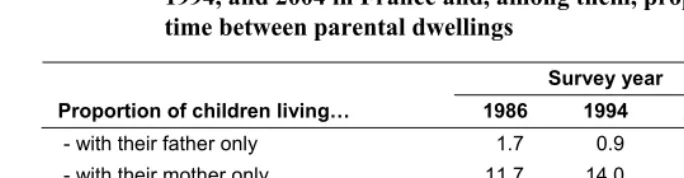
Table 7: Proportion of children (aged 0-17) with separated parents in 1986, 1994, and 2004 in France and, among them, proportion dividing their time between parental dwellings
Survey year
Proportion of children living… 1986 1994 2004
Increase 1986-2004
- with their father only 1.7 0.9 2.1 +0.4 - with their mother only 11.7 14.0 13.6 +1.9 - sharing between parents 0.9 1.3 2.2 +1.3 - Total with separated parents 14.4 16.1 17.9 +3.5 - Erroneous total (with double counts) 15.0 17.1 19.7 +4.7
Note: in 1986 and 1994 corrected weights were used. The erroneous totals for 1986 and 1994 have been estimated from the exact total, applying the bias due to double-counting in 2004 (presented in Table 3).
Sources: INED- ESF 1986 (Leridon and Villeneuve-Gokalp 1994), INED- ESFE 1994, INSEE- French EU-SILC, 2004
7. Conclusion
Several results may be highlighted from this work. First, there is an emerging phenomenon of two-home adults and children, which is much more visible in France than in Australia.
In France, depending on the hypotheses regarding the eligibility of the second dwelling of two-home adults, the estimated proportion of adults living in more than one usual dwelling ranges from 4% to 6%. Our preferred estimate is 3.7% of inhabitants commuting between households. In Australia, a lower percentage is observed (1.7%), partly due to the data collection method, which seeks to minimize double counting; and partly due to the fact that some second homes may not be considered to be a ‘usual residence’ by some respondents.
separated parents. Some one-parent families and stepfamilies thus only exist on a ‘part-time’ basis, as children from a previous union also spend some time with the other parent. Censuses and surveys that do not take two-dwelling situations of adults into account may overestimate one-parent families for another reason: parents may live together as a couple, but may not be identified as such. Identifying two-home children may also be useful per se, and not just to avoid double counting, as their family situation is very specific, and their number is increasing.
Multi-residence is important not only for the family situation of children. At older ages, there are other reasons for living in several dwellings. Two-home adults include those living apart together, but spending some nights together; those who usually live in a dwelling in addition to the ‘family home’ for some reason (such as health, work, or other constraints); retirees who visit and stay with their children and relatives for longer periods, and who may therefore be considered to have several usual homes, and who may also spend a few months each year in a retirement home or in a holiday home that becomes a usual dwelling.
The next EU-SILC waves will allow us to study the entries into and exits from these situations of multi-residence (Ardilly, Labarthe, and Lorgnet 2007; Toulemon and Pennec 2009). Some of these situations are likely to be temporary, and a knowledge of their dynamics will help us to characterise these situations more accurately. The HILDA survey also provides a means of following multi-residence situations for children from one year to the next (Watson 2008).
Furthermore, concepts such as household composition and household size may change dramatically if individuals no longer live in just one dwelling. For instance, the proportions of persons who live alone in all their dwellings, or in one of their dwellings, are diverging.
For all these reasons, INED and INSEE are preparing a methodological survey on families and dwellings. This survey will use a large sample, and will be linked with the census in 2011. It will therefore be similar to the study of family history conducted as part of the 1999 general population census (Cassan, Héran, and Toulemon 2000). Multi-residence will also be investigated in a future census in Australia. Different sets of questions have been tested to determine which questions best capture all these complex situations. (P. Corr and M. Sheley, ABS, personal communication; ABS 2007).
8. Acknowledgements
We wish to thank Stefan Lollivier and Julie Labarthe, from INSEE, who made the French EU-SILC 2004 dataset available to us for this research.
This paper also uses unit record data from the Household, Income, and Labour Dynamics in Australia (HILDA) Survey. The HILDA Project was initiated and is funded by the Australian Government Department of Families, Housing, Community Services, and Indigenous Affairs (FaHCSIA); and is managed by the Melbourne Institute of Applied Economic and Social Research (MIAESR). The findings and views reported in this paper are, however, those of the authors, and should not be attributed to either FaHCSIA or the MIAESR.
We wish to thank Patrick Corr and Margaret Sherley from the Australian Bureau of Statistics, who provided us with input on how multi-residence is capture in the current census form, and with results of tests they are running for a future census round. We would also like to thank Nicole Watson from the Melbourne Institute of Applied Economic and Social Research for her answers to our questions regarding multi-residents and double counting in HILDA.
References
ABS (Australian Bureau of Statistics) (2007). Outcomes from the first round testing of questions proposed for the 2011 Australian population census. Cognitive testing, September/October 2007, focus test on second residence topic. (J763 Detailed Working Report.doc).
ABS (Australian Bureau of Statistics). (2009). Population Estimates: Concepts, Sources and Methods [electronic resource]. Canberra: Australian Bureau of Statistics. (ABS Catalogue No. 3228.0.55.001). http://www.ausstats.abs.gov.au/Ausstats/ subscriber.nsf/0/7B92336BE30E0D7DCA2575D2001B0013/$File/3228055001 _2009.pdf.
Algava, E. and Robertson, G.D. (2002). France's one-parent families in 1999. Population–E 57(4/5): 729-752. doi:10.2307/3246663.
Ardilly, P., Labarthe, J., and Lorgnet, J.-P. (2007). Rapport intermédiaire sur la qualité des données françaises E.U-SILC 2005 [electronic resource]. Paris: INSEE. (Document de travail, N° F0706). http://www.insee.fr/fr/nom_def_met/ methodes/doc_travail/docs_doc_travail/F0706.pdf.
Brandon, P.D. (2004). Identifying the diversity in Australian children's living arrangements: A research note. Journal of Sociology 40(2): 179-192. doi:10.1177/1440783304042872.
Brown, S.L. and Manning, W.D. (2009). Family Boundary Ambiguity and the Measurement of Family Structure: The Significance of Cohabitation. Demography 46(1): 85-101. doi:10.1353/dem.0.0043.
Callister, P. and Birks, S. (2006). Two parents, two households: New Zealand data collections, language and complex parenting. [electronic resource]. Wellington: Families Commission. (Blue Skies Report No 2/06). http://www.nzfamilies.org.nz/research/two-parents-two-households.
Caradec, V. (1997). Forms of conjugal life among the ‘young elderly’. Population: An English Selection 9: 47-73. http://www.jstor.org/stable/2953825.
Cassan, F., Héran, F., and Toulemon, L. (2000). Study of Family History. France’s 1999 Family Survey. Courrier des statistiques, English series 6: 7-19. http://www.insee.fr/en/ffc/docs_ffc/cs93e.pdf.