December 2012 - Special Issue on Positive Psychology, Volume 1 Number 3, 7-20
Perspective-taking and outgroup helping: The moderating
role of warmth impression and outgroup status
Mashuri, Ali
Department of Psychology, University of Brawijaya, Malang, Indonesia ([email protected])
Zaduqisti, Esti
STAIN Pekalongan, Indonesia ([email protected])
Supriyono, Yoyon
Department of Psychology, University of Brawijaya, Malang, Indonesia ([email protected])
Received: 10 November 2012 Revised: 15 December 2012 Accepted: 22 December 2012
Available Online: 30 December 2012 DOI: 10.5861/ijrsp.2012.238
ISSN: 2243-7681 Online ISSN: 2243-769X
OPEN ACCESS
Abstract
This study intended to investigate the effect of perspective-taking on outgroup helping, with
warmth impression and outgroup status serving as the moderating variables. Data from this
study (
n
= 201) provided full support for all hypotheses specified. Warmth impression,
perspective-taking, and outgroup status turned out to have significant main effects on
outgroup helping. Two-way interaction effects between perspective-taking and warmth
impression (perspective-taking x warmth impression) as well as perspective-taking and
outgroup status (perspective-taking x outgroup status) on outgroup helping were also
significant. Finally, as predicted, outgroup helping was significantly affected by a three-way
interaction of perspective-taking, warmth impression and outgroup status. Both theoretical
and practical implications for these findings were discussed.
Mashuri, A., Zaduqisti, E., & Supriyono, Y.
Perspective-taking and outgroup helping: The moderating role of warmth impression
and outgroup status
1. Introduction
There is a growing debate surrounding the effect of perspective-taking on outgroup helping. Voluminous studies have optimistically advocated their findings that persuading people to take the perspective of outgroup members (i.e., perspective-taking) can be an effective tool to promote harmonious intergroup attitudes in general (Dovidio et al., 2004; Galinsky & Ku, 2004; Galinsky & Moskowitz, 2000; Vescio, Sechrist, & Paolucci, 2003) and outgroup helping in particular (Batson, Chang, Orr, & Rowland, 2002; Batson, Early, & Salvarini, 1997; Mashuri, Hasanah, & Rahmawati, 2012; Stürmer, Snyder, Davis, & Maitner, 2009). However, other studies have challenged this generalization by arguing that at individual level, perspective-taking is not immune to perspective-takers’ self-serving motives (Galinsky, Maddux, Gilin, & White, 2008; Trötschel, Hüffeimer, Loschelder, Schwartz, & Gollwitzer, 2011; Vorauer & Sasaki, 2009). At group level, perspective-taking can instead impair pro-outgroup behaviors among ingroup members whose social identity is threatened (Zebel, Doosje, & Spears, 2009) and who strongly identify with their own group (Tarrant, Calitri, & Weston, 2012).
This study aimed at verifying whether or not perspective-taking is indeed beneficial to promote outgroup helping in the lens of two moderating variables: ingroup’s warmth impression (low versus high) and outgroup’s comparative status (lower versus higher). The scenario used to test this idea is a humanitarian natural disaster assumed to afflict a neighboring country. Natural disaster can be a good, representative scenario to investigate the dynamics of outgroup helping (Zagefka, Noor, Brown, Hopthrow, & de Moura, 2012; Zagefka, Noor, Brown, de Moura, & Hopthrow, 2011). This is clearly evidenced for instance in case of December 2004 tsunami in Southeast Asia in which the acts of helping to the victims came from people around the globe, transcending geographical, national, or ethnic group boundaries (van Leeuwen, 2007; van Leeuwen & Mashuri, 2011).
2. Literature Review
2.1 Warmth impression and perspective-taking
A growing body of research has found that outgroup helping or the act of helping to members of a group having multifarious different social categories, be they ethnicity, nationality, university affiliation, religion, and so forth, is more prevalently ignited by strategic motives (Hardy & van Vugt, 2006; van Leeuwen & Täuber, 2011; van Vugt & Hardy, 2009). Such motives imply that, as explained by van Leeuwen and Täuber (2010), the provision of help serves as a medium through which members of ingroup aspire to meet their vested interests to exert power and dominance (Nadler & Halabi, 2006; Nadler, Harpaz-Gorodeisky, & Ben-David, 2009), to restore a threatened identity (van Leeuwen, 2007), and to enhance good ingroup reputation and qualities (Hopkins et al., 2007). Related to this last motive, recently van Leeuwen & Täuber (2012) have reported that ‘warmth’ proved to be one of those qualities which encourages willingness of members of ingroup to endorse outgroup helping .
Perspective-taking and outgroup helping: The moderating role of warmth impression and outgroup status
found in their 3 experiments that in a response to refute unfavorable images about their own group such as stingy, self-centered, and individualistic imposed by members of another group (negative meta-stereotype), participants’ concerns for the warmth image of their ingroup (i.e., friendly, social, generous, warm, and helpful) predict outgroup helping.
To date, there have been no studies to examine the combined effect of perspective-taking and warmth impression on outgroup helping. Perspective-taking and warmth impression are considered as two independent determinants of outgroup helping, with the first serving as pro-social motive while the latter as a strategic motive. Previous studies have demonstrated that perspective-taking elicits outgroup helping via the activation of a pro-social motive of empathy (Batson et al., 2002; Batson, Early, & Salvarini, 1997; Batson, van Lange, Ahmad, & Lishner, 2007; Mashuri, Hasanah, & Rahmawati, 2012). Pro-social motive in the context of intergroup helping means that the provision of helping to another group (outgroup helping) is primarily directed to benefiting help recipients. On the contrary, a strategic motive means that outgroup helping is primarily dedicated in favor of ingroup as the helper (van Leeuwen & Täuber, 2011). This rationale therefore implies that the combination of a pro-social motive of perspective-taking and a strategic motive of warmth impression requires the domination of one motive, at the expense of another motive. Concisely speaking, perspective-taking can be still an effective tool to promote outgroup helping only when the perspective-takers’ concerns for warmth impression is low. When impression is high, the reverse effect will emerge, wherein perspective-taking no longer have impact in outgroup helping.
2.2 Outgroup status and perspective-taking
Within the framework of Social Identity Theory (Tajfel & Turner, 1979), intergroup status differences mirror comparative rank-orderings along prestigious dimension, encompassing relative task performance (Turner & Brown, 1978), capabilities (Ellemers, van Knippenberg, de Vries, & Wilke, 1988), opportunities (Platow, Byrne, & Ryan, 2005), and economic advantage (Tajfel &Turner, 1979). ) One of intergroup status differences that have been widely connected to outgroup helping is economic or material superiority. In this domain of intergroup helping studies, people tend to be reluctant to support for helping dedicated to members of another group having higher economic status, more prominently in the condition in which the status is described as threatening the currently economic advantage of ingroup (Cunningham & Platow, 2007; Halabi, et al., 2008; Jackson & Esses, 2000; Mashuri, Hasanah, & Rahmawati, 2012).
The reasons why higher outgroup status propels less degree of outgroup helping could be explained in terms of Realistic Group Conflict Theory (RGCT: Sherif, Harvey, White, Hood, & Sherif, 1961). This theory views that observing members of another group as possessing more advantageous material status could be experienced as economic threat, which in turn producesconflicting goals over scarce resources between the groups in question (Jackson, 1993). Affirming this notion, Cikara, Botvinick, and Fiske (2011) identified that a competitive orientation that fuelled intergroup hostility and conflict emerges as a result of economic threat.
Mashuri, A., Zaduqisti, E., & Supriyono, Y.
ingroup as the help providers are less powerful than those of outgroup. This effect therefore contradicts with the sole, isolated effect of outgroup status on outgroup helping, wherein the higher the status of outgroup the less likely it is that members of ingroup are willing to help that group.
2.3 The Present Study
This study is the first to examine the combined effects of perspective-taking, warmth impression, and outgroup status on outgroup helping. Perspective-taking was manipulated using the successful paradigm used by Mashuri, Hasanah, & Rahmawati (2012), which originally came from the procedure in the study by Batson and Ahmad (2001). Warmth impression was measured by incorporating some traits which are previously developed by Cuddy, Fiske, & Glick (2007, 2008) as well as van Leeuwen and Täuber (2012). The authors manipulated outgroup status by replicating the paradigm used in the study by Mashuri, Hasanah, and Rahmawati, which was adopted from the study by Cunningham and Platow (2007). Outgroup helping in this study was operationalized both impersonally and personally. Impersonal outgroup helping means that the help actor is not the participants themselves, but external agents such as the government. Personal out-helping implicates that the actor is the participants themselves.
Based on theoretical rationales and empirical findings discussed above, the authors proposed several hypotheses. Firstly, it was predicted that participants having high warmth impression more than those having low warmth impression would report higher degree of outgroup helping (Hypothesis 1). The next hypothesis specified that lower outgroup status than higher outgroup status would trigger higher degree of outgroup helping (Hypothesis 2). The authors also predicted that strong perspective-taking compared to weak perspective-taking would elicit higher degree of outgroup helping (Hypothesis 3). Referring to a zero sum game relationship between perspective-taking and warmth impression in which the salience or domination of the first victimizes the latter or vice versa, the authors then predicted that strong perspective-taking than weak perspective-taking would induce higher degree of outgroup helping only when warmth impression was low (Hypothesis 4). Based on the argumentation that power hinders perspective-taking, it was also predicted that strong perspective-taking than weak perspective-taking would elicit higher degree of outgroup helping, more particularly when the members of outgroup was depicted as having higher status (Hypothesis 5). Finally, the authors predicted that strong perspective-taking than weak perspective-taking would promote higher outgroup helping more prominently when warmth impression was low and when the helping was addressed to outgroup having higher status (Hypothesis 6).
3. Methods
3.1 Participants
Participants were 100 students from the Department of Islamic Education, STAIN Pekalongan, and 101 students from the Department of Psychology, University of Brawijaya (46 Males, 152 Females, 3 participants did not mention their gender; Mage = 19, SDage = 1.02). Participants were mainly Javanese (n = 191), and small portion of them were Maduranese, Sundanese, and others (n = 10). They participated voluntarily, in exchange of no rewards. The research was based on a 2 (Outgroup Status: higher versus lower) by 2 (Perspective-Taking: strong versus weak) between-subjects design. Participants were randomly assigned to one of 4 combined conditions: higher outgroup status and strong perspective-taking (n = 51), higher outgroup status and weak perspective-taking (n = 49), lower outgroup status and strong perspective-taking (n = 53), lower outgroup status and weak perspective-taking (n = 48).
3.2 Materials and Procedures
Perspective-taking and outgroup helping: The moderating role of warmth impression and outgroup status
= not at all – 5 = very much), and scales were made by averaging the items. First of all, warmth impression was measured using the scale developed by the authors in which participants were asked to rate the extent to which some traits (i.e., generous, friendly, caring, faithful, reliable, and honest; α = .82; corrected item-total correlations varied between .54 and .66) are typical for the Indonesians. This scale indeed represented warmth impression as it highly correlated with a warmth trait which functioned as a filler item, r = .40, p = .000. Following this measure was an article about a current academic survey of comparative income between the Vietnamese and the Indonesians to manipulate outgroup status, which derived from the study by Mashuri, Hasanah, and Rahmawati (2012). In the higher outgroup status condition, the article depicted that the average income of Vietnamese surpassed that of Indonesians. On the contrary, in the lower outgroup status condition the income of Vietnamese was less than that of Indonesians. Ostensibly published in a well-known newspaper in Indonesia, the article also specified that the trend in both conditions was predicted to be stable over the next 10 years.
The next part of the questionnaire was a passage, which was adopted from the study by Mashuri, Hasanah, and Rahmawati (2012). This passage in essence described about a current flood tragedy ostensibly afflicting some provinces in Vietnam, published in a top Indonesian newspaper. Then, participants were presented with a second passage to manipulate perspective-taking, using the same paradigm as that in the study by Mashuri, Hasanah, and Rahmawati (2012). In the strong perspective-taking condition, participants were exposed with verbal instructions to be emphatic toward as well as deeply concerned with others’ misery. In the reverse direction, participants in the weak perspective-taking condition were instructed to be objective and detached as much as possible in responding others’ misery. Subsequently following these manipulations, participants were asked to answer an item (i.e., “The survey about comparative income of the Vietnamese and the Indonesians was realistic and trusted”), which intended to measure the credibility of the manipulation of outgroup status. Another single item (i.e., “The article about a flood disaster in Vietnam was realistic and trusted”) was given to participants subsequently, which was to measure the credibility of the passage about the tragedy.
Two items to measure the degree to which participants understand content of the first article then followed (i.e., “According to the article, the Vietnamese were poorer than the Indonesians”; “According to the article, the average income of the Vietnamese was less than that of the Indonesians”; α = .89). Participants were also asked to answer an item to measure the extent to which they understand the instructions in the second passage (i.e., “I was instructed to try at my best to be objective and detached toward, as well as not affected by, others’ misery”). Coming after this item was a filler item to measure the extent to which participants considered warm as the Indonesians’ typical trait. The last part of the questionnaire was 5 items to measure outgroup helping, which was created by the authors (e.g., “I was willing to give some of my clothes and household apparatus to the victims of a flood disaster in Vietnam”; “I was willing to joint in a volunteer group to help the victims of a flood disaster in Vietnam”; α = .65; corrected item-total correlations ranged from .328 to .490). Participants were finally asked to inform their age and gender. After completing the questionnaire, participants were debriefed and thanked.
4. Results
4.1 Manipulation Checks
Mashuri, A., Zaduqisti, E., & Supriyono, Y.
should try at their best to be objective toward and not affected by others’ misery in the weak perspective-taking condition (M = 3.98, SD = 1.06) was significantly higher than in the strong perspective-taking condition (M = 2.76, SD = 1.30), t(199) = 7.25, p = .00. Thus, the instruction of the third article to manipulate perspective-taking could also be comprehended correctly by the participants.
4.2 Preliminary Analyses
The effect of gender (coded 0 for female and 1 for male) on outgroup helping was assessed using an independent sample t-test, the result of which both female (M = 3.69, SD = .64) and male (M = 3.74, SD = .53) participants reported the same degree of outgroup helping, t(196) = .46, p = .65. The effect of age on outgroup helping, which was assessed using a simple regression analysis, was also not significant, B = -.05, t(192) = -1.22, p = .23. Implicatively, demographic variables of gender and age did not need to be controlled and included in the next analyses to test the hypotheses.
4.3 Main Effect Analyses
Participants’ degree of outgroup helping was analyzed in a multiple regression analysis. In this analysis, warmth impression (transformed to a dichotomous variable, coded 1 for high warmth impression, coded 0 for low warmth impression), outgroup status (coded 0 for higher outgroup status, 1 for lower outgroup status), perspective-taking (coded 0 for weak perspective-taking, 1 for strong perspective-taking), and all interaction terms (i.e., outgroup status x perspective-taking, warmth impression x outgroup status, warmth impression x perspective-taking, and warmth impression x outgroup status x perspective-taking) were entered as predictors. The equation was significant, R2= .14, F(7, 193) = 4.47, p = .00.
The analysis revealed a main effect of warmth impression, B = .56, t = 3.41, p = .00. Supporting Hypothesis 1, participants with high warmth impression reported higher outgroup helping (M = 3.99, SD = .61) than those with low warmth impression (M = 3.43, SD = .61), F(1, 193) = 11.26, p = .00. The main effect of outgroup status was also significant, B = .70, t = 4.30, p = .00. In support of Hypothesis 2, participants in the lower outgroup condition reported higher degree of outgroup helping (M = 3.86, SD = .63) than those in the higher outgroup status condition (M = 3.55, SD = .55), F(1, 193) = 18.44, p = .00. Perspective-taking was also found to uniquely affect outgroup helping, B = .48, t = 2.86, p = .01. The degree of outgroup helping among participants in the strong perspective-taking condition (M = 3.93, SD = .55) was significantly higher than those in the weak perspective-taking condition (M = 3.46, SD = .66), F(1, 193) = 8.17, p = .01. This result therefore corroborated Hypothesis 3.
4.4 Interaction Effect Analyses
The multiple regression analysis described above also revealed a significant interaction effect of Warmth Impression and Perspective-Taking on Outgroup Helping, B = -.60, t = -2.59, p = .01. As demonstrated in Figure 1, a simple slope analysis resulted in higher degree of outgroup helping in the strong perspective-taking condition (M = 3.90, SD = .59) than in the weak perspective-taking condition (M = 3.43, SD = .67), F(1, 97) = 9.20, p = .00, but only when participants’ concerns for warmth impression was low. When the warmth impression was high, strong perspective-taking did not trigger higher outgroup helping (M = 3.69, SD = .52) than weak perspective-taking (M = 3.81, SD = .71), F(1, 96) = .52, p = .47. Accordingly, this finding was in line with Hypothesis 4.
Perspective-taking and outgroup helping: The moderating role of warmth impression and outgroup status
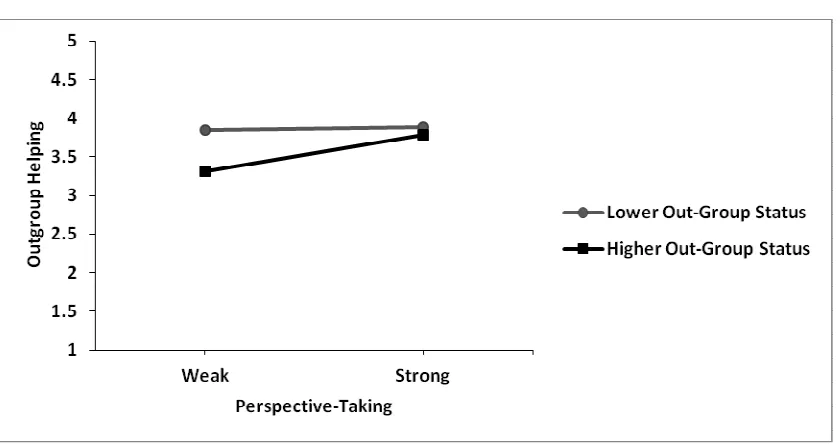
perspective-taking condition (M = 3.84, SD = .72), F(1, 97) = .04, p = .84. In conclusion, Hypothesis 5 was also supported.
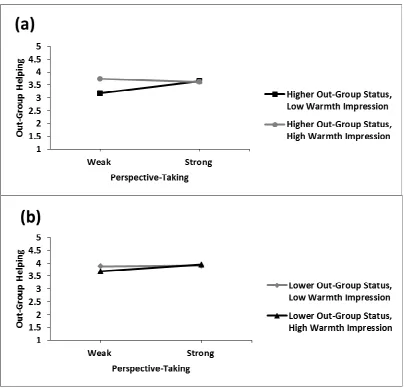
Finally, the interaction of warmth impression, outgroup status, and perspective-taking was also significant, B = .82, t = 2.51, p = .01. As could be seen in Figure 3a, in the higher outgroup status condition, strong perspective-taking elicited higher outgroup helping (M = 3.65, SD = .56) than weak perspective-taking (M = 3.18, SD = .41), F(1, 46) = 11.24, p = .00, but only when participants’ degree of warmth impression was low. When participants’ degree of warmth impression was high, however, in the condition of higher outgroup status, strong perspective-taking elicited the same degree of outgroup helping (M = 3.94, SD = .46) as weak perspective-taking
Figure 1. The effect of Perspective-Taking (strong versus weak) on Outgroup Helping among participants with
low and high Warmth Impression
Figure 2. The effect of Perspective-Taking (strong versus weak) on Outgroup Helping in the lower and higher
Mashuri, A., Zaduqisti, E., & Supriyono, Y.
(M = 3.68, SD = .86), F(1, 46) = 1.73, p = .20. In the lower outgroup status condition, as shown in Figure 3b, strong perspective-taking compared to weak perspective-taking did not trigger higher degree of outgroup helping, either when participants’ warmth impression was low, [MStrong Perspective-Taking = 3.91, SDStrong Perspective-Taking = .60; MWeak Perspective-Taking = 3.88, SDWeak Perspective-Taking = .57; F(1, 51) = .05, p = .82], or high, [MStrong Perspective-Taking = 3.94, SDStrong Perspective-Taking = .46; MWeak Perspective-Taking = 3.68, SDWeak Perspective-Taking = .86; F(1, 46) = 1.73, p = .20]. All of these findings thus were in accordance with Hypothesis 6.
5. Discussion
The main goal of this study was to attain a new insight regarding how outgroup helping is jointly influenced by perspective-taking, warmth impression, and outgroup status. The results of this study demonstrated that perspective-taking, warmth impression, and outgroup status uniquely explained outgroup helping. Strong perspective-taking than weak perspective-taking, high warmth impression than low warmth impression, and lower outgroup status than higher outgroup status aroused higher degree of outgroup helping. Some combined interaction effects also held, in line with hypotheses specified. Firstly, strong perspective-taking compared to weak perspective-taking triggered higher outgroup helping, but only when the degree of participants’ concerns for warm traits was low instead of high. Secondly, strong perspective taking was more effective than weak
Figure 3. (a) The effect of Perspective-Taking (strong versus weak) on Outgroup Helping among participants with low and high
Warmth Impression, directed to higher Outgroup Status, (b) The effect of Perspective-Taking (strong versus weak) on Outgroup
Perspective-taking and outgroup helping: The moderating role of warmth impression and outgroup status
perspective-taking in eliciting outgroup helping more particularly when outgroup helping was dedicated to higher outgroup status and not lower outgroup status. Finally, strong perspective-taking turned out to encourage higher outgroup helping than weak perspective-taking more primarily among participants with low warmth and in the condition of higher outgroup status.
Some researchers in the past studies have treated pro-social motive and impression management as opposing poles of a continuum of other-serving versus self-serving motivation which drive people to engage in helping behavior (e.g., de Dreu, 2006; Meglino & Korsgaard, 2006). For example, Rioux and Penner (2001) found that some people in the organization are indeed pro-socially motivated to help other people, in the sense that such behavior is genuinely to serve the benefit of these people. However, the two researchers also identified that some other people in the same organization are willing to help other people mainly to help their own images. This finding thus confirmed the nature of pro-social motive and impression management as bipolar opposites in driving helping behavior.
Other researchers however conversely have argued that pro-social motives and impression management motive may coexist in shaping helping behavior. For example, across to studies Grant and Mayer (2009) consistently found that pro-social motive and impression management motive interact positively in predicting helping behavior and courtesy. More specifically, the two researchers observed that the high pro-social motive than low pro-social motive contributed to higher helping behavior, but this effect emerged only among people with high impression management. This is totally contradictive to what the authors found in this study in which the strong perspective-taking (or the high pro-social motive) compared to weak perspective-taking (or low pro-social motive) elicit higher outgroup helping, but only when participants’ concerns for warmth are low (low impression management) instead of high (high impression management). Nevertheless, the difference is that helping behavior in the study by Grant and Mayer was directed to members of people within the same organization (ingroup helping) while helping behavior in our study is directed to members of people in other country (outgroup helping).
Next studies thus may solve this contradictive finding by examining the interactive effect of perspective-taking and warmth impression which is directed to either ingroup or outgroup. Moreover, van Leeuwen and Täuber (2012) noticed that warmth impression could predict outgroup helping more specifically under the presence of meta-stereotype. Accordingly, next studies also need to incorporate meta-stereotype condition and test how perspective-taking jointly affect outgroup helping with warmth impression.
This study also revealed, as concluded above, that strong perspective-taking more than weak perspective-taking is more promising in inducing higher outgroup helping especially when this helping is addressed to higher outgroup status. At one hand, this result therefore is not in keeping with the sole effect of outgroup status in which lower outgroup status than higher outgroup status generally urges higher outgroup helping. At another hand, however, this result corroborated Galinsky and colleagues’ argumentation (2006) that perspective-taking and power are opposing concepts, wherein power so often diminishes perspective-taking. It needs to accentuate that the authors in this study analogized the concept of power and group status. More specifically, members of ingroup portrayed as having lower material status than outgroup (i.e., higher outgroup status) resembles having less power. Vice versa, members of ingroup portrayed as having higher material status than outgroup (i.e., lower outgroup status) resembles having more power. In other words, higher outgroup status also means ingroup having less power and lower outgroup status means ingroup having more power.
Mashuri, A., Zaduqisti, E., & Supriyono, Y.
social implications in which the first promotes altruism and helping behavior (Batson, 1991) whereas the latter enhances anti-social behavior such as sexual harassment (Bargh, Raymond, Pryor, & Strack, 1995). These rationales could be a logical reason to answer why strong perspective-taking than weak perspective-taking, as found in this study, elicited higher outgroup helping particularly when the outgroup described as having higher status than ingroup (or when the ingroup described as having less power than outgroup). This effect may hold only when people weakly and not strongly identify with their group, as noted by Tarrant, Calitri, & Weston (2012), since perspective-taking is beneficial to boost pro-outgroup behavior only among these people. Next studies need to verify this notion.
From the strategic motive standpoint (van Leeuwen 2007; van Leeuwen & Täuber, 2009; van Leeuwen & Täuber, 2011), outgroup helping reflects unbalanced status relation between the helpers and recipients, wherein the first are prevalently the more fortunate, the more skillful, and the rich whereas the latter are the less fortunate, the less skillful, and the poor. This implies that out-group helping harbors a blatant categorization that the helpers seem more superior to the recipients. Transcending this categorization boundary, perspective-taking was found to evoke self-other overlap or a shared common identity, which in turn fosters social bond and facilitates social coordination (Galinsky, Ku, & Wang, 2005).
Based on this positive finding, perspective-taking has been widely implemented as a core feature in diversity training, a program to enhance harmonious intergroup relations by integrating instead of excluding the minority into the organization (Pendry, Driscoll, & Field, 2007). This diversity training that is relied on the importance of perspective-taking can be possibly applied for potential helpers to promote pro-social motive rather than strategic motives in conducting or supporting for out-group helping. This way, people are willing to do out-group helping not because they want to make their group look warm or because they consider the out-group as having lower or higher economic status. Rather, people help outgroup simply because they consider that this group is their fellow members, who have the same, more inclusive social category as, for example, human beings, Southeast Asian people, and so forth.
Some limitations of this study are noteworthy. First, this study recruited mostly the Javanese, whereas in fact Indonesia consists of people with multifarious ethnicities. As a result, this study cannot be generalized to ethnic groups other than the Javanese. Second, outgroup helping in this study is not measured behaviorally, but verbally in the form of paper-and-pencil. The findings in this study thus will be more robust if next studies measure outgroup helping behaviorally and observe the same results. Finally, the sampling in this study is mainly Indonesian university students. Implicatively, this study cannot be generalized to younger people (junior high school students, senior high school students) or older people than university students.
6. Conclusion
This study confirmed an interactive instead of bipolar model of perspective-taking and impression management of warmth in predicting outgroup helping. In line of this perspective, both perspective-taking and warmth can coexist in affecting outgroup helping. More particularly, strong perspective-taking proved to be more effective than weak perspective-taking in inducing people’s willingness to help members of outgroup especially when their warmth impression is low. Moreover, this study also provides justification for the truism that perspective-taking and power are opposite concepts in which power can limit the effect of perspective-taking on outgroup helping. Strong perspective-taking than weak perspective-taking is still indeed beneficial to determine outgroup helping but more strongly in the condition in which members of ingroup depicted as having less power (or lower material status) than those of outgroup.
Perspective-taking and outgroup helping: The moderating role of warmth impression and outgroup status
intergroup contact. As argued by Mashuri, Hasanah, & Rahmawati (2012), intergroup contact in the domain of cross-country bilateral or multilateral relationships can be realized by, for example, promoting cooperation among countries in terms of student exchange or cross-cultural exhibition.
7. References:
Bargh, J .A., Raymond, P., Pryor, J. B., & Strack, F. (1995). Attractiveness of the underling: An automatic power-sex association and its consequences for sexual harassment and aggression. Journal of Personality and Social Psychology, 68, 768–781.http://dx.doi.org/10.1037/0022-3514.68.5.768
Batson, C. D., Chang, J., Orr, R., & Rowland, J. (2002). Empathy, attitudes, and action: Can feeling for a member of a stigmatized group motivate one to help the group? Personality and Social Psychology Bulletin, 28, 1656−1666.http://dx.doi.org/10.1177/014616702237647
Batson, C. D., Early, S., & Salvarini, G. (1997). Perspective taking: imagining how another feels versus imagining how you would feel. Personality & Social Personality Bulletin, 23, 751−758.
http://dx.doi.org/10.1177/0146167297237008
Batson, C. D., Van Lange, P. A. M., Ahmad, N., & Lishner, D. A. (2003). Altruism and helping behavior. In M. A. Hogg & J. Cooper (Eds.), Sage handbook of social psychology (pp. 279−295). London: Sage
Publication.
Batson, C. D. (1991). The altruism question: Toward a social–psychological answer. Hillsdale, NJ: Erlbaum. Bilewicz, M. (2009). Perspective taking and intergroup helping intentions: The moderating role of power
relations. Journal of Applied Social Psychology, 39, 2779−2786.
http://dx.doi.org/10.1111/j.1559-1816.2009.00548.x
Cikara, M., Botvinick, M. M., & Fiske, S. T. (2011). Us versus them: Social identity shapes neural responses to intergroup competition and harm. Psychological science, 22(3), 306−13.
http://dx.doi.org/10.1177/0956797610397667
Cuddy, A. J. C., Fiske, S. T., & Glick, P. (2004). When professionals become mothers, warmth doesn’t cut the ice. Journal of Social Issues, 4, 701−718.http://dx.doi.org/10.1111/j.0022-4537.2004.00381.x
Cuddy, A. J. C., Fiske, S. T., & Glick, P. (2007). The BIAS Map: Behaviors from intergroup affect and stereotypes. Journal of Personality and Social Psychology, 92, 631−648.
http://dx.doi.org/10.1037/0022-3514.92.4.631
Cuddy, A. J. C., Fiske, S. T., & Glick, P. (2008). Warmth and competence as universal dimension of social perception: The stereotype content model and the BIAS MAP. Advances in Experimental Social Psychology, 40, 61−148.http://dx.doi.org/10.1016/S0065-2601(07)00002-0
Cunningham, E., & Platow, M. J. (2007). On helping lower-status outgroups: The nature of the help and the stability of the intergroup status hierarchy. Asian Journal of Social Psychology, 10, 258−264.
http://dx.doi.org/10.1111/j.1467-839X.2007.00234.x
de Dreu, C. K. W. (2006). Rational self-interest and other orientation in organizational behavior: A critical appraisal and extension of Meglino and Korsgaard (2004). Journal of Applied Psychology, 91, 1245–1252. http://dx.doi.org/10.1037/0021-9010.91.6.1245
Dovidio, J. F., ten Vergert, M., Stewart, T. L., Gaertner, S. L., Johnson, J. D., Esses, V. M., Riek, B. M., & Pearson, A. R. (2004). Perspective and prejudice: Antecedents and mediating mechanisms. Personality and Social Psychology Bulletin, 30, 1537−1549.http://dx.doi.org/10.1177/0146167204271177
Ellemers, N., Van Knippenberg, A., De Vries, N., & Wilke, H. (1988). Social identification and permeability of group boundaries. European Journal of Social Psychology, 18, 497−513.
http://dx.doi.org/10.1002/ejsp.2420180604
Fiske, S. T., Cuddy, A. M., Glick, P., & Xu, J. (2002). A model of (often mixed) stereotype content: Competence and warmth respectively follow from perceived status and competition. Journal of Personality and Social Psychology, 82, 878−902.http://dx.doi.org/10.1037/0022-3514.82.6.878
Fiske, S. T., Xu, J., Cuddy, A. M., & Glick, P. (1999). (Dis)respecting versus (Dis)liking: Status and
Mashuri, A., Zaduqisti, E., & Supriyono, Y.
473−489.http://dx.doi.org/10.1111/0022-4537.00128
Fiske, S. T. (1993). Controlling other people: The impact of power on stereotyping. American Psychologist, 48, 621–628. http://dx.doi.org/10.1037/0003-066X.48.6.621
Galinsky, A. D. & Ku, G. (2004). The effects of perspective-taking on prejudice: The moderating role of self-evaluation. Personality and Social Psychology Bulletin, 30, 594−604.
http://dx.doi.org/10.1177/0146167203262802
Galinsky, A. D., Ku, G. & Wang, C. S. Wang. (2005). Perspective-taking: Fostering social bonds and facilitating social coordination. Group Processes and Intergroup Relations, 8, 109−125.
http://dx.doi.org/10.1177/1368430205051060
Galinsky, A. D., Magee, J. C., Inesi, M. E., & Gruenfeld, D. H (2006). Power and perspectives not taken. Psychological Science, 17, 1068−1074.http://dx.doi.org/10.1111/j.1467-9280.2006.01824.x
Galinsky, A. D., & Moskowitz, G. B. (2000). Perspective-taking: Decreasing stereotype expression, stereotype accessibility, and ingroup favoritism. Journal of Personality and Social Psychology, 78, 708–724.
http://dx.doi.org/10.1037/0022-3514.78.4.708
Galinsky, A. D., Maddux, W. W., Gilin, D., & White, J. B. (2008). Why it pays to get inside the head of your opponent: The differential effects of perspective-taking and empathy in negotiations. Psychological Science, 19(4), 378-384.http://dx.doi.org/10.1111/j.1467-9280.2008.02096.x
Grant, A. M., & Mayer, D. M. (2009). Good soldiers and good actors: Prosocial and impression management motives as interactive predictors of affiliative citizenship behaviors. Journal of Applied Psychology, 9, 900−912. http://dx.doi.org/10.1037/a0013770
Halabi, S., Dovidio, J. F., & Nadler, A. (2008). When and how do high status group members offer help: Effects of social dominance orientation and status threat. Political Psychology, 29(6), 841−858.
http://dx.doi.org/10.1111/j.1467-9221.2008.00669.x
Hardy, C. L., & van Vugt, M. (2006). Nice guys finish first: The competitive altruism hypothesis. Personality and Social Psychology Bulletin, 32, 1402−1413.http://dx.doi.org/10.1177/0146167206291006
Hopkins, N., Reicher, S., Harrison, K., Cassidy, C., Bull, R., & Levine, M. (2007). Helping to improve the group stereotype: On the strategic dimension of pro-social behavior. Personality and Social Psychology Bulletin, 33,776−788.http://dx.doi.org/10.1177/0146167207301023
Jackson, J. W. (1993). Realistic group conflict theory: A review and evaluation of the theoretical and empirical literature. Psychological Record, 43, 395−415.
Jackson, L. M., & M, Esses, V. M. (2000). Effect of perceived economic competition on people's willingness to help empower immigrants. Group Processes and Intergroup Relations, 3, 419−435.
http://dx.doi.org/10.1177/1368430200003004006
Keltner, D., Gruenfeld, D. H, & Anderson, C. (2003). Power, approach, and inhibition. Psychological Review, 110, 265–284.http://dx.doi.org/10.1037/0033-295X.110.2.265
Mashuri, A., Hasanah, N., & Rahmawati, I. (2012). The effect of outgroup status and perspective-taking on empathy and outgroup helping. International Journal of Research Studies in Psychology. Advance online publication. Available online: August 3, 2012. http://dx.doi.org/10.5861/ijrsp.2012.149
Meglino, B. M., & Korsgaard, M. A. (2006). Considering situational and dispositional approaches to rational self-interest: An extension and response to De Dreu (2006). Journal of Applied Psychology, 91, 1253–1259. http://dx.doi.org/10.1037/0021-9010.91.6.1253
Nadler, A., & Halabi, S. (2006). Intergroup helping as status relations: maintaining or challenging social dominance between groups through helping. Journal of Social Issues, 58, 487-502.
http://dx.doi.org/10.1111/1540-4560.00272
Nadler, A., Harpaz-Gorodeisky, G., & Ben-David, Y. (2009). Defensive helping: Threat to group identity, ingroup identification, status stability, and common group identity as determinants of intergroup help-giving. Journal of Personality and Social Psychology, 97, 823−834. http://dx.doi.org/10.1037/a0015968
Pendry, L. F., Driscoll, D. M., & Field, S. C. T. (2007). Diversity training: Putting theory into practice. Journal of Occupational and Organizational Psychology, 80, 27−50.
Perspective-taking and outgroup helping: The moderating role of warmth impression and outgroup status
Pettigrew, T. F., & Tropp, L. R. (2008). How does intergroup contact reduce prejudice? Meta-analytic tests of three mediators. European Journal of Social Psychology, 38, 922−934.
http://dx.doi.org/10.1002/ejsp.504
Platow, M. J., Byrne, L. & Ryan, M. K. (2005). Experimentally manipulated high ingroup status can buffer personal selfesteem against discrimination. European Journal of Social Psychology, 35, 599–608.
http://dx.doi.org/10.1002/ejsp.292
Rioux, S. M., & Penner, L. A. (2001). The causes of organizational citizenship behavior: A motivational analysis. Journal of Applied Psychology, 86, 1306–1314. http://dx.doi.org/10.1037/0021-9010.86.6.1306
Sherif, M., Harvey, O. J., White, B. J., Hood, W. R. & Sherif, C. (1961). Intergroup Conflict and Cooperation: The Robber’s Cave Experiment. Norman: University of Oklahoma Press.
Stürmer, S. Snyder, M., Davis, M. H., & Maitner, A. T. (2009). Perspective taking and intergroup helping. In: S. Sturmer & M. Snyder (Eds.). The psychology of prosocial behavior: Group processes, intergroup relations, and helping (pp. 81− 99). Chichester, UK: Wiley-Blackwell.
Tajfel, H. & Turner, J. C. (1979). An integrative theory of intergroup conflict. In: W. G. Austin & S. Worchel (Eds.) The Social Psychology of Intergroup Relations, pp. 33–47. Monterey, CA: Brooks/Cole. Tarrant, M., Calitri, R., & Weston, D. (2012). Social identification structures the effects of perspective-taking.
Psychological Science, 23(9), 973-978.http://dx.doi.org/10.1177/0956797612441221
Tjosvold, D., & Sagaria, S. (1978). Effects of relative power on cognitive perspective-taking. Personality and Social Psychology Bulletin, 4, 256−259. http://dx.doi.org/10.1177/014616727800400217
Trötschel, R., Hüffmeier, J., Loschelder, D. D., Schwartz, K., & Gollwitzer, P. (2011). Perspective taking as a means to overcome motivational barriers in negotiations: When putting oneself in the opponent's shoes helps to walk towards agreements. Journal of Personality and Social Psychology, 101, 771−790.
http://dx.doi.org/10.1037/a0023801
Turner, J. C., & Brown, R. J. (1978). Social status, cognitive alternatives, and intergroup relations. In: H. Tajfel, ed. Differentiation Between Social Groups, pp. 201–234. London: Academic Press.
van Leeuwen, E. (2007). Restoring identity through outgroup helping: Beliefs about international aids in response to the December 2004 Tsunami. European Journal of Social Psychology, 37(4), 661−671.
http://dx.doi.org/10.1002/ejsp.389
van Leeuwen, E., & Mashuri, A. (2012). When common identities reduce between-group helping. Social Psychological and Personality Science, 3, 259−265.http://dx.doi.org/10.1177/1948550611417315
van Leeuwen, E., & Täuber, S. (2011). Demonstrating knowledge: The effects of group status on outgroup helping. Journal of Experimental Social Psychology, 47(1), 147−156.
http://dx.doi.org/10.1016/j.jesp.2010.09.008
van Leeuwen, E., & Tauber, S. (2012). Outgroup helping as a tool to communicate ingroup warmth. Personality and Social Psychology Bulletin, 38, 772−783. http://dx.doi.org/10.1177/0146167211436253
van Leeuwen, E., Täuber, S. (2010). The strategic side of outgroup helping. In: S. Sturmer & M. Snyder (Eds.). The psychology of prosocial behavior: Group processes, intergroup relations, and helping (pp. 81−99). Chichester, UK: Wiley-Blackwell.
van Vugt, M., & Hardy, C. (2009). Cooperation for reputation: Wasteful contributions as costly signals in public goods. Group Processes Intergroup Relations,13, 101−111.
http://dx.doi.org/10.1177/1368430209342258
Vescio, T. K., Sechrist, G., & Paolucci, M. P. (2003). Perspective taking and prejudice reduction: The mediational role of empathy arousal and situational attributions. European Journal of Social Psychology, 33, 455−472.http://dx.doi.org/10.1002/ejsp.163
Vorauer, J. D., & Sasaki, S. J. (2009). Helpful only in the abstract? Ironic effects of empathy in intergroup interaction. Psychological Science, 20, 191−197.http://dx.doi.org/10.1111/j.1467-9280.2009.02265.x
Zagefka, H., Noor, M., Brown, R., de Moura, G. R., & Hopthrow, T. (2011). Donating to disaster victims: Responses to natural and humanly caused events. European Journal of Social Psychology, 41, 353–363.
http://dx.doi.org/10.1002/ejsp.781
Mashuri, A., Zaduqisti, E., & Supriyono, Y.
victims: Psychological considerations. Early view (Online version of record published before inclusion in an issue). Available online: August 3, 2012. http://dx.doi.org/10.1111/j.1467-839X.2012.01378.x
Zebel, S., Doosje, B., & Spears, R. (2009). How perspective-taking helps and hinders group-based guilt as a function of group identification. Group Processes and Intergroup Relations,