© 2018, IRJET | Impact Factor value: 7.211 | ISO 9001:2008 Certified Journal
| Page 5361
Effect of Partial Replacement of Fine Aggregate by Waste Glass Powder
on Compressive Strength and Flexural Strength of Concrete
Bobade S.S
1, Arkas G.N
2, Deokate A.B.
3, Gaikwad R.R
4, Jadhav A.R
5, Kalbhor R.D
61
Assistant Professor, Department of civil Engineering, S.V.P.M.COE, Malegaon (Bk), Baramati, Maharashtra, India.
2,3,4,5,6Student of B.E. ( Civil) S.V.P.M,COE, Malegaon (Bk),Baramati, Maharashtra, India.
---***---Abstract - Concrete is an artificial stone like material used for various structural purposes . It is made by mixing cement and various aggregates, such as sand, pebbles, gravels, shale, etc., with water and allowing the mixture to harden by hydration. An interesting point about the glass recycling process is that can be recycled as many times as required, without any deterioration in quality. Here is only a finite amount of resource on this planet. Although some are renewable our demand for resource is very high. By recycling, we reduce our demand for raw material to make the product we use. We return valuable materials back into the economic system, reducing our rate of resource consumption.
At present world concrete industry is one of the largest consumers of natural resource due to which sustainability of concrete industry is under threat. The environmental an economical concerned is the biggest challenge concrete industry is facing. In this paper, the issues of environmental and economic concern are addressed by the use of waste glass as partial replacement of fine aggregate in concrete. Fine aggregate were replaced by waste glass powder as 10%, 20%, 30% and 40% by weight for M30 mix. The
concrete specimens were tested for compressive strength test and flexural strength test at 7 days and 28 days the results obtained were compared with those of normal concrete. In that study we use the glass powder as replacement of fine aggregate. And reduce the load on natural ingredients like Aggregate. And also create an option to natural aggregates.
Key Words:Cement, Fine aggregate, Waste glass powder,
Compressive strength, Flexural Strength, Workability, Dry density, Recycling, Concrete
1.
INTRODUCTION1.1 GENERAL
Concrete is the second largest of widely used materials; but there are environmental issues related with its use which are needed to be taken under considerations. Due to various factories and industries large volume of waste produced daily .The disposal of the waste generated from industries has become serious issue. Solid waste management is one of the major environmental concerns in the world. Concrete is an all-round composite incorporation of materials consisting of cement, sand, coarse aggregate and water mixed in an appropriate proportion to obtain the desired strength. It has many advantages such as good
compressive strength, durability, specific gravity etc. due to which it has proved its efficiency in the vast field of construction industry to build a typical infrastructural applications which include tunnels, large and small buildings, dams and a variety of other major structures in the universe. It has certain disadvantages which include brittleness, low tensile strength, low impact strength, heavy weight etc. These demerits have controlled the civil engineers to direct its ingredients by the addition of a suitable material to have a significant effect in order to develop its mechanical properties. Since long a variety of the materials have been used to avoid its drawbacks such as steel, glass and plastic fibers which have shown the fair results to improve the properties of the concrete.
The glass is non-biodegradable material and it is not suitable for landfill although glass can be recycled and reused but the cost of recycled glass is more than that of the virgin glass. Glass is a general product that can be found in different types: bottles, jars, window, windshields, bulbs, and cathode ray tubes etc. These goods have a narrow lifetime and generally disposed of after its usage. Utilization of waste glass has fascinated construction industry due to its feasible utilization in concrete. Use of waste glass as aggregate in concrete has been attempted by many scientists. Fine aggregate was partially replaced with glass powder at 10%,, 20%,30% and 40% by weight of the fine aggregate and tested for its compressive strength and flexural strength at7 days and 28 days was compared with conventional concrete. From the results obtained, it was found to be glass powder can be effectively used as fine aggregate replacement. The recycling and reuse of the waste has become the best alternatives as their disposal problem of waste .The reuse of such waste will reduce the environment impact and is more economical the energy required to reuse the recyclable material is less than that of virgin materials. Use of natural aggregates at a great rate leads to a question about the preservation of natural aggregates sources. In addition, operation associated with aggregates extraction and processing is the principal causes environmental concern.
© 2018, IRJET | Impact Factor value: 7.211 | ISO 9001:2008 Certified Journal
| Page 5362
construction material worldwide. It can be engineered to satisfy a wide range of performance specifications, unlike other building materials, such as natural stone or steel, which generally have to be used as they are .The properties of concrete depend not only on the various constituent materials but also on the way they are proportioned and mixed, as well as on the methods of placing and curing the composite. Waste recycling can provide an opportunity to collect and dispose it in an environmental and economical way and it can be also converted into a resource.
The utilization of industrial waste or secondary materials has encouraged the production of cement and concrete in construction field. Over recent decades, intensive research studies have been carried out to explore all possible reuse methods. Further investigations are needed to clarify for instance which are the possibilities and means to maximize concrete performance. Materials accounts for about half of all materials used and about half the solid waste generated worldwide. Due to the increase in the economic growth after development and redevelopment projects in the country and subsequent increase in the urbanization in the cities has made construction sector to grow drastically on one side and on other side construction and demolition waste poses a great environmental impact due to increase in urban solid waste management. Construction and demolition waste is generated up to 25% annually in India. This has become scarce and highly expensive. Hence the need for an alternative for the river sand has become a major Concern for all.
1.2 PROBLEM STATEMENT
Concrete is that pourable mix of cement, water, sand, and gravel that hardens into a super-strong building material. Aggregates are the important constituents in the concrete composite that help in reducing shrinkage and impart economy to concrete production. River sand used as fine aggregate in concrete is derived from river banks. River sand has been the most popular choice for the fine aggregate component of concrete in the past, but overuse of the material has led to environmental concerns, the depleting of river sand deposited and an increase in the price of the material. The developing country like India facing shortage of good quality of natural sand and particularly in India, natural sand deposits are being are be used up and causing serious threats to environment as well as society rapid extraction of sand from the river bed cause problem like deepening of river beds, loss of vegetation on the bank of river, disturbance to the aquatic life as well as agriculture due to lowering the water table in the well. etc. Therefore construction industries of developing countries are in stress to identify alternative materials to replace demand for river sand. Hence partial replacement of river sand by the other materials like a glass powder.
The reuse of these waste will help to save cost, conserve limited resources and ultimately protect the environment.
1.3 OBJECTIVE
1. To evaluate the utility of glass powder as a partial replacement of fine aggregate in concrete. 2. To understand the effect on compressive strength of glass powdered
concrete on convectional concrete. 3. To study and compare the performance of convectional
concrete and glass powder concrete.
4. To improve the workability of concrete using glass waste.
5. To decrease the density of concrete. 6. To produce cost effective concrete.
1.4 SCOPE OF THE PROJECT WORKS
This study can show an alternative use of glass powder by incorporating them into concrete construction in replacement of fine aggregate. Of course, the concept that the problem emerges from urbanization and the solution goes along with it can also be appreciated.
Therefore, the aim of this study is to introduce an environmental friendly technology, which can benefit the society and the nation and loss the effect on natural ingredients on convectional concrete.
In that study the replacement of fine aggregate in percentage of 0% to 40% at interval of 10%. In that project waste glass are recycled by waste glass as replacement of fine aggregate. Because of that these projects reduce the wastage of glass, it recycled very smoothly and the depletion of natural sand reduces.
1.5 MATERIALS USED AND THEIRE PROPERTIES
A) CEMENT
Cement is binder, a substance that sets and hardens and can bind other materials together. The word “cement” can be traced back to the roman term opus caementicium, used to describe masonry resembling modern concrete that was made crushed rock with burn lime as binder. (OPC 53 Grade).
B) WATER
© 2018, IRJET | Impact Factor value: 7.211 | ISO 9001:2008 Certified Journal
| Page 5363
C) AGGREGATE
Fine aggregate, in building and construction, material used for mixing with cement, to form concrete or mortar. Fine aggregate size conforming to sieve passing through 2.36mm course aggregate are partial greater than 4.75mm, but generally range between 9.5mm to 37.5mm in diameter. Maximum nominal size of course aggregate: 20mm.
D) GLASS POWDER
Glass Make a large component of household an industrial waste due to its weight and density. The glass component in municipal waste is usually made of bottles, broken glassware, light bulbs and other items. Adding to this waste is the fact that many manual methods of creating glass objects have a defect rate of around 40%. Glass recycling uses less energy than manufacturing glass from sand, lime and soda.
2. METHODOLOGY
2.1 COLLECTION AND PROPERTIES OF MATERIALS:
To prepare concrete the material required is cement, aggregate, water, waste glass powder. We have collected these samples having standard properties.
2.2 PRELIMINARY TEST FOR MATERIALS:
Preliminary test which are to be perform on cement, aggregate, waste glass powder, are as follows:
1. Cement: fineness test, consistency test.
2. Aggregate: fineness test, specific gravity, water absorption test.
3. Waste glass powder: fineness test, specific gravity.
2.3 MIX DESIGN: For mix design the grade of concrete which is to be use is M30 and mix design is performed in accordance with IS 10262: 2009.
2.4 CASTING AND CURING OF SPECIMEN: Cubes and beams are to be cast with proper compaction and curing of these will be done with specified period.
2.5 TESTS ON CONCRETE:
1. TEST ON FRESH CONCRETE:
To check the workability of fresh concrete slump cone test will be perform.
2. TEST ON HARDEN CONCRETE
2.1 COMPRESSIVE STRENGTH
Compressive strength test was carried out in accordance with [I.S.4031, part 6, 1988, 2000]. For each replacement level, 3 cubes were prepared, cured and tested and the average values of the 3 results were used.
2.2 FLEXURAL STRENGTH
Flexural strength test was carried out in accordance with [IS 516-2002]. For each replacement level, 3 beams were prepared, cured and tested and the average value of the three results was used.
2.3 TEST SPECIMENS
The experimental work consisted of tests of standard size controlled specimens of concrete. The casting and testing were conducted to find the compressive strength on the cubes of size 150mmX150mmX150mm.For flexural strength test of concrete beams of size 100 mm X 100 mm X 500 mm.
3. ANALYSIS AND DISCUSSION:
We have to perform the strength analysis of convectional concrete and concrete with waste glass powder, and then compare the results of both.
4. RESULT OF PRELIMINARY TEST OF MATERIALS:
4.1 TESTS ON CEMENT:
1. Consistency of cement = 34 %
2. Initial setting time = 72 min
3. Final setting time = 180 min
4.2 TESTS ON FINE AGGREGATE:
1. Specific gravity fine aggregate = 2.64
2. Fineness modulus = 3.1 mm
3. Zone = Zone 3
4.3 TESTS ON COURSE AGGREGATE:
1. Water absorption = 5 %
2. Specific gravity = 2.6
© 2018, IRJET | Impact Factor value: 7.211 | ISO 9001:2008 Certified Journal
| Page 5364
5. RESULTS
5.1 WATER ABSORPTION TEST:
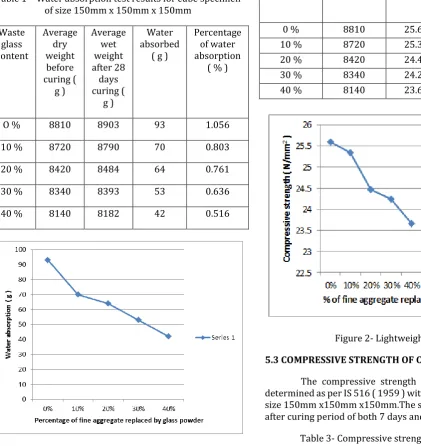
Water absorption test was carried out for all mixtures and percentage water absorption was measured.
Table 1 – Water absorption test results for cube specimen of size 150mm x 150mm x 150mm
Waste glass Content
Average dry weight before curing (
g )
Average wet weight after 28
days curing (
g )
Water absorbed
( g )
Percentage of water absorption
( % )
O % 8810 8903 93 1.056
10 % 8720 8790 70 0.803
20 % 8420 8484 64 0.761
30 % 8340 8393 53 0.636
40 % 8140 8182 42 0.516
Figure 1- Water absorption test
5.2 DRY DENSITY OF CONCRETE:
Average dry weight of cube specimens of each mixture as compared to reference mix was studied and it was observed that density decreases with increase in waste glass content.
Table 2- Lightweight test results for cube specimens of size 150mm x 150mm x150mm.
Waste glass
Content Average dry weight of cubes
( g )
Dry density ( KN/m3 )
Percentage change in weight with
respect to reference M30
cube
0 % 8810 25.60 0 %
10 % 8720 25.34 - 1 %
20 % 8420 24.47 - 4.59
30 % 8340 24.24 - 5.30
40 % 8140 23.66 - 7 .56
Figure 2- Lightweight test
5.3 COMPRESSIVE STRENGTH OF CONCRETE:
[image:4.595.43.465.178.625.2]The compressive strength of all the mixes was determined as per IS 516 ( 1959 ) with cubical specimens of size 150mm x150mm x150mm.The specimens were tested after curing period of both 7 days and 28 days.
Table 3- Compressive strength test results
Waste glass
Content strength of concrete Compressive at 7 Days ( N/mm1 )
Compressive strength of concrete
at 28 Days ( N/mm2 )
0 % 24.07 34.86
10 % 26.66 37.51
20 % 27.05 38.51
30 % 27.34 38.21
© 2018, IRJET | Impact Factor value: 7.211 | ISO 9001:2008 Certified Journal
| Page 5365
Figure 3- Compressive strength of concrete at 7 days and 28 days.
5.4 FLEXURAL STRENGTH OF CONCRETE:
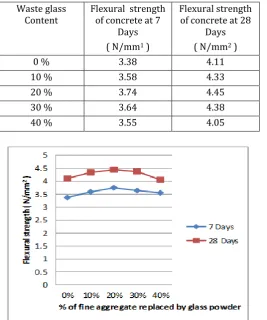
[image:5.595.32.300.403.724.2]The Flexural strength of all the mixes was determined as per IS 516 ( 1959 ) with specimens of size 100mm x 100mm x 500mm .The specimens were tested after curing period of both 7 days and 28 days.
Table 4- Flexural strength test results
Waste glass
Content Flexural strength of concrete at 7 Days ( N/mm1 )
Flexural strength of concrete at 28
Days ( N/mm2 )
0 % 3.38 4.11
10 % 3.58 4.33
20 % 3.74 4.45
30 % 3.64 4.38
40 % 3.55 4.05
Figure 4- Flexural strength of concrete at 7 days and 28 days
6. CONCLUSIONS:
On the basis of results obtained, following conclusion can be drawn:
1. When we replacing fine aggregate by waste glass powder up to 30 % replacement compressive strength of concrete increases.
2. When we replacing fine aggregate by waste glass powder up to 30 % replacement flexural strength of concrete increases.
3. With increase in waste glass content, percentage water absorption decreases
4. with increase in waste glass content density of concrete decreases.
5. Use of waste glass in concrete can prove to be economical as it is non-useful waste and free of cost
6. Use of waste glass in concrete will eradicate the disposal problem of waste glass and proved to be environment friendly thus paving way for greener concrete.
7. Use of waste glass in concrete will preserve natural resources particularly river sand and thus make concrete construction industry sustainable.
REFERANCES:.
1. Mohammad iqbal malik1, aarif manzoor2, barkat ahmad3, syed asima4,
2. Rozi ali5, muzafar bashir6 “positive potential of partial replacement of fine aggregates by waste glass in concrete”. Volume 5, issue 11, november (2014),
3. M. Mageswari1,* and dr. B.vidivelli2 “the use of sheet glass powder as fine aggregate replacement in concrete”. The open civil engineering journal, 2010, 4, 65-71
4. 5. Jitender1, prof. Archana tiwari2 “evaluation of strength properties of concrete containing glass powder waste “.volume: 03 issue: 07 | july-2016
5. S.p. Gautam, vikas srivastava and v.c. Agarwal” use of glass wastes as fine aggregate in concrete”. J. Acad. Indus. Res. Vol. 1(6) november 2012
© 2018, IRJET | Impact Factor value: 7.211 | ISO 9001:2008 Certified Journal
| Page 5366
7. M.S.Kuttimarks, R.Shruti “Experimental studies on replacement of fine aggregate with glass” Volume 2, May-2014.
8. A.W.Otunyo and B.N.Okechukwu “Performance of concrete with partial replacememt of fine aggregate with crushed waste glass” Volume 2, April-2017.
9. M.Adaway and Y.Wang “Recycled glass as Partial replacement for fine aggregate in a structural concrete, April-2015
Reference Books:
1. Concrete Technology- M. S .Shetty, S. Chand Publications.
2. Concrete Technology-M. L. Gambhir, Tata Mcgraw Hill Publications.
3. Concrete Technology by R. S. Concrete Technology Varshaney, Oxford and IBH.
4. Design of Concrete Mixes by Raju N Krishna, CBS Publisher.
5. Concrete Technology- A. R. Santhakumar, Oxford University Press.
Reference IS Codes:
1. IS 456: 2000 (Reaffirmed 2005) ‘Indian standard code of Plain and Reinforced concrete Code of Practice.’
2. IS 102620 : 2009, ‘Indian standard code of Recommended Guidelines for concrete mix design’
3. IS 2386 : 1963, ‘Indian Standard Methods of test for aggregates for concrete’