MARCH
1961
•
VOL. 10 - NO. 3 & 38
NOVEL APPLICATIONS OF COMPUTERS
AND DATA PROCESSORS
Automated Material Control
a DATA-PHON E case history
Biggest
DATA-PHONE
system
in the United States toda;l{,'
\
I
A midwestern insurance company sets a dramatic
example for users of data-processing equipment
The Hardware Mutuals - Sentry
Life insurance group is using a new
data-communications system to
speed data handling by 500 per cent
and reduce operating costs by over
a million dollars a year.
The new system makes use of the
nationwide Long Distance
tele-phone network.
It
combines the
Bell System's new Data-Phone
serv-ice with data processing equipment
to send business records from 32
branches to the company's
central-ized computer center at Stevens
Point, Wisconsin.
Machines "talk" to machines
All kinds of daily operating data,
from widely scattered points, are
handled efficiently and accurately at
speeds up to 200 words per minute.
The data is keyed into punch cards.
A Data-Phone unit is connected to
business machines at both the
send-ing and receivsend-ing locations. A phone
call is put through-and the
ma-chines immediately start "talking"
data. It's that simple.
The system is as flexible as the
telephone network itself. The
insur-ance company pays for telephone
circuits only when using them, as
for any branch-to-headquarters call.
And Data-Phone takes up little more
space than a standard typewriter.
Learn how high-speed, low-cost
Data-Phone service can streamline
your company's data processing. Just
call your Bell Telephone Business
Office and ask for a
Communica-tions Consultant. He'll bring you
the complete story.
James P. Jacobs, President, Hardware Mutuals - Sentry Life insurance group, says:
"Our new data-processing tech-nique-with the rapid communica-tion of data made possible by Data-Phone-is benefiting our business in many important ways.
"It lets us collect the mass of information we need for manage-ment decisions almost instantly. It has cut the time needed for certain policy-handling functions from three days to three minutes. It is reducing our operating costs by over $1,000,000 a year and is helping us give our policyholders better service than ever before.
"Naturally, we're enthusiastic about it."
The one source for all business communications
-
.. ,,~<J('(?'>-_?;o"" ..
,,';:Ml'';~jIjI!:@
BELL TELEPHONE SYSTEM
~S9CIATEDC.O~<q"i'~:
COMPUTERS alld AUTO~L\TIO:\' for ~[arch, 1961.,..
"
_.1
TIl Ca
eq\
In
wij drE ofCal
adl
TIl
ter
Cal
prj
or
T1
;()uth
Calif. 10.
sselll-~Hill()'
i'(:ally
f illl-e
ar-t thc
'ssillg
'c ar-dings nagc-,tem; )hies,
peri-and
aties Me-5t 42
nted,
>vide sub-laties
The letic; trig-even
'The
cuits or is
pen-tical
:ven-are had
uter Co.,
:J6,
I. able ~ital
:0111-Iller ents
i. /
l 9,
ing
age
Lter
I /
Y.
/
/
ry,
'p.,
len
:j(jl
... even four times faster than any previous Philco 2000 systems
Philco 2000 Data Processing Systems have always been among the fastest and most reliable. Now, the new model 212 central processor brings an entirely new concept in data processing speed, efficiency and flexibility to business, industry and science.
Advanced four-way processing, which permits simultaneous processing of four instructions; faster circuits, with diode-transistor logic; improved internal organization; all contribute to the tremendous speed of the 212 ... four times faster than any previous model. For example, it can perform 639,000 additions in one second. .
Faster running time, more effective use of memory and reduced program-ming time, result in the greatest possible economy in data processing.
The 212 central processor is fully compatible with all Philco 2000 systems. You can install a Philco 2000 system now, utilizing either the model 210 or 211 central processor, and as your work load increases, replace the central processor with the model 212, without reprogramming! Write today for complete information.
Features
• Asynchronous design
• Fully compatible with other Philco computers • Faster circuits
• Diode-transistor logic • Improved internal organization • Simplified maintenance
• Multiplication range between 3 and 12 microseconds, average of 8 microseconds • Advanced four-way processing. Permits four instructions to be processed simultaneously • Access time of 1 microsecond for a pair
of instructions
• Expanded instruction catalog of 248 instructions
• Four modes of automatic index register modification for maximum program efficiency • Expanded repeat functions to allow automatic
looping of up to four instructions
PHILCO CORPORATION • GOVERNMENT & INDUSTRIAL GROUP • COMPUTER DIVISION, 3900 WELSH ROAD, WILLOW GROVE, PA.
COM vp
~.-U
T E R S
atzd
AUTOMATION
COMPUTERS AND DATA PROCESSORS, AND THEIR CONSTRUCTION,
APPLICATIONS, AND IMPLICATIONS, INCLUDING AUTOMATION
Volume
10Number 3
&3B
MARCH,
1961
Established
September
1951EDMUND C. BERKELEY Editor
NEIL D. MACDONALD Assistant Editor
MOSES M. BERLIN Assistant Editor
PATRICK J. McGOVERN Assistant Editor
CONTRIBUTING EDITORS ANDREW D. BOOTH
NED CHAPIN JOHN W. CARR, III
ALSTON S. HOUSEHOLDER
ADVISORY COMMITTEE MORTON M. ASTRAHAN
HOWARD T. ENGSTROM GEORGE E. FORSYTHE
RICHARD W. HAMMING ALSTON S. HOUSEHOLDER
HERBERT F. MITCHELL, JR. SAMUEL B. WILLIAMS
SALES AND SERVICE DIRECTOR EDMUND C. BERKELEY
815 Washington St. Newtonville 60, Mass.
DEcatur 2-5453
ADVERTISING REPRESENT A TIVES
Los Angeles 5 WENTWORTH F. GREEN
439 So. Western Ave. DUnkirk 7-8135
San Francisco 5
605 Market St.
A. S. BABCOCK YUkon 2-3954
Elsewhere EDMUND C. BERKELEY
815 Washington St. DEcatur 2-5453 Newtonville 60, Mass.
COMPUTERS and AUTOMATION is published 13 times a year (monthly except two issues in July) at 815 Washington St., Newtonville 60, Mass., by Berkeley Enterprises, Inc. Printed in U.S.A.
SUBSCRIPTION RATES: (United States) $7.50 for 1 year, $14.50 for 2 years; (Canada) $8.00 for 1 year, $15.50 for 2 years; (Foreign) $8.50 for 1 year, $16.50 for 2 years. Address all Editorial and Subscription Mail to Berkeley Enterprises, Inc., 815 Washington St., Newtonville 60, Mass.
ENTERED AS SECOND CLASS MATTER at the Post Office at Boston, Mass.
POSTMASTER: Please send all Forms 3579 to Berkeley Enter-prises, Inc., 815 Washington St., Newtonville 60, Mass. Copyright, 1961, by Berkeley Enterprises, Inc.
CHANGE of ADDRESS: If your address changes, please send us both your new address and your old address (as it appears on the magazine address imprint), and allow three weeks for the change to be made.
Vol.
10~No. 3B
News of Computers and Data Processors:
ACROSS THE EDITOR'S DESK
inserted between pages 8 and 9 and between pages 24 and 25
NOVEL APPLICATIONS OF
COMPUTERS AND DATA PROCESSORS
Digital Computer Instead of Stable Platform in InertialNavigation Systems, S. H. McALONEY "Writing Letters" on Past Due Accounts,
WILLIAM R. PLATT
"Suggesting Improvements" in the Design of Circuits, and Other Engineering Work,
J.
R. LAMB, JR. Voice Reporting of Current Stock Prices UponInterrogation, WALTER CLARK.
A Coordinate Conversion Computer for Project Echo, JOHN V. COCKIN .
Aptitude Testing and Answer Timing by Use of a Computer in Real Time, WOLF RESEARCH AND DEVELOPMENT CORP.
FRONT COVER
6 6 7 7 7 8
Telephone Terminal to Outer Space
ARTICLES
1, 21
Automated Material Control, PAUL L. RUSSELL. The Automatic Meteorological Observation Station
(AMOS) Computer,
NATIONAL BUREAU OF STANDARDS . The Advantages of Numerically Controlled Machine
Tools, G. S. JOLLIS .
Computer Monitoring of Reactor Radioactivity Levels, DR. JAN PAUL.
READERS' AND EDITOR'S FORUM
Optimization of Business Operations - More Discussion, RA YMOND OVERELL. . .
The Siemens 2002, MAJER-TRENDEL Calendar of Coming Events.
REFERENCE INFORMATION
Survey of Recent Articles, MOSES M. BERLIN Books and Other Publications, MOSES M. BERLIN
INDEX OF NOTICES
Advertising Index
10 12 15 19 21 21 22 24 26 30 Computer Directory and Buyers' Guide
Glossary of Terms Manuscripts
Reference and Survey Information Who's Who Entry Form.
8
see Feb., page 26 see Feb., page 12 see Feb., page 23 see Feb., page 15
COMPUTERS and AUTOMATION for March, 1961
"I manl uniql alph, nalin and/ book Cool, Ell I] 42 pri TI dud( troni sente in tE the I tratil Leve El, OSI N( pp TI basis plied need cent secti for men Com The prog telee cisio patt, Gre, List U ar FI gl BI
of a
ns;
gh
011
rc-
IP-
la-raI
111-:te.
liT
lU-he
an an
23,
Lg-~d,
ed
rc-
id-eh
..
Ib-It'S
~cs
ns,
ncl
I
on >rk
lP,
ng
Lre lal
al-
Ill-rcr
:n-.ps
111-itc ,1st
~n-:al
~o- Ii-ch
:h-I
hc lcl lin en hc
of
lc-
:n-he )e-
ro-nel
111-
lr-I
iaI
10.
ox
)ls
or
ell ics
,\,O
H~-of
~A
LO, 111,
la- p-'aI
I(il
Design changes double power of Honeywell
400
Internal speed increased
to
10,000
three-address operations
a
second; new independent
console,
FACT
business compiler, optional off-line printing,
more
optional tape drives.
Honeywell's EDP Division has greatly broadened the appli-cation of Honeywell 400 - and extended the benefits of electronic data processing to more companies - by incor-porating into this System a number of outstanding new features. These new developments, a result of Honeywell's continuous research, have further enhanced the pre-eminence of Honeywell 400 in its class. And, except for the new optional features, there has been no increase in cost.
Internal speed iumps -
The internal speed of the Hon-eywell 400 is now approximately 10,000 three-address opera-tions per second - the equivalent of 20,000 one-address operations. Multiplication is about twice as fast as before, and division about four times as fast. Multiply time for a six non-zero digit multiplier is 1.9 ,milliseconds. Division times range from 1.6 to 8.6 milliseconds.FACT business compiler available -
Now, in addition to the EASY assembly program, the FACT compiler is avail-able with Honeywell 400. FACT, a widely acclaimed, highly efficient automatic programming system, is unique in that it can be applied to all typical functions of business data proc-essing with ease and uniformity. This includes input editing, sorting, processing of variable-length records, and report writing.New independent console -
Included in the basic sys-tem price of $8,660 a month is a new independent console equipped with a keyboard, printer, and breakpoint switches. This new console enables Honeywell 400 operators to com-municate more easily with the System.Optional
off~lineprinting -
Now organizations such as public utilities and insurance companies can print bills or premium notices in huge volume without attenuating the important processing work going on inside their Honey-well 400.An off-line printing configuration consisting of a printer, high-speed magnetic tape unit, and electronic control equip-ment is now available at a rental of $3,500 per month.
More tape drives may be connected -
The maximumnumber of magnetic tape units which may be used with the Honeywell 400 has been increased from six to eight. (Basic system includes four tape units.)
Expansion now easy. economical -
By vastly increas-ing the processincreas-ing power without increasing the price, and by making new optional equipment available, the new Honeywell 400 gives users power to spare for the years of growth ahead. It also makes easy and economical the possible future jump to Honeywel1 800, the most powerful of all computers in the Honeywell family.The outstanding performance of Honeywell 400 in the areas of storage and high-speed manipulation of large vol-umes of data make it exceptionally efficient at sorting and file maintenance ..
SUMMARY OF KEY FEATURES
Basic package:
Includes central processor, four speed magnetic tape units, console and console printer, high-speed printer and card reader.Price of basic package:
Monthly rental- $8,660 per month. Price - $390,000.Options:
Various input-output devices including off-line printing, up to four additional tape units, card punch (100 or 250 cards per minute), paper tape input and output units.EQUIPMENT SPECIFICATIONS CENTRAL PROCESSOR:
Speed 10,000 (approx.) 3-address operations per second. Memory 1,024 words of core memory (approx. 10,000
characters).
Checking Internal parity checking.
Features Simultaneous read·write, special automatic editing provisions, high·speed sorting ability.
Options Multiply·divide, print storage for simultaneity with other operations, additional memory.
MAGNETIC TAPES:
Speed 96,000 decimal digits per second. Features Identical to Honeywell 800 tape units.
PRINTER:
Speed Horizontal
span Features
CARD READER:
Speed Feature
CONSOLE:
Features
Orthotronic Control (automatic error detection and correction).
900 lines per minute.
120 columnar positions.
Up to 10 clean carbons, rugged construction, fully checked. .
650 cards per minute. Fully checked.
Printer and keyboard for both input and output, breakpoint switches.
AUTOMATIC PROGRAMMING AIDS:
EASY Assembly Program. FACT Business Compiler.
If you have any questions about this new and more powerful Honeywell 400, just write Honeywell EDP, Wellesley Hills 81, Mass. Or Honeywell Controls Limited, Toronto 17, Ontario.
Honey"\lVell
Novel Applications of Computers
Neil MacdonaldAssistant Editor of Computers and Automation
From time to time, Computers and Automation publishes a section on "Novel Applications of Com-puters." Here is the call for information which we sent out on January 24:
The March issue of Computers and Automation will contain a special section on:
NOVEL APPLICATIONS OF COlYIPUTERS AND DATA PROCESSORS
H you have, or know of, any novel or unusual a pplications of computers or data processors, we should be very glad to publish three to six para-graphs about them, with the author's name. Pictures will be considered also.
lY1ay we hear from you by Friday, February 10,
the closing date [or the "March issue?
If at any time you have any "novel applications of computers or data processors" to report, please write to us sending us the asked-for information, and we shall be glad to publish it in an early issue.
DIGITAL COMPUTER INSTEAD OF STABLE
PLATFORM IN INERTIAL NAVIGATION
SYSTEMS
S. H. McAloneyFord Instrument Company Division of Sperry Rand Corp.
Long Island City I, .N. Y.
Two new special-purpose digital computers, now being designed and built by Ford Instrument Co. as part of the AN
j
AJN-7 "strapped-down" inertial navigation system, moved recently from the theoreti-cal to the hardware stage with construction of the first equipment modules.Developed by Ford Instrument, under U. S. Air Force contract, for the V\Teapons Guidance Laboratory of 'Vright Air Development Command, the new "Fordac" computer is the heart of an airborne in-ertial navigation system that does away with the "stable platform" of conventional inertial navigation systems. The new system is called a "strapped-down" inertial system (or sometimes a "platformless" or "no-gimbal" system) because the gyroscopic components are body-mounted. The usual functions of a stable platform are performed by the computer mathemati-cally.
In its final configuration "Fordac" will be a com-pact, lightweight, all-solid-state computer especially suited for airborne packaging. It employs novel tech-niques to compute and maintain the nine direction
6
cosines that relate the coordinate system defining the vehicle axes to a space-fixed [rame of reference. The name "Fordac" is derived from the words "Ford Altitude Computer."
In conventional inertial navigation systems, the moving gimbal structure requires a great deal of un-obstructed space. Usually, space requirlments
in-crease with accuracy requirements. F)rthermore,
gimbal structures must be built to exper~sivel)' close tolerances. All of these problems are byp;'Lssed in the AN
jAJN-7
system. .The second computer, which was deyeloped by Ford Instrument under a supplement to ;:he original
AN
j
AJN-7 contract, is a new solid state digital COlll-puter that combines incremental and DDA (Digital Differential Analysis) techniques. The computer has been nicknamed "Poco" [rom POsition COmputer.It will combine the output of "Fordac" with informa-tion from vehicle sensors to compute the posiinforma-tion of the vehicle with respect to the earth.
"WRITING LETTERS" ON PAST DUE
ACCOUNTS
William R. Platt
The National Cash Register Co. Dayton 9, Ohio
An NCR 304 Electronic Data Processor writes letters on past-due accounts for Johnson'S 'I\Tax.
Actually, letter writing is just a small part of the job done by the system. The NCR 30"1 processes orders received from 23 branches over leased wires, checks credit of purchasers, and prints invoices, bills of lading, and shipping labels. The processor also keeps an inventory for all 23 branch warehouses and the main warehouse and regulates shipments from factory to warehouse and from warehouse to ware-house so as to keep shipping costs down while main-taining an adequate supply of products at every out-let. Furthermore, the system handles payroll, accounts receivable. accounts payable and other accounting operations.
If an order exceeds the purchaser'S allowable credit, the system prints out his complete credit history with Johnson's 'I\Tax, and also his Dun & Bradstreet rating and any other pertinent information available for review by the credit manager.
The letters on past-due accounts are pre-printed. The NCR 304 addresses them and fills in the details of the transaction on which payment is overdue.
There are four letters in the series, but only three are sent to anyone customer in a given sequence. One letter is sent as a second letter if the situation
COMPUTERS O1ul AUTOMATION for March, 1961
•
.,
Teel lion; 'rhe lion: lion
Com cussi
Bihl Gar1
PI
D.
ar
PI
A
worl
sisto Desi and is ~
Dep Can diSCI
p1ifi
Five
dam
and Gre:
H
S~
'W ci
C(
T
;HI
a ut(
IIsin
dcrs acc{)
the
aut(
seve
Dat; grar
and Dec opn
tory
lcm prol tion
Vall
h
"
N 4!
.-\ mo(
pre~
disc lioll lhe~
rela Son cha worl
Sym ano indl
Eps
84
N
P:
~ ing
hoo
CIIS~
tio!'
lipl non
Kel gra]
inc1 Tru
of
o
p y
$ oJ
5630
alif. lcst.
[1(lix t of lan-1, is
the tate-~scd. :x is
ltrol
~ton
J. I
•
)ach 19 a 'olv-,tive [lcar A bed, lems lap-the ling Ited. :on- Un-The sses, :ory, lOok lien the lIan
. Y.
the this eco-ions tics, con-It a gan, !pts, 'aln-the phy asic lOok Hill ~cw pp,
I) a ; 2)
ons, tria- nta- om-wed ains roh- his-s I the
COt',
s of
lIate ago. :om- ill-iOlls tioll 1!J()1
remains unchanged; a different letter is sent if another payment has become past due in the interval since the first letter was sent.
"SUGGESTING IMPROVEMENTS" IN THE
DESIGN OF CIRCUITS, AND OTHER
ENGINEERING WORK
J. R. Lamb, Jr.
General Precision Inc.Pleasantville, N. Y.
In regard to computers used to assist engineering here, we have used the LGP-30, made by Librascope and marketed by Royal McBee, Port Chester, N.Y., [or a wide variety of design applications.
These include (1) exploring the characteristics of filters for frequency trackers of Doppler radar naviga-tion systems, (2) studies of the altitude-hold effect and its relation to antenna design in Doppler systems, (3) space navigation studies and error calculations, (4) calculations of the effects of frequency modulation in a carrier.
In addition, the computer has been used to check the reliability of designed circuits, and to re-design them when necessary to improve performance or to alter input-output specifications.
Take, for example, one such application, a four-transistor flip-flop. To begin with, the circuit used a basic two-transistor amplifier at each output. At the start of the analysis, an engineer writes separate, in-dependent, nodal equations to satisfy the circuit. In these equations, the currents are expressed in terms of voltages across resistors. The engineer then estab-lishes the criteria for circuit stability.
The basic equations describing the circuit and giving component values are then inserted in the LGP-30. The computer makes a run for each set of data with different values of transistor characteristics.
It assigns a value to each resistor and voltage in the circuit. Each run differs from the others by a varia-tion of one or more of the parameters involved.
The effects of aging, high temperature, fluctuations in power supplies, initial spread of transistor, and parameters of other components are evaluated. In some cases, the effects of several parameter changes can be lumped into a single, properly weighted, hypothetical parameter. ';\Then the computer finds a circuit with inadequate reliability, it can "suggest improvements" by introducing modifications of com-ponent values.
VOICE REPORTING OF CURRENT STOCK
PRICES UPON INTERROGATION
Walter Clark
Teleregister Corll. 445 Fairfield Ave., Stamford, Conn.
A talking data processor will soon be reporting stock quotations over the telephone to brokers of the American Stock Exchange. Being built by The Tele-register Corporation, this processor is believed to be the ,,"orld's first commercial system to use automatic voice output.
This 'is a real-time, on-line system. It will keep a continuously updated record of price and volume information on 1100 stocks, and will announce this
COMPUTERS and AUTOMATION for March, 19GI
data to some 750 brokers upon being interrogated via telephone dial. Within two seconds after a broker finishes dialing a stock code number, he will be listening to a report which will include the stock symbol, the prices, "bid, offer, open, high, low and last," volume, and size (number of shares bid for and offered).
The heart of the system, called a Telefile®, is a real-time data processor which can answer 20 in-quiries per second, and which can talk to hundreds of brokers simultaneously, giving reports on any selection of different stocks.
Input to the magnetic storage is by keysets. The audio sub-system of the data processor stores a vocabulary sufficient for any possible reporting
re-quirement. Subscribing brokers need only their
regular telephones to obtain information from the data processor; but teletype inquiry and print-out is also available where desired.
Future functions of the Telefile may include operating the American Stock Exchange ticker system, performing clearing functions, and doing billing. It can also be expanded to handle more stocks and serve more subscribers.
The system is to be in operation by early 196;)
and will cost $3,000,000.
The New York Telephone Co. cooperated on the communications phase and will supply the telephone lines.
A COORDINATE CONVERSION COMPUTER
FOR PROJECT ECHO
John V. Cockin
Comlluter Control Co., Inc. Framingham, Mass.
Project Echo is sponsored by the National Aero-nautics and Space Administration to prove the techni-cal feasibility of two-way microwave communication between the U.S.A.'s East and
';\Test
Coasts using a 100-foot aluminized balloon satellite as a reflector orbiting 1,000 miles above the earth.The earth's curvature constitutes a natural barrier to microwave transmission beyond the horizon. Pre-vious attempts to bounce microwaves off layers in the ionosphere have not proved to be consistently depend-able. Once the technological objectives of Project Echo have been established, a very important new method of global communication becomes available. A significant contribution to the success of this
project is a Coordinate Conversion Computer
designed and built by this company for the Jet Propulsion Laboratory, Calif., a research facility of the National Aeronautics and Space Administration. The computer operates at a one-megacycle clock rate and continually positions the two 85-foot parabolic antennas at the West Coast (Goldstone, Calif.) site to track the orbiting satellite. The two antennas, their servo-drive systems, tracking optics, a microwave data link, and the coordinate converter combine to form a closed-loop tracking system.
The COlllpliter performs the following- functions: (I) Accepts data on satellite position from
pre-compllted orbit data recorded on paper tape, or frolll receiver antenna position data.
(2) Directs both receiving and transllllttmg an-tennas in hour-angle declination and azimuth-elevation coordinates, respectively.
(3) Computes orbital data from stored parameters by integrating the satellite's differential equa-tions of motion. In these computaequa-tions the Computer considers and makes corrections for parallax due to earth curvature and physical separation of the receiving and transmitting antennas.
(4) Extrapolates continuously to produce a smooth, well-timed, continuous series of com-mands between the computed commands appearing everyone and two seconds.
(5) Time-compares all input orbit data for real-time computation.
(6) Generates error signals by a digital comparison of the digital antenna position readout signals and the computed position data.
(7 Introduces digital offset signals to correct for system misalignment.
(8) Generates a rectangular search scan pattern for the antenna.
(9) Accepts the receiver antenna readout as com-puter inputs and transforms these coordinates to position the transmitter antenna. In this mode the two antennas are directed to the same point in space through a radio freq uency lock on the received microwaves.
The Computer proper is a general-purpose com-puter utilizing a stored program. The high-speed serial-parallel arithmetic unit performs the necessary coordinate conversions and parallax corrections. It
provides output commands to the digital servos within 20 milliseconds from the time of input com-mands. These rapid computations are necessary to maintain systems synchronization and to reduce phase shift. In the time between basic computations the system integrates the differential equations of the satellite's motion. This computation provides an independent means of tracking the satellite should input data be in error or fail to be received. The Computer is given position data and velocity vectors of the satellite for a given time. These values are precalculated by a computing center at another loca-tion. Using this information the Coordinate Con-version Computer starts integrating the equations about one minute before the satellite balloon appears above the horizon. The Coordinate Conversion Com-puter keeps equations updated and synchronizes them with real-time.
\\Thile the Computer is operating from the orbital integration data, the commands to the digital servos are given at one-second intervals. \\Then working from stored data on punched tape, the commands are given every two seconds. The Computer word length is 25 bits, including sign. The Computer can perform high speed addition, subtraction and multi-plication. It can compute A
+
BX
C+
D in 50 microseconds. \I\Then multiplying it can transmit the product back to the multiplier or multiplicand registers controlled from the multiplication command. Built-in operations include octant reduction, sine-cosine manipulation, time conversion, maxnTIum8
absolute value comparisons, extract or logical prod-pcts, and block transfers.
APTITUDE TESTING AND ANSWER TIMING
BY USE OF A COMPUTER IN REAL TIME
Wolf Research and Development Corp. Boston 16, Mass.
A computer program which aids in the screening and selection of computer programmers has been developed by this company.
A Bendix G-15D computer has been programmed to administer multiple choice tests of 100 or less questions. The program is used in real time. Richard P. Gagan, an analyst, and lVII'S. Frances Tessler, a programmer, devised the test. Time, as well as correct and incorrect answers, is an important element in evaluating the results of tests taken by applicants in this method.
T!le program is known as "PAT"-Programmer AptItude Tester. To take the test, an applicant seats hImself at the computer typewriter. Questions are contained on cards; a choice of five answers, one of '~hich i~ correct, is provided. The computer is pro-VIded WIth a corresponding answer sheet. \\Then the applicant has selected his answer, he types in the number of it. The computer then types out the num?er of the nex~ question, and automatically starts to tIme the applIcant on that question, stopping when the answer is typed in.
UI?on completion of the test, a raw score (number of nght ans:vers ]~linus one-quarter of the wrong answers), a tIme-adJusted score, and the mean time per question are typed out, followed by the tillle in seconds and results on each question.
The program is general enough for use with any multiple choice test.
THE COMPUTER DIRECTORY AND BUYERS'
GUIDE FOR 1961, 7TH ANNUAL EDITION
The Computer Directory and Buyers' Guide for 1961,. the 7th annual edition, will be published this year In July on a new basis.
. We shall seek .to ~ake it a complete and inclusive dIrectory and gUlde for the greatly expanding field of computers and data processors.
It will contain at least the following reference information:
1. Roster of Organizations
2. Roster of Products and Services: The Buyers' Guide 3. Roster of Computing Services
4. Roster of Consulting Services
5. Descriptions of General Purpose Digital Computing Systems
6. Descriptions of Analog Computers
7. Descriptions of Special Purpose Computers and other reference information
For subscriptions received March 1 and later, the "Computer Directory" will no longer be automatically included in every subscription to "Computers and AU,tamation." The price of the directory will be $12 before p'ublica~ion, $15 ~fter p~blication. Any pur-chaser of the dIrectory wIll receIve the monthly issues of "Computers and Automation" at no additional cost. If the directory is not included in a subscription, the price of the monthly issues of "Computers and Automation" will remain at .$7.50 per year (in the United States).
CO~fPUTERS and AUTOMATION for March, 1961
:.
langl on Sl
eludi liabil tems, brief proC( elude Data tio of De W4 lin TI tool man;
of cc
intcr list must essin, prest cusse Dehu Ou gr. El4 Br EIE na no 17: III Or Com descI turcs prob ;nnpl accOl
of jl
inclll RUS8 ne Gr 42 TI mati ion plisb sidcl aeti" IJlcn l1arn prac ex an pIic( Mon: C(] C(] 19 Pt hu A pcct cont The tena dCSCl nom
of tl Why ne Gl St
'1'1 ~r. I
of t
chec
of tl
is to logi( alc
form
.\nal
~r
~o
.c
:h
ld
:es
l-
)-J,
NEWS
of
Computers and Data Processors
~~ACROSS
THE
EDITOR'S DESK"
COMPUTERS AND AUTOMATION
Volume 10
Number 3B
MARCH
2, 1961
Established September 1951
Published by Berkeley Enterprises, Inc., 815 Washington
St.,
Newtonville 60, Mass.
EIGHT POUND MEMORY OOUM
STORES 358,000 BITS
Sperry Gyroscope Company
Division of Sperry Rand Corp.
Great Neck, New York
A miniature memory drum that
can spin indefinitely and store
an extraordinary amount of
in-formation within its
baseball-size, cylindrical frame has been
designed by this company.
The drum is able to operate
"reliably under extremely adverse
conditions, and turns in an
air-bearing suspension. It can be
made to almost any size to fit
the application.
The eight-pound aluminum
cy-linder can store information at
600 bits to the incn, and can
hold 358,000 bits of information,
about six times tnat of a
compar-able commercial drum.
'Floating magnetic neads
Itpick up and record data; they are
cushioned on a film of air one
ten-thousandth of an inch above
the drum's surface.
Tne drum also has a
'~neword loop", which speeds
comput-er pcomput-erformance by enabling it to
utilize information virtually as
fast as it receives it and
de-posits it on the drum.
-- An engineer in an ultra-clean,
hospital-like laboratory tests the performance of the
newly-developed computer memory drum, which
is able to store 358,000 bits of information
in its baseball-size frame.
It is suspended
on air bearings, instead of conventional ball
bearings, and should be able to perform
in-definitely, making it very suitable for
prolonged use in space.
NEW MAGNETIC MEMORY DISC FILE DELIVERED
Joseph
E.
Smith, Gen. Mgr.
Bryant Computer Products
852
Ladd Road
Walled Lake, Mich.
The first random access, mass memory
de-vice made by an independent equipment supplier
to the electronic computer industry has been
delivered by this company.
The memory device is a magnetic disc
file, which combines the reliability and fast
access of magnetic drum memories, and the
high capacity and low cost of magnetic tape
memories.
A broad line of disc files, ranging in
capacity from 30 million to 600 million bits
of information is to be produced.
Maximum
access time of all units is 167 milliseconds,
including 100 milliseconds for positioning.
Average access time excluding positioning is
34 milliseconds.
Cost per bit will range
from one-tenth of a cent in the smallest unit
to one-fortieth of a cent in the largest.
The disc files are pr0cision
electro-mechanical devices, in which business
inform-ation is stored in magnetic code on a number
2B
of vertical discs. "Reading" and "writing" of
information are accomplished by air-floated
transducers which scan the sides of the discs.
A disc file may contain from one to 20
discs; they use a common base structure and
a common drive system housed in a centralized
pedestal mounted on the base. The discs are
mounted on interchangeable precision spindles
of the length required for the number of discs
in a unit. Rotational speeds of 900-1200 RPM
are standard.
"Reading" and "writing" on each disc face
is accomplished by six magnetic heads mounted
on a rocker arm which is movable to permit
each head to serve 128 tracks. All of the
rocker arms are locked together for movement
as a unit under control of a digital actuator.
The actuator is an open-loop, hydraulic
sys-tem capable of moving the heads to anyone of
128
positions with an accuracy of better than
0.0005
inches. Positioning is accomplished
in less than one-tenth of a second in response
to seven binary address signals. Positioning
accuracy is guaranteed for the life of the
file.
The recording surface of each disc is
~hard magnetic oxide, micro-finished to insure
recovery of all recorded information, and to
C:OMPUTERS and AUTOMATION
for
March,1961
..
enc
The
ed
nec
It
to
th~
lei
ca'
onl
tu
to
an
Th
po
ra
ev
of
ti
ma
ti
at
ti
ch
mll
ac
to
S€ Sf
tE
a
oj
v(
nE
CI
al
•
I
d
st
s-n
1
maintain a normal signal-to-noise ratio of
40to
1.Simultaneous positioning of all heads
makes parallel "reading" and "writing" with
a number of heads inherently possible. Clock
tracks are used to time reauing and writing
accurately, and thus permit selective
altera-tion of recorded informaaltera-tion. A single set
of six clock tracks is normally provided for
the entire disc file, with one track for each
of the six heads per disc side. Recordirig
frequencies ranging from 174 kc in the
inner-most tracks of a disc to
431kc in the
outer-most tracks, based upon a maximum pulse
pack-ing of 273 bits per
inc~are standard.
Read and write circuits, head switching,
and clock circuits are completely
transistor-ized and modularly packaged to facilitate
as-sembling uf systems to meeting special needs
for serial, parallel, or serial-parallel
re-cording capability.
Additional flexibility may be achieved
by incluJing multiple,
individually-address-able actuators, each controlling the position
of a group of heads, or
by including a second
set of heads, serving the same tracks and
positioned by an independent actuator.
VERSATILE
DIGI1~LTRANSDUCERS
De-Jur Amsco Corp.
Northern Blvd.
&
45th St.
Long Island City
I,N.Y.
Development and production of sensors
and transducers for direct use with digital
computers ha3 not kept pace with the
tremend-ous progress of the digital computer
industr~Seeking to bridge this gap, this company
has developed a complete line of digital
trans-ducers with true digital outputs. These
de-vices reduce the overall size of
instrumenta-tion and control systems, increase their
re-liability and produce results which can be
directly stored and used in digital computers.
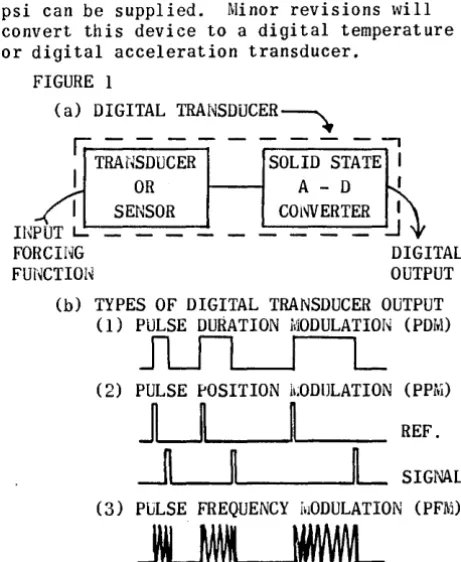
Figure lea) block diagram illustrates the
principle of operation of these transducers.
The input forcing function can originate from
several primary sources of energy (pressure,
temperature, acceleration, rate of flow, etc.).
When fed into the transducer or sensor, the
analog signal is subsequently converted into
a true digital signal by means of solid-state
conversion circuits.
Figure l(b) illustrates various types 'of
time base outputs that can be made available
from the converter, and are directly
propor-COMPUTEHS and AUTOl\1ATION for March, 1961
tional to the input forcing function. Output
(1) is commonly referred to as pulse duration
modulation (PDM); the width of the pulse in
time units (microseconds) is directly
propor-tional to the input signal. Output (2) is
pulse position modulation (PPM) and consists
of a reference pulse and a signal pulse whose
position in time deviates from the reference
pulse in direct proportion to the input signal.
Output
(3)is shown as pulse frequency
modula-tion (PFM) and is made up of a number of pulses
with thitotal per unit time directly
propor-tional to the input.
Important features which characterize
this unusual digital transducer is its ability
to sense many different sources of energy in
one miniature self-contained package, and
de-liver
atrue digital signal output directly
proportional to the amount of energy detected.
Als~
its solid state circuits make this
trans-ducer relatively impervious to environmental
variations. This desirable characteristic to
withstand exposure to extremes of environment
is a critical requirement necessary for
mili-tary applications. Another advantage is the
ability to pre-calibrate the digital output to
correspond directly with the value of the
parameter being measured without need for
zero suppression.
For example, a digital
pressure transducer with a full range of
0-1000psi can be made to indicate an output
of
0-1000microseconds (PDM or PPM) for this
input pressure range.
Together with its new line of
subminia-ture pressure instruments, digital pressure
transducers for pressure ranges from 5 to
8000psi can be supplied. Minor revisions will
convert this device to a digital temperature
or digital acceleration transducer.
FIGURE
1(a) DIGITAL
TRANSDUCER~r ; : - - - -
- - - ,
TRAl'~SDUCER
SOLID STATE
II
OR
A - D
INPUT
L..:FORCING
FUNCTIOl~
SENSOR
COIWERTER
DIGITAL
OUTPUT
(b) TYPES OF DIGITAL TRANSDUCER OUTPUT
(I)
PULSE DURATION
MODULATIor~(PDM)
( 2)
PULSE POSITION lI;ODDLATION (PPtti)
JU
~
-.Jl---'~'-
_ _
L
REF.
SIGNAL
(3) PULSE FREQUENCY IilODULATION (PFM)
[image:11.617.339.570.448.729.2]AUTOilil\TIC COMPUTING OF PARKING CHARGES
Airport Parking Co. of America
1306
~rospectAve.
Cleveland 15, Ohio
The first airport parking installation
of automatic computing equipment to hasten
the in-and-out flow of motorists, and make
sure of the accuracy of the fees charged, is
being tested by the Airport Parking Company
of America in its lot at the Washington, D.C.
National Airport.
The ticket coder shown in the doorway
punches the time of entry into the
parking ticket, in the test
installa-tion of automatic computing equipment
at the Washington D.C. National
Air-port. When the motorist's parking
check is fed into the slot of the
automatic computer, the computer
figures out the fee in less than 3
seconds, and flashes it on the easily
visible panel at the upper right.
--As the motorist enters the lot, he
re-ceives a claim check with a pattern of
punches expressing the time of entry. The
same information is printed on a ticket stub
which can be slipped under the windshield
wiper or placed with the customer's keys in
the attendant's shelter, for use if the
mo-torist loses his own parking ticket.
When the customer leaves the lot, his
ticket is inserted in a ticket reader slot
of a parking computer.
In 3 seconds or less,
4B
the computer adds up the cash total due and
flashes it on a lighted panel easily visible
to the motorist, who thus can be his own
audi-tor in making certain the fee is correct.
The system in use at the Washington
Na-tional Airport is a Unipark Parking Computer,
produced by the Universal
~atchCorporation.
An automatic coder and dispenser of
tick-ets is being designed; it will code, stamp, and
cut off a ticket, and present it to the customer
within easy reach on the driver's side, thus
making entry into the parking lot even faster.
This company now has automatic equipment
of various types in more than half of its
air-port and downtown parking facilities, and is
planning many additional installations.
The new computing system offers
particu-larly good possibilities for airport parking,
because motorists using these facilities are
usually in a hurry, either to catch a plane
or to get home after a trip. Automatic
com-puting to prevent delays is a major step in
speeding entrance and exit, as well as
assur-ing correct charyassur-ing and improved financial
controls.
1.
COMPUTING IVlAP GRIDS FOR READING
SATELLITE WEATHER PICTURES
Allied Research Associates
43 Leon St.
Boston 15, Mass.
By Robert A. Fischer, Development Planner
We at Allied Research were most interested
to read the account "Computer Handling Satellite
Weather Data," which appeared on page IB of the
January 1961, issue of your magazine.
Recently
some significant advances have been made·in the
state of the art which should be of interest to
your readers. These are described in the
fol-lowing remarks by Dr. Christopher Dean of our
company.
II. By Dr. Christopher Dean, Senior Scientist
The perspective grids to which your article
refers were produced by this company as part of
their first-generation techniques for
operation-al TIROS data processing. They permitted
maxi-mum flexibility during the initial experimental
work by using an auxiliary coordinate grid (the
"rectangular grid" referred to in the article)
which is thought of as sliding along the
earth's surface so as to be always directly
centered on the TIROS optical axis.
Conver-sion to latitude and longitude involved a
second step.
More recently, the company has developed
and delivered to the TIROS II meteorological
unit at Pt. Mugu, California, a program for
the Bendix G-15 computer and plotter which
will generate an individual perspective grid
of true latitude and longitude for each TIROS
picture. Grids are now prepared by a
comput-er at the site shortly before each telemetry
period, so that the picture interpretation
can start immediately. Because true latitude
and longitude are shown directly, the
meteor-ological information can be transferred
di-rectly from the projected picture onto a
standard ,map base, saving time and eliminating
errors.
In the most recent version of the Allied
Research program, the G-15 computer uses
sat-ellite orbit and orientation constants to
calculate the parameters needed for each
pic-ture. With this program the grids for an
en-tire sequence of pictures are produced
auto-matically. This procedure eliminates a
con-siderable amount of effort heretofore
re-quired to obtain these parameters graphically
and to read them individually into the machine.
~lliCHANICAL
DRAWINGS REPRODUCED IN
ONE-HALF SECOND BY COMPUTER, CATHODE RAY
TUBE, AND MICROFILM
Stromberg-Carlson-San Diego
Division of General Dynamics Corp.
San Diego 12, Calif.
Complex engineering drawings can now be
produced by electron beams in less than
one-half second from information supplied by a
computer.
This company's S-C 4020 High-Speed
Micro-film Recorder can use a mathematical code
sup-plied by a computer and an electron beam for
drawing; it then produces lines, curves,
sym-bols, dimensions, captions, etc., necessary
to give detailed drawings, in a fraction of a
second.
The views are produced on a cathode
ray tube and photographed on microfilm.
Until the development of this equipment,
it might require from a week to a month to
take a design engineer's ideas, convey them
to a draftsman, produce an engineering
draw-ing for the machine tool operator, and then
have the parts made.
Now, a computer can be programmed with
the contours and specifications of the part
to be designed, and the information
trans~ferred to the Microfilm Recorder. This
de-vice then makes mechanical drawings of the
part from a specified viewpoint in a
frac-tion of a second.
COMPUTERS and AUTOMATION for March, '1961
Once the engineering specifications are
placed in the computer, the equipment can be
asked to produce drawings of any view or
cross-section of the part in three dimensions.
Not only can the machine produce a
mechan-ical drawing directly from a computer code but
also it can use the same code to produce tapes
to operate the production equipment.
Any individual view on microfilm frame
can be photographically enlarged and
repro-duced in any quantity. An accessory unit
per-mits automatic processing and projection of
the film on a 2' x 2' screen within 8 seconds.
This complex circuit diagram was
auto-matically drawn with an electron beam
on the face of the 7-inch Charactron
Shaped Beam Tube in the
Stromberg-Carlson S-C 4020 High-Speed Microfilm
Recorder. The equipment records
drawings on 35-mm microfilm in less
than one-half second.
NEW COMPUTER SERVICE
FOR SMALL AND MEDIUM-SIZED COMPANIES
National Cash Register Co.
50 Rockefeller Plaza
New York, N.Y.
A new computer service will make
elec-tronic data processing available for the first
time to companies as small as a neighborhood
store with one cash register. This computer
service was opened in New York in January by
this company, which plans to offer similar
service in major cities throughout the United
States.
Equipped with a new $75,000 computer,
the NCR 390, the service will automatically
prepare sales and inventory reports, payrolls,
customer bills and other business records.
The center will be able to handle
record-keeping jobs for many different types of
busi-ness firms, including stores, manufacturing
plants, brokerage houses and others.
In one hour, the desk-size NCR 390
com-puter can automatically turn out a detailed
analysis of 50,000 retail transactions. In
less than an hour, it can figure the earnings
and deductions for a company with 250
em-ployees, write their pay checks and prepare
a complete payroll record for each individual.
Any company equipped with a National Cash
Register adding machine plus a punched paper
tape recorder will be able to use the new
low-cost computer service. The computers also
process paper tape created by accounting
ma-chines and cash registers equipped with
re-corders.
In addition to punched tape, the
centers also will process punched cards.
Companies will be able to obtain from
the new service daily, weekly and monthly
breakdowns showing sales and profits for each
department
an~,if desirable, for each
indi-vidual product. The service will also
pro-°
vide reports on the performance of sales
personnel.
LARGEST SYSTEM OF PRIVATE TELEPHONES
AND COMPUTER LINKS ESTABLISHED
Lockheed Aircraft Corp.
Burbank, Calif.
To speed up company communications artd
save a quarter-million dollars a year, this
company on January 16 established the world's
largest private telephone system.
6B
Linking 65 Lockheed offices and
facili-ties across the United States, the network
involves 100,000 miles of lines leased from
15 major U. S. telephone companies, and
con-nects 21,727 telephones.
Besides serving as an improved
instru-ment for manageinstru-ment of the company's missile,
aircraft, electronics, shipbuilding, space,
and related activities, the system will
in-crease the flexibility of electronic computers
for business and scientific work in the
com-pany's four main data processing centers.
The network is desigOned to transmit data
between high-speed electronic computer centers
at each of the company's major divisions
dur-ing the light-traffic evendur-ing hours and early
morning hours.
Four automatic switching centers --
rout-ing calls and handlrout-ing traffic for the
net-work -- will operate in Sunnyvale (headquarters
of Lockheed's Missiles and Space Division, near
San Francisco), Van Nuys (serving the Los
Angeles area), Marietta (headquarters of the
company's Georgia Division), and Plainfield
(in New Jersey, location of Lockheed
Elec-tronics Company's main office).
COMPUTER PAPERS AT THE AMERICAN INSTITUTE OF
ELECTRICAL ENGINEERS MEETING IN NEW YORK,
,JAN. 29-FEB. 3, 1961
C. A. R. Kagan
Vice Chairman, Computing Devices Committee
American Institute of Electrical Engineers
33 West 39 St.
New York 18, N.Y.
Thirty-seven computer papers were
pre-sented at the AlEE Winter General Meeting in
New York from January 30 to February'3, 1961.
The 7 sessions sponsored by the Computing
De-vices Committee were: Advances in Data
Pro-cessing Systemsj Logic and Switching Circuit
TheorYj Shaft-Position Encoder Methodsj
Tu-torial Session on Computer Application to
De-sign Evaluation and Simulationj Man-Machine
Aspects of Automatic Programming for Digital
Control Systemsj the Organization of
Large-Volume Data-Processing Systems; Methods for
the Automatic Design of Electronic Equipment.
A total of over 100 sessions were scheduled,
many others also being of interest to computer
designers and users.
The AlEE makes preprints of all papers
available before the
meeting~A complete
program of all sessions and preprints can be
obtained from the Institute headquarters,
address above.
COMPUTERS and AUTOMA TION for March, 1961
a
Pi
a
t
c a s g
e
w
or es-and These 'y the elp of Com-,e im-it is on of con-
onsid-"
ulting1m H.
3, no. :iates, etroit
nning by a future ,uthor n op-ement odern
Weld
r vol.
'Asso-'ower,
readc
lputer :ussed. com-ribed; cussed
I J.
;earch Nov., ldison
al
de-lui no Irithm ussion a use :icular mmed detail.
11 cri-~
"ef-st
ap-
Uni-R. I
I, 113
~
pub-1 sub-I proc-lbility
quiva-: Ma-Ir Sta-Using
"On ystems
hnical hoslo-34 pp,
AUTOMATED MATERIAL CONTROL
Paul L. Russell Application Engineer
General Electric Co.
(Based on a talk before the American Society for Testing Materials, New England District, October 27, 1960, Boston, Mass.)
In some types of manufacturing, costs of handling the material can be as much as 40% of total product cost. These costs represent the real but as yet largely untapped potential for automation of material han-dling. Here's a major opportunity to reduce costs and achieve much greater efficiency, yet at the same time improve quality and service to customers.
It is convenient to refer to this whole area as automated material control, or AlVIC. Some people may think of automatic warehousing, but it en-compasses more than that. Warehousing may be only a small part of AMC. \,yhat we are really talking about are automated material handling systems; whether they involve finished goods, in-process goods. or raw materials; whether they occur in warehousing, manufacturing, distribution, or related fields like air-line baggage handling.
In the past few years there has been rapidly ex-panding interest in the application of automatic con-trol to material handling. Simultaneously there has been a trend to automate much of the paper work of production and distribution. And, in wedding these two, lie big opportunities.
Why Automate Material Handling?
In the next decade we in New England, will be faced with critical pressures to increase the efficiency of our operations and at the same time improve our products and service. AlVIC is not only desirable, it is essential, if American industry is to continue to compete successfully; and the more complete we make
it, the more competitive shall we be.
Because both domestic and foreign competition grows keener every day, our competitive position is of increasing concern. \Ve worry about rising costs; we maintain closer controls over quality; we make maximum use of capital; we pay more careful atten-tion to the availability and maximum titilizaatten-tion of electric powered equipment versus human energy; we continually strive to improve the speed and efficiency of our production; and we all look for ways to serve our customers better. In all these areas AMC can help.
Some of the immediate benefits to be obtained from automating material handling are:
Heduced Operating Cost-AlVIC systems can auto-matically control the handling and flow of your goods or materials with little or no human intervention, and with greater accuracy. Labor released from pure manual handling of goods is made available for more productive work. Daily output is paced by machine
10
speed rather than being dependent on human variation.
Heduced Inventory-With quicker, more efficient handling and more accurate up-to-date inventory con-trol, turnover of goods is faster, and investment in inventory can be reduced for immediate savings and this capital used elsewhere to further increase profitability.
Better Inventory Control-By integrating material handling control systems with accounting and inven-tory procedures, management can be provided with up-to-the-minute information on all items in the plant. From receiving to storage to shipment, you have control of the material flow.
Improved Customer Service-Customer orders are filled faster and more accurately. These faster ship-ments in turn allow customers to reduce their inven-tories with associated benefits repeated to them. Shorter shipping time, plus flexibility in meeting customer needs, results In more orders from more
satisfied customers.
More Efficient Use of Space-Elimination of wasted aisle space and utilization of overhead areas makes use of otherwise unproductive space. Further savings result from the accompanying reduction in maintenance and service costs on the reduced area required.
Reduced Facilities Costs-Less stringent lighting, heating and ventilating requirements may be possible. Reduced Losses of Goods-Automated material handling systems result in greater accuracy of records, reduced damage, spoilage, and pilfering. Some of the benefits of AlVIC cannot be assigned dollar values, yet they are equally important to the success of the business operation. Having current operational data is valuable to management. Continuous and accurate figures on production, inventory, orders and shipment can take much of the guess work out of many business decisions.
What Businesses Can Benefit Most from Automated Material Control?
\Vhether your business is primarily concerned with manufacturing, warehousing, or the distribution of goods, material handling automation can benefit you. Generally, a high volume of relatively few types of items tends to favor AMC. The higher the volume of goods handled, the grea tel' is the need for material handling automation and the greater are the benefits
COMPUTERS alld .\UTOM:\TION for March, 1961 \
May Cc Cl
gr;
Cl May
Tt: AI
Jo
W
June
fe:
be
Kl Pa June
Ul
K1 June
N; H, 17
July
MI In
co
Pb
July El,
W H,
El July
Al co
fo
Se; Aug.
tac
Lo
Sept. Ca Sept. Cc
fo:
Cc
m;
Sept.
Te
Ba Sept.
1111
Te
RI Sept.
fOI
Ca
ra1
W Sept.
C)
Tl
Ba