Original Article
J Reprod Infertil. 2015;16(2):96-101
Effect of Administration of Single Dose GnRH Agonist in Luteal Phase on
Outcome of ICSI-ET Cycles in Women with Previous History of IVF/ICSI
Failure: A Randomized Controlled Trial
Simin Zafardoust 1, Mahmood Jeddi-Tehrani 2, Mohammad Mehdi Akhondi 1, Mohammad Reza Sadeghi 2,
Koorosh Kamali 1, Sara Mokhtar 1, Bita Badehnoosh 1, Fatemeh Arjmand-Teymouri 1, Farnaz Fatemi 1,
Afsaneh Mohammadzadeh 1*
1- Reproductive Biotechnology Research Center, Avicenna Research Institute, ACECR, Tehran, Iran 2- Reproductive Immunology Research Center, Avicenna Research Institute, ACECR, Tehran, Iran
Abstract
Background: GnRH agonist administration in the luteal phase has been suggested to beneficially affect the outcome of intracytoplasmic sperm injection (ICSI) and em-bryo transfer (ET) cycles. This blind randomized controlled study evaluates the ef-fect of GnRH (Gonadotropine Releasing Hormone) agonist administration on ICSI outcome in GnRH antagonist ovarian stimulation protocol in women with 2 or more previous IVF/ICSI-ET failures.
Methods: One hundred IVF failure women who underwent ICSI cycles and stimu-lated with GnRH antagonist ovarian stimulation protocol, were included in the study. Women were randomly assigned to intervention (received a single dose injection of GnRH agonist (0.1 mg of Decapeptil) subcutaneously 6 days after oocyte retrieval) and control (did not receive GnRH agonist) groups. Implantation and clinical preg-nancy rates were the primary outcome measures.
Results: Although the age of women, the number of embryos transferred in the cur-rent cycle and the quality of the transferred embryos were similar in the two groups, there was a significantly higher rate of implantation (Mann Whitney test, p=0.041) and pregnancy (32.6% vs. 12.5%, p=0.030, OR=3.3, 95%CI, 1.08 to 10.4) in the in-tervention group.
Conclusion: Our results suggested that, in addition to routine luteal phase support using progesterone, administration of 0.1 mg of Decapeptil 6 days after oocyte re-trieval in women with previous history of 2 or more IVF/ICSI failures led to a signif-icant improvement in implantation and pregnancy rates after ICSI following ovarian stimulation with GnRH antagonist protocol.
Keywords: Decapeptil, GnRH agonist, GnRH antagonist, ICSI, Implantation failure, Intracytoplasmic sperm injection, IVF failure, Luteal phase support.
To cite this article: Zafardoust S, Jeddi-Tehrani M, Akhondi MM, Sadeghi MR, Kamali K, Mokhtar S, et al. Effect of Administration of Single Dose GnRH Agonist in Luteal Phase on Outcome of ICSI-ET Cycles in Women with Previous History of IVF/ICSI Failure: A Ran-domized Controlled Trial. J Reprod Infertil. 2015;16(2):96-101.
Introduction
roduction of progesterone during the luteal phase is necessary for successful implanta-tion of the embryo. Defect in progesterone production in luteal phase leads to implantation failure. Luteal phase support in assisted reproduc-tion technology (ART) is important, because it increases rate of conception in assisted reproduce-
tion cycles. Providing hormonal supplementation during the luteal phase with either progesterone, or human chorionic gonadotropin (hCG), which stimulates progesterone production, may improve implantation and, thus, pregnancy rates (1, 2). The fertility drugs that are administered to women who undergo assisted reproductive treatment (such
* Corresponding Author:
Afsaneh Mohammadzadeh, Reproductive
Biotechnology Research Center, Avicenna Research Institute, ACECR, Tehran, Iran, P.O box: 19615-1177, Postal code: 1936773493
E-mail:
Received: Sept. 2, 2014
J Reprod Infertil, Vol 16, No 2, Apr-Jun 2015 97 Zafardoust S, et al.
JRI
as ICSI and IVF), may disturb the natural hor-mones that are involved in establishment of preg-nancy. On the other hand, the aspiration of the granulosa cells that surround the oocyte, the use of gonadotropin analogs (agonist or antagonist) during assisted reproduction technology (ART) treatment and supraphysiologic estradiol level after application of ovarian stimulation drugs can interfere with the production of progesterone dur-ing the luteal phase (3-6). The most important problem whit HCG administration in luteal phase support is OHSS (Ovarian Hyper Stimulation Syn-drome) (7). It is suggested that co-administration of a single dose of GnRH agonist in midluteal phase significantly improves implantation and live birth rates in women undergoing intracytoplasmic sperm injection (ICSI) (8). Beneficial effect of single dose GnRH agonist administration in luteal phase in ICSI cycles has also been shown in some recent data (9-13). The action mechanism of GnRH agonist administration in luteal phase is not clear. A prospective randomized study evaluated the effect of administration of GnRH agonist in luteal phase of ICSI cycles (GnRH agonist and antagonist protocols) and helped to clarify its mechanism. The scholars indicated the direct ac-tion of GnRH agonist on the embryo (10). It was suggested that GnRH agonist can affect the maintenance of corpus luteum by LH secretion, act via local receptors on endometrium and has effect on embryos (14, 15). In this randomized controlled study, an attempt was made to assess the effect of single dose GnRH agonist (0.1 mg
Decapeptyl), 6 days after oocyte retrieval in an-tagonist protocols for prevention of premature LH surge in ICSI cycles. The most important differ-ence between our study and other studies is our distinctive population. Our women had 2 or more previous implantation failures with good embryo quality in IVF-ET or ICSI-ET cycles. The main outcome of the study was implantation and clini-cal pregnancy rates.
Methods
Design and population: This randomized con-trolled study IRCT.ir Trial registration number 2012111111430N1was conducted to evaluate the hypothesis that a single 0.1 mg dose of Decapeptil administered 6 days after oocyte retrieval in women with a history of 2 or more previous IVF-ET or ICSI-IVF-ET failures would increase the im-plantation and clinical pregnancy rates in women undergoing GnRH antagonist protocol. The study
population consisted of 100 women who under-went ICSI after ovulation induction by gonadotro-pins and administration of GnRH antagonist for the prevention of a premature LH surge. This study was conducted between February 2013 and January 2014 in Avicenna infertility Clinic affili-ated to Avicenna Research institute, Tehran, Iran. It involved 100 infertile couples with history of 2 or more previous IVF-ET or ICSI-ET failures treated by GnRH antagonist protocol for ICSI. This study was approved by the Ethical Commit-tee of Avicenna Research Institute and informed consent was obtained from all participants. Wom-en with history of 2 or more previous IVF-ET or ICSI-ET failures who were stimulated with GnRH antagonist protocol and were planned to undergo ICSI were included in the study. The women were under 42 years old and had FSH levels <12
mIU/ml on 2nd or 3rd day of menstrual bleeding with normal thyroid and prolactin levels and the couples had at least one embryo available for transfer. Women with hydrosalpinx or anatomical uterine disorders or those with thrombophilia dis-orders were excluded from the study. In addition, couples suffering from azoospermia who required testicular sperm retrieval and those who had un-dergonePreimplantationGeneticDiagnosis(PGD) were also excluded from the study.
Randomizationprotocol:Computer-generated ran-domization list was used for ranran-domization. Se-lection was performed on the day of OCP admin-istration for GnRH antagonist cycle. There were two groups. Intervention group received Decapep-til (Ferring, Germany) 0.1 mg S.C., 6 days after oocyte retrieval and control group did not receive Decapeptil. All women received routine luteal phase support with 800 mg vaginal progesterone daily.
98 J Reprod Infertil, Vol 16, No 2, Apr-Jun 2015 GnRHa in Luteal Phase Support
JRI
of 0.25 mg S.C. until at least 2 follicles reached a diameter of ≥18 mm. HCG (Choriomon-IBSA, Switzerland), 10 000 IU intramuscularly was then administered and after 36 hr, oocyte retrieval was undertaken under vaginal ultrasonography guide. Fertilization was achieved with ICSI in all cou-ples. ET was performed on day 3. All women af-ter oocyte retrieval were given 400 mg Cyclogest (vaginal progesterone suppository, PhEur-Acta-vis) daily until ET and after that they were given 800 mg daily until 12 weeks of pregnancy.
Assisted Reproduction Techniques: The oocytes surrounding by granolosa cells were primarily kept in culture medium. They were then denuded from the cumulus oophorus and corona radiate cells by mechanic and Enzymatic dissection using hyaluronidase and followed by incubation in G1-medium (Vitrolife) at 37°C with 6% CO2 for 1-3
hr. Mature (metaphase II) oocytes were selected for ICSI (16). Then, they were incubated in G1-medium. Fertilization was assessed 16-18 hr post ICSI. They were kept in the medium for 3 days after ICSI. At the time of medium change on day 2 and day 3 (10-30 min before embryo transfer), cleaving embryos were evaluated by morphologic criteria (16). Embryos that had more than 6 cells at 3 days after ICSI, or more than 3 cells at 2 days after ICSI and showed less than 10% of their space was occupied by cell fragments were in good morphologic conditions and were selected for embryo transfer (ET). Embryo transfer was performed with the use of embryo transfer set (Cook, Queensland, Australia) three days after ICSI. Number of transferred embryos was 1-3 in each cycle according to condition of women and
quality of embryos. In our study, only fresh em-bryos were transferred.
Embryo selection: Selection of embryos was based on number of blastomers, evaluation of symmetric blastomers and fragmentation. Embry-os that had more than 6 cells at 3 days after ICSI, or more than 3 cells at 2 days after ICSI and showed less than 10% of their space was occupied by cell fragments were in good morphologic con-ditions and were selected for embryo transfer (ET).
Outcome measures: Pregnancy was tested by measuring serum beta-hCG levels 14 days after ET. The implantation rate was calculated as the ratio of the number of embryonic sacs detected by ultrasonography to the total number of embryos transferred. Clinical pregnancy was defined as the presence of a fetus with a heart beat by vaginal ultrasonography at 6 weeks of pregnancy. Multi-ple pregnancies were defined by presence of more than one fetus in vaginal ultrasonography.
Statistical analysis: Data were analyzed by SPSS 11.5. The results are shown as mean and standard deviation. Chi-squared test, Student’s t-test, Fish-er’s exact test and Mann-whitney U testwere used for comparing the study groups. The p-<0.05 was considered statistically significant.
Results
Out of 100 women, there were 17 dropouts. Fi-nally, 83 women were included in the final analy-sis. Among the women assigned to GnRH agonist (intervention group n=43) group, 2 discontinued the ovarian stimulation, 1 had no embryos for transfer, 3 were OHSS and their embryos were
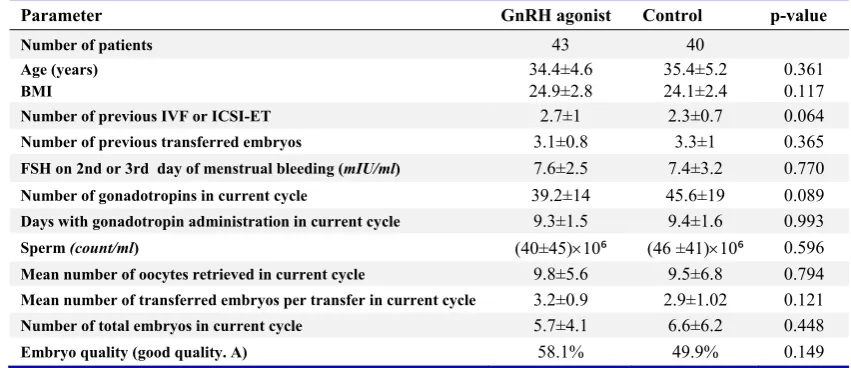
Table 1. Demographic characteristics of patients in GnRH agonist and control groups
Parameter GnRH agonist Control p-value
Number of patients 43 40
Age (years) 34.4±4.6 35.4±5.2 0.361
BMI 24.9±2.8 24.1±2.4 0.117 Number of previous IVF or ICSI-ET 2.7±1 2.3±0.7 0.064
Number of previous transferred embryos 3.1±0.8 3.3±1 0.365
FSH on 2nd or 3rd day of menstrual bleeding (mIU/ml) 7.6±2.5 7.4±3.2 0.770
Number of gonadotropins in current cycle 39.2±14 45.6±19 0.089
Days with gonadotropin administration in current cycle 9.3±1.5 9.4±1.6 0.993
Sperm (count/ml) (40±45)×10⁶ (46 ±41)×10⁶ 0.596
Mean number of oocytes retrieved in current cycle 9.8±5.6 9.5±6.8 0.794
Mean number of transferred embryos per transfer in current cycle 3.2±0.9 2.9±1.02 0.121
Number of total embryos in current cycle 5.7±4.1 6.6±6.2 0.448
J Reprod Infertil, Vol 16, No 2, Apr-Jun 2015 99 Zafardoust S, et al.
JRI
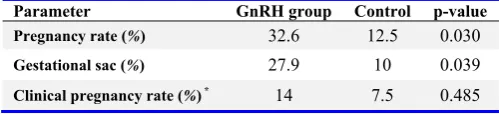
frozen and one was lost to follow-up. Among con-trol group (without GnRH agonist n=40), 5 wom-en discontinued the ovarian stimulation or had no embryos for transfer and 5 women did not transfer because of OHSS. There were no significant dif-ferences in the demographic characters of the two groups and their ovulation stimulation cycle char-acters were also comparable (Table 1). They re-ceived equal numbers of embryos with similar qualities. The level of beta-HCG, 14 days after ET in both groups, did not differ significantly (p= 0.588). Pregnancy rate increased significantly in GnRH group compared to controls (p=0.030, OR= 3.3, 95% CI, 1.08 to 10.4). In this regard, 14 women in GnRH agonist group (32.6%) and 5 women in control group (12.5%) had beta-HCG levels (positive chemical pregnancy). Gestational sacs were detected in 12 women (27.9%) in Gn-RH agonist group and in 4 women (10%) in the control group (Table 2) and this difference was significant (p=0.039, OR=3.4, 95% CI, 1.01 to 11.9). Implantation rate significantly improved in the GnRH agonist group compared to the control group (Mann-whitney test, p=0.041). All pregnan-cies were with one gestational sac. Fetal heart rates were detected in 6 women in GnRH agonist group and 3 women in the control group (14% vs. 7.5%, p=0.485).
Discussion
Aspiration of granulosa cells and suppression of LH following GnRH agonist and GnRH antago-nist admiantago-nistration in ovarian stimulation cycles leads to luteal phase deficiency and this is sug-gested in several lines of evidence (3-6). The most common form of luteal phase support in these women is progesterone or HCG administration in luteal phase (1, 2). Recently, the effect of GnRH agonist administration in luteal phase of ICSI cy-cles in different studies has been the center of at-tention. Most of these studies agree that admin-istration of GnRH agonist in luteal phase of ICSI cycles does not guarantee the continuation of pregnancy resulting from assisted reproduction attempts but rather seems to support implantation
(17-19). This randomized controlled study was undertaken to evaluate the effect of a single 0.1
mg dose of Decapeptil administration 6 days after oocyte retrieval in women with 2 or more previ-ous IVF-ET or ICSI-ET failures who were stimu-lated with antagonist protocol. In addition to vagi-nal progesterone 800 mg daily, these women re-ceived 0.1 mg Decapeptil S.C. 6 days after oocyte retrieval. Tesarik et al. (2006) reported that re-ceiving a single dose GnRH agonist 6 days after oocyte retrieval in GnRH antagonist ovarian stim-ulation protocol significantly increased serum concentration of E2 on days 7 and 15 after oocyte retrieval, progesterone on both 7 and 15 after oo-cyte retrieval and beta-HCG 15 days after oooo-cyte retrieval, compared with placebo. They suggested that GnRH agonist has a direct action on embryo and/or endometrium (10). In our study, no signifi-cant differences in beta-HCG concentrations were detected in the two groups (p=0.588). They had 15 multiple births (all twins) in GnRH agonist group as compared with only two multiple births (all twins) in placebo group but there were no multiple pregnancies in our study. This may be due to few-er samples in our study. On the othfew-er hand, our population were women with 2 or more IVF/ICSI-ET failures with good quality embryos and there were lower pregnancy rates among these women (20). Tesarik et al. (2006) reported significant in-crease in clinical implantation rates (29.8% vs. 18.2%, p<0.05), live birth rates (27.4% vs. 18.2%, p<0.05) and nonsignificant increase in clinical pregnancy and ongoing pregnancy rates in GnRH agonist group as compared with placebo group in GnRH agonist ovarian stimulation cycle. They also reported significant improvement in clinical implantation (27.1% vs. 17.4%, p<0.05), ongoing pregnancy (43.3% vs. 30.7%, p<0.05) and live birth rates (25.2% vs. 14.6%, p<0.05) in GnRH antagonist ovarian stimulation cycles and also a trend toward a higher clinical pregnancy rate (p=0.083) in GnRh agonist group. Razieh et al. (2009) observed that administration of 0.1 mg of GnRH agonist triptorelin on day 3 after embryo transfer led to a significant improvement in im-plantation rate (12.3% vs. 7.3%) and clinical pregnancy rate (25.5% vs. 10.0%) as compared with placebo (13). In a study by Isik et al. (2009), the same results were demonstrated. All cases in that study received intravaginal micronized pro-gesterone (600 mg daily) for luteal phase support in GnRH antagonist during ovarian stimulation cycles. Although the number and the quality of
Table 2. Outcome measures in GnRH and control groups
Parameter GnRH group Control p-value
Pregnancy rate (%) 32.6 12.5 0.030
Gestational sac (%) 27.9 10 0.039
Clinical pregnancy rate (%) * 14 7.5 0.485
100 J Reprod Infertil, Vol 16, No 2, Apr-Jun 2015 GnRHa in Luteal Phase Support
JRI
embryos transferred were similar in the two groups, the women in the luteal phase agonist group (0.5 mg leuprolide acetate, subcutaneously on day 6 after ICSI) had significantly higher rates of implantation and clinical pregnancy rates (p< 0.05) compared with the group that received only routine luteal phase support (9). In our study, pregnancy rate increased significantly in GnRH group compared to the control. Implantation rate significantly improved in the GnRH agonist group compared to the control group and clinical preg-nancy rate improved nonsignificantly in GnRH group. Pregnancy developed to stage of gestation-al sac formation in the GnRH agonist group com-pared to the control group. One of the most frus-trating problems in infertility today is IVF failure-also called implantation failure.
Various attempts to improve success in repeated IVF failure include blastocyst transfer, assisted hatching, prophylactic salpingectomy, preimplant-ation genetic diagnosis, and coculture methods. Petersen et al. (2005) reported that in women with repeated implantation failures, the implantation rate in those who received laser-thinned embryos was significantly higher (p=0.02) than in those whose embryos were not laser-thinned (10.9 and 2.6%, respectively) (21). Our population in this study had history of 2 or more IVF/ICSI failures and when compared with other treatments in IVF failure women, it seems administration of GnRH agonist in luteal phase in these women has ac-ceptable results. The mechanism of GnRH agonist in luteal phase support is not clear. Based on the increase in level of estradiol and progestrone in luteal phase of these women scrutinized in few studies, the mechanism of GnRH agonist may be due to its effect on pituitary or ovaries (10). It was suggested that GnRH agonist can affect mainte-nance of corpus luteum by LH secretion, act via local receptors on endometrium and has effect on embryos (14, 15). The main difference between the present study and the previous reports was our distinctive population. Our women had a history of 2 or more previous IVF-ET or ICSI-ET fail-ures. GnRH antagonist was used in ovarian stim-ulation cycles for prevention of premature LH surge. It may be speculated that stimulation of corpus luteum activity by GnRH agonist may re-sult from stimulation of LH secretion, given that despite the blockage, the pituitary remains respon-sive to the administration of GnRH or GnRH ago-nist. Oliveira et al. (2010), based on a meta-analy-sis study, concluded demonstrated that the luteal
phase single dose GnRH agonist administration can improve clinical outcomes after ICSI. How-ever, because of heterogeneity between the trials, many more trials might be needed to be undertak-en before one could recommundertak-end GnRH agonist administration in the luteal phase (11).
Conclusion
Our results suggested that, in addition to routine luteal phase support with progesterone, admin-istration of one dose of Decapeptil 6 days after oocyte retrieval in women with previous history of 2 or more IVF/ICSI failures with good embryo quality, led to a significant improvement in im-plantation and pregnancy rates in ICSI cycles fol-lowing ovarian stimulation with GnRH antagonist protocol.
Acknowledgement
We are grateful to all of the colleagues at the Avicenna fertility clinic for their inspiration and contribution. We would like to thank the patients for their kind help in this research. In addition, we are grateful to Hamid Hamzezad for helpful ad-vice, and Zahra Akbarzadeh Pasha and Reyhaneh Tokhmechi for their kindly cooperation.
Conflict of Interest
Authors declare that there is no conflict of inter-est.
References
1. Jindal UN, Verma S, editors. Luteal Phase Support. London-United Kingdom: Jaypee Brothers, Medi-cal Publishers; 2013. 622 p. (Rao KA, Carp HJA, Fischer F. Textbook of In Vitro Fertilization; vol. 2).
2. Aflatoonian A, Asgharnia M, Alshohadaei FS. Comparison of progesterone administration before and after embryo transfer in ART cycles. J Reprod Infertil. 2004;5(1):44-51.
3. Smitz J, Devroey P, Camus M, Deschacht J, Khan I, Staessen C, et al. The luteal phase and early pregnancy after combined GnRH-agonist/HMG treatment for superovulation in IVF or GIFT. Hum Reprod. 1988;3(5):585-90.
4. Van Steirteghem AC, Smitz J, Camus M, Van Waesberghe L, Deschacht J, Khan I, et al. The lu-teal phase after in-vitro fertilization and related procedures. Hum Reprod. 1988;3(2):161-4.
J Reprod Infertil, Vol 16, No 2, Apr-Jun 2015 101 Zafardoust S, et al.
JRI
6. Garcia J, Jones GS, Acosta AA, Wright GL Jr. Corpus luteum function after follicle aspiration for oocyte retrieval. Fertil Steril. 1981;36(5):565-72. 7. Pritts EA, Atwood AK. Luteal phase support in
infertility treatment: a meta-analysis of the ran-domized trials. Hum Reprod. 2002;17(9):2287-99. 8. van der Linden M, Buckingham K, Farquhar C,
Kremer JA, Metwally M. Luteal phase support for assisted reproduction cycles. Cochrane Database Syst Rev. 2011;(10):CD009154.
9. Isik AZ, Caglar GS, Sozen E, Akarsu C, Tuncay G, Ozbicer T, et al. Single-dose GnRH agonist admin-istration in the luteal phase of GnRH antagonist cycles: a prospective randomized study. Reprod Biomed Online. 2009;19(4):472-7.
10. Tesarik J, Hazout A, Mendoza-Tesarik R, Mendo-za N, MendoMendo-za C. Beneficial effect of luteal-phase GnRH agonist administration on embryo implanta-tion after ICSI in both GnRH agonist- and antago-nist-treated ovarian stimulation cycles. Hum Reprod. 2006;21(10):2572-9.
11. Oliveira JB, Baruffi R, Petersen CG, Mauri AL, Cavagna M, Franco JG Jr. Administration of sin-gle-dose GnRH agonist in the luteal phase in ICSI cycles: a meta-analysis. Reprod Biol Endocrinol. 2010;8:107.
12. Kyrou D, Kolibianakis EM, Fatemi HM, Tarlatzi TB, Devroey P, Tarlatzis BC. Increased live birth rates with GnRH agonist addition for luteal support in ICSI/IVF cycles: a systematic review and meta-analysis. Hum Reprod Update. 2011;17(6):734-40. 13. Razieh DF, Maryam AR, Nasim T. Beneficial ef-fect of luteal-phase gonadotropin-releasing hor-mone agonist administration on implantation rate after intracytoplasmic sperm injection. Taiwan J Obstet Gynecol. 2009;48(3):245-8.
14. Sasaki K, Norwitz ER. Gonadotropin-releasing hormone/gonadotropin-releasing hormone receptor
signaling in the placenta. Curr Opin Endocrinol Diabetes Obes. 2011;18(6):401-8.
15. Wu S, Wilson MD, Busby ER, Isaac ER, Sher-wood NM. Disruption of the single copy gonado-tropin-releasing hormone receptor in mice by gene trap: severe reduction of reproductive organs and functions in developing and adult mice. Endocri-nology. 2010;151(3):1142-52.
16. Tesarik J, Greco E. The probability of abnormal preimplantation development can be predicted by a single static observation on pronuclear stage mor-phology. Hum Reprod. 1999;14(5):1318-23. 17. Balasch J, Martinez F, Jove I, Cabre L, Coroleu B,
Barri PN, et al. Inadvertent gonadotrophin-releas-ing hormone agonist (GnRHa) administration in the luteal phase may improve fecundity in in-vitro fertilization patients. Hum Reprod. 1993;8(7): 1148-51.
18. Elefant E, Biour B, Blumberg-Tick J, Roux C, Thomas F. Administration of a gonadotropin-re-leasing hormone agonist during pregnancy: follow-up of 28 pregnancies exposed to triptoreline. Fertil Steril. 1995;63(5):1111-3.
19. Uehara S, Sakahira H, Tamura M, Watanabe T, Yajima A. Normal outcome following administra-tion of gonadotropin-releasing hormone (GnRH) agonist during early pregnancy. Congenit Anom. 1998;38(1):81-5.
20. Schroder AK, Katalinic A, Diedrich K, Ludwig M. Cumulative pregnancy rates and drop-out rates in a German IVF programme: 4102 cycles in 2130 pa-tients. Reprod Biomed Online. 2004;8(5):600-6. 21. Petersen CG, Mauri AL, Baruffi RL, Oliveira JB,