
Hadron Medium Modifications
Steffen Strauch
University of South Carolina, Columbia, SC 29208
Abstract. Proton recoil polarization in quasielastic electron scattering is a powerful tool to study properties of nucleons bound in the nuclear medium. The most precise results have been obtained at Jefferson Lab in the4He(e,ep)3H reaction at four momentum trans-fers ofQ2 =0.8 (GeV/c)2and at 1.3 (GeV/c)2. The ratio of polarization-transfer compo-nents,Px/Pz, is significantly reduced compared to the ratio obtained in elastic1H(e,ep)
scattering. This depletion is well described with models which include in-medium modi-fications of the proton form factor or, alternatively, by strong charge-exchange final-state interactions. A future experiment will measure the dependence of this effect on the mo-mentum of the struck nucleon in both, the4He(e,ep)3H and2H(e,ep)nreactions.
1 Introduction
Nucleon structure functions can be extracted from deep inelastic lepton scattering cross sections. These functions relate to the parton distributions of the nucleon. Cross section measurements of the European Muon Collaboration (EMC) on iron found a depletion of the deep inelastic structure function observed in the valence quark regime if compared to measurements on deuterium [1]. These findings have been confirmed by many measurements over a wide range of nuclei; seee.g.[2] for a review. In a recent experiment Seelyet al.[3] measured the EMC effect for very light nuclei. While the specific causes of the modifications observed in the nuclear structure functions have not yet been identified with certainty, it is unlikely that the depletion can be understood in a conventional nucleon-meson treatment of nuclear physics [4]. In fact, a wide variety of QCD-based models, including quark-meson coupling [5, 6] and chiral-quark soliton [7, 8] models, predict that the nucleons change properties with increasing nuclear density. These models do not only describe the EMC effect while being consistent with Drell-Yan data [7], they also predict observable changes in the electromagnetic form factors in nuclear matter. The predicted form-factor modifications are generally consistent with present constraints for both the electric form factor (from the Coulomb Sum Rule, for Q2 <0.5 (GeV/c)2 [9–11]) and the magnetic
form factor (from ay-scaling analysis [12] for Q2 >1 (GeV/c)2), and with limits on the scaling of nucleon magnetic moments in nuclei [13].
Measurements of the transverse and longitudinal polarization-transfer observables,PxandPz, in the1H(e,ep) reaction have been extensively used to extract the ratio of the electric to magnetic Sachs
form factors of the proton,GpEandGpM, for the proton [14]. In the one-photon exchange approximation GEp/GpMis directly proportional to the observablePx/Pz[15, 16]:
GpE GpM =−
P x Pz ·
E+E
2mp tan(θ/2), (1)
where E andEare the energies of the incident and scattered electron, θis the electron scattering angle, andmp is the proton mass. The induced polarizationPyin elasticepscattering is zero in this approximation. Experimentally the proton polarization is determined from azimuthal asymmetries in
a e-mail:
C
Owned by the authors, published by EDP Sciences, 2012
This is an Open Access article distributed under the terms of the Creative Commons Attribution License 2.0, which permits unrestricted use, distribution, and reproduction in any medium, provided the original work is properly cited.
a
, 1
e’
x y
reaction plane scattering plane
e
pq
x e
z
p
t
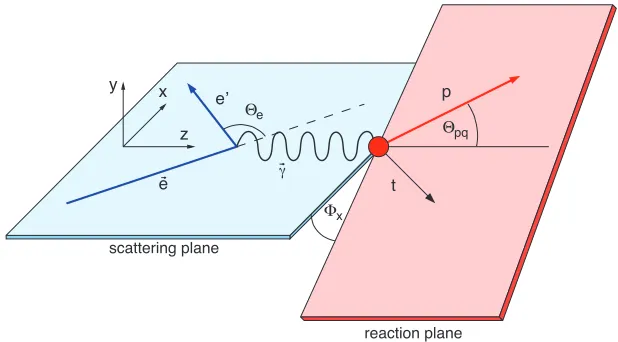
Fig. 1.Schematic of the4He(e,ep)3H reaction. The components of the proton recoil polarization are recon-structed in a coordinate system where thezaxis is along the three-momentum transfer,q, theyaxis is perpen-dicular to the scattering plane, and thexaxis is in the scattering plane perpendicular to the momentum transfer, forming a right-handed system.
the angular distribution of the protons after scattering in the analyzer, typically carbon, of a focal plane polarimeter.
MeasuringPx/Pz on a nuclear target in quasi-elastic proton knockout, A(e,ep), is an intuitive method to investigate the properties of nucleons in the nuclear medium; see Fig. 1 for a definition of the reference system. The polarization-transfer double ratio
R= (Px/Pz)A (Px/Pz)1H
(2)
is then an experimental observable which directly reveals medium effects. It can be measured with small systematic uncertainties. To which extend these medium effects are due to changes in the wave function of the bound nucleons or due to more conventional many-body effects, such as meson-exchange currents (MEC), isobar configurations (IC), and final-state interactions (FSI), can only be determined within the context of a model. In that context polarization-transfer observables provide us with a way to study the behavior of the nucleon form factors in the nuclear medium. Excellent control over the reaction mechanism effects is certainly required [17]. At high momentum transfer, however, the contribution of many-body and rescattering mechanisms are strongly suppressed [18].
An important constraint of these rescattering mechanisms comes from the induced polarizationPy of the ejected proton. In the one-photon exchange approximation the induced polarization in quasielas-tic electron scattering is zero when no FSI between the ejected nucleon and the residual nuclear system are considered [19]. Induced-polarization data can be taken simultaneously to polarization-transfer data, however, they are often plagued by sizable systematic uncertainties due to possible instrumental asymmetries.
2 Present Experimental Results
Polarization transfer in the quasielasticA(e,ep) reaction has been measured on2H [20–23] , on4He
2
(GeV/c)
2Q
0 1 2 3
H
)
z/P'
x/ (P'
A
)
z/P'
x(P'
0.81.0 1.2
H: JLab 2
He: MAMI 4
He: JLab 4
Fig. 2.Polarization-transfer ratio, (Px/Pz)A, for2H(e,ep)n(triangles) from [23] and for4He(e,ep)3H (circles)
from [24–26] normalized to the polarization-transfer ratio for1H(e,ep). All data were taken at low missing
momentum.
analyzer [29]. Figure 2 compares the polarization-transfer double ratio from2H and4He for various values of the four-momentum transfer,Q2. All measurements were taken at low missing momentum
to minimize conventional many-body effects. Within statistical uncertainties, no evidence of medium modifications are found in2H. This is not surprising as the sampled density in 2H is small and the
nucleons are only weakly bound. The mean value of the polarization-transfer double ratio from the much denser4He, however, is significantly different from one. Also the per-nucleon deep inelastic
structure function in4He is significantly different than that for deuterium [3]. While the4He
double-ratio atQ2=1.6 (GeV/c)2is consistent with one, a statistical analysis seems to indicate that this could
merely be a statistical fluctuation.
Figure 3 shows the4He(e,ep)3H polarization-transfer double ratio (upper panel) and the induced
polarization, Py, (lower panel) from JLab experiments E93-049 [25] and E03-104 [26, 27]. The Py data have been corrected for the spectrometer acceptance and its comparison with models is made for missing momentumpm≈0. Dedicated calibration data were taken during experiment E03-104 at Q2 =0.8 and 1.3 (GeV/c)2 to significantly reduce the otherwise sizable systematic uncertainties in
2
(GeV/c)
2Q
0 1 2 3
H
)
z/P'
x/ (P'
He
)
z/P'
x(P'
0.8 0.9 1.0 1.1
Madrid RDWIA (RLF) Madrid RDWIA (RLF) + QMC Madrid RDWIA (RLF) + CQS Schiavilla (2010)
MAMI E93-049 E03-104
2
(GeV/c)
2Q
0 1 2 3
= 0)
m
(p
yP
-0.05 0.00
Madrid RDWIA (RLF) Madrid RDWIA (RLF) + QMC Madrid RDWIA (RLF) + CQS Schiavilla (2010)
E93-049
E03-104
Fig. 3.4He(e,ep)3H polarization-transfer double ratioR(upper panel) and induced polarizationP
y(lower panel)
as a function ofQ2from MAMI, Mainz [24] and Jefferson Lab E93-049 [25] (open symbols) and E03-104 [26, 27] (filled circles) experiments. The data are compared to calculations from Schiavillaet al.[30] and the Madrid group [31–33] using thecc1(lower set of curves) andcc2(upper set of curves) current operators. In-medium form factors from the QMC [5] (solid curve) and CQS [8] (dashed curve) models were used in two of the Madrid calculations. Note that thePydata have been corrected for the spectrometer acceptance and the comparison with
models is made for missing momentumpm≈0. Figure taken from [34].
and spin-dependent charge-exchange terms. Parameters of the FSI model have been constrained by the newPydata from E03-104.
3 Possible Future Experiments
The existing4He(e,ep)3H polarization-transfer data can be well described by either the inclusion of
medium-modified form factors or strong charge-exchange FSI in the models. While the Madrid and Schiavillaet al.models are quite different, their free-form-factor results do agree with each other for Q2≥1.3 (GeV/c)2where ambiguities in the choice of the current operator become smaller. The effect
of in-medium modifications of the nucleon form factors, however, reduces the polarization-transfer double ratio by at least 5%, as shown by the Madrid calculations in Fig. 3. An effect that large is easily observable. After the energy upgrade of Jefferson Lab, experiment E12-11-002 [39] will measure with high precision the proton recoil polarization atQ2=1.8 (GeV/c)2. Compared to the before mentioned
measurements this experiment will benefit from the larger spectrometer acceptances in JLab Hall C and a substantial increase in beam time; for technical details see [39].
The present studies in the4He(e,ep)3H reaction were performed at small missing momentum to
minimize conventional many-body effects and final-state interactions. This is a reasonable approach if medium modifications depend only on the mean nuclear density. If, as Ciofi degli Attiet al.[40] argue, the modification of the bound-nucleon wave function depends on the momentum of the nucleon the approach minimizes observable effects. In fact, Weinstein et al.[41] found that the magnitude of the EMC effect is linearly related to the per-nucleon probabilities of nucleon-nucleon short-range correlations (SRC). SRCs occur between pairs of nucleons with high relative momentum and low center of mass momentum. The observed linearity thus supports the idea that the EMC effect is caused by high-momentum nucleons in the nucleus. A second part of E12-11-002 will therefore be a detailed study of the polarization-transfer observables as a function of missing momentum.
In the impulse approximation the missing momentum can be related to the momentum,p, of the stuck nucleon throughp2=(mA−Em)2−p2m, whereEmandpmare respectively the missing energy and momentum in theA(e,ep) reaction. The proton virtuality is then defined asv=p2−m2
p. Figure 4 shows the polarization-transfer double ratio for the present and for the expected data as a function of the proton virtuality. Explicit results for the electromagnetic form factors as a function of the momentum of the off-shell proton have been obtained by Kondratyuket al.[42] with a dressedK-matrix model. E12-11-002 will measure both the4He(e,ep)3H and2H(e,ep)nreactions atQ2=1.0 (GeV/c)2over a wide range of proton virtualities. While the average densities of2H and4He are very different, the
experiment can probe similar proton virtualities in both reactions at larger missing momenta and is thus uniquely suited to study the density and momentum dependence of the bound nucleon knockout. The experiments discussed so far only probe medium effects in the quasielastic (e,ep) reaction. Complementary measurements in the (e,en) could provide important new insides. Studies found a marked difference of the in-medium modification of the nucleon electromagnetic form factor ratio for the proton and for the neutron at lowQ2[43]. The in-medium ratio of the neutronGn
E/GnMform factor ratio is predicted to increase relative to the free result, while the ratio for the proton is expected to decrease in the medium. A comparison of high-precision measurements of the reactions2H(e,en)p and4He(e,en)3He would allow to test these predictions.
4 Summary
The ratio of polarization-transfer coefficients,Px/Pz, in the quasi-elastic nucleon-knockout reaction is arguably one of the most direct experimental observables to identify nuclear-medium changes to nucleon properties as other conventional medium effects are suppressed. Furthermore, the possible role of FSI in the interpretation of these data can be constrained by the induced polarizationPy. After such constraints, present4He(e,ep)3H polarization-transfer data can be well described by either the
2
)
2Proton Virtuality (GeV/c
-0.15 -0.10 -0.05 0.00
H
1
)
z/P'
x/ (P'
A
)
z/P'
x(P'
0.0 0.5 1.0
Madrid RDWIA (RLF) Madrid RDWIA (RLF) + QMC Madrid RDWIA (RLF) + CQS
2 = 0.8 (GeV/c) 2
He Data, Q 4
JLab
2 = 1.0 (GeV/c) 2
H Data, Q 2
JLab
2 = 1.0 (GeV/c) 2
He Data, Q 4
Proposed
2 = 1.0 (GeV/c) 2
H Data, Q 2
Proposed
Fig. 4. Polarization-transfer double ratio in the4He(e,ep)3H and2H(e,ep)nreactions The curves are various
calculations using the Madrid RDWIA model for the reaction on4He and current operatorscc1 (lower set of curves) andcc2 (upper set of curves). The points indicate existing data [23, 26] (solid symbols) and the statistical uncertainties of the expected data from E12-11-002 [39] which are arbitrarily placed on the RDWIA (cc1) curve for4He and atR=1 for2H.
An upcoming measurement of the quasielastic (e,ep) reaction offboth4He and2H targets will
allow to further probe the momentum dependence of the bound nucleon electromagnetic current, in-cluding possible medium modifications of the proton electromagnetic form factor.
5 Acknowledgments
This work was supported in parts by the U.S. National Science Foundation: NSF PHY-0856010. Jef-ferson Science Associates operates the Thomas Jefferson National Accelerator Facility under DOE contract DE-AC05-06OR23177.
References
1. J. Aubertet al., Phys.Lett.B123(1983) 275. 2. P. Norton, Rept.Prog.Phys.66(2003) 1253. 3. J. Seelyet al., Phys. Rev. Lett.103(2009) 202301.
4. G. A. Miller and J. R. Smith, Phys. Rev.C65(2002) 015211.
5. D.-H. Lu, A. W. Thomas, K. Tsushima, A. G. Williams, and K. Saito, Phys. Lett.B417(1998) 217.
6. D.-H. Lu, K. Tsushima, A. W. Thomas, A. G. Williams, and K. Saito, Phys. Rev. C60(1999) 068201.
7. J. R. Smith and G. A. Miller, Phys.Rev.Lett.91(2003) 212301. 8. J. R. Smith and G. A. Miller, Phys. Rev.C70(2004) 065205. 9. J. Jourdan, Phys. Lett.B353(1995) 189.
10. J. Morgenstern and Z. E. Meziani, Phys. Lett.B515(2001) 269.
12. I. Sick, Comments Nucl. Part. Phys.A18(1988) 109. 13. T. E. O. Ericson and A. Richter, Phys. Lett.B183(1987) 249.
14. C. Perdrisat, V. Punjabi, and M. Vanderhaeghen, Prog.Part.Nucl.Phys.59(2007) 694. 15. A. I. Akhiezer and M. P. Rekalo, Sov. J. Part. Nucl.4(1974) 277.
16. R. G. Arnold, C. E. Carlson, and F. Gross, Phys. Rev.C23(1981) 363. 17. J. W. Van Orden, Phys. Rev.C74(2006) 034607.
18. J.-M. Laget, Nucl. Phys.A579(1994) 333.
19. A. Picklesimer and J. Van Orden, Phys.Rev.C35(1987) 266. 20. D. Eylet al., Z. Phys.A352(1995) 211.
21. B. D. Milbrathet al., Phys. Rev. Lett.80(1998) 452. 22. D. H. Barkhuffet al., Phys. Lett.B470(1999) 39. 23. B. Huet al., Phys. Rev.C73(2006) 064004. 24. S. Dieterichet al., Phys. Lett.B500(2001) 47. 25. S. Strauchet al., Phys. Rev. Lett.91(2003) 052301. 26. M. Paoloneet al., Phys. Rev. Lett.105(2010) 072001.
27. S. Malace, M. Paolone, S. Strauch, I. Albayrak, J. Arrington,et al., Phys.Rev.Lett.106 (2011) 052501.
28. S. Malovet al., Phys. Rev.C62(2000) 057302. 29. V. Punjabiet al., Phys. Rev.C71(2005) 055202.
30. R. Schiavilla, O. Benhar, A. Kievsky, L. E. Marcucci, and M. Viviani, Phys. Rev. Lett.94(2005) 072303.
31. J. M. Udias, J. A. Caballero, E. Moya de Guerra, J. E. Amaro, and T. W. Donnelly, Phys. Rev. Lett.83(1999) 5451.
32. J. A. Caballero, T. W. Donnelly, E. Moya de Guerra, and J. M. Udias, Nucl. Phys.A632(1998) 323.
33. J. M. Udias and J. R. Vignote, Phys. Rev.C62(2000) 034302. 34. S. Strauch, S. Malace, and M. Paolone, Fizika B20(2011) 149. 35. T. De Forest, Nucl. Phys.A392(1983) 232.
36. C. J. Horowitz, Phys. Rev.C31(1985) 1340.
37. D. P. Murdock and C. J. Horowitz, Phys. Rev.C35(1987) 1442. 38. J.M. Udias, private communication (2010).
39. Jefferson Lab Experiment E12-11-002, ”Proton Recoil Polarization in the1H(e,ep),2He(e,ep)n,
and4He(e,ep)3H Reactions”, E. Brash, G.M. Huber, R. Ransome, and S. Strauch, spokespersons.
40. C. Ciofi degli Atti, L. L. Frankfurt, L. P. Kaptari, and M. I. Strikman, Phys. Rev. C76(2007) 055206.
41. L. Weinstein, E. Piasetzky, D. Higinbotham, J. Gomez, O. Hen,et al., Phys.Rev.Lett.106(2011) 052301.
42. S. Kondratyuk, K. Kubodera, and F. Myhrer, Phys.Rev.C71(2005) 028201.
![Fig. 2. Polarization-transfer ratio, (P′x/P′z)A, for 2H(e, e′p)n (triangles) from [23] and for 4He(e, e′p)3H (circles)from [24–26] normalized to the polarization-transfer ratio for 1H(e, e′p)](https://thumb-us.123doks.com/thumbv2/123dok_us/8072679.1346547/3.482.89.394.57.271/polarization-transfer-ratio-triangles-circles-normalized-polarization-transfer.webp)
![Fig. 3. as a function ofmodels is made for missing momentum4He(e, e′p)3H polarization-transfer double ratio R (upper panel) and induced polarization Py (lower panel) Q2 from MAMI, Mainz [24] and Jefferson Lab E93-049 [25] (open symbols) and E03-104 [26,27]](https://thumb-us.123doks.com/thumbv2/123dok_us/8072679.1346547/4.482.94.384.63.497/function-ofmodels-missing-momentum-polarization-transfer-polarization-jeerson.webp)
![Fig. 4. Polarization-transfer double ratio in theuncertainties of the expected data from E12-11-002 [39] which are arbitrarily placed on the RDWIA (forcurves) andcalculations using the Madrid RDWIA model for the reaction on 4He(e, e′p )3H and 2H(e, e′p )n](https://thumb-us.123doks.com/thumbv2/123dok_us/8072679.1346547/6.482.89.388.63.276/polarization-transfer-theuncertainties-expected-arbitrarily-forcurves-andcalculations-reaction.webp)
