Published online 2016 February 20. Research Article
Performance of Clinical Nurse Educators in Teaching Pharmacology and
Medication Management: Nursing Students’ Perceptions
Zohre Ghamari-Zare
1and Mohsen Adib-Hajbaghery
2,*1Faculty of Nursing and Midwifery, Qom Branch, Islamic Azad University, Qom, IR Iran
2Trauma Nursing Research Center, Faculty of Nursing and Midwifery, Kashan University of Medical Sciences, Kashan, IR Iran
*Corresponding author: Mohsen Adib-Hajbaghery, Trauma Nursing Research Center, Faculty of Nursing and Midwifery, Kashan University of Medical Sciences, Kashan, IR Iran. Tel: +98-3155540021, Fax: +98-3155544999, E-mail: [email protected]
Received 2015 May 12; Revised 2015 September 28; Accepted 2015 October 15.
Abstract
Background: Pharmacological knowledge and medication management skills of student nurses greatly depend on the clinical nurse educators’ performance in this critical issue. However, the Iranian nurse educators’ performance in teaching pharmacology and medication management are not adequately studied.
Objectives: The current study aimed to investigate the nursing students’ perceptions on the status of clinical pharmaceutical and medication management education.
Materials and Methods: A cross-sectional study was conducted on all 152 nursing students registered in the seventh and eighth semesters at the Qom and Naragh branches of Islamic Azad University, and Kashan University of Medical Sciences in 2013 - 2014 academic year. The students’ perceptions on the performance of clinical nurse educators in teaching pharmacology and medication management were assessed using a researcher made questionnaire. The questionnaire consisted of 31 items regarding clinical educators’ performance in teaching pharmacology and medication management and two questions about students’ satisfaction with their level of knowledge and skills in pharmacology and medication management. Descriptive statistics was employed and analysis of variance was performed to compare the mean of scores of teaching pharmacology and medication management in the three universities.
Results: Among a total of 152 subjects, 82.9% were female and their mean age was 22.57 ± 1.55 years. According to the students, instructors had the weakest performance in the three items of teaching pharmacology and medication management based on the students’ learning needs, teaching medication management through a patient-centered method and teaching pharmacology and medication management based on the course plan. The students’ satisfaction regarding their own knowledge and skill of pharmacology and medication management was at medium level.
Conclusions: Nursing students gave a relatively low score in several aspects of their instructors’ performance regarding teaching pharmacology and medication management. It seems that many clinical nurse educators in the studied settings were incompetent especially in teaching pharmacology and medication management, while these are critical areas and need special attention.
Keywords: Pharmacology, Medication Therapy Management, Teaching, Nursing Students
Copyright © 2016, Kashan University of Medical Sciences. This is an open-access article distributed under the terms of the Creative Commons Attribution-Non-Commercial 4.0 International License (http://creativecommons.org/licenses/by-nc/4.0/) which permits copy and redistribute the material just in noncommercial usages, provided the original work is properly cited.
1. Background
Nurses are among multidisciplinary team members who play a significant role in health care and are involved in pharmacological management of the patients’ condi-tions. They should have enough knowledge and skills re-garding pharmacological and medication management, in order to establish a safe and high quality care (1).
Nursing education in Iran is a four year graduate model. In the first three years, students are taught in the nurs-ing schools and also pass some clinical apprenticeship courses in hospitals under direct supervision of clinical instructors. Due to the load of teaching duties of edu-cators, a large part of clinical courses are supervised by trainers or mentors other than those who taught stu-dents in nursing schools. The fourth year of nursing edu-cation is held in the form of internship in which nursing
students take direct role in implementing the patients caring plans with little or no supervision by an instructor or a mentor.
It is the nurses’ and nursing students’ responsibility to evaluate every patient before prescribing medications, administer the medication safely, monitor the patients for side effects, decide if a dose reduction is required for a pa-tient (i. e, with renal failure) and to evaluate the efficiency of the prescribed medication. It is also essential to explain to the patients about their medicines and help the physi-cian and pharmacist solve potential problems (2).
Some of the studies also reported that nursing students were not effectively prepared in the area of pharmaco-logical and medication management (1, 4, 5) and empha-sized that the current nursing curricula do not provide the students with sufficient opportunities to promote their performance in medication management. Conse-quently, many medication-related errors are made by nursing students (6-8) and nurses (9). A number of stud-ies reported that nursing students have problems in cal-culation of medication dosage (10), frequently encounter uncertainty in the process of medication management (11), experience difficulties in application of safe injecting methods (12) and in understanding and demonstrating pharmacological concepts in clinical practice (13).
Reviewing medication management education systems, some of the studies addressed the reasons behind nursing students’ medication errors and gaps in pharmacology (6-8, 14, 15). Several studies on factors affecting students’ learning of pharmaceutical care, reported that clinical in-structors’ professional competence is the most determin-ing factor in this area (5, 16, 17). It is reported that many nursing instructors are inexperienced and not competent in clinical training and clinical supervision (18).
Some of the studies investigated the nursing educators’ challenges regarding clinical education and reported that despite their crucial role in preparing nursing students, they receive little support in developing their teaching skills, do not have opportunities for formal education and professional development related to their role (19, 20), and have no formal authority in clinical settings (21).
Most of the studies in the area of nursing students’ pharmacological management investigated their knowl-edge and skills (2, 3, 11), the problems they experienced in their work (16), the type of medication errors they made (8), their confidence in medication calculations (10), or their perceptions on effective medication administration education and pharmacological education needs (22, 23). In two studies from Iran, Ghamari Zare et al. studied the nursing students’ perspectives on factors affecting learn-ing of pharmaceutical care in clinical settlearn-ings (5) and their medication management skills (11). However, few studies are available on the status of clinical pharmaceu-tical care education. These studies are also conducted overseas and no studies on nursing students’ views in this regard are available from Iran.
2. Objectives
The current study aimed to investigate the nursing stu-dents’ perceptions on the status of clinical pharmaceu-tical and medication care education during internship program.
3. Materials and Methods
This cross-sectional study was conducted in two se-mesters in the 2013 - 2014 academic year at the Qom and Naragh branches of Islamic Azad University, and Kashan
University of Medical Sciences. The study population comprised senior nursing students and sampling includ-ed all nursing students who were in their fourth year of studying in nursing in these semesters (i.e., from October 2013 to late June 2014).
All of the students (those who were visitors at the insti-tutions) were included in the population participating in the study (n = 152) and completed the questionnaire. Out of the 152 respondents, a total of 44, 29 and 79 were the students registered at the Qom and Naragh branches of Islamic Azad University, and Kashan University of Medical Sciences, respectively.
A three-part, researcher made instrument was used to collect the data. The first section included three questions about students’ gender, age and affiliation. The second sec-tion including 31 items associated with clinical educators’ performance in teaching the process of pharmacological management. The students were asked to evaluate their educators’ performance during four years at university using the percentage they enhanced the students’ knowl-edge and skills in pharmacology and medication manage-ment. The range of responses included less than 50% (= 1); 50% to 75% (= 2); and 75% to 100% (= 3). Questions were not divided into themes or groups. They were prepared through literature review and in accordance with the prin-ciples of teaching and skills of medicine preparation and administration activities, clinical skill of administering an injection and post medication care (24). Finally, there were two questions about students’ satisfaction with their level of knowledge and skills in pharmacology and medi-cation management. They were: “Currently, how much are you satisfied with your own pharmaceutical care skills?” and “Currently, how much are you satisfied with your own pharmacology knowledge?” The answers were very low (= 1), low (= 2), moderate (= 3), high (= 4) and very high (= 5). The instrument was distributed among the students in their breaks during the internship period.
The questionnaire was reviewed by a number of nurs-ing faculty members at the school of medical sciences of Islamic Azad University, Qom branch, and Kashan Univer-sity of Medical Sciences and they confirmed its content validity after some modifications based on their com-ments. The reliability of the questionnaire was assessed through internal consistency method (25) after admin-istration among ten senior students in Islamic Azad Uni-versity (Qom branch); and the Cronbach’s alpha was 0.87. The respondents were invited to complete the ques-tionnaires in a quiet and private environment and the researcher or a research assistant collected the question-naires after the completion which took about 15 minutes.
3.1. Ethical Considerations
program at the Qom and Naragh branches of Islamic Azad University, and Kashan University of Medical Sci-ences were invited to participate in the study. All of the respondents voluntarily signed the written consent form attached to the questionnaire. The students were assured that all the information would remain confidential and the questionnaires were anonymous. The researcher ex-plained to the participants about their rights of volun-tary participation.
3.2. Data Analysis
Data analysis was performed using the SPSS Version 13. Descriptive statistics (frequency, rate of frequency, mean, and standard deviation (SD) were used in this study. The
maximum and minimum of the total average were also calculated for each item. ANOVA was performed to com-pare the mean of pharmaceutical care education scores in the three universities.
4. Results
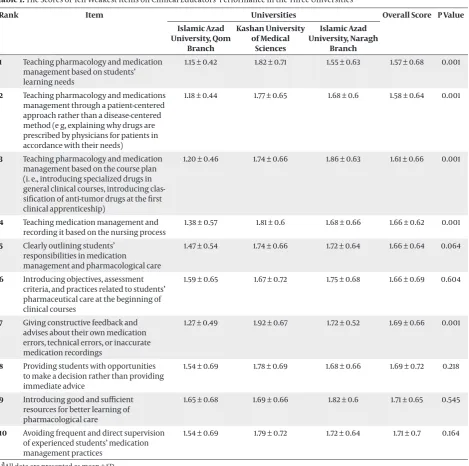
The study was conducted on 152 nursing students among whom 82.9% were female and their mean age was 22.57 ± 1.55 years, ranging from 21 to 29 years. The mean and standard deviation of 10 weakest items on clinical ed-ucators’ performance in teaching pharmacological man-agement in the three universities are presented in Table 1. The item “teaching pharmacological management based on students’ learning needs” earned the lowest rank.
Table 1. The Scores of Ten Weakest Items on Clinical Educators’ Performance in the Three Universitiesa
Rank Item Universities Overall Score P Value
Islamic Azad University, Qom
Branch
Kashan University of Medical
Sciences
Islamic Azad University, Naragh
Branch 1 Teaching pharmacology and medication
management based on students’ learning needs
1.15 ± 0.42 1.82 ± 0.71 1.55 ± 0.63 1.57 ± 0.68 0.001
2 Teaching pharmacology and medications management through a patient-centered approach rather than a disease-centered method (e g, explaining why drugs are prescribed by physicians for patients in accordance with their needs)
1.18 ± 0.44 1.77 ± 0.65 1.68 ± 0.6 1.58 ± 0.64 0.001
3 Teaching pharmacology and medication management based on the course plan (i. e., introducing specialized drugs in general clinical courses, introducing clas-sification of anti-tumor drugs at the first clinical apprenticeship)
1.20 ± 0.46 1.74 ± 0.66 1.86 ± 0.63 1.61 ± 0.66 0.001
4 Teaching medication management and
recording it based on the nursing process 1.38 ± 0.57 1.81 ± 0.6 1.68 ± 0.66 1.66 ± 0.62 0.001
5 Clearly outlining students’ responsibilities in medication management and pharmacological care
1.47 ± 0.54 1.74 ± 0.66 1.72 ± 0.64 1.66 ± 0.64 0.064
6 Introducing objectives, assessment criteria, and practices related to students’ pharmaceutical care at the beginning of clinical courses
1.59 ± 0.65 1.67 ± 0.72 1.75 ± 0.68 1.66 ± 0.69 0.604
7 Giving constructive feedback and advises about their own medication errors, technical errors, or inaccurate medication recordings
1.27 ± 0.49 1.92 ± 0.67 1.72 ± 0.52 1.69 ± 0.66 0.001
8 Providing students with opportunities to make a decision rather than providing immediate advice
1.54 ± 0.69 1.78 ± 0.69 1.68 ± 0.66 1.69 ± 0.72 0.218
9 Introducing good and sufficient resources for better learning of pharmacological care
1.65 ± 0.68 1.69 ± 0.66 1.82 ± 0.6 1.71 ± 0.65 0.545
10 Avoiding frequent and direct supervision of experienced students’ medication management practices
1.54 ± 0.69 1.79 ± 0.72 1.72 ± 0.64 1.71 ± 0.7 0.164
According to the majority of students, 75% - 100% of edu-cators are always or often eager to promote students’ knowledge and medication management skills. The stu-dents indicated that they were taught the skills related to medication management (i. e., hand washing, cleaning the tray before putting the drug, wearing gloves before injections, etc.) and safety practices related to medica-tion management (i. e., asking patients’ names, avoiding re-using needles, informing patients about medication side-effects and management of saline solution, etc.).
Students’ responses to two of the questions related to their level of satisfaction with the knowledge of pharma-cology and skills of medication management produced the mean and standard deviation of 2.56 ± 1.03 and 2.87 ± 0.91, respectively. These values are close to medium sat-isfaction.
5. Discussion
The current study aimed to assess the status of clinical pharmaceutical and medication care education from the nursing students’ perceptive. Authors did not focus on specific educators; but focused on the performance of all clinical nurse educators regarding pharmacology and medication management education. The results in-dicated a poor quality of education in several aspects of pharmacology and medication management education. Due to the crucial importance of pharmacology and medication management in nursing and in patients’ health and safety, the findings signified the urgent need to take measures to overcome the problems and reduce the potential risks.
According to the students, instructors had the weakest performance in the three items of “teaching pharmacol-ogy and medication management based on students’ learning needs”, “teaching medication management through a patient-centered method” and “teaching phar-macology and medication management based on the course plan”. Teaching pharmacological management in clinical setting is a very important activity which not only needs paying attention to the patients’ health and safety needs but also to the students’ learning needs. A clinical educator who teaches clinical pharmacology and medication management should be proficient in pharmacology and diagnosing and prioritizing both the patients and the students’ needs. The current study findings showed that clinical instructors were weak in clinical education and had weak knowledge on pharma-cology and medication management. It also seems that clinical educators have no specific course plans or spe-cific objectives especially in the field of pharmacology and medication management. This made them present some general and occasionally unrelated materials in inappropriate occasions. For instance they might pres-ent some materials about classification of anti-tumor drugs at the first clinical apprenticeship. Previous stud-ies in Iran have also shown that the majority of nurse
educators mostly focus on issues such as dosage calcula-tion and take the prescribed dose in specific times of a day (5, 26, 27), instead of how a nurse can decide a dose reduction required for a patient with renal failure for ex-ample. Such a condition also implies that educators have little knowledge of pharmacology. This is why nurses and nursing students need a high level of knowledge on phar-macology and medication management in order to care for their patients appropriately. Although not on nursing students’ however, a study on nurses’ information needs and information seeking behaviors, have reported that nurses require pharmacological information more often than other types of information. Therefore, they sought pharmacological information nine times a week while they sought epidemiological data only twice a week (28). A study in Iran showed that nursing students are often anxious about their capability to implement their knowl-edge and skills on physiology, anatomy and pharmacol-ogy. They mostly attributed this weakness to ineffective teaching (28).
The results of the present study implied that the stu-dents wished to receive constructive feedbacks about their medication management practices. However, the item “giving constructive feedback and advice about their own medication errors, technical errors, or inaccu-rate medication recordings” was among the ten weakest items. This finding not only shows the weak performance of clinical instructors in this regard, but also signifies the importance of timely and appropriate feedback on the students learning. Consistently, a qualitative study on student nurses’ perceptions of effective medication administration education, has reported that nursing stu-dents wished not only to encounter frequent learning op-portunities, but also to receive timely feedback on their performances in medication administration (22).
In the present study, the item “teaching pharmacol-ogy and medications management through a patient-centered approach” scored as the second weak item. This finding confirms that clinical instructors usually teach through a functional or work-based approach in their clinical educations. A previous study showed that nurs-ing students prefer to learn pharmacology and phar-maceutical care through a patient-centered approach (5). Heshmati et al. investigated the nursing students perspective on effective clinical teaching and reported that nursing students believed that patient-centered ap-proaches cause patients be considered as a whole, while work-based training cannot produce a meaningful learn-ing (29).
pharmacological knowledge of nursing students predis-poses them to medication errors (8, 31). For instance, the lack of pharmaceutical knowledge and medication man-agement skills might lead the students to administer penicillin to the patients who re penicillin-allergic due to the lack of check (32).
The present study showed that although nursing schools of all the three universities were relatively simi-lar in their educational performance in teaching phar-macology and medication management, however the scores of Kashan University of Medical Sciences were ap-proximately higher in most instances. This finding shows the urgent need to pay special attention to the quality of education in all nursing schools and with special focus on the Islamic Azad University.
In conclusion, the study showed that nursing students give a relatively low score in several aspects of their in-structors’ performance regarding teaching pharmacol-ogy and medication management. It seems that many clinical nurse educators in the studied settings are in-competent especially in teaching pharmacology and medication management while this is a critical area and needs special attention. It is necessary to plan properly for each element of clinical education (objectives, con-tent, educators, and evaluation) to achieve the goals of nursing education. According to the above-mentioned findings and nursing instructors’ incompetency in some areas, it is necessary to enable nurse instructors in teach-ing principles and practices of pharmaceutical care and to revise nursing programs. Therefore, it is recommend-ed that clinical nurse recommend-educators go through in-service courses to upgrade their competency not only in clinical teaching, but also in pharmacology and pharmacologi-cal management. The current study examined only the students’ perspective; however, the instructors’ perspec-tive on the existing barriers to appropriate pharmacolog-ical and medication management education should also be assessed. In addition, more objective assessments on the students’ knowledge and skills and the clinical educa-tors’ performance are recommended. The study also as-sessed the students’ perspective of all educators and had no focus on the performance of individual instructors. Then, the retrospective nature of the assessment might induce some biases on the results. It is recommended that the students’ perspective on the same issue be im-mediately assessed after each clinical rotation, not only the performance of all instructors, but also their specific strengths and weaknesses can be assessed. Then more appropriate in-service education programs might be de-signed to overcome the problems.
Acknowledgments
The researchers would like to express their gratitude to all of the participants in this study. The authors appreci-ate Mr. John James Musafiri for providing valuable com-ments and editing the text.
Footnotes
Authors’ Contribution:Zohre Ghamari Zare: study conception and design, preparing the first draft of man-uscript and data collection from the Qom and Naragh branches of Islamic Azad University, and Kashan Univer-sity of Medical Sciences and the data analysis. Mohsen Adib-Hajbaghery: design of questioner, made critical re-visions to the paper, and preparing the final revision of the manuscript.
Financial Disclosure:The authors declared no compet-ing interests.
Funding/Support:None declared.
References
1. Manias E. Pharmacology content in undergraduate nursing programs: is there enough to support nurses in providing safe and effective care? Int J Nurs Stud. 2009;46(1):1–3. doi: 10.1016/j. ijnurstu.2008.06.002. [PubMed: 18656874]
2. Shams S, Khajehali N, Baghayee R. Comparing pharmacology knowledge and pharmaceutical calculations skill in Cardiac Care Unit (CCU) among nursing students of Oroumiyeh and Khouy. J Crit Care Nurs. 2013;6(3):181–8.
3. Morrison-Griffiths S, Snowden MA, Pirmohamed M. Pre-regis-tration nurse education in pharmacology: is it adequate for the roles that nurses are expected to fulfil? Nurse Educ Today.
2002;22(6):447–56. [PubMed: 12387758]
4. Adib-Hajbaghery M, Karbasi-Valashani K, Heidari-Haratmeh A. Correlation of Clinical Skills Self-Assessment of Nursing Intern-ship Trainees With Their Teachers’ Evaluation. Nurs Midwifery Stud. 2012;1(2):94–9.
5. Ghamari Zare Z, Purfarzad Z, Ghorbani M, Zamani M. Factors Af-fecting Learning of Pharmaceutical Care in Clinical Education: Arak Nursing Students’ Perspectives [in Persian]. Iran J Med Educ.
2012;12(4):265–73.
6. Dolansky MA, Druschel K, Helba M, Courtney K. Nursing stu-dent medication errors: a case study using root cause analysis.
J Prof Nurs. 2013;29(2):102–8. doi: 10.1016/j.profnurs.2012.12.010. [PubMed: 23566456]
7. Warholak TL, Queiruga C, Roush R, Phan H. Medication error identification rates by pharmacy, medical, and nursing students.
Am J Pharm Educ. 2011;75(2):24. [PubMed: 21519414]
8. Wolf ZR, Hicks R, Serembus JF. Characteristics of medication errors made by students during the administration phase: a descriptive study. J Prof Nurs. 2006;22(1):39–51. doi: 10.1016/j.prof-nurs.2005.12.008. [PubMed: 16459288]
9. Kazaoka T, Ohtsuka K, Ueno K, Mori M. Why nurses make medica-tion errors: a simulamedica-tion study. Nurse Educ Today. 2007;27(4):312– 7. doi: 10.1016/j.nedt.2006.05.011. [PubMed: 16859813]
10. Andrew S, Salamonson Y, Halcomb EJ. Nursing students' con-fidence in medication calculations predicts math exam per-formance. Nurse Educ Today. 2009;29(2):217–23. doi: 10.1016/j. nedt.2008.08.005. [PubMed: 18834649]
11. Ghamari Zare Z, Purfarzad Z, Adib-Hajbaghery M. Medication Management Skills of Nursing Students: Comparing the Stu-dents and Their Instructors'; Evaluation in two Universities. Nurs Midwifery Stud. 2013;1(3):139–45.
12. Cornwall J. Are nursing students safe when choosing gluteal in-tramuscular injection locations? Australas Med J. 2011;4(6):315–21. doi: 10.4066/AMJ.2011764. [PubMed: 23386894]
13. Manias E, Bullock S. The educational preparation of undergradu-ate nursing students in pharmacology: clinical nurses' percep-tions and experiences of graduate nurses' medication knowl-edge. Int J Nurs Stud. 2002;39(8):773–84. [PubMed: 12379295] 14. Zareie F, Orojlu S, Rasuli D, Naseri O, Shams S. Lack of Knowledge
perspectives of the cause of medication errors. Nurse Educ To-day. 2014;34(3):434–40. doi: 10.1016/j.nedt.2013.04.015. [PubMed: 23669600]
16. Elcigil A, Yildirim Sari H. Determining problems experienced by student nurses in their work with clinical educators in Turkey.
Nurse Educ Today. 2007;27(5):491–8. doi: 10.1016/j.nedt.2006.08.011. [PubMed: 17070621]
17. McCready T. Portfolios and the assessment of competence in nursing: a literature review. Int J Nurs Stud. 2007;44(1):143–51. doi: 10.1016/j.ijnurstu.2006.01.013. [PubMed: 16631759]
18. Kermansaravi F, Navidian A, Imani M. Nursing Students’ Views Toward Quality of Theoretical and Clinical Nursing Education: A Qualitative Study [in Persian]. J Med Edu Dev.
2013;7(4):28–40.
19. Dahlke S, Baumbusch J, Affleck F, Kwon JY. The clinical instruc-tor role in nursing education: a structured literature review. J Nurs Educ. 2012;51(12):692–6. doi: 10.3928/01484834-20121022-01. [PubMed: 23092120]
20. Ironside P, Diekelmann N, Hirschmann M. Students' voices: lis-tening to their experiences in practice education. J Nurs Educ.
2005;44(2):49–52. [PubMed: 15719710]
21. Adib-Hagbaghery M, Salsali M, Ahmadi F. The factors facilitating and inhibiting effective clinical decision-making in nursing: a qualitative study. BMC Nurs. 2004;3(1):2. doi: 10.1186/1472-6955-3-2. [PubMed: 15068484]
22. Krautscheid LC, Orton VJ, Chorpenning L, Ryerson R. Student Nurse Perceptions of Effective Medication Administration Edu-cation. Int J Nurs Educ Scholarsh. 2011;8(1):1–15.
23. King RL. Nurses' perceptions of their pharmacology educational needs. J Adv Nurs. 2004;45(4):392–400. [PubMed: 14756833] 24. Taylor CR, Lillis C, LeMone P, Lynn P, Lebon M. Fundamentals of
Nursing: the Art and Science of Nursing Care. Philadelphia: Lippin-cott Williams & Wilkins; 2010.
25. Tavakol M, Dennick R. Making Sense of Cronbach's Alpha. Int J Med Educ. 2011;2:53–5. doi: 10.5116/ijme.4dfb.8dfd.
26. Khajeali N, Baghaei R. A Comparative Study of Drug Knowledge and Drug Calculation Skills Among Critical and General Nurses [in Persian]. J Nurs Manag. 2013;2(4):48–55.
27. Kouhestani H, Baghcheghi N. Medication Calculation Skills in Nursing Students of Arak University of Medical Sciences in 2007 [in Persian]. Iran J Med Educ. 2008;7(2):353–60.
28. Cogdill KW. Information needs and information seeking in primary care: a study of nurse practitioners. J Med Libr Assoc.
2003;91(2):203–15. [PubMed: 12883577]
29. Heshmati F, Vanaki Z. Effective Clinical Instructor: a Qualitative Study [in Persian]. Iran J Nurs Res. 2009;4:12–3.
30. Honey M, Lim AG. Application of pharmacology knowledge in medication management by final year undergraduate nursing students. Contemp Nurse. 2008;30(1):12–9. [PubMed: 19072187] 31. Grandell-Niemi H, Hupli M, Leino-Kilpi H, Puukka P. Finnish
nurses' and nursing students' pharmacological skills. J Clin Nurs.
2005;14(6):685–94. doi: 10.1111/j.1365-2702.2005.01131.x. [PubMed: 15946276]