Munro, T. and Childerhouse P. (2018). Construction supply chain integration: Understanding its applicability in infrastructure asset maintenance and renewal programmes. International Journal of
Construction Supply Chain Management Vol. 8, No. 1 (pp. 01-18). DOI: 10.14424/ijcscm801018-01-18
1
Construction supply chain integration: Understanding its
applicability in infrastructure asset maintenance and renewal
programmes
Tim Munro, Infracure Limited, New Zealand
Paul Childerhouse, Massey University, New Zealand
ABSTRACT
Extant research in construction supply chains focuses on new asset construction projects, with little addressing longer duration asset and network renewal and maintenance programmes. The purpose of this research is to address a gap in construction supply chain research, and consider if supply chain integration is applicable in long-term work programmes in civil infrastructure.
This qualitative research draws on data provided by semi-structured interviews with contractors, clients, sub-contractors and materials providers from two roading network case studies. The data were analysed using ethnographic content analysis in three stages, which generated propositions aligned to aggregate dimensions identified in the literature.
The findings suggest that there is an underlying demand and value for increased integration, and a willingness and trust amongst the focal actors to integrate more with upstream and horizontal partners. However, implementation would be hindered by the focal actors’ limited capabilities and maturity in supply chain management and supply chain integration. The research concludes that focal actors, delivering long-term programmes of planned and response works, could adapt prevailing supply chain methodologies to benefit from increased integration. The research contributes to knowledge through an increased understanding of supply chain integration considerations in asset maintenance and renewal programmes.
KEYWORDS: Horizontal collaboration, Infrastructure networks, Supply chain integration.
INTRODUCTION
Civil infrastructure networks such as for roads, waters and parks, are supported by long term asset maintenance and renewal work programmes. These programmes include the capital renewal projects, planned and response asset-maintenance and service-delivery activities required to deliver the required levels of service. These programmes are often fully or partially outsourced through multi-year contracts with prime and secondary contractors and materials providers, which raises the issue of supply chain integration (SCI) from the asset owning client through to second and third tier subcontractors and materials providers.
Munro, T. and Childerhouse P. (2018). Construction supply chain integration: Understanding its applicability in infrastructure asset maintenance and renewal programmes. International Journal of
Construction Supply Chain Management Vol. 8, No. 1 (pp. 01-18). DOI: 10.14424/ijcscm801018-01-18
2
Firstly, in terms of asset ownership, the client (e.g. Councils), usually owns and manages the entire horizontal infrastructure in their jurisdiction, which creates opportunities for coordination of service delivery within a network due to the single source of planning, funding and policy. Secondly, the assets in horizontal infrastructure often share the same space, e.g. play, roading and hygiene assets at a beach can all be inside the road reserve, but managed by different client departments. Similarly, supply chains undertake physical works in locations shared with the public, which creates a common need for site establishment activities such as traffic management and road opening notices. Last, many master contractors and engineering consultants, and second and third tier suppliers, are common to roads, waters, and parks construction and maintenance services. This, together with operating in a common space, suggests opportunities for efficiencies.
The purpose of this research is to increase knowledge about the applicability and benefits of SCI in civil infrastructure network planned and response work programmes. Research into SCI in construction supply chains (CSCs) discusses SCI’s value adding constructs (Eriksson, 2015), and there is research into how CSC clients might engage with second and third tier actors (Errasti, Beach, Oyarbide, & Santos, 2007). However, the research focus is on individual projects, or whole of life management of standalone assets, rather than networks of inter-related assets, and this research expands these discussions to include the longer term programmes of asset renewal and maintenance works typical of civil infrastructure networks.
LITERATURE REVIEW
Extant research into CSCs focuses primarily on construction projects, with little addressing longer term maintenance and renewal programmes. There is also significant research into SCI and relationships in CSCs and other supply chain settings, which might be applicable to infrastructure network supply chains. Accordingly, the literature was managed in three streams; construction supply chains, SCI functions and structure, and relationships.
Construction Supply Chains (CSC)
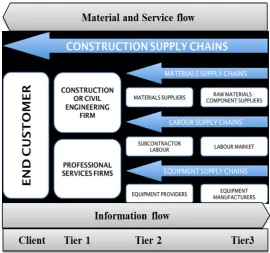
CSC is an established research focus area and collaboration and integration can be traced back to the often cited Latham (1994), and Egan (1997) reports (Akintoye, McIntosh & Fitzgerald, 2000). Research has identified the common prevalent issues, such as fragmentation and temporary project-centric supply chains, and how SCM methodologies and practices, such as integration and collaborative working, may improve supply chain efficiency and effectiveness (Dainty, Millett & Briscoe, 2001). The CSC as shown in Figure 1, is common to most construction settings, but does not adequately demonstrate how some sub-contractors and specialist providers could be involved in project planning, design, or associated risk management processes, i.e. the information flow is two way (Eriksson, Dickinson & Khalfan, 2007).
Munro, T. and Childerhouse P. (2018). Construction supply chain integration: Understanding its applicability in infrastructure asset maintenance and renewal programmes. International Journal of
Construction Supply Chain Management Vol. 8, No. 1 (pp. 01-18). DOI: 10.14424/ijcscm801018-01-18
3
Figure 1: Construction supply chain actors (Adapted from Cox and Ireland, 2002)
Lean construction is addressed in the literature, but with mixed views as to its applicability in CSCs due to difficulties in establishing lean systems in unique projects (Segerstedt, Lönngren, Rosenkranz & Kolbe, 2010). It has been posited that agile practices could have a place in CSCs if the focal supply chain was able to implement collaborative planning (Fulford & Standing, 2014). Lean, agile and leagile are strategic options to consider when developing appropriate levels of flexibility and responsiveness in CSCs (Gosling, Naim & Towill, 2013), which could apply in networks managing a mix of planned and response works. Similarly, infrastructure networks may benefit from supply chain scheduling to optimise resources, time and materials (Stadtler, Kilger & Meyr, 2015), and adapted and integrated for both discrete and continuous processes (Ivanov & Sokolov, 2010).
Second and third tier integration is addressed in the context of project planning (Eriksson et al., 2007), but research suggests that while tier one suppliers maintain long-term relationships with some tier two and three suppliers, there is little evidence of integration (Dainty et al., 2001). Integration and standardisation have been adopted in some projects (Ross, 2003), which suggests that some actors have the maturity and experience to extend integration and collaborative working to a network environment.
Supply Chain Integration Functions
Munro, T. and Childerhouse P. (2018). Construction supply chain integration: Understanding its applicability in infrastructure asset maintenance and renewal programmes. International Journal of
Construction Supply Chain Management Vol. 8, No. 1 (pp. 01-18). DOI: 10.14424/ijcscm801018-01-18
4
Ireland, 2002). It also means upstream suppliers are rarely brought into the planning stages of a project by either the contractor or the lead consultant (Eriksson et al., 2007), and (Eriksson & Westerberg, 2011).
Knowledge sharing is viewed as a value-adding benefit of collaborative working in relationally integrated networks (Kumaraswamy, Anvuur & Smyth, 2010). While tier one suppliers gain extensive knowledge about their clients, this is not consistently shared with tier two suppliers (Briscoe & Dainty, 2005). Cheng et al. (2010) demonstrate that the technology exists to support an integrated CSC, and posit the use of a technology ‘collaborator’ to coordinate information flows across the focal members. Relationally integrated value networks (RIVANs) offer a framework that models how people and information can be connected, and accumulated knowledge and experience leveraged, to enhance end user experience (Kelwin, Wong, Kumaraswamy, Mahesh & Ling, 2014).
A supply chain operating model (SCOM) provides a framework under which focal networks can operationalise strategy, and considers the integration of functions, people, systems, governance and policy in the context of its market and external influences to deliver desired performance (Stevens & Johnson, 2016). Once established, the SCOM can be kept current through tools such as business process re-engineering (BPR) and co-located task teams in a continuous improvement environment (Childerhouse, Lewis, Naim & Towill, 2003; Ross, 2003; Eriksson, 2015).
Supply Chain Management (SCM) Relationships
Culture and trust are recognised as key enablers to successful integration, and the absence of trust, conflicting cultures, or issues stemming from a long history of adversarial relationships will likely result in failed outcomes (Venselaar, Gruis & Verhoeven, 2015; Meng, Sun & Jones, 2011: Dainty et al., 2001). Integration partners require aligned values, and appropriate partnering and integration capability, and maturity in order to be successful (Meng et al., 2011) and (Errasti et al., 2007). CSC culture and practice suggests that the client will need to lead the process due to the master contractor’s likely unwillingness to particiINT6e, and the subcontractors distrust of master contractors (Errasti et al., 2007). Collaborative working is a key enabler to integration (Cheng, 2010) and (Briscoe & Dainty, 2005), but there is limited success in collaborative working across all of the client and tier one to tier three actors in a CSC (Kumaraswamy et al., 2010). Collaborative working is supported with effective supplier relationship management (SRM) in long-term relationships (Park, Shin, Chang & Park, 2010), and is supported by appropriate incentives enabled through good contract and performance management (Ross, 2003; Love, Davis, Chevis & Edwards, 2011; Errasti et al., 2007).
The Conceptual Model
Munro, T. and Childerhouse P. (2018). Construction supply chain integration: Understanding its applicability in infrastructure asset maintenance and renewal programmes. International Journal of
Construction Supply Chain Management Vol. 8, No. 1 (pp. 01-18). DOI: 10.14424/ijcscm801018-01-18
5
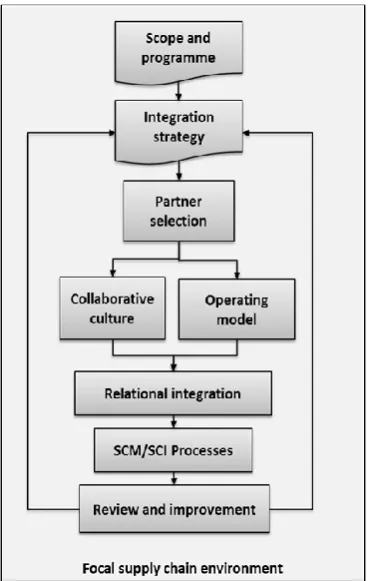
Figure 2: Conceptual model of SCI strategic dimensions in infrastructure CSCs
Research Gap
There is research into how CSC clients might engage with second and third tier actors (Errasti et al., 2007), but the focus is on individual ETO projects, or whole of life management of standalone assets, rather than networks of inter-related assets (Dainty et al., 2001). The literature review has identified a number of strategic SCI, SCOM, procurement and SRM models and frameworks that are, or can be, applied to CSCs, but none focus on infrastructure networks or programmes made up of many capital renewal and upgrade projects and asset maintenance activities (Park et al., 2010), (Anvuur, Kumaraswamy & Mahesh, 2011) and (Stevens & Johnson, 2016). The research gap lies in understanding if SCI is applicable in the civil infrastructure network environment, and if so, do the actors have the capability and maturity to implement it?
RESEARCH METHODOLOGY
The proposition for this research is that supply chain integration, in a civil infrastructure network of the client and tier one, two and three suppliers in polyadic relationships, will deliver benefits for all actors. The research will seek to answer the following questions:
1. Are the focal actors in a civil infrastructure network capable of applying SCI?
2. Can the conceptual model be refined into a strategic framework which most infrastructure networks can adapt to establish and manage an integrated supply chain?
Munro, T. and Childerhouse P. (2018). Construction supply chain integration: Understanding its applicability in infrastructure asset maintenance and renewal programmes. International Journal of
Construction Supply Chain Management Vol. 8, No. 1 (pp. 01-18). DOI: 10.14424/ijcscm801018-01-18
6
Methodology
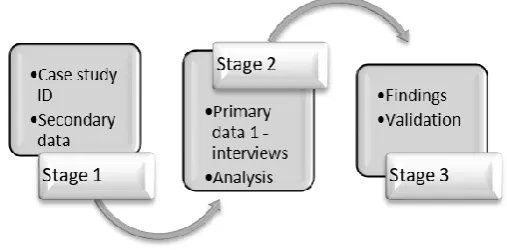
The researcher observes that groups of actors determine the unique social construct in their instance of a supply chain, and therefore has applied a qualitative approach. The research uses ethnographic content analysis (Altheide, 1987) in three inductive stages, described in Figure 3, to help ensure rigour and address challenges, such as focusing on existing constructs rather than allowing new concepts to emerge (Gioia, Corley & Hamilton, 2013). Findings were internally triangulated to support validation, and themes developed using data structure modelling to describe the phenomena and findings that align to the literature (Gioia et al., 2013).
Figure 3: Qualitative research process
Approach
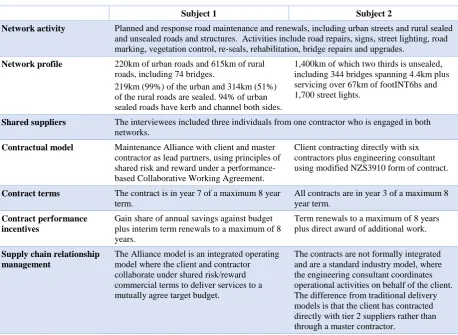
This research is based on case studies of two different network supply chains operating in close proximity geographically, which adds richness to the data as there are actors who are involved in both networks but delivering services under different models. The primary data were gathered through semi-structured interviews of approximately one hour’s duration, where interviewees were asked to describe their interactions and experiences with the supply chain. The subject networks and interviewees are profiled in Table 1 and 2.
DATA ANALYSIS
Interview data have been reviewed and analysed in three separate processes to support ECA in establishing common themes. Initial analysis identified common views across several dimensions that included risk, communications and leadership, the form of contract, value and critical success factors. The second process sought to align the data to the research question which added interviewees’ perspectives on willingness to integrate, capability and maturity, and integration with horizontal partners. In the third step, the analysis process developed common themes and an assessment of the subject network’s relative capability and maturity in SCI.
Emerging Themes
Munro, T. and Childerhouse P. (2018). Construction supply chain integration: Understanding its applicability in infrastructure asset maintenance and renewal programmes. International Journal of
Construction Supply Chain Management Vol. 8, No. 1 (pp. 01-18). DOI: 10.14424/ijcscm801018-01-18
7
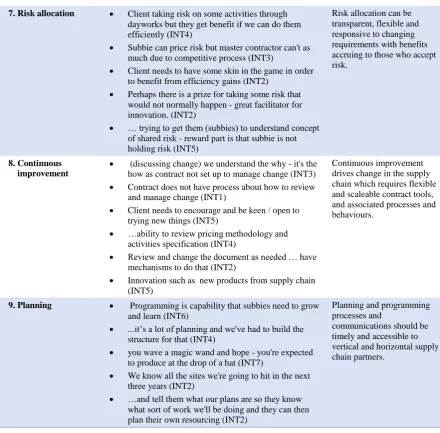
programming. The data has been tabulated by dimension with 1st order concepts made up of relevant interviewee quotes and paraphrases, and then emerging 2nd order propositions. In developing the propositions it became clear that the dimensions can be grouped into three high level categories that reflect the stage in the relationship where the dimension is most likely to occur. Table 3 reflects the establishment stage where partners are selected, objectives set and trust is established. Table 4 focuses on how the relationship will be managed and developed through collaboration, communication and problem solving practices. The third group in Table 5 reflects an operational focus through risk allocation, continuous improvement and planning.
Table 1: Research subject profiles
Subject 1 Subject 2
Network activity Planned and response road maintenance and renewals, including urban streets and rural sealed and unsealed roads and structures. Activities include road repairs, signs, street lighting, road marking, vegetation control, re-seals, rehabilitation, bridge repairs and upgrades.
Network profile 220km of urban roads and 615km of rural
roads, including 74 bridges.
219km (99%) of the urban and 314km (51%) of the rural roads are sealed. 94% of urban sealed roads have kerb and channel both sides.
1,400km of which two thirds is unsealed, including 344 bridges spanning 4.4km plus servicing over 67km of footINT6hs and 1,700 street lights.
Shared suppliers The interviewees included three individuals from one contractor who is engaged in both
networks.
Contractual model Maintenance Alliance with client and master
contractor as lead partners, using principles of shared risk and reward under a performance-based Collaborative Working Agreement.
Client contracting directly with six contractors plus engineering consultant using modified NZS3910 form of contract.
Contract terms The contract is in year 7 of a maximum 8 year
term.
All contracts are in year 3 of a maximum 8 year term.
Contract performance incentives
Gain share of annual savings against budget plus interim term renewals to a maximum of 8 years.
Term renewals to a maximum of 8 years plus direct award of additional work.
Supply chain relationship management
The Alliance model is an integrated operating model where the client and contractor collaborate under shared risk/reward commercial terms to deliver services to a mutually agree target budget.
The contracts are not formally integrated and are a standard industry model, where the engineering consultant coordinates operational activities on behalf of the client. The difference from traditional delivery models is that the client has contracted directly with tier 2 suppliers rather than through a master contractor.
SYNTHESIS OF FINDINGS
Demand for SCI
Munro, T. and Childerhouse P. (2018). Construction supply chain integration: Understanding its applicability in infrastructure asset maintenance and renewal programmes. International Journal of
Construction Supply Chain Management Vol. 8, No. 1 (pp. 01-18). DOI: 10.14424/ijcscm801018-01-18
8
Table 2: Interviewee profiles
Interviewees (coded) Role
INT1 Subject 2’s Transportation Manager responsible for establishing and managing network
maintenance contracts.
INT2 Subject 1’s Roading Engineer responsible for establishing and managing network
maintenance contracts.
INT3 Area Manager for large national civil contracting firm with responsibilities for performance of
business in the area including network maintenance contracts for subject 2 and NZTA.
INT4 Managing Director of regional civil contracting firm supplying services direct to clients and to
master contractors including subject 2.
INT5 (2 interviewees) Contract Manager and Operations manager for large national civil contracting firm responsible for subject 1’s Alliance contract.
INT6 Contract Manager for national engineering services consultancy responsible for network,
programme, budget and contract management for subject 2’s network.
INT7 Manager of local quarrying company providing material to clients, contractors and other
smaller clients including subject 2’s supply chain.
Table 3: Establishment dimensions and themes Aggregate
Dimension 1
st Order Concepts 2nd Order Propositions
Establishment - the dimensions that focus on establishing the preferred partners and aligning them to common goals for the focal network, and understanding the levels of trust that may or may not already exist
1. Procurement Pledged to have at least xx% spend through the supply
chain (INT3)
We will nominate preferred subbies... sometimes dealing with them directly and say to send bill to contractor (INT6)
We have to keep our subcontractor supply chain alive to cope with peak loads … so they are pre-qualified and understand our procedures (INT2)
Look for opportunities to align contract terms to create options and look for opportunities to manage niche subbies (INT2)
Partner selection is more than procurement as it includes direct and indirect relationships, and considers vertical and horizontal supply chains, and internal and external stakeholders.
2. Objectives …confusion as client asking for outcomes and then
prescribing the outputs (INT3)
I get the biggest value from ensuring that the operations and maintenance and renewal of infrastructure support this community (INT1) Driven by what is best value for our community
(INT2)
KPIs to demonstrate value for money and efficiencies to deliver an outcome (INT2)
Shared goals form the basis of value and performance measures that can be applied across the supply chain, i.e. not limited to dyadic contracted relationships.
3. Trust … need a near open-book approach to build trust
(INT1)
The relationship that you build with subbies and suppliers and the trust that's there (INT5)
Starting to see confidence from subbies to invest as a result of more predictable work (INT1)
Payment predictability … hear that we are known as good payers quite a lot (INT5)
We’ve been here all our lives so you know who you can trust and deal with (INT4)
Trust is valued by all actors and is founded in
Munro, T. and Childerhouse P. (2018). Construction supply chain integration: Understanding its applicability in infrastructure asset maintenance and renewal programmes. International Journal of
Construction Supply Chain Management Vol. 8, No. 1 (pp. 01-18). DOI: 10.14424/ijcscm801018-01-18
9
Table 4: Relationship dimensions and themes
Aggregate Dimension 1st Order Concepts 2nd Order Propositions
Relationships - those dimensions that consider how the focal actors will work together in a SCI environment.
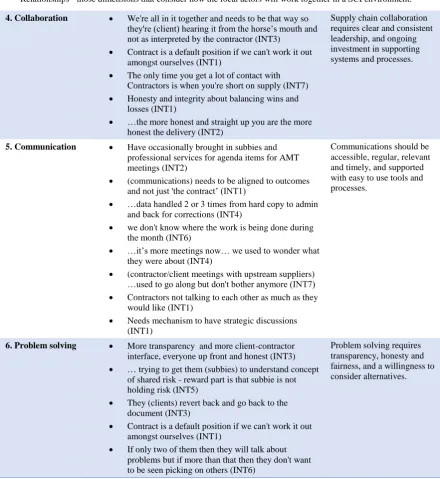
4.Collaboration We're all in it together and needs to be that way so
they're (client) hearing it from the horse’s mouth and not as interpreted by the contractor (INT3)
Contract is a default position if we can't work it out amongst ourselves (INT1)
The only time you get a lot of contact with Contractors is when you're short on supply (INT7) Honesty and integrity about balancing wins and
losses (INT1)
…the more honest and straight up you are the more honest the delivery (INT2)
Supply chain collaboration requires clear and consistent leadership, and ongoing investment in supporting systems and processes.
5.Communication Have occasionally brought in subbies and
professional services for agenda items for AMT meetings (INT2)
(communications) needs to be aligned to outcomes and not just 'the contract’ (INT1)
…data handled 2 or 3 times from hard copy to admin and back for corrections (INT4)
we don't know where the work is being done during the month (INT6)
…it’s more meetings now… we used to wonder what
they were about (INT4)
(contractor/client meetings with upstream suppliers) …used to go along but don't bother anymore (INT7) Contractors not talking to each other as much as they
would like (INT1)
Needs mechanism to have strategic discussions (INT1)
Communications should be accessible, regular, relevant and timely, and supported with easy to use tools and processes.
6.Problem solving More transparency and more client-contractor
interface, everyone up front and honest (INT3) … trying to get them (subbies) to understand concept
of shared risk - reward part is that subbie is not holding risk (INT5)
They (clients) revert back and go back to the document (INT3)
Contract is a default position if we can't work it out amongst ourselves (INT1)
If only two of them then they will talk about problems but if more than that then they don't want to be seen picking on others (INT6)
Problem solving requires transparency, honesty and fairness, and a willingness to consider alternatives.
Capability and maturity to implement SCI
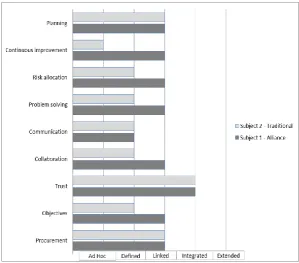
To assess the relative maturity and capability of each of the two subject supply chains an assessment model developed by Söderberg and Bengtsson (2010), was used, as it considers both maturity and capability in the context of process and organisation improvement as shown in Table 6. The maturity assessment is described in Table 6 and then the comparative assessment is illustrated in Figure 4.
Munro, T. and Childerhouse P. (2018). Construction supply chain integration: Understanding its applicability in infrastructure asset maintenance and renewal programmes. International Journal of
Construction Supply Chain Management Vol. 8, No. 1 (pp. 01-18). DOI: 10.14424/ijcscm801018-01-18
10
combination of relationship stability and maturity (the contract is in its 7th year), and the adoption of the Alliance collaborative working model. Subject 2 is a less mature contract using a traditional contract model. However, because the client in Subject 2 has contracted directly with upstream suppliers with whom there is a high level of trust established through long term business and community relationships, they have achieved a higher level of integration than perhaps their capability would suggest. All interviewees expressed a willingness to collaborate, but both cases failed to achieve high levels of integration, and it is interesting to note that no interviewee demonstrated any awareness or understanding of SCI.
Table 5: Operations dimensions and themes
Aggregate Dimension 1st Order Concepts 2nd Order Propositions
Operations - the dimensions that focus on the mechanics of the focal infrastructure
7.Risk allocation Client taking risk on some activities through
dayworks but they get benefit if we can do them efficiently (INT4)
Subbie can price risk but master contractor can't as much due to competitive process (INT3)
Client needs to have some skin in the game in order to benefit from efficiency gains (INT2)
Perhaps there is a prize for taking some risk that would not normally happen - great facilitator for innovation. (INT2)
… trying to get them (subbies) to understand concept of shared risk - reward part is that subbie is not holding risk (INT5)
Risk allocation can be transparent, flexible and responsive to changing requirements with benefits accruing to those who accept risk.
8.Continuous improvement
(discussing change) we understand the why - it's the how as contract not set up to manage change (INT3) Contract does not have process about how to review
and manage change (INT1)
Client needs to encourage and be keen / open to trying new things (INT5)
…ability to review pricing methodology and activities specification (INT4)
Review and change the document as needed … have
mechanisms to do that (INT2)
Innovation such as new products from supply chain (INT5)
Continuous improvement drives change in the supply chain which requires flexible and scaleable contract tools, and associated processes and behaviours.
9.Planning Programming is capability that subbies need to grow
and learn (INT6)
...it’s a lot of planning and we've had to build the structure for that (INT4)
you wave a magic wand and hope - you're expected to produce at the drop of a hat (INT7)
We know all the sites we're going to hit in the next three years (INT2)
…and tell them what our plans are so they know what sort of work we'll be doing and they can then plan their own resourcing (INT2)
Planning and programming processes and
Munro, T. and Childerhouse P. (2018). Construction supply chain integration: Understanding its applicability in infrastructure asset maintenance and renewal programmes. International Journal of
Construction Supply Chain Management Vol. 8, No. 1 (pp. 01-18). DOI: 10.14424/ijcscm801018-01-18
11
Table 6: Maturity model (Söderberg & Bengtsson, 2010)
Assessment Description
Ad hoc The supply chain and its practices are unstructured and ill-defined. Process measures are not in place. Jobs and organizational structures are not based on horizontal supply chain processes. On this level there are few structured practices and there is a lack of competencies. Success is based on individual heroics and “working around the system.”
Defined Basic SCM processes are defined and documented. Jobs and organization basically remain
traditional. Process performance is more predictable. Targets are defined but still missed more often than not. The organization practices collaboration among representatives, but only as representatives of their ordinary functions.
Linked Broad SCM jobs and structures are put in place outside and in addition to traditional functions. Cooperation among intra-company functions, vendors, and customers takes the form of teams that share common SCM measures and goals that reach horizontally across the supply chain. There is a need for continuous improvements and a broad understanding of how to deal with root cause elimination and performance improvements.
Integrated The supply chain actors take cooperation to the process level. Organizational structures and jobs are based on SCM procedures. SCM measures and management systems are deeply embedded. Advanced SCM practices, such as collaborative forecasting and planning with customers and suppliers, take shape. The organization uses teams when they set process goals.
Extended Multi-client SCM teams with common processes, goals, and broad authority take shape.
Figure 4: Comparison of research subjects’ SCI capability and application
Through use of the Alliance model, Subject 1 had established good collaborative working practices with the Contractor, and this extended in a limited way to some upstream suppliers. In Subject 2’s case, collaboration was hindered by a lack of appropriate governance, processes and systems, which was mainly due to their adoption of traditional contracting processes.
Munro, T. and Childerhouse P. (2018). Construction supply chain integration: Understanding its applicability in infrastructure asset maintenance and renewal programmes. International Journal of
Construction Supply Chain Management Vol. 8, No. 1 (pp. 01-18). DOI: 10.14424/ijcscm801018-01-18
12
relies more on personal relationships is more effective in both subjects. Overall, the analysis suggests that although the subjects are willing to work more closely with others further upstream or downstream from their own position, there is a lack of capability or maturity in some key areas, which is hindering aspirations for an ‘extended’ level of cooperation.
Summary of findings
Although the analysis has indicated a lack of capability and maturity to implement SCI in the subject supply chains, there are foundations of willingness, trust and underlying demand and value that can be built on. The subjects have not exhibited an awareness of the concept or dimensions of SCI, and there appear to be no strategic plans for its implementation and development. Clients and contractors undertake regular forecasting and programming activity, but meaningful and timely sharing with both vertical and horizontal partners is hindered by the internal focus of their ICT development. There is a reliance on personal relationships to manage upstream suppliers, and little development of goal oriented performance management that adequately incentivises and rewards the upstream supply chain for innovation and cost efficiencies. However, the industry has experience with integrated SCOM, such as the Alliance model used by one subject, and if focal actors are able to agree in principle to a change and adopt a shared investment approach to ICT and people development, then together with the aforementioned foundations they should be able to develop and implement an SCM and SCI strategy.
DISCUSSION
Demand for SCI
The research suggests that there is an underlying demand for SCI driven by master contractors who are rarely able to deliver all services using only their own resources, and that engaging local tier two and three suppliers is a high-value goal for infrastructure network clients. There is a willingness to collaborate more with upstream suppliers, but there is a lack of maturity in SCM and SCI which inhibits collaboration and efficiencies led value creation (Miller et al., 2002; Broft, Liyanage, Badi & Pryke, 2016).
Horizontal partners
Munro, T. and Childerhouse P. (2018). Construction supply chain integration: Understanding its applicability in infrastructure asset maintenance and renewal programmes. International Journal of
Construction Supply Chain Management Vol. 8, No. 1 (pp. 01-18). DOI: 10.14424/ijcscm801018-01-18
13
The geographic dynamic, or regionalism, in infrastructure networks was evident in the research subjects. This suggests that the concept of supply chain clusters will have applicability, where focal partners form long and short term modular networks of internal and external clients and suppliers to deliver common goals, e.g. a CBD streetscape upgrade, (Stevens & Johnson, 2016) and (Broft et al., 2016). There may also be lessons to be learned from Humanitarian Aid supply chains where many agencies are operating in the same place and cooperate to optimise limited or shared resources, (Balcik, Beamon, Krejci, Muramatsu & Ramirez, 2010; Tatham, Jahre & Jensen, 2010).
Figure 5: Sample supply chain mapping illustrating potential horizontal partner intercepts
Strategic dimensions in infrastructure SCI
The concept model in Figure 2 suggested strategic dimensions included integration strategy, partner selection, collaborative culture, operating model, relational integration, SCM/SCI processes and continuous improvement. Data analysis found that an adaptation of the maturity model posited by Meng et al. (2011) offered a typography that was more closely aligned to interviewees’ phenomenology (Tables 3, 4 and 5 above), however there are limitations that became apparent when synthesising the propositions from the raw data that has led to a revision of the concept model.
Munro, T. and Childerhouse P. (2018). Construction supply chain integration: Understanding its applicability in infrastructure asset maintenance and renewal programmes. International Journal of
Construction Supply Chain Management Vol. 8, No. 1 (pp. 01-18). DOI: 10.14424/ijcscm801018-01-18
14
efficiently as possible. The research has also identified trust is developed and maintained between clients, contractors and subcontractors across many contractual relationships, and is therefore an environmental, rather than situational factor to consider. The data highlighted the importance of ongoing review and improvement, collaborative working and communications, and leadership in ongoing capability and relationship development. Active risk management was raised in the context of cost and value for money and should be regularly reviewed with a greater emphasis on network resilience and vulnerability (Heckmann, Comes & Nickel, 2015; Christopher & Peck, 2004).
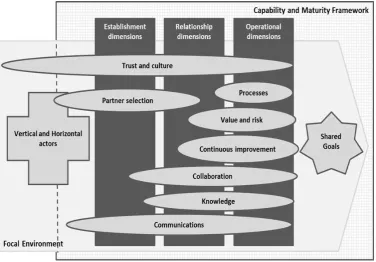
The revised dimensions model (Figure 6) builds on both the findings and discussion to recognise that actors may need to modify their approaches for the different foci of establishment, relationships and operations. It also seeks to demonstrate that trust and culture are strongly influenced by the existing relationships between individuals and firms, and that effective communications are a constant requirement. Lastly, the potential number of individuals and firms involved (see Figure 5), will likely result in a wide range of SCI capabilities and experience to manage, and the focal supply chain will benefit from an appropriate capability and maturity support and development framework.
Figure 6: Strategic dimensions in infrastructure maintenance networks
CONCLUSION
Munro, T. and Childerhouse P. (2018). Construction supply chain integration: Understanding its applicability in infrastructure asset maintenance and renewal programmes. International Journal of
Construction Supply Chain Management Vol. 8, No. 1 (pp. 01-18). DOI: 10.14424/ijcscm801018-01-18
15
predictability and surety of work. This results in more confidence to invest in plant and people, which then flows back to the client value proposition for local involvement - a virtuous circle.
There is a willingness and trust amongst the research subjects’ interviewed to work more collaboratively with upstream actors, but they do not have the necessary capability and maturity to sustain SCI over the long term. Lead partners in a focal network could evolve their existing relationships, and develop a shared SCI strategy using lessons learned from other industries. This can then be progressively implemented, and expanded to incorporate horizontal partners working in the same location. The requirement for a shared strategy led to a refinement of the conceptual model, which sought to establish the key strategic dimensions for SCI in the infrastructure environment. The model requires validation through case studies, but should give practitioners a good foundation to work with.
The literature review highlighted the relatively small amount of extant research into SCM and SCI in the context of infrastructure network management, which impacted the correlation of findings. The research subjects provided a rich source of data for analysis, but as there are only two subject supply chains, reliability and validity of the findings are difficult to establish.
There are aspects of the findings that support the literature, such as the importance of trust, knowledge management, shared goals and investment in people and ICT. There are also aspects of the findings that would benefit from further research, such as a quantitative review of the management application of the proposed dimensions, and longitudinal case studies capturing the impacts of both vertical and horizontal integration in a variety of jurisdictions and settings.
REFERENCES
Akintoye, A., McIntosh, G., & Fitzgerald, E. (2000). A survey of supply chain collaboration and management in the UK construction industry. European Journal of Purchasing Supply
Management, 6(3-4), 159-168. https://doi.org/10.1016/S0969-7012(00)00012-5
Altheide, D. (1987). Ethnographic content analysis. Qualitative Sociology, 10(1), 65-77. https://doi.org/10.1007/BF00988269
Anvuur, A. M., Kumaraswamy, M. M., & Mahesh, G. (2011). Building "relationally integrated value networks" (RIVANS). Engineering, Construction and Architectural Management, 18(1), 102-120. https://doi.org/10.1108/09699981111098711
Balcik, B., Beamon, B. M., Krejci, C. C., Muramatsu, K. M., & Ramirez, M. (2010). Coordination in humanitarian relief chains: Practices, challenges and opportunities. International Journal
of Production Economics, 126(1), 22-34. https://doi.org/10.1016/j.ijpe.2009.09.008
Briscoe, G., & Dainty, A. (2005). Construction supply chain integration: An elusive goal? Supply
Chain Management: An International Journal, 10(4), 319-326.
https://doi.org/10.1108/13598540510612794
Broft, R., Liyanage, C., Badi, S. M., & Pryke, S. (2016). Towards supply chain maturity in construction. Built Environment Project and Asset Management, 6(2), 187-204. https://doi.org/10.1108/BEPAM-09-2014-0050
Munro, T. and Childerhouse P. (2018). Construction supply chain integration: Understanding its applicability in infrastructure asset maintenance and renewal programmes. International Journal of
Construction Supply Chain Management Vol. 8, No. 1 (pp. 01-18). DOI: 10.14424/ijcscm801018-01-18
16 Childerhouse, P., Lewis, J., Naim, M., & Towill, D. R. (2003). Re‐engineering a construction
supply chain: A material flow control approach. Supply Chain Management: An
International Journal, 8(4), 395-406. https://doi.org/10.1108/13598540310490143
Christopher, M., & Peck, H. (2004). Building the resilient supply chain. The International Journal
of Logistics Management, 15(2), 1-14. https://doi.org/10.1108/09574090410700275
Cox, A., & Ireland, P. (2002). Managing construction supply chains: the common sense approach.
Engineering, Construction and Architectural Management, 9(5-6), 409-418.
https://doi.org/10.1046/j.1365-232X.2002.00273.x
Dainty, A., Millett, S., & Briscoe, G. (2001). New perspectives on construction supply chain integration. Supply Chain Management: An International Journal, 6(4), 163-173. https://doi.org/10.1108/13598540110402700
Eriksson, E. (2015). Partnering in engineering projects: Four dimensions of supply chain integration. Journal of Purchasing and Supply Management, 21(1), 38-50.
https://doi.org/10.1016/j.pursup.2014.08.003
Eriksson, E., Dickinson, M., & Khalfan, M. M. A. (2007). The influence of partnering and procurement on subcontractor involvement and innovation. Facilities, 25(5/6), 203-214. https://doi.org/10.1108/02632770710742174
Eriksson, E., & Westerberg, M. (2011). Effects of cooperative procurement procedures on
construction project performance: A conceptual framework. International Journal of Project
Management, 29(2), 197-208. https://doi.org/10.1016/j.ijproman.2010.01.003
Errasti, A., Beach, R., Oyarbide, A., & Santos, J. (2007). A process for developing partnerships with subcontractors in the construction industry: An empirical study. International Journal
of Project Management, 25(3), 250-256. https://doi.org/10.1016/j.ijproman.2006.10.002
Fulford, R., & Standing, C. (2014). Construction industry productivity and the potential for collaborative practice. International Journal of Project Management, 32(2), 315-326. https://doi.org/10.1016/j.ijproman.2013.05.007
Gioia, D. A., Corley, K. G., & Hamilton, A. L. (2013). Seeking qualitative rigor in inductive research: Notes on the Gioia Methodology. Organizational Research Methods, 16(1), 15-31. https://doi.org/10.1177/1094428112452151
Gosling, J., Naim, M., & Towill, D. (2013). A supply chain flexibility framework for engineer-to-order systems. Production Planning & Control, 24(7), 552-566.
https://doi.org/10.1080/09537287.2012.659843
Gosling, J., Towill, D. R., Naim, M. M., & Dainty, A. R. J. (2015). Principles for the design and operation of engineer-to-order supply chains in the construction sector. Production Planning
& Control, 26(3), 203-218. https://doi.org/10.1080/09537287.2014.880816
Heckmann, I., Comes, T., & Nickel, S. (2015). A critical review on supply chain risk – Definition, measure and modeling. Omega, 52, 119-132. https://doi.org/10.1016/j.omega.2014.10.004
Ivanov, D., & Sokolov, B. (2010). Dynamic supply chain scheduling. Journal of Scheduling, 15(2), 201-216. https://doi.org/10.1007/s10951-010-0189-6
Kelwin, K.W. Wong, K., Kumaraswamy, M., Mahesh, G., & Y.Y. Ling, F. (2014). Building integrated project and asset management teams for sustainable built infrastructure
Munro, T. and Childerhouse P. (2018). Construction supply chain integration: Understanding its applicability in infrastructure asset maintenance and renewal programmes. International Journal of
Construction Supply Chain Management Vol. 8, No. 1 (pp. 01-18). DOI: 10.14424/ijcscm801018-01-18
17 Kumaraswamy, M. M., Anvuur, A. M., & Smyth, H. J. (2010). Pursuing "relational integration"
and "overall value" through "RIVANS". Facilities, 28(13/14), 673-686. https://doi.org/10.1108/02632771011083702
Love, P. E. D., Davis, P. R., Chevis, R., & Edwards, D. J. (2011). Risk/Reward compensation model for civil engineering infrastructure alliance projects. Journal of Construction
Engineering and Management, 137(2), 127-136.
doi:10.1061//ASCE/CO.1943-7862.0000263
Love, P. E. D., Irani, Z., & Edwards, D. J. (2004). A seamless supply chain management model for construction. Supply Chain Management: An International Journal, 9(1), 43-56.
https://doi.org/10.1108/13598540410517575
Meng, X., Sun, M., & Jones, M. (2011). Maturity model for supply chain relationships in construction. Journal of Management in Engineering, 27(2), 97-105.
https://doi.org/10.1061/(ASCE)ME.1943-5479.0000035
Miller, C. J. M., Packham, G. A., & Thomas, B. C. (2002). Harmonization between main contractors and subcontractors: A prerequisite for lean construction? Journal of
Construction Research, 3(1), 67-82. https://doi.org/10.1142/S1609945102000059
Park, J., Shin, K., Chang, T. W., & Park, J. (2010). An integrative framework for supplier relationship management. Industrial Management & Data Systems, 110(4), 495-515. https://doi.org/10.1108/02635571011038990
Pomponi, F., Fratocchi, L., & Tafuri, S. R. (2015). Trust development and horizontal collaboration in logistics: A theory based evolutionary framework. Supply Chain Management: An
International Journal, 20(1), 83-97. https://doi.org/10.1108/SCM-02-2014-0078
Ross, J. (2003). Introduction to Project Alliancing. Alliance Contracting Conference, Sydney, Australia, 30 April. 43.
Saad, M., Jones, M., & James, P. (2002). A review of the progress towards the adoption of supply chain management (SCM) relationships in construction. European Journal of Purchasing &
Supply Management, 8(3), 173-183. https://doi.org/10.1016/S0969-7012(02)00007-2
Safa, M., Shahi, A., Haas, C. T., & Hipel, K. W. (2014). Supplier selection process in an integrated construction materials management model. Automation in Construction, 48(2014), 64-73. https://doi.org/10.1016/j.autcon.2014.08.008
Segerstedt, A., Lönngren, H. M., Rosenkranz, C., & Kolbe, H. (2010). Aggregated construction supply chains: Success factors in implementation of strategic partnerships. Supply Chain
Management: An International Journal, 15(5), 404-411.
https://doi.org/10.1108/13598541011068297
Simatupang, T. M., & Sridharan, R. (2002). The collaborative supply chain. The International
Journal of Logistics Management, 13(1), 15-30.
https://doi.org/10.1108/09574090210806333
Söderberg, L., & Bengtsson, L. (2010). Supply chain management maturity and performance in SMEs. Operations Management Research, 3(1-2), 90-97. doi:10.1007/s12063-010-0030-6 https://doi.org/10.1007/s12063-010-0030-6
Munro, T. and Childerhouse P. (2018). Construction supply chain integration: Understanding its applicability in infrastructure asset maintenance and renewal programmes. International Journal of
Construction Supply Chain Management Vol. 8, No. 1 (pp. 01-18). DOI: 10.14424/ijcscm801018-01-18
18 Stevens, G. C., & Johnson, M. (2016). Integrating the supply chain… 25 years on. International
Journal of Physical Distribution & Logistics Management, 46(1), 19-42.
https://doi.org/10.1108/IJPDLM-07-2015-0175
Tatham, P., Jahre, M., & Jensen, L. M. (2010). Coordination in humanitarian logistics through clusters. International Journal of Physical Distribution & Logistics Management, 40(8/9), 657-674. https://doi.org/10.1108/09600031011079319
Thomé, A. M. T., Scavarda, L. F., Fernandez, N. S., & Scavarda, A. J. (2012). Sales and operations planning and the firm performance. International Journal of Productivity and
Performance Management, 61(4), 359-381. https://doi.org/10.1108/17410401211212643
Venselaar, M., Gruis, V., & Verhoeven, F. (2015). Implementing supply chain partnering in the construction industry: Work floor experiences within a Dutch housing association. Journal
of Purchasing & Supply Management, 21(1), 1-8.