Sosna Patrycja. Beverages from coffee beans of Arabica as a source of health-promoting and psychoactive compounds. Journal of Education, Health and Sport. 2019;9(3):525-534. eISNN 2391-8306. DOI
http://dx.doi.org/10.5281/zenodo.2613144
http://ojs.ukw.edu.pl/index.php/johs/article/view/6741 https://pbn.nauka.gov.pl/sedno-webapp/works/908992
The journal has had 7 points in Ministry of Science and Higher Education parametric evaluation. Part B item 1223 (26/01/2017). 1223 Journal of Education, Health and Sport eISSN 2391-8306 7
© The Authors 2019;
This article is published with open access at Licensee Open Journal Systems of Kazimierz Wielki University in Bydgoszcz, Poland
Open Access. This article is distributed under the terms of the Creative Commons Attribution Noncommercial License which permits any noncommercial use, distribution, and reproduction in any medium, provided the original author (s) and source are credited. This is an open access article licensed under the terms of the Creative Commons Attribution Non commercial license Share alike.
(http://creativecommons.org/licenses/by-nc-sa/4.0/) which permits unrestricted, non commercial use, distribution and reproduction in any medium, provided the work is properly cited. The authors declare that there is no conflict of interests regarding the publication of this paper.
Received: 01.03.2019. Revised: 15.03.2019. Accepted: 28.03.2019.
B
EVERAGES FROM COFFEE BEANS OFA
RABICA AS A SOURCE OFHEALTH
-
PROMOTING AND PSYCHOACTIVE COMPOUNDSN
APOJE Z ZIAREN KAWYA
RABIKA JAKO ŹRÓDŁO ZWIĄZKÓW PROZDROWOTNYCH I PSYCHOAKTYWNYCHPatrycja Sosna
Department of Processing and Chemistry of Plant Raw Materials Faculty of Food Science, University of Warmia and Mazury in Olsztyn
University of Warmia and Mazury in Olsztyn,
Department of Processing and Chemistry of Plant Raw Materials Pl. Cieszyński 1, 10-726 Olsztyn
e-mail: [email protected]
Abstract
Introduction: Coffee is one of the most widely consumed beverage in the world. Its popularity stems from organoleptic, psychoactive properties and health-promoting compounds content. Thanks to caffeine, it has stimulant properties, warming effects, and also positively affects the digestive system. In turn, frequently occurring polyphenols are potentially protective agents against chronic neurodegenerative diseases, cancer and diabetes. They have been associated with antioxidant effects and support the cardiovascular system.
content of caffeine and polyphenols were examined, and their effect on the antioxidant potential of the beverages.
Results:It was found that beverages prepared from coffees of different origins differed in terms of caffeine and polyphenols content. The least of the compounds was in beverages with Guatemala coffee, while beverages with India and Brazil coffee contained more of them. The fineness of beans also affects the composition of the beverages. Generally, greater fragmentation increased the extraction of caffeine and polyphenols. The antioxidant potential of the beverages depended more on the country of origin of the coffee than fineness of beans. The beverages from Guatemala and Costa Rica coffee were characterised by greater antioxidant potential.
Keywords: coffee Arabica, country of origin, fineness of beans, caffeine, polyphenols, antioxidant activity
Introduction
The coffee is the most consumed beverage after water, and the second commercial product in the world after crude oil. Every day approx. 15 billion cups of coffee are consumed in the world. A statistical Pole consumes 3.5 kg per year coffee when the Swede has 8.69 kg and Fin 11.92 kg. The vast majority of Poles often choose ground coffee (61.4%) than soluble coffee (38.6%). Only 6% of consumed coffee in Poland is coffee consumed outside the home. Similar trends can be observed in most European countries. The exception is the United Kingdom, where coffee consumption outside the home was declared by 45% of respondents. The popularity of coffee is dictated primarily by stimulating and warming effects, as well as its positive effect on the digestive system [9, 15, 26].
and stimulants [3, 4, 24, 27]. According to a study conducted by the Canadian Ministry of Health (Health Canada), daily intake of caffeine up to 400 mg for healthy adults does not expose them to the potential adverse effects of intake of this substance. As for children, Health Canada reported that 10-12-year-olds should not consume more than 85 mg of caffeine per day, while adolescents aged 13-18 do not exceed 2.5 mg / kg body weight. The European Food Safety Authority (EFSA) has published information for adults the usual intake of caffeine up to 400 mg per day and an intake of up to 3 mg / kg b.w. per day for children and adolescents does not raise safety concerns. In turn, for pregnant women, a maximum daily dose of caffeine was set at 200 mg daily [22].
The belief that consuming caffeine can have an adverse effect on health, discourages people from drinking coffee, which undoubtedly contributes to the increased demand for decaffeinated coffee. Unpleasant short-term side effects which may occur after consumption of caffeine include palpitations, gastrointestinal disorders, anxiety, tremors, increased blood pressure and insomnia [3]. On the other hand, long-term excessive consumption of foods rich in caffeine can result in the development of diseases such as hypertension, coronary heart disease, anxiety, insomnia, depression, osteoporosis, anemia, inflammation of the intestinal mucosa and stomach, pregnancy problems. However, many studies indicate a different effect and reverse relationship between the occurence of cancer or metabolic diseases and consumption of caffeine. The latest information on phytochemistry and biological properties of coffee gradually lead to its recognition as a potential functional food, because the benefits to human health resulting from its consumption appear to outweigh the negative effects. It is attributed to its positive effect on the body: delaying neurological diseases (Parkinson's and Alzheimer's disease, tension headaches and migraines) and cancer (breast and colorectal cancer), inhibition of metabolic disorders (type 2 diabetes) and liver dysfunction (cirrhosis) [4, 5, 6, 24, 27].
11]. Watanabe et al. [23] found chlorogenic acids (CGA) in the extract from coffee beans reduce blood pressure in male rats and people with hypertension.
The content of the compounds in coffee and subsequent formation of the specific aroma of the beverage is affected by many factors. One of them is the type of raw material (species, origin or genetic features). Coffea arabica (Arabica) is considered more noble and more aromatic than Coffea canephora (Robusta). Harvest time and technology, storage conditions and subsequent roasting also influence the formation of new compounds, including aromatic. During roasting, the smell of beans varies from cereal to toast. Too short roasting makes the aroma less educated with a hint of bread. On the other hand beans which has been roasted for too long becomes bitter and less aromatic. There are many degrees of roasting, which are used depending on the traditions and cultural preferences. Starting from roasting a light giving a little spicy infusion, through medium and dark to so-called. Italian, which gives strongly burnt, bitter and greasy infusions. In order to extract the best fragrance compositions, a mixture of several species of beans or beans with various degrees of calcination. Also relevant is the method of grinding and brewing (boiled, filtered or espresso) [5, 11]. It is recommended to grind the beans just before brewing coffee. The fineness of the beans should be based on how to prepare subsequent infusion. Very finely ground coffee is better suited for brewing Turkish coffee, and for the overflow or pressure coffee makers it is better to choose coarsely ground coffee. The shorter the time of contact of water with coffee, the greater should be the degree of beans refinement in order to extract more compounds and a better aroma [18].
Aim of the study
The aim of the study was to compare beverages from Arabica coffee beans in terms of the content of selected psychoactive (caffeine) and health-promoting compounds (polyphenols). The factors differentiating the examined beverages were the country of origin of coffee and the fineness of the beans. Additionally, the effect of these compounds on the antioxidant potential of coffee beverages was evaluated.
Research materials and methods
The test material consisted of 4 types of coffees from Brazil, India, Costa Rica and Guatemala. The coffees came from the coffee roaster Lani Coffee, Morąg (Warmian-Masurian Voivodeship), where all beans were roasted to an average degree of roasting. This is the most usual way of roasting beans. Coffee beans from such roasting are slightly brown, the taste of coffee is balanced, with low acidity and light bitterness, and the aroma is clearly perceptible. All the coffee was ground using an electric coffee grinder from De 'Longhi SpA (Treviso, Italy) adjusting the degree of grinding, so as to obtain three types of samples: coarse, medium and fine beans.
Preparation of coffee beverages
Brewing was performed according to the recommendations set out in the Polish Standard [20]. 7 g of ground coffee were weighed and poured with 100 mL of water at 98C. It was left for 5 minutes to infuse, and then the infusion was separated from solids using a medium filter. The resulting coffee beverage was cooled to room temperature.
Determination of caffeine
alkaline solution was transferred to a separating funnel and extracted with three portions of chloroform (10 mL/5 mL/5 mL) at room temperature. The organic layer with the extracted caffeine was collected into a 25 mL graduated flask of and made up to the mark with chloroform. The absorbance measurement was performed at a wavelength of 276 nm as the maximum absorbance and caffeine at a wavelength of 310 nm (background) to chloroform. The correct caffeine absorbance was calculated from the difference.The caffeine content was calculated from the standard curve. The determination was performed in three parallel repetitions.
Determination of polyphenols
The total polyphenol content was determined spectrophotometrically using the Folin-Ciocalteu reagent [2]. The procedure was as follows: to a 15 mL tube, 100 µL of the beverage were taken, then 500 µL of Folin-Ciocalteau reagent (diluted with water in 1: 2 ratio), 3 mL of sodium carbonate solution (14% aqueous solution) and 6400 mL of distilled water were added. The sample was incubated at room temperature in the dark for 1 h. After this time the mixture was centrifuged 10 minutes (16,000 rpm) in a Eppendorf type 5417R centrifuge, followed by the absorbance of the supernatant solution measured against the blank at 720 nm using the OMEGA BMG FLUOStar apparatus. The blank sample was prepared in the same manner as the correct one, but the beverage was replaced with an equal volume of distilled water. The polyphenol content was calculated from the calibration curve for various concentrations of D-catechin in water. The determination was performed in three parallel repetitions.
Determination of the antioxidant potential
The antioxidant potential was determined using the synthetic DPPH (2,2-diphenyl-1-picrylhydrazyl) radical [17]. Preparation of the sample for analysis consisted of measuring 100 µL of the beverage and adding 2400 µL of the DPPH radical solution (0.02 g of the radical in 250 µL of methanol). 16 minutes after the addition of the radical solution, absorbance at 515 nm was measured against methanol as a blank. The absorbance of the zero sample prepared by mixing 100 µL of methanol and 2400 µL of the DPPH radical solution was also measured. Based on these results, the % scavenging of the DPPH radical was calculated. The OMEGA BMG FLUOStar apparatus was used to measure the absorbance. The determination was performed in three parallel repetitions.
Statistical analysis
The data was analysed using variance analyses (with Tukey test) with STATISTICA v.12 software (StatSoft, Inc., Krakov, Poland). The calculations were performed at a significance level of p≤0.05. Pearson's linear correlation coefficients were also calculated.
Results and discussion
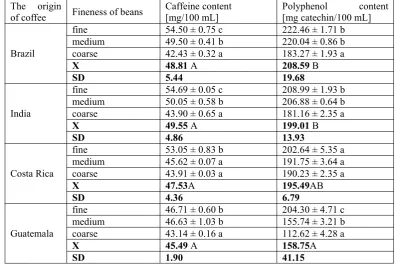
beans from Guatemala were characterised by the smallest fluctuations in caffeine content depending on the degree of bean refinement. However, during the traditional brewing of coffee, the lowest efficiency of caffeine extraction occurs in the case of coarsely ground coffee beans.
Table 1. The content of caffeine and polyphenols in coffee beverages depending on the origin of coffee and fineness of beans.
The origin
of coffee Fineness of beans Caffeine content[mg/100 mL] Polyphenol[mg catechin/100 mL]content
Brazil
fine 54.50 ± 0.75 c 222.46 ± 1.71 b medium 49.50 ± 0.41 b 220.04 ± 0.86 b coarse 42.43 ± 0.32 a 183.27 ± 1.93 a
X 48.81A 208.59B
SD 5.44 19.68
India
fine 54.69 ± 0.05 c 208.99 ± 1.93 b medium 50.05 ± 0.58 b 206.88 ± 0.64 b coarse 43.90 ± 0.65 a 181.16 ± 2.35 a
X 49.55A 199.01B
SD 4.86 13.93
Costa Rica
fine 53.05 ± 0.83 b 202.64 ± 5.35 a medium 45.62 ± 0.07 a 191.75 ± 3.64 a coarse 43.91 ± 0.03 a 190.23 ± 2.35 a
X 47.53A 195.49AB
SD 4.36 6.79
Guatemala
fine 46.71 ± 0.60 b 204.30 ± 4.71 c medium 46.63 ± 1.03 b 155.74 ± 3.21 b coarse 43.14 ± 0.16 a 112.62 ± 4.28 a
X 45.49A 158.75A
SD 1.90 41.15
– average value,– standard deviation A,B,C/ a,b,c - Mean values followed by the same letter (upper case letter for country of origin and lower case letter for particle size) are not significantly different (p0.05).
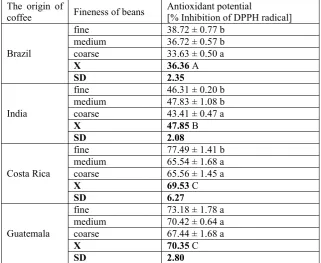
Table 2. The antioxidant potential of coffee beverages depending on the origin of coffee and fineness of beans.
The origin of
coffee Fineness of beans Antioxidant potential[% Inhibition of DPPH radical]
Brazil
fine 38.72 ± 0.77 b medium 36.72 ± 0.57 b coarse 33.63 ± 0.50 a
X 36.36A
SD 2.35
India
fine 46.31 ± 0.20 b medium 47.83 ± 1.08 b coarse 43.41 ± 0.47 a
X 47.85B
SD 2.08
Costa Rica
fine 77.49 ± 1.41 b medium 65.54 ± 1.68 a coarse 65.56 ± 1.45 a
X 69.53C
SD 6.27
Guatemala
fine 73.18 ± 1.78 a medium 70.42 ± 0.64 a coarse 67.44 ± 1.68 a
X 70.35C
SD 2.80
– average value, – odchylenie standardowe A,B,C/ a,b,c - Mean values followed by the same letter (upper case letter for country of origin and lower case letter for particle size) are not significantly different (p0.05).
Coffees from different regions of the world differ significantly in terms of their antioxidant potential (Table 2). The highest DPPH radical scavenging capacity was in Costa Rica and Guatemala coffees (68 and 70% of DPPH radical reduction, respectively), and the smallest was in coffee from Brazil (36% of DPPH radical reduction). Fărcaş et al. [10] show that robusta coffee infusions have an antioxidant potential of 43.63% inhibition of the DPPH radical, while arabica coffee only 36.18%. However, research published by Wolska et al. [25] show much higher antioxidant abilities of infusions (expressed as % inhibition of DPPH radical) from 80.90 to 82.2% and from 78.92 to 82.2%, respectively. These studies showed that the biggest difference in the antioxidant potential was found in green coffee infusions depending on the brewing method (71.97-83.21%). Heat treatment of coffee beans (roasting process) affects the level of antioxidant potential. In addition to the phenolic compounds present in coffee, which are partially destroyed by the roasting process, other antioxidant compounds, such as melanoidins, may be formed, and thus it is possible to maintain or enhance the antioxidant activity. However, after exceeding a certain threshold, the formation of new compounds may not compensate for the large loss of phenolic compounds. According to Hecimovic et al. [12] roasted coffee beans showed a higher antioxidant capacity than green coffee beans, and increased coffee consumption decreased its antioxidant potential.
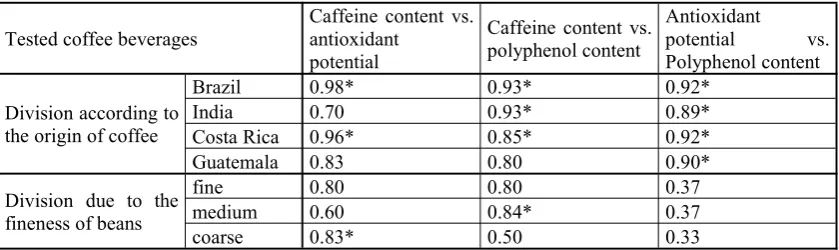
compounds contained in the beverages. The literature lacks data on the correlation between the total content of phenolic compounds and caffeine content in coffee beverages and their antioxidant potential. Most authors mainly focus on the content of chlorogenic acid derivatives. This may be due to the fact monocafoylquinone acids are the most widespread phenolic compounds in coffee. Ludwig et al. [16] stated that at the beginning of coffee brewing, the most caffeoylic acids were extracted and this was correlated with the antioxidant infusion capacity measured by means of % inhibition of the DPPH radical. Furthermore, researchers usually investigate the antioxidant activity of alcoholic or aqueous coffee bean extracts (other extraction conditions than typical brewing coffee). For example, Daniel and Workneh [7] showed a positive and high correlation between total phenolic content and DPPH free radical scavenging inhibition activity for aqueous and ethanolic extracts. In turn, Lopez-Galilea et al. [15] reported a significant correlation between caffeine content in coffee beans and antioxidant activity in the coffee brews results obtained by DPPH.
Table 3. Pearson’s linear correlation coefficients (r) determined for the relationship between caffeine content, polyphenols and the antioxidant potential of coffee beverages.
Tested coffee beverages Caffeine content vs.antioxidant potential
Caffeine content vs. polyphenol content
Antioxidant
potential vs. Polyphenol content Division according to
the origin of coffee
Brazil 0.98* 0.93* 0.92*
India 0.70 0.93* 0.89*
Costa Rica 0.96* 0.85* 0.92*
Guatemala 0.83 0.80 0.90*
Division due to the fineness of beans
fine 0.80 0.80 0.37
medium 0.60 0.84* 0.37
coarse 0.83* 0.50 0.33
*Pearson’s correlation coefficient is statistically significant (p0.05). Conclusions
1. The coffee beverages prepared from coffees of different origins differed in terms of the studied health-promoting and psychoactive compounds.
2. The least of caffeine and polyphenols contents were in beverages with coffee beans from Guatemala, while beverages with coffee beans from India and Brazil contained more of them.
3. The degree of grinding coffee beans affects the composition of the beverage. The greater fragmentation increased the passage of caffeine and polyphenols into a beverage.
4. The antioxidant potential of the coffee beverages depended on the country of origin of the coffee. The coffee beverages from Guatemala and Costa Rica coffee were characterised by greater antioxidant potential.
References
1. Angeloni G., Guerrini L., Masella P., Bellumori M., Daluiso S., Parenti A., Innocenti M. What kind of coffee do you drink? An investigation on effects of eight different extraction methods, Food Research International. 2019; 116: 1327-1335. 2. AOAC (Association of Official Analytical Chemists), Official Methods of Analysis,
12th edition, Washington DC, 1974, 9, 10.
3. Ashihara H. Crozier A. Caffeine: a well known but little mentioned compound in plant science, TRENDS in Plant Science. 2001; 6(9): 407- 413.
4. Bojarowicz H., Przygoda M. Kofeina. Cz. I. Powszechność stosowania kofeiny oraz jej działanie na organism, Problemy Higieny i Epidemiologii. 2012; 93(1): 8-13.
5. Burdyn G. Niepowtarzalny aromat kawy, Przegląd Piekarski i Cukierniczy. 2007; 2: 56-57.
6. Ciaramelli C., Palmioli A., Airoldi C. Coffee variety, origin and extraction procedure: Implications for coffee beneficial effects on human health, Food Chemistry. 2019; 278: 47-55.
7. Daniel A., Workneh M. Determination of total phenolic content and antioxidant activities of five different brands of Ethiopian coffee, International Journal of Food and Nutrition Research. 2017; 1(2):1-10.
8. De Marco I. Riemma S. Iannone R. Life cycle assessment of supercritical CO2 extraction of caffeine from coffee beans, The Journal of Supercritical Fluids. 2018; 133: 393-400.
9. Farah A., Donangelo C.M. Phenolic compounds in coffee, Brazilian Journal of Plant Physiology. 2006; 18(1): 23-36.
10. Fărcaş A.C., Socaci S.A., Bocăniciu J., Pop A., Tofană M., Muste S. Evaluation of biofunctional compounds content from brewed coffee, Bulletin UASVM Food Science and Technology. 2014; 71(2): 114-118.
11. Gonzalez de Mejia E., Vinicio Ramirez-Mares M. Impact of caffeine and coffee on our health, Trends in Endocrinology and Metabolism. 2014; 25(10): 489-492. 12. Hecimović I., Belšcak-Cvitanović A., Horzić D., Komes D. Comparative study of
polyphenols and caffeine in different coffee varieties affected by the degree of roasting, Food Chemistry. 2011; 129: 991-1000.
13. Jeon J.S., Kim H.T., Jeong I.H., Hong S.R., Och M.S., Park K.H., Shim J.H., Abd El-Aty A.M. Determination of chlorogenic acids and caffeine in homemade brewed coffee prepared under various conditions, J Chromatogr B Analyt Technol Biomed Life Sci. 2017; 1064: 115-123.
14. Kociuba A. Rynek kawy, Przegląd Gastronomiczny. 2012; 9: 3.
15. Lopez-Galilea I., De Pena M.P., Cid C., Correlation of Selected Constituents with the Total Antioxidant Capacity of Coffee Beverages: Influence of the Brewing Procedure, Journal of Agricultural and Food Chemistry. 2007; 55:6110-6117. 16. Ludwig I.A., Sanchez L., Caemmerer B., Kroh L.W., De Peña M.P., Cid C.
Extraction of coffee antioxidants: Impact of brewing time and method, Food Research International. 2012; 48(1): 57-64.
17. Moure A., Franco D., Sineiro J., Dominguez H., Núñez M.J., Lema J.M. Antioxidant activity of extracts from Gevuina avellana and Rosa rubiginosa
defatted seeds, Food Research International. 2001; 34: 103-109.
18. Ocieczek A. Wpływ stopnia rozdrobnienia kawy palonej na jej właściwości higroskopijne, Inżynieria i Aparatura Chemiczna. 2013; 52: 78-80.
20. Polska Norma PN-ISO 6668:1998 Kawa zielona - Przygotowanie próbek do analizy sensorycznej.
21. Szymanowska K., Wołosiak R. Wpływ prażenia kawy na wybrane parametry jej jakości, Aparatura badawcza i dydaktyczna. 2014; 1:77-83.
22. Verster J.C., Koenig J. Caffeine intake and its sources: A review of national representative studies, Critical Reviews in Food Science and Nutrition. 2018; 58(8): 1250-1259.
23. Watanabe T., Arai Y., Mitsui Y., Kusaura T., Okawa W., Kajihara Y., Saito I. The blood pressure-lowering effect and safety of chlorogenic acid from green coffee bean extract in essential hypertension, Clinical and Experimental Hypertension. 2006; 28(5): 439-449.
24. Wierzejska R. Caffeine – common ingredient in a diet and its influence on human health, Roczniki Państwowego Zakładu Higieny. 2012; 63(2): 141-147.
25. Wolska, J., Janda, K., Jakubczyk, K., Szymkowiak M., Chlubek D., Gutowska I. Levels of antioxidant activity and fluoride content in coffee infusions of arabica, robusta and green coffee beans in according to their brewing methods, Biological Trace Element Research. 2017; 179: 327-333.
26. Zawadzka-Ben Dor R., Kawa rozgrzewa ciało i duszę, Przegląd Piekarski i Cukierniczy. 2008; 11: 94-95.