R E S E A R C H A R T I C L E
Open Access
Challenges and strategies for implementing
genomic services in diverse settings:
experiences from the Implementing
GeNomics In pracTicE (IGNITE) network
Nina R. Sperber
1,7,16*, Janet S. Carpenter
2, Larisa H. Cavallari
3, Laura J. Damschroder
4, Rhonda M. Cooper-DeHoff
5,
Joshua C. Denny
6, Geoffrey S. Ginsburg
7, Yue Guan
8, Carol R. Horowitz
9, Kenneth D. Levy
2, Mia A. Levy
6,
Ebony B. Madden
10, Michael E. Matheny
11, Toni I. Pollin
8, Victoria M. Pratt
2, Marc Rosenman
2, Corrine I. Voils
12,13,
Kristen W. Weitzel
5, Russell A. Wilke
14, R. Ryanne Wu
7,15and Lori A. Orlando
7Abstract
Background:To realize potential public health benefits from genetic and genomic innovations, understanding how best to implement the innovations into clinical care is important. The objective of this study was to synthesize data on challenges identified by six diverse projects that are part of a National Human Genome Research Institute (NHGRI)-funded network focused on implementing genomics into practice and strategies to overcome these challenges.
Methods:We used a multiple-case study approach with each project considered as a case and qualitative methods to elicit and describe themes related to implementation challenges and strategies. We describe challenges and strategies in an implementation framework and typology to enable consistent definitions and cross-case comparisons. Strategies were linked to challenges based on expert review and shared themes.
Results:Three challenges were identified by all six projects, and strategies to address these challenges varied across the projects. One common challenge was to increase the relative priority of integrating genomics within the health system electronic health record (EHR). Four projects used data warehousing techniques to accomplish the integration. The second common challenge was to strengthen clinicians’knowledge and beliefs about genomic medicine. To overcome this challenge, all projects developed educational materials and conducted meetings and outreach focused on genomic education for clinicians. The third challenge was engaging patients in the genomic medicine projects. Strategies to overcome this challenge included use of mass media to spread the word, actively involving patients in implementation (e.g., a patient advisory board), and preparing patients to be active participants in their healthcare decisions.
(Continued on next page)
* Correspondence:[email protected] 1
Division of General Internal Medicine, Duke University School of Medicine, Durham, NC, USA
7
Duke Center for Applied Genomics & Precision Medicine, Duke University, Durham, NC, USA
Full list of author information is available at the end of the article
(Continued from previous page)
Conclusions:This is the first collaborative evaluation focusing on the description of genomic medicine innovations implemented in multiple real-world clinical settings. Findings suggest that strategies to facilitate integration of genomic data within existing EHRs and educate stakeholders about the value of genomic services are considered important for effective implementation. Future work could build on these findings to evaluate which strategies are optimal under what conditions. This information will be useful for guiding translation of discoveries to clinical care, which, in turn, can provide data to inform continual improvement of genomic innovations and their applications.
Keywords:Precision medicine, Pharmacogenomics, Electronic health record, Patient engagement, Provider engagement, Implementation
Background
Precision medicine, which addresses individual variability in effectiveness of disease prevention and treatment strategies, is a rapidly growing field, with application on a broad scale spurred by innovations resulting from the accu-mulation of massive amounts of health and biologic data. The Precision Medicine Initiative, launched by President Obama in 2015, reflects a public health commitment to developing not only technologies but also infrastructure for harnessing and sharing data from a national initial cohort of one million volunteers to develop precision medicine applications [1, 2]. Discovery is proceeding rapidly, and there is a need for systems capable of integrating genetic evidence-based applications into routine health care [3].
Even with agreed-upon clinically actionable recom-mendations, uptake of recommendations by clinicians and health systems is not optimal. For example, though there is adequate evidence that testing for Lynch Syn-drome, the most common form of hereditary colorectal cancer, could improve outcomes for patients and rela-tives, there has been a low level of screening in high-risk patients [4]. Similarly, despite sufficient evidence of cer-tain gene/drug interactions such as between CYP2C19
and clopidogrel and CYP2C9/VKORC1 and warfarin, routine genotyping is not performed either preemptively or at the time of prescribing [5, 6].
In order to optimize potential public health benefits from genetic and genomic innovations, there is a need to focus on developing both the evidence base for their im-pact on health outcomes and also strategies that can be used to put them into practice at a broad scale. Implemen-tation science, the systematic study of strategies to adopt and integrate evidence-based interventions in real-world settings seeks to shed light on how to accelerate adoption of genomic innovations. Understanding the influences of contextual factors on implementation strategies and adap-tations of genomic interventions is essential [7–9].
From previous work completed in single settings, it is known that barriers to adoption of genomic medicine in-clude unclear organizational policies or criteria for use, inconsistent modes for integrating genomic information into the electronic health record system, and concerns
about cost of testing for patients and institutions. At an individual level, factors related to poor uptake include lack of knowledge by physicians on how to interpret in-formation and lack of understanding by patients about genomic testing and the implication of results [8, 10]. These individual and system level barriers can interact such that decision makers may not consider genomics at all or may consider the obstacles too great in planning new models of care [11]. Johnson and Weitzel assert that, in private practice settings, local champions who can advocate for the value of genomic medicine are es-sential to advance implementation [12].
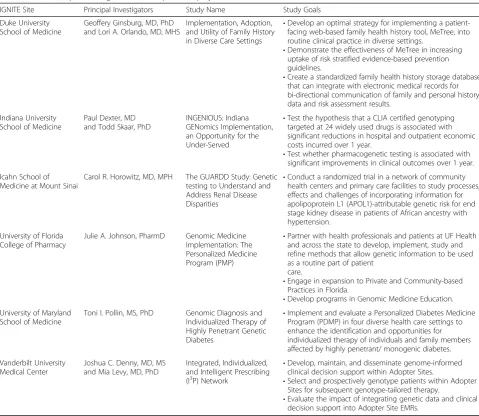
Although there is a body of literature describing chal-lenges to routine use of genomic innovation in specific settings, widespread integration of genomic innovations into clinical care, a public health objective [13], could be advanced by collaborative identification of best practices based on experiences across settings [3]. We present common strategies for implementation of genomic inno-vations across six diverse projects (Table 1) within the National Human Genome Research Institute (NHGRI)-funded network called IGNITE (Implementing GeNom-ics In pracTicE) [14]. Our results are organized using a well-accepted implementation framework, the Consoli-dated Framework for Implementation Research (CFIR), to systematically define barriers and facilitators [15–17].
Methods
We applied a multiple case study approach with each IG-NITE project considered as a case, or unit of analysis. Some projects were implemented in more than one health care setting and thus, for those cases, the challenges and strategies were aggregated to explain implementation across different health care settings at the project level. This case series sought to address research questions re-lated to understanding how genomic medicine innova-tions are implemented in real-world clinical settings, using in-depth information from within each case and additional insights by comparing across cases [18].
defined and grouped a priori according to a taxonomy published by the Expert Recommendations for Imple-menting Change (ERIC) project [19]. (For example, strat-egies related to adapting and tailoring context were listed on one worksheet and strategies related to training and educating stakeholders were listed in another worksheet.) Project leaders responded via email as to whether and how they had used each strategy. The researcher con-ducted an independent review to check that strategies described fit with the definitions established by the ERIC project and identify strategies that were used by at least three projects.
The final step involved organizing strategies according to relevant challenges that had been identified by all pro-jects in an open-ended discussion during an in-person meeting, 21 months after the launch of IGNITE. Two implementation researchers (LD, NS) mapped these
challenges to constructs from the CFIR, resolved slight disagreements through discussion, and achieved 100% consensus on the mapping: the CFIR, designed to provide an overarching typology to promote implementation the-ory development about determinants of implementation across multiple contexts, has been widely used by imple-mentation scientists to guide data collection, analysis or reporting, demonstrating that it can be used to generalize information about implementation experiences [17]. Strat-egies presented below are those that relate to one of these three common challenges via shared themes (e.g., the elec-tronic health record (EHR) was identified as a locus for both challenge and strategy). Documentation of the chal-lenges and strategies was verified via email and telephone conference discussion with investigators from each pro-ject, and the relationships between challenges and strat-egies were validated by an implementation expert (LD). Table 1IGNITE (Implementing GeNomics In pracTicE) projects
IGNITE Site Principal Investigators Study Name Study Goals
Duke University School of Medicine
Geoffery Ginsburg, MD, PhD and Lori A. Orlando, MD, MHS
Implementation, Adoption, and Utility of Family History in Diverse Care Settings
•Develop an optimal strategy for implementing a patient-facing web-based family health history tool, MeTree, into routine clinical practice in diverse settings.
•Demonstrate the effectiveness of MeTree in increasing uptake of risk stratified evidence-based prevention guidelines.
•Create a standardized family health history storage database that can integrate with electronic medical records for bi-directional communication of family and personal history data and risk assessment results.
Indiana University School of Medicine
Paul Dexter, MD and Todd Skaar, PhD
INGENIOUS: Indiana GENomics Implementation, an Opportunity for the Under-Served
•Test the hypothesis that a CLIA certified genotyping targeted at 24 widely used drugs is associated with significant reductions in hospital and outpatient economic costs incurred over 1 year.
•Test whether pharmacogenetic testing is associated with significant improvements in clinical outcomes over 1 year.
Icahn School of Medicine at Mount Sinai
Carol R. Horowitz, MD, MPH The GUARDD Study: Genetic testing to Understand and Address Renal Disease Disparities
•Conduct a randomized trial in a network of community health centers and primary care facilities to study processes, effects and challenges of incorporating information for apolipoprotein L1 (APOL1)-attributable genetic risk for end stage kidney disease in patients of African ancestry with hypertension.
University of Florida College of Pharmacy
Julie A. Johnson, PharmD Genomic Medicine Implementation: The Personalized Medicine Program (PMP)
•Partner with health professionals and patients at UF Health and across the state to develop, implement, study and refine methods that allow genetic information to be used as a routine part of patient
care.
•Engage in expansion to Private and Community-based Practices in Florida.
•Develop programs in Genomic Medicine Education. University of Maryland
School of Medicine
Toni I. Pollin, MS, PhD Genomic Diagnosis and Individualized Therapy of Highly Penetrant Genetic Diabetes
•Implement and evaluate a Personalized Diabetes Medicine Program (PDMP) in four diverse health care settings to enhance the identification and opportunities for individualized therapy of individuals and family members affected by highly penetrant/ monogenic diabetes.
Vanderbilt University Medical Center
Joshua C. Denny, MD, MS and Mia Levy, MD, PhD
Integrated, Individualized, and Intelligent Prescribing (I3P) Network
•Develop, maintain, and disseminate genome-informed clinical decision support within Adopter Sites.
•Select and prospectively genotype patients within Adopter Sites for subsequent genotype-tailored therapy.
•Evaluate the impact of integrating genetic data and clinical decision support into Adopter Site EMRs.
Results
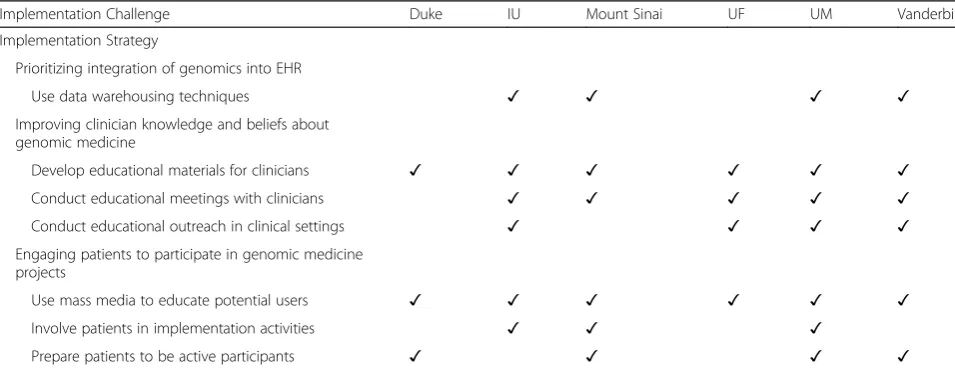
Three challenges were identified by all six projects: 1) prioritizing integration of genomics into the EHR, 2) im-proving clinicians’knowledge and beliefs about genomic medicine, and 3) engaging patients to participate in the genomic medicine projects. Below, we describe the na-ture of these common challenges and strategies used by projects to address them. Table 2 provides an overview of these results.
Challenge 1: prioritizing integration of genomics into EHR The more that an innovation is perceived and pro-moted as a priority from within an organization, the more likely it is that implementation will be successful; other initiatives and priorities can mitigate this effect, by subsuming attention and resources [16]. All IGNITE projects specifically reported challenges with integrat-ing elements of their program into the EHR in settintegrat-ings that have many competing priorities. In the Indiana University (IU) study, the salience of implementing pharmacogenomics testing was relegated to be a lower priority issue as the health system’s priority was focused on large scale transition to a new EHR. In the Vanderbilt study, the salience of implementing the evidence was questioned. In that study, the Veteran’s Affairs (VA) system had nationally authored and proctored criteria for use of clopidogrel and alternative agents; the culture did not include routine genomic testing and the local VA hos-pital would consider adding routine genomic testing for clopidogrel candidate patients only if the genotyping was conducted within a clinical trial. By contrast, at all of the other sites in IGNITE, genotyping to guide the use of clopidogrel is considered standard of care; increasing genotyping for clopidogrel was considered quality
improvement. Variation in the relative priority of genom-ics had downstream effects beyond the scope of any indi-vidual project including (1) a variety of different models being applied for data extraction and analysis and (2) in-formed consent processes that impacted data sharing. While most of the IGNITE sites with manually extracted data collect coded data prospectively using an informed consent model, some sites analyze existing de-identified data under a waiver of consent as non-human subjects re-search. Because of a policy change at NIH at the beginning of 2016, de-identified data collected with a waiver of con-sent may no longer be eligible for submission into the database of Genotypes and Phenotypes (dbGaP); some local IRBs may no longer certify data for dbGaP. To ad-dress this situation, dbGaP submission is done site-by-site rather than collectively across the entire IGNITE network.
Strategy: use data warehousing techniques
To implement specific tools within EHRs across health systems in the IGNITE network, most projects de-scribed using data warehousing techniques. The sites extract data from multiple sources to integrate clinical records across organizations into a central repository, which is one strategy to adapt and tailor innovations amongst various contexts [20]. IU’s INGENIOUS trial worked to integrate pharmacogenomics alerting and reporting into EHR and Clinical Decision Support sys-tems at a large safety-net hospital system. However, during the course of the project the hospital system mi-grated from a home grown EHR to the Epic Systems Corporation electronic health record (Epic). Therefore, the IU team will be using data warehousing techniques to address the transition and migration of the recruit-ment and reporting. At this point, there is no standard
Table 2Implementation strategies by challenge and IGNITE project
Implementation Challenge Duke IU Mount Sinai UF UM Vanderbilt
Implementation Strategy
Prioritizing integration of genomics into EHR
Use data warehousing techniques ✓ ✓ ✓ ✓
Improving clinician knowledge and beliefs about genomic medicine
Develop educational materials for clinicians ✓ ✓ ✓ ✓ ✓ ✓
Conduct educational meetings with clinicians ✓ ✓ ✓ ✓ ✓
Conduct educational outreach in clinical settings ✓ ✓ ✓ ✓
Engaging patients to participate in genomic medicine projects
Use mass media to educate potential users ✓ ✓ ✓ ✓ ✓ ✓
Involve patients in implementation activities ✓ ✓ ✓
Prepare patients to be active participants ✓ ✓ ✓ ✓
method for creating alerts about actionable variants: each site has created its own clinical decision support (CDS) rules. Mount Sinai’s GUARDD study relied heavily on the Epic data warehouse at both Sinai and their partner network of neighborhood health centers, the Institute for Family Health, to identify potentially eligible patients and return results to providers through best practice alerts [21]. Mount Sinai has selected variants based on published guidelines from the Clinical Pharmacogenetics Implemen-tation Consortium (CPIC) and other organizations and has prioritized those for which testing is permitted by New York State Clinical Laboratory Improvement Amendments (CLIA) regulations [22]. Because the Uni-versity of Maryland (UM) project utilizes next-generation sequencing (NGS) to identify unique variants and generate highly individualized reports, they are currently providing an in person or telephone genetics consult to each pa-tient with a positive result (pathogenic or likely patho-genic monopatho-genic diabetes variant identified by NGS, classified for pathogenicity using the 2015 American College of Medical Genetics and Genomics/Association for Molecular Pathology (ACMG/AMP) standards as implemented in a tool they created [23, 24], and con-firmed by CLIA-compliant Sanger sequencing) and uploading a copy of the laboratory report, the clinical consult note, and a genetic counseling summary letter to Epic; they also mail copies to the patient. For pa-tients referred from outside the four study sites, these materials are sent to the referring provider via fax and to the patient by mail. Vanderbilt’s I3P is implementing a clinical decision support into four different EHRs in five different collaborating sites. In some systems, these data can be directly stored in the EHR in a structured format. At Vanderbilt genotype data include variants of unknown pharmacogenetics effect. These variants are stored outside the formal EHR system. If new studies suggest a variant is actionable and once CDS is built for the variant, new actionable variants can be moved into the EHR (e.g., Vanderbilt has moved into guidance and results support for tacrolimus and CYP3A5 variants after initial launch). New CDS and actionable guidance follows oversight by a special pharmacogenetics panel of the institutional Pharmacy and Therapeutics commit-tee. In general, guidance for specific variants has followed CPIC recommendations when these are available, and all current CDS have CPIC guidelines at this time. For other I3P sites, only actionable data are being transferred into the EHR. Similarly, integrating decision support into order entry was not reasonably possible at all of the I3P sites given their EHR systems. To compensate, it was decided to notify the provider of genomic results and implications for treatment instead by directing the information to the provider as a clinical note in the EHR that requires co-signature by the provider.
Challenge 2: improving clinician knowledge and beliefs about genomic medicine
Knowledge by individual stakeholders about how to use innovations is important for buy-in and utilization [16]. However, for all projects, lack of provider knowledge about how to interpret genomic data and apply it to pa-tient care was a challenge. IU indicated that this was a particularly large challenge for its project because of the variety of providers (physicians, nurse prescribers, phar-macists) across health care settings (inpatient, outpatient primary care clinics, outpatient specialty care clinics, emergency room) who might receive pharmacogenomic reports. Thus, IU conducted data analyses to understand in what settings prescriptions for the targeted medica-tions arose and to follow patients longitudinally to evalu-ate what additional settings were visited, and the heterogeneity in settings [25]. For example, warfarin pre-scriptions were not limited to cardiology clinics, suggest-ing that a system-level educational effort was needed. In general, this challenge was addressed by strategies to train and educate clinicians and by disseminating mate-rials and conducting in-person trainings.
support alerts in the EHR, evidence summaries for providers to use to support clinical recommendations and engage other clinicians, and a website and online genom-ics newsletter (http://personalizedmedicine.ufhealth.org/). UM developed information sheets for providers on when and how to make referrals and what to expect after their patients are enrolled in the study. Through I3P, Vanderbilt is supported by websites originally developed to support Vanderbilt’s PREDICT (germline pharmacoge-nomic testing) and Personalized Cancer Medicine Initiative: www.mydruggenome.org and www.mycancergenome.org, accessible publicly and for providers and staff. These web-sites are directly linked from the EHR systems to allow providers to learn more about actionable, relevant drug/ genome interactions. MyCancer genome also includes links to relevant genomically-driven clinical trials. I3P found that individuals routinely believed pharmacogenomics were im-portant, though needed decision support (provided by link-ing to a Web site) to be able to explain actionability of the germline or somatic variants in practice [26].
Strategy: conduct educational meetings with clinicians Five projects additionally conducted educational meetings, targeted to clinicians to teach them about the clinical innovation [20]. IU presented study training programs to the health system senior leadership team, which included clinical and non-clinical administrative personnel, and training programs for the IU School of Medicine Resident and Fellow faculty leaders. IU also held in-person meet-ings (with repeat educational sessions due to provider turn-over), conducted journal clubs, and held a day-long continuing education (CE)/continuing medical education (CME) conference/workshop to educate clinicians about pharmacogenomics and the potential to improve patient outcomes. Mount Sinai described how they joined existing clinician meetings held at the fifteen participating clinic sites/practices to describe APOL1, genomics, and the study and answer provider questions about testing and returning results. UF planned meetings with various levels of stakeholders to ensure understanding and engagement throughout. UM conducted monthly group meetings with clinicians, divisional and departmental grand rounds, ex-ternal lectures, and educational outreach visits with two genetic counselors to facilitate implementation at different sites. The Vanderbilt study team met with providers, pa-thologists, and IT representatives in person on location at I3P sites as well as through virtual meetings to educate and facilitate implementation by having a discussion to bring new ideas to the table, learn about new hurdles and try to come up with solutions.
Strategy: conduct educational outreach in clinical settings Four of the projects reported strategies to conduct edu-cational outreach, which consists of having a trained
Challenge 3: engaging patients to participate in genomic medicine projects
One core component of an implementation process is attracting and involving appropriate stakeholders in the implementation and use of the innovation [16]. All pro-jects faced challenges with finding providers and patients willing to enroll and, for some sites, to know at which level to initiate strategies to engage stakeholders. For most sites directed by the Vanderbilt I3P team, gene-based drug dosing was deployed within the context of routine clinical care; therefore, no direct patient consent was required. For example, Imagenetics at Sanford Health embeds genetic counselors in outpatient internal medicine clinics at all major division sites across the upper Midwest, facilitating rapid access to genetic coun-selors for providers to better identify which patients are most appropriate for pre-emptive pharmacogenetics testing and help for patients to better understand the clinical impact of their pharmacogenetics test results as their healthcare unfolds [27]. This allows early engage-ment with patients in their own healthcare as well as providing opportunities to describe how genomic medi-cine projects could be beneficial to them. However, one of Vanderbilt’s sites, the VA Tennessee Valley Healthcare System, did have to directly consent patients for enroll-ment, with patients explicitly consenting to sharing their data on dbGaP, rendering it more challenging to engage patients at that site. This was due to the VA national policy on data release, and there is ongoing national pol-icy discussion about changing the data sharing and release policies of VA.
Strategy: use mass media to educate potential users All six projects have used mass media, a strategy to spread the word about the innovation by communicating to large audiences [20]. Duke promoted news articles on TV, the radio, and local newspapers. The IU School of Medicine, in collaboration with the IU Kelley School of Business developed a detailed launch plan for the IN-GENIOUS study that included a plan for widely publi-cizing the study within the health system and externally to the general public (local and national) via email press releases, forwarded by senior leaders, and to local and national media by communications departments, result-ing in publicity by over 207 websites and journals with a potential reader reach of over 20 million visitors per day. In addition, the Chief Medical Officer at the health system highlighted the value of the IGNENIOUS study in one of his monthly newsletters. UM sought oppor-tunities for patient advocates to speak publicly and for news reports [28]. UF has developed a robust online presence, including its SNP•its publication, which is partnered with the Pharmacogenomics Knowledgebase,
UF Health Personalized Medicine Program Twitter ac-count (@UFPersonalMed), and development of a recur-ring Personalized Medicine Column in a nationally distributed electronic physician newsletter. In addition, a patient who receiving genotype-guided drug therapy at UF has been featured on a local news station and both pharmacy and local magazines and their pharmacist train-ing programs have been featured in national pharmacy publications. Vanderbilt and Sanford Health have both also leveraged media via press and in promotional mate-rials to promulgate use of genomics to improve care.
Strategy: involve patients in implementation activities Three projects additionally involved patients in imple-mentation activities. IU conducted a focus panel with patients to obtain their input in the creation of a pharmacogenomics patient education tool, using inter-active methods from design research to assist partici-pants in drawing on their lived experiences to explore study issues and envision solutions to improve patient recruitment for the pharmacogenetics study. This re-sulted in patient-authored similes to be used during recruitment, for example, “Pharmacogenetics is kind of like being able to try on clothes before you buy them in-stead of crossing your fingers and hoping they fit,” as well as a visual tool to aid research assistants in recruit-ing patients and a companion piece for patients to take home containing the most important information as de-termined by the session participants. Another project, (Mount Sinai), relied on a genomics community board of patients, advocates and clinicians to develop all patient and clinician-facing materials, and all implemen-tation strategies [29]. Together, they conducted a forma-tive study prior to the randomized trial to help guide implementation. UM developed a relationship with a pa-tient advocate recently diagnosed with monogenic dia-betes, formed an alliance to increase patient and provider awareness (http://medschool.umaryland.edu/ endocrinology/mdrap.asp), and used community partici-patory approach to develop patient educational materials (e.g. photo novella), engagement of media, and patient public speaking opportunities.
Strategy: prepare patients to be active participants
of the recommendations were described to facilitate dis-cussions and shared decision making with their doctors. Mount Sinai also used this strategy by meeting with nu-merous patients tested for APOL1 to develop and revise an education booklet about genetic testing, managing their high blood pressure and asking their doctor about tests for kidney function. UM facilitated the insurance appeals process for monogenic diabetes genetic testing by developing a template appeal letter, conducting a systematic website analysis on monogenic diabetes to identify high quality, patient-friendly online educational resources, and providing each patient diagnosed with monogenic diabetes with a customized consult note, patient friendly letter and lab report explaining the diag-nosis and its implications. The PI also led a roundtable discussion on monogenic diabetes at a consumer ori-ented American Diabetes Association (ADA) summit in Baltimore, providing patients and ADA program staff with opportunities to gain awareness of monogenic dia-betes through informal conversation with the PI, co-I, and their patient advocate partner. Vanderbilt has made genomic testing part of the patient portal with patient-friendly explanations of genetic test results. Additionally, patients have access to examples of CDS for genetic tests at Vanderbilt through the clinical decision support knowl-edgebase (CDS-KB) website (www.cdskb.org). With these resources, patients can better understand the role of gen-etic testing and be more prepared to engage with their providers about their care.
Discussion
We identified common challenges faced by six diverse projects related to implementing genomic services into routine clinical care and strategies identified by at least half of the projects to overcome the challenges. We describe cross-project comparisons regarding which implementation strategies were employed using a pub-lished implementation framework and typology; these strategies, can be translated to other projects and settings. These findings complement work of other NHGRI-funded consortia that also are working to fur-ther implementation of precision medicine into clinical care. The CSER (Clinical Sequencing and Exploratory Research) consortium [30] is focused on studying impli-cations of clinical sequencing for clinical care. eMERGE (Electronic Medical Records and Genomics) [31] is a consortium that is focused on developing ways to best use EHRs for linking biorepository and phenotypic data within EHRs. This synthesis of IGNITE projects pro-vides the necessary evidence to understand how preci-sion medicine can be incorporated innovatively into practice settings and thus allow for the ongoing devel-opment of evidence about what works under which
conditions in real-world settings-evidence that is not possible to obtain prior to implementation [7].
All IGNITE projects noted challenges regarding inte-gration of specific genomic innovations into some, though not all, health system EHRs. This challenge is particularly important, as EHRs are the foundation and central point that merges genomic data and the point of care contact with the patient. Without the EHR pro-viding the network for integrating genomic and clinical data in different forms and from different sources to provide decision support in real time, successful imple-mentation of clinically actionable genomic data would not be possible [32]. An advantage of integrating gen-omic information into EHRs is improved access to data across networks, a strategy not possible with paper-based systems. However, to realize the potential of gen-omic implementation, there are data challenges that need to be addressed, including integration of clinical decision support systems into current workflows [33]. eMERGE found that larger sample sizes from cross-site pooling of data were important for discoveries of new genotype-phenotype associations and reuse of data for different phenotypes not included in the primary re-search plan; to share data in this way, the EHR algo-rithms were developed to be portable across sites with different systems and settings [34]. Regardless of which technology is used to link data, collaboration between research and practice is key. Precision medicine is poised to produce massive amounts of data, and one expert has described the more immediate data chal-lenge as that of a “complex” rather than “big” data problem, with the need for solutions to link and inte-grate data from various sources [35]. It is interesting to consider that the implementation strategies used by projects to bring genomic data to point of care and fa-cilitate clinical decision making could have an added benefit of feeding back outcome data to, in turn, inform health system improvement, a hallmark of a learning healthcare system [15].
though as with EHR systems, it can be difficult to share CDS across different EHR products or health systems. Peterson et al. (2016) found that clinicians do heed phar-macogenomic advice delivered by decision support sys-tem, though actions taken vary by provider, underscoring the utility of meetings and outreach, as conducted by IG-NITE projects, to facilitate consistent use of these systems [37]. It is important to note that among IGNITE projects, education activities were conducted not only in academic centers but also in community settings, which serve greater numbers of patients and often have less educa-tional support. Further, offering CME credit for participa-tion in these activities as some projects did can be important for boosting participation, as providers have many priorities and limited time for CE [38]. It is possible that deficits in clinician knowledge coupled with EHR issues could only serve to magnify the impact of individual challenges, for example, by having to educate not only about content (genetics), but also the platform (new alerts in EHR). Timing of strategies to address the combined effect of these challenges would be important, such as ensuring that EHR is functioning before educating pro-viders so that the system will be able fully answer their questions.
IGNITE projects conducted activities to educate not only providers but also patients in order to facilitate im-plementation. Personalized medicine is essentially indi-vidualized even when applied on a public health scale, and thus it is important to involve patients in the imple-mentation process to be able to take into account social norms, culture, risk perception, and family factors among other personal information. It is also necessary to engage patients to facilitate within-family communi-cation, not only to obtain family health history informa-tion, but also pursue cascade testing. Here also implementation strategies can interact in that providers who know how to use and interpret genomic medicine innovations will be in a better position to engage pa-tients to elicit these contextual factors that are import-ant for a comprehensive consideration of options for and impact of genomic approaches. The Genetic Coun-seling Working Group of the CSER consortium con-ducted an analysis of all CSER projects to understand best practices for obtaining informed consent from and returning results to patients when conducting clinical sequencing. Lessons learned include importance of man-aging expectations in pre-test and post-test counseling that negative findings do not mean that the condition is not genetic; that both healthy and ill patients need follow-up for recommendations of incidental findings; that providers should consider individual patients’ thoughts and emotions around sequencing; and, to con-sider variability in reactions to genetic sequencing within a family [39]. Training providers and other allied health
professionals in patient-centered approaches and ad-vanced communication skills will be necessary to engage patients in decision-making around using genomic data [40]. MedSeq is one project that is studying how pre-pared physicians are to return results of pathogenic vari-ants, likely pathogenic varivari-ants, and suspicious variants of uncertain significance to patients [41].
Comparison of these findings with other studies that have used the CFIR to identify implementation chal-lenges underscores the notion that key constructs will vary by type of intervention and, possibly, setting. For example, as with this study,“engaging stakeholders”was identified as a distinguishing construct for a VA-based lifestyle coaching health promotion program, with a strong correlation to program referral rates; however, “networks and communication,” which refers to nature and quality of formal and informal interaction within an organization, was also identified as distinguishing for that program as well as for another on-site group weight management within the VA health system, though this construct did not stand out for IGNITE projects. The IGNITE projects could have proactively facilitated devel-opment of social networks and communication channels with the outreach and education that was necessary to educate and engage stakeholders about value of genomic services. Thus, reducing the CFIR to fewer constructs that have been shown to differentiate implementation outcomes for the sake of parsimony, as recommended by Varsi et al., may, instead, limit the frame, precluding identification of factors that may matter for some [42]. As Kirk et al. suggest based on results from their sys-tematic review of CFIR in empirical research, it will be important for future work on implementation of any program, including those related to genomic medicine, to articulate a rationale for selecting CFIR constructs and design studies to assess relationship between imple-mentation constructs and outcomes [17]. This work will serve to build our understanding of which factors matter in what circumstances and can be used to refine imple-mentation strategies to promote use of genomic services more widely and contribute to the field of implementa-tion research.
Conclusions
This cross-project, cross-setting synthesis represents a collaboration by members of a network devoted to gen-erating evidence to facilitate implementation of genomic medicine into routine clinical care. Others can learn from these experiences about challenges they might ex-pect to encounter, namely having to work around other health system priorities for the EHR and educating clini-cians and patients to facilitate their engagement with genomic services and skill in shared decision-making. Policy implications can include support to accelerate linking data across systems and broader-based education of providers and the public about how to use genomic information to make personal health decisions.
Abbreviations
ACMG/AMP:American College of Medical Genetics and Genomics/ Association for Molecular Pathology; ADA: American Diabetes Association; CDS: Clinical decision support; CDS-KB: Clinical decision support
knowledgebase; CE: Continuing education; CFIR: Consolidated framework for implementation research; CLIA: Clinical laboratory improvement
amendments; CME: Continuing medical education; CPIC: Clinical pharmacogenetics implementation consortium; CSER: Clinical sequencing and exploratory research; dbGaP: database of genotypes and phenotypes; EHR: Electronic health record; eMERGE: Electronic Medical Records and Genomics Network; Epic: Epic Systems Corporation; ERIC: Expert Recommendations for Implementing Change; IGNITE: Implementing Genomics in Practice; IU: Indiana University; NGS: Next-generation sequencing; NHGRI: National Human Genome Research Institute;
UF: University of Florida; UM: University of Maryland; VA: U.S. Department of Veterans Affairs
Acknowledgements Not applicable.
Funding
This work was supported by grants from the National Institutes of Health (U01 HG007269, UL1 TR 000064, U01 HG007253, U01 HG007762, U01 HG007282, U01 HG007775, U01 HG007278).
Availability of data and materials
Data generated or analyzed during this study are included in this published article. Additional information about the data is available from the corresponding author on reasonable request.
Authors’contributions
NRS made substantial contribution to the conception, design, analysis, and interpretation of the study; led the drafting and revisions of the manuscript; and, gave final approval of the manuscript. LAO conceived of the study; made substantial contribution to the design and interpretation of analysis; and, read and approved the final manuscript. The following authors made substantial contributions to the acquisition, analysis or interpretation of data; were involved in drafting or critically revising the manuscript for important intellectual content; and read and approved the final manuscript: JSC, LHC, LD, RMC, JCD, GSG, YG, CRH, KDL, MAL, EBM, MEM, TIP, VMP, MR, CIV, KW, RAW, RW.
Competing interests
The authors declare that they have no competing interests.
Consent for publication Not applicable.
Ethics approval and consent to participate Not applicable.
Publisher’s Note
Springer Nature remains neutral with regard to jurisdictional claims in published maps and institutional affiliations.
Author details
1Division of General Internal Medicine, Duke University School of Medicine,
Durham, NC, USA.2Indiana University School of Nursing, Indianapolis, IN, USA.3Department of Pharmacotherapy and Translational Research and Center for Pharmacogenomics, University of Florida, Gainesville, FL, USA. 4Implementation Pathways, LLC and VA Ann Arbor Center for Clinical
Management Research, Ann Arbor, USA.5University of Florida, College of Pharmacy and Medicine and Center for Pharmacogenomics, Gainesville, USA. 6Vanderbilt University Medical Center, Nashville, USA.7Duke Center for
Applied Genomics & Precision Medicine, Duke University, Durham, NC, USA. 8University of Maryland School of Medicine, Baltimore, USA.9Icahn School of
Medicine at Mount Sinai, New York, USA.10National Human Genome Research Institute (NHGRI), Rockville, USA.11Vanderbilt University Medical Center, Tennessee Valley HealthCare System VA, Nashville, USA.12William S. Middleton Memorial Veterans Hospital, Madison, WI, USA.13Department of Surgery, University of Wisconsin-Madison, Madison, WI, USA.14Sanford School of Medicine, University of South Dakota, Vermillion, USA.15Duke University, Duke-National University of Singapore Medical School, 8 College Road, Singapore 169857, Singapore.16VA Health Services Research & Development, Durham VA Health Care System, 411 West Chapel Hill Street, Suite 600, Durham, NC 27701, USA.
Received: 2 December 2016 Accepted: 10 May 2017
References
1. The Precision Medicine Initiative (PMW) Working Group. The Precision Medicine Initiative Cohort Program—Building a Research Foundation for 21st Century Medicine. September 17 2015. https://acd.od.nih.gov/reports/ DRAFT-PMI-WG-Report-9-11-2015-508.pdf. Accessed 16 Feb 2017. 2. Collins FS, Varmus H. A new initiative on precision medicine. N Engl J Med.
2015;372(9):793–5.
3. National Academies of Sciences, Engineering, and Medicine. Applying an implementation science approach to genomic medicine: workshop summary. Washington, DC: The National Academies Press; 2016.
4. Karlitz JJ, Hsieh M-C, Liu Y, Blanton C, Schmidt B, Jessup JM, et al. Population-based lynch syndrome screening by microsatellite instability in patients≤50: prevalence, testing determinants, and result availability prior to colon surgery. Am J Gastroenterol. 2015;110(7):948–55.
5. Shahin MHA, Johnson JA. Clopidogrel and warfarin pharmacogenetic tests: what is the evidence for use in clinical practice? Curr Opin Cardiol. 2013;28(3):305–14. 6. Dunnenberger HM, Crews KR, Hoffman JM, Caudle KE, Broeckel U, Howard SC,
et al. Preemptive clinical pharmacogenetics implementation: current programs in five United States medical centers. Annu Rev Pharmacol Toxicol. 2015;55:89. 7. Chambers DA, Feero W, Khoury MJ. Convergence of implementation
science, precision medicine, and the learning health care system: a new model for biomedical research. JAMA. 2016;315(18):1941–2.
8. Burke W, Korngiebel DM. Closing the gap between knowledge and clinical application: Challenges for genomic translation. Plos Genetics. 2015;11(2):1–9. 9. Chambers D, Ginsburg GS. The intersection between precision medicine
and implementation science. CDC Public Health Genomics Webinar. 2016. https://www.cdc.gov/genomics/events/webinar_precision_med2.htm. Accessed 16 Feb 2017.
10. Manolio TA, Chisholm RL, Ozenberger B, Roden DM, Williams MS, Wilson R, et al. Implementing genomic medicine in the clinic: the future is here. Genet Med. 2013;15(4):258–67.
11. Feero WG, Manolio TA, Khoury MJ. Translational research is a key to nongeneticist physicians’genomics education. Genet Med. 2014;16(12):871–3. 12. Johnson JA, Weitzel KW. Advancing pharmacogenomics as a component of precision medicine: how, where, and who? Clin Pharmacol Ther. 2016; 99(2):154–6.
13. Green R, Dotson W, Bowen S, Kolor K, Khoury M. Genomics in public health: perspective from the office of public health genomics at the centers for disease control and prevention (CDC). Healthcare. 2015;3(3):830. 14. Weitzel KW, Alexander M, Bernhardt BA, Calman N, Carey DJ, et al. The
15. Fisher ES, Shortell SM, Savitz LA. Implementation science: a potential catalyst for delivery system reform. JAMA. 2016;315(4):339–40.
16. Damschroder L, Aron D, Keith R, Kirsh S, Alexander J, Lowery J. Fostering implementation of health services research findings into practice: a consolidated framework for advancing implementation science. Implementation Sci. 2009;4(1):50.
17. Kirk MA, Kelley C, Yankey N, Birken SA, Abadie B, Damschroder L. A systematic review of the use of the consolidated framework for implementation research. Implementation Sci. 2016;11(1):1–13.
18. Yin RK. Case study research: design and methods. 5th ed. Washington DC: Sage; 2014.
19. Waltz T, Powell B, Matthieu M, Damschroder LJ, Chinman MJ, Smith J, et al. Use of concept mapping to characterize relationships among implementation strategies and assess their feasibility and importance: results from the expert recommendations for implementing change (ERIC) study. Implementation Sci. 2015;10(1):109.
20. Powell B, Waltz T, Chinman M, Damschroder LJ, Smith JL, Matthieu MM, et al. A refined compilation of implementation strategies: results from the expert recommendations for implementing change (ERIC) project. Implementation Sci. 2015;10(1):21.
21. Horowitz CR, Abul-Husn NS, Ellis S, Ramos MA, Negron R, Suprun M, et al. Determining the effects and challenges of incorporating genetic testing into primary care management of hypertensive patients with African ancestry. Contemp Clin Trials. 2016;47:101–8.
22. Relling MV, Klein TE. CPIC: clinical pharmacogenetics implementation consortium of the pharmacogenomics research network. Clin Pharmacol Ther. 2011;89(3):464–7.
23. Richards S, Aziz N, Bale S, Bick D, Das S, Gastier-Foster J, et al. Standards and guidelines for the interpretation of sequence variants: a joint consensus recommendation of the American college of medical genetics and genomics and the association for molecular pathology. Genet Med. 2015;17(5):405–24. 24. Kleinberger J, Maloney KA, Pollin TI, Jeng LJ. An openly available online
tool for implementing the ACMG/AMP standards and guidelines for the interpretation of sequence variants. Genet Med. 2016;18(11):1165. 25. Carpenter JS, Rosenman MB, Knisely MR, Decker BS, Levy KD, Flockhart DA.
Pharmacogenomically actionable medications in a safety net health care system. SAGE Open Med. 2016;4:2050312115624333.
26. Peterson JF, Field JR, Shi Y, et al. Attitudes of clinicians following large-scale pharmacogenomics implementation. Pharmacogenomics J. 2016;16(4):393–8. 27. Larson EA, Wilke RA. Integration of genomics in primary care. Am J Med.
2015;128(11):1251. e1–5.
28. McDaniels AK. University of Maryland School of Medicine researchers are studying a rare form of diabetes In: The Baltimore Sun. December 22, 2015\. http://www.baltimoresun.com/health/bs-hs-monogenic-diabetes-20151203-story.html. Accessed 16 Feb 2017.
29. Horowitz CR FK, Negron R, Sabin T, Rodriguez M, Zinberg RF, Bottinger E, Robinson M. Race, genomics and chronic disease: What patients with African ancestry have to say. J Healthcare poor and underserved. in press. 30. Clinical Sequencing Exploratory Research (CSER). https://www.genome. gov/27546194/clinical-sequencing-exploratory-research/(2017). Accessed 16 Feb 2017.
31. Electronic Medical Records and Genomics (eMERGE) Network. https://www. genome.gov/27540473/electronic-medical-records-and-genomics-emerge-network/(2017). Accessed 16 Feb 2017.
32. Castaneda C, Nalley K, Mannion C, Bhattacharyya P, Blake P, Pecora A, et al. Clinical decision support systems for improving diagnostic accuracy and achieving precision medicine. J Clin Bioinform. 2015;5(1):1–16.
33. Akerkar R. Towards an intelligent integrated approach for clinical decision-support. In: Aggarwal A, editor. Managing big data integration in the public sector. Hershey PA: IGI Global; 2016. p. 187–205.
34. Crawford DC, Crosslin DR, Tromp G, Kullo IJ, Kuivaniemi H, Hayes MG, et al. eMERGEing progress in genomics—the first seven years. Front Genet. 2014;5(184):1–11.
35. Barash CI, Elliston KO, Faucett WA, Hirsch J, Naik G, Rathjen A, et al. Harnessing big data for precision medicine: A panel of experts elucidates the data challenges and proposes key strategic decisions points. Appl Transl Genomics. 2015;4:10–3.
36. Shirts BH, Salama JS, Aronson SJ, Chung WK, Gray SW, Hindorff LA, et al. CSER and eMERGE: current and potential state of the display of genetic information in the electronic health record. J Am Med Inform Assoc. 2015;22(6):1231–42.
37. Peterson JF, Field JR, Unertl K, Schildcrout JS, Johnson DC, Shi Y, et al. Physician response to implementation of genotype‐tailored antiplatelet therapy. Clin Pharmacol Ther. 2016;100(1):67–74.
38. Murray MF. Educating physicians in the era of genomic medicine. Genome Med. 2014;6(6):1–3.
39. Amendola LM, Lautenbach D, Scollon S, Bernhardt B, Biswas S, East K, et al. Illustrative case studies in the return of exome and genome sequencing results. Pers Med. 2015;12(3):283–95.
40. Daack-Hirsch S, Campbell CA. The role of patient engagement in personalized healthcare. Pers Med. 2014;11(1):1–4.
41. Green RC, Goddard KAB, Jarvik GP, Amendola LM, Appelbaum PS, Berg JS, et al. Clinical sequencing exploratory research consortium: accelerating evidence-based practice of genomic medicine. Am J Hum Genet. 2016;98(6):1051–66. 42. Varsi C, Ekstedt M, Gammon D, Ruland CM. Using the consolidated framework
for implementation research to identify barriers and facilitators for the implementation of an internet-based patient-provider communication service in five settings: a qualitative study. J Med Internet Res. 2015;17(11):e262.
• We accept pre-submission inquiries
• Our selector tool helps you to find the most relevant journal • We provide round the clock customer support
• Convenient online submission • Thorough peer review
• Inclusion in PubMed and all major indexing services • Maximum visibility for your research
Submit your manuscript at www.biomedcentral.com/submit