Advances in the modelling of in-situ powder
diffraction data
Advances in the modelling of in-situ powder
diffraction data
Von der Fakultät Chemie der Universität Stuttgart zur Erlangung der Würde eines
Doktors der Naturwissenschaften (Dr. rer. nat.) genehmigte Abhandlung
Vorgelegt von
Melanie Müller
aus Stuttgart
Hauptberichter: Prof. Dr. R. E. Dinnebier
Mitberichter: Prof. Dr. F. Gießelmann
Zweiter Mitberichter: Prof. Dr. P. Scardi
Mitprüfer: Prof. Dr. T. Schleid
Tag der mündlichen Prüfung: 29.11.2013
Max-Planck-Institut für Festkörperforschung, Stuttgart
Università degli Studi di Trento
Approved by:
Prof. Paulo Scardi
Department of Civil, Mechanical and Environmental Engineering, University of Trento, Italy
Prof. Robert Dinnebier
Max Planck Institute for Solid State Research, Stuttgart, Germany
Ph. D. Commission:
Prof. Antonio Marigo
Department of Chemical Sciences, University of Padova, Italy
Prof. Frank Gießelmann
Institute for Physical Chemistry, University of Stuttgart, Germany
Prof. Thomas Schleid
Preface
This thesis was made in the frame of a cotutelle agreement between
the University of Trento (Italy) and the University of Stuttgart
(Germany). The research work was carried out at the University of
Trento and the Max Planck Institute for Solid State Research
Table of Contents
Abbreviations ... 15
1 Introduction ... 17
1.1 In-situ powder diffraction ... 17
1.2 Thesis outline ... 18
2 Theory ... 20
2.1 X-ray powder diffraction... 20
2.2 Full powder pattern analysis ... 22
2.2.1 Pawley and Le Bail fitting ... 23
2.2.2 Rietveld refinement and parametric Rietveld refinement ... 24
2.2.2.1 Agreement factors in Rietveld refinement ... 26
2.2.3 Whole Powder Pattern Modelling (WPPM) ... 27
3 In-situ X-ray diffraction analysis of structural phase transitions ... 31
3.1 Methodological background... 32
3.1.1 Symmetry mode analysis ... 32
3.1.2 Rigid bodies and rigid body symmetry modes... 34
3.1.3 The theory of phase transitions (Landau theory) ... 36
3.2 The first-order phase transition of CsFeO2 ... 41
3.2.1 Introduction ... 41
3.2.1.1 The compound CsFeO2 ... 41
3.2.2 Experimental ... 43
3.2.2.1 Material synthesis ... 43
3.2.2.2 Measurement ... 44
3.2.3 Method and Results ... 44
3.2.4 Conclusions ... 55
3.3 The high-temperature phase transition of CuInSe2 ... 57
3.3.1 Introduction ... 57
3.3.1.1 Crystal structure and applications of CuInSe2 ... 58
3.3.2 Experimental ... 59
3.3.3 Method ... 60
3.3.4 Results ... 66
3.3.5 Conclusion ... 73
3.4 Rigid body rotations during the high temperature phase transition of Mg[H2O]RbBr3 ... 74
3.4.2 Sample preparation and measurement ... 77
3.4.3 Method ... 79
3.4.4 Results ... 81
3.4.4.1 Sequential refinement of the laboratory data ... 81
3.4.4.2 Sequential and parametric refinements of the in-situ synchrotron data . 82 3.4.5 Thermal behavior of Mg[H2O]6RbBr3 double salt ... 89
3.4.6 Conclusion ... 91
3.5 Photodimerization kinetics of 9-methylanthracene ... 92
3.5.1 Introduction ... 92
3.5.1.1 Photochemical reactions ... 92
3.5.2 Experimental ... 94
3.5.3 Method ... 96
3.5.3.1 Theoretical background ... 96
3.5.3.2 Refinement ... 98
3.5.4 Results ... 100
3.5.5 Conclusion ... 104
4 X-ray diffraction analysis of nanocrystalline materials ... 105
4.1 Methodological background... 106
4.1.1 Sol-gel preparation ... 106
4.1.2 Growth kinetics of nanocrystalline materials... 107
4.1.2.1 Isothermal grain growth kinetics ... 108
4.1.2.2 Non-isothermal growth ... 111
4.2 Investigated materials... 112
4.2.1 CeO2 ... 112
4.2.1.1 The crystal structure of CeO2 ... 112
4.2.2 Cu2ZnSnS4 (CZTS) ... 114
4.2.2.1 The crystal structure of CZTS ... 114
4.2.2.2 Preparation of CZTS ... 115
4.3 Influence of preparation conditions on CeO2 xerogels defect density ... 117
4.3.1 Introduction ... 117
4.3.2 Experimental ... 117
4.3.2.1 Sample preparation ... 117
4.3.2.2 Measurements ... 118
4.4 Kinetic study of isothermal CeO2 growth ... 128
4.4.1 Introduction ... 128
4.4.2 Experimental ... 128
4.4.3 Results ... 129
4.4.4 Conclusion ... 134
4.5 Isothermal and isochronal growth of sol-gel prepared Cu2ZnSnS4 ... 135
4.5.1 Introduction ... 135
4.5.2 Experimental ... 135
4.5.2.1 Sample preparation ... 135
4.5.2.2 Measurements ... 136
4.5.3 Results ... 138
4.5.3.1 Isothermal measurements ... 138
4.5.3.2 Isochronal measurements... 145
4.5.4 Conclusion ... 153
4.6 Properties of sol-gel prepared CZTS and its application in photovoltaic devices ... 155
4.6.1 Introduction ... 155
4.6.2 Experimental ... 156
4.6.3 Results ... 157
4.6.3.1 Thin film characterisation ... 157
4.6.3.2 Characterisation of CZTS solar cells ... 160
4.6.4 Conclusions ... 163
5 Summary ... 164
6 Zusammenfassung... 168
7 References ... 172
List of Tables ... 189
List of Figures ... 191
Curriculum Vitae ... 199
Publications ... 200
Erklärung über die Eigenständigkeit der Dissertation ... 203
9-MA 9-methylanthracene
AC atomic coordinates
acac acetylacetonate
CIF Crystallographic Information File
CZTS Cu2ZnSnS4
EDX energy dispersive X-ray spectroscopy
esd estimated standard deviation
ESRF European Synchrotron Research Facility
FT Fourier transform
FWHM Full Width at Half Maximum
IB integral breadth
irrep irreducible representation
JMAK Johnson-Mehl-Avrami-Kolmogorov
HS high symmetry
HT high temperature
LS low symmetry
LT low temperature
OA oriented attachment
OW Ostwald ripening
RB rigid body
RM rigid body symmetry mode
RT room temperature
SEM scanning electron microscopy
SLG soda lime glass
SM symmetry mode
SRXRD Synchrotron Radiation X-ray Diffraction
TT thermal treatment
UV ultraviolet
WPPD Whole Powder Pattern Decomposition
WPPF Whole Powder Pattern Fitting
WPPM Whole Powder Pattern Modelling
1
Introduction
1.1 In-situ powder diffraction
In-situ powder diffraction is one of the most popular and powerful methods to analyse
processes which occur within materials once they are subjected to a non-ambient
environment. The method itself is non-contact and (mostly) non-destructive and
allows following changes in crystal structure, microstructure and phase composition
(Norby & Schwarz, 2008). With the development of fast detectors and increased
brilliance of 3rd generation synchrotrons, powder diffraction pattern can nowadays be
recorded within seconds, making data analysis of huge numbers of datasets a
challenge.
Depending on the aim of an in-situ diffraction study, there are different methods that
can be used to model the obtained data. One popular method of analysing X-ray
powder diffraction data is Rietveld refinement. In 1967, Hugo Rietveld (Rietveld,
1967; Rietveld, 1969) developed a method that allows refining structural parameters
(atomic positions) from neutron powder diffraction data taking overlapping
reflections into account. Starting 1977, the method was also applied to X-ray powder
diffraction data (Malmros & Thomas, 1977; Khattak & Cox, 1977; Young et al.,
1977). With the development of the method of Pawley (1981), the refinement of unit
cell parameters and the extraction of peak intensities from a powder diffraction
pattern became possible. A different approach to intensity extraction using the
Rietveld recursive formula was later developed by Le Bail et al. (1988).
Within the following years, the application of the Rietveld method has been extended
to the extraction of non-structural sample properties, e.g. quantitative phase analysis
(Hill & Howard, 1987; Bish & Howard, 1988). Furthermore, the influence of the
sample microstructure to the peak profile observed in a powder diffraction pattern was
also implemented into modelling using the Rietveld approach. The first notice of the
influence of the coherent scattering domain1 size on the peak width observed in a
1
powder diffraction pattern was already made by Scherrer in 1918 (Scherrer, 1918). 69
years later, these findings were introduced into Rietveld refinement by Thompson et
al. (1987). Among further microstructural effects, which were integrated to Rietveld
refinement, are e.g. a phenomenological description of sample texture (Popa, 1992) or
a phenomenological model of anisotropic strain broadening (Stephens, 1999).
Recently, the extended method of parametric Rietveld refinement was described
(Stinton & Evans, 2007). It allows modelling of in-situ powder diffraction data
recorded in dependence on external variables (temperature, pressure, time, …) using
physically based or phenomenological functions.
A more elaborate way to directly analyse the microstructure of a material is Whole
Powder Pattern Modelling (WPPM) (Scardi & Leoni, 2002). In contrast to traditional
X-ray line profile analysis methods, like integral breadth methods as the Scherrer
formula (Scherrer, 1918) or the Williamson-Hall plot (Williamson & Hall, 1953),
which were used for decades, in this approach a powder diffraction pattern is
modelled by lattice parameters and defect content (density, outer cut-off radius, and
contrast factor of dislocations, twin and deformation fault probabilities, mean and
variance of a grain-size distribution, …).
The analysis of X-ray diffraction data is strongly dependent on the investigated
material and its peculiarities as well as the desired information. Whole powder pattern
fitting (WPPF) methods (as e.g. the Rietveld method) on one hand and WPPM on the
other hand, use both the same type of data, though they are suited for different
problems. The information obtained with the respective method is specific.
1.2 Thesis outline
The aim of the present thesis is to present the application of WPPF and WPPM to
in-situ powder diffraction data and to illustrate differences and peculiarities of these
1) the analysis of structural phase transition using WPPF:
Rietveld refinement and parametric Rietveld refinement are used to model
in-situ powder diffraction data of structural phase transitions for a selection of
materials with different properties. Special focus is given on the improvement
of the structural description of the investigated materials. Different approaches
to describe the crystal structure like symmetry modes (Perez-Mato, 2010),
polyhedral tilting, rigid body symmetry modes (Müller et al., 2013) among
others are used. Depending on the analysed material and its structural
peculiarities, the most appropriate description is determined.
2) the analysis of nanocrystalline grain growth using WPPM:
The dependence of preparation conditions in sol-gel synthesis on the
properties (e.g. crystal shape and size) of the obtained material as well as their
influence on the nanocrystalline growth kinetics are studied using WPPM.
Analysis is performed for CeO2 and Cu2ZnSnS4 as those materials possess
actual industrial application.
The present thesis can be divided into three main parts. The first part (chapter II)
introduces the methods used during the course of the work and their theoretical
background.
In chapter III several examples of structural phase transitions treated by sequential
and parametric Rietveld refinement are discussed. Except for the photodimerization
kinetics of 9-methylanthracene, all transitions under investigation are temperature
dependent.
Chapter IV deals with X-ray diffraction analysis of nanocrystalline materials which
were prepared by sol-gel synthesis. For CeO2 and Cu2ZnSnS4 (CZTS) the influence of
the preparation conditions on the obtained material and on nanocrystalline grain
growth are investigated. In case of CZTS, the applicability of the obtained material
2
Theory
2.1 X-ray powder diffraction
Crystalline materials exhibit a three-dimensional periodic arrangement of atoms. This
fact, and X-rays being electromagnetic waves with a wavelength λ, which is in the
range of interatomic distances, allows diffraction to occur.
If coherent X-ray radiation hits a crystal, the electrons in its atoms are induced to
vibrations, which cause X-ray emission of the same wavelength as the initial
radiation. In some directions the emitted rays interfere constructively, while in others
they cancel each other. Bragg gave in 1912 an explanation of this phenomenon
(Bragg, 1913). He described X-ray diffraction as a reflection of X-rays on atomic
layers, the so-called lattice planes, comparable to light which is reflected by a mirror.
In contrast to light, X-rays can penetrate the material and are therefore reflected on
several equivalent planes. In order to obtain constructive interference, the path length
difference, which occurs when X-rays hit two parallel lattice planes with distance d,
has to be a multiple of the wavelength λ of the radiation. The path length difference
depends on the angle of incidence of the X-rays and the distance d of the lattice
planes:
2dsin
n Bragg equation. (2.1)
As previously stated, X-rays are emitted by the electrons, which are bound to atoms
and not reflected by planes. Atoms in succeeding planes are not necessarily placed
one after another. A scheme of such a situation can be seen in Figure 2.1. It can be
proven that the Bragg equation is also valid in such cases (Bloss, 1994).
Still, the difference in path length needs to be a multiple of the wavelength λ. In
Figure 2.1, the path length can be described as the two distances PN andNQ, which
This leads to the following equation (Bloss, 1994):
) cos( ))
( 180
cos(
MN MN
n (2.2)
cos()cos()
MN (2.3)
sinsin
2MN
. (2.4)
The distance MN can be given in terms of the distance d of the lattice planes and the
angle α:
sin
d N
M . (2.5)
Using this in equation (2.4) leads to the Bragg equation:
2dsin
n . (2.6)
One of the benefits of powder diffraction is that a powder contains small crystallites,
ideally of random orientations. Because of that, there are always some crystals which
fulfil the Bragg equation (2.1). For powders the reflected rays form cones with
different apex angles. On a screen perpendicular to the direction of the initial beam,
the reflected interfered radiation is located on rings, which are called Debye-Scherrer
rings. The recorded powder diffraction pattern contains plenty of information about
the sample. The position of the peaks 2θ0 provides information about the crystal
system, space group and unit cell dimensions. The integral peak intensities are related
to the content of the unit cell. The shape and the width of a peak, which is given in
terms of the Full Width at Half Maximum (FWHM) or the Integral Breadth2 (IB), are
influenced by domain size and root mean square microstrain (Dinnebier & Billinge,
2008).
Nowadays powder diffraction is widely used for qualitative analysis, quantitative
analysis, structure refinement, structure solution and microstructural analysis.
2.2 Full powder pattern analysis
An X-ray powder diffraction pattern can be analysed using different methods
depending on sample properties and the desired information. Among them, there are
Whole Powder Pattern Fitting (WPPF) and Whole Powder Pattern Modelling
(WPPM).
WPPF can be performed using various methods. Some of them require a structural
model (e.g. the Rietveld method (Rietveld, 1967)) while others (e.g. the Le Bail (Le
Bail et al., 1988) and the Pawley method (Pawley, 1981)) only require knowledge of
the lattice parameters and the space group, while the peak intensity is refined and not
calculated. The latter are also denoted as Whole Powder Pattern Decomposition
(WPPD) methods. In contrast to WPPF, there is the method of WPPM (Scardi &
Leoni, 2002). WPPF generally uses arbitrary profile functions to fit the diffraction
2
patterns. In the WPPM approach instead, physical models of the sample
microstructure are applied to analyse the experimental powder diffraction pattern.
WPPM is mainly used for nanocrystalline samples (Scardi et al., 2007).
All these methods are based on a least square minimisation process independent from
their peculiarities. A minimisation process is performed on the difference between the
observed intensity Yobs and a calculated intensity Ycalc, which is calculated according
to the formalism of the respective method:
2
Yobs Ycalc
Min . (2.7)
Even though both approaches, WPPF and WPPM, aim to model the diffraction pattern
using a least square minimisation process, the obtained information and the required
knowledge about the structure and microstructure of the sample are different.
2.2.1 Pawley and Le Bail fitting
The Pawley and the Le Bail method allow extracting peak intensities from the X-ray
powder diffraction pattern without knowledge of the crystal structure, using only
lattice parameters and the space group (Pawley, 1981; Le Bail et al., 1988).
In case of the Pawley method within a least square approach, in addition to lattice
parameters and profile parameters, all individual peak intensities are freely refined.
This can cause problems in case of highly overlapping peaks as negative peak
intensities are not excluded within the least square approach. With the number of
measured reflections the number of parameters increases. For a huge number of
reflections which are weak or heavily overlapped, the method can become
numerically unstable (Percharsky & Zavalij, 2009), though nowadays modern
Rietveld programs (e.g. TOPAS (Bruker AXS, 2009)) master these problems.
The Le Bail approach can overcome some of these difficulties. During a single least
square refinement cycle the intensities of each reflection remain unchanged. At the
and the so extracted intensities are used within the next least square refinement cycle.
This procedure is performed iteratively until the process converges (Le Bail, 2008).
Convergence is usually reached after few cycles. In case of an overestimated
background the Le Bail method can also lead to negative peak intensities (Percharsky
& Zavalij, 2009).
2.2.2 Rietveld refinement and parametric Rietveld refinement
The Rietveld method was introduced by Hugo Rietveld in the late 1960s (Rietveld,
1967; Rietveld, 1969). He developed this method to overcome problems of
overlapping reflections within neutron powder diffraction pattern taking all individual
intensities of a step-scanned diffraction pattern with n steps into account (Rietveld,
1993). Thus the angular position 2θi within the powder pattern needs to be considered,
which can be done using the following equation:
2 2
2 i starti (2.8)
(with: 2θstart: starting angle; Δ2θ: angular step width; i
0,1,....n1
running index ).As stated before, minimisation is performed on the difference between observed
intensity Yobs and calculated intensity Ycalc which is calculated at any point 2θi of the
diffraction pattern using the following equation:
i obs ph hkl i ph hkl hkl phases
ph hkl ph ph hkl ph
i
calc s K F b
Y
))) 2 2 ( (
( 2 ( ) ( )
1 ( )
)
( . (2.9)
The summation is performed over all phases ph that are present in the powder pattern.
These phases are scaled with a scaling factor sph, which is proportional to the weight
fraction of each phase. In order to determine the contribution of the different phases at
the position 2θi within the powder diffraction pattern, which is given by the running
index i, a further summation, over all reflections hkl of all phases, contributing to this
position is needed. Within this summation over all different reflections hkl, Khkl(ph)
Fhkl(ph) is the structure factor and Φhkl(ph)(2θ-2θhkl(ph)) is the angle dependent profile
function which depends on the instrument and the sample (Dinnebier & Müller,
2012). The observed background bobsi is added.
Before the minimisation process can start, the whole powder diffraction pattern is
calculated using a starting model. Within the minimisation process, a weighting factor
wi is introduced for not overestimating peaks with high intensity. In general, there are
different definitions of the weighting factor wi. For this work, a factor as defined in
the Rietveld refinement software TOPAS3 (Bruker AXS, 2009) was applied using the
square of the variance of the observed intensity σ(Yobs i) at point i:
) ( 1 2 i obs i Y w
. (2.10)
Thus the minimisation formula (equation (2.7)) changes to:
) ) ( ( 2 1 0 i calc i obs n i
i Y Y
w
Min
. (2.11)
For in-situ powder diffraction a series of measurements is performed in dependence
on an external variable (temperature, pressure, time, …)4. In in-situ powder
diffraction usually a huge number of datasets needs to be analysed. Conventionally
each powder diffraction pattern is analysed by itself and for all further investigations
(e.g. fitting with empirical or physically based functions), the values obtained in those
single refinements are used. The approach of parametric Rietveld refinement (Stinton
& Evans, 2007) allows refining a series of powder diffraction pattern simultaneously
as in this case functional dependencies of parameters are refined instead of refining
the single parameter values. This approach is advantageous as the correlation between
parameters and the final standard uncertainty can be reduced and non-crystallographic
parameters can be refined directly from the measured powder patterns (Stinton &
Evans, 2007).
3
Throughout the course of this work all Rietveld refinements were performed using the software TOPAS version 4.2 (Bruker AXS, 2009).
4
In the following, temperature T is used to define the equations, though any external
variable can be treated equally. For each powder diffraction pattern the intensity at
each point is a function of several parameters p. Some of those parameters p might be
a function of the external variable T. So these parameters can be defined as a function
of T and only the parameters of the function are refined. This reduces the total number
of parameters drastically. Consequently for parametric Rietveld refinement the
minimisation is additionally performed over all patterns (Dinnebier & Müller, 2012):
) )) ( ( ( 2 1 0 T Y Y wMin obsi calci
n
i i patterns
. (2.12)
2.2.2.1 Agreement factors in Rietveld refinement
For the assessment of the quality of a Rietveld refinement various statistical
agreement factors (R-factors) have been introduced. The agreement between the
observed and calculated profile is considered in the profile R-factor RP:
1 0 1 0 n i i obs n i i calc i obs P Y Y YR . (2.13)
This value is strongly influenced by the background if the peak to background ratio is
low, so that a background corrected RP' can be defined:
1 0 1 0 ' n i i obs i obs n i i calc i obs P b Y Y YR . (2.14)
Both RP and RP' overemphasize strong reflections, so that a weighting scheme based
on the intensities is advisable. This is realised using the weighting factor given in
1 0 2 1 0 2 n i i obs i n i i calc i obs i wP Y w Y Y wR (2.15)
1 0 2 1 0 2 ' n i i obs i obs i n i i calc i obs i wP b Y w Y Y wR . (2.16)
The expected R-value Rexp gives a measure of the value which would be obtained for
the best possible fit based on counting statistics. For the calculation of Rexp the number
of data points M and the number of parameters P are taken into account. Also in this
case a background subtracted value (R'exp) is possible.
1 0 2 exp n i i obs iY w P MR (2.17)
1 0 2 ' exp n i i obs i obsi Y b
w
P M
R . (2.18)
Using Rexp and RwP a further significant measure of the quality of a refinement is the
goodness of fit (GOF) which is obtained by dividing RwP by Rexp:
P M Y Y w R R GOF n i i calc i obs i wP
1 0 2 exp. (2.19)
2.2.3 Whole Powder Pattern Modelling (WPPM)
Whole powder pattern modelling (WPPM) was developed in order to obtain
pattern modelling the microstructural parameters are refined in the same way as the
structural parameters of a sample are used in Rietveld refinement. In WPPM all peaks
of a powder diffraction pattern are modelled using physical parameters which
describe the microstructure of the sample as well as instrumental effects without the
use of arbitrary profile functions as Gaussian or Lorentzian functions.
Among the most important microstructural properties, there are domain5 size, lattice
distortions and lattice faults. The influence of the diffraction domain sizes and shapes
and their distribution can be modelled using various shapes and mathematical
distribution functions. To model lattice distortion or dislocations, their density, the
effective outer cut-off radius, the contrast factor and their character (edge or screw
dislocation) need to be considered. Stacking faults can be subdivided in twin and
deformation faults. For their implementation two faulting probabilities are needed
(Scardi & Leoni, 2002; Scardi & Leoni, 2004).
The intensity of a reflection hkl is determined by all contributions from the instrument
and the sample and calculated by the following formula:
T L A L A L A iB L e dL
s
Ihkl( ) hklIP( ) hklD ( ) hklS ( )( hklF hklF )( ) 2Ls . (2.20) In this equation TIP(L) represents the contribution of the instrument, AD(L) is the
Fourier transform (FT) of the contribution of lattice distortions, AS(L) the FT of
domain size and shape contribution and (AF+iBF)(L) the one from faulting while L is
the Fourier length and s the reciprocal distance of the lattice planes (Scardi & Leoni,
2002; Scardi & Leoni, 2004).
In the course of this work, the main feature which was used for modelling of powder
diffraction patterns obtained from nanocrystalline materials was the domain shape and
size distribution, therefore a more detailed explanation is given on its contribution to
the profile.
5
Very early in the history of X-ray diffraction, it was noticed that the domain size of
the sample influences the line broadening observed in the diffraction pattern and the
following relation was established relating the full width at half maximum (FWHM)
of a peak to the edge length Λ of a cube (for domains with a cubic shape) using a cube
specific shape factor
2 ln2
K , the wavelength λ and the Bragg angle θ (Scherrer,
1918): cos 1 2 ln 2
FWHM Scherrer equation. (2.21)
Though, a profound understanding of the effect of domain size on a powder
diffraction pattern is difficult as no physical principle directly refers to domain
morphology because domain size is not a tensor property of a crystal (Scardi & Leoni,
2002; Scardi & Leoni, 2004). The size and the shape of a crystal do not depend on its
crystal structure but on preparation technique and treatments. Therefore the crystal
shape is independent from the crystal system and frequently simple geometrical
shapes (sphere, cube, octahedron, …) are observed (Leoni & Scardi, 2001). Within a
real sample a distribution of different domain sizes is likely (Leoni & Scardi, 2001),
so crystal shape and size distribution need to be taken into account.
Simple geometric shapes can be characterised by a single length parameter D (e.g. the
diameter of a sphere or the edge of a cube). The intensity which is scattered by one
small crystal cs with length parameter D is given by (Leoni & Scardi, 2001):
dL e D L A s k D s
Ics CS 2iLs
0 ) , ( ) ( ) , (
. (2.22)
With s = 2 sinθ/λ, L is the length in real space and Acs(L,D) is the Fourier transform
(FT) of the diffraction profile for the crystal cs. The prefactor k(s) includes all
If a distribution of the length parameter D exists, consequently the crystal volume
Vcs(D) is summed up in a weight function w(D) = g(D)Vc(D) and the FT of A(L) can
be written as (Leoni & Scardi, 2001):
dD D w dD D w D L A L A cs ) ( ) ( ) , ( )( . (2.23)
Using such a distribution function, the size Λ, which can be obtained using the
Scherrer equation (2.21) is the ratio of the fourth order moment M4 and the third order
moment M3 of the distribution taking the corresponding shape factor Kβ into account.
The i-th moment Miof a distribution can be calculated by:
dD D d D
Mi i ( ) . (2.24)
From this, it follows that Λ is:
3 4 M M K
. (2.25)
For the assessment of the quality of modelling basically the same agreement factors as
3
In-situ
X-ray diffraction analysis of structural phase transitions
The study of phase transitions of materials is of general interest as most material
properties are related to the atomic structure of the compound and therefore are
different if the crystal structure changes. Soon after the development of X-ray
diffraction methods, they were applied to materials at non-ambient conditions e.g. for
structure solution of solid carbon dioxide (De Smedt & Keesom, 1925) or nitrogen
(Vegard, 1929). Shortly after the development of the Rietveld method (Rietveld,
1967), it was applied to investigate structural changes occurring during phase
transitions (e.g. Loopstra, 1970; Hewat, 1973). Nowadays, X-ray powder diffraction
is routinely used to analyse such transitions. Modern laboratory powder
diffractometers and advanced scattering facilities allow rapid collection of high
resolution powder diffraction patterns as a function of parameters like temperature,
pressure or simply time. 2D position sensitive detectors enable efficient
measurements of a series of powder patterns near a phase transition.
Care must be taken in data analysis: the choice of parameters, especially concerning
positional parameters of light atoms, is essential. Sometimes other approaches than
the traditional atomic coordinates, might be more suitable for structural descriptions
and better/easier to refine. Such an approach is the use of rigid bodies, which were
originally developed for single crystal analysis but are applied for description of
groups of connected atoms in powder diffraction as well (Dinnebier, 1999). The
application of them in structural description is beneficial as the number of parameters
is reduced and meaningless changes of individual atomic positions are avoided
(Dinnebier, 1999).
Recently symmetry modes (Campbell et al., 2006; Orobengoa et al., 2009) came into
the focus, providing an alternative way to describe the structural changes that happen
when partial symmetry loss occurs at a phase transition. Based on the fact, that many
crystal structures can be related to a structure with higher symmetry (a parent
structure), atomic positions in the low symmetry (LS) structure can be described using
the atomic position in the high symmetry (HS) structure plus a distortion vector.
parameters of the irreducible representations (irrep) of the parent space group
symmetry, and have been employed in the determination and direct refinement of
displacive superstructures (Campbell et al., 2007; Kerman et al., 2012). Compared to
a traditional description based on the coordinates of individual atoms, the
symmetry-mode basis has the advantage that nature tends to activate a relatively small fraction
of the modes available to a given distortion, so that structural complexity is
effectively reduced (Kerman et al., 2012).
The rigid body motions encountered in molecular crystals and polyhedral inorganics
can be treated strictly in terms of atomic displacements, and therefore can be
described using symmetry modes. However, the atoms in the rigid body (RB) will
typically possess different symmetry modes which must then be tied together in an
unnatural fashion to preserve the internal structure of the RB. This is not a very
natural parameter set for a RB containing a large number of atoms. Purely rotational
symmetry modes were introduced to address this problem. They are called rigid body
symmetry modes (RM) and act directly on position and orientation of a RB, which
allows refining rigid body rotations directly in a more practical way (Müller et al.,
2013).
Depending on the investigated material, its structure and the occurring changes, the
most appropriate method to describe structural changes might be different. In the
following, the basic features of each method are explained.
3.1 Methodological background
3.1.1 Symmetry mode analysis
The concept of symmetry mode analysis is based on the fact that some crystal
structures can be described as a distorted version of a structure with higher symmetry
also denoted as parent phase. Distortion in this sense refers to anything that can break
the symmetry of the HS structure, e.g. atomic displacement, changes in site
more structural degrees of freedom than the parent phase. A group-subgroup
relationship must exist between the HS parent structure and the LS structure.
The basic idea of describing crystal structures using distortions was already developed
in the 1980ies (Kopský, 1980) and even applied in the analysis of structural phase
transitions (Zuñiga et al., 1982). At that time symmetry mode decomposition required
a deep knowledge of group theory and was therefore difficult and took time for
calculation. With the development of free web-based tools (ISODISTORT by
Campbell et al., 2006 and AMPLIMODES by Orobengoa et al., 2009) mode
decomposition became easy and available to everyone.
The distortions can be classified by the irreducible representations (irrep) of the parent
space group symmetry (Stokes et al., 1991) and are referred to as symmetry-adapted
distortion modes, or more simply as symmetry modes. The symmetry modes of a
given type (e.g. lattice strain, displacement or occupancy) belonging to the same irrep
collectively comprise an “order parameter” Q (Stokes et al., 1991). These order
parameters tend to place the daughter atoms of a given parent atom onto more general
Wyckoff sites and often split a parent atom across multiple unique daughter sites. The
key order parameters that define a structural transition have zero amplitude within the
HS structure, and take non-zero amplitudes on the LS structure. A parameter in the LS
phase rLS can be calculated from its value in the HS phase rHS plus the static
contribution of all associated symmetry modes (Perez-Mato et al., 2010):
m m m
m HS
LS
Q c r
r
. (3.1)The m index runs over all of the modes associated with the parent atom, εm is the
component of the unnormalized polarization vector ε of the mth mode associated with
the respective atom and cm is a normalisation coefficient. Qm is the amplitude of the
mth mode, and equals the root-summed-squared displacement, summed over all
supercell atoms affected by the mode (Müller et al., 2011). So each symmetry mode is
Within a phase transition, typically only a fraction of all possible symmetry modes is
active. This reduction in the number of active parameters can simplify a structure
solution and stabilise a difficult structure refinement (Campbell et al., 2007).
In the present thesis symmetry modes were applied for investigation of several phase
transitions. In all cases, the decomposition of the crystal structure in terms of
symmetry modes was performed using ISODISTORT (Campbell et al., 2006). For
decomposition, crystallographic information files (CIFs) of a real or hypothetical HS
parent structure and the LS structure were used. ISODISTORT uses group-theoretical
methods to compute the symmetry-mode polarization vectors and normalization
coefficients (Campbell et al., 2006).
For Rietveld refinement a code which relates symmetry modes and structural
parameters was obtained from the program. This allows direct refinement of
symmetry mode amplitudes within Rietveld refinement using TOPAS (Bruker AXS,
2009).
3.1.2 Rigid bodies and rigid body symmetry modes
Many crystal structures contain groups of atoms with a specific and fixed
arrangement, e.g. benzene rings. During refinement, it can be beneficial to treat these
atoms as a rigid unit with fixed or constrained arrangement, which is done by
describing them as a rigid body (RB). This offers several advantages, since the RB is
shifted as a whole unit, avoiding meaningless changes of individual atoms. The
number of refined parameters is reduced and the remaining parameters can be refined
with higher accuracy. Even hydrogen atoms can be included into the RB if their
positions in relation to neighbouring atoms are known (riding model) (Dinnebier,
1999).
In order to position a RB within a crystal structure in general six external parameters
need to be defined. The position of the center of the RB is given by three translational
parameters, while the orientation is defined by three rotation angles. Those parameters
There are different ways for the setup of rigid bodies. Within TOPAS (Bruker AXS,
2009) two different approaches can be pursued. The simplest way is to use a
fractional Cartesian coordinate system, placing the atoms on distinct positions. In
TOPAS (Bruker AXS, 2009) this is done by an operation, which is called “point for
site”. The other possibility is to use a z-matrix. A z-matrix defines a RB in terms of
the internal parameters namely bond lengths, angles and torsion angles (Leach, 2001).
In order to generate the z-matrix one starts with one atom or pseudo atom, which is
placed in the origin of the internal rigid body coordination system. It is advantageous
to use the centre of gravity as origin of the RB, even if no atom is present, to allow for
uniform rotations. Based on the center of the RB, all atoms are placed using
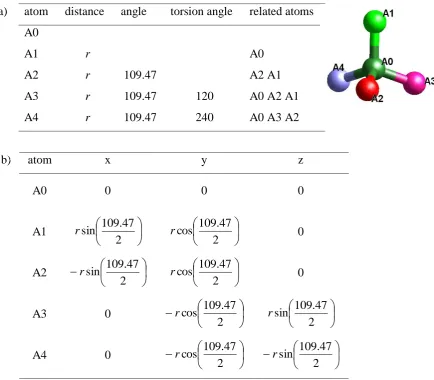
interatomic distances, angles and torsion angles. In the first column of a z-matrix,
starting with the second atom, the distance to a previously defined atom is given, in
the second column, starting from the third atom, an angle between the atoms and in
the third column, starting with the fourth atom, a torsion angle with respect to
previous defined cites is given (Leach, 2001). A comparison of the two possible
descriptions of a RB for a tetrahedron is given in Table 3.1 (Dinnebier & Müller,
2012).
During a phase transition the orientation and position of a RB within a crystal
structure might change. In order to follow such changes the up to six position and
orientation parameters of the RB need to be followed within refinement of a series of
in-situ powder diffraction data. This can be performed for simple structures, though,
for more complex ones, a different approach reducing the number of parameters even
further can be beneficial. Furthermore the interatomic distances and angles within the
RB might change so that they need to be analysed as well.
In order to facilitate and enhance the analysis of rigid body rotations during a phase
transition, a symmetry adapted parameter set was developed. The new parameter set,
which is denoted as rigid body symmetry modes, combines features of rigid bodies
and symmetry modes. In this method, the orientation and position of a RB is given by
a rotational vector. In general, both, rotational and displacive vectors can be used to
describe a crystal structure, though the intrinsic tensor properties are different. An
one, which leads to different behaviour with respect to symmetry elements. However
it can be shown that intrinsic and extended rigid body rotations can be described
within traditional crystallographic space groups (Müller et al., 2013).
Table 3.1: Comparison of different RB descriptions of a tetrahedron composed of five atoms using a) z-matrix notation and b) Cartesian coordinates. The distance between two neighbouring atoms is r. The angle of 109.47° is the typical tetrahedron angle.
b) atom x y z
A0 0 0 0
A1
2 47 . 109 sin r 2 47 . 109 cos r 0
A2
2 47 . 109 sin r 2 47 . 109 cos r 0
A3 0
2 47 . 109 cos r 2 47 . 109 sin r
A4 0
2 47 . 109 cos r 2 47 . 109 sin r
3.1.3 The theory of phase transitions (Landau theory)
A phase transition within a material is characterized by a discontinuous change of at
least one material property (e.g. density, elasticity, magnetic and electric properties or
crystal structure). Throughout the work of this thesis, different structural phase
transitions with different mechanisms were studied.
a) atom distance angle torsion angle related atoms
A0
A1 r A0
A2 r 109.47 A2 A1
A3 r 109.47 120 A0 A2 A1
The type of structural change can be used to distinguish structural phase transition
into different classes. During a reconstructive phase transition, atomic bonds are
broken and/or build. The crystal structure can change completely; therefore this
process cannot be continuous. A contrast to such transitions is the displacive
transition. During a displacive phase transition, atomic positions change continuously.
A third type of transitions is the order-disorder transition, which is characterized by a
change in atomic positions between an ordered arrangement and a less ordered
arrangement.
In another classification all phase transitions, which are accompanied by a change in
the point group symmetry are called ferroic. A ferroic distortion can be further
classified as ferroelastic if it changes the shape of the unit cell in such a way as to
alter the crystal system (Wadhawan, 1982).
In 1933, Ehrenfest (Ehrenfest, 1933) developed a classification of phase transitions
which is based on the thermodynamic free energy G (also known as Gibbs energy).
Transitions which are characterized by a jump of the first derivative of the
thermodynamic free energy G are called first-order. In case of second-order
transitions, volume and entropy change continuously, though the second derivative of
the Gibbs free energy G exhibits a jump (Müller, 2012). Nowadays, phase transitions
are distinguished in discontinuous and continuous transitions, whereupon still the
phrase “first-order transition” is used for discontinuous transitions and “second-order
transition” for continuous transitions. In case of a discontinuous or hysteretic
transition, the order parameter and the entropy jump at the transition point, while in
case of a continuous transition, they change smoothly, requiring that another
thermodynamic function is discontinuous (Müller, 2012).
In order to describe phase transitions, Landau developed a phenomenological theory
(Landau, 1937). Based on the precondition that there is a group-subgroup relation
between the HS and LS structure, a thermodynamic variable needs to exist in order to
describe the thermodynamic state of the LS phase (Salje, 1990). Therefore a new
variable was introduced: the order parameter Q. The energy difference of the Gibbs
energy, which stabilises the LS phase, is thus dependent on the usual parameters
The order parameter decreases continuously to zero at a second-order phase transition,
whereas an order parameter can abruptly "jump" at a first-order transition. In case of a
temperature dependent phase transition, the order parameter Q can be modelled by an
empirical power law of the form:
T T f
Q crit (3.2)
where Tcrit is the transition temperature, β6 is the critical exponent, and f is a prefactor.
Typical values of β are ½ for ordinary scalar second-order transitions, or ¼ for a
transition at the tricritical point that marks the boundary between first- and
second-order transitions. Values between ¼ and ½ might be obtained for a variety of reasons
(Salje, 1990; Cowley, 1980).
The Landau critical exponent is derived by calculating the first derivative of the
Taylor series expansion of a truncated Gibbs energy with respect to the order
parameter and setting it to zero (Landau, 1937; Müller, 2012):
0 Q G
. (3.3)
This approach is correct for small values of Q (close to Tcrit), though it has proven to
be applicable in a larger range. A truncation of the Taylor series is possible, if the last
term has a positive prefactor, which guarantees that an increase in Q leads to an
increase in G (Müller, 2012).
Within the Taylor series of G (also known as Landau potential) only even power
terms are allowed as G must be positive, independent from the sign of Q, in case of a
continuous phase transition (Müller, 2012):
6 4 2 0 6 1 4 1 2 1 CQ BQ AQ G
G . (3.4)
6β
For temperatures above Tcrit a minimum is given for the trivial solutionQ0. Below
Tcrit a minimum will be present atQ0, so the dependence of the prefactors A, B and
C on temperature must be evaluated. The factor A is the most important one, it need
to be zero at the transition temperature Tcrit, above Tcrit it must be positive, and below
negative. The simplest solution, which fulfils the above requirements, is a linear
dependency:
) (T Tcrit k
A with k 0. (3.5)
Assuming B to beB0, C can be set to zero as its influence in this case is negligible. Under these conditions, the Landau potential is reduced to its 2nd and 4th order terms,
which is called 2-4 potential (Salje, 1990; Müller 2012):
4 2 0 4 1 2 1 BQ AQ G
G . (3.6)
Taking the derivative leads to:
0 3 BQ AQ Q G (3.7)
and Q(ABQ2)0. (3.8)
The trivial solution is Q0for T > Tcrit. Otherwise the solution is: 2
Q B A
. (3.9)
Using equation (3.5) for A, the following result for T < Tcrit will be obtained:
Q 2
1
)
(T Tcrit
B
k
or more general 2
1
) (T Tcrit
f
Q , (3.10)
which proves that the critical exponent β = ½ for a second-order phase transition
In a similar way it can be shown that in case of a tricritical (also called “weakly”
first-order) transition a value of ¼ is obtained (Salje, 1990). In this case the same
behaviour of A is assumed, though B is assumed to be not positive, and therefore is set
to zero. This requires using the 6th order term with C > 0. The resulting potential is
denoted as 2-6 potential (Salje, 1990; Müller, 2012):
6 2 0 6 1 2 1 CQ AQ G
G . (3.11)
As for the previous case, the derivative needs to be taken and the following equations
are obtained: 0 5 CQ AQ Q G (3.12) 0 ) (ACQ4
Q . (3.13)
Using equation (3.5) for A, solutions of equation (3.13) are:
0
Q for T > Tcrit and
4 1
4 (T Tcrit)
C k
Q or more general 4
1 ) (T Tcrit f
Q . (3.14)
So for a tricritical phase transition the critical exponent β is equal to ¼.
It has also been shown that non-standard critical exponents β obtained from fits over
extended temperature ranges are often due to temperature-dependent
energy-expansion coefficients of order four or higher and have nothing at all to do with
critical phenomena (Giddy et al., 1989; Radescu et al., 1995).
As Landau theory can describe ferroic phase transitions, an equation based on
equation (3.2) was used in sequential and parametric Rietveld refinements in order to
model the behaviour of parameters in dependence on an external variable.
3.2 The first-order phase transition of CsFeO2
The work presented in this chapter was published in: Melanie Müller, Robert E.
Dinnebier, Naveed Z. Ali, Branton Campbell and Martin Jansen: Direct Access to the
Order Parameter: Parameterized Symmetry Modes and Rigid Body Movements as a
Function of Temperature. Materials Science Forum (Extending the Reach of Powder
Diffraction Modelling) (2010) 651, 79-95.
Sample synthesis was performed by Naveed Zafar Ali (formerly Max Planck Institute
for Solid State Research). The synchrotron measurements were performed by Denis
Sheptyakov from Laboratory for Neutron Scattering, ETH Zürich (Switzerland) and
PSI Villigen (Switzerland).
3.2.1 Introduction
The first-order phase transition of CsFeO2 was investigated using in-situ synchrotron
powder diffraction data measured in dependence on temperature. Two alternative
approaches were used to describe the deviation of the framework crystal structure
relative to the high symmetry parent structure: symmetry modes (SM) and rigid body
(RB) parameters. In both cases, the relevant parameters were refined as a function of
temperature using the method of parametric Rietveld refinement (Müller et al., 2010).
3.2.1.1 The compound CsFeO2
CsFeO2 belongs to the group of alkali metal oxoferrats(III) with composition AFeO2.
Those compounds as well as other oxoferrates(III) of light alkali metals are
structurally closely related to the group of oxosilicates due to the predominance of
tetrahedral coordination of Fe(III) (Frisch & Röhr, 2005). Most of the alkali metal
oxoferrats(III) crystallise in structures which can be derived from a stuffed
β-cristobalite structure, so they are members of the structure family of feldspars (Nuss et
At ambient conditions, CsFeO2 crystallises in the orthorhombic space group Pbca.At
about 80°C, it undergoes a first-order phase transition to the cubic space group
m
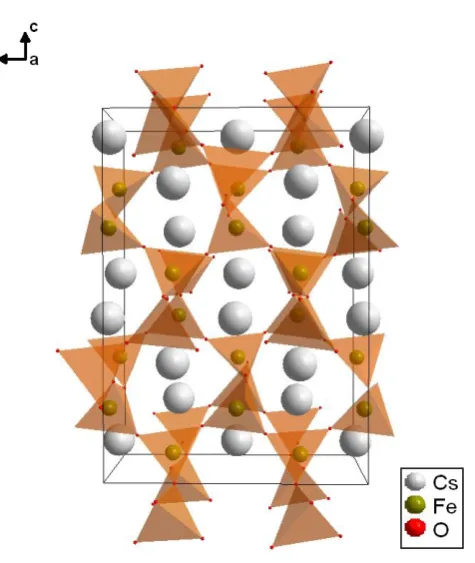
Fd3 (Ali et al., 2010). The LS crystal structure is shown in Figure 3.1. Within the HS cubic structure the Fe-O tetrahedra are arranged in a more ordered way. The
difference between the arrangements can be seen in Figure 3.2.
Figure 3.2: Arrangement of six connected Fe-O tetrahedra within the low symmetry orthorhombic (a) and high symmetry cubic (b) structures of CsFeO2. Within the LS structure the tetrahedra are twisted with respect to each other.
3.2.2 Experimental
3.2.2.1 Material synthesis
Sample preparation was performed following the azide/nitrate route (Trinschek &
Jansen, 1999; Sofin et al., 2002) using cesium nitrate (CsNO3), cesium azide (CsN3)
and active iron oxide (Fe2O3) according to the following equation:
5 CsN3 + CsNO3 + 3Fe2O3 → 6 CsFeO2 + 8 N2 . (3.15)
The preparation process was described by Ali et al. (2010). After grinding the
appropriate amount of the starting materials (see equation (3.15)), the obtained
powder was pressed into pellets under nitrogen pressure. These pellets were dried in
vacuum at 127°C and given into a steel vessel with silver inlet under argon
atmosphere. Following a suitable temperature profile (Ali et al., 2010), a powdered
sample was obtained, which is sensitive to humidity and thus must be handled in inert
3.2.2.2 Measurement
For temperature dependent in-situ powder diffraction measurements, the material was
sealed into a Hilgenberg quartz-glass capillary with a diameter of 0.3 mm.
Measurements were performed at the Materials Sciences (MS-Powder) beamline of
the Swiss Light Source using synchrotron radiation at a wavelength of 0.49701 Å.
The powder sample was heated from 30 – 136°C with steps of 1K using a STOE
capillary furnace. The diffraction patterns were collected using a Microstrip
Mythen-II detector with an acquisition time of 40 seconds for each pattern (4 scans of 10
seconds each) in the angular range from 3.0° – 53.38° 2θ.
3.2.3 Method and Results
Two different models were used for structural description during the phase transition
from orthorhombic to cubic CsFeO2. The first approach, which was applied, is the
symmetry mode approach, which will be denoted as SM. In order to obtain the
required information to do the symmetry mode Rietveld refinements, CIFs of the HS
m
Fd3 and LS Pbca phases were subjected to the ISODISTORT software to perform an automatic symmetry mode decomposition of the low symmetry distorted structure
into modes of the high symmetry cubic parent.
The cubic phase contains in total 32 atoms in the conventional face-centred unit cell,
which do not have any general atomic coordinates, so all atoms are placed on special
Wyckoff positions. In the orthorhombic phase, however, there are 24 free atomic
coordinates. Because the symmetry mode basis is related to the traditional atomic
coordinate basis by a linear transformation, there must also be 24 displacive
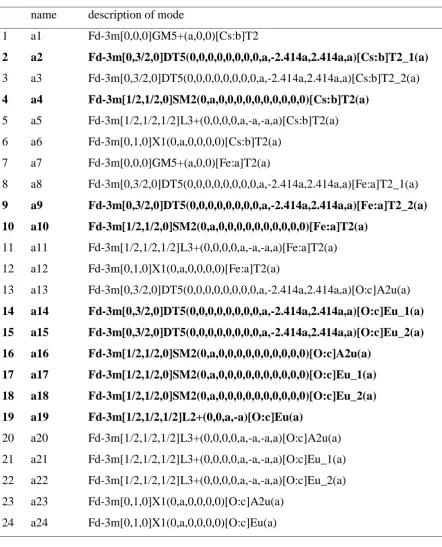
symmetry modes (Müller et al., 2010). A list of all modes is given in Table 3.2. Table
3.2 contains number, name and description of each symmetry mode. Within the mode
name the parent space group symmetry, the k-point (the point in reciprocal space that
will get intensity if the mode is activated), the space group irrep label and order
parameter direction (dictates which space group symmetry operations are preserved
the point-group symmetry (dictates which site symmetry operations are preserved by
the mode) and the order parameter branch are given (Campbell et al., 2006).
Furthermore these results are saved in form of a set of linear equations, which can be
used in Rietveld refinement.
In order to describe the phase transition the mode amplitudes of ten out of the 24
displacive symmetry modes need to be refined, while the others are set to zero. The
following modes were used in refinement (see Table 3.2): two (a2 and a4) for caesium,
two (a9 and a10) for iron and six (a14, a15, a16, a17, a18 and a19) for oxygen. The a2
-mode affects the y-coordinates of both caesium atoms, while a4 only affects the x
-coordinate of Cs2. The a9 mode influences the y-coordinate of the Fe1 and Fe2 atoms,
while the a10 mode influences only the x-coordinate of the Fe1 atom. The combination
of the oxygen modes a14 to a19 describes the rotation of the FeO4 tetrahedron, which
should not be substantially distorted (Müller et al., 2010).
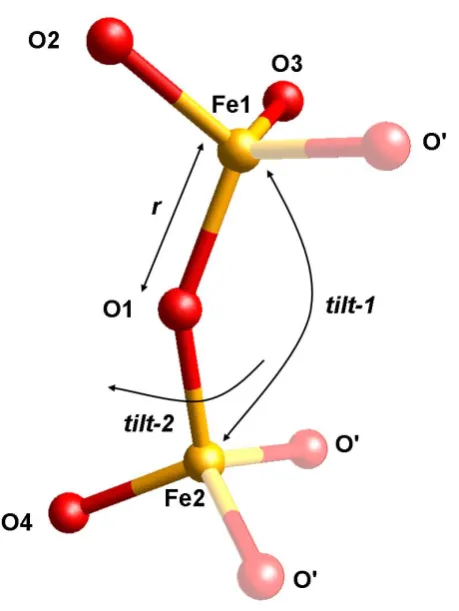
Furthermore the crystal structure of CsFeO2 was described using rigid bodies. In order
to do so, a RB which can describe the LS and HS crystal structure was developed. It is
built of two corner sharing FeO4 tetrahedra, which can be tilted with respect to each
other. The RB consists of two iron and four oxygen atoms, the other atoms, needed to
complete the tetrahedra, are generated by space group symmetry (Müller et al., 2010).
Within the RB, there are three internal degrees of freedom: two tilting angles and the
average interatomic distance r. The two tilt angles are (1) the Fe1-O1-Fe2 (tilt-1)
bond angle and (2) the O4-Fe2-O1-Fe1 torsion angle (tilt-2) between the two
tetrahedra. The RB and the corresponding tilt angles are shown in Figure 3.3. The
Table 3.2: Symmetry-adapted distortion modes available to the ferroelastic phase transition of CsFeO2 from ̅ to Pbca symmetry. The ten modes that were
actually used for Rietveld refinements appear in bold.
name description of mode
1 a1 Fd-3m[0,0,0]GM5+(a,0,0)[Cs:b]T2
2 a2 Fd-3m[0,3/2,0]DT5(0,0,0,0,0,0,0,0,a,-2.414a,2.414a,a)[Cs:b]T2_1(a)
3 a3 Fd-3m[0,3/2,0]DT5(0,0,0,0,0,0,0,0,a,-2.414a,2.414a,a)[Cs:b]T2_2(a)
4 a4 Fd-3m[1/2,1/2,0]SM2(0,a,0,0,0,0,0,0,0,0,0,0)[Cs:b]T2(a)
5 a5 Fd-3m[1/2,1/2,1/2]L3+(0,0,0,0,a,-a,-a,a)[Cs:b]T2(a)
6 a6 Fd-3m[0,1,0]X1(0,a,0,0,0,0)[Cs:b]T2(a)
7 a7 Fd-3m[0,0,0]GM5+(a,0,0)[Fe:a]T2(a)
8 a8 Fd-3m[0,3/2,0]DT5(0,0,0,0,0,0,0,0,a,-2.414a,2.414a,a)[Fe:a]T2_1(a)
9 a9 Fd-3m[0,3/2,0]DT5(0,0,0,0,0,0,0,0,a,-2.414a,2.414a,a)[Fe:a]T2_2(a)
10 a10 Fd-3m[1/2,1/2,0]SM2(0,a,0,0,0,0,0,0,0,0,0,0)[Fe:a]T2(a)
11 a11 Fd-3m[1/2,1/2,1/2]L3+(0,0,0,0,a,-a,-a,a)[Fe:a]T2(a)
12 a12 Fd-3m[0,1,0]X1(0,a,0,0,0,0)[Fe:a]T2(a)
13 a13 Fd-3m[0,3/2,0]DT5(0,0,0,0,0,0,0,0,a,-2.414a,2.414a,a)[O:c]A2u(a)
14 a14 Fd-3m[0,3/2,0]DT5(0,0,0,0,0,0,0,0,a,-2.414a,2.414a,a)[O:c]Eu_1(a)
15 a15 Fd-3m[0,3/2,0]DT5(0,0,0,0,0,0,0,0,a,-2.414a,2.414a,a)[O:c]Eu_2(a)
16 a16 Fd-3m[1/2,1/2,0]SM2(0,a,0,0,0,0,0,0,0,0,0,0)[O:c]A2u(a)
17 a17 Fd-3m[1/2,1/2,0]SM2(0,a,0,0,0,0,0,0,0,0,0,0)[O:c]Eu_1(a)
18 a18 Fd-3m[1/2,1/2,0]SM2(0,a,0,0,0,0,0,0,0,0,0,0)[O:c]Eu_2(a)
19 a19 Fd-3m[1/2,1/2,1/2]L2+(0,0,a,-a)[O:c]Eu(a)
20 a20 Fd-3m[1/2,1/2,1/2]L3+(0,0,0,0,a,-a,-a,a)[O:c]A2u(a)
21 a21 Fd-3m[1/2,1/2,1/2]L3+(0,0,0,0,a,-a,-a,a)[O:c]Eu_1(a)
22 a22 Fd-3m[1/2,1/2,1/2]L3+(0,0,0,0,a,-a,-a,a)[O:c]Eu_2(a)
23 a23 Fd-3m[0,1,0]X1(0,a,0,0,0,0)[O:c]A2u(a)
Figure 3.3: Rigid body consisting of the Fe-O double tetrahedron in CsFeO2 exhibiting three internal parameters: r, tilt-1 and tilt-2. Solid atoms are implemented into the program; semitransparent atoms are generated due to space group symmetry.
Table 3.3: Z-matrix description of the crystallographically independent atoms of the Fe2O7 rigid body. The three internal refinable parameters (tilt-1, tilt-2 and r) are displayed in bold.
atom distance angle torsion angle related atoms
O1
Fe1
O2
O3
Fe2
O4
r
r
r
r
r
109.47
109.47
tilt-1
109.47
120
180
tilt-2
O1
Fe1 O1
Fe1 O2 O1
O1 Fe1 O2
For Rietveld refinement, the orientation and position of the RB relative to the internal
coordinate system of the crystal were kept constant over the entire temperature range
of investigation and only the three internal degrees of freedom were subjected to
refinement. As the two caesium atoms in the voids of the framework are independent
of the RB, their crystallographically relevant atomic coordinates were refined
separately (Müller et al., 2010).
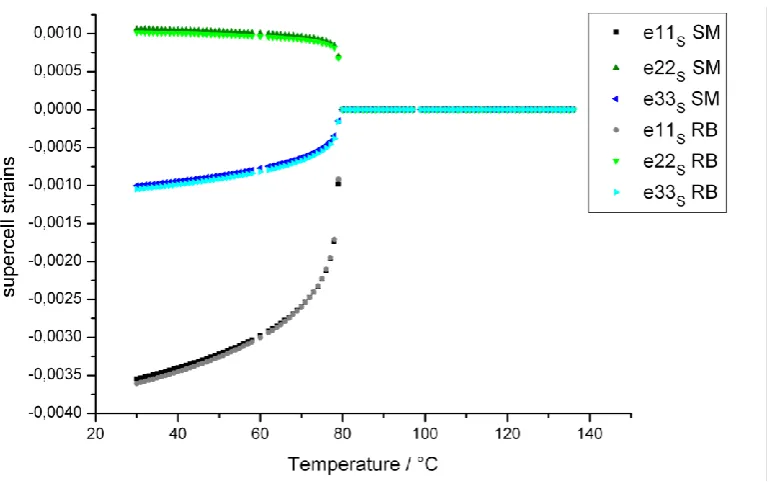
The behaviour of the lattice parameters in dependence on temperature was described
using lattice strain. Strain is a symmetric second rank tensor which is represented by a
33 matrix. In case of orthorhombic symmetry (actual supercell) it reduces to a diagonal matrix with the following diagonal elements:
⁄√ (3.16)
√ (3.17)
(3.18)
with the lattice parameters of the supercell as, bs, cs and the isothermal lattice
parameters as0, bs0 and cs0. The isothermal lattice parameters can be given as well in
dependence on the isothermal lattice parameters of the cubic parent cell ap0.
The same description can be used in dependence on the cubic parent cell. In this case,
strain is represented by a diagonal matrix with e11p e22p e33p and
0
13 23
12p e p e p
e (Müller et al., 2010).
Upon formation of the ferroelastic strain, the parent cell becomes a pseudo-cubic
monoclinic cell defined by three independent order parameters that we will denote by
, where indicates one of three strain mode irreps: 1, 3 and 5. The 1 mode
causes a thermal expansion. The 3 mode affects the ratio of the lattice parameters a
and b with respect to the lattice parameter c. And the 5 mode results in a monoclinic
shear that changes the parent lattice angle γ and gives rise to a non-zero e12 strain
In the coordinate system of the parent cell, the relationship