University of Trento
CIMeC Doctoral School in Cognitive and Brain Sciences
Track Language, Interaction and Computation
Learning the Meaning of Quantifiers
from Language and Vision
Sandro Pezzelle
Supervisor:
Raffaella Bernardi
Submitted in partial fulfillment of the requirements for the degree of
Doctor of Philosophy in Cognitive and Brain Sciences
Abstract
Sandro Pezzelle
Defining the meaning of vaguequantifiers (‘few’, ‘most’, ‘all’) has been, and still is,
the Holy Grail of amare magnum of studies in philosophy, logic, and linguistics. The
way by which they are learned by children has been largely investigated in the realm
of language acquisition, and the mechanisms underlying their comprehension and
pro-cessing have received attention from experimental pragmatics, cognitive psychology,
and neuroscience. Very often their meaning has been tied to that of numbers, amounts,
and proportions, and many attempts have been made to place them on ordered scales.
In this thesis, I study quantifiers from a novel, cognitively-inspired computational
per-spective. By carrying out several behavioral studies with human speakers, I seek to
answer several questions concerning their meaning and use: Is the choice of
quanti-fiers modulated by the linguistic context? Do quantiquanti-fiers lie on a mental,
semantically-ordered scale? Which are the features of such a scale? By exploiting recent advances
in computational linguistics and computer vision, I test the performance of state-of-art
neural networks in performing the same tasks and propose novel architectures to model
speakers’ use of quantifiers in grounded contexts. In particular, I ask the following
questions: Can the meaning of quantifiers be learned from visual scenes? How does
this mechanism compare with that subtending comparatives, numbers, and proportions?
The contribution of this work is two-fold: On the cognitive level, it sheds new light
on various issues concerning the meaning and use of such expressions, and provides
experimental evidence supporting the validity of the foundational theories. On the
com-putational level, it proposes a novel, theoretically-informed approach to the modeling
of vague and context-dependent expressions from both linguistic and visual data. By
carefully analyzing the performance and errors of the models, I show the effectiveness
of neural networks in performing challenging, high-level tasks. At the same time, I
highlight commonalities and differences with human behavior.
Acknowledgements
My first, most heartfelt thanks are for my supervisor Raffaella Bernardi31. At the
be-ginning of the journey, she told me: Doing research is like running, it’s a lot more fun
if you do it with someone. She was right, running with her was the best training ever.
Thanks, Raffa, for the constant and wise guidance through good and bad moments,
suc-cesses and failures. It is the backbone of this work. I am very grateful to the members of
my Oversight Committee Manuela Piazza, Roberto Zamparelli6and Marco Baroni5for
their invaluable feedback and support, and to the reviewers Judith Degen, Lucia Specia,
and Jakub Szymanik for their precious comments and observations. Thanks to Leah
Mercanti and the Doctoral Program Committee for making CIMeC a great place.
In these years, I was incredibly lucky to
work with many amazing researchers. I
am particularly grateful to Aur´elie Herbelot2,
Ionut Sorodoc, Ravi Shekhar, and Marco
Marelli for the cheek-to-cheek working
hours, the outstanding discussions, the
last-minute rushes. Thanks a lot to Gemma
Boleda4, Angeliki Lazaridou8, Moin Nabi,
Shane Steinert-Threlkeld, Jakub Szymanik,
Germ´an Kruszewski7, Raquel Fern´andez,
De-nis Paperno1, Nghia The Pham10, Enver
Sangineto, Tassilo Klein, Francesca Franzon, Chiara Zanini, Addison Smith, Claudio
Greco, Alberto Testoni, Alexander Kuhnle, Rossella Varvara. Thanks to the SAP
Ma-chine Learning team, working with you all was a great experience.
Thanks to the members of the ‘Gilda club’ Marta Mangiarulo, Flavio Ragni, Addison
Smith, Ionut Sorodoc, and Simone Vigan`o for the pizza-pasta combo, the political
fo-rums, the ping-pongdebacles. You became more than friends. Thanks to Mirko Broilo,
Alessia De Felice, Carola Canella, Luca Ducceschi, Demetrio Ferro, Marco Pagani,
Mariagrazia Popeo, Ben Timberlake for making Rovereto (and indievano) so special.
Last but not least, I would like to saygrazieto mamma, pap`a, Annica, and Marco. To
my second parents Egle and Rino, and my longtime friends Andrea, Marco, Salvo for
being always there. Thanks to Alice. You keep smiling, we go far.
1Some people have a number in subscript. This is because they are in the picture! To find who is who,
count them clockwise starting from the left-most standing person. Hint: the ninth is me.
Publications
This thesis collects several articles which have been published during my PhD. As such,
most of the contents of this thesis have appeared in the following publications:
• Pezzelle, S., Steinert-Threlkeld, S., Bernardi, R., & Szymanik, J. (2018). Some
of them can Be Guessed! Exploring the Effect of Linguistic Context in
Predict-ing Quantifiers. In Proceedings of the 56th Annual Meeting of the Association
for Computational Linguistics (Volume 2: Short Papers)(Vol. 2, pp. 114–119).
(Chapter3)
• Pezzelle, S., Bernardi, R., & Piazza, M. (2018). Probing the mental representation
of quantifiers.Cognition, 181, 117–126. (Chapter4)
• Pezzelle, S., Marelli, M., & Bernardi, R. (2017). Be Precise or Fuzzy: Learning
the Meaning of Cardinals and Quantifiers from Vision. In Proceedings of the
15th Conference of the European Chapter of the Association for Computational
Linguistics: Volume 2, Short Papers, (Vol. 2, pp. 337–342). (Chapter5)
• Pezzelle, S., Sorodoc, I. T., & Bernardi, R. (2018). Comparatives, Quantifiers,
Proportions: a Multi-Task Model for the Learning of Quantities from Vision. In
Proceedings of the 2018 Conference of the North American Chapter of the
Asso-ciation for Computational Linguistics: Human Language Technologies, Volume 1
(Long Papers)(Vol. 1, pp. 419–430). (Chapter6)
Moreover, some excerpts have appeared in the following publication:
• Sorodoc, I., Pezzelle, S., Dimiccoli, M., Herbelot, A., & Bernardi, R. (2018).
Learning quantification from images: A structured neural architecture. Natural
Language Engineering, 24(3), 363–392. (Section2.6and2.7)
Sar`a che nei tuoi capelli arruffati, nella tua barba scompigliata e nella tua determinazione vorremmo vederci tutti un po’ riflessi. Sar`a perch´e uno slogan, uno soltanto, ce l’abbiamo pure noi. E lo urliamo in silenzio, a testa alta.
Verit`a per Giulio Regeni
Contents
Abstract i
Acknowledgements iii
1 Introduction 1
2 Theoretical Framework 7
2.1 Formal Semantics: Relations between Sets . . . 7
2.2 Pragmatics: Scalar Implicatures . . . 9
2.3 Quantifiers, Quantities, and Contextual Effects. . . 10
2.4 Quantifiers and the Brain . . . 12
2.5 Quantifiers Grounded in Vision . . . 14
2.6 Modeling Quantifiers: Computational Linguistics . . . 16
2.7 Modeling Quantities: Computer Vision. . . 17
3 Quantifiers and Linguistic Contexts 21 3.1 Introduction . . . 21
3.2 Related Work . . . 23
3.3 Datasets . . . 24
3.4 Human Evaluation . . . 25
3.4.1 Method . . . 25
3.4.2 Linguistic Analysis . . . 26
3.5 Models . . . 28
3.7 Discussion. . . 33
3.7.1 Context Dependence . . . 33
3.7.2 Mental Scale . . . 33
4 Probing the Quantifier Scale: Two Behavioral Studies 35 4.1 Introduction . . . 35
4.2 Methods . . . 39
4.2.1 Grounded Task: Quantifiers Used in Perception . . . 39
4.2.2 Abstract Task: Semantic Similarity Judgements . . . 43
4.3 Analysis and Results . . . 43
4.3.1 Grounded Task: Quantifiers Used in Perception . . . 43
4.3.2 Abstract Task: Semantic Similarity Judgements . . . 49
4.4 Discussion. . . 51
4.4.1 Visually-Grounded Representation . . . 51
4.4.2 Abstract Representation . . . 53
4.4.3 Mental Order . . . 54
4.4.4 Impact of our Results on Foundational Theories . . . 55
4.4.5 Final remarks . . . 56
5 Quantifiers vs Cardinals: Two Computational Mechanisms 57 5.1 Introduction . . . 57
5.2 Data . . . 60
5.2.1 Building the Scenarios . . . 61
5.2.2 Datasets . . . 61
5.3 Experiments . . . 62
5.3.1 Only-Vision Evaluation. . . 62
5.3.2 Cross-Modal Mapping . . . 63
5.4 Results. . . 65
5.5 Discussion. . . 66
5.5.1 Two Mechanisms . . . 66
5.5.2 One Expression, One Model . . . 66
5.5.3 Limitations . . . 67
6 A Multi-Task Model for Learning Quantity Expressions from Vision 69 6.1 Introduction . . . 69
6.2 Related Work . . . 72
6.2.1 Quantities in Language & Vision. . . 72
6.2.2 Multi-Task Learning . . . 73
6.3 Tasks and Dataset . . . 74
6.3.1 Tasks . . . 74
6.3.2 Dataset . . . 75
6.4 Models . . . 77
6.4.1 One-Task Models . . . 77
6.4.2 Multi-Task Model . . . 78
6.5 Results. . . 79
6.6 In-Depth Evaluation. . . 82
6.6.1 Absolute Numbers in the Loop . . . 82
6.6.2 Reversing the Architecture . . . 83
6.6.3 Does MTL Generalize? . . . 83
6.7 Discussion. . . 85
6.7.1 Ratio-Based Mechanisms. . . 85
6.7.2 Quantifiers vs Numbers. . . 85
7 Conclusion 87
Bibliography 89
List of Tables
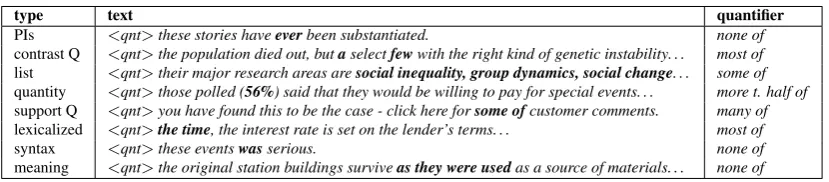
3.1 Cues that might help human participants to predict the correct quantifier (1-Sent). . . 25
3.2 Examples of cases that are correctly guessed in 3-Sent (but not in
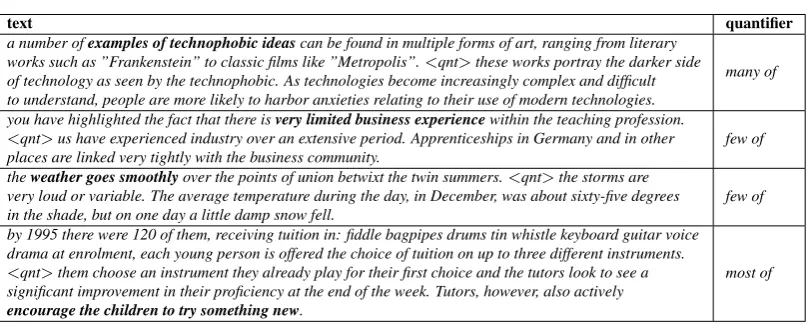
1-Sent). Linguistic context that appears to be particularly helpful to retrieve the correct quantifier is inbold. . . 27
3.3 Accuracy of models and humans. Values inboldare the highest in the column. *Note that due to an imperfect balancing of data, chance level for humans (computed as majority class) is0.124. . . 29
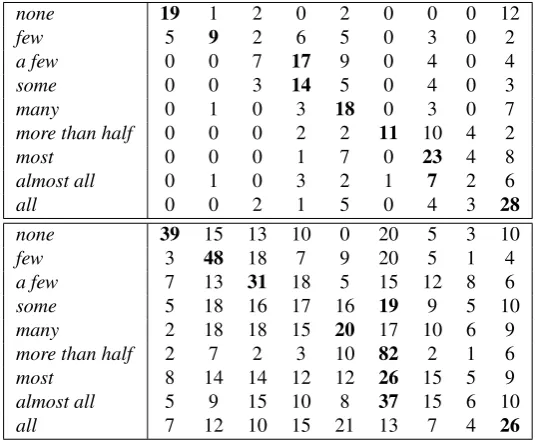
3.4 Responses by humans (top) andAttCon-LSTM(bottom) in 3-Sent
(val). Values inboldare the highest in the row. . . 31
4.1 Descriptive statistics. Columns are sorted with respect to ascending pro-portion of targets (b), which also corresponds to ascending cardinality of targets (c). Values in brackets refer to SD. . . 44
4.2 AIC scores for each of the models. Bold values (lowest) correspond to best models. Empty cells indicate cases for which the number of datapoints was too low to perform statistical analyses. . . 46
4.3 Estimate, z-value and p-value of the quadratic term for each of the best models. . . 47
4.4 AIC score, estimate, z-value and p-value of the quadratic term (linear term for ‘almost all’) for each of the best models in the subitizing range. 48
5.1 Combinations in Train and Test. . . 62
5.2 mAPandP2for each model. . . 65
5.3 Left: Q nn-cos, retrieved cases in top-2 positions. Right: same for C nn-dot. . . 66
6.1 Number and partitioning of the datapoints. . . 76
absolute number of targets (nTarg). Values inboldare the highest. . . . 79
6.3 Unseen dataset. Performance of the models in each task. Values inbold
are the highest. . . 84
List of Figures
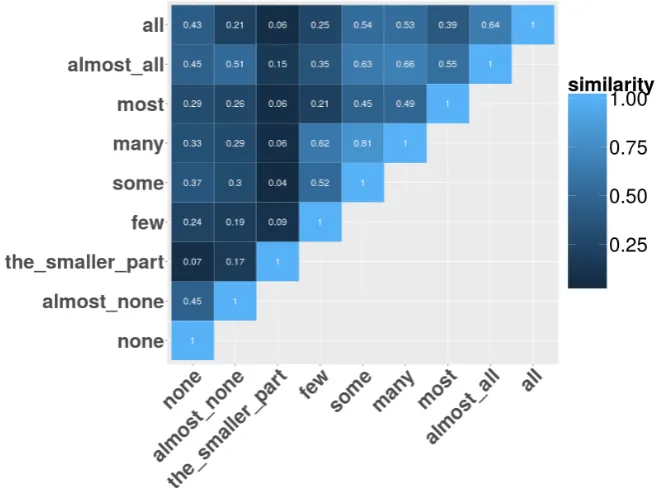
1.1 Heatmap reporting pairwise similarity between vectors of number words. 3
1.2 Heatmap reporting pairwise similarity between vectors of quantifier words. 4
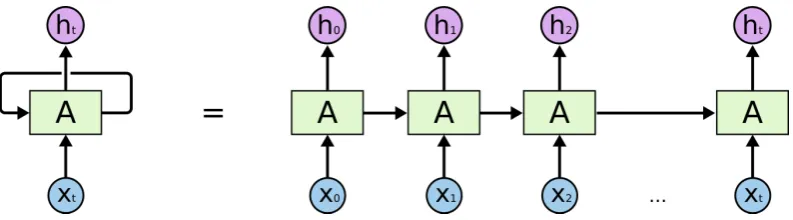
2.1 Schematic representation of an unrolled Recurrent Neural Network (RNN). 16
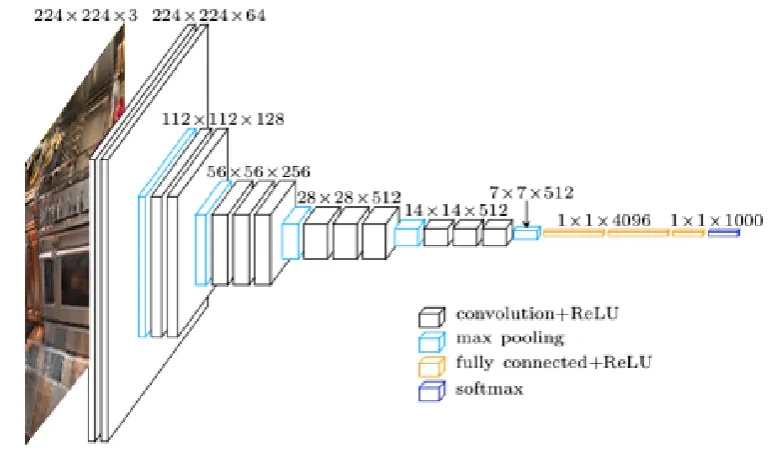
2.2 Schematic representation of VGG-16 (Simonyan and Zisserman,2014), one of the most popular Convolutional Neural Networks (CNNs) for image feature extraction. . . 18
3.1 Given a target sentencest, or st with the preceding and following
sen-tence, the task is to predict the target quantifier replaced by<qnt>. . . 22
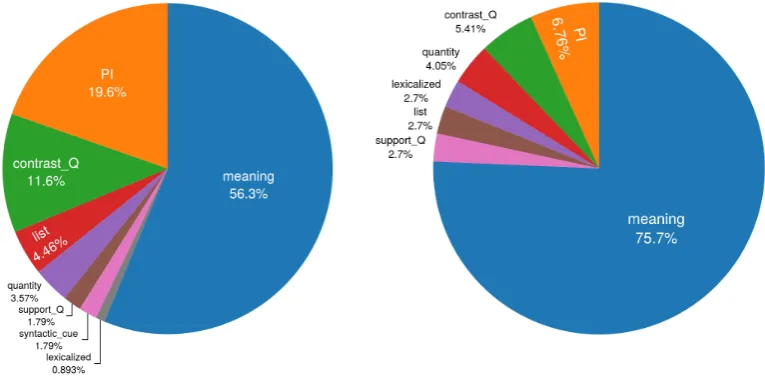
3.2 Left: Distribution of annotated cues across correcly-guessed cases in
1-Sent (112 cases). Right: Distribution of cues across correctly-guessed cases in3-Sent, but not in1-Sent(74 cases). . . 26
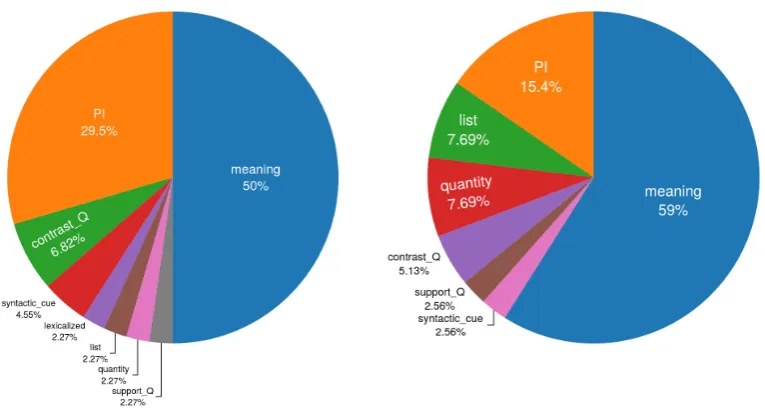
3.3 Human vs AttCon-LSTM accuracy (val) across quantifiers, loosely ordered by magnitude. . . 30
3.4 Left: Distribution of cues exploited by AttCon-LSTM across cases correctly-guessed by speakers in1-Sent(44 cases). Right: Distribu-tion of cues across cases correctly-guessed by speakers in3-Sent(39 cases). . . 32
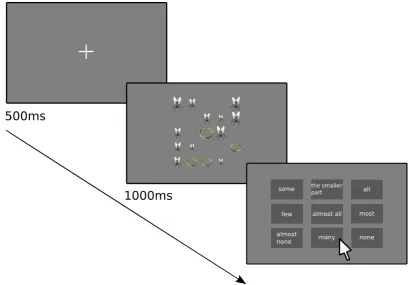
4.1 Schematic representation of the experiment. After a fixation cross of
500ms, a trial is presented for1,000ms. Then the participant is asked to click on the quantifier that better describes the scene. . . 40
4.2 One visual scene used in the experiment, representing a targets:non-targets ratio of1:3(i.e.25% of total items are targets). . . 42
4.3 Density plot reporting the frequency distribution of responses for the9
quantifiers (y-axis) against the proportion of targets in the scene (x-axis). 45
subitizing range (left) and exceeding it (right). . . 45
4.5 Heatmap reporting the average semantic similarity between quantifiers pairs. The lighter the blue, the more similar the pair. . . 49
4.6 Line plot reporting the average semantic similarity between quantifiers. 50
4.7 Plot reporting the absolute distance of quantifiers as resulting from a two-dimension metric MDS analysis.. . . 51
5.1 How many pets aredogs? Three/Most. Image credits: cvalleyvet.com . 58
5.2 Left: Qs against cosine distance. Right: Cs against dot product. . . 63
5.3 Left: Qs against dot product. Right: Cs against cosine distance. . . 64
5.4 One learning event of our proposed cross-modal mapping. Cosine is used for quantifiers (few), dot product for cardinals (two). . . 64
6.1 Toy representation of the quantification tasks and corresponding outputs explored in the chapter. Note that quantification always refers to animals (target set). . . 71
6.2 Two scenes included in our dataset. The letfmost one depicts a ratio1:4
(3animals,12artifacts,15total items), the rightmost one a ratio2:3(6,
9,15). . . 75
6.3 Architecture of themulti-task-propmodel jointly performing (a) set comparison, (b) vague quantification, and (c) proportional estimation. 78
6.4 PropTarg. Heatmap reporting the errors made by themulti-task-prop
model. Note that labels refer toratios, i.e. 14stands for ratio1:4(20% targets). . . 80
6.5 PCA visualization of the last layer (before softmax) of the proportional task in the MTL model. . . 81
6.6 VagueQ. Probability values predicted by themulti-task-propmodel against ground-truth probability distributions for each quantifier. . . 82
6.7 PropTarg. Heatmap with the errors made by themulti-task-prop
model in the unseen dataset. . . 85
Chapter 1
Introduction
A writer should have the precision
of a poet and the imagination
of a scientist.
VLADIMIRNABOKOV
There are many ways to communicate quantities. A football commentator, after yet
an-other goal by the visiting team, might notice that ‘Most of the supporters of the home
team are leaving the stadium’. Alternatively, he might state that ‘The home fans who
are leaving the stadium are seven thousands’ or that, ‘In the home fans area, there are
moreempty seats than occupied ones’. Similarly, he might say that ‘Three quarters(or
seventy-five percent) of the home fans are leaving before the game ends’. Though
refer-ring to the same event, these sentences convey different quantitative information. The
first, containing the quantifiermost, is rather ‘vague’: The supporters who are leaving
the stadium are likely more than half of the total and probably not all. The second, in
contrast, is very ‘precise’:1 We know the absolute numberof people who are leaving,
though we cannot infer whether they constitute the majority of the home fans or, rather,
just a small fraction. The third, by means of acomparative, gives us a precise (though
1A note on the terminology. In this thesis, the termvagueand the concept of ‘vagueness’ are used
to refer to quantifiers whose interpretation can be borderline and not generally-agreed (Van Deemter,
2012). Consistently, I do not consider quantifiers like ‘at most 5’ or ‘fewer than 8’ as vague since these expressions establish a clear-cut division between two sets of numbers, such that 7 is undoubtedly less than 8 (Van Deemter,2012). Similar reasons hold for numbers, comparatives, and proportions, that I therefore consider asprecise. As a general note, it is worth mentioning that vague expressions such as ‘few’ or ‘many’ are notambiguousas words like ‘bank’ or ‘pitcher’. While the latter have several, well-defined and different meanings, the former have a non-specific but single meaning (Tuggy,1993). I refer the reader toVan Deemter(2012) for a detailed discussion on vagueness and its relation with ambiguity.
rather coarse) answer to the previous question. The fourth, by specifying a fraction
(proportion), provides us with the exact percentage of disappointed supporters.
Being merely quantitative, the meaning of number words, comparatives, fractions and
proportions is straightforward. Being vague and context-dependent, the meaning of
quantifiers is not. The former are clearly ordered on quantitative scales: ‘one’, ‘two’,
‘three’; ‘less’, ‘same’, ‘more’; 10%, 50%, 90%. The latter are often claimed to be, but
both the existence and the nature of such a scale is highly debated (Holyoak and Glass,
1978;Routh,1994;Moxey and Sanford,2000). Indeed, the notion of a ‘quantifier scale’
has been largely investigated by psychological and psycholinguistic work aimed at
link-ing the meanlink-ing of these expressions to scales of numbers, amounts, proportions (see
Section2.3). Though generally shared among scholars, the intuition that quantifiers are
orderedterms (e.g. that ‘very few’ refers to something less than ‘few’) has been
repeat-edly shown to be more fragile than expected. For example,Moxey and Sanford(1993b)
demonstrated that anyquantitativedifference between the quantifiers ‘few’, ‘very few’,
‘only a few’, ‘not many’, and ‘a few’ disappears when participants are prevented from
comparing one expression against the others. To account for these results,Moxey and
Sanford (1993b) proposed that the difference between these expressions, rather than
quantitative, might be in theperspectivethey take to this information. Intuitively, this is
not the case for numbers or proportions, where an ordering between elements on solely
quantitative bases can always be found. Finally, the use of quantifiers has been shown
to also depend on the context (Degen and Tanenhaus,2015), expectations (Degen and
Goodman,2014), and individual differences among speakers (Yildirim et al.,2016).
One computational way to study the meaning of these expressions is using
Distribu-tional Semantics Models (DSMs) (Landauer and Dumais, 1997; Turney and Pantel,
2010;Baroni et al., 2014). Based on the hypothesis that similar words occur in similar
contexts (Harris,1954;Firth,1957), DSMs use largecorporaof texts to build meaning
representations that encode statistics on word associations and co-occurrences. In
stan-dard count DSMs, the meaning of a word is initially represented as a N-dimensional
vector encoding the raw frequency of the target word in each of the N contexts. The
vector is further reduced/transformed by means of various techniques such as Singular
Value Decomposition (SVD) to obtain a higher order semantic representation. A more
recent approach exploits neural networks topredict word vectors (embeddings) on the
basis of the surrounding words (Mikolov et al., 2013;Pennington et al.,2014). In both
approaches, the resulting vectors are typically used to compute the degree of semantic
operational-3
Figure 1.1: Heatmap reporting pairwise similarity between vectors of number words.
ized in terms of the cosine of the angle between the vectors: The closer the vectors, the
higher their semantic similarity.
If quantifiers are semantically-ordered expressions, we should expect a measure of
se-mantic similarity to be able to capture such a scale. For example, ‘none’ should be closer
to ‘few’ compared to ‘many’, as well as, among numbers, ‘two’ should be closer to
‘three’ than to ‘six’. The rationale is that, among ordered elements, items that are close
to each other on the scale are expected to be more semantically similar compared to
elements that are far. Here, I report the results of a proof-of-concept analysis performed
on 9 number words (from 0 to 8) and 9 quantifiers (the same explored in Chapter4and Chapter6). Word embeddings were obtained by training a state-of-the-artword2vec
model (Mikolov et al., 2013) on the same corpus2 and with the the best configuration
of parameters used inBaroni et al.(2014). Then, pairwise similarities were computed.
As can be seen in Figure1.1, the expected pattern is generally confirmed among num-bers. Except for ‘zero’, which turns out to be very dissimilar from all other elements,
increasing values from left to right (and from top to bottom) are observed for almost
all cases. For example, the similarity between ‘eight’ and the other numbers starts very
low (0.15 with ‘zero’) and slowly increases as soon as the numbers get higher: 0.5 with
‘one’, 0.7 with ‘two’, 0.79 with ‘three’, and so on. In contrast, the patterns of similarity
among quantifiers (Figure1.2) are much less straightforward: ‘all’ is closer to ‘none’
2The corpus was previously pre-processed to ensure that multi-word quantifiers (e.g. ‘the smaller
Figure 1.2: Heatmap reporting pairwise similarity between vectors of quantifier words.
(0.43) compared to ‘most’ (0.39), and ‘few’ is closer to ‘many’ (0.62) than to ‘almost
none’ (0.19). Though just exploratory, such analysis confirms that numbers and
quan-tifiers have a very different semantics. The former, perhaps except ‘zero’, display an
almost exclusively quantitative meaning and are thus well ordered on a numerical scale.
The latter, whose meaning is something more complex (and different) than numbers,
amounts, proportions (Nouwen, 2010) display a much intricate pattern of similarities,
possibly dependent on lexical-semantic besides quantitative factors.3
Coming back to our football commentator, it might be that his sentence ‘Most of the
supporters of the home team are leaving the stadium’ was not at all intended to tell us
something about the number of people disappointed by the match. Perhaps his
inten-tion was just to express the sadness of the moment, and although the supporters leaving
were just, e.g., one-fifth of the total, viewers at home were able to understand the
rea-sons of his exaggeration. However, a more pragmatically plausible option is that the
professional speaker wanted to reliably describe what was happening in the stadium,
and after rapidly seeing that significantly more than half of the home-fans seats were
empty, he said that to the microphone. If this was the case, the choice of using the
quantifier ‘most’ was aimed at communicating a somehow ‘objective’ quantity that was
3For example, there seems to be an effect ofantonymy, in a way that antonyms are generally similar
5
grounded in perception and, particularly, in vision. This possibility would be in line
with the evidence that quantifiers’ use, in visual contexts, is sensitive to quantitative
information (Coventry et al.,2010;Degen and Tanenhaus, 2015) and, more in general,
that quantity expressions are used and evaluated by speakers against real-life
scenar-ios (Heim et al.,2012).
In this thesis, I investigate vague, non-numerical quantifiers (‘none’, ‘few’, ‘almost all’,
‘many’, ‘all’, etc.) from a novel, cognitively-inspired computational perspective. By
carrying out several behavioral studies with human speakers, I seek to answer several
questions concerning their meaning and use: Is the choice of quantifiers modulated
by the linguistic context? Do quantifiers lie on a mental, semantically-ordered scale?
Which are the features of such a scale? By exploiting recent advances in computational
linguistics and computer vision, I test the performance of state-of-art neural networks in
performing the same tasks and propose novel architectures to model the speakers’ use
of quantifiers in grounded contexts. In particular, I ask the following questions: Can
the meaning of quantifiers be learned from visual scenes? How does this mechanism
compare with that subtending comparatives, numbers, and proportions? The
contribu-tion of this work, thus, is two-fold: On the cognitive level, it sheds new light on various
issues concerning the meaning and use of such expressions and provides
experimen-tal evidence supporting the validity of the foundational theories. On the computational
level, it proposes a novel, theoretically-informed approach to the modeling of vague
and context-dependent expressions from both linguistic and visual data. By carefully
analyzing the performance and errors of the models, I show their effectiveness in
per-forming challenging, high-level tasks while highlighting commonalities and differences
with human behavior.
In Chapter 3, I study the role of linguistic context in modulating the choice of 9 fre-quently used English quantifiers. Tested in the challenging task of predicting a missing
quantifier from either short or longer texts, humans and the models are shown to use
dif-ferent strategies, the former relying more on the information conveyed by the broader
context, the latter being more effective in exploiting lexical-semantic cues. Moreover,
both humans and the models make ‘plausible’ errors, that is, they are almost always able
to grasp the ‘magnitude’ of the missing quantifier. This supports the idea that quantifiers,
in language, are loosely ordered on some sort of quantitative scale. The characteristics
of such a scale are explored in Chapter4. By means of two behavioral experiments with human participants and a ‘balanced’ set of 9 Italian quantifiers, I show that quantifier
sim-ilar to that of perceptual quantities. Moreover, quantifiers turn out to be best predicted
by proportional information when used to refer to objects in visual scenes. Both
find-ings are in line with the idea that representations of quantifiers are mainly constructed by
mapping them to the representations of quantities that we derive from perception. Along
these lines, Chapter5explores the computational mechanisms underlying the learning of numbers and quantifiers from vision. I show that while numbers in the subitizing
range require a model including a precise identification of the instances to be counted,
quantifiers ‘no’, ‘few’, ‘most’, and ‘all’ are better learned by a model capitalizing on
a fuzzy measure of similarity. Building on all this converging evidence, in Chapter6I use the same visual stimuli and the same 9 quantifier words explored in Chapter4and propose that comparatives (‘more’), quantifiers (‘most’), and proportions (‘80%’) can
be jointly learned from visual scenes by means of a multi-task computational model.
The motivation is that these expressions are governed by the same cognitive
mecha-nism, which is different from that underlying numbers. By using I prove that sharing a
core mechanism is beneficial for all these tasks, while numbers are shown to require a
radically different operation.
In the next chapter, I briefly introduce the theoretical framework which motivates the
questions explored in this work. While each of the following chapters is accompanied
by a detailed and somehow more specific motivation, the aim of Chapter 2 is to pro-vide a general overview of the problems connected with the semantics, the use, and
the modeling of quantifiers. Some notions on the technical background subtending the
Chapter 2
Theoretical Framework
2.1
Formal Semantics: Relations between Sets
Studies on the semantics of quantifiers are dominated by Generalized Quantifier Theory
(hence, GQT) based on the mathematical principles described by Mostowski (1957);
Lindstr¨om (1966) and systematically applied to linguistics by Barwise and Cooper
(1981); Keenan and Stavi (1986); van Benthem (1986).1 The overall aim of GQT is
to devise a general semantics for expressions of quantity by applying mathematical (or
generalized) quantifiers to linguistics. Quantifier meanings are defined set-theoretically
by means of categorical evaluation functions yielding either truth or falsity of a sentence
in which a quantifier is present. As such, quantifiers are conceived as non-referential:
They do not denote objects, but instead relations between sets of objects.
The core idea is that a quantifier like ‘some’ or ‘every’ expresses a relation between
two sets. The GQT formalization includes a typology of quantifiers. In particular,
noun/determiner phrases (i.e. ‘some donkeys’) correspond to the type (1) quantifier.
This type is called(1) because it expresses anunaryrelation, that is a set.
Determiner-like quantifiers Determiner-like ‘some’ or ‘every’ represent the type(1,1), where(1,1)stands for a
binaryrelation, that is a relation between two sets. To illustrate:
1. some(A, B) is true iffkAk ∩ kBk 6=∅
2. many(A, B) is true iffkAk ∩ kBk>n, wherenis some large number
1SeePeters et al.(2006) for an exhaustive overview.
That is, the sentence ‘some donkeys fly’ is true if and only if the intersection of the
donkeys and the flying things is not empty. That implies that the sentence always holds
truth except in the case when no donkeys fly. In other words, it is true either when only
one donkey out of all donkeys in the world can fly or when all of them do. In the case of
‘many donkeys fly’, the sentence is true if the cardinality of the flying donkeys is larger
than some contextual normn.
In formal semantics, there exists an extensive literature on quantifiers whose meanings
depend on such a contextual norm, like ‘few’ and ‘many’ (Partee,1989;Solt,2009).
Par-tee(1989), for example, proposes that ‘few’ and ‘many’ are ambiguous because of the
nature of n, which can stand for either a cardinalor a proportion. The idea is further
extended and formalized by Solt (2009) in terms of ‘scale’ structures. In a nutshell,
the cardinal reading would arise when the involved scale does not display a clear
up-per bound (hence, the scale is numerical). In contrast, the presence of an upup-per bound
would license the proportional reading (hence, the scale is made of proportions).
Cru-cially, such formalization is not aimed at mapping the set-theoretic definition to any
well-defined scale of numbers or proportions. However, it highlights two core features
of quantifiers: They are vague and context-dependent (see section2.3).
Another interesting distinction within GQT has been proposed betweenfirst order(FO)
and higher order (HO) quantifiers (van Benthem, 1986). The former class includes
quantifiers that are definable in first-order logic and can be computed by simple devices
without cycles (e.g. finite automata, that is, simple idealized machines used to either
accept or reject an input). In contrast, the latter class includes quantifiers which are
not definable in first-order logic and require computability models using some internal
memory (see Szymanik and Zajenkowski (2010)). That is, the meaning of the latter
would require some more complex operations to be recognized and verified in a context
compared to the former. By definition, FO include Aristotelean quantifiers such as ‘no’,
‘some’, ‘all’ as well as cardinal/numerical quantifiers like ‘at least three’, ‘at most two’.
The reason is that Aristotelean can be translated into numerical ones. For example,
‘some’ can be rephrased as ‘at least one’, ‘no’ as ‘at most zero’, and so on. In contrast,
HO include both proportional quantifiers such as ‘more than half’, ‘most’ and parity
quantifiers such as ‘an even/odd number of’, whose comprehension would require to
keep some information in the memory. According toClark(2011), GQT formalization
would thus imply a direct connection between quantifiers and numbers interpretation
2.2. Pragmatics: Scalar Implicatures 9
To sum up, GQT defines the semantics of quantifiers in terms of set relations. As
such, the meaning of these expressions is logically unambiguous. Though extremely
powerful, the formalization provided by GQT has been repeatedly shown to be poorly
connected with the pragmaticuseof quantifiers (Nouwen,2010). For example, the
in-terpretation of ‘some’ as ‘at least one and possibly all’ has appeared to be too broad and
coarse-grained compared to speakers’ use in real contexts. In the next section, I briefly
review the pragmatic approach on quantifiers, which is aimed at studying the use and
interpretation of quantifiers in real-communication contexts.
2.2
Pragmatics: Scalar Implicatures
The pragmatic approach focuses on the informative strength ofutterances(i.e., units of
speech) containing a quantifier. Typically, the focus is on a particular type of
implica-ture, called ‘scalar implicature’ (Grice, 1975), which consists in the attribution of an
implicitmeaning that is neither expressed nor strictly implied by the utterance
contain-ing the quantifier. For example, in the utterance ‘Someof the home supporters left the
stadium’, the use of ‘some’ would implicate that ‘Not all of the home supporters left
the stadium’. Crucially, this view is in contrast with GQT (see section 2.1), accord-ing to which ‘some’ would be logically consistent with ‘all’, in a way that usaccord-ing the
former term would not exclude that ‘all’ of the supporters are leaving the stadium. In
conversational settings, however, speakers are ordinarily required to be as informative
as possible (but not more informative than required). Therefore, the choice of using a
given quantifier would be determined by its position on theimplicationalscale, which
ranges from informatively weaker to stronger elements.Horn(1972), for example,
pro-posed the following scale, ordered from weaker to stronger elements: ‘one’, ‘some/a
few’, ‘several’, ‘many’, ‘half’, ‘most/a majority’, ‘all/every’.
Scalar implicatures have been largely investigated in experimental pragmatics, where
the focus is on how they are computed by listeners in real-time language
comprehen-sion. Across the various accounts proposed, scalar implicatures have been considered
as either a default (Levinson, 2000), a literal-first (Huang and Snedeker, 2009), or a
context-driven(Breheny et al.,2006) process. According to the default view, generating
the implicature would be immediate and effortless. According to the literal-first view,
they would require computing the literal meaning first. According to the context-driven
would depend on multiple cues that are available in the context. Evidence for the latter
possibility was brought by Degen and Tanenhaus (2011), who employed a ‘gumball’
paradigm (i.e., visual scenes depicting a variable number of gumballs) to investigate the
role of various cues in affecting the scalar implicature of ‘some’. Their results showed
that the syntactic form of the quantifier phrase, the availability of alternatives, and the
size of the referred set affect various aspects of the processing of the scalar
implica-ture. The same experimental paradigm was employed byDegen and Tanenhaus(2015)
to explore the ‘naturalness’ of quantifiers and number terms when used to refer to sets
containing a variable number of gumballs (ranging from 0 to 13). ‘Some’ turned out to
be more natural in some settings (e.g., when referring to small sets) compared to others
(e.g., when referring to the set containing all 13 gumballs), thus bringing new evidence
in favor of the context-driven view of scalar implicatures. Further work strengthened
this claim by showing that both prior knowledge (Degen and Goodman,2014) and the
availability of lexical alternatives (Degen and Tanenhaus, 2016) have an early role in
the pragmatic utterance interpretation.
By supporting the hypothesis that scalar implicatures vary on the basis of various
con-textual factors, this line of work brings important evidence in favor of the vague and
context-dependent status of quantifiers (see section 2.3). At the same time, the prag-matic approach postulates the existence of a quantifier scale whose elements are clearly
ordered on the basis of their informative strength. While pragmatics is crucial to explore
the use and interpretation of quantifiers, it does not directly focus on the general
seman-ticsof these expressions. Instead of answering the question ‘What doessomemean?’, it
rather focuses on questions like ‘What does the use ofsomeimplicate in an utterance?’
or ‘Under which circumstances and to what extent the use ofsomeimplicates, e.g.,not
all?’. In the next section, I review some linguistic and psychological work aimed at
studying the meaning of quantifiers from aquantitativeperspective, namely by linking
their semantics to scales ofexact numbers or proportions. Crucially, contextual factors
are often not taken into account in these accounts, based on the assumption that the
meaning of quantifiers is well-defined and stable across situations.
2.3
Quantifiers, Quantities, and Contextual Effects
One of the very first attempts to link the meaning of quantifiers to exact quantities is
2.3. Quantifiers, Quantities, and Contextual Effects 11
large number of quantifying expressions such as ‘none’ (0%), ‘a part’ (20%), ‘not much’
(10%), ‘the greater part’ (70%), and so on. Although the aim of the work was to help
writers to properly use these expressions in English, this proposal is interesting for at
least two reasons. First, it overtly assumes that the meaning of quantifiers is defined by
proportions– not, e.g., by absolute numbers. Second, the percentage assigned to each
quantifier is thought to befixedand not affected by any contextual effect.
To empirically test these assumptions, Hammerton (1976) designed an experimental
setup where participants were asked to assign percentages ranging from 0 to 100 to
quantifiers embedded in sentences. The same set of quantifiers by Graves and Hodge
(1943) was used. Overall, the results of this study replicated the previously-defined
percentages, thus supporting both the validity of the proposed scale and the hypothesis
of prototypicalfocalranges associated with each quantifier.
While intriguing, such a well-defined picture has been repeatedly shown to become
much less clear when taking into account a number of factors. For instance, Moxey
and Sanford(1993a) demonstrated that when preventing participants from comparing
one quantifier versus another (i.e., when removing lexical alternatives; see section2.2) in the task of assigning a precise number to a given quantifier word, any difference
between quantifiers ‘a few’, ‘only a few’, ‘not many’, ‘few’, and ‘very few’ disappeared.
Moreover, they showed that the number assigned to a given quantifier heavily depends
on the context, with e.g. ‘lots of stars in the sky’ being matched with a rather different
number compared to e.g. ‘lots of typos in this thesis’. Similarly,Newstead and Collis
(1987) found that low-magnitude quantifiers such as ‘few’ and ‘several’ refer to greater
percentages when describing small sets compared to larger sets. That is, the assigned
percentage is affected by the cardinality of the set and thus not stable across conditions.
Since quantifiers are often used for communication purposes that are different or wider
in scope compared to that of conveying quantity information, many scholars maintained
that they cannot be simply considered as words that stand for numbers, amounts,
propor-tions (Paterson et al.,2009;Nouwen,2010). The supporting evidence is provided by the
fact that in sentences like ‘There aremanypeople in this queue’ the meaning of ‘many’
could depend on speaker’s expectations (e.g., he/she thought there was a shorter queue)
and psychological attitude (e.g. he/she does not like waiting in a queue) besides purely
quantitative aspects. Moreover, quantifier meanings have been shown to depend on both
listeners’ adaptation to the statistics of the linguistic environment (Yildirim et al.,2013)
While a certain correspondence between quantifier meanings and scales of exact
num-bers or proportions is observed, such correspondence has been repeatedly proved to be
affected by a wide range of contextual factors. Indeed, these factors have appeared to
be something more than simple pragmatic add-ons to numerical information, being
re-sponsible of affecting thesemanticsof quantifiers besides theirinterpretation. Though
it is generally accepted that quantities alone cannot account for the whole meaning of
such expressions, however, it has been proposed that the quantitative aspects of
quanti-fier semantics are better linked to anapproximate– rather than exact – representation of
quantities. In the next section, I discuss work aimed at exploring this connection from a
cognitive and neuroscience perspective.
2.4
Quantifiers and the Brain
A crucial issue in the psychological, developmental, and neuroscience literature on
quantifiers is determining which kind of numerical information, if any, underlies their
comprehension and meaning. Despite their commonalities with cardinals (e.g. ‘one’,
‘two’, ‘eleven’) with respect to a number of syntactic, semantic and pragmatic
proper-ties (Hurewitz et al.,2006), quantifiers have been shown to differ from cardinals in
sev-eral respects. First, even though they are both learned in a fairly stable order of
acquisi-tion across languages (Wynn,1992;Katsos et al.,2016), they are handled differently by
the language acquisition system. That is, children who lack exact cardinality concepts
are able to understand and appropriately use quantifiers in grounded contexts (Halberda
et al., 2008; Barner et al., 2009). This indicates that knowledge about (large) precise
numbers is neither necessary nor sufficient for learning the meaning of quantifiers.
Sec-ond, adult speakers are able to reliably answer questions involving quantifiers even in
contexts that preclude counting (Pietroski et al., 2009). This evidence suggests that the
semantics of quantifiers relies on a mechanism of numerosity estimation based on the
Approximate Number Sense (ANS), that is a pre-verbal system for the representation
of numerical magnitude (Feigenson et al.,2004;Piazza,2010). The key feature of ANS
is that it is not precise, and it becomes less precise with increasing magnitudes.
More-over, the power to discriminate among sets varies according to the numerical ratio in
observance of Weber’s law (Piazza and Eger,2016).
Some interesting insight on the interplay between numerical information and
2.4. Quantifiers and the Brain 13
byMcMillan et al.(2005), who conjectured that precise number sense is required in
or-der to unor-derstand quantifiers. To test their hypothesis, they carried out a neuroimaging
study where participants were presented with a sentence containing a quantifier (e.g.
‘some apples are green’) followed by a visual scenes containing both target (i.e. ‘green
apples’) and distractor objects (i.e. ‘non-green apples’). Participants were asked to
judge the truth of the sentence with respect to the visual stimulus. Their results showed
that all quantifiers recruited right inferior parietal cortex (IPC), that is the area
typi-cally associated with numerosity processing (see for a review Kadosh et al. (2008)).
These findings led the authors to claim that precise numerical information is required
for understanding all types of quantifiers (see alsoClark and Grossman(2007)). Similar
conclusions were drawn by Heim et al.(2012), who performed a complex parametric
study to investigate the neural networks involved in the comprehension and verification
of proportional quantifiers. Overall, their results revealed that numerical processing is
required to understand (proportional) quantifiers in grounded contexts.
A different pattern of results was found by Troiani et al. (2009), who focused on the
distinction between Aristotelean (e.g. ‘some’, ‘all’ ) and numerical quantifiers (e.g. ‘at
least three’, ‘an odd number of’). The aim of the study was to show that the latter are
associated with numerical information, whereas the former are not. Consistent with
their hypotheses, only numerical quantifiers were found to be supported by a
parietal-dorsolateral prefrontal network (in IPC) depending on quantity-based or numerical
pro-cessing. Logical quantifiers, in contrast, turned out to be associated with rostral medial
prefrontal cortex involved in elementary logic operations, and supported by a selective
visual-spatial attention mechanism in posterior cingulate cortex. The authors claimed
that such a dissociation is in line with the two separate learning processes reported in
children acquisition of numbers and quantifiers (Hurewitz et al., 2006;Papafragou and
Schwarz, 2006; Halberda et al., 2008). Consistent results were obtained by Morgan
et al. (2011), who investigated the neural representation of logical/Aristotelean (e.g.
‘some’, ‘all’), cardinal (e.g. ‘at least three’), and majority (e.g. ‘at least half’)
quan-tifiers in patients with corticobasal syndrome (CBS), posterior cortical atrophy (PCA),
and behavioral variant frontotemporal dementia (bvFTD).
Similarly toTroiani et al.(2009), a dissociation was found between (a) cardinal (i.e.
re-quiring quantity processing) and (b) logical-majority quantifiers (i.e. rere-quiring executive
functioning). Using a semantic distance judgment task,Wei et al. (2014) investigated
brain activation for six types of materials, including Arabic digits (e.g. ‘1’, ‘2’),
‘few’, ‘several’, ‘some’, ‘many’, ‘abundance’, ‘myriad’). Their results showed a clear
dissociation between the quantity processing of quantifiers and that of numbers and
nu-merosities. In particular, the latter stimuli elicit more activation in the right intraparietal
sulcus (IPS) than quantifiers do. Also, the processing of quantifiers turned out to be
more associated with brain regions for general semantic processing, namely left middle
temporal gyrus and inferior frontal gyrus. This findings led the authors to claim that,
consistently with the results byTroiani et al.(2009), ‘pure’ quantifiers are not processed
in IPS, but rather in the brain’s language areas.
To wrap up,McMillan et al.(2005) reported a similar activation in IPC for all
quanti-fiers (e.g. ‘at least three’ and ‘some’) ingroundedcontexts. Similarly,Heim et al.(2012)
demonstrated a role of IPS during both estimation and comparison, which are required
steps for assessing the validity of a proportional quantifier. In contrast,Wei et al.(2014)
reported no activation in IPS for any quantifiers in a semantic judgment task.
Finer-grained dissociations were found by Troiani et al. (2009) and Morgan et al. (2011),
who showed that only numerical quantifiers elicit brain areas associated with quantity
processing in grounded tasks. Overall, these results might suggest that numerical
in-formation comes into play for some classes of quantifiers (i.e. numerical, proportional,
parity), but not for others (i.e. Aristotelean). Moreover, it seems to be involved when
a ‘quantitative’ interpretation of quantifiers is explicitly required, namely in grounded
contexts. In the next section, I discuss some behavioral work aimed at exploring the role
of quantitative information in visually-grounded quantifiers.
2.5
Quantifiers Grounded in Vision
To explore the quantitative features of quantifiers meaning, a few behavioral studies
investigated their use in grounded contexts. A first study byNewstead and Coventry
(2000) employed visual stimuli depicting a bowl and a number of black dots to test
the role of object size in affecting the use of five quantifiers (‘few’, ‘a few’, ‘several’,
‘many’, ‘lots of’). By manipulating the number of the dots and the size of both the
dots and the bowl, they found that low-magnitude quantifiers (e.g. ‘few’) were more
appropriate when the dots were small and the bowl was big, with an opposite trend for
high-magnitude quantifiers (e.g. ‘many’).
Coventry et al. (2005) used visual scenes containing both striped and white fish to
appropriate-2.5. Quantifiers Grounded in Vision 15
ness. They varied (a) number of target (range 3-18) and distractor objects (range 0-18),
(b) spacing between objects, (c) spatial disposition of the objects in the scene (either
grouped or mixed). All these factors turned out to affect quantifiers interpretation, but
only when the number of targets exceeded the ‘subitizing’ range (i.e., the range of
car-dinalities, typically up to 3-4, which can be automatically and precisely enumerated;
seeRevkin et al.(2008)). That is, the meaning of low-magnitude quantifiers turned out
to be ‘stable’ and somehow not affected by other factors than target cardinality.
The same set of quantifiers used byCoventry et al.(2005) was also explored by
Coven-try et al.(2010), who investigated (a) how judgments about quantifiers are affected by
the presence of distractor objects and (b) whether the kind and function of objects
af-fect the judgments. They employed visual stimuli where targets and distractors were
either semantically similar (men-women) or different (men-crocodiles). Moreover, they
manipulated thefunctionof both target and distractor objects (playing golf-not playing
golf). In all cases, a reliable effect of the number of distractors was observed. Moreover,
in contrast withCoventry et al. (2005), the number of distractors was found to play a
role also in the subitizing range.
Finally, an unpublished paper (van Tiel et al., in preparation) used visual stimuli to
investigate whether thefocal ranges(i.e. prototypical numbers/proportions) associated
with quantifiers match the traditional semantic formalization (e.g., that ‘half’ is equal
to exactly 50%). To test their hypotheses, the authors experimented with visual scenes
where the proportion of red and black dots varied. Participants were asked to produce
a quantifier to describe the scene. The results showed that the proportion of target dots
associated with each quantifier did not clearly match the expected interpretation.
Overall, these studies indicate that the meaning of quantifiers in grounded contexts is
mostly described by quantitative features such as either the cardinality of the sets or
the proportion of target objects in the scene. On the one hand, this suggest that
quan-tifiers are mentally represented on an ordered, quantitative scale whose representation
and components, however, none of these studies explicitly investigated. On the other,
these findings support the hypothesis that at least some components of the meaning of
quantifiers are directly connected with approximate numerical information, partly in
Figure 2.1: Schematic representation of an unrolled Recurrent Neural Network (RNN). Among RNNs, Long-Short Term Memory networks (LSTMs) (Hochreiter and Schmid-huber, 1997) have become particularly popular in the Natural Language Processing (NLP) community. What makes this kind of RNNs special is their ability to learn long-term dependencies. That is, these networks can ‘remember’ information for long periods of time, which in natural language means that they can be used to handle long sequences of text. In a nutshell, LSTMs are structured as a chain of modules of neural network, usually called ‘cells’. Each cell processes the state coming from the preceding cell, and forwards information to the following one. While processing the information, the cell ‘decides’ what information is important to keep (and what to forget) to perform the task. Starting from continuous representations or embeddings of words (which can be learned ‘from scratch’ or pre-computed using, e.g., the methods proposed by Mikolov et al.(2013);Pennington et al. (2014)), LSTMs can be trained to make predictions for virtually any NLP task, e.g. Sentiment Analysis, Question Answering, etc. Image cred-its:Colah’s blog on Understanding LSTM Networks.
2.6
Modeling Quantifiers: Computational Linguistics
The problem of algorithmically describing logical quantifiers was first addressed byvan
Benthem(1986) using automata (see section2.1). Following these first efforts, a lot of work has been done in computational formal semantics to model quantifiers in language
(see e.g.Szabolcsi(2010);Keenan and Paperno(2012);Szymanik(2016) for a in-depth
overview). For example,Szymanik and Zajenkowski(2010) compared the time needed
for understanding different types of quantifiers and showed a psychologically-relevant
distinction between quantifiers recognized by different types of automata.
Recently, distributional semantics (see Chapter1) has turned to the problem, with Ba-roni et al.(2012) demonstrating that some entailment relations hold between quantifier
vectors obtained from large corpora, and Herbelot and Vecchi(2015) mapping a
dis-tributional vector space to a formal space from which the quantification of a
concept-property pair can be predicted. By focusing on the distributional representation of
‘ev-ery’,Capetola(2013), showed the limitations of such an approach in modeling the
2.7. Modeling Quantities: Computer Vision 17
proposed by Lewis and Steedman(2013), who showed the benefits of combining
dis-tributional semantics with formal logical semantics for the representation of function
words such as quantifiers. Overall, this work highlighted the limitations of the
distri-butional approach in capturing the semantics of quantifiers (see also the results of our
exploratory study in Chapter1).
In recent years, quantifiers have received renewed attention along with the explosion of
neural networks for language modeling (see Figure2.1for a schematic representation of a Recurrent Neural Network (RNN) and a brief description of one of the most popular
architectures, namely Long-Short Term Memory (Hochreiter and Schmidhuber,1997)).
These models have been applied, for example, to solve the tasks of Natural Language
Inference (Nangia et al., 2017;Ghaeini et al.,2018) and Question Answering (Andreas
et al., 2016), where quantifiers were among the cases used to evaluate the models in
those specific tasks. However, no previous work exploited these architectures to
specif-ically explore quantifiers and their semantic representation.
2.7
Modeling Quantities: Computer Vision
The first attempt to model quantification mechanisms from visual inputs dates back
toDehaene and Changeux(1993). Using a forerunner neural network, this study showed
that approximate numerosity could be extracted from a visual input without serial
count-ing, bringing computational evidence to the psycholinguistic observation that infants
develop numerosity abilities before being able to count. More recently,Rajapakse et al.
(2005) used a similar network to reproduce the human use of quantifiers in grounded
contexts. The model was trained on human annotations of images consisting of white
and stripy fish (fromCoventry et al.(2005)). Given an image, the model had to predict
which number of fish was stripy, using the given quantifiers. The authors showed that
both spacing and the number of objects played a role in the prediction. Crucially, both
these studies were carried out before the revolutionary advent of Convolutional Neural
Networks (CNNs)2, which gave rise to a new era in the field of Computer Vision (see
Figure2.2for a schematic representation of VGG-16 (Simonyan and Zisserman,2014), one of the most popular and successful CNNs for image feature extraction).
Exploiting CNNs, a number of works in Computer Vision have proposed specific
Figure 2.2: Schematic representation of VGG-16 (Simonyan and Zisserman,2014), one of the most popular Convolutional Neural Networks (CNNs) for image feature extrac-tion. CNNs are designed to process data that is structured in multiple arrays. This is the case of color images, which are composed of three 2D arrays containing pixel intensi-ties in the three RGB channels. Generally speaking, the architecture of a CNN includes various types of layers: Convolutional layers followed by non-linear transformations (e.g. ReLu), pooling layers, and fully-connected layers. Convolutional layers are used to extract local features from the input image while preserving the spatial relationships between pixels. The role of pooling layers, instead, is to merge semantically similar fea-tures into one. Finally, fully-connected (FC) layers are Multi-Layer Perceptrons (MLPs) whose units are connected to every unit in the subsequent layer. FCs encode high-level features of the input image, such as information on the object class (e.g. ‘dog’). Indeed, the final FC is typically used to perform object classification by means of asoftmax ac-tivation function. Note that VGG-16 includes 13 convolutional layers, 5 pooling layers, and 3 FC layers followed by softmax. Image credits:abtosoftware.com
chitectures for counting digits (Segu´ı et al., 2015), people in the crowd (Zhang et al.,
2015a), or penguins (Arteta et al.,2016). With a more cognitive flavor,Chattopadhyay
et al.(2017) proposed a ‘divide-and-conquer’ strategy to split the image into subparts
and count the objects in each subpart by mimicking the subitizing mechanism (see
sec-tion 2.5). Inspired by the same cognitive ability is Zhang et al. (2015b), who trained a CNN to detect and count the salient objects in the image. Except Suhr et al.(2017),
who built a dataset for visual reasoning to be evaluated against various types of quantity
expressions including existential quantifiers, however, these works exclusively focused
2.7. Modeling Quantities: Computer Vision 19
Focused on the modeling of approximate quantities isStoianov and Zorzi (2012), who
experimented with hierarchical generative models and showed their effectiveness in
learning ANS as a statistical property of synthetic images. Tested on the task of set
comparison (‘more/less’), their proposed networks were shown to obtain a remarkable
93% accuracy. As for quantifiers, to our knowledge no previous studies focused on
the learning of such expressions from visual scenes. Besides the studies reported in
this dissertation, two other works from our group3 tackled these issues. In
particu-lar,Sorodoc et al.(2016) proposed a model to assign the correct quantifier to synthetic
scenes of colored dots, whereas Sorodoc et al. (2018) operationalized the same task
in a Visual Question Answering (VQA) fashion, using real images and object-property
queries (e.g. ‘How manydogsareblack?’). Overall, the results of these studies showed
that vague quantification can be learned by neural networks, though the performance is
much lower when using real images and complex queries. Moreover, in both studies,
quantifiers were simplistically operationalized in terms of ranges of proportions (as in
Chapter5). In this thesis, I seek to overcome this issue by collecting (Chapter4) and modeling human data (Chapter6).
Chapter 3
Quantifiers and Linguistic Contexts
In this chapter, I study the role of linguistic context in modulating the choice of
quanti-fiers. Tested in the task of predicting a missing quantifier from alocalcontext
(single-sentence) and aglobalcontext (multi-sentence) condition, humans and state-of-the-art
computational models are shown to use different strategies: The former are boosted by
the information conveyed by the broader context, the latter are more effective in
exploit-ing local lexical-semantic cues. Overall, both humans and the models make ‘plausible’
errors, that is, they are almost always able to grasp the ‘magnitude’ of the missing
quan-tifier. This supports the idea that quantifiers are loosely ordered on a quantitative scale.
3.1
Introduction
Cloze deletion test (Oller, 1973) is a typical exercise which is used to evaluate a
lan-guage learner. In this task, a word is removed and learners must exploit their lanlan-guage
abilities to understand the context and the vocabulary in order to identify the correct
word. Since the comprehension of the missing word is boosted by the surrounding
lin-guistic context, the larger the linlin-guistic context, the easier the test becomes. Indeed, it
has been recently shown that higher-ability test takers rely more on global information,
with lower-ability test takers focusing more on the local context, namely information
contained in the words immediately surrounding the gap (McCray and Brunfaut,2018).
In this chapter, I exploit a cloze-test setting and explore the role of linguistic context in
predicting quantifiers (see Figure 3.1). Both human and model performance is evalu-ated in alocal(single-sentence) and aglobalcontext (multi-sentence) condition to study
Figure 3.1: Given a target sentencest, or stwith the preceding and following sentence,
the task is to predict the target quantifier replaced by<qnt>.
the role of context and assess the cognitive plausibility of the models. As discussed in
Chapter 2, quantifiers are of central importance in linguistic semantics and its inter-face with cognitive science (Barwise and Cooper, 1981;Peters and Westerst˚ahl, 2006;
Szymanik,2016). Moreover, the choice of quantifier is known to depend both on local
context (e.g., positive and negative quantifiers license different patterns of anaphoric
reference) and global context (the degree of positivity/negativity is modulated by
dis-course specificity) (Paterson et al., 2009). Finally, and more generally, the ability of
predictingfunction wordsin the cloze test has been shown to represent a benchmark test
for human linguistic competence (Smith,1971;Hill et al.,2016a).
Our conjecture is that human performance will be boosted by more context and that
this effect will be stronger for proportional quantifiers (e.g. ‘few’, ‘many’, ‘most’)
than for logical quantifiers (e.g. ‘none’, ‘some’, ‘all’) because the former are more
dependent on discourse context (Moxey and Sanford, 1993a; Solt, 2016). In contrast,
we expect models to be very effective in exploiting the local context (Hill et al.,2016a)
but to suffer with a broader context, due to their reported inability to handle longer
sequences (Paperno et al., 2016). Both hypotheses are confirmed. The best models
are very effective in the local context condition, where they significantly outperform
humans. Moreover, model performance declines with more context, whereas human
performance is boosted by the higher accuracy with proportional quantifiers like ‘many’
and ‘most’. Finally, best-performing models and humans are found to make similar
errors. In particular, they tend to confound quantifiers that denote a similar ‘magnitude’,
namely they confound e.g. ‘most with ‘many’, but not e.g. ‘few’ with ‘almost all’ (Bass
3.2. Related Work 23
The contribution of this chapter is twofold. First, a new task and results for training
models to learn semantically-rich function words are presented.1 Second, the role of
linguistic context in both humans and the models is carefully analyzed, with
implica-tions for cognitive plausibility and future modeling work.
3.2
Related Work
Studies on the interplay between linguistic context andfunction wordsdate back at least
toSmith(1971). In this study, it was claimed that (a) function words are easier to
pre-dict in a cloze test than content words and (b) larger context is beneficial for content
words but detrimental for function words. The main reason for (a) is that predicting
function words implies choosing among a limited number of options, whereas content
words have much many alternatives. Strictly related, the main reason for (b) is that
function words would depend more on clues that are immediately close to the deleted
word rather than on the ‘meaning’ of the broader context (Rankin and Thomas,1980).
Though generally considered as belonging to the class of function words, quantifiers
display a somehow hybrid status. Indeed, they are semantically-rich expressions whose
meaning has been usually tied to some sort of quantitative information (Graves and
Hodge, 1943; Bass et al., 1974; Hammerton, 1976; Newstead and Collis, 1987). As
such, their choice has been shown to depend both on local and global context (Paterson
et al., 2009). For example, the presence of a localPolarity Item (PI) like ‘any’ (‘none
of them has any constraints’) restrict the choice only to those quantifiers that can
li-cense it (Krifka,1995). Moreover, quantifiers like ‘few’ or ‘many’ are dependent on a
contextual norm(Partee, 2008;Solt,2009), whose cardinality can be inferred from the
meaning of the (broader) surrounding context.
Computational models have been extensively tested on the cloze test. However, most
previous work (see, among others, Hermann et al. (2015); Onishi et al. (2016)) has
focused on content words and named entities, whereas there has been little interest in
modeling function words. A notable exception is represented by Hill et al. (2016a),
who evaluated a number of models in the task of predicting prepositions besides verbs,
nouns and named entitities. Crucial for our purposes, they showed that Long-Short Term
Memory (LSTM) models outperform humans in predicting prepositions (‘on’, ‘at’, etc.).
Moreover, adding context decreases their performance. Based on this evidence, the
authors claimed that LSTM predictions are almost exclusively based on local contexts.
Similar conclusions can be drawn from recent work challenging computational models
with larger and more sophisticated language contexts (Paperno et al., 2016;Chu et al.,
2016). In these studies, state-of-the-art models were shown to fail in predicting words
that require understanding the broader context.
Focusing on quantifiers, a class of semantically-rich function words, we follow a
sim-ilar approach and test how the models’ and humans’ performance compare in the two
settings. To our knowledge, we are the first investigating the effect of linguistic context
in predicting these expressions.
3.3
Datasets
To test our hypotheses, we need linguistic contexts containing quantifiers. To ensure
similarity in the syntactic environment of the quantifiers, we focus on partitive uses:
where the quantifier is followed by the preposition ‘of’. To avoid any effect of
inten-sifiers like ‘very’ and ‘so’ and adverbs like ‘only’ and ‘incredibly’, we study only
sen-tences in which the quantifier occurs at the beginning (see Figure3.1). We experiment with a set of 9 quantifiers: ‘a few’, ‘all’, ‘almost all’, ‘few’, ‘many’, ‘more than half’,
‘most’, ‘none’, ‘some’. This set strikes the best trade-off between number of quantifiers
and their frequency in oursourcecorpus, a large collection of written English including
around 3B tokens.2
We build two datasets. One dataset –1-Sent– contains datapoints that only include
the sentence with the quantifier (thetargetsentence,st). The second –3-Sent–
con-tains datapoints that are 3-sentence long: the target sentence (st) together with both the
preceding (sp) and following one (sf). To directly analyze the effect of the linguistic
context in the task, the target sentences are exactly the same in both settings. Indeed,
1-Sentis obtained by simply extracting all target sentences<st>from3-Sent(<sp,
st, sf>).
The3-Sentdataset is built as follows: (1) We split our source corpus into sentences
and select those starting with a ‘quantifier of’ construction. Around 391K sentences
of this type are found. (2) We tokenize the sentences and replace the quantifier at the
beginning of the sentence (the target quantifier) with the string <qnt>, to treat all
3.4. Human Evaluation 25
type text quantifier
PIs <qnt>these stories haveeverbeen substantiated. none of
contrast Q <qnt>the population died out, butaselectfewwith the right kind of genetic instability. . . most of
list <qnt>their major research areas aresocial inequality, group dynamics, social change. . . some of
quantity <qnt>those polled (56%) said that they would be willing to pay for special events. . . more t. half of
support Q <qnt>you have found this to be the case - click here forsome ofcustomer comments. many of
lexicalized <qnt>the time, the interest rate is set on the lender’s terms. . . most of
syntax <qnt>these eventswasserious. none of
meaning <qnt>the original station buildings surviveas they were usedas a source of materials. . . none of
Table 3.1: Cues that might help human participants to predict the correct quantifier
(1-Sent).
target quantifiers as a single token. (3) We filter out sentences longer than 50 tokens
(less than 6% of the total), yielding around 369K sentences. (4) We s