Positive imagery cognitive bias
modi
fi
cation (CBM) and internet-based
cognitive behavioural therapy (iCBT)
versus control CBM and iCBT for
depression: study protocol for a
parallel-group randomised controlled trial
Alishia D Williams,1,2Simon E Blackwell,3Emily A Holmes,3Gavin Andrews1,2
To cite:Williams AD, Blackwell SE, Holmes EA, et al. Positive imagery cognitive bias modification (CBM) and internet-based cognitive behavioural therapy (iCBT) versus control CBM and iCBT for depression: study protocol for a parallel-group randomised controlled trial. BMJ Open2013;3:e004049. doi:10.1136/bmjopen-2013-004049
▸ Prepublication history for
this paper is available online. To view these files please visit the journal online (http://dx.doi.org/10.1136/ bmjopen-2013-004049).
Received 18 September 2013 Accepted 2 October 2013
For numbered affiliations see end of article.
Correspondence to Dr Alishia Williams; [email protected]
ABSTRACT
Introduction:The current randomised controlled trial
will evaluate the efficacy of an internet-delivered positive imagery cognitive bias modification (CBM) intervention for depression when compared with an active control condition and help establish the additive benefit of positive imagery CBM when delivered in combination with internet cognitive behavioural therapy for depression.
Methods and analysis:Patients meeting diagnostic
criteria for a current major depressive episode will be recruited through the research arm of a not-for-profit clinical and research unit in Australia. The minimum sample size for each group (αset at 0.05, power at 0.80) was identified as 29, but at least 10% more will be recruited to hedge against expected attrition. We will measure the impact of CBM on primary measures of depressive symptoms (Beck Depression Inventory— second edition (BDI-II), Patient Health Questionnaire (PHQ9)) and interpretive bias (ambiguous scenarios test-depression), and on a secondary measure of psychological distress (Kessler-10 (K10)) following the 1-week CBM intervention. Secondary outcome measures of psychological distress (K10), as well as disability (WHO disability assessment schedule-II), repetitive negative thinking (repetitive thinking questionnaire), and anxiety (state trait anxiety inventory-trait version) will be evaluated following completion of the 11-week combined intervention, in addition to the BDI-II and PHQ9. Intent-to-treat marginal and mixed effect models using restricted maximum likelihood estimation will be used to evaluate the primary hypotheses. Clinically significant change will be defined as high-end state functioning (a BDI-II score <14) combined with a total score reduction greater than the reliable change index score. Maintenance of gains will be assessed at 3-month follow-up.
Ethics and dissemination:The current trial protocol
has been approved by the Human Research Ethics Committee of St Vincent’s Hospital and the University of New South Wales, Sydney.
Trial registration:Australian New Zealand Clinical
Trials Registry: ACTRN12613000139774 and Clinicaltrials.gov: NCT01787513. This trial protocol is written in compliance with the Standard Protocol Items: recommendations for Interventional Trials (SPIRIT) guidelines.
BACKGROUND AND RATIONALE
Depression is a global health problem, esti-mated as the leading cause of burden of all dis-eases in middle and high-income countries, and to become the leading cause worldwide by 2030.1 The limitations in efficacy and accessi-bility of current treatments for depression have led to an increasing recognition of the need for treatment innovation, such as development of novel, easier to access and more cost-effective psychological therapies.2 Cognitive science provides one promising avenue for such work. Cognitive models propose that biases in the processing of emotional informa-tion contribute to the onset, maintenance and recurrence of depression.3 These biases have traditionally been targeted through psycho-logical therapies such as cognitive behaviour therapy (CBT), which has established efficacy for depression.4However, research has begun to demonstrate more recently that simple com-puterised procedures, known as cognitive bias
ARTICLE SUMMARY
Strengths and limitations of this study ▪ Clinical controlled trial with diagnostic interviews.
▪ Limited follow-up (3 months).
▪ Use of an active comparator control condition.
on September 22, 2020 by guest. Protected by copyright.
modification (CBM5) may be used to selectively target biases and lead to significant reductions in symptoms related to depressed mood and depression.6–9
In the CBM paradigm most commonly used for depres-sion (an imagery focused form of interpretation bias train-ing), participants listen to descriptions of everyday situations that start ambiguous as to their potential outcome, but which are consistently resolved positively. While listening to the descriptions, participants are required toimagine themselves in the situation described, through their own eyes (in a ‘field perspective’), as if actively involved in the situation. By repeatedly constrain-ing participants to imagine positive (rather than negative) outcomes for the hundreds of ambiguous situations encountered in the training, this imagery CBM aims to train a bias to automatically imagine positive resolutions for novel ambiguous situations encountered in daily life. Depressed individuals may struggle to imagine positive future events10 11and tend to interpret ambiguous infor-mation negatively rather than positively—a negative inter-pretation bias,12 and thus the repeated practice of generating positive mental imagery in the context of ambi-guity may be particularly helpful in reducing symptoms of depression through targeting these particular processes.13
The preliminary findings investigating imagery CBM in depression suggest that it may have therapeutic
bene-fits when delivered as a standalone intervention.6 7 Alternatively, as experts in the field of CBM research14 have noted that since CBM procedures lend themselves to being delivered remotely, CBM procedures could potentially be combined with existing evidence-based internet programmes such as internet cognitive behav-ioural therapy (iCBT) to produce optimal therapeutic outcomes. However, combining two interventions target-ing similar cognitive processes into a starget-ingle treatment package may pose unique difficulties as they could potentially interact in a way that cancels out their indi-vidual therapeutic benefits.15 Whether it is possible to successfully combine the imagery CBM with iCBT into an efficacious treatment for depression is therefore an important question to evaluate.
In the first trial to evaluate this proposal we16 rando-mised patients diagnosed with a major depressive episode to an 11-week intervention (CBM+iCBT) or a wait-list control (WLC). Intent-to-treat (ITT) analyses demon-strated significant reductions in primary measures of depressive symptoms and distress (Beck Depression Inventory—second edition (BDI-II), Patient Health Questionnaire (PHQ9), Kessler-10 (K10)), corresponding to large effect sizes (Cohen’s d=1.85–2.40) and in second-ary measures of disability, anxiety and repetitive negative thinking (WHO disability assessment schedule-II (WHODAS-II), state trait anxiety inventory-trait version (STAI-T), repetitive thinking questionnaire (RTQ); Cohen’s d=1.33–2.00). Treatment superiority over the WLC was also evident on all outcome measures (Hedges’
g=0.74–0.98). Sixty-five per cent of patients who completed the combined intervention evidenced clinically significant
change (reaching high end-state functioning). Further, analyses demonstrated that the change on the imagery-based interpretation bias test (ambiguous scenarios test-depression (AST-D)) at least partially mediated the rela-tionship between intervention condition and the reduc-tion in depression symptoms following imagery CBM.
Study objectives (rationale and choice of comparators)
Findings from thisfirst trial provide encouraging results of the integration of internet-based technologies into an effi -cacious and acceptable form of treatment delivery for major depression. However, this trial was limited in that the comparison group was a WLC. In the absence of an active control group, the design of the first trial does not allow us to solely attribute clinical change to the interven-tion. Effects could be attributed to placebo response or contact with the research team and clinician during the CBM phase, for example. A more rigorous test would be a comparison between the CBM training paradigm and an active control intervention (ie, exposed to identical inter-vention procedures minus one or more of the active treat-ment ingredients). Thus, there are clearly numerous possible control conditions which may control for a wide variety of aspects in the intervention from interpretation bias, to imagery, to repeated task effects, ‘placebo’ of taking part in an academic trial and so forth. For example Langet al7investigated a CBM only intervention (without an iCBT component) where individuals diagnosed with major depressive disorder were assigned to one of two groups: a positive imagery CBM or control CBM condition. In the positive imagery CBM condition, all the ambiguous training stimuli were resolved positively. In the control CBM condition, participants received an identical sched-ule of CBM sessions with the same number of training stimuli. However, in this control condition half of the stimuli were resolved positively and half were resolved negatively (ie, a control for the interpretation bias aspect of the procedure). Individuals receiving the positive imagery CBM demonstrated significant improvements from pretreatment to post-treatment in depressive symp-toms, cognitive bias and intrusive sympsymp-toms, compared with the active control condition. While providing further support for the clinical potential of imagery CBM in depression, this study also demonstrated that the effects of the programme were not simply due to non-specific effects such as repeatedly engaging in a task or distraction. Further, the study suggested that it was the consistently positive resolution of the imagined scenarios (for positive interpretation bias acquisition), rather than generation of imagery per se, that accounted for the effects of the inter-vention. To investigate the additive benefit of positive imagery CBM when delivered prior to iCBT, compared with iCBT alone, using an active control for the CBM com-ponent of the intervention would similarly allow us to demonstrate that any additional effects of the positive imagery CBM were not simply due to non-specific factors, or any potential ‘active’ components shared with the control condition.
on September 22, 2020 by guest. Protected by copyright.
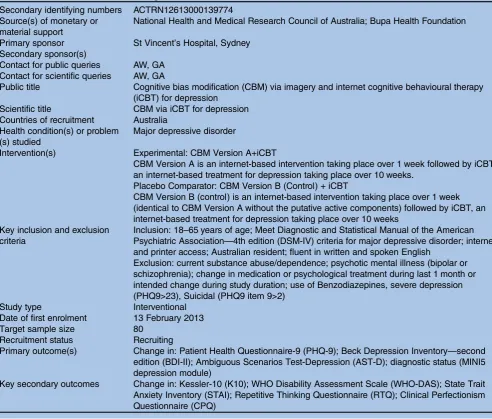
The current SPIRIT-compliant17 protocol outlines the methodology of a randomised controlled trial (RCT) to establish the efficacy of our internet-delivered positive imagery CBM intervention for depression when com-pared with an active control condition (CBM control, see below). To establish the additive benefit of positive imagery CBM when delivered in combination with iCBT all patients will complete iCBT (the Sadness Program) following the 1-week CBM intervention (table 1).
Trial design
The trial is a randomised controlled superiority trial with two parallel arms using a 1:1 allocation ratio.
Hypotheses
On the basis of previous findings7 16 we predict that patients randomised to positive imagery CBM will evi-dence significant reductions on primary measures of depressive symptoms (BDI-II, PHQ9) and interpretive bias (AST-D), and on a secondary measure of psychological
distress (K10) following the 1-week CBM intervention. We predict superiority (as indexed by hedgesgbetween-group comparisons) of positive imagery CBM over CBM Control on these measures. Further, we predict that patients rando-mised to the combined intervention group (CBM+iCBT) will evidence significant reductions in the measures of depression (BDI-II, PHQ9) and psychological distress (K10), as well as disability (WHODAS), repetitive negative thinking (RTQ) and anxiety (STAI) following completion of the combined programme. We further predict that ben-efits will be maintained at 3-month follow-up. We will also investigate the potential impact of baseline variables on treatment adherence, ratings of acceptability and thera-peutic outcomes.
METHODS Study setting
The Clinical Research Unit for Anxiety and Depression (CRUfAD) is a not-for-profit joint initiative of St Vincent’s Hospital and the University of New South
Table 1 Items from the WHO Trial Registration Data Set Secondary identifying numbers ACTRN12613000139774 Source(s) of monetary or
material support
National Health and Medical Research Council of Australia; Bupa Health Foundation
Primary sponsor St Vincent’s Hospital, Sydney Secondary sponsor(s)
Contact for public queries AW, GA Contact for scientific queries AW, GA
Public title Cognitive bias modification (CBM) via imagery and internet cognitive behavioural therapy (iCBT) for depression
Scientific title CBM via iCBT for depression Countries of recruitment Australia
Health condition(s) or problem (s) studied
Major depressive disorder
Intervention(s) Experimental: CBM Version A+iCBT
CBM Version A is an internet-based intervention taking place over 1 week followed by iCBT, an internet-based treatment for depression taking place over 10 weeks.
Placebo Comparator: CBM Version B (Control) + iCBT
CBM Version B (control) is an internet-based intervention taking place over 1 week (identical to CBM Version A without the putative active components) followed by iCBT, an internet-based treatment for depression taking place over 10 weeks
Key inclusion and exclusion criteria
Inclusion: 18–65 years of age; Meet Diagnostic and Statistical Manual of the American Psychiatric Association—4th edition (DSM-IV) criteria for major depressive disorder; internet and printer access; Australian resident; fluent in written and spoken English
Exclusion: current substance abuse/dependence; psychotic mental illness (bipolar or schizophrenia); change in medication or psychological treatment during last 1 month or intended change during study duration; use of Benzodiazepines, severe depression (PHQ9>23), Suicidal (PHQ9 item 9>2)
Study type Interventional Date of first enrolment 13 February 2013 Target sample size 80
Recruitment status Recruiting
Primary outcome(s) Change in: Patient Health Questionnaire-9 (PHQ-9); Beck Depression Inventory—second edition (BDI-II); Ambiguous Scenarios Test-Depression (AST-D); diagnostic status (MINI5 depression module)
Key secondary outcomes Change in: Kessler-10 (K10); WHO Disability Assessment Scale (WHO-DAS); State Trait Anxiety Inventory (STAI); Repetitive Thinking Questionnaire (RTQ); Clinical Perfectionism Questionnaire (CPQ)
on September 22, 2020 by guest. Protected by copyright.
Wales, School of Psychiatry in Sydney, Australia. CRUfAD specialises in the development, evaluation and
dissemination of evidence-based CBT programmes
through the internet. The mode of internet recruitment and delivery enables potential participants from all Australian states to be eligible to apply for enrolment in the current trial.
Participants and recruitment
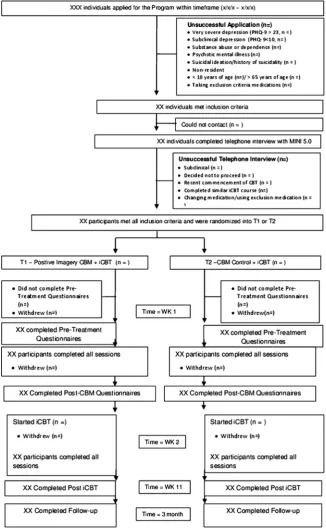
Power calculations were informed by calculation of effect size data from Langet al7providing a between-group effect corresponding to Hedges’ g of 0.66. The minimum sample size for each group (αset at 0.05, power at 0.80) was identified as 29, but at least 10% more will be recruited to hedge against expected attrition. Participants will be recruited through the research arm of a not-for-profit clinical and research unit affiliated with St Vincent’s Hospital and the University of New South Wales, Australia. Applicantsfirst complete online screening questionnaires about symptoms and demographic details (see figure 1: participant flowchart). Inclusion criteria are as follows: meet diagnostic criteria for Major Depressive Disorder; internet and printer access; Australian resident;fluent in written and spoken English. Exclusion criteria are as follows: non-resident of Australia; less than 18 or older than 65 years of age; currently receiving CBT for depres-sion or recently completed an iCBT programme for depression; severe depression and (PHQ9>23)/or suicidal ideation (PHQ9 item 9=3); drug or alcohol dependence; psychotic disorder or taking atypical antipsychotics or ben-zodiazepines; if taking medication for anxiety or depres-sion, has been taking the same dose for less than 1 month or intended to change the dose during the course of the programme. Excluded applicants receive information on alternative services and are encouraged to discuss their symptoms with their physician. Applicants who pass the screening phase are telephoned for a diagnostic interview using the Mini International Neuropsychiatric Interview V.5.0.0 (MINI18) to determine whether they meet the diag-nostic criteria for a major depressive episode. All interviews will be conducted by a registered psychologist trained in the administration of the diagnostic interview. Applicants who satisfy all inclusion criteria will be informed of the study design and will complete an electronic informed consent prior to being enrolled in the trial. All participants are informed in writing that they have the right to with-draw from the study at any time without jeopardising their relationship with St Vincent’s Hospital or the University of New South Wales.
Randomisation
Eligible participants accepted into the programme will be randomised based on an allocation sequence gener-ated by an independent person not involved in the study through a true randomisation process (http://www. random.org). Numbers corresponding to treatment group (1 or 2) will be placed in sealed opaque envel-opes with the sequential order number written on each
envelope to ensure participants are allocated according to the predetermined sequence. Participants remain blind to treatment group allocation. A member of the research team will open the envelope after all screening procedures have occurred and after the diagnostic inter-view has been conducted.
Interventions
CBM programme (both positive imagery and control conditions)
There are seven sessions of the imagery-focused CBM programme completed daily over the course of 1 week. Each session is approximately 15–20 min in duration. Participants are required to imagine themselves in the training scenarios, which is not only important for the acquisition of the interpretive bias,9but may also remedi-ate the deficit of being unable to imagine a positive future that characterises depression.7 10Prior to session 1 participants complete baseline measures and read an online introduction to imagery generation and practice generating mental images. Session 1 includes 32 training scenarios grouped into four blocks of eight paragraphs. Each subsequent training session includes 64 training scenarios, grouped into eight blocks of eight paragraphs as in.6 16There are a total of 416 different positive train-ing paragraphs, half recorded in a male voice and half in a female voice. Each scenario was digitally recorded and is 10–13 s in audio length. Scenarios are presented stereophonically through headphones or through the participant’s computer speakers. Presentation of each paragraph is followed by a 2 s pause (to imagine the outcome) and an audio ‘beep’to prompt participants to open their eyes. The paragraphs were designed such that they start out ambiguous as to their potential outcome, which only becomes clear towards the end of the state-ment. Participants are instructed ‘imagine the scenarios as if you are actively involved, seeing them through your own eyes’. To focus participants on generating imagery,19 after each training paragraph, they rate the vividness of their imagery (‘How vividly could you imagine the situ-ation that was described?’) on a five-point1–5 scale ranging from‘not at all’to‘very’.
Positive imagery CBM
In this version (the intervention condition) all scenarios have a positive resolution. For example:‘You ask a friend to look over some work you have completed. They come back with some comments, which are all very positive’
( positive resolution in italics), thus a specific learning contingency is established between the ambiguous start of the scenario and the imagined positive resolution.
Control CBM
In this version (the control condition) 50% of the scen-arios have a positive resolution and 50% have a negative resolution (eg, ‘They come back with some comments,
which are all critical’), thus no contingency is established
on September 22, 2020 by guest. Protected by copyright.
between the start of the scenario and the valence of the imaginedfinal resolution.7
iCBT—The Sadness Program
The Sadness Program has been evaluated in four previ-ous trials20–23 and a quality assurance effectiveness study conducted in primary care.24 Briefly, the programme consists of six online lessons representing best practice CBT as well as regular homework assignments and access to supplementary resources. Each lesson was designed using a cartoon narrative and included: psychoeducation, behavioural activation, cognitive restructuring, graded
exposure, problem solving, assertiveness skills and relapse prevention. Patient queries throughout the pro-gramme are primarily addressed by email contact from the clinician or the research support officer. If clinically indicated, or if patients’ K-10 and/or PHQ-9 scores deteriorate, the clinician would make telephone contact. Adherence to the CBM programme is monitored through the computer software that records all data. If a participant misses a session of the CBM programme, a member of the research team will send an email reminder through the Virtual Clinic system or make tele-phone contact to remind the participant to login to Figure 1 Study flow chart.
on September 22, 2020 by guest. Protected by copyright.
complete the session. Adherence is similarly monitored throughout the iCBT programme. Once enrolled, a par-ticipant can elect to discontinue at any time. The section for revocation of consent should be forwarded to Professor Gavin Andrews, head of CRUfAD. A participant may be withdrawn from the trial for the following reasons: lack of computer and internet access; change in medication prescribed to treat depression; change in medication status of exclusion medications; suicidality or clinical risk; failure to complete baseline questionnaires; failure to start the CBM programme; failure to complete a minimum of four CBM sessions; failure to complete post CBM programme questionnaires. Lack of adherence throughout the iCBT programme is not a specified reason for participant withdrawal, although a participant may withdraw voluntarily. All reasons for withdrawal status will be documented.
Primary outcome measures
Beck Depression Inventory—second edition
The BDI-II is a 21-item self-report inventory that measures symptoms of depression.25 The BDI possesses high internal consistency, withα coefficients of 0.86 and 0.81 for psychiatric and non-psychiatric populations, respectively.25
Patient Health Questionnaire
The PHQ-9 is a self-report questionnaire corresponding to the DSM-IV diagnostic criteria for major depressive disorders.26 Each item is rated in frequency on a four-point (0=not at all, 3=nearly every day) scale. Total scores range from 0 to 27 with higher scores reflecting higher levels of psychopathology. A PHQ-9 score of≥10 is used as a clinical cut-off for probable DSM-IV diagno-sis of MDD.27 The PHQ-9 demonstrates good psycho-metric properties and has been used extensively to measure treatment outcomes during internet CBT inter-ventions targeting depression and anxiety.16 28
Kessler-10 psychological distress scale
The K10 consists of 10 items ranked on afive point scale designed to measure non-specific psychological dis-tress.29 For the current study, the time-frame was
modi-fied to assess psychological distress in the past 2 weeks rather than in the past 30 days. The K10 possesses strong psychometric properties.29 30
The PHQ9, BDI-II and K10 will be administered at baseline, following the 1-week CBM intervention, follow-ing the combined intervention and at 3-month follow-up.
Ambiguous scenarios test-depression
The AST-D is a measure of mental imagery-based inter-pretation bias comprised of 12 ambiguous scenarios rated in terms of their emotional valence (1=extremely unpleasant to 9=extremely pleasant).31 Scores are aver-aged to form a total score. Participants are asked to imagine each of the scenarios and imagine the event happening to them prior to making their ratings of
valence (eg, ‘You buy a new outfit for a party. Other people’s reactions show how you look.’). There are two versions of the AST-D to be presented in counterba-lanced order. The AST-D will be collected at baseline, following the 1-week CBM intervention, and at 3-month follow-up.
Diagnostic status
Change in diagnostic status will be indexed using the MINI.18 Depression Module administered at baseline and 3-month follow-up.
Secondary outcome measures
The following secondary measures will be collected at baseline, following completion of the combined inter-vention, and at 30-month follow-up.
WHO disability assessment schedule II
The WHODAS-II contains 12 items designed to measure disability and activity limitation in the past 30 days in a variety of domains: (1) understanding and communicat-ing, (2) self-care, (3) mobility, (4) interpersonal relation-ships, (5) work and household roles and (6) community and civic roles. Each of these domains loads significantly onto one underlying latent factor of global disability.32 Scores range from 0 to 60, with higher scores indicating greater disability. The WHODAS-II demonstrates strong psychometric properties.33
State trait anxiety inventory-trait version
The STAI-T will be used to index trait anxiety and con-sists of 20 anxiety-relevant items on which participants rate how they‘generally feel’ on a 4-point scale.34Scores range from 20 to 80 with higher scores indicative of greater anxiety. The STAI-T is widely used in CBM research and has satisfactory reliability and validity.34
Repetitive thinking questionnaire-10
The RTQ is a10-item content-independent self-report measure of preservative thinking.35Respondents rate the degree to which each item is true (1=Not at all true— 5=Very true) in reference to their experience following a recently occurring distressing event. The RTQ demon-strates good psychometric properties in non-clinical and clinical samples.35 36
Comorbid diagnostic status
Comorbid Generalised Anxiety Disorder (GAD) and Social Phobia (SP) status will be indexed by the MINI GAD and SP modules conducted at baseline and 3-month follow-up.
Treatment expectancy and outcomes questionnaire
At baseline participants will complete two treatment expectancy questions (adapted from Ref. 37 (1) At this point, how logical does the program offered to you seem?
(0=‘Not at all logical’—4= ‘Very logical’) and (2)At this point, how useful do you think this treatment will be in
on September 22, 2020 by guest. Protected by copyright.
reducing your depression symptoms?(0= ‘Not at all useful’— 4=‘Very useful’). Following the combined intervention participants will also rate treatment satisfaction: Overall, how satisfied are you with your treatment? (1=‘Very
dissatis-fied’—5=‘Very satisfied’).
Additional measures
TheProspective Imagery Task(PIT10 38) was used to measure imagery for 10 positive and 10 negative prospective events. As in Holmeset al10participants were asked to rate the viv-idness of prospective positive events (eg,‘You will have lots of energy and enthusiasm’) or negative events (eg,
‘Someone close to you will reject you’) on a five-point scale (1=no image at all; 5=very vivid). The PIT will be administered at baseline as a potential moderator of the CBM intervention and to check that both groups are balanced on imagery ability at baseline.
Clinical perfectionism questionnaire
The clinical perfectionism questionnaire (CPQ) is a 12-item self-report measure of clinical perfectionism, or the striving for high personal standards in combination with negative self-evaluations about the impact of not meeting these standards.39 40 Respondents rate the extent to which each of the 12 items describes them over the past month (1=not at all—4=all of the time). Higher scores indicate greater levels of clinical perfec-tionism. The CPQ will be administered at baseline and following completion of the combined intervention. The CPQ will be included as a potential moderator based on evidence that clinical perfectionism may impede the suc-cessful treatment of depression.41
Skills of cognitive therapy-patient version
The skills of cognitive therapy-patient version (SoCT-P) is an eight-item self-report measure designed to assess patients’understanding and use of basic cognitive therapy skills.42 Ratings of patients’ skill usage are made on fi ve-point scale (1=never—5=always or when needed). Higher scores reflect greater patient skill in applying cognitive therapy principles and coping strategies. The SoCT-P demonstrates good psychometric properties (Cronbach’s
α=0.86–0.89; Jarrett et al42). The SoCT-P will be adminis-tered following completion of the combined intervention. The SoCT-P will be included as a potential moderator of treatment response during iCBT.
Data collection and management
Data for the primary and secondary outcome question-naires are collected via the Virtual Clinic system software and Key Survey software licensed by UNSW. All informa-tion collected by the Key Survey and CBM software is coded with either a participant identification number or an email address to facilitate data-to-patient matching. Clinical information, including diagnostic status using the MINI, is collected by interview via telephone and stored in written format in a secure location at CRUfAD. Any identifiable information that is collected remains
confidential, except as required by law. Only members of the site (CRUfAD) research team will have access to participant information and data.
To promote participant retention, participants are reminded that data collection is an important aspect of research that enables the research team to track their pro-gress and to evaluate the programme. Participants are offered one entry into a draw for a gift card valued at $A100 in exchange for the completion of the 3-month follow-up questionnaires. All data will be extracted from the CBM and iCBT software servers in the form of either an SPSS outputfile or an Excel-compatiblefile to be trans-ferred to SPSS by a member of the research team. All data will be stored on a secure Virtual Clinic server.
Participants are informed in writing that the research team will plan to publish the results of the trial in peer-reviewed scientific publications and presentations. Participants are informed that in any publication or presentation, information will be provided in such a way to maintain anonymity. All members of the research team who provide intellectual input to the trial design, execution or write-up will be acknowledged as an author on any publication. Participants will be sent (through email) a written summary of the results in lay terms fol-lowing completion of the trial study phase.
Statistical methods
Significance testing of group differences regarding demographic data and pretreatment measurements will be conducted using analysis of variance and χ2 where the variables consist of nominal data. ITT mixed models using restricted maximum likelihood (REML) estimation will be used to account for missing data due to partici-pant drop-outs without assuming that the last measure-ment is stable (the last observation carried forward assumption.43 REML models are appropriate for RCTs with multiple time points and pre–post only designs.44 The assumption that data is Missing at Random (MAR) will be evaluated using binary logistic regression to predict drop-outs (0=no drop-out, 1=drop-out) and by comparing these two groups on baseline measures. Significant effects will be followed up with pair wise con-trasts comparing pretreatment to post-treatment scores. Complete-case analyses of the primary hypotheses using data from participants who complete all seven sessions of the CBM programme will also be conducted. The effect of potential treatment moderators will be evalu-ated by including baseline variables of interest as a cov-ariate and interaction term in separate mixed models analyses. Analyses will be performed in SPSS V.21. Effect sizes will be calculated between groups (Hedges’ g) and within groups (Cohen’s d, adjusting for the repeated measures correlation) using the pooled SD and adjusted for sample size. Consistent with previous research,45 clin-ically significant change will be defined as high-end state functioning (a BDI-II score <14) combined with a total score reduction greater than the reliable change index score (RCI) of 7.16.46 Owing to the high rate of
on September 22, 2020 by guest. Protected by copyright.
comorbid anxiety disorders, clinically significant change will also be calculated for the STAI-T based on an RCI of 7.86 in combination with a final score below the recommended cut-score of 45.7.47 Estimates of indirect effects will be generated using bootstrapping analysis and PROCESS.48
Monitoring
The clinical trials manager of CRUfAD and a member of the research team will oversee data collection and monitoring. An interim analysis will only be conducted to check that the planned number of participants have been retained in the trial following enrolment. Any adverse event will be reported to the head of CRUfAD and to the Human Research Ethics Committee (HREC) of St Vincent’s Hospital, the responsible body for initiat-ing a clinical trial audit.
DISCUSSION
The current RCT will provide a test of the effectiveness of a combined imagery CBM and iCBT intervention in the treatment of current major depression. It will also attempt to replicate the initial successful application of imagery CBM delivered through the internet without face-to-face contact, and establish whether this is super-ior to a closely matched control version when delivered in this manner.
The choice of control condition is a challenge and raises questions. For example, whether to control for bias, imagery, activity such as engaging in repeated prac-tice of a computer task, or some other aspect. The main aim of the current study was to investigate the efficacy of the combined imagery CBM and iCBT intervention, and the choice of control CBM is a pragmatic choice based on a previous study7and experimental work,49 albeit in shorter time frames. However, we note that both the positive imagery and this control condition involve gen-erating mental images. It may be that this mental imagery practice in itself (regardless of imagery valence) could enhance the subsequent effects of iCBT, for example, by facilitating access to alternative meanings, or facilitating the kind of (imagery-based) future simula-tion involved in planning,50 for example, activity sched-uling. If this is the case and both conditions improve then it may be interesting to dismantle. Conversely, dif-ferential outcomes following the combined intervention would suggest that it is the consistently positive reso-lution of the imagined scenarios that leads to enhanced outcomes, either by additive or interactive effects of combining imagery CBM and iCBT. Results will there-fore inform further clinical trials of the combined inter-vention and basic research investigating the range of potential treatment mechanisms.
Trial status
This article was submitted on 16 September 2013. To date 96 participants have met eligibility requirements
and been randomised to treatment condition. The first round of applications opened on 12 February 2013 and the first participant was enroled on 13 February 2013. Data collection aims to be completed in March 2014.
Author affiliations
1UNSW Medicine, School of Psychiatry, University of New South Wales,
Sydney, New South Wales, Australia
2Clinical Research Unit for Anxiety and Depression (CRUfAD), St Vincent’s
Hospital, Sydney, New South Wales, Australia
3MRC Cognition and Brain Sciences Unit, Cambridge, UK
Contributors ADW conceived of the study. ADW, SEB, EAH and GA initiated the study design. All authors contributed to refinement of the study protocol and approved the final manuscript.
Competing interests ADW is supported by an Australian National Health and Medical Research Council (NHMRC) Fellowship (630746). Portions of this research were supported by a University of New South Wales Medicine faculty grant awarded to ADW and a Bupa Health Foundation grant awarded to ADW, EAH, SEB and GA. EAH and SEB are supported by the Medical Research Council (UK) intramural programme (MC-A060-5PR50) and a grant from the Lupina Foundation. EAH is also supported by a Wellcome Trust Clinical Fellowship (WT088217), and the National Institute for Health Research (NIHR) Oxford Biomedical Research Centre based at Oxford University Hospitals NHS Trust, Oxford University (REF A93182).
Ethics approval Human Research Ethics Committee (HREC) of St. Vincent’s Hospital and the University of New South Wales.
Provenance and peer review Not commissioned; internally peer reviewed.
Open Access This is an Open Access article distributed in accordance with the Creative Commons Attribution Non Commercial (CC BY-NC 3.0) license, which permits others to distribute, remix, adapt, build upon this work non-commercially, and license their derivative works on different terms, provided the original work is properly cited and the use is non-commercial. See: http:// creativecommons.org/licenses/by-nc/3.0/
REFERENCES
1. World Health Organization.The global burden of disease: 2004 update. Geneva, Switzerland: World Health Organization, 2008. 2. Simon GE, Ludman EJ. It’s time for disruptive innovation in
psychotherapy.Lancet2009;374:594–5.
3. Williams JM, Watts FN, MacLeod C,et al.Cognitive psychology and emotional disorders. 2nd edn. Chichester, UK: John Wiley & Sons, 1997.
4. National Institute for Health and Clinical Excellence.Depression. The treatment and management of depression in adults. London, UK: National Institute for Health and Clinical Excellence (NICE), 2009. 5. Macleod C. Cognitive bias modification procedures in the
management of mental disorders.Curr Opin Psychiatry
2012;25:114–20.
6. Blackwell SE, Holmes EA. Modifying interpretation and imagination in clinical depression: a single case series using cognitive bias modification.Appl Cogn Psychol2010;24:338–50.
7. Lang TJ, Blackwell SE, Harmer CJ,et al. Cognitive bias modification using mental imagery for depression: developing a novel
computerized intervention to change negative thinking styles.Eur J Pers2012;26:145–57.
8. Lang TJ, Moulds ML, Holmes EA. Reducing depressive intrusions via a computerized cognitive bias modification of appraisals task: developing a cognitive vaccine.Behav Res Ther2009;47:139–45. 9. Holmes EA, Lang TJ, Shah DM. Developing interpretation bias
modification as a‘cognitive vaccine’for depressed mood: imagining positive events makes you feel better than thinking about them verbally.J Abnorm Psychol2009;118:76–88.
10. Holmes EA, Lang TJ, Moulds ML,et al. Prospective and positive mental imagery deficits in dysphoria.Behav Res Ther2008;46:976–81. 11. Morina N, Deeprose C, Pusowski C,et al. Prospective mental
imagery in patients with major depressive disorder or anxiety disorders.J Anxiety Disord2011;25:1032–7.
12. Butler G, Mathews A. Cognitive processes in anxiety.Adv Behav Res Ther1983;5:51–62.
on September 22, 2020 by guest. Protected by copyright.
13. Holmes EA, Lang TJ, Deeprose C. Mental imagery and emotion in treatment across disorders: using the example of depression.Cogn Behav Ther2009:38(Suppl 1):21–8.
14. MacLeod C, Koster EH, Fox E. Whither cognitive bias modification research? Commentary on the special section articles.J Abnorm Psychol2009;118:89–99.
15. Browning M, Grol M, Ly V,et al. Using an experimental medicine model to explore combination effects of pharmacological and cognitive interventions for depression and anxiety.
Neuropsychopharmacology2011;36:2689–97.
16. Williams AD, Blackwell SE, Mackenzie A,et al. Combining
imagination and reason in the treatment of depression: a randomized controlled trial of internet-based cognitive-bias modification and internet-CBT for depression.J Consult Clin Psychol2013;81:793–9. 17. Chan AW, Tetzlaff JM, Gotzsche PC,et al. SPIRIT 2013 explanation
and elaboration: guidance for protocols of clinical trials.BMJ
2013;346:e7586.
18. Sheehan DV, Lecrubier Y, Sheehan KH,et al. The Mini-International Neuropsychiatric Interview (M.I.N.I.): the development and validation of a structured diagnostic psychiatric interview for DSM-IV and ICD-10.J Clin Psychiatry1998;59(Suppl 20):22–33;quiz 4–57. 19. Holmes EA, Mathews A, Dalgleish T,et al. Positive interpretation
training: effects of mental imagery versus verbal training on positive mood.Behav Ther2006;37:237–47.
20. Perini S, Titov N, Andrews G. The climate sadness program of internet-based treatment for depression: a pilot study.E-J Appl Psychol2008;4:18–24.
21. Perini S, Titov N, Andrews G. Clinician-assisted internet-based treatment is effective for depression: randomized controlled trial.
Aust N Z J Psychiatry2009;43:571–8.
22. Titov N, Andrews G, Davies M,et al. Internet treatment for depression: a randomized controlled trial comparing clinician vs. technician assistance.PLoS ONE2010;5:e10939.
23. Watts S, Mackenzie A, Thomas C,et al. CBT for depression: a pilot RCT comparing mobile phone vs. computer.BMC Psychiatry2013;13:49. 24. Williams AD, Andrews G, Andersson G. The effectiveness of internet
cognitive behavioural therapy (iCBT) for depression in primary care: a quality assurance study.PLoS ONE2013;8:e57447.
25. Beck AT, Steer RA, Brown GK.Beck depression inventory (2nd rdition)-manual. San Antonio, TX: The Psychological Corporation, 1996. 26. Kroenke K, Spitzer RL, Williams JB. The PHQ-9: validity of a brief
depression severity measure.J Gen Intern Med2001;16:606–13. 27. Zuithoff NP, Vergouwe Y, King M,et al. The Patient Health
Questionnaire-9 for detection of major depressive disorder in primary care: consequences of current thresholds in a cross sectional study.
BMC Fam Pract2010;11:98.
28. Newby JM, Mackenzie A, Williams AD,et al. Internet cognitive behavioural therapy for mixed anxiety and depression: a randomized controlled trial and evidence of effectiveness in primary care.
Psychol Med2013;FirstView:1–14.
29. Kessler RC, Andrews G, Colpe LJ,et al. Short screening scales to monitor population prevalences and trends in non-specific psychological distress.Psychol Med2002;32:959–76. 30. Sunderland M, Wong N, Hilvert-Bruce Z,et al. Investigating
trajectories of change in psychological distress amongst patients with depression and generalised anxiety disorder treated with internet cognitive behavioural therapy.Behav Res Ther2012;50:374–80. 31. Berna C, Lang TJ, Goodwin GM,et al. Developing a measure of
interpretation bias for depressed mood: an ambiguous scenarios test.Pers Individ Dif2011;51:349–54.
32. Andrews G, Kemp A, Sunderland M,et al. Normative data for the 12 item WHO Disability Assessment Schedule 2.0.PLoS ONE2009;4: e8343.
33. Federici S, Meloni F, Lo Presti A. International literature review on WHODAS II (World Health Organization Disability Assessment Schedule II).Life Span Disabil2009;12:83–110.
34. Spielberger CD, Gorsuch RL, Lushene R,et al.Manual for the state-trait anxiety inventory. Palo Alto, CA: Consulting Psychologists Press, 1983.
35. McEvoy PM, Mahoney AE, Moulds ML. Are worry, rumination, and post-event processing one and the same? Development of the repetitive thinking questionnaire.J Anxiety Disord2010;24:509–19. 36. Mahoney AE, McEvoy PM, Moulds ML. Psychometric properties of the Repetitive Thinking Questionnaire in a clinical sample.J Anxiety Disord2012;26:359–67.
37. Devilly GJ, Borkovec TD. Psychometric properties of the credibility/ expectancy questionnaire.J Behav Ther Exp Psychiatry2000;31:73–86. 38. Stöber J. Prospective cognitions in anxiety and depression:
replication and methodological extension.Cognit Emotion
2000;14:725–9.
39. Fairburn CG, Cooper Z, Shafran R. Cognitive behaviour therapy for eating disorders: a‘transdiagnostic’theory and treatment.Behav Res The2003;41:509–28.
40. Shafran R, Cooper Z, Fairburn CG. Clinical perfectionism: a cognitive-behavioural analysis.Behav Res Ther2002;40:773–91. 41. Blatt SJ, Zuroff DC, Bondi CM,et al. When and how perfectionism
impedes the brief treatment of depression: further analyses of the National Institute of Mental Health Treatment of Depression Collaborative Research Program.J Consult Clin Psychol
1998;66:423–8.
42. Jarrett RB, Vittengl JR, Clark LA,et al. Skills of Cognitive Therapy (SoCT): a new measure of patients’comprehension and use.
Psychol Assess2011;23:578–86.
43. Gueorguieva R, Krystal JH. Move over ANOVA progress in analyzing repeated-measures data and its reflection in papers published in the archives of general psychiatry.Arch Gen Psychiatry
2004;61:310–17.
44. Salim A, Mackinnon A, Christensen H,et al. Comparison of data analysis strategies for intent-to-treat analysis in pre-test-post-test designs with substantial dropout rates.Psychiatry Res
2008;160:335–45.
45. Vernmark K, Lenndin J, Bjarehed J,et al. Internet administered guided self-help versus individualized e-mail therapy: a randomized trial of two versions of CBT for major depression.Behav Res Ther
2010;48:368–76.
46. Jacobson NS, Truax P. Clinical significance: a statistical approach to defining meaningful change in psychotherapy research.J Consult Clin Psychol1991;59:12–19.
47. Fisher PL, Durham RC. Recovery rates in generalized anxiety disorder following psychological therapy: an analysis of clinically significant change in the STAI-T across outcome studies since 1990.
Psychol Med1999;29:1425–34.
48. Hayes AF.An introduction to mediation, moderation, and conditional process analysis. New York: Guilford Press, 2013.
49. Pictet A, Coughtrey AE, Mathews A,et al. Fishing for happiness: the effects of generating positive imagery on mood and behaviour.
Behav Res Ther2011;49:885–91.
50. Schacter DL, Addis DR, Buckner RL. Remembering the past to imagine the future: the prospective brain.Nat Rev Neurosci
2007;8:657–61.
on September 22, 2020 by guest. Protected by copyright.