THE CLASSIFICATION OF IRREGULAR CLUSTERS: AN
IMPROVED SEMI-SUPERVISED CLUSTERING ALGORITHM
1.2MA CHI, 1GAO XUEDONG, 2ZHANG CHUNNA, 2LI YIRAN
1Dongling School of Economics and Management, University of Science and Technology Beijing, Beijing
10083, China
2College of Software, University of Science and Technology Liaoning, Anshan 114054, China
E-mail: [email protected]
ABSTRACT
This paper proposed a improved semi-supervised clustering algorithm, aiming at the limitations of the traditional k-means algorithm in the irregular clusters division. This paper mainly discusses two problems: the closure replacement and the traction between data points. First of all, made use of the closure center to replace the original sample point, and to calculated the sample clustering center combining the semi-supervised clustering ideology with a small amount of the tagged data; next, in the process of clustering is introduced into the definition about the traction distance of the clustering center and the traction between the data points, given a complete description of the relationship between data points; finally, fully consider the effect about the tagged data points, especially isolated point, on untagged data point, implement clustering data in the sample space. Experimental results indicate that the cluster is much more efficient than the other existing algorithms when dealing with the irregular cluster.
Keywords: Semi-supervised clustering, K-means algorithm, Closure Center, Irregular cluster
1.
INTRODUCTIONThe cluster analysis is the most important research directions of the knowledge discovery and data mining areas, in accordance with certain rules, which is divided into different classes, the higher similarity of data is divided into a class, and the lower divided into another class. With the deepening of the data mining technology applications in various fields, the clustering analysis is one of the most frequently used technique, which also more and more is converted into a practical application.
The semi-supervised clustering is an emerging cluster analysis method, which combines the traditional supervised learning and the unsupervised learning[1], to make use of a priori knowledge supports clustering, its advantages are the completed classification in the case of less knowledge, the supervised learning object can be both the tagged data and untagged data, so that the clustering process will become very easy.
In 1967, the k-means algorithm was first proposed by MacQueen, which has gradually developed one of the most commonly used cluster analysis algorithm[2]. With the development of the semi-supervised clustering, the research which combined two becomes more and more [3-5].
supervised clustering algorithm, which using sample point closure center instead of dispersed sample point calculation of cluster centers, and introduce the traction force between data points to build traction matrix, constantly optimize the cluster centers in process of iterative, in order to seek the optimal solution. The experimental part of this paper analyses and contrasts the clustering accuracy of different clustering algorithms. The experiments show that the improved semi-supervised k-means algorithm clustering effect is better.
2.
THE SEMI-SUPERVISED K-MEANS CLUSTERING ALGORITHM2.1 The k-means algorithm
Set the finite set in Qdimensional space Q
S as
1 2
{ , , , n}
X = x x x , the initialization can be divided
into
k
class randomly, denoted as C C1, 2,,Ck, if aclass has n objects, the i clustering center can be
defined as Z Z1, 2,,Zk ,
1 1
, [1, ]
n
i j
j
Z x j k
n =
=
∑
∈ , thedefinition of the objective function as follows:
, 2
1 1
j
xjZi
n k
i j
J D
= =
=
∑∑
(1)In the formula,
,
2
xjZi
D represents the distance that
the j text to a class i clustering center, that is, Euclidean distance.
The core idea of this algorithm is through continuous iteration to find the
k
optimal cluster centers of the sample data set, and other data move to the cluster center, until the objective function value is minimum.2.2 The algorithmic thought
The semi-supervised clustering sample data sets can be classified as follows: the tagged data set and the untagged data set, there are
nL
tagged data in the training set, the tagged data result set can be expressed as: xi ={ ,x x1 2,,xnL| 1≤ ≤i nL} , theremaining sample data is the untagged data, it is expressed as: xj ={xnL+1,xnL+2,,xn|nL+ ≤ ≤1 j n}.
In the formula, x xi, j∈X , and xixj = X . The
tagged data in semi-supervised clustering usually have three kinds of functions: the clustering seed, the clustering limit and the clustering feedback. This article discusses the data graphically showed a cluster of irregular and dynamic, namely the clustering previous number of entries is not known.
Based on this kind of uncertainty should be considered the third function of the semi-supervised clustering, namely the clustering feedback.
Through the use of tagged data as the clustering feedback for semi-supervised clustering, first of all, organizing the training set and using the unsupervised of spherical K-means algorithm implemented clustering; next, the result of clustering is introduced the tagged data, and to fine-tune it, the adjustment results as the initial value of the again cluster; finally, noting the iteration is needed to keep the cluster number unchanged, at the same time detection value of the objective function is or not to achieve the desired value, if fulfilled, is terminated, or to continue. The algorithm contains the following steps:
Input: The sample data set X ={xi| 1≤ ≤i n},
and Q
i
x ∈S , define k clusters randomly, the relationship between the tagged data sets with the sample data sets expressed as:
1 2 k j
X X X X = X.
Output: The clustering results are the objective function of the minimum k divided set:{ | 1}
k
m m
X = .
Step 1: Using the tagged data to calculate the initial cluster center: 0
1 |
m k
m
Z = , to make
|
i i
m i m
m
x
Z x X
X
=
∑
∈ , Set the iteration operator l=0;Step 2: Assigned the data ofX to the similar clusters, referring the initial cluster centers;
Step 3: The cluster centers are calculated according to the formula in step 1 again, and updated iteration operatorl, to make l= +l 1, the process constantly back and forth until convergence.
2.3 The effect analysis
The above discussion algorithm is usually applied to the rule clusters, but the irregular clusters found ability is poor. This article defined it as KM algorithm.
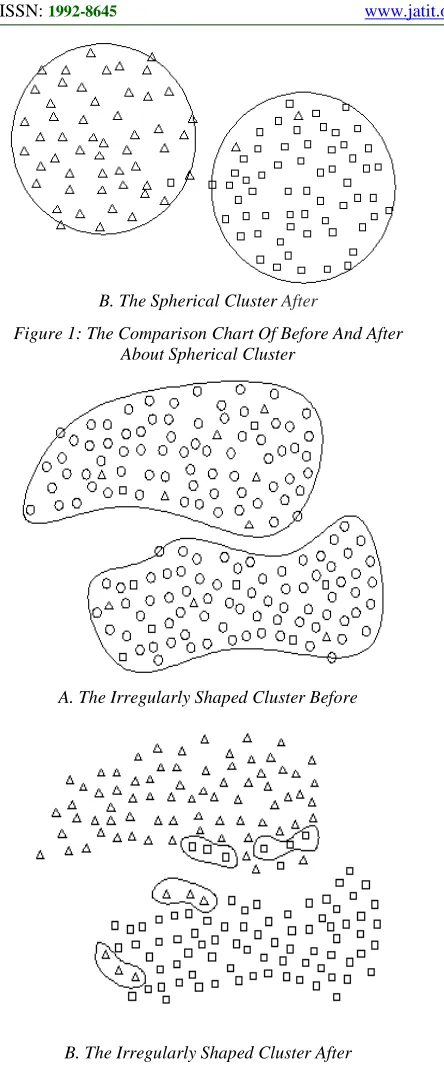
B. The Spherical Cluster After
Figure 1: The Comparison Chart Of Before And After About Spherical Cluster
A. The Irregularly Shaped Cluster Before
[image:3.612.94.316.76.614.2]B. The Irregularly Shaped Cluster After
Figure 2: The Comparison Chart Of Before And After About Irregularly Shaped Cluster
In the figure 1 and figure 2, represents the untagged data,
and
represents the tagged data, the data as a whole is divided into two categories, namely
and
. Through analysis, the figure 1 is a regular spherical, after cluster, the division of the cluster is more reasonable, the upper part and the lower part of the figure 1b respectively only one point appears deviation; the figure 2 is anirregular pattern, after the algorithm cluster as showed in figure2b, the upper part and the lower part of the figure respectively six point appear deviation. It can clearly be seen that the algorithm for the clustering effect of regular and irregular graphics are quite different.
Through the analysis of the misjudgment point knows, when the untagged data is wrong divided, there will be a few isolated
or
within a certain distance of the nearby, However in other non-isolated point are fewer errors. This can be understood as follows: untagged data on its short distance, there is a convergence of the tagged data, and the further away from the tagged data have been exclusive. In addition, due to the limitation of the traditional K-means algorithm, the effect is poor for irregular-shaped clusters clustering.3. K-MEANS CLUSTERING BASED ON THE SEMI-SUPERVISED OF THE CLOSURE REPLACEMENT
3.1 The Algorithmic Thought
There is stability in the processing of the conventional semi-supervised clustering algorithm for the irregular clusters treatment, the reason mainly comes from the impact of the tagged data to untagged data. This paper presents an improved K-means clustering algorithm based on the semi-supervised, it is introduced the nearest neighbor point impact factor on the basis of the RKM to improve stability, while taking advantage of the center of the closure instead of the sample point implement clustering to avoid clustering deviation, it needs to consider the following two problems:
(1) The tagged data on adjacent data has effect. The experimentally measured that, in terms of distance to one untagged data, the tagged data of the shorter distance to its influence are far greater than the longer distance, therefore the initially determined by the distance that the untagged data belong to which kinds of tagged data group.
(2)The traction between different kind of tagged data. A group includes different kinds of tagged data and a number of clustering center, when untagged data are dragged by the relevant cluster center, if tagged data are relatively few and the distance to arrive untagged data point is nearly around it, the traction force of the data greater than other types of data.
Definition 1: Clustering center traction distance:
set the sample data set X ={xi| 1≤ ≤i n},and
Q i
x ∈S , the tagged data
set { | 1}
k
m m
P= x = , corresponding to the cluster centerZm|km=1,the cluster distance of data points xi is
defined as: | |
i
x i i
D = x −Z .
Definition 2: Traction between the data points: sample data setsXis divided into k clusters in the beginning, set xiand xjbelong Ci cluster and Cj
cluster respectively, and the tagged sequence sets PU =X , among them,U is an untagged sequence sets, traction of the data points of xjtoxi
can be defined as follows:
2
( , ) ,
j i
i j i
x U x
TF x x x U
D
λ
∈
=
∑
∉
(2)
In the formula, 0 ,
1 ,
i i j
i i j
x U x C
x U x C
∈ ∉ ∈ ∈
但
且 ,
λ
as agravity factor, if λ=0,then TF x x( ,i j)=0, there was
no difference with the RKM algorithm.
In order to effectively improve the clustering effect, this paper is based on a sample point distance relationship, put forward by using the adjusted virtual sample points instead of actual sample point to solve the problem of large deviation of sample clustering, defined as follows:
Definition 3: The same cluster closure, sample points set { ,x x1 2,,xn} , in the formula, ( ,x xi j)Î Sm,i¹ j,1£ i j, £ n, then the set formed
by{ ,x x1 2,,xn}is called the same cluster closure.
Definition 4: Special cluster closure, suppose there are two special closure sets X ={ ,x x1 2,xn} andY={ ,y y1 2,,ym} , in the formula,(x yk, l)Î Sc,1£ k£ n,1£ £l m, and
k
x Î X ,yl Î Y, then
X
andY
are closures.Definition 5: Closure centre, suppose there exists the same cluster closure set{ ,x x1 2,,xn},
then define
1
1 n
i i
x x
n =
=
å
as the centre of the closureset.
With the closure center instead of sample set closure, not only can reduce the size of the sample set, but also can effectively eliminate the effect from the isolated point traction, the sample set
transform intoX={ ,x x1 2,,xl},l£ n.
It is noted that the clustering objects becomes the center of the closure from the sample point, here, the closure center and the cluster center, both physical and logic are very close, the following, this paper attempts to analyze, after the closure center was replaced, the clustering results without deviation, set Xi ={ ,x x1 2,, }xl is the same
cluster closure in the same sets, the closure centre is
i
x , k cluster centers can be expressed as:
1 2
{ , , k}
Z = z z z ,
k
clustering cluster is expressed as: { ,c c1 2,,ck} . ∀ ∈zi Z , to make2
arg min(||xi−zi|| )≤ε , so xi∈C . Here, xi
instead of Xi , therefore
,
i i i j j j j j
x ∈C ⇒X ∈C y ∈C ⇒Y ∈C . After the
closure is replaced, the same cluster closure Xi still belongs to the original cluster, the above validation also apply equally to different clusters closure. In Special cluster closure, the closures
centers respectively are x yi, j , Xi and Yj are
different clusters closure each other, and each is in the same cluster closure, namely
,
i i i j j j j j
x ∈C ⇒X ∈C y ∈C ⇒Y ∈C . In this way, the mutually different clusters closure
,
i j
X Y guaranteed belong to a different class,
therefore, the use of samples closure can solve the deviation problem of clustering.
3.2 Algorithm steps
By analysis, the traction force in Formula (2) acting on between the data points, the untagged data has been associated with the tagged data closely, and further build traction matrix to clear the right value. In the experiment, set gravity factor
λ
=1.2, the specific steps are as follows:Input: The sample data setX ={xi| 1≤ ≤i n}, and
Q
i
x ∈S , define k clusters randomly, tagged sequence sets P , untagged sequence sets
U,PU X= .
Output: The clustering results are the objective function of the minimum k divided set:{ | 1}
k
m m
X = .
Step 1: Initialize the sample set closure Center;
Step 2: Using the initialized closure center to calculate the cluster center;
Step 3: Formula(2) also use closure replacement,
on it to establish traction matrix
M
in between the data points:11 12 1
21 22 2
1 2
k
k
n n nk
m m m
m m m
M
m m m
= (3)
In the formula, mijrepresent the traction force of
j
x toxi , and satisfy formula (3).
Step 4: In the process of clustering, if ∈xi U ,
and xi∈Ci , then xi belong to the class i ; else
if ∈xi U,and xi∉Ci, then xi belong to the Cluster
k
C , and the limiting condition of the cluster to be
defined:
2 1
2
| |
{(1 ) }
i k j j k x ik i Z C D m k x δ = − = − +
∑
(4)In the formula, δ is a correction factor, ∈(0,1).
Step 5: According to the formula (4) recalculate
the cluster center, 1
1 , 1, 2, ,
i
m i
m
Z m k
X
x +
+
=
∑
= .Step 6: If the condition i1 i
m m
Z+ =Z is satisfied, the algorithm ends; else update iteration factor, to make
1
l= +l , the process constantly back and forth until convergence.
The initial number of clusters is set in the K-means algorithm, and the cluster centers are selected randomly, therefore, the choice of the initial value will greatly influence the results of clustering. The introduction of the closure replacement in the text makes the cluster center under the supervision obtained greater credibility, while reducing the complexity of the algorithm; the introduction of traction in between the data points can also be effective to prevent the deviation of the individual untagged data clustering.
4. EXPERIMENTAL ANALYSIS
This paper involved three kinds of algorithm: the traditional K-means algorithm, denoted as KM;
introducing the traction force of the K-means algorithm, denoted as TKM, as well as proposed in this paper CTKM algorithm based on the closure replacement. The experimental data derived from the three data sets in the universal database UCI: Balance, Similar and Simple. Use two quantitative
indexes: NMI (normalized mutual information) and the clustering accuracy. NMI is a kind of clustering effect evaluation index, response samples clustering results and real class similarity, its range is set to [0,1], the larger the better description of clustering.
The parameter settings as follows: k=3,
δ
=0.5, each algorithm is run 15 times in the data set, figure 3 is a schematic diagram of the effect, respectively, showing the calculated maximum, minimum and mean:0 1 2
0.0 0.2 0.4 0.6 0.8 N MI max,min,avg CTKM PKM KM a .Balance
0 1 2
0.0 0.2 0.4 0.6 0.8 N MI max,min,avg CTKM TKM KM b .Similar
0 1 2
0.0 0.1 0.2 0.3 0.4 0.5 0.6 0.7 0.8 N MI max,min,avg CTKM TKM KM c .Simple
Figure3: The Comparison Chart Of NMI Indicators
algorithms. In the case of the KM, The algorithm TKM and CTKM of results relatively close, the major difference of the two is the closure replacement, using the closure center instead of the ordinary sample point, the algorithm complexity is reduced, not only the time efficiency is improved, and the traction force between the sample points reflects obvious. With the lowest value of the three analysis, NMI value of the improved algorithm has a great improvement in the level, illustrate the isolated point classification higher accuracy, the clustering result of the algorithm is better.
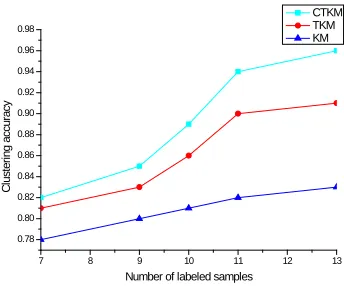
In order to eliminate the impact of the supervision information randomness, according to the five groups different sets of data , three kinds of algorithm each run 5 times to calculate the accuracy of clustering, and each run randomly generated the tagged data, a number of categories are defined as 3 , the experimental results as shown in figure 4:
7 8 9 10 11 12 13
0.78 0.80 0.82 0.84 0.86 0.88 0.90 0.92 0.94 0.96 0.98
C
lus
ter
ing ac
cur
ac
y
Number of labeled samples
[image:6.612.112.284.327.470.2]CTKM TKM KM
Figure 4: Clustering Accuracy
It can be seen by the experimental results of Figure 4: the improved algorithm of TKM and CTKM accuracy rate than KM increased significantly; taking into consideration the influence of the traction force between the data points, when the supervision information is small, the difference was not very obvious; With the increase in the supervision data, the gap of the accuracy rate between the algorithm is gradually widened, therefore, the influence of the tagged data to the untagged data has increased with the increase in the number. In addition, due to the closure replacement thinking adopted in the algorithm CTKM, isolated point can be accurately classified, the cluster effect is better.
5. CONCLUSION
In this paper, based on the thinking of semi-supervised clustering, we presents the closure
replacement improved K-means algorithm to solve the irregular cluster clustering. The algorithm takes advantage of a small amount of the supervised information of tagged data, introduces the traction impact factor between the data points, at the same time, with the center of the closure instead of the original sample points, to simplify the process of clustering, also to eliminate the limitations of the K-means on the irregular cluster clustering. Experimental results indicate that the improved algorithm is much more efficient and simple than other algorithms on the comparison of the two indicators of the NMI and clustering accuracy.
REFRENCES:
[1] Chin-Chun Chang, Hsin-Yi Chen, “Semi-supervised clustering with discriminative random fields”, Pattern Recognition, 2012, 45(12): 4402-4413.
[2] DoganayMC,Pedersen TB, SayginY, SavaşE, LeviA, “Distributed privacy preserving k-means clustering with additive secret sharing”, PAIS '08 Proceedings of the 2008 international workshop on Privacy and anonymity in
information society, 2008,3-11.
[3] Yeming Hu,Evangelos E. Milios, James Blustein, “Enhancing semi-supervised document clustering with feature supervision”,
SAC '12 Proceedings of the 27th Annual ACM
Symposium on Applied Computing, 2012,
929-936.
[4] Guobiao Hu, Shuigeng Zhou, Jihong Guan, Xiaohua Hu, “Towards effective document clustering: A constrained K-means based approach”, Information Processing and
Management, 2008, 44(4):1397-1409.
[5] M. Eduardo Ares, Javier Parapar, Álvaro Barreiro, “An experimental study of constrained clustering effectiveness in presence of erroneous constraints”, Information Processing
and Management, 2012, 48(3):537-551.
[6] Vid Podpečan, Miha Grčar,Nada Lavrač, “Semi-supervised constrained clustering: an expert-guided data analysis methodology”, PRICAI'10 Proceedings of the 11th Pacific Rim international conference on Trends in artificial
intelligence, 2010:219-230.
[7] Faußer S, Schwenker F, “Semi-Supervised kernel clustering with sample-to-cluster weights”, PSL'11 Proceedings of the First IAPR TC3 conference on Partially Supervised
[8] Tianhao Wu, Pottenger WM, “A semi-supervised active learning algorithm for information extraction from textual data: Research Articles”,
ALNLP '10 Proceedings of the NAACL HLT 2010 Workshop on Active Learning for Natural
Language Processing, 2010, 10-17.
[9] ChristianBöhm, Claudia Plant. HISSCLU: a hierarchical density-based method for semi-supervised clustering”, EDBT '08 Proceedings of the 11th international conference on Extending database technology: Advances in
database technology, 2008: 440-451.
[10] ConstantinopoulosC, LikasA, “Semi-supervised and active learning with the probabilistic RBF classifier”, Neurocomputing, 2008, 13-15(71): 2489-2498.
[11] Ruiz C, Spiliopoulou M, Menasalvas E, “Density-based semi-supervised clustering”,
Data Mining and Knowledge Discovery, 2010,