R E S E A R C H
Open Access
Constructing M&A valuation: how do
merger evaluation methods differ as
uncertainty and controversy vary?
Hyoung-Goo Kang
1, Wonseok Woo
2, Richard M. Burton
3and Will Mitchell
4** Correspondence:
4Strategic Management, Rotman
School of Management, Toronto, Canada
Full list of author information is available at the end of the article
Abstract
We investigate the idea that firms’choices of M&A evaluation methods are influenced by two socio-political factors that arise in the behavioral theory of the firm—uncertainty and controversy. In doing so, we investigate boundary conditions between arguments that expect firms to use financial analysis such as net present value as the primary tool and arguments that emphasize different forms of socio-political processes, often supplemented by subsequent financial analysis. We undertake exploratory qualitative analysis of multiple cases at a Korean chaebol, complemented by interviews with global deal-makers. The analysis highlights four approaches to M&A evaluation that vary with combinations of uncertainty and controversy: desktop valuation based on financial analysis, capability design using scenario-planning and goal-setting techniques, issue lists that identify conflicting goals, and storytelling methods that attempt to articulate compelling logics for a deal. The results suggest that M&A values are sometimes endogenously created as a result of the method that firms use to evaluate a deal. The work addresses and links two audiences: First, M&A scholars who often do not engage with the idea of socio-political processes but are open to the idea that there are important boundary conditions to the frameworks that are relevant when one does not do so. Second, scholars who do regularly engage with the idea of socio-political processes and are intrigued with determining how social constructs such as uncertainty and
controversy will shape particular types of decisions.
Keywords:Mergers and acquisitions, Valuation, Uncertainty, Controversy, Capital budgeting
Introduction
Research in finance, strategy, and management demonstrates that firms use multiple combinations and sequences of quantitative and qualitative methods to evaluate busi-ness acquisitions (Mellen and Evans 2010). Some approaches emphasize identifying the underlying financial value of a deal (Brealey et al. 2005; Ross et al. 2009) and then use qualitative assessment to reinforce the value in what Trice et al. (1969: 2) refer to as
“organizational ceremonials.”By contrast, other approaches suggest that socio-political context of a deal shapes initial construction of the qualitative value of strategic options followed by financial methods that justify or clarify the decisions (Trautwein 1990; Gaughan 2002; Koller et al. 2010; Bower 1970; Narayanan 1985; Maritan 2001; Graham
© The Author(s). 2018Open AccessThis article is distributed under the terms of the Creative Commons Attribution 4.0 International
and Harvey 2002; Graham et al. 2005); in this approach, financial valuations serve as the organizational ceremonials. Although we recognize that alternative sequences of qualitative and quantitative assessment exist, there are substantial gaps in our under-standing of the characteristics of different methods as well as what factors influence the choices (Bower 2001; Christensen et al. 2011). This paper investigates two socio-political factors that arise in the behavioral theory of the firm (Cyert and March
1963)—uncertainty and controversy—and seeks to determine how the types of M&A
evaluation methods that firms use vary with different combinations of the socio-political factors.
We emphasize uncertainty and controversy based on suggestions that the concepts will be relevant for the socio-political context of deal making, such as M&A evaluation. Bower (1970: 314), in particular, highlights these socio-political factors in capital bud-geting activities, noting that, “At least two kinds of problems exist” in attempting to undertake financial decision-making, including uncertainty and what Bower refers to as controversialism (in our terms, controversy). Uncertainty in the form that we focus on arises when decision-makers cannot specify reliable statistical parameter distributions, such as mean and variance, which would help estimate the value of a decision (Knight 1921; Boudreaux and Holcombe 1989; Epstein 2001); this is sometimes referred to as
Knightian uncertainty or as ambiguity.1 Knightian uncertainty differs from risk, for
which a reliable distribution can be described. In parallel, controversy arises when there are at least two strong coalitions with competing goals (Weick 1979; Coff 1999; Burton et al. 2015). Although these two socio-political factors may partly operate at the same time, uncertainty and controversy have sufficient independence for separate examin-ation (we discuss potential multicollinearity when addressing empirical issues in Stage 1 of the research design). Other factors also are likely to influence choice of evaluation methods, such as deal importance, firm size, and decision-maker experience, but uncer-tainty and controversy offer an empirically parsimonious and conceptually credible framing for the argument and analysis.
By examining the impact of uncertainty and controversy, we begin to unpack differ-ent aspects of Bower’s notion of socio-political processes in a way that helps investigate M&A evaluation. Acquisitions reflect substantial variation in uncertainty and social complexity (Cartwright et al. 1992; Cartwright and Cooper 1993). Investigating these two factors offers a starting point for clarifying how firms combine qualitative and quantitative M&A evaluation methods in different contexts.
We use ten semi-structured case studies to explore how variation in uncertainty and controversy influence choices of M&A evaluation methods. The cases include inter-views and archival data regarding potential acquisition targets at a Korean chaebol dur-ing the 2000s, together with supplemental interviews with M&A financial executives. Our qualitative empirical approach specifies framing concepts followed by triangula-tion plus within- and cross-case analysis to identify emergent concepts (Strauss and Corbin 1990; Eisenhardt 1989).
differences concerning who leads the evaluation process, in terms of both functional skill sets and use of external advisors to assist with deal evaluation.
Our research proceeded in three stages. In Stage 1 (identify independent variables), we identified multiple potential M&A targets within the chaebol and selected cases that reflected combinations of high and low states of uncertainty and controversy, based on information from a series of initial interviews. That is, in order to avoid sampling on the dependent variable (valuation methods), we sampled in terms of the independent variables (uncertainty and controversy) that we wanted to investigate in terms of how they influence choices of valuation methods. In Stage 2 (characterize dependent vari-able), we assessed the approaches that the chaebol used to evaluate each potential M&A deal. In Stage 3 (matching independent and dependent variables), we assess whether the evaluation methods tended to vary systematically across the combinations of uncertainty and controversy.
In this design, the unit of analysis is a deal, the independent variables are uncertainty and controversy (assessed in Stage 1), and the dependent variables (examined in Stage 2) are the evaluation methods the group used for deals with different combinations of uncertainty and controversy (matched in Stage 3). When we interpret the results, the types of evaluation methods that we identify arise as ex post categories, rather than preceding the analysis. Before explaining Stage 1, 2, and 3, the next section discusses the background of this paper.
Background
Gaps in understanding about M&A evaluation methods
M&As are critically important to corporate strategy and performance throughout the world (Capron 1999; Agrawal and Jaffe 2000). M&A evaluation commonly involves combinations and sequences of quantitative and qualitative assessment. The most basic approach is financial assessment of whether two firms are more valuable jointly than separately, after estimating discounted cash flows and exposure to systematic risks (Brealey et al. 2005; Ross et al. 2009). In other cases, though, M&A evaluation reflects socio-political factors that are not included in straightforward financial valuation models (e.g., Trautwein 1990; Haspeslagh and Jemison 1991; Capron et al. 1998; Bower 2001). Our goal is to find points of convergence and difference among financial and socio-political perspectives on M&A evaluation methods, in order to identify a more general understanding of the types of M&A evaluation tools that firms use and when particular tools are most common. We focus on uncertainty and controversy as factors that will shape abilities to estimate joint versus separate values (Gaughan 2002; Koller et al. 2010; Uhlaner and West 2011).
Orienting proposition
while leaving room for new ideas to emerge when there is enough conceptual back-ground that fully inductive work is not necessary.
As we noted above, behavioral theory suggests that uncertainty and controversy shape major decisions. Uncertainty limits actors’ability to undertake focused financial analysis, turning attention instead to qualitative tools (e.g., Cyert and March 1963; Bower 1970; Eisenmann and Bower 2000; Bower and Gilbert 2005; Stirling 2010) such as scenario building (e.g., Nishimura and Ozaki 2006; Caballero and Krishnamurthy 2008). In parallel, controversy about major goals limits the utility of primary analysis, instead causing decision-makers to emphasize negotiation and building coalitions to support desired objectives (e.g., Giddens 1979, 1984; Weick 1979; Tjosvold & Deborah 1980; Tjosvold 1985; Eisenhardt and Zbaracki 1992; Wall and Callister 1995; Nutt 1998; Holmstrom and Kaplan 2001; Kaplan 2008). These two concepts are likely to shape firms’choice of M&A evaluation methods, although it is not immediately clear what form the evaluation methods will take. Appendix 1 outlines ideas from relevant strategy and organizational literatures about how uncertainty and controversy are relevant for studying M&As.
We focus on uncertainty and controversy as general concepts.2Clearly, one could elab-orate on each concept. Within the definition of uncertainty as an actor’s inability to specify a reliable distribution, other aspects of uncertainty can reflect elements such as complexity, volatility, unknowable versus unfamiliar, differences in ability to parameterize across actors, and differences in understanding of the elements of uncertainty (Knight 1921; Keynes 1921; Boudreaux and Holcombe 1989; Gilboa and Schmeidler 1989). Several scholars argue that firms frequently attempt to avoid uncertainty (Cyert and March 1963; Schmeidler 1989). Within the general definition of controversy as the presence of compet-ing goals among coalitions, meanwhile, controversy may involve differences in ranges of stakeholders and potential compatibility or incompatibility of goals among executives, variations in power, depths of beliefs, and differences in understanding of the relevant dimensions (Tjosvold and Deborah 1980; Tjosvold 1985; Eisenhardt and Zbaracki 1992). Related concepts include controversy in Hobbes (1651), Coase (1946), and Rawls (1971); conflict in Cyert and March (1963); controversialism in Bower (1970); alignment of inter-ests between principals and agents (Jensen and Meckling 1976; Holmstrom and Tirole 1989); opportunism, information impact, and information asymmetry (Akerlof 1970; Williamson 1975); and organizational politics (Cyert and March 1963; Pettigrew 1973). Such multi-dimensionality of the concepts of uncertainty and controversy is beyond our empirical range and, importantly, is often beyond the scope of the fac-tors that decision-makers address in practice.
benchmarks by which to assess financial output or even to use financial models. We will use the orienting proposition as a base from which to explore the types of methodologies that arise as uncertainty and controversy vary.
Empirical context: Korean chaebol
For the empirical exploration, we identified a Korean chaebol that evaluated multiple po-tential M&A targets during the 2000s. From 2010 through 2012, we started from personal networks to reach executives at the chaebol (two authors have investment banking, con-sulting, and chaebol experience), which helped develop a rich understanding of potential deals and the evaluation methods the firm used for individual deals. We study multiple cases of M&A within a single chaebol in order to control firm-level variation of factors such as culture and governance, so that we can focus on the effects of varying uncertainty and controversy. Additional interviews with investment bankers, lawyers, and accountants with extensive M&A experience at the focal chaebol and across global markets supple-mented the cases. The case study design derives from the qualitative procedures for grounded theory suggested in Strauss and Corbin (1990) and Bettis et al. (2015). In total, the interviews and data acquisition took about 3 years to carry out.
Chaebols are relevant organizations in which to study decision-making because of their size, scope, and global influence (Chang 2003); Appendix 2 provides more details about chaebols. Our subject chaebol has a strongly shared culture among its employees and businesses. The chaebol has a central think tank (which is common among major chaebols), plus long-standing systems in charge of managing shared culture across subsidiaries. The shared culture helps minimize affiliate-specific effects; indeed, a sim-ple ex ante expectation would be that members of the chaebol would use the same evaluation techniques for all potential deals.
Stage 1: identifying variation in uncertainty and controversy (independent variables)
Case selection had three steps: (1) identifying respondents, (2) initial assessment of uncertainty and controversy, and (3) iterating the process to converge on clear-cut assessments. First, we identified executives who were aware of the deals that the chae-bol had considered from 2000 to 2012. We began with personal contacts and then expanded to executives the first contacts suggested.
they differentiated between high and low states. In the cases where we did not explicitly define the concepts in the beginning, we judged the high and low states based on their description of the deal. From the interviews, we identified cases with combinations of high and low states of uncertainty and controversy, based on the descriptions that the interviews provided.
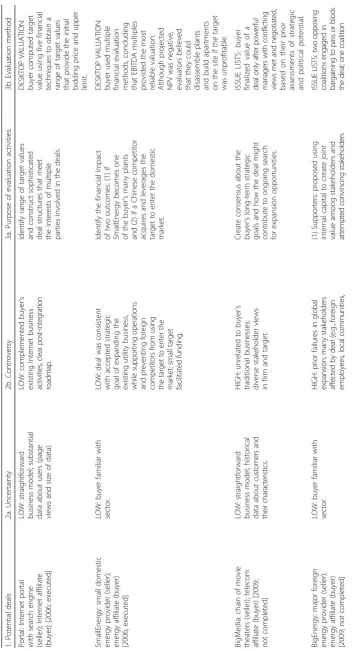
Table 1 summarizes the cases. Column 1 lists the cases, while columns 2a and 2b summarize uncertainty and controversy status based on the interviews in Stage 1. Columns 3a and 3b summarize the evaluation methods (we discuss the evaluation method labels in column 3b when we describe Stage 2 below.)
The ten targets, which were evaluated by five different affiliates of the chaebol,
in-clude a mix of opportunities: Portal (web portal with an established search engine),
SmallEnergy(domestic utility company),BigMedia(chain of movie theaters), uppose Bi-gEnergy (foreign utility), Chip (global semiconductor player), Apparel (small fashion
company), SNS (early social network service), Card (domestic credit card business),
BigMobile(US wireless operator), andSmallMedia(media content specialist). Together, the cases provide a strong base for studying M&A evaluation methods. The cases pro-vide relevant combinations of uncertainty and controversy. They also propro-vide enough information to permit a rich study that assesses the core concepts, while allowing ideas to emerge from the investigation. Information about evaluation processes—the dependent variable—emerged from the interviews during Stage 2 of the research.
Independent variables: assessing uncertainty and controversy
The following discussion addresses how we measured the independent variables, that is, the extent of uncertainty and controversy for each case. This is a form of within-case analysis (Eisenhardt 1989). We triangulated the analysis with multiple interviewees and archival documents. We determined the extent of uncertainty based on how reli-ably the acquiring firm believed it could assess the nature of the target’s capabilities as well as the opportunities in the market for which the capabilities would be used (i.e., the extent to which the firm could or could not assign a probability distribution to the value of the deal). In turn, we determined the extent of controversy based on what the respondents told us about the degree of consensus within the buyer about the value of the potential target’s capabilities and about how the buyer might use them if it were to complete the deal.
Low uncertainty and low controversy
Several quotations from the interviews illustrate that uncertainty and controversy were low in Portal and SmallEnergy. The managers in charge of the Portal deal assessed un-certainty in terms of “whether it is easy to quantify the combined value of the target
and the deal.” They concluded that uncertainty was low because“page views and user
size inform the value of the target and synergy.”The target’s main capability (a search engine) did not overlap with the buyer’s capabilities, so that“simply adding the users in
the target and the buyer” could approximate the number of users and value of the
Table 1 Case summary: deals, uncertainty and controversy, evaluation purpose, and evaluation methods (Continued) 1. Potent ial deals 2a. Uncert ainty 2b. Contro versy 3a. Purpose o f evaluation activ ities 3b . Evaluation me thod SNS : early soc ial network servic e (selle r); Interne t affi liate (buyer) [2003; exec uted] HIGH: unf amiliar with social net work services. LOW: legitim ate solution to internal pressure to add services to parent ’ s new ly laun ched po rtal an d help ex pa nd it s us er ba se ; su ff ic ie nt in te rn al ca pi ta l. Cre ate an d ass ess st rategic opport unities, usin g scenarios in whic h Tar get value = Co nstant × (# of cust omers)
2;“
believed was “essential in becoming a market leader.” Thus, all key managers at the buyer welcomed the deal.
From the interviews about Portal:
Low uncertainty: “We combined the number of the target’s and our page views for
valuation. They did not overlap much because users use two sites for different pur-poses.” “We had a large number of log-in users, while the target’s search engine had many visitors. The combined business model is very easy to conceptualize. The value proposition of our new portal was straightforward.”
Low controversy: “We had tried to develop our own search engine in vain. … We
needed that capability to make our portal successful. …The target had a good search
engine.” “We had strong communities and social networks. A search engine was the
only missing part.” “The target’s search engine would allow us to enter the market for search ads.” “Less than 30% of our log-in users had used our search engine before the
merger. …Our log-in users had created a lot of contents, but could not access them
through search engine.” “Neither we nor the target were market leaders. We needed to
work together to overtake the market leader.”
Interviewees for the SmallEnergy deal assessed uncertainty in terms of“familiarity of the business.”The buyer and the target were in the same sector, but, although the deal was important to the affiliate because it would help advance the top management
teams’ strategy, the target was smaller than the buyer. As such, the perceived
uncer-tainty was low. Controversy was low because the deal would be easy to finance and be-cause there was consensus about the strategic value of the deal. The interviewees believed the deal was necessary “in order to become a global player” in line with the firm’s strategic goals and “to prevent foreign competitors from using the target as a
stepping-stone to entering the domestic market.” Interestingly, despite the pre-deal
consensus, an interviewer now regrets the deal, telling us that “we should not have
acquired [SmallEnergy]”owing to difficulties in generating value from its resources. From the interviews about SmallEnergy:
Low uncertainty: “The target was a small company and in the same sector as ours.”
“The target was just like one of our plants. There was no uncertainty.” “It was likely that we would lose some money with the target, but the target was clearly at strategic
position.” “There were many ways to convince the government about anti-trust dispute
in the deal.”
Low controversy: “Unless one of our domestic players buys the target, foreign firms
will buy it and become a competitor. Our firm is the market leader, so we had to buy
it.” “We expected the deal would consolidate our leadership in the domestic market
and position us as a global player in line with our vision.” “Being a major player in the oil industry, we could facilitate our many activities like financing, alliance, and bargain-ing.” “We would leverage the target to enter Chinese market as we planned.” “The tar-get had made too much noise in domestic market with disruptive marketing activities.
The acquisition would stabilize the domestic market and marketing practices.” “The
target is close to the biggest domestic market; thus, after the acquisition, we would not have to transport our products from remote plants.”
High uncertainty and low controversy
uncertainty in terms of experience and cultural differences. The buyer had little experi-ence in design, but the target had strong capabilities. This made it difficult to assess the value of the deal quantitatively. Cultural fit was another concern: “We are a big firm with collective culture, while the target consisted of designers, artists, and people with
a small-firm mindset.” The interviewees assessed controversy in terms of the
percep-tion that value-chain complementarities existed. There was an internal consensus that
“we should develop an in-house design capability to enter the Chinese market and
be-came a prominent fashion house. The target possessed the needed design capability.”
Therefore, the deal produced little controversy. From the interviews about Apparel:
High uncertainty: “We acquired the target in order to obtain their design capabilities. It is almost impossible to conduct valuation for its design capabilities quantitatively.”
“We knew fashion design was full of uncertainties. So, we neither modeled nor
esti-mated future cash flows.” “We were in a hurry to complete the deal in 25 days. So, we did not have the time to do a detailed financial analysis or to prepare potential uncer-tainties about cultural issues with the target’s designers.” “Our goal was to enter global fashion markets, but the financial crisis added significant uncertainties.” “Designers’ emotion and feeling mattered to accomplish a successful integration.” “People were less confident with acquiring a firm in a different sector. Many doubted whether we could handle the deal and integration.”
Low controversy: “Top managers in our holding company joined the deal process
and sponsored it from the beginning.” “Everyone fully knew why we needed the design
capabilities of the target.” “There was no controversy in and out of our firm. Everyone
cheered the deal.” “We want to become a brand player like LVMH or Chanel. Design
capabilities, especially for couture, play an essential part in the value chain to accom-plish our vision.” “We did not have design capabilities for globalization, while the target lacked resources to expand its design capabilities into the global market. We were a
perfect match.” “Few people objected to the deal, but many worried what to do after
the integration.” “Globalization in fashion business requires design capabilities.” The interviewees for the Card deal assessed uncertainty in terms of global uncertainty in the financial sector, lack of experience, and concern about backlash from
competi-tors. They assessed controversy in terms of “fit with traditional and long-term goals
and with behaviors of existing customers” (i.e., whether the knowledge about the
target’s card users would enhance returns from the buyer’s customers). Most of all, the urgency to increase average revenue per user (ARPU) in the mature domestic wireless market pushed the buyer to brainstorm for new services, such as combining mobile and financial services (cross selling). This meant high uncertainty and low controversy within the firm.
From the interviews about Card:
High uncertainty: “The target did not have large credit card users. We needed to
evaluate our capabilities of increasing the card users.” “We had tried mobile finance services before, but failed. To create synergy with the target, we should introduce new
and even untested services.” “Our competitors were making the same effort. Handset
the financial sector could increase the uncertainty of all Chaebol subsidiaries, especially when financial crisis emerged.”
Low controversy: “The more people use smart phones, the more the financial
func-tions matter to mobile services. We needed to move first.” “As the wireless market
became saturated, we needed to find a new source of revenue to increase ARPU. We needed out-of-the-box thinking.” “We had tried to enter the credit card business for a long time.” “Credit service would lower churn rates.” “Given our marketing costs, the
deal was not a big expense.” “Our database on mobile and membership card users will
create synergies with credit card users.”
The SNS interviewees regarded uncertainty as high because “the target’s business
model was innovative and Internet users were unpredictable.” They regarded
contro-versy as low because top managers at the holding company all saw innovation at the
target. “We had invested many resources to find innovative services and to become a
leader quickly.” While the target’s business model was difficult to comprehend, there was agreement that this might have large potential for the buyer’s future; interestingly, controversy was low because uncertainty was high. The target also had a large number of users that stakeholders at the buyer needed.
From the interviews about SNS:
High uncertainty:“Suppose you saw Facebook 10 years ago. Do you think you would
have understood the business model?” “It is one of the first serious social networking services. Few could comprehend what we could do with it and how to generate cash flow.” “Tastes of Internet users are unpredictable anyway.”
Low controversy: “We desperately needed an engine for growth.” “Although it was
difficult to understand the business model, we felt there might be something innovative. The uncertainty in the business model actually minimized controversy. Experts and
visionaries’opinions mattered more.” “We needed an investment opportunity in which
we could spend our resources. Abundant internal resource must have driven valuation process.” “We had pressure from the top to deliver something.” “We entered the portal market late, so we had to acquire an established player like SNS.” “They had many on-line communities while we had none.” “It cost just seven million dollars to acquire it.”
“The target’s social networking services and our existing portal may conflict, but could be complementary as well.”
Low uncertainty and high controversy
Several quotations from our cases illustrate the combination of high uncertainty and low controversy in BigMedia, BigEnergy, and Chip. The interviewees about BigMedia assessed uncertainty in terms of industry dynamics. The target operated a movie
the-ater chain. The interviewees regarded the sector as “saturated and well known.” The
market share of competing firms had remained constant for several years. Interviewees
assessed controversy in terms of “how the business fit our vision, what disagreements
we have then, which strategies to take in order to use the target to enter the Chinese market, and how stock analysts might react.”
From the interviews about BigMedia:
High controversy:“There was not much uncertainty, which may imply fewer opportun-ities. That was the cause of much controversy in the deal.” “The sector was mature, not
good for our growth strategy.” “Movie chains can be valuable in entering the Chinese
market, but I wonder whether they are in line with our traditional business.” “Post-merger
strategy was unrealistic to the managers in charge of implementation.” “The vision
seemed convincing, but it would be very hard to implement.” “The target was only a
minor player in the sector. Its market share was shrinking. It required business-group-level marketing coordination to turn around the target after the deal.” “Stock analysts were highly skeptical about the deal. Our stock price in fact rose after our bid failed.” “We should not propose a deal without considering execution in great detail, although some would disagree.” “The stakeholders of the target were very heterogeneous with different interests.” “Entertainment is not in our path.” “It was unrealistic to use the target to enter a foreign market. Would foreign competitors sit idly?” “Our team would have to take over the business if the deal succeeded. The plan would simply put us on the brink. The deal may be profitable, but we should consider the implementation and operation parts more seriously. Deal makers and we have very different incentives.” “Our conservative culture
was at odds with many merger deals.” “Subgroups in our traditional businesses did
not like entering this type of new area. They argued that such deals would reduce our capabilities in key sectors.”
Interviewees about BigEnergy assessed uncertainty in terms of whether the buyer had experience in the target sector. The interviewees perceived uncertainty as low because the target and the buyer were in the same sector. Interestingly, the interviewees also assessed controversy based on their past experience. The buyer had experienced little success in global markets, which made the deal controversial in the organization. In addition, the target had many stakeholders, including foreign employees, local commu-nities, foreign governments, and other consumer groups, which added further layers of controversies to the deal.
From the interviews about BigEnergy:
Low uncertainty:“We and the target were in the same sector.” “It was easy and famil-iar for us to valuate oil refinery firms.” “We knew that the boom of oil business would be short. Refinery business will be difficult until 2015 or 2020.” “The technology for re-finery is not special.” “There were not many rooms for synergy. It would be certainly difficult to come up with an innovation to make the target suddenly more productive. These commodity products did not allow visible synergy. The target had few employees either, so the benefit from restructuring would be minimal.”
High controversy: “Most of our attempts to expand globally have failed until now.”
“It was unclear how to address the challenges of managing foreign employees,
commu-nity, local government, and other stakeholders in the deal.” “Our CEO made a very
judicious decision in the middle of heated debates and conflicting views, by balancing different opinions and fostering negotiations, even though he had preferred entering
the North American market.” “Some managers chase deals without worrying about
post-merger integration. Some managers are very cautious on deals because they have
to implement them. People’s different incentives generate controversies as this deal
demonstrated.” “While top managers and their aides are eager to find a deal, operations
managers are very cautious.” “Operations managers and minor shareholders are
player by acquiring North American players.” “A huge amount of internal capital in-creased the level of controversy about how to use the internal capital: big projects vs. payout.” “Deal brokers such as M&A boutiques were good at reading the minds of top managers. However, many suspect that deal brokers tend to propose deals for their own interest only.”
Interviewees about Chip assessed uncertainty in terms of the target’s future strategy and the characteristics of global semiconductor industry. The interviewees perceived uncer-tainty as low because being a smart follower is the clear strategy for the target; the semi-conductor sector is business-to-business, so that marketing and sales are less subject to the whim of high tech retail consumers, and the monitoring and support from external stakeholders such as creditors and the government can reduce uncertainties. On the other hand, controversy is high. The deal was regarded as “one of the most significant in the history of our group,”such that the deal could strongly influence the future of the chae-bol. There were internal controversies about whether the deal was to create synergy or to find new growth opportunities. There were external controversies about whether the deal was a special favor of the government to the chaebol and whether premiums would reflect the interests of both internal and external stakeholders.
From the interviews about Chip:
Low uncertainty: “The target has done well even without financial and technological
capabilities. They can continue what they have done. In addition, with our resources, it can succeed further.” “The target can simply follow the strategy of Samsung, the leader
of the semiconductor sector.” “Being a smart follower is simple compared with other
strategies.” “The semiconductor business is less uncertain than other high tech busi-nesses such as smart phones. The former is business-to-business while the latter is for retail customers.” “The subject had been in the M&A market more than 10 years. We examined the subject and had prepared the deal for a very long time. We set up a team internally to research the subject and potential deal. We received a lot of external consulting and advice.” “It is not a cross border deal.”
High controversy:“Top managers had substantial differences of opinions. Such differ-ences were discussed and addressed at the very high level of managers. The deal did not go through low-level processes to balance the differences.” “While the deal has low uncertainty, it has high controversy. Low uncertainty implies clear pros and cons about the deal; that clarity generates controversy.” “This is one of the most important deals in the history of our group. This can change our future significantly. We had substantial differences of opinions. This is not surprising.” “This is serious unrelated diversification. The key issue was whether the subject would enhance the resource and capability of our entire business groups.” “If the premium we pay is too low, people will regard this deal as the preferential treatment of government. If the premium is too high, internal objections will be stronger despite the will of top executives.” “This deal will make us a
global player suddenly. Does it correspond to our vision?” “We needed to determine
whether the deal would generate synergy or find new growth opportunities.”
High uncertainty and high controversy
ramifications of such large financing, how to structure the deal or syndicate compos-ition, and how foreign governments would respond. The interviewees also considered controversy based on their past experience. Little experience of success in global mar-kets made the deal controversial. In particular, a similar deal by the firm had recently failed, so that starting the new deal generated large controversy in the buyer. In addition, the interviewees assessed controversy based on the number of stakeholders in the target. Since the target had gone through a merger and was being integrated, its organizational culture and governance were complex. Foreign governments thought that the target was important in national security. There had been debates about whether the deal would present the best use of their resources and capabilities.
From the interviews about BigMobile:
High uncertainty: “We were not confident enough to manage the target after the
deal.” “There would be many uncertainties in raising such a large amount of funds.”
“Even if the deal had succeeded, we would have faced regulatory uncertainties because
the target owned significant national infrastructure. We did not know how new
admin-istrations would change policy and how public opinions would change.” “The deal was
too large. I was not sure whether we had the capabilities to manage the integration process.” “I do not believe we had the capabilities to structure the deal for our best
in-terests.” “The economy was about to downturn. There was significant macroeconomic
uncertainty.” “We did not know much about the culture and the industrial norm of the
target.”
High controversy: “We failed a greenfield strategy as a mobile virtual network oper-ator (MVNO) recently. We sold the venture. Would it be wise to invest in the same
market in order to acquire an MVNO player?” “Without any experience of success in
global expansion, I was not sure whether we could convince people to agree on such a large investment.” “The target is twice the size of our company. It would be very
diffi-cult to convince our shareholders and other stakeholders.” “How could we convince
the foreign government to allow us to buy the significant national infrastructure?” “The target was a complicated entity because it merged with its large competitor recently
and operated two separate wireless networks.” “The deal would consume our internal
resources, which we could use more productively in other ways.”
The interviewees about SmallMedia assessed uncertainty in terms of how familiar the buyer was with the target’s culture, sector, prospect, and strategies. The target produced entertainment content, a sector that was “volatile and relied on several key people.” A trend of industry convergence added further uncertainty. Moreover, the buyer had little experience in the sector. Thus, interviewees regarded uncertainty about the deal as high. The interviewees assessed controversy with“cultural fit, investment horizon, and governance”issues. Many people within the firm believed that the entertainment sector might not fit with the buyer’s conservative culture and its impatience with long-term
investment. Many people worried that it might be a bad idea to“allow much discretion
to the existing management of the target”as the deal specified. From the interviews about SmallMedia:
in the already uncertain entertainment sector.” “It was almost impossible and meaningless to evaluate the uncertainties in contents and entertainment sector financially! That would require too many variables and assumptions.” “The target could lead us to prepare the convergence of communication and broadcasting, the path of which was still uncertain.”
“How to build the capabilities of star management and production with the target was the most uncertain but important factor in the deal.” “The target should become instrumental in our global strategies although we would develop a more detailed road map later.”
High controversy: “Our telecom businesses tend to be conservative toward risks,
which contrasted the target’s business model and culture.” “Investments in visual and audio contents required our patience. Long-term investment was required, and profit
would remain low for a long time.” “I was not sure whether the target could produce
contents suitable for our mobile users. I was not sure whether it was our priority to
be-come a media and entertainment company.” “We had promised not to intervene with
the management of the target, but such nonintervention might hamper building our capabilities, the very purpose of this deal.” “We expected many conflicts and controver-sies during integration process between the target’s and our people.”
Empirical issues in Stage 1
Combinations of uncertainty and controversy
The four combinations of uncertainty and controversy reflect different mixes of beliefs about probability distributions. With a more fine-grained measurement of uncertainty and controversy (e.g., high, middle, low), we would have needed a substantially larger number of cases and interviews to carry out the research. Fortunately, we were able to identify cases that reflected clear differences in levels of high and low uncertainty and controversy.
We conducted at least two interviews per case. In total, we discussed 13 potential deals with 41 people. The face-to-face interviews occurred from March 2011 through July 2012. Less formal email and telephone interviews that complemented the face-to-face interviews occurred during the following year.
We used three criteria to select target cases from the set of deals we discussed with re-spondents. (1) We selected a mix of cases with high and low uncertainty and controversy, based on the information from the first stage interviews. (2) We assessed the importance of a case to the chaebol based on discussions during the interviews; we wanted cases with sufficient financial value and/or extensive media attention to have substantive importance to the firm and receive substantial corporate attention. (3) We selected cases only when we could find reliable interviewees and could gain supplemental access to internal archival information about the deals.
We followed guidelines for semi-structured interviews (Huber and Power 1985; Yin 1985). We sent questions to our interviewees beforehand via e-mail and supplemented face-to-face interviews with phone and e-mail. In-person interviews in Korean lasted about 2 hours. Two thirds of the interviews occurred in the interviewees’office, while the others occurred in restaurants at the suggestion of interviewees. Two authors attended about one third of the interviews together; the other interviews were one-on-one meetings that we later reviewed together. We could not record interviews because
We collected archival information to cross-check the interviews. We requested in-ternal documents from the interviewees. We gathered information from the press, books, case studies, and analyst reports in both English and Korean. The archival infor-mation helped structure interview questions and to triangulate whether the comments were consistent with the documented information. As follows, we explain how we address specific empirical challenges.
Independence of uncertainty and controversy (potential multicollinearity)
The question arises of how often uncertainty and controversy arise independently of each other. We recognize that high uncertainty can be a source of controversy. In the BigMobile case {high uncertainty, high controversy}, the global financial crisis generated uncertainty and may be one reason why people had controversies about the timing of investment. In the SmallMedia case (also {high, high}), concerns about cultural conflict were the source of controversy in the valuation process; the cultural concerns appear, in part, to reflect inex-perience in the media sector, which was also the source of uncertainty. As we note above, though, we found multiple off-diagonal cases that we could use for the analysis ({low, high}: BigMedia, BigEnergy, Chip; {high, low}: Apparel, SNS, Card).
Nonetheless, it is possible that such off-diagonal cases are outliers. Suppose the chae-bol had engaged in 100 deals, and only six of them were {high uncertainty, low contro-versy} or {low uncertainty, high controcontro-versy}, our interpretations would still be accurate but would apply in relatively rare circumstances. Fortunately, although we could not determine precise distributions, the interviewees told us that there were a substantial number of cases with {high, low} and {low, high} uncertainty and conflict.
The frequency of off-diagonal cases arises for two reasons. First, the chaebol often seeks high uncertainty deals (due to the new opportunities that such deals provide), particularly deals where there is substantial agreement within the company about the value of pursu-ing the M&A (i.e., low controversy). The followpursu-ing quotes reflect this point:“We know we need to undertake deals to find innovation opportunities [low controversy] although such deals are full of uncertainties [high uncertainty].” “Everyone agrees [low controversy] that we should do some moonshot projects [high uncertainty].” “We agree that we should find our next food [low controversy] in highly innovative deals [high uncertainty].” “We (the chaebol) recognize that we have grown [low controversy] by undertaking M&A deals with extreme uncertainties in the history of Korean business [high uncertainty].”
Second, {low, high} low uncertainty and high controversy deals often reflect organizational issues within the chaebol, such as differences among managers in different business areas. Chaebols are highly diversified business groups in which managers are keen to protect themselves from others who might encroach on their business area. The following quotes illustrate this point: “We are not interested in many (financially) clear deals [low uncertainty] if the deals are not consistent with our goal [high controversy].”
“Some [straightforward] deals [low uncertainty] can generate many debates if they are
linked with organizational issues such as roles and responsibilities [high controversy].” In sum, the variables may correlate, with uncertainty sometimes leading to controversy. Nonetheless, our data have three cases with each off-diagonal combination of uncertainty and controversy. Moreover, the interviews suggested that such cases are common.
Other issues in data collection
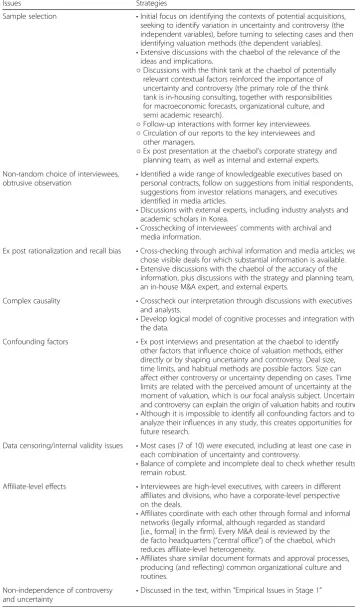
observation, ex post rationalization and recall bias, complex causality, the possibility of confounding factors, and data censoring. Table 2 summarizes how we address these issues. In addition, Appendix 3 describes why uncertainty and controversy are unlikely to correlate with other factors that might drive M&A evaluation methods, such as relatedness v. unrelatedness and cost v. revenue synergies; this means that our interpre-tations based on variation in uncertainty and controversy should have only limited bias arising from such omitted variables. No set of strategies can achieve complete confi-dence in any research—whether qualitative or quantitative—but we believe that these steps provide reasonable reliability in the results.
We sought to validate the concepts and implications with knowledgeable experts throughout the research activity and cross-checked information with archival records. We circulated our reports to the key interviewees (Laamanen and Wallin 2009) and then asked them for further opinions. These processes can lessen ex post rationalization bias and help triangulate our analysis. One of the authors has held an advisory relationship with the chae-bol for several years. He meets top managers regularly and interacts with the corporate HR team. This relationship facilitated our data collection and triangulation process. We also discussed our concepts and initial interviews at a think tank meeting of the chaebol in 2011, with an audience of think tank researchers, executives, and external experts such as professors and consultants; their comments helped refine our interpretation.
We conducted interviews with an in-house expert, a former investment banker who
has acted in many of the chaebol’s M&A deals since 2003. We asked him about our
interpretations, comments from interviewees, and results. His feedback pointed us to additional interviews.
We assessed reliability in two ways. First, we presented our preliminary results at the cor-porate strategy and planning team (CSP) of the chaebol (May 2012). CSP team members and external experts with consulting relationships attended our presentation; the presenta-tion and post-presentapresenta-tion interacpresenta-tions allowed internal and external experts to comment on whether our interpretations are correct. Second, as we noted above, we gathered archival information from media articles and internal records. These steps help ensure that the information we received is accurate and that our interpretations are reliable.
The cases include a mix of deals that reached completion (seven cases) and were not executed (three). In the three incomplete deals, we could observe the valuation methods used until the project was abandoned, but it is possible that the chaebol might have used additional methods if the acquisition had moved forward, which raises an issue of data cen-soring. Therefore, we ensured that each combination of uncertainty and controversy had at least one completed deal. On the other hand, it is desirable to consider both incomplete and executed deals, to ensure that there is no completion bias. All three incomplete cases involved high controversy; in itself, this is an intriguing pattern suggesting that controversy is particularly difficult to overcome, which provides an opportunity for future research.
Stage 2: identifying M&A evaluation methods (dependent variables)
Table 2Empirical issues in qualitative research and strategies to address
Issues Strategies
Sample selection •Initial focus on identifying the contexts of potential acquisitions, seeking to identify variation in uncertainty and controversy (the independent variables), before turning to selecting cases and then identifying valuation methods (the dependent variables). •Extensive discussions with the chaebol of the relevance of the
ideas and implications.
○Discussions with the think tank at the chaebol of potentially relevant contextual factors reinforced the importance of uncertainty and controversy (the primary role of the think tank is in-housing consulting, together with responsibilities for macroeconomic forecasts, organizational culture, and semi academic research).
○Follow-up interactions with former key interviewees.
○Circulation of our reports to the key interviewees and other managers.
○Ex post presentation at the chaebol’s corporate strategy and planning team, as well as internal and external experts.
Non-random choice of interviewees,
obtrusive observation •
Identified a wide range of knowledgeable executives based on personal contracts, follow on suggestions from initial respondents, suggestions from investor relations managers, and executives identified in media articles.
•Discussions with external experts, including industry analysts and academic scholars in Korea.
•Crosschecking of interviewees’comments with archival and media information.
Ex post rationalization and recall bias •Cross-checking through archival information and media articles; we chose visible deals for which substantial information is available. •Extensive discussions with the chaebol of the accuracy of the
information, plus discussions with the strategy and planning team, an in-house M&A expert, and external experts.
Complex causality •Crosscheck our interpretation through discussions with executives and analysts.
•Develop logical model of cognitive processes and integration with the data.
Confounding factors •Ex post interviews and presentation at the chaebol to identify other factors that influence choice of valuation methods, either directly or by shaping uncertainty and controversy. Deal size, time limits, and habitual methods are possible factors. Size can affect either controversy or uncertainty depending on cases. Time limits are related with the perceived amount of uncertainty at the moment of valuation, which is our focal analysis subject. Uncertainty and controversy can explain the origin of valuation habits and routines. •Although it is impossible to identify all confounding factors and to
analyze their influences in any study, this creates opportunities for future research.
Data censoring/internal validity issues •Most cases (7 of 10) were executed, including at least one case in each combination of uncertainty and controversy.
•Balance of complete and incomplete deal to check whether results remain robust.
Affiliate-level effects •Interviewees are high-level executives, with careers in different affiliates and divisions, who have a corporate-level perspective on the deals.
•Affiliates coordinate with each other through formal and informal networks (legally informal, although regarded as standard [i.e., formal] in the firm). Every M&A deal is reviewed by the de facto headquarters (“central office”) of the chaebol, which reduces affiliate-level heterogeneity.
•Affiliates share similar document formats and approval processes, producing (and reflecting) common organizational culture and routines.
Non-independence of controversy and uncertainty
contacted relevant managers and helped us to arrange interviews. Each interviewee also recommended other experts. In total, we spoke with 21 executives at this stage of the research, including 13 people who had not participated in Stage 1 of the research.
We also undertook 11 supplemental interviews: five with management consultants from three management consulting firms; three with the heads of the investment bank-ing divisions of global banks that are leadbank-ing M&A book runners, underwriters, and ad-visors; two with senior executives from a law firm; and one with a local accounting firm that is actively involved in M&A deals. The interviewees had M&A experience with our subject chaebol as well as with many other deals. These discussions extended our understanding of different evaluation methods. The supplemental interviews and comments became part of our content if they included relevant information about our ten selected deals.
The categorization process for the M&A evaluation methods proceeded as follows. Based on the information we gained from interviews and archival material, we sought to identify categories of M&A evaluation methods as emergent concepts. The categorization procedure involved discussions among the authors, using our judgment about what char-acteristics were relevant to associate with each other. We also discussed the information from the interviews with knowledgeable industry analysts, to help refine our judgement. We found that it was possible to create four categories that clustered around common as-pects within each category and substantial differences of characteristics across categories.
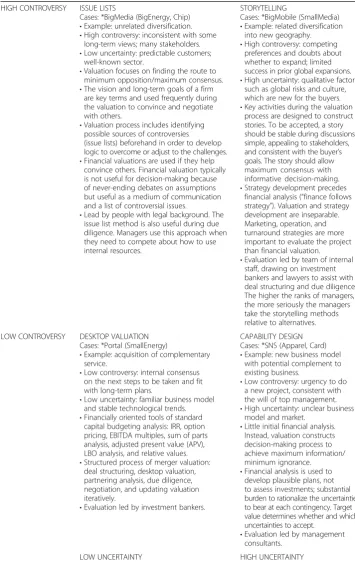
As we note in Table 3 and discuss below, we labeled the four cells as desktop valu-ation, capability design, issue lists, and storytelling methods. This labeling took place during Stage 2 of the research, when we investigated evaluation methods that the chaebol used for the cases. We settled on four categories of evaluations methods for two reasons. First, the data settled into the comparative categories, as we discuss below. Second, as in the choice for measuring uncertainty and controversy, additional variety in measuring evaluation methods would have required substantially more cases and interviews. Fortunately, the data provide meaningful implications with this measurement approach.
The next subsection describes the information that our interviewees provided for each of the ten deals and discusses the identification of the four evaluation methods. We group similar quotes of interviewees that reflect patterns within the cases. We reinforced the analysis with multiple interviews and archival documents.
Desktop valuation
The buyer estimated revenue in two steps. First, it estimated the change in page views and log-in users after the merger. The buyer had a large number of log-in users but had a weak search engine. Portal had a small number of log-in users but owned a
Table 3M&A evaluation with different combinations of uncertainty and controversy
HIGH CONTROVERSY ISSUE LISTS
Cases: *BigMedia (BigEnergy, Chip) •Example: unrelated diversification. •High controversy: inconsistent with some
long-term views; many stakeholders. •Low uncertainty: predictable customers;
well-known sector.
•Valuation focuses on finding the route to minimum opposition/maximum consensus. •The vision and long-term goals of a firm
are key terms and used frequently during the valuation to convince and negotiate with others.
•Valuation process includes identifying possible sources of controversies (issue lists) beforehand in order to develop logic to overcome or adjust to the challenges. •Financial valuations are used if they help
convince others. Financial valuation typically is not useful for decision-making because of never-ending debates on assumptions but useful as a medium of communication and a list of controversial issues.
•Lead by people with legal background. The issue list method is also useful during due diligence. Managers use this approach when they need to compete about how to use internal resources.
STORYTELLING
Cases: *BigMobile (SmallMedia) •Example: related diversification
into new geography. •High controversy: competing
preferences and doubts about whether to expand; limited success in prior global expansions. •High uncertainty: qualitative factors,
such as global risks and culture, which are new for the buyers. •Key activities during the valuation
process are designed to construct stories. To be accepted, a story should be stable during discussions, simple, appealing to stakeholders, and consistent with the buyer’s goals. The story should allow maximum consensus with informative decision-making. •Strategy development precedes
financial analysis (“finance follows strategy”). Valuation and strategy development are inseparable. Marketing, operation, and turnaround strategies are more important to evaluate the project than financial valuation. •Evaluation led by team of internal
staff, drawing on investment bankers and lawyers to assist with deal structuring and due diligence. The higher the ranks of managers, the more seriously the managers take the storytelling methods relative to alternatives.
LOW CONTROVERSY DESKTOP VALUATION Cases: *Portal (SmallEnergy)
•Example: acquisition of complementary service.
•Low controversy: internal consensus on the next steps to be taken and fit with long-term plans.
•Low uncertainty: familiar business model and stable technological trends. •Financially oriented tools of standard
capital budgeting analysis: IRR, option pricing, EBITDA multiples, sum of parts analysis, adjusted present value (APV), LBO analysis, and relative values. •Structured process of merger valuation:
deal structuring, desktop valuation, partnering analysis, due diligence, negotiation, and updating valuation iteratively.
•Evaluation led by investment bankers.
CAPABILITY DESIGN Cases: *SNS (Apparel, Card) •Example: new business model
with potential complement to existing business.
•Low controversy: urgency to do a new project, consistent with the will of top management. •High uncertainty: unclear business
model and market. •Little initial financial analysis.
Instead, valuation constructs decision-making process to achieve maximum information/ minimum ignorance.
•Financial analysis is used to develop plausible plans, not to assess investments; substantial burden to rationalize the uncertainties to bear at each contingency. Target value determines whether and which uncertainties to accept.
•Evaluation led by management consultants.
LOW UNCERTAINTY HIGH UNCERTAINTY
The table provides examples of the four categories of evaluation
strong search engine. The complementarities allowed estimating the change of page views and log-in users from the sum of the views and users of the two services. Second, the buyer computed advertising and other revenue per user in a similar fashion.
Portal: “One of our team members is from a credit rating firm. He computed the
target’s value using five different quantitative techniques. As a result, we can obtain the range of target values upon which we set initial bidding price and upper limit.”
For SmallEnergy, the buyers sought to identify the direct financial impact of the deal, as well as to consider the benefits of blocking a foreign competitor from using the target to enter the buyer’s home market. The buyer evaluated the deal as if the target was one of its divisions and plants. Considering the size of the buyer, the target had a moderate size, similar to the size of projects that the buyer had conducted many times in order to extend or alter existing activities. The buyer applied standard valuation models, using perform-ance indices and tools such as earnings before interest, taxes, depreciation, and amortization (EBITDA) multiples, comparables, and standard discounted cash flow.
SmallEnergy: “The deal is not small, but so simple that we did not even hire
invest-ment bankers or consultants.” “We used multiple valuation methods. EBITDA
multi-ples tended to produce the most reliable valuation.” “If the target becomes
unprofitable, we can simply disassemble plants and build apartments on the site
in-stead. That pays back our investment.” “We do not prefer discounted cash flow (DCF)
models because they assume too much, but DCF is a convenient initial tool that helps us consider many variables. Our favorite for final decisions is EBITDA multiples.”
The investment bankers we interviewed used what they referred to as “desktop
valu-ation” at the initial stage of deals with low uncertainty and low controversy. Desktop valuation employs ranges of standard techniques such as net present value (NPV), internal rate of return (IRR), valuation multiples, leveraged buy-out (LBO) valuation, and relative values. Thus, desktop valuation applies the most standard valuation models and derives ranges of valuation that become useful during the bargaining process.
Investment bankers: “We first determine exit value using trading multiples in IPO
markets, for example. Then, we determine leverage. Finally, we set target IRR. Valu-ation leads to solutions for leverage conditional on the exit value, leverage, and target IRR jointly.” “This booklet is one of our manuals to do valuation in standard situations.
We have well defined methodologies and processes for valuation.” “We often use the
methods that previous deals have used.”
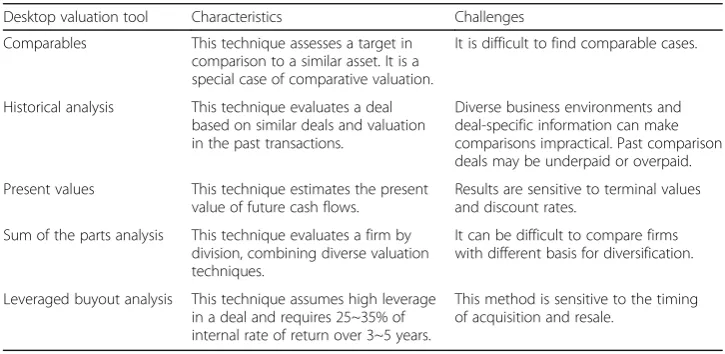
In sum, in these cases, the buyer emphasized conventional financial methods of M&A valuation, such as net present value, comparables, IRR, payback period, LBO valuation, and EBITDA multiples. We use the term desktop valuation to refer to these methods, based on a term common among investment bankers. Appendix 4 summarizes discussions about desktop valuation tools mentioned in the interviews.
Capability design
may be used in such cases but as supplements to capability design, rather than as the primary drivers of valuation.
In the Apparel deal, the buyer used the evaluation to help advance its plan of becom-ing a global player in the fashion industry. The buyer conducted valuation analyses to discover ramifications of acquiring design capabilities for its value chain. It applied scenario planning instead of standard financial valuation approaches in order to de-velop plans and strategies about how to use the acquired design capabilities. The plans and strategies suggested how much the buyer could afford to pay for the target.
Financial analyses assisted with scenario planning. For instance, the buyer used finan-cial analysis in order to set goals and develop performance indexes and compensation systems for creative talent, as opposed to using the analysis to discover the target’s
value. One interviewee stated, “Valuation was also for creating a vision and building
capabilities consistent with that vision, not for estimating the target’s value from the
analysis about [exogenously] predetermined cash flows.” Another argued that financial
valuation was “harmful because it could reduce the buyer’s strategic flexibility and limit the full use of our resources.”Clearly, time limits can force managers to decide without quantitative information, which can increase uncertainty.
Apparel:“We assessed what the implications to the entire value chain would be if we had acquired the fashion firm with design capabilities. We developed possible scenarios of synergies in our value chain. We conducted rough financial valuation because it helped us to understand scenarios.” “The core of valuation was to develop the measure-ment and compensation system for creative talents, which would be used after
integra-tion.” “Our valuation for the target was the sum of real estate value, enhanced
bargaining power, the opportunity cost of building the target’s business, and new business potential. Measuring the opportunity cost required evaluating and enhancing our capabil-ities about couture design at the same time. Increasing the value of the new business po-tential essentially became our goal and vision. Thus, valuation was not about estimating future cash flows. It was more about visioning and capability building about our growth.”
“Speed was important to make the deal successful … we could not wait completing
comprehensive financial analysis.” “Financial valuation may be insufficient or reduce our strategic flexibility. Textbook methods can be destructive in this deal.”
The Card deal also demonstrates capability design approach. The buyer used the evaluation to identify opportunities to gain synergies with its existing wireless busi-ness. The buyer first investigated what resources and capabilities (the buyer called
them “R&C”) they needed in the era of technological and market convergence.
Next, they examined how much it would cost to acquire the resources and capabil-ities. If the cost was within the budget predetermined at the last period, the buyer would consider investing; otherwise, the buyer would wait. The buyer used such valuation processes to formulate investment targets, determine required resources, and settle on potential investment. This approach is similar to an exploration tool (March, 1991), while strikingly different from the use of standard financial models to evaluate investment opportunities with given cash flows and size. Instead, the valuation process formulates cash flow and investment size conditional on the buyer’s goals.
crisis lowered the offer price of the target to meet our budget. …We needed the
tar-get’s resources and capabilities. We had asked how much we had to pay to obtain the
resources and capabilities. Once the offer price became affordable, we purchased the target.” “As far as we could develop vision and strategic plans, we would buy the target. Its valuation numbers and uncertainties are less relevant.” “Uncertainties over financial cri-sis made quantitative analycri-sis less useful. Formulating plausible strategies and capabilities became more important in valuation.”
Similarly, the SNS deal did not depend on standard valuation models. The buyer used the evaluation to help assess strategic opportunities in an evolving industry. In doing so, it created and assessed scenarios in which Target value = Constant × (# of cus-tomers)2; the constant was based on qualitative assessments of the opportunity, using several scenarios about the parameter. Moreover, instead of beginning with quantitative financial analysis, the buyer concentrated on understanding what the target’s business model was, how to create synergy, and what business model to design for the combined
firm. Then, the buyer formulated plausible strategies about how to use the target’s
unfamiliar business model, which in turn determines valuation.
Based on the plausible strategies, the buyer decided how much to invest and what
re-sources to commit and developed a roadmap and role of the target within the buyer’s
long-term goals. These decisions became part of the basis of deal value, although the buyer acquired the target even before it completed the analysis and then spent several years finalizing the strategies. Hence, rather than fully financially evaluating or even un-derstanding the target, the buyer studied what factors it could leverage in the target and surrounding dynamics of the Internet business.
SNS:“The more detailed or rigorous our valuation model becomes, the less useful to
develop plausible and flexible strategies. Developing detailed and rigorous strategy
should be first. They determine the goal and projections about cash flows and risks”
“Although no one can understand the target’s business model [one of the first social network services in the world], we just felt there was something. Then, our valuation meant how to understand the service, how to integrate the service to our portal, and how to generate cash from the service. We use valuation tools in order to study the buyer. We set our bidding price based on the study.” “We analyze uncertainty qualita-tively using the variations of strategies, scenarios, and management consulting
frame-works.” “The deal was a good opportunity to study Internet businesses, which was in
fact one of the goals on the deal.” “We valued the experience of conducting this kind of deals. This will enhance our capabilities to acquire larger players in future.”
Issue lists
“issue list” method, where the label arises from a buyer who developed lists in order to identify challenges that might arise in a deal.
A key purpose of the issue list method is to create a common goal about a deal. This point illustrates the idea that the value of some deals is socially constructed and en-dogenously formed, rather than existing as a pre-existing number that will be discov-ered via financial tools. Quantitative evaluation is useful as supporting analysis for the issue list approach as far as financial valuation helps validate stakeholders’ perceived value, vision, and strategy for a deal. If analyses conflict with the goals, then managers tend to update the quantitative models until they generate “intuitive and legitimate” numbers.
BigMedia illustrates how a deal’s value can be socially constructed via interactions be-tween a powerful manager’s preferences and less powerful managers’incentives. Those involved in the deal used quantitative models for the deal but used the results to reinforce political and organizational interactions rather than to provide objective facts. Different people in the case used similar quantitative models to come up with vastly different numbers, depending on their starting point assumptions and goals. The
inter-viewees commonly believed that “it was a waste of time to argue with algorithms and
assumptions in a financial model”; as one interviewee put it,“professionals rarely do such a thing; only amateurs do so.”Another interviewee told us that“the mind of those who control the target matters most, and this control right cannot be objectively valued given the preferences, contexts, and goals of stakeholders.”In practice, the value of the deal was set and finalized only after powerful managers on both sides of deal met. As one person put it,“We formulated the deal value over drinks.”
BigMedia:“Valuation was a consensus building process.” “The will of the owner mat-ters. The goal of this complex process of valuation is about how to convince the owner
and to make the deal legitimate.” “The tastes of stakeholders are important. For
ex-ample, buyers often argue that valuation does not matter much because we want to keep the target forever. That is why expectations of management is important in any merger deal. They often call the buyer’s taste a long-term goal, vision, the will of the owner, face saving, and pride. Who convinces the owner and how to convince the owner ultimately matter most in valuation. Hard numbers are not always a good way of
convincing people.” “Who controls the buyer can determine valuation. For instance,