Department of Psychology, Health & Technology
Faculty of Behavioral, Management and Social sciences (BMS)
1st Supervisor: Dr. M. Radstaak/ Drs. Ing. I. Zweers
2nd Supervisor: Dr. M. L. Noordzij
Diem Tran, s1600060
25-06-2018
T
HE DIFFERENCE IN
PERCEPTION OF ONLINE
AND OFFLINE SOCIAL
SUPPORT
1
Abstract
Background. Perceiving social support is important because it is positively linked to our
mental health. In times of the advanced and beneficial technology, social support can also be perceived through social media. Existing work on the effects of perceiving social support in online settings has often stressed that social media can give the possibility, especially for young adults, to receive and perceive social support. The aim of this study was to compare the difference in the perception of social support in real life and through social media with the focus on the three social provisions attachment, reassurance of worth and social integration. Methods. 173 subjects (130 female, 43 male) aged 18 to 59 years, who were mostly students, participated in the study. The participants filled out the same questionnaire consecutively two times, but with different instructions. One time for the perception of offline social support and the other for the perception of online social support.
Results. There is a difference between the perception of attachment online and offline, likewise there is a difference between the perception of reassurance of worth online and offline. However, little difference was found between social integration online and offline. The mean scores speak for the perception of social support in real life rather than the perception of social support through social media.
2
1. Introduction
Encourage, lift and strengthen one another. For the positive energy spread to one will be felt
by us all. For we are connected, one and all.
Deborah Day
Throughout life, we receive social support from a variety of people, which is defined as “the cognitive appraisal of being reliably connected to others” (Barrera, 1986). The process of interaction in various relationships improves our coping, esteem, belonging and
competence (Gottlieb, 2000). Having connections to other individuals and how we perceive their support is thus important for our mental health. The perception of social support during times of stress has been consistently linked to good mental health, for example low levels of psychological distress (Barrera, 1986). Not just improving mental health, perceiving social support can also reduce negative physical effects because of the link between the
psychological well-being and the physical health (Nabi & Prestin, 2013).
Cohen and Wills (1985) distinguished between two mechanisms through which social support is related to mental health outcomes, the main effect and the stress-buffering effect. The main effect of social support can occur when a person receives regular positive
experiences. This has a direct effect on our health. The stress-buffering effect is a mechanism by which support can affect physiological processes. Those who receive great social support, have greater health and well-being than those with poor social support. This effect posits that social support is linked to health because it weakens the link between stress and negative health outcomes. Most researches on social support assume that the link between social support and mental health reflects the stress-buffering effect (Cohen & Wills, 1985).
3
According to Tang, Chen, Yang, Chung and Lee (2016), especially students are motivated to use Facebook regularly because of the giving and receiving of online support and the maintaining of relationships. Facebook can provide three types of online social
support. First, informational support offers guidance, advice, information and feedback, which can help the user to solve a problem and is provided by friends who can quickly give
suggestions via Facebook. Second, affectionate support offers expressions of love and
affection in form of “likes” or messages, that can express support and various emotions. Last, Facebook seems to enable social companionship in a known and trusted online environment, where users can spend time and share memories with each other. (Tang, Chen, Yang, Chung & Lee, 2016).
Nabi and Prestin (2013) revealed that the more friends someone has on Facebook, the stronger is the perception of social support. Having many Facebook friends is associated with reduced stress and increased well-being. Acquiring social support is thus one of the most important reasons for online social networking (Park, Kee & Valenzuela, 2009). Still, there are contrasting opinions about the perception of online social support and offline social support, which is social support in real life.
Pfeil, Zaphiris and Wilson (2009) asked participants in their previous research about their perceptions of online and offline support. Some participants mentioned that online support was their main support in challenging times in their lives. They especially valued this kind of social support as the career restricts them to meet other people in real life. However, the fact that the physical presence and body language was missing in online social support was crucial for other participants. They stated that the lack of non-verbal cues limited the quality of online social support. Furthermore, the immediate feedback and reaction was missing when one really needed emotional support. Some participants felt insecure with the fact that they did not know when they will get an answer and misunderstandings could arise easily, which in return could be solved quickly in offline settings. Other participants did not agree with this statement. They argued that the possibility for creating a misunderstanding can be avoided, because people can take their time to think thoroughly about what they answer, and they also have the possibility to read it through again. The researchers concluded that it is essential to know the person and the context of the situation well when giving online as well as offline social support (Pfeil, Zaphiris & Wilson, 2009)
4
to feel adequately supported, namely attachment, social integration, reliable alliance, guidance, opportunity for nurturance and reassurance of worth. Cutrona and Russell (1987) developed the Social Provisions Scale, which items were based on these provisions. Three of the provisions, namely attachment, reassurance of worth and social integration have parallels with Cobb’s (1976) three classes of social support. According to Cobb (1976), social support is information that can lead the individual to believe that he or she (1) is cared and loved for, (2) is esteemed and valued and (3) belongs to a network of communication and mutual obligation. Attachment, reassurance of worth and social integration represent Cobb’s emotional, esteem and network support, which is why this study only focuses on these three social provisions.
According to Russell and Cutrona (1987), attachment is defined as the emotional closeness one has to another person. A sense of safety and security can be derived from such a relationship. Reassurance of worth is provided by relationships in which one’s abilities, values and skills are acknowledged. The term self-efficacy is linked to this social provision. Lastly, social integration is provided by a network of relationships in which individuals feel a sense of belonging and share similar interests and concerns with each other. Such a support provides a sense of identity, pleasure, comfort and can even have an impact on the own well-being (Russell & Cutrona, 1987). Getting these three functions through social support is essential, because deficits in for example attachment can lead to emotional loneliness or social loneliness when there is no social integration (Russell, Cutrona, Rose & Yurko, 1984).
When comparing the three social provisions in online and offline settings, the social provision attachment is probably more provided through offline than through online
5
though both online connections as well as offline connections can probably provide a sense of identity and belonging to the individual, it can be assumed that social media users can create an identity more faster and easier. In the real life, this presumably takes more effort and time
(Pfeil, Zaphiris & Wilson, 2009). Furthermore, there is probably no need for social media users to be in an intimate relationship to share similar interests or concerns.
These three social provisions can be used to measure how an individual perceives social support. Since the perception of social support is linked to mental health (Cohen & Wills, 1985, it is important to do further research in this field. By investigating social support not just in real life but also in various social media, because of the rising use and popularity among young adults, the question of the difference in perception of online and offline social support comes up. This study will focus on the comparison of the perception of online and offline social support by measuring the social provisions attachment, reassurance of worth and social integration.
Following hypotheses occur:
It is expected that
1. the perception of attachment is greater through offline social support
6
2. Methods
2.1 Design
This study used a cross-sectional online survey design to examine the difference between the perception of social support online and offline. The participants were recruited by
convenience sampling. This study was part of a larger study that was conducted together with four other researchers under the broad topic “Social media and mental health”.
2.2 Participants
173 subjects (130 female and 43 male) participated in the study. The age range of the
participants was from 18 to 59 years (M = 21.66, SD = 3.67). 61.3% of the participants lived in Germany, 34.1% in the Netherlands and 4.7% in other countries. The majority (68.2%) answered that the highest degree they already have received is “High school graduate or Abitur”. Furthermore, the current employment status of the most participants were
“University student” (60.7%) and “Student (school)” (30.1%). Participants who did not give their informed consent and did not answer all questions, were taken out before the data analysis.
2.3 Procedure
The ethics commission of the University of Twente approved the study, before putting the questionnaire online. During the period of April and May 2018, participants were recruited. Each of the researchers recruited at least 25 peers and family members by asking them if they want to contribute to the study. Those who decided to participate received a link, which directly led them to the questionnaire on Qualtrics, a software with which researchers can collect and analyze data. Also university of Twente students could participate in the study by logging into the university’s test subject pool called SONA where they could fill out the same questionnaire.
The questionnaire started with an informed consent, which briefly gave the participants information what the questionnaire is about and what they can expect. The confidentiality of their answers was emphasized, and participants had to give their consent to continue. After giving the consent, participants filled out the questionnaire. At the end of the questionnaire, an appreciation message was shown and a short debriefing to let the
participants know what concepts the researchers wanted to measure. In case of remaining questions or remarks the participants got the possibility to contact one of the researchers.
7
participated voluntarily in the study and did not receive any reward, besides the students of the university of Twente who received 0.75 credit points for their participation on SONA.
2.4 Materials
2.4.1 Demographics
At the beginning of the questionnaire the participants were asked a few demographic questions. The multiple-choice questions asked about the participants’ sex, age, residence, occupation and educational level. An example of a demographic question is: “What is the highest degree or level of school you have completed? If you are currently enrolled, what is the highest degree you have received already?”. The participants could choose to answer the educational level question with “No schooling completed”, “Middle school”, High school”, “Bachelor”, “Master” and with some more options.
2.4.2 Social Provisions Scale
The Social Provisions Scale developed by Cutrona and Russell (1987) was used. The
questionnaire measures six provisions or functions. Each provision consists of four items, so the scale has 24 items in total. The provisions are: (1) attachment, which is provided by intimate relationships (example item: “I have close relationships that make me feel good”); (2) social integration, which means to share interests and concerns with social relationships (“There is no one who likes to do the things I do”); (3) reassurance of worth, which
acknowledges the individual’s skills and abilities (“There are people who value my skills and abilities”); (4) reliable alliance, derived from relationships in which assistance under any circumstances is the most important (“If something went wrong, no one would help me”); (5) guidance, in which trustworthy and authoritative individuals give sufficient advice (“I have someone to talk to about decisions in my life”) and (6) opportunity for nurturance, in which the individual is responsible for the well-being of another. An example item would be: “I feel responsible for taking care of someone else” (Weiss, 1974, as cited in Russell,
Altmaier, & Van Velzen, 1984).
8
predictive validity of this instrument (Russell, Cutrona, Rose & Yurko, 1984; Russell, Altmaier and Van Velzen (1984).
2.4.3 Stimuli
The Social Provisions Scale could be filled out online on Qualtrics or on the test subject pool of the University of Twente (SONA). The participants had to fill out the Social Provisions Scale two times. The first time was to examine the degree to which the participants’ social relationships in real life provide various dimensions of social support. Examples of social support in general were given to the participants, for example “friends, coworkers, fellow students around you”, to clarify that this scale is about the participants’ perception of offline social support. The second time was to examine the degree to which social relationships on social media provide various dimensions of social support. Participants were given the examples of social support through Facebook, Instagram and Twitter.
2.5 Data analysis
9
3. Results
3.1 Descriptive statistics
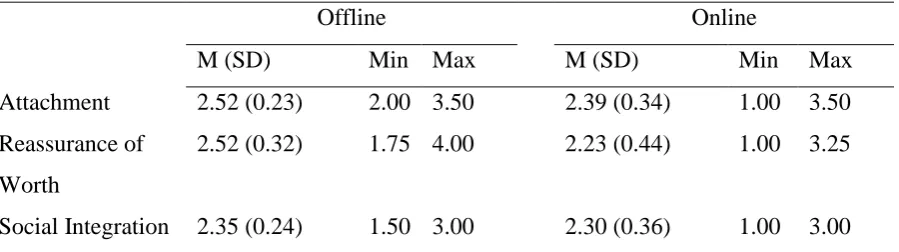
[image:10.595.77.527.274.400.2]The means, standard deviations and ranges of the social provisions attachment, reassurance of worth and social integration online and offline are presented in table 1. Notably, all of the mean scores for offline social support are higher than the mean scores for online social support.
Table 1
Comparison of means, standard deviations and ranges for the three provisions online and offline
Offline Online
M (SD) Min Max M (SD) Min Max
Attachment 2.52 (0.23) 2.00 3.50 2.39 (0.34) 1.00 3.50 Reassurance of
Worth
2.52 (0.32) 1.75 4.00 2.23 (0.44) 1.00 3.25
Social Integration 2.35 (0.24) 1.50 3.00 2.30 (0.36) 1.00 3.00 Note. Responses were made on a 4-point Likert scale.
3.2 Hypothesis testing
To examine the mean differences between the perception of social support online and offline, a paired-samples t-test was conducted. To test if attachment was greater perceived in real life than through social media, the first pair consisted of the variables attachment online and offline. Results showed that there was a significant mean difference in the scores for
attachment (M = 0.12, SD = 0.37; t = 4.37, p < .001). Looking at the mean scores in table 1, the offline score (M = 2.52) for attachment is higher than the online score (M = 2.39).
To test if reassurance of worth is greater perceived in real life than through social media, the second pair consisted of the variables reassurance of worth online and offline. A significant mean difference could also be found in the scores for reassurance of worth (M = 0.28, SD = 0.53; t = 7.09, p < .001). The offline mean score (M = 2.52) was likewise higher than the online mean score (M = 2.23).
10
the mean score for social integration offline (M = 2.35) is slightly higher than the mean score online (M = 2.30), the difference is not big enough to state that both variables differ from each other.
11
4. Discussion
The aim of this study was to investigate the difference between the perception of social
support online and offline. Particularly three social provisions were taken into account,
namely attachment, reassurance of worth and social integration.
The results showed that there is a difference in the perception of attachment online and
offline. Since the participants perceived more attachment offline than online, hypothesis 1 can
be supported. One possible reason for this result could be that the population, which is mainly
consisting of students, seek a lot of intimate relationships and a sense of safety and security at
their age. This is presumably easier perceived in real life than through social media (Pfeil,
Zaphiris & Wilson, 2009). According to Bowlby (as cited in Collins, Ford, Guichard, Kane &
Feeney, 2010), attachment in adulthood can best be seen when facing stressful events. The
proximity to significant others are seeked in response to fatigue, feelings of rejections by
others, achievement failures and more. Support and care is strongly needed in such situations.
Students, who are mostly young adults, can be faced with stressful situations, when they are
for example studying for a test or achieving a bad grade. Their need for emotional closeness is
expectedly strong, also because young adults are presumed to have a lot of dating
experiences, passion and intimacy (Montgomery, 2005).
The results also show that there is a difference in the perception of reassurance of
worth online and offline. Participants perceived more reassurance of worth offline than
online, hypothesis 2 can thus be supported. Reassurance of worth had the greatest mean
difference of all three provisions. A possible explanation is, that this provision is mostly
provided in settings where the own skills and abilities are acknowledged, for example at the
university (Russell, Cutrona, Rose & Yurko, 1984). Because a large portion of the participants were students or pupils, it is reasonable that they would perceive reassurance of worth by people at the university or school, likely when showing or applying the own skills in a groups project.
The results are not in accordance with the third hypothesis. Other than expected, there
is no significant difference between the perception of social integration online and offline. It
was expected that the perception of social integration is greater in online than in offline
settings, because there are so many possibilities to share similar interests through social media
(Java, Song, Finin & Tseng, 2007). Unexpectedly, the mean scores for offline social
integration were higher than the online scores. Despite the little differences in the mean, the
12
possible explanation could be again, the sample. On the one hand, students can share similar
interests and concerns with friends, fellow students in a study association or in a sports club.
There are many possibilities where students can create a social identity in their immediate
environment to feel a sense of belonging (Freeman, Anderman & Jensen, 2007). On the other
hand, with the rise of the internet it gets easier to create a social identity online (Ellison,
Steinfield & Lampe, 2007) and as expected, many can share similar concerns and interests
through. This result does not only speak for the perception of social integration in real life but
also through social media, which in turn can be indicative of the need to further investigate
social support online and offline.
4.1 Strengths and limitations
This study has strengths as well as limitations. One remarkable strength is, that there are a lot
of studies which focused on social media, online social support or social support, but no
studies were found that combined these concepts with each other. The investigation of the
difference between the perception of online and offline support in light of the three social
provisions can thus be seen as a novelty in the field. As the interest and use of social media is
rising, it can be beneficial to combine these social provisions and to research how that can affect people’s perception, and well-being. If the influence is positive, social media use can be
further developed to increase the mental health of social media users. It is thus recommended
to do more research about these combined concepts.
Of course, this study also had several limitations that need to be taken in account when
looking at the results. First, there were two groups of participants which were
over-represented in the study, namely female and students. About 75% of the participants were
female and about 60% students, which is why the study cannot be generalized. The study
restricted participation especially to students or young adults, since this age group is most
likely to use social media (Tang, Chen, Yang, Chung & Lee, 2016). To tackle this limitation, it is suggested to target more male and non-students for a more equally distributed sample.
Second, the study did not counterbalance the order of the stimuli. The participants had
to fill out the Social Provisions Scale twice. The first was to measure perceived offline social
support and the second was to measure perceived online social support. This could have led to an order effect, which refers to how the order of stimuli influences the participants’ behavior.
The results from the scale about the perception of online social support could be lower
because participants may become bored, tired or fed up by the time (McLeod, 2007). To
13
means, one half of the participants are filling out the questionnaire about the perception of
offline social support and the other half the questionnaire about the perception of online social
support.
The last limitation would be that the Social Provisions Scale is not aimed to measure
the three provisions online, despite a good validity. There is no assurance if the scale is also measuring the participants’ perception of social support online. To make sure that the
participants answered the questionnaires in according to the different instructions, examples
of offline social support were given in the instruction of the first questionnaire and examples
of online social support were given in the instruction of the second questionnaire. For the next
time, it is suggested to additionally state in the beginning that one questionnaire will be about
the perception of offline social support and one about the perception of online social support.
This way, participants will know that there will be two identical questionnaires, but with
different instructions.
All in all, it is proposed to do further research to investigate the relevance of different
variables in combination with perceived social support online and offline.
4.2. Conclusion
14
Reference list
Barrera, M. (1986). Distinctions between social support concepts, measures, and models. American journal of community psychology, 14(4), 413-445.
Caplan, S. E. (2003). Preference for online social interaction: A theory of problematic Internet use and psychosocial well-being. Communication research, 30(6), 625-648.
Cobb, S. (1976). Social support as a moderator of life stress. Psychosomatic medicine. Cohen, S., & Wills, T. A. (1985). Stress, social support, and the buffering hypothesis.
Psychological bulletin, 98(2), 310.
Collins, N. L., Ford, M. B., Guichard, A. C., Kane, H. S., & Feeney, B. C. (2010).
Responding to need in intimate relationships: Social support and caregiving processes
in couples. Prosocial motives, emotions, and behavior: The better angels of our
nature, 367-389.
Cutrona, C. E., & Russell, D. W. (1987). The provisions of social relationships and adaptation
to stress. Advances in personal relationships, 1(1), 37-67.
Ellison, N. B., Steinfield, C., & Lampe, C. (2007). The benefits of Facebook “friends:” Social capital and college students’ use of online social network sites. Journal of computer-mediated communication, 12(4), 1143-1168.
Freeman, T. M., Anderman, L. H., & Jensen, J. M. (2007). Sense of belonging in college
freshmen at the classroom and campus levels. The Journal of Experimental
Education, 75(3), 203-220.
Gottlieb, B. H. (2000). Selecting and planning support interventions. Social support
measurement and intervention: A guide for health and social scientists, 195-220. Java, A., Song, X., Finin, T., & Tseng, B. (2007, August). Why we twitter: understanding
microblogging usage and communities. In Proceedings of the 9th WebKDD and 1st
SNA-KDD 2007 workshop on Web mining and social network analysis (pp. 56-65).
ACM.
Kaplan, A. M., & Haenlein, M. (2010). Users of the world, unite! The challenges and opportunities of Social Media. Business horizons, 53(1), 59-68.
McLeod, S. A. (2007). Experimental design. Retrieved from:
www.simplypsychology.org/experimental-designs.html
Montgomery, M. J. (2005). Psychosocial intimacy and identity: From early adolescence to
emerging adulthood. Journal of Adolescent Research, 20(3), 346-374.
15
being. Cyberpsychology, Behavior, and Social Networking, 16(10), 721-727. Park, N., Kee, K. F., & Valenzuela, S. (2009). Being immersed in social networking
environment: Facebook groups, uses and gratifications, and social outcomes. CyberPsychology & Behavior, 12(6), 729-733.
Pfeil, U., Zaphiris, P., & Wilson, S. (2009). Older adults’ perceptions and experiences of online social support. Interacting with computers, 21(3), 159-172.
Pittman, M., & Reich, B. (2016). Social media and loneliness: Why an Instagram picture may
be worth more than a thousand Twitter words. Computers in Human Behavior, 62,
155-167.
Russell, D. W., Altmaier, E., & Van Velzen, D. (1987). Job-related stress, social support, and
burnout among classroom teachers. Journal of applied psychology, 72(2), 269.
Russell, D., & Cutrona, C. E. (1987). The Social Provisions Scale: A multidimensional measure of perceived social support. Manuscript in preparation.
Russell, D., Cutrona, C. E., Rose, J., & Yurko, K. (1984). Social and emotional loneliness: an examination of Weiss's typology of loneliness. Journal of personality and social psychology, 46(6), 1313.
Tang, J. H., Chen, M. C., Yang, C. Y., Chung, T. Y., & Lee, Y. A. (2016). Personality traits,
interpersonal relationships, online social support, and Facebook addiction. Telematics