37(2), Summer 2018, pp. 125-167- ISSN: 2008-8191 DOI: 10.22099/jtls.2019.31617.2611
The Impact of Sequence Map, Answering Question, and 3-2-1 Techniques on EFL Learners’ Summary
Writing Ability
Rasoul Mohammad Hosseinpur Reza Bagheri Nevisi ** Saeid Bahrani ***
Abstract
Considering the challenges inherent in learning and teaching of summary writing in EFL/ ESL settings, it is crucial to look into various instructional techniques thoroughly. This study investigated the relative effectiveness of three summary writing techniques: Sequence map, answering question, and 3-2-1 technique. To this end, 60 language learners from an English language institute in Ahvaz participated in the study. Before implementing the instructional techniques, a pre-test was administered to gauge the participants' fundamental knowledge of L2 summary writing. Three experimental groups were instructed through the already-mentioned techniques for ten weeks while the control group was given no such treatment. Finally, a post-test was administered to ascertain the effectiveness of such techniques in improving EFL learners' summary writing. The TOEFL-iBT scoring rubric was adopted to score the summaries holistically. Paired sample t-test and ANOVA were run to analyze the data. The findings revealed that the sequence map group outperformed the other three groups in terms of the written summaries. The study further implies that the employment of graphical or spatial representation of textual concepts reduces the complexity and ambiguity of the presented information.
Keywords: Summary writing, sequence map, answering question, 3-2-1 technique
Received: 05/01/2019 Accepted: 03/03/2019
Assistant Professor, University of Qom- Email: [email protected]
(Corresponding author)
Writing is commonly rated as the most challenging language skill to master. Several important subskills should be called upon to generate a well-written text. The writer needs to internalize not only the essential mechanics but also be well-equipped with the most proper writing strategies (Harris & Graham, 2005). Such strategies include content generation, thought and text organization, intended audience consideration and evaluation, and final product revision. Therefore, not only the writing task itself must be paid due and sufficient attention to, but also the writer needs to be engaged in a self-monitoring process (Harris, Graham, & Mason, 2003).
From among different subskills of writing students have to learn in the course of their academic career, summary writing appears to be one of the most challenging ones to gain mastery over (Lin & Maroof, 2013). L2 summary writing requires language learners to not only systematically manipulate words, phrases, and sentences in such ways that the intended meaning of the source is kept intact but also the ability to wisely substitute words with proper synonyms and alter the structural patterns of a sentence (Baba, 2009). The writer, in the process of summary writing, needs to make a full appreciation of the original text to decide which points are the main ideas to be restated and which are the details that can be ignored or shortened without losing track of the most important points or the overall message of the content materials (Kim, 2001).
map, answering question, and 3-2-1 techniques. These techniques, which are mainly used for teaching reading comprehension skill and have not been thoroughly investigated for teaching summary writing, can be put into practice in the classroom context regardless of language learners' proficiency level and age, and no special equipment is required for their implementation.
Literature Review
Summary writing as an integrative and interrelated activity consists of the interaction of two subskills – the capability to comprehend the essential points and comply with the content organization rhetorically and the subskill to restate the intention of the writer as succinctly and coherently as possible. (Enright, et al., 2000). Friend (2001, p. 3) defined summary writing as "the method of figuring out which information in a text is the most essential and transforming it into a simple statement in one's own words." As Jensen (2010) and Otero (2008) pointed out, the summarization technique enables the writers to restate the most critical points of the text logically, to establish crucial facts and information in long-term memory for future use, and to make sense of what is being read.
According to Melton (2003), four crucial points should be considered when writing a summary: First, a concrete target and objective should be stuck to; personalization of ideas should be avoided when summarizing a text. Second, all the essential points of the source will have to be kept intact and maintained. Third, all critical points should be given equal weight. Finally, brevity and clarity should also be observed.
Sequence Map Technique
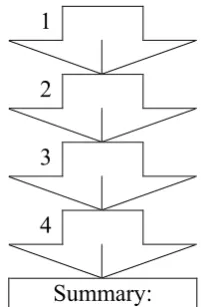
2004). Here, learners put story’s events (the beginning, middle, and end) in the charts in order to identify when and how they happened. The ability to sequence events in a text is a technique to comprehend a text, especially for narrative texts (Dell`Olio & Donk, 2007).
1
2
3
4
Summary:
Figure 1: A sequence map chart (Baxendell, 2003)
The idea of the sequence map is grounded in Ausubel’s assimilation theory of cognitive learning (Ausubel, 1978). The cognitive approach to learning deals with the way processing new information transpires and the way its structuring into memory takes place. According to this theory, learning is successfully attained when the systematic presentation of new information and coherent, meaningful and recyclable storage of data occur in the learners' long-term memory (McElroy & Coughlin, 2010).
vein, Stull and Mayer (2007) maintain that through sequence maps, the organization of new information will be best achieved by accurately outlining, precisely arranging and adequately sequencing the most critical points. As a result, sequence maps relate the new information to the prior knowledge and help students to identify the missing or vague data.
3-2-1 Technique
The 3-2-1 as a reading strategy was developed by Zygouris-Coe, Smith, and Wiggins (2004). Zygouris-Coe et al. (2004) stated that the technique is a reading strategy that enables language learners to actively engage in condensing and abridging the essential points of the source. In using the 3-2-1 technique, the learners are first required to complete a chart print-out. The 3-2-1 chart print-out consists of 3 phases: Phase 3 (i.e., the discovery phase), Phase 2 (i.e., outlining the general elements and events) and Phase 1(i.e., generating one specific question). The ultimate goal of the 3-2-1 chart print-out is to enable the language learners to readily grasp the content materials through the provision of many relevant guidelines.
3 Things you found out 2 Interesting things
1 A question you still have
Figure 2: 3-2-1 Technique chart (Marlini, 2015)
The 3-2-1 technique can be applied, well-adapted and adjusted for classroom use and practice by language teachers. Teachers can make judicious use of the 3-2-1 technique to promote the learners' reading comprehension and summary writing abilities likewise. This technique encourages language learners to become more autonomous thinkers and invites them to be more personally engaged and involved with the content materials.
post-reading activity. The whole point is to condense some critical concepts and notions, rearrange and reorganize them in order to come up with the most intriguing parts. Finally, a question will be posed to reveal where understanding is still needed. The rationale behind using this technique is that it helps students summarize the text to which they have been exposed to. Summarization is all about concentrating on the essential elements and components of a text and making the right decisions about what important parts to incorporate into the outcome. When going through lengthier content materials or texts, this technique enables readers to critically review what they have already been exposed to in one specific section of the text before changing directions to the upcoming elements of the text. The 3-2-1 technique allows readers to be dynamically and meaningfully involved in the reading process. First, the most important ideas are extracted from the source and appropriately summarized. Second, some insights into what constitute the most intriguing elements or parts of the original text are gained. Finally, learners are provided with the opportunities to pose and raise questions about what they have already covered (Zygouris-Coe et al., 2004).
Answering Question Technique
Researchers have corroborated the fact that question answer relationship (QAR) instruction enables language learners to develop their reading comprehension abilities and find the most appropriate answers to the already-posted questions (Raphael, 1986). This technique not only allows the readers to come up with the most suitable and relevant answers to the teacher-posed questions but also provides them with the necessary feedback to be able to self-correct themselves and their peers. These questions should not be yes/no or one-word answer questions. As a result, the learners will be provided with a real and genuine purpose for reading; their full mental power will be tapped.
that information recall and retrieval can be more accomplished. One specific type of answering question technique merely requires the learners to get back inside the text to discover the answers to questions for which no possible clues can be found after initial screening of the content materials or the original text. Another answering question technique acts as a facilitative tool for language learners to determine and identify answer-question connections and patterns—the interrelationships and possible links among questions and where the answers to them can be spotted. This technique enables readers to discover ways to come up with the most appropriate answers to the questions based on a genuine apprehension of the intended data (Armbruster, Lehr, & Osborn, 2003).
Answering question strategy is based upon three central theoretical notions. The first one is the zone of proximal development which underlies that students of differing levels of proficiency can benefit from various types and degrees of answering question instruction. The second notion is the gradual release of responsibility in which the teacher role as a model provider or guide is delegated to the one which merely provides learners with opportunities to try different strategies on their own. The third notion is that students will have to use their metacognition in order to increase the likelihood of independent strategy use (Raphael & Au, 2005).
Empirical Studies
Wichadee (2013) investigated the impact of wiki-based approach as a social networking instrument on summary writing in comparison with more traditional modes of summary writing. The instruction was provided in an EFL setting, and the learners benefited from various tests of summary writing, a well-developed questionnaire, and the summary writing products. The results indicated that both summarizing techniques led to overall improvements in the learners' summary writing ability. McDonough, Crawford and De Vleeschauwer (2014) instructed summarization strategies to Thai EFL students for 17 weeks. They specifically focused on the rhetorical organization and employment of original text information in the learners’ summaries. They found that the students’ heavy reliance on copied word strings reduced considerably, implying that summary writing instruction culminates in improved textual appropriation. Mohammad Hosseinpur (2015) addressed summary writing instruction and the learners’ microgenetic development of summary writing ability in the Iranian EFL context. After eight weeks of instruction, he reported that instruction was effective in the learners' summary writing ability and that some summarization strategies such as inventing, syntactic transforming, and generalizing are more complicated and improve at subsequent developmental phases.
scaffolding device that is beneficial to beginning writers as well. Marlini (2015) carried out a study in the Indonesian EFL context to find out whether or not students instructed through 3-2-1 strategy significantly differed from those taught via teacher independent strategy development on reading comprehension achievement tests. The results indicated that the learners' reading comprehension scores increased significantly from pre-test to post-test after being exposed to the 3-2-1 strategy. The study generally indicated that 3-2-1 teaching technique was more helpful in improving reading comprehension. Hemmati and Bemani (2013) investigated the impact of 'Question-Answer Relationship (QAR) strategy,' 'summarizing,' and 'syntactic structure identification training' on the reading comprehension of Iranian EFL learners. Thirty-four female and 26 female intermediate students took part in the study. The findings demonstrated that the reading comprehension abilities of the three classes differed significantly from one another. Furthermore, the application of QAR technique resulted in more improved reading comprehension gains and scores compared to the utilization of syntactic structure training and summarizing whose differences concerning the reading comprehension were almost insignificant.
Considering the challenges inherent in the summary writing learning and teaching in EFL/ ESL settings, it is thus crucial to thoroughly look into and probe approaches to teaching and learning summary writing. Therefore, this study was an attempt to examine teaching summary writing through the sequence map, answering question, and 3-2-1 techniques. To achieve the above-stated objectives of the research, the following questions were formed:
1) Does “sequence map technique” significantly impact EFL learners’ summary writing ability?
2) Does “answering question technique” significantly impact EFL learners’ summary writing ability?
4) Which summary writing technique is more effective in improving EFL learners’ summary writing ability?
Method Participants
Due to administrative challenges inherent in randomization, convenient or available sampling was utilized. Quick Oxford Placement Test (QOPT) of Oxford University Press and University of Cambridge Local Examinations Syndicate was performed on 100 Iranian EFL learners studying at Shima language institute in Ahvaz city. Concerning the guidelines of the test, the participants whose scores were between 30 and 39 out of 60 were labeled as intermediate-level learners, and 60 students out of 100 were qualified to be the final participants of this study. The participants' ages ranged from 18 to 30, and essential demographic characteristics such as their L1 and culture were common among them.
Instrumentation
To collect data, the researchers utilized different instruments. Quick Oxford Placement Test (2001), a standard test that enjoys an acceptable validity and reliability, was used in this study in order to homogenize the participants and determine the learners’ level of language proficiency. The test consisted of 65 multiple-choice questions including 15 vocabulary questions, 20 grammar questions, and 30 cloze tests.
words. In the process of summarization, they were not allowed to make use of their dictionaries, but the source texts were at their disposals while they were wiring the summary.
One final instrument was the TOEFL-iBT scoring rubric used in Baba (2009). This instrument is a well-known and widely-used scoring rubric for rating summaries. It was adopted to holistically rate the written summaries on a four-point scale by two professional raters. The scoring guidelines evaluated the summaries from (1) the inclusion of the significant ideas; (2) the overall organization; (3) linguistic structure; and (4) exact word-for-word copying from the original content material.
Data Collection Procedure
Sixty language learners from Shima language institute in Ahvaz city, Khuzestan Province participated in this study. To homogenize all 100 participants, the Quick Oxford Placement Test was administered. About the guidelines of the test, those whose scores fell between 30-39 band scores were labeled intermediate-level language learners and were included in the current study.
At the beginning of the course, all the participants were randomly assigned to four groups (each group included 15 participants). Three experimental groups were instructed through and exposed to three different instructional techniques: Sequence map, answering question, and 3-2-1 techniques while the control group received no such treatments and was taught otherwise.
correct, and finally, whether the summary included mere word-for-word copying from the original text or it was written in writers' own words.
The first experimental group was taught summary writing through sequence map technique. At first, the sequence map technique was fully and sufficiently explained to the learners so that they were familiarized with the way it could be used to enhance their summary writing. Having read the story well, the teacher provided all the students with specific charts to fill out based on the provided information from the story. Such charts enabled the students to visualize the story content more vividly, and it would help them follow the story-line more precisely and retain and remember the story-related information more successfully.
The learners of the second experimental group were taught summary writing through answering question technique. Every week, one short story was selected from the book entitled Far From the Madding Crowd by Thomas Hardy (2000). Meanings of the unclear parts were clarified, and explanations were provided whenever necessary to facilitate comprehension by the teacher. Next, some relevant questions about the story were posed by the teacher. The teacher then wrote the questions on the board requiring and encouraging all the students to provide essay-type answers rather than yes-no ones for the intended questions. Finally, the students received feedback from the teacher on how to embark well on the process of summary writing and were asked to write a summary of their own based on the provided instruction about the presented story.
and write story-based questions. Having followed all these methodological steps, they then initiated the summary writing process.
The students in the control group were not instructed through the techniques as mentioned above and were taught traditionally. That is, each week, the story was read through a grammar-translation method. Meanings of the ambiguous parts were made manifest through translation to students' L1, and structural ambiguities were also explicitly dealt with partly in the learners' mother tongue and partly in L2. Having gone through the story in this way, the language learners were then invited to write their summaries.
When all four groups had completed their ten-week summary writing the instructional course, the post-test (Gabriel Oak falls in love) was administered to gauge the relative effectiveness of sequence map, answering question, and 3-2-1 techniques on Iranian EFL learners' summary writing compared to the fourth group which was taught traditionally.
Data analysis
To analyze the data, the researchers employed both descriptive and inferential statistics. The collected data were analyzed through SPSS software version 21. First, drawing upon the Pearson correlation coefficient, the researchers calculated inter-rater reliability which yielded an acceptable level of agreement (r= .85). Then, descriptive statistics indices were used to describe the data in terms of means, standard deviations, minimums, and maximums. Finally, inferential statistics including t-test and ANOVA were run to explore within-group and between-group differences.
Results
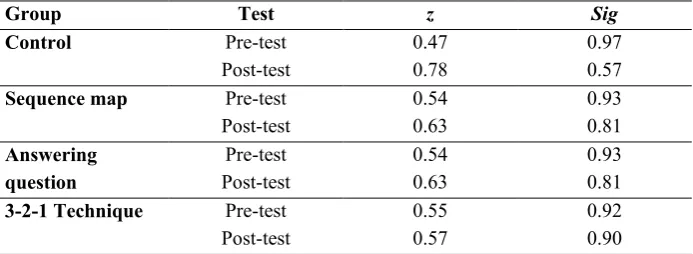
Table 1.
Tests of Normality on the Data
Sig z Test Group 0.97 0.57 0.47 0.78 Pre-test Post-test Control 0.93 0.81 0.54 0.63 Pre-test Post-test Sequence map 0.93 0.81 0.54 0.63 Pre-test Post-test Answering question 0.92 0.90 0.55 0.57 Pre-test Post-test 3-2-1 Technique
Table 1 shows that all significant values in Kolmogorov-Smirnov tests were higher than the confidence level of 0.05. This is indicative of the fact that the data were normally distributed. Table 2 demonstrates the means and standard deviations of the participants' scores on the pretest and posttest.
Table 2.
Descriptive Statistics of the Tests
Test Group M SD N
Pretest Sequence map Answering question 3-2-1 Technique Control 13.86 13.73 13.26 13.26 3.02 2.65 2.65 3.21 15 15 15 15
Posttest Sequence map Answering question 3-2-1 Technique Control 15.73 13.86 13.63 13.75 2.81 2.19 2.50 2.81 15 15 15 15
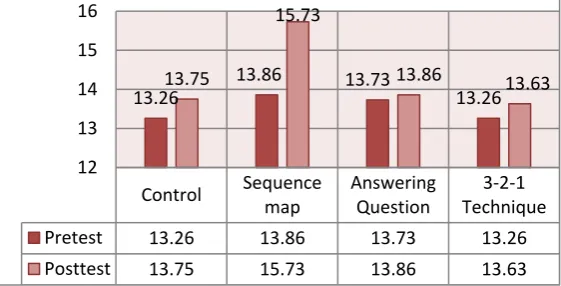
the participants’ posttest in the sequence map group (M = 15.73, SD = 2.81), answering question group (M= 13.86; SD= 2.19), 3-2-1 technique group (M= 13.63; SD= 2.50), and the control group (M = 13.75; SD = 2.91). The sequence map group had the highest mean score on the posttest.
To ascertain whether the differences in the descriptive statistics of the four groups were statistically significant or not, a one-way analysis of variance was conducted. As shown in Table 6, the differences in pretest scores are insignificant (p > 0.05). In other words, the participants' level of summary writing ability was statistically equal before the implementation of the instructional techniques.
The First Research Question
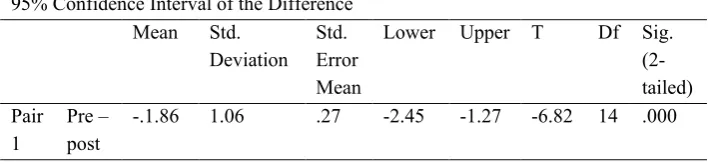
Concerning the impact of the sequence map technique on improving EFL learners' summary writing, the findings demonstrated that the participants' performance in the sequence map group significantly improved from pretest to posttest.
Table 3.
Results of the Paired Sample T-Test for Sequence Map Group
95% Confidence Interval of the Difference
Sig. (2-tailed) Df
T Upper Lower
Std. Error Mean Std.
Deviation Mean
.000 14 -6.82 -1.27
-2.45 .27
1.06 -.1.86 Pre –
post Pair 1
001(two-tailed) was significant. The mean in students’ scores was -1.86 with a 95% confidence interval ranging from -2.45 to -2.27.
It was then concluded that the sequence map technique instruction positively affected Iranian EFL learners' summary writing ability. The results of the post-test of summary writing for this group illustrated that EFL learners' mean scores of the posttest differed significantly from those of their pretest.
The Second Research Question
Concerning the impact of the answering question technique on improving EFL learners' summary writing ability, the findings indicated that the participants' summary writing performance in answering question group did not significantly differ from pretest to posttest.
Table 4.
Results of the Paired Sample T-Test for the Answering Question Technique
95% Confidence Interval of the Difference
Sig. (2-tailed) Df T Upper Lower Std. Error Mean Std. Deviation Mean .670 14 -435 .52413 -.79080 .30654 1.18723 -.13333 Pre– post Pair 1
As the results of the paired samples t-test in Table 4 demonstrates, the increase in the scores of the students in the answering question technique from pretest (M= 13.73, SD=2.65) to posttest (M=13.86, SD =2.19), t(14)= -4.3, p< 001(two-tailed) was insignificant. The mean in students’ scores was 1.13 with a 95% confidence interval ranging from -7.90 to 0.52.
The Third Research Question
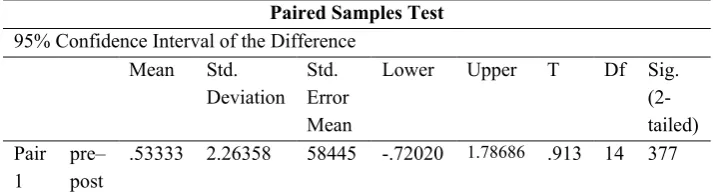
Regarding the impact of the 3-2-1 technique on improving EFL learners’ summary writing, the findings revealed that the participants’ performance in the 3-2-1 group on the summary writing improved slightly compared to their performance in the pretest. A paired-sample t-test was run to discern whether this amount of difference was statistically significant or not.
Table 5.
Results of the Paired Sample T-Test for the 3-2-1 Technique Paired Samples Test
95% Confidence Interval of the Difference
Sig. (2-tailed) Df
T Upper Lower
Std. Error Mean Std.
Deviation Mean
377 14 .913
1.78686
-.72020 58445
2.26358 .53333
pre– post Pair 1
As the results of the paired samples t-test in Table 5 indicates, the increase in the scores of the students in the 3-2-1 technique from pretest (M= 13.26, SD=3.02) to posttest (M=15.73, SD =2.65), t (14) = 0.91, p< 001(two-tailed) was insignificant. The mean in students’ scores was -1.86 with a 95% confidence interval ranging from -7.20 to 1.78.
It came to light that the 3-2-1 technique instruction did not have a significant impact on Iranian EFL learners' summary writing ability. The results of the post-test of summary writing for the 3-2-1 group revealed that EFL learners’ mean scores of the posttest did not differ significantly from those of their pretest.
The Fourth Research Question
scores of the groups during the posttest. The results of the one-way ANOVA (p < .05 level: F (4.289), p= 009) indicated that the mean scores of the groups on the posttest differed significantly from one another.
Table 6.
Results of the Analysis of Variance for the Pretest and Posttest Sum of
squares
Df Mean Square
F Sig.
Pretest Between groups 4.40 3 1.46 .175 .913 Within groups 470.53 56 8.40
Total 474.93 59
Posttest Between groups 90.20 3 30.06 4.28 .009 Within groups 392.53 56 7.01
Total 482.73 59
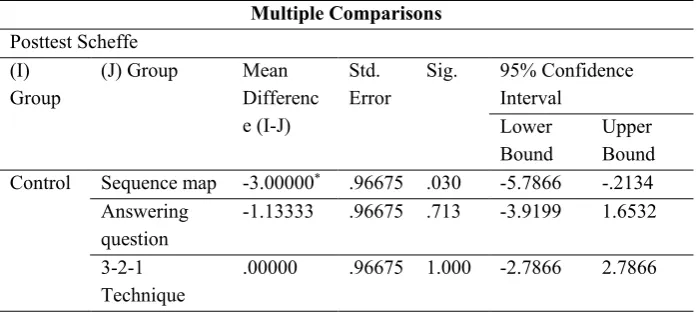
To clarify precisely where the differences were, post-hoc Scheffe’s tests were employed. As Table 7 displays, there existed a significant difference between the mean scores of the sequence map group and the 3-2-1 and control groups. However, the results did not reveal any significant difference between the mean scores of the sequence map group and answering question group on the posttest.
Table 7.
Results of the Analysis of Post Hoc Test for the Sequence Map, Answering Question, 3-2-1 Technique, and Control Group
Multiple Comparisons
Posttest Scheffe (I)
Group
(J) Group Mean Differenc e (I-J)
Std. Error
Sig. 95% Confidence Interval
Lower Bound
Upper Bound Control Sequence map -3.00000* .96675 .030 -5.7866 -.2134
Answering question
-1.13333 .96675 .713 -3.9199 1.6532
3-2-1 Technique
Sequenc e map
Control 3.00000* .96675 .030 .2134 5.7866
Answering question
1.86667 .96675 .303 -.9199 4.6532
3-2-1 Technique
3.00000* .96675 .030 .2134 5.7866
Answeri ng question
Control 1.13333 .96675 .713 -1.6532 3.9199 Sequence map -1.86667 .96675 .303 -4.6532 .9199 3-2-1
Technique
1.13333 .96675 .713 -1.6532 3.9199
3-2-1 Techniq ue
Control .00000 .96675 1.000 -2.7866 2.7866 Sequence map -3.00000* .96675 .030 -5.7866 -.2134
Answering question
-1.13333 .96675 .713 -3.9199 1.6532
*. The mean difference is significant at the 0.05 level.
As illustrated in Figure 3, the sequence map group manifested the highest mean score on the posttest and was the most useful summary writing technique for the participants of this study.
Figure 3: Mean Comparisons of Groups
Discussion
Majority of EFL learners are not exposed to various instructional techniques in order to be able to improve their summary writing abilities (Keck, 2006). This study aimed at determining the relative effectiveness
Control Sequence map Answering Question 3-2-1 Technique
Pretest 13.26 13.86 13.73 13.26
Posttest 13.75 15.73 13.86 13.63
of three instructional techniques (i.e., sequence map, answering question, and 3-2-1 technique) on improving Iranian EFL learners’ summary writing ability. The overall findings of this study, consistent with the results of previously-conducted studies (e.g., Chen & Su, 2012; Choy & Lee, 2012; Lee, 2010; Graham & Perin, 2007; McDonough et al., 2014; Mohammad Hosseinpur, 2015; Wichadee, 2013), generally indicate the effectiveness of applying instructional techniques to improve the learners’ summary writing ability. Moreover, the results of the research indicated that learners in the sequence map group outdid the other groups (i.e., 3-2-1 technique, answering question, and control group).
The results of the current research are in agreement with Tayib (2015) which revealed that the sequence maps significantly impacted and enhanced the students' writing ability. Previous studies (e.g., Anggrainy, Diem, Vianty, & Sugandi, 2016; Hoffmann, 2010; Grabe & Jiange, 2007) also support the efficacy of this technique in developing better reading comprehension skills and gaining mastery over text structures (e.g., Robinson, Corliss, Bush, Bena, & Tomberlin, 2006; Williams, et al., 2005). One probable justification for the effectiveness of sequence map instruction can be attributed to the reduction of semantic processing demands through this technique which in turn fastens and expedites the comprehension process. As Stull and Mayer (2007) put it, relying upon this technique, L2 learners will be able to outline, arrange, and sequence the main ideas. Consequently, L2 learners' schemata will be activated so that proper new links will be made to their prior knowledge through the sequence map technique, and new information will be more easily retained and recalled later.
represented so L2 learners' remembrance and recall of information will be enhanced. Moreover, language learners' autonomy will be seemingly maximized through sequence map technique. Consistent with Ellis and Howard (2005), graphic organizers in general and sequence maps, in particular, encourage language learners to think more strategically and more independently since such an instructional technique enables learners to organize and prioritize various concepts and events. As a result, a better-developed and a more fair written summary can be produced via this technique as a facilitative instructional tool.
The results of the current research regarding the application of answering question technique are incongruent with those of (Alsamadani, 2011; Conner, 2006; Hemmati & Bemani, 2013; Okebuko & Owolabi, 2007; Peng, Hoon, Khoo, & Joseph, 2007; Stafford, 2012) who found the technique quite beneficial in reading comprehension. As stated earlier, in the answering question technique, some pertinent questions about the story were posed by the teacher. The teacher then wrote the questions on the board requiring and encouraging all the students to provide essay-type answers rather than yes-no ones for the intended questions. Finally, the students received feedback from the teacher on how to embark well on the process of summary writing and were asked to write a summary of their own based on the provided instruction about the presented story. However, students in this group made the lowest achievements compared to other groups. This ineffectiveness might have been explained by the fact that the questions posed by the teacher were of the inappropriate level of difficulty and were not expected by the students. Therefore, the question types and their syntactic and semantic complexities might have contributed to the ultimate failure of such an instructional technique.
improvement to produce well-written summaries with the answering question technique. Moreover, the answering question technique requires language learners to make use of their metacognition, and the students' lack of metacognitive awareness could have also played a role. Another crucial factor that might have been overlooked is the grammatical competence of language learners to produce well-formed sentences in response to teacher-posed questions. Another important reason for the inefficacy of such a technique could be ascribed to the very nature of the questions posed. The questions might have been taken at face value whereas they require a great amount of deep mental processing to be properly tackled. Processing such information is quite time-consuming and challenging. The short and limited period allocated to handle the questions might have put a great deal of pressure on students' working memory and led to their inability to report the necessary incidents of the story indeed. Last but not necessarily the least, the teacher might have failed to provide the appropriate kind and level of scaffolding needed throughout the structured feedback sessions.
sorting out the details of the story all at once. The story-related charts provided by the teacher might merely have added to the already-existing confusion and further complicated the summary writing process.
Finally, the students in the control group who were instructed traditionally surprisingly surpassed those in the answering question and 3-2-1 groups in terms of the progress they had made in their written summaries. This could have emanated from the fact that L1 application in the classroom might have lowered the affective filter and positively influenced their overall understanding and grasp of the story. The freedom they felt to express themselves in their mother tongue could have been a mitigating factor to remove the lexical and syntactic ambiguities involved in the stories.
Conclusion and Implications
Summary writing in L2 requires a great deal of cognitive and metacognitive processing. On the one hand, many EFL students are unaware of the underlying processes they have to go through to come up with a well-written summary. On the other hand, an absolute majority of EFL teachers turn a blind eye to these underlying processes and teach summary writing through traditional methods (Mohammad Hosseinpur, 2015). They are either unaware of different user-friendly instructional techniques or are reluctant to take advantage of them.
techniques require great understanding and expertise on the part of the teacher otherwise it will be impossible to initiate learners into the process of writing, create and raise their consciousness level, provide the right amount and type of scaffolding and feedback whenever necessary and finally present instructional materials appropriately tailored to students' current developmental status.
The instructional techniques used in this study can be considered valuable tools to be properly taken advantage of under various circumstances. This study could be replicated with a more significant number of students at different proficiency levels and with more representative samples of Iranian EFL learners. Teachers and learners will have to be familiarized with the way they work best in EFL classroom settings so that they can make the most of the resources at their disposal. Material developers and course designers need to prioritize and evaluate the effectiveness of such techniques and make informed decisions about their inclusion in educational courses accordingly.
References
Alsamadani, H. (2011). The effects of the 3-2-1 reading strategy on EFL reading comprehension. English Language Teaching, 4(3), 184-191.DOI: 10.5539/elt.v4n3p184
Anggrainy, S., Diem, C., Vianty, M. & Sugandi, B. (2016). The effect of graphic organizers, guided writing strategies, and reading levels on the writing achievement of the fourth-semester students of Pgmi program at Iain Raden Intan Lampung. Sirwijaya University Learning and Education International Conference, 2(1), 1029-1052.
Armbruster, B. B., Lehr, F. & Osborn, J. (2003). Kindergarten through to grade 3: put reading first: the research building blocks of reading instruction: kindergarten to grade 3. Washington: National Institute for Literacy.
Baba, K. (2009). Aspects of lexical proficiency in writing summaries in a foreign language. Journal of Second Language Writing, 18(3), 191–208. DOI: 10.1016/j.jslw.2009.05.003
Baxendale, B. (2003). Consistent, coherent, creative: The 3Cs of graphic organizers. Council for Exceptional Children, 36(3), 46-53. DOI: 10.1177/004005990303500307
Brown, H. D. (2001). Teaching by principles: An interactive approach to language pedagogy (2nd Ed.). New York: Longman.
Chen, Y. S. & Su, S. W. (2012). A genre-based approach to teaching EFL summary writing. ELT Journal, 66(2), 184-192. DOI: 10.1093/elt/ccr061
Choy, S. & Lee, M. (2012). Effects of teaching paraphrasing skills to students learning summary writing in ESL. Journal of Teaching and Learning, 8(2), 77-89. DOI: 10.22329/JTL.V8I2.3145
Conner, J. (2006). Instructional reading strategy: DR-TA (Directed Reading Thinking Activity). Retrieved from http://www.indiana.edu/~l517/DRTA.htm.
Dell'Olio, J. M. & Donk, T. (2007). Advance Organizers. In Models of teaching: Connecting student learning with standards. Thousand Oaks, California: SAGE Publication.
Ellis, E. (2004). Q&A: What is the big deal with graphic organizers?. Retrieved from Masterminds Publishing, LLC Web site: http://www.graphicorganizers.com/Sara/ArticlesAbout/Q&A%20G raphic%20Organizers.pdf.
Ellis, E., & Howard, P. (2005). Graphic organizers: Power tools for teaching students with learning disabilities. Retrieved from www.GraphicOraganizers.com.
Enright, M. K., Grabe, W., Koda, K., Mosenthal, P. Mulcahy-Ernt, P., & Schedl, M.A. (2000). TOEFL 2000 reading framework: A working paper. Princeton: Educational Testing Service.
Journal Educational Computing Research, 33(1), 53 – 80. DOI: 10.2190/DH8F-QJWM-J457-FQVB
Friend, R. (2001). Effects of strategy instruction on summary writing of college students. Contemporary Educational Psychology, 26(1), 3-24. DOI:10.1006/ceps.1999.1022
Grabe, W. & Jiang, X. (2007). Graphic organizers in reading instruction: Research findings and issues. Reading in a Foreign Language, 19(1), 34-55.
Graham, S. & Perin, D, (2007). A meta-analysis of writing instruction for adolescent students. Journal of Educational Psychology, 99(3), 445-476.
Hardy, T. (2000). Far from the madding crowd. Oxford, Oxfordshire: Oxford University Press.
Harris, K. R. & Graham, S. (2005). Writing better: Teaching writing process and self-regulation to students with learning problems. Baltimore, Maryland: Brookes.
Harris, K., Graham, S., & Mason, L. (2003). Self-regulated strategy development in the classroom: Part of a balanced approach to writing instruction for students with disabilities. Focus on Exceptional Children, 35, 1-16.
Hemmati, F., & Bemani, S. (2013). Comparing the effect of
summarizing, question-answer relationship, and syntactic structure identification on the reading comprehension of Iranian EFL
students. International Journal of Applied Linguistics & English Literature, 2, 151-156. Retrieved from
https://journals.aiac.org.au/index.php/IJALEL/article/view/893/824
Hoffmann, K. F. (2010). The impact of graphic organizer and meta-cognitive monitoring instruction on expository science text comprehension in fifth-grade students. (Unpublished doctoral dissertation). North Carolina State University, Raleigh.
Jensen, M. (2010). Improving reading comprehension of junior division students as the teacher-librarian: An action research study.
www.nipissingu.ca/oar/Reports/reports_and_documents-Melissa_Jensen.pdf
Keck, C. (2006). The use of paraphrase in summary writing: A comparison of L1 and L2 writers. Journal of Second Language Writing, 15(4), 261–278.
Kim, S. (2001). Characteristics of EFL readers’ summary writing: A study with Korean university students. Foreign Language Annals, 34, 569-581. DOI: 10.1111/j.1944-9720.2001.tb02104.x
Lee, L. (2010). Exploring wiki-mediated collaborative writing: A case study in an elementary Spanish course. CALICO Journal, 27(2), 260-276. Retrieved from
http://www.jstor.org/stable/calicojournal.27.2.260
Lehr, F., & Osborn, J. (2005). A focus on comprehension. Honolulu: Pacific Resources for education and learning. Retrieved from www.prel.org/programs/rel/rel.asp
Lin, O. P. & Maroof, N. (2013). Collaborative writing in summary writing: Student perceptions and problems. Procedia-Social and
Behavioral Sciences, 90, 599-606.
DOI:10.1016/j.sbspro.2013.07.131
Marlini, L. (2015). Teaching reading comprehension by using 3-2-1 strategy to the tenth-grade students of Sma Ethika Palembang Edukasi. Journal Pendidikan Dan Pengajaran, 2(2), 159-172. Retrieved from
http://jurnal.radenfatah.ac.id/index.php/edukasi/article/view/606 McDonough, K., Crawford, W.J., & De Vleeschauwer, J., (2014).
Summary writing in a Thai EFL university context. Journal of
Second Language Writing, 24, 20–32.
DOI:10.1016/j.jslw.2014.03.001
Melton, J. (2003). Summarizing strategies strengthen learning. Retrieved from http://www.kidbibs.com/learningtips/1t33.htm
Mohammad Hosseinpur, R. (2015). The impact of teaching summarizing on EFL learners’ microgenetic development of summary writing. The Journal of Teaching Language Skills, 7(2), 69-92. DOI: 10.22099/JTLS.2015.3531
Okebukola, F. & Owolabi, T. (2007). The efficacy of question-answer-relationships (QAR) on students’ achievement and conceptual change in science. The International Journal of Learning, 14 (5) 173-178.
Otero, R. C. (2008). Summary of integration information processes form multiple documents. Retrieved from
http://dialnet.unirioja.es/servlet/tesis?codigo=7205&info=resumen &modo=popu
Peng, R. G. S., Hoon, T. L., Khoo, S. F., & Joseph, I. M. (2007). The impact of question-answer relationships on reading comprehension. Retrieved from
http://iresearch.osprey.url3.net/iresearch/slot/u110/Alar/.../ar_peich un_qar.pdf
Preszler, J. (2006). More strategy to guide learning. Rapid City BHSSC 1925: Plaza Boulevard.
Quick Oxford Placement Test (2001). Quick placement test. London: Oxford University Press and the University of Cambridge Local Examinations Syndicate.
Raphael, T. (1986). Teaching question-answer relationships revisited. The Reading Teacher, 39(6), 516-522. DOI: 10.2307/20199149 Raphael, T. E., & Au, K. (2005). QAR: Enhancing comprehension and
test-taking across grades and content areas. The Reading Teacher, 59(3), 206-221. DOI: 10.2307/20204340
Robinson, D. H., Corliss, S. B., Bush, A. M., Bena, S. J., & Tomberlin, T. (2006). Optimal presentation of graphic organizers and text: A case for large bites?. Educational Technology Research and Development, 51 (4), 25-41. DOI: 10.1007/bf02504542
Stafford, T. (2012). The effect of question-answer relationships on ninth-grade students' ability to accurately answer comprehension questions. (Unpublished doctoral dissertation). University of Central Florida, Orlando.
Stull, A. T. & Mayer, R. E. (2007). Learning by doing versus learning by viewing: Three experimental comparisons of learner-generated versus author-provided graphic organizers. Journal of Educational Psychology, 99(4), 808-820. DOI: 10.1037/0022-0663.99.4.808 Tayib, A. (2015). The effect of using graphic organizers on writing: A
case study of preparatory college students at Umm-Al-Qura University. International Journal of English Language and Linguistics Research, 3(1), 15-36.
Wade-Stein, D., & Kintsch, E. (2004). Summary street: interactive computer support for writing. Cognition & Instruction, 22, 333– 362. DOI: 10.1207/s1532690xci2203_3
Wichadee, S. (2013). Improving students’ summary writing ability through collaboration: A comparison between online wiki group and conventional face-to-face group. The Turkish Online Journal of Educational Technology, 12(13), 107-116.
Williams, J. P., Hall, K. M., Lauer, K. D., Stafford, K. B., DeSisto, L. A., & deCani, J. S. (2005). Expository text comprehension in the primary grade classroom. Journal of Educational Psychology, 97, 538-550. DOI: 10.1037/0022-0663.97.4.538
Appendix A
The Quick Placement Test of Oxford University Press and University of Cambridge Local Examinations Syndicate
Oxford University Press and
University of Cambridge Local Examinations Syndicate
Name: ……… Date: ……….
Quick Placement Test
Part 1
Questions 1 – 5
• Where can you see these notices?
• For questions 1 to 5, mark one letter A, B or C on your Answer Sheet
1. A in a shop B in a hotel C in a taxi
2.
2. A in a library B in a bank
C in a police station
3. A outside a theatre B outside a supermarket C outside a restaurant
AFTERNOON SHOW BEGINS
AT 2PM
Foreign money changed here
Please leave your room key at
4. A at a travel agent’s B at a music school C at a restaurant
5. A at a cinema B in a hotel
C on a camp-site
• In this section you must choose the word which best fits each space in the text below.
• For questions 6 to 10, mark one letter A, B or C on your Answer Sheet. Scotland
Scotland is the north part of the island of Great Britain. The Atlantic Ocean is on the west and the North Sea on the east. Some people (6) ... Scotland speak a different language called Gaelic. There are (7) ... five million people in Scotland, and Edinburgh is (8) ... most famous city.
Scotland has many mountains; the highest one is called ‗Ben Nevis‘. In the south of Scotland, there are a lot of sheep. A long time ago, there (9) ... many forests, but now there are only a (10) ... .
Scotland is only a small country, but it is quite beautiful.
6 A on B in C at 7 A about B between C among 8 A his B your C its 9 A is B were C was 10 A few B little C lot
Price per night:
£10 a tent
£5 a person
CLOSED FOR HOLIDAYS
Lessons start again on the 8th
• In this section you must choose the word which best fits each space in the texts.
• For questions 11 to 20, mark one letter A, B, C or D on your Answer Sheet. Alice Guy Blaché
Alice Guy Blaché was the first female film director. She first became involved in cinema whilst working for the Gaumont Film Company in the late 1890s. This was a period of great change in the cinema and Alice was the first to use many new inventions, (11) ... sound and colour.
In 1907 Alice (12) ... to New York where she started her own film company. She was (13) ... successful, but, when Hollywood became the centre of the film world, the best days of the independent New York film companies were (14) ... . When Alice died in 1968, hardly anybody (15) ... her name
11 A bringing B including C containing D supporting 12 A moved B ran C entered D transported 13 A next B once C immediately D recently 14 A after B down C behind D over
15 A remembered B realized C reminded D repeated UFOs – do they exist?
UFO is short for ‗unidentified flying object‘. UFOs are popularly known as flying saucers, (16) ... that is often the (17) ... they are reported to be. The (18) ... "flying saucers" were seen in 1947 by an American pilot, but experts who studied his claim decided it had been a trick of the light. Even people experienced at watching the sky, (19) ... as pilots, report seeing UFOs. In 1978 a pilot reported a collection of UFOs off the coast of New Zealand. A television (20) ... went up with the pilot and filmed the UFOs. Scientists studying this phenomenon later discovered that in this case they were simply lights on boats out fishing.
16 A because B therefore C although D so 17 A look B shape C size D type 18 A last B next C first D oldest 19 A like B that C so D such 20 A cameraman B director C actor D announcer
Questions 21 – 40
• In this section you must choose the word or phrase which best completes each sentence.
• For questions 21 to 40, mark one letter A, B, C or D on your Answer Sheet. 21 The teacher encouraged her students...to an English pen-friend. A should write B write C wrote D to write
22 They spent a lot of time...at the pictures in the museum. A looking B for looking C to look D to looking
23 Shirley enjoys science lessons, but all her experiments seem to...wrong.
A turn B come C end D go 24...from Michael, all the group arrived on time. A Except B Other C Besides D Apart 25 She...her neighbor's children for the broken window. A accused B complained C blamed D denied
26 As I had missed the history lesson, my friend went ... the homework with me.
A by B after C over D on 27 Whether she‘s a good actress or not is a...of opinion. A matter B Subject C point D case
28 The decorated roof of the ancient palace was...up by four thin columns.
A built B carried C held D supported 29 Would it...you if we came on Thursday?
A agree B suit C like D fit 30 This form...be handed in until the end of the week. A doesn‘t need B doesn‘t have C needn‘t D hasn’t go 31 If you make a mistake when you are writing, just ...it out with your pen.
A cross B clear C do D wipe
34 The newspaper report contained ... important information. A many B another C an D a lot of 35 Have you considered ... to London?
A move B to move C to be moving D moving 36 It can be a good idea for people who lead an active life to increase their...of vitamins.
A upturn B input C upkeep D intake 37 I thought there was a ... of jealousy in his reaction to my good fortune.
A piece B part C shadow D touch 38 Why didn‘t you ... that you were feeling ill?
A advise B mention C remark D tell 39 James was not sure exactly where his best interests... . A stood B rested C lay D centred 40 He‘s still getting ...the shock of losing his job.
A across B by C over D through
Part 2
Questions 41 – 50
• In this section you must choose the word or phrase which best fits each space in the texts.
• For questions 41 to 50, mark one letter A, B, C or D on your Answer Sheet. The tallest buildings – SKYSCRAPERS
Nowadays, skyscrapers can be found in most major cities of the world. A building which was many (41) ……….. high was first called a skyscraper in the United States at the end of the 19th century, and New York has perhaps the (42) ……….. skyscraper of them all, the Empire State Building. The (43) ……….. beneath the streets of New York is rock, (44) ……….. enough to take the heaviest load without sinking, and is therefore well-suited to bearing the (45) ……….. of tall buildings.
41 A stages B steps C stores D levels
42 A first-rate B top-class C well-built D best-known 43 A dirt B field C ground D soil
44 A hard B stiff C forceful D powerful 45 A weight B height C size D scale
SCRABBLE
Scrabble is the world‘s most popular word game. For its origins, we have to go back to the 1930s in the USA, when Alfred Butts, an architect, found himself out of (46) ……….. . He decided that there was a (47) ………. for a board game based on words and (48) ………. to design one. Eventually he made a (49) ………. from it, in spite of the fact that his original (50) ………. was only three cents a game.
46 A earning B work C income D job 47 A market B purchase C commerce D sale 48 A took up B set out C made for D got round 49 A wealth B fund C cash D fortune 50 A receipt B benefit C profit D allowance Questions 51 – 60
• In this section you must choose the word or phrase which best completes each sentence.
• For questions 51 to 60, mark one letter A, B, C or D on your Answer Sheet. 51 Roger‘s manager ... to make him stay late if he hadn‘t finished the work.
A insisted B warned C threatened D announced 52 By the time he has finished his week‘s work, John has hardly ... energy left for the weekend.
53 As the game...to a close, disappointed spectators started to leave. A led B neared C approached D drew 54 I don‘t remember...the front door when I left home this morning. A to lock B locking C locked D to have locked
55 I...to other people borrowing my books: they always forget to return them.
A disagree B avoid C dislike D object 56 Andrew‘s attempts to get into the swimming team have not...with much success.
A associated B concluded C joined D met 57 Although Harry had obviously read the newspaper article carefully, he didn‘t seem to have...the main point.
A grasped B clutched C clasped D gripped 58 A lot of the views put forward in the documentary were open to... A enquiry B query C question D wonder 59 The new college ...for the needs of students with a variety of learning backgrounds.
A deals B supplies C furnishes D caters 60 I find the times of English meals very strange – I‘m not used ... dinner at 6pm.
The Answer Key to the Test
Appendix B The Pretest
Write a summary for the following story. The Summary should contain 200-250 words.
Gabriel Oka Falls in Love
Gabriel Oka was a sensible man of a good character, who had been brought up by his father as a shepherd and then managed to save enough money to rent his own farm on Norcombe Hill, in Dorset. He was twenty-eight, a tall, well-built man, who did not seem, however, to think his appearance was very important. One winter morning he was in one of his fields on the side of Norcommbe Hill. Looking over his gate, Gabriel could see a yellow cart, loaded with furniture and planets, coming up the road. Right on top of the pile sat a handsome young woman. As Gabriel was watching, the cart has stopped at the top of hill, and the driver climbed down to go back and fetch something that had fallen off.
The girl sat quietly in the sunshine for a few minutes. Then she picked up a parcel lying next to her, and looked round to see if the driver was coming back. There was no sign of him. She unwrapped the parcel, and took out the mirror it contained. The sun shone on her lovely face and hair. Although it was December, she looked almost summery, sitting there in bright red jacket with
1 B 16 A 31 A 46 B
2 B 17 B 32 A 47 A
3 A 18 C 33 C 48 B
4 B 19 D 34 D 49 D
5 C 20 A 35 D 50 C
6 B 21 D 36 D 51 C
7 A 22 A 37 D 52 A
8 C 23 D 38 B 53 D
9 B 24 D 39 C 54 B
10 A 25 C 40 C 55 D
11 B 26 C 41 C 56 D
12 A 27 A 42 D 57 A
13 C 28 C 43 C 58 C
14 D 29 B 44 A 59 D
the fresh green plants around her. She looked at herself in the mirror and smiled, thinking that only the birds could see her. But behind the gate Gabriel Oka was watching too.
‘She must be rather vain,’ he thought. ‘She doesn’t need to look in that mirror at all.’ When the wagon had passed on, Gabriel withdrew from his point of espial, and descending into the road, followed the vehicle to the turnpike-gate some way beyond the bottom of the hill, where the object of his contemplation now halted for the payment of toll. About twenty steps still remained between him and the gate, when he heard a dispute. lt was a difference concerning twopence between the driver and the man at the toll-bar.
‘My mistress’s niece that’s her on top of the things, is not going to pay you the extra twopence,’ said the driver.
‘Well, if she doesn’t pay the toll, your mistress’s niece can’t pass through the gate,’ replied the gatekeeper.
Gabriel thought that twopence did not seem worth bothering about, so he stepped forward. ‘Here,’ he said, handing the coins to the gatekeeper ‘let the young woman pass.’
The girl in red jacket looked carelessly down at Gabriel, and told her man to drive on, without thanking the farmer. Gabriel and the gatekeeper watched the cart move away. ‘That’s lovely young woman,’ said the gatekeeper.
‘But she has her faults,’ answered Gabriel. ‘True, farmer.’
‘And the greatest of them is, what it is always is with women.’ ‘Wanting to win the argument every time? Oh, you are right.’ ‘No, her great fault is that she’s vain.’
the wheels, standing in the corner of field. Shepherds’ huts like this are used as a shelter during the winter and spring, when shepherds have to stay out all the night in the fields, looking after very young lambs.
Gabriel’s two hundred and fifty sheep were not yet paid for. He knew that, in order to make successes of the farming business, he had to make sure they produced a large number of healthy lambs. So he was determined to spend as many nights as necessary in the fields, to save his lambs from dying of cold or hunger.
The hut was warm and quite comfortable inside. There was a stove, and some bread and beer on a shelf. On each side of the hut was a round hole like a window, which could be closed with a piece of wood. These air-holes were usually kept open when the stove was burning, because too much smoke in a small, airless hut could kill the shepherd.
From time to time the sound of the flute stopped, and Gabriel came out of his hut to check his sheep. Whenever he discovered a half-dead new lamb, he brought the creature into the hut. In front of the stove it soon came back to life, and then he could return to its mother. He noticed a light further down the hill. It came from a wooden hut at the edge of a field. He walked down to it and put his eye to a hole in the wood. Inside, two women were feeding a sick cow. One of the women was middle-aged. The other was young and wore a cloak. Gabriel could not see her face.
‘I think she’ll be all right now, aunt,’ said the younger woman. ‘I can come and feed her again in the morning. What a pity I lost my hat on the way here!’ Just then the girl dropped her cloak, and her long hair fell on the shoulders of her red jacket. Gabriel recognized the girl of the yellow cart and the mirror, the girl who owed him twopence.
Appendix C The Posttest
Write a summary paragraph for the following story. The summary should contain 200-250 words.
Gabriel Oka Falls in Love
As the sun was rising the next morning, Gabriel waited outside his hut until he saw the young woman riding up the hill. She was sitting sideways on the horse in the usual lady’s position. He suddenly thought of the hat she had lost, searched for it, and found it among some leaves on the ground. He was just going to go up to her to give it back, when the girl did something very strange. Riding under the low branches of a tree, she dropped backwards flat on the horse’s back, with her feet on his shoulders. Then, first looking round to make sure no one was watching, she sat up straight again and pulled her dress to her knees, with her legs on either side of the horse. This was obviously easier for riding, but not very ladylike. Gabriel was surprised and amused by her behaviour. He waited until she returned from her aunt’s hut, and stepped out into the path in front of her.
‘I found a hat,’ he said.
‘It’s mine,’ she said. She put it on and smiled. ‘It flew away.’ ‘At one o’clock this morning?’
‘Well, yes I needed my hat this morning. I had to ride to hut in that field, where there’s a sick cow belonging to my aunt.’
‘Yes, I know. I saw you.’ ‘Where?’ she asked, horrified.
‘Riding all the way up the hill, along the path,’ said Gabriel, thinking of her unlady like position on the horse’s back.
Five morning and evening passed. The young woman came regularly to take care of the sick cow, but never spoke to Gabriel. He felt very sorry he had offended her so much by telling her he had seen her when she thought she was alone.
Then, one freezing night, Gabriel returned, exhausted, to his hut. The warm air from the stove made him sleepy and he forgot to open one of the air-holes before going to sleep. The next thing he knew was that the girl with the lovely face was with him in the hut, holding his head in arms.
‘Whatever is happening’? he asked, only half-conscious.
‘Nothing now,’ she answered, ‘but you could have died in this hut of yours.’ ‘Yes, I suppose I could,’ said Gabriel. He was hoping he could stay there, close to her, for a long time. He wanted to tell her so, but he knew he could not express himself well, so he stayed silent. ‘How did you find me?’ he asked in the end.
‘Oh, I heard your dog scratching at the door, so I came to see what the matter was. I opened the door and found you unconscious. It must have been the smoke from the stove.’
‘I believe you saved my life, Miss- I don’t know your name.’ ‘There is no need to know it. I probably won’t see you again.’ ‘My name is Gabriel Oak.’
‘Mine isn’t. You sound very proud of your name.’ ‘Well, it’s the only one I shall ever have.’
‘I don’t like mine.’
‘I should think you’ll soon get a new one.’ ‘Well! That’s my business, Gabriel Oak.’
‘I’m not very clever at talking, miss, but I want to thank you. Come, give me your hand!’
‘You may have it again then. Here it is.’
Gabriel held it longer this time. ‘How soft it is, even in winter, not rough at all!’ he said.
‘There, that’s long enough,’ she said, but without pulling it away.
‘But I suppose you’re thinking you’d like to kiss it? You may if you want to.’ ‘I wasn’t thinking any such thing,’ said Gabriel, ‘but_’
‘Oh no you won’t!’ She pulled her hand sharply away. ‘Now discover my name,’ she added, laughing and left.
Appendix D
Scoring Guidelines for the Summary Writing Task (Baba, 2009) 4. A response at this level has all of the following qualities:
- principal ideas presented accurately with ample and accurately connected key supporting points/elaboration as required to fulfill the task effectively and organization effective in response to the task.
- sentence formation and word forms accurate and appropriate; response may have occasional minor grammatical or lexical errors.
- appropriate use of own language and language from source text
3. A response at this level has all of the following qualities:
- principal ideas presented accurately as required by the task, though one or two key supporting points/details/ elaboration may be omitted, misrepresented, or somewhat unclear, inexplicit, or inexplicitly connected organization generally effective in response to the task
- sentence formation and word choice generally accurate and appropriate; response may have noticeable minor errors and some imprecision and/or unidiomatic language use and/or imprecise connections among ideas; however, these do not obscure meaning
- generally appropriate use of own language and language from the source text
2. A response at this level is marked by inconsistency:
- principal ideas inconsistently presented: some are discussed accurately with key supporting points/elaboration; other support/elaboration may be absent, incorrect or unclear/obscured by weaknesses in language; or
- inconsistent facility in sentence formation and word choice present (meaning may be unclear and may be occasionally obscured); or
but they do not move sufficiently away from exact wordings and/or structures in the source text
- inconsistent facility in expressing connections between and among ideas (connections exist but are not effective)
1. A response at this level is marked by flaws in presentation of information or language:
- significantly incomplete, or unclear presentation of principal ideas and key supporting points; or
- consistent lack of facility in sentence formation, word choice, word forms and/or connection between and among ideas