IJSM
Bayesian analysis of shape parameter of Lomax
distribution using different loss functions
1
Afaq Ahmad,
1S.P Ahmad and
2A. Ahmed
1
Department of Statistics, University of Kashmir, Srinagar, India
2
Department of Statistics and Operation Research, Aligarh Muslim University, India
Corresponding Author: Afaq Ahmad, Department of Statistics, University of Kashmir, Srinagar, India, Tel: +919596169720, Email: [email protected]
The Lomax distribution also known as Pareto distribution of the second kind or Pearson Type VI distribution has been used in the analysis of income data, and business failure data. It may describe the lifetime of a decreasing failure rate component as a heavy tailed alternative to the exponential distribution. In this paper we consider the estimation of the parameter of Lomax distribution. Baye’s estimator is obtained by using Jeffery’s and extension of Jeffery’s prior by using squared error loss function, Al-Bayyati’s loss function and Precautionary loss function. Maximum likelihood estimation is also discussed. These methods are compared by using mean square error through simulation study with varying sample sizes. The study aims to find out a suitable estimator of the parameter of the distribution. Finally, we analyze one data set for illustration.
Keywords: Lomax distribution, Bayesian estimation, priors, loss functions, fisher information matrix.
INTRODUCTION
The Lomax distribution also known as Pareto distribution of second kind has, in recent years, assumed opposition of importance in the field of life testing because of its uses to fit business failure data. It has been used in the analysis of income data, and business failure data. It may describe the lifetime of a decreasing failure rate component as a heavy tailed alternative to the exponential distribution. Lomax distribution was introduced by Lomax (1954), Abdullah and Abdullah (2010), estimates the parameters of Lomax distribution based on Generalized probability weighted moment. Zangan (1999) deals with the properties of the Lomax distribution with three parameters. Abd-Elfatth and Mandouh (2004) discussed inference for R = Pr{Y<X} when X and Y are two independent Lomax random variables. Nasiri and Hosseini (2012) performs comparisons of maximum likelihood estimation (MLE) based on records and a proper prior distribution to attain a Bayes estimation (both informative and non-informative) based on records under quadratic loss and squared error loss functions. The cumulative distribution function of Lomax distribution is given by
(
:
,
)
1
1
(
1
)
x
x
F
Therefore, the corresponding probability density function is given by International Journal of Statistics and Mathematics
Vol. 2(1), pp. 055-065, January, 2015. © www.premierpublishers.orgISSN: 2375-0499 x
(
;
,
)
1
;
0
,
,
0
(
2
)
) 1 (
x
x
x
f
where
and
are shape and scale parameters, respectively.The survival function is given by
(
;
,
)
1
(
3
)
x
x
R
and the hazard function is given by
(
;
,
)
1
(
4
)
) 1 2 (
x
x
h
This paper is arranged as follows: Section 2, 3 and 4 discusses the Bayesian methodology using Jeffrey’s prior and extension of Jeffrey’s prior information under different loss functions for estimation of the shape parameter of Lomax distribution with known scale. Section 5, focuses in the simulation study and results to compare the estimators and finally section 6 is the conclusion of the paper.
MATERIAL AND METHODS Prior and Loss Functions
Recently Bayesian estimation approach has received great attention by most researchers. Bayesian analysis is an important approach to statistics, which formally seeks use of prior information and Bayes Theorem provides the formal basis for using this information. In this approach, parameters are treated as random variables and data is treated fixed. An important pre-requisite in Bayesian estimation is the appropriate choice of prior(s) for the parameters. However, Bayesian analysts have pointed out that there is no clear cut way from which one can conclude that one prior is better than the other. Very often, priors are chosen according to ones subjective knowledge and beliefs. However, if one has adequate information about the parameter(s) one should use informative prior(s); otherwise it is preferable to use non informative prior(s). In this paper we consider the extended Jeffrey’s prior proposed by Al-Kutubi (2005) as:
I
c
R
g
c1,
1
where
2log
2;
nE
f
x
I
is the Fisher’s information matrix. For the model (2),
12 c
n
k
g
where
k
is a constant, with the above prior, we use three different loss functions for the model (2), first is the squarederror loss function which is symmetric, second is Albayyati,s loss function and third is the precautionary loss function which is a simple asymmetric loss function.
It is well known that choice of loss function is an integral part of Bayesian inference. As there is no specific analytical procedure that allows us to identify the appropriate loss function to be used, most of the works on point estimation and point prediction assume the underlying loss function to be squared error which is symmetric in nature. However, in-discriminate use of SELF is not appropriate particularly in these cases, where the losses are not symmetric. Thus in order to make the statistical inferences more practical and applicable, we often needs to choose an asymmetric loss function. A number of asymmetric loss functions have been shown to be functional, see Zellner (1986), Chandra (2001) etc. In the present work, we consider symmetric as well as asymmetric loss functions for better comprehension of Bayesian analysis.
Int. J. Stat. Math. 056
ˆ
,
ˆ
(
5
)
2
1
c
l
which is symmetric,
and
ˆ
represent the true and estimated values of the parameter. This loss function is frequentlyused because of its analytical tractability in Bayesian analysis.
b) The second is the Al-Bayyati’s loss function of the form
l
(
,
)
c2(
)
2,
c
2
R
(
6
)
c) The third is the precautionary loss function given by:
ˆ
(
7
)
ˆ
,
ˆ
2
l
which is an asymmetric loss function, for details, see Norstrom (2012). This loss function is interesting in the sense that
a slight modification of squared error loss introduces asymmetry.
Maximum Likelihood Estimation
In this section we consider maximum likelihood estimators (MLE) of Lomax distribution. Let x1, x2,…, xn be a random
sample of size n from Lomax distribution, then the log likelihood function can be written as
ni
x
n
n
L
1
1
ln
)
1
(
ln
ln
)
,
(
ln
As the parameter
is assumed to be known, the ML estimator of
is obtained by solving the equation
ln
(
,
)
0
L
ln
1
0
1
n
i
x
n
(
8
)
1
ln
1
n
i ML
x
n
Bayesian estimation of Lomax distribution under Jeffrey’s prior by using different loss function:
Consider n recorded values,
x
(
x
1,
x
2,...,
x
n)
having probability density function as
0
1
)
,
;
(
) 1 (
x
x
x
f
The likelihood function is given by
ni n
x
x
L
1
) 1 (
1
)
/
(
where
k-vector is valued parameter andI
(
)
is the Fisher’s information matrix of orderk
k
.
For the model (2) the prior distribution is given by
)
1
(
g
The posterior distribution of
is given by
(
/
x
)
L
(
x
/
)
g
(
)
n i nx
x
1 ) 1 (1
1
)
/
(
n i n nx
x
1 11
ln
)
1
(
exp
)
/
(
n i nx
k
x
1 11
ln
exp
)
/
(
where k is independent of
and
x
d
k
n i n
0 1 1 11
ln
exp
n n ix
n
k
1 11
ln
n
x
k
n n i
11
ln
Hence posterior distribution of
is given by
n i n n n ix
n
x
x
1 1 11
ln
exp
1
ln
)
/
(
(
9
)
exp
)
/
(
1t
n
t
x
n n
where
n ix
t
11
ln
Estimator under squared error loss function
By using squared error loss function
(
,
)
1(
)
2
c
l
for some constant c1 the risk function is given by
)
,
(
)
(
E
l
R
x
d
l
Int. J. Stat. Math. 058
t
d
n
t
c
nn
(
)
2 1exp
0 1
d
t
d
t
d
t
n
t
c
n n nn
exp
2
exp
exp
0 1 1
0 1 2
0 1 1
2
1 2
1
(
2
)
2
(
1
)
2
n n
n n
t
n
t
n
t
n
n
t
c
t
n
c
t
n
n
c
c
1
2 1 2
1
2
)
1
(
Now solving
(
)
0
R
, we obtain the Baye’s estimator as
(
1
)
2
10
2 1 1
2
t
n
c
t
n
n
c
c
2
1
2
1
0
t
n
c
c
t
n
s
(
10
)
1
ln
1
n
i s
x
n
Estimation under Al-Bayyati’s Loss Function
Al-Bayyati, [5] introduced a new loss function given as
(
,
)
2(
)
2
c
l
. Employ this loss function, we obtain theBaye’s estimator under Jeffery prior information.
By using this loss function, we obtained the following risk function
x
d
R
(
)
c(
)
2(
/
)
02
t
d
n
t
R
nn
c
(
)
exp
)
(
2 10
2
0
1 2
)
exp(
)
(
)
(
2
t
d
n
t
R
n cn
t
c
n
t
c
n
c
n
n
t
R
c
)
1
(
2
)
2
(
)
(
1
)
(
22 2 2
2
2
Now solving
(
)
0
R
, we obtain the Baye’s estimator as
0
)
1
(
2
)
2
(
)
(
1
22 2 2
2
2
t
c
n
t
c
n
c
n
n
t
c
0
)
1
(
2
)
(
2
1
22
2
t
c
n
c
n
n
t
c
t
c
n
A
2
(
11
)
1
ln
12
n
i A
x
c
n
Estimation under Precautionary Loss Function:
For determining the Baye’s estimator of
we will introduce asymmetric precautionary loss function given by
,
)
(
)
2(
l
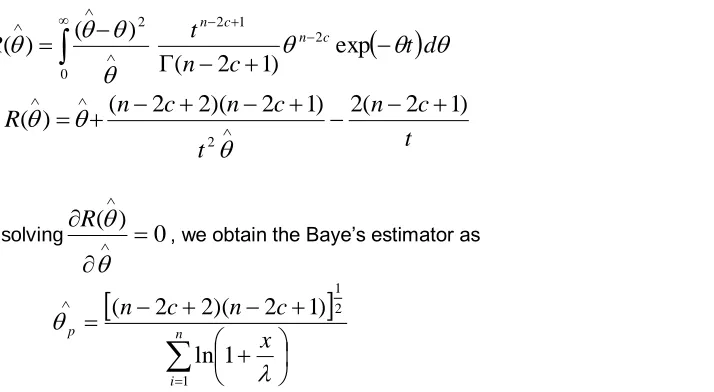
By using this loss function the risk function is given by
0
1 2
exp
)
(
)
(
t
d
n
t
R
nn
0
1 2 2
exp
)
(
)
(
t
d
n
t
R
nn
t
n
c
t
n
n
c
c
12 1 1
2
)
1
(
Now solving
(
)
0
R
, we obtain the Baye’s estimator as
(
12
)
1
ln
)
1
(
1
2 1
ni p
x
n
n
Bayesian estimation of Lomax distribution under the extension of Jeffrey’s prior by using different loss function
We consider the extended Jeffery prior is taken as
I
c
R
Int. J. Stat. Math. 060
where
log
(
2;
,
)
)
(
nE
f
x
I
is the Fisher’s information matrix. For the model (2) the prior distribution of
isgiven by
g
(
)
1
2c
The posterior distribution of
is given by
n i c nx
x
1 2 ) 1 (1
1
)
/
(
n i n c nx
x
1 21
ln
)
1
(
exp
)
/
(
n i c nx
k
x
1 21
ln
exp
)
/
(
where k is independent of
and
x
d
k
n i c n
0 1 2 11
ln
exp
1 2 1 11
ln
)
1
2
(
n n ci
x
c
n
k
(
2
1
)
1
ln
1 2 1
c
n
x
k
c n n i
Hence posterior distribution of
is given by
(
13
)
exp
)
1
2
(
)
/
(
2 1 2t
c
n
t
x
n cc n
where
is
independen
t
of
x
t
n i
11
ln
Estimator under squared error loss function
By using squared error loss function
(
,
)
1(
)
2
c
L
for some constant c the risk function is given by
t
d
c
n
t
c
R
n c
1 2 3 2 1 2 1 21
(
2
1
)
(
2
3
)
2
(
2
1
)
)
1
2
(
2 c n c n c n c nt
c
n
t
c
n
t
c
n
c
n
t
c
t
c
n
c
t
c
n
c
n
c
c
(
2
2
)(
2
1
)
2
1(
2
1
)
2 1 2 1
Now solving
(
)
0
R
, we obtain the Baye’s estimator as
)
14
(
1
ln
1
2
1
2
1
n i s sx
c
n
t
c
n
Remark 1.1: Replacing c= 1/2 in (14), we get the same Bayes estimator as obtained in (10) corresponding to the Jeffrey’s prior.
Estimation under Al-Bayyati’s Loss Function
By using the Al-Bayyati’s loss function the risk function is given by
t
d
c
n
t
R
n cc n c
)
exp(
)
1
2
(
)
(
)
(
2 1 2 0 2 2
0 2 2 1 2)
exp(
)
(
)
1
2
(
)
(
2
t
d
c
n
t
R
n c cc n
2 2 2 3 2 2 1 2 2 2 1 2 2 2 2)
2
2
(
2
)
3
2
(
)
1
2
(
)
1
2
(
)
(
c c n c c n c c n c nt
c
c
n
t
c
c
n
t
c
c
n
c
n
t
R
t
c
c
n
t
c
c
n
c
c
n
c
n
t
c)
2
2
(
2
)
3
2
(
)
1
2
(
)
1
2
(
1
2 2 2 2 22
Now solving
(
)
0
R
, we obtain the Baye’s estimator as
(
2
1
)
(
2
3
)
2
(
2
2
)
0
)
1
2
(
1
2 2 2 2 22
t
c
c
n
t
c
c
n
c
c
n
c
n
t
c
)
15
(
1
ln
1
2
1
2
1 2 2
n i A Ax
c
c
n
t
c
c
n
Remark 1.2: Replacing c= 1/2 in (15), we get the same Bayes estimator as obtained in (11) corresponding to the Jeffrey’s prior.
Estimation under Precautionary loss function
By using precautionary loss function
,
)
(
)
2(
Int. J. Stat. Math. 062
t
d
c
n
t
R
n cc n
exp
)
1
2
(
)
(
)
(
21 2
0
2
t
c
n
t
c
n
c
n
R
(
)
(
2
2
)(
2
1
)
2
(
2
1
)
2
Now solving
(
)
0
R
, we obtain the Baye’s estimator as
(
16
)
1
ln
)
1
2
)(
2
2
(
1
2 1
ni p
x
c
n
c
n
Remark 1.3: Replacing c= 1/2 in (16), we get the same Bayes estimator as obtained in (12) corresponding to the Jeffrey’s prior.
Simulation Study
In our simulation study, we chose a sample size of n=25, 50 and 100 to represent small, medium and large data set. The shape parameter is estimated for Lomax distribution with Maximum Likelihood and Bayesian using Jeffrey’s & extension of Jeffrey’s prior methods. For the shape parameter we have considered = 0.5 and 1.5. The values of Jeffrey’s
extension were c = 0.5 and 1.0. The value for the loss parameter c2 = 1.0 and 2.0. This was iterated 5000 times and
the shape parameter for each method was calculated. A simulation study was conducted R-software to examine and compare the performance of the estimates for different sample sizes with different values for the Extension of Jeffreys’ prior and the loss functions. The results are presented in tables for different selections of the parameters and c extension of Jeffrey’s prior.
Table 1. Mean Squared Error for
(
)
under Jeffery’s priorn
ML
S A
c2=1
A
c2= -1
A
c2= 2.0
A
c2 = -2.0
p
25 0.5 1.0 0.0118 0.0113 0.0129 0.0106 0.0154 0.0108 0.0120
1.5 1.0 0.1298 0.1255 0.1492 0.1106 0.1815 0.1043 0.1362
0..5 2.0 0.0111 0.0107 0.0090 0.0131 0.0079 0.0161 0.0098
1.5 2.0 0.0872 0.0840 0.0777 0.0966 0.0780 0.1156 0.0801
50 0.5 0.5 0.0050 0.0049 0.0050 0.0049 0.0053 0.0052 0.0049
1.5 1.5 0.0811 0.0800 0.0918 0.0704 0.1059 0.0630 0.0856
0.5 0.5 0.0056 0.0055 0.0059 0.0052 0.0066 0.0052 0.0057
1.5 1.5 0.0680 0.0682 0.0591 0.0786 0.0514 0.0904 0.0635
100 0.5 0.5 0.0024 0.0024 0.0024 0.0024 0.0024 0.0025 0.0024
1.5 1.5 0.0752 0.0751 0.0691 0.0813 0.0634 0.0880 0.0721
0.5 0.5 0.0028 0.0028 0.0030 0.0027 0.0033 0.0026 0.0029
1.5 1.5 0.0242 0.0240 0.0225 0.0259 0.0214 0.0282 0.0232
ML= Maximum Likelihood, S=SELF, A= Al-Byatti’s Loss Function, P= Precautionary Loss Function
In Table 1, Bayes estimation with Al-Bayytai’s Loss function under Jeffrey’s prior provides the smallest values in
Table 2. Mean Squared Error for
(
)
under extension of Jeffery’s priorn
CML
S A
c2=1
A
c2=-1
A
c2=2
A
c2=-2
p
25 0.5 1.0 0.5 0.0118 0.0113 0.0129 0.0106 0.0154 0.0108 0.0120
0.5 1.0 1.0 0.0143 0.0117 0.0133 0.0110 0.0160 0.0112 0.0124
1.5 1.0 0.5 0.1007 0.0979 0.0822 0.1192 0.0721 0.1461 0.0894
1.5 1.0 1.0 0.0872 0.0934 0.0808 0.1124 0.0745 0.1379 0.0863
0.5 2.0 0.5 0.0260 0.0102 0.0087 0.0124 0.0079 0.0152 0.0094
0.5 2.0 1.0 0.0158 0.0134 0.0157 0.0120 0.0191 0.0117 0.0144
1.5 2.0 0.5 0.1073 0.1045 0.0866 0.1281 0.0739 0.1568 0.0949
1.5 2.0 1.0 0.0977 0.0880 0.0900 0.0939 0.0994 0.1074 0.0881
50 0.5 1.0 0.5 0.0052 0.0050 0.0054 0.0050 0.0059 0.0051 0.0052
0.5 1.0 1.0 0.0059 0.0067 0.0058 0.0078 0.0051 0.0090 0.0063
1.5 1.0 0.5 0.2795 0.2781 0.3147 0.2443 0.0354 0.2137 0.2959
1.5 1.0 1.0 0.0972 0.1094 0.0960 0.1240 0.0833 0.1399 0.1026
0.5 2.0 0.5 0.0112 0.0112 0.0098 0.0127 0.0085 0.1445 0.0105
0.5 2.0 1.0 0.0077 0.0087 0.0075 0.0103 0.0065 0.0115 0.0081
1.5 2.0 0.5 0.1225 0.1212 0.1398 0.1051 0.1608 0.0914 0.1301
1.5 2.0 1.0 0.1525 0.1682 0.1514 0.1859 0.1356 0.2048 0.1597
100 0.5 1.0 0.5 0.0025 0.0025 0.0025 0.0025 0.0027 0.0025 0.0025
0.5 1.0 1.0 0.0024 0.0025 0.0023 0.0026 0.0023 0.0028 0.0024
1.5 1.0 0.5 0.0229 0.0226 0.0216 0.0240 0.0211 0.0258 0.0221
1.5 1.0 1.0 0.0516 0.0564 0.0513 0.0618 0.0466 0.0675 0.0538
0.5 2.0 0.5 0.0027 0.0026 0.0027 0.0025 0.0029 0.0025 0.0026
0.5 2.0 1.0 0.0025 0.0026 0.0025 0.0028 0.0023 0.0031 0.0025
1.5 2.0 0.5 0.0736 0.7377 0.0808 0.0664 0.0890 0.0601 0.0770
1.5 2.0 1.0 0.0225 0.0222 0.0221 0.0228 0.0223 0.0239 0.0221
ML= Maximum Likelihood, S=SELF, A= Al-Bayytai’s Loss Function, P= Precautionary Loss Function
In Table 2, Bayes estimation with Al-Bayytai’s Loss function under extension of Jeffrey’s prior provides the smallest values in most cases especially when loss parameter C2 is -1,-2 whether the extension of Jeffrey’s prior is 0.5, 1.0.
Moreover, when the sample size increases from 25 to 100, the MSE decreases quite significantly.
Application
Here, we use a real data set to compare the estimates of the Lomax distribution. We consider an uncensored data set corresponding an uncensored data set from consisting of 100 observations on breaking stress of carbon fibers (in Gba): 3.7, 2.74, 2.73, 2.5, 3.6, 3.11, 3.27,2.87, 1.47, 3.11,4.42, 2.41, 3.19, 3.22, 1.69, 3.28, 3.09, 1.87, 3.15, 4.9, 3.75, 2.43, 2.95, 2.97, 3.39, 2.96, 2.53,2.67, 2.93, 3.22, 3.39, 2.81, 4.2, 3.33, 2.55, 3.31, 3.31, 2.85, 2.56, 3.56, 3.15, 2.35, 2.55, 2.59,2.38, 2.81, 2.77, 2.17, 2.83, 1.92, 1.41, 3.68, 2.97, 1.36, 0.98, 2.76, 4.91, 3.68, 1.84, 1.59, 3.19,1.57, 0.81, 5.56, 1.73, 1.59, 2, 1.22, 1.12, 1.71, 2.17, 1.17, 5.08, 2.48, 1.18,3.51, 2.17, 1.69,1.25, 4.38, 1.84, 0.39, 3.68, 2.48, 0.85, 1.61, 2.79, 4.7, 2.03, 1.8, 1.57, 1.08, 2.03, 1.61, 2.12,1.89, 2.88, 2.82, 2.05, 3.65. These data are used here only for illustrative purposes. The required numerical evaluations are carried out using the Package of R software.
We used the non-informative Jeffery’s priors for θ when
= 1, 2, values of Jeffrey’s extension were c = 1.0 and when cInt. J. Stat. Math. 064
Table 3: Estimates incase of Jefffery’s prior
ML
S A
c2=1A
c2= -1A
c2= 2.0A
c2 = -2.0p
1.0 0.0978 0.0977 0.1026 0.0929 0.1076 0.0882 0.1001
2.0 0.5471 0.5469 0.5650 0.5291 0.5834 0.5116 0.5560
Table 4. Estimates in case of extension of Jeffery’s prior
CML
S A
c2=1
A
c2=-1
A
c2=2
A
c2= -2
p
1.0 1.0 0.0978 0.0929 0.0977 0.0882 0.1026 0.0837 0.0953
2.0 1.0 0.5471 0.5290 0.5468 0.5115 0.5649 0.4943 0.5379
From these tables we conclude that Al-Bayytai’s loss is best among these as it gives the smallest values of estimates especially when c2 = -1 , -2.
CONCLUSION
In this article, we have primarily studied the Bayes estimator of the parameter of the Lomax distribution under the Jeffery’s and extended Jeffrey’s prior assuming three different loss functions. The extended Jeffrey’s prior gives the opportunity of covering wide spectrum of priors to get Bayes estimates of the parameter - particular cases of which are Jeffrey’s prior and Hartigan’s prior. We have also addressed the problem of Bayesian estimation for the Lomax distribution, under symmetric loss functions and that of Maximum Likelihood Estimation. From the results, we observe that in most cases, Bayesian Estimator under New Loss function (Al-Bayyati’s Loss function) has the smallest Mean Squared Error values for both prior’s i.e, Jeffrey’s and an extension of Jeffrey’s prior information.
ACKNOWLEDGMENT
The authors would like to thank the referee for a very careful reading of the manuscript and making a number of nice suggestions which improved the earlier version of the manuscript.
REFERENCES
Abdullah, MA, Abdullah, HA (2010). Estimation of Lomax parameters based on Generalized Probability Weighted
Moment, JKAU, Sci (22), 171-184.
Abd-Elfattah, M, Mandouh, RM (2004). Estimation of Pr [Y< X] in Lomax case, The 13th Annual Conference in Statistics
Computer Science and Operation Research, ISSR, Cairo University, Egypt, Part, 1, 156-166.
Al-Bayyati (2002). Comparing methods of estimating Weibull failure models using simulation, Ph.D. Thesis, College of
Administration and Economics, Baghdad University, Iraq.
Al-Kutubi, HS (2005). On Comparison Estimation Procedures for parameter and survival function. Iraqi Journal of Statistical Science, vol. 9, 1-14.
Chandra, M. J., (2001). “Statistical Quality Control”, CRC Press, Boca Raton.
Jeffery’s, H (1964). An invariant form for the Prior Probability in estimation problems, Proceedings of the Royal Society of London, Series. A., 186: 453-461.
Nasiri, P, Hosseini, S (2012). Statistical Inferences for Lomax Distribution Based on Record Values (Bayesian and
Classical), Journal of Modern Applied Statistical Methods, 11, 179-189.
Norstrom, JG (1996). The use of Precautionary Loss Functions in Risk Analysis, IEEETransactions on reliability, (3),
400-403.
Reshi, JA, Ahmed, A, Ahmad, SP (2014). Bayesian Analysis of Scale Parameter of the Generalized Inverse Rayleigh
Model Using Different Loss Functions, International Journal of Modern Mathematics, 10(2), pp. 151-162.
Zellner, A, (1986). Bayesian estimation and prediction using asymmetric loss function, J.Amer. Statist. Assoc., 81, pp. 446-451.exponential distribution using simulation. PhD Thesis, Baghdad University, Iraq.
Zagan, AA, (1999). Lomax distribution and its role in reliability and life testing, M.Sc Thesis, King Abdul –Alaziz University, Saudia Arabia.
Accepted 12 January, 2015.
Citation: Afaq A, SP Ahmad, Ahmed A (2015). Bayesian analysis of shape parameter of Lomax distribution using different loss functions. Int. J. Stat. Math., 2(1): 055-065.