_____________________________________________________________________________________________________ *Corresponding author: E-mail: [email protected];
Technology
1(4): 1-6, 2017; Article no.AJB2T.36519
Determination of Proximate, Mineral and Vitamin
Composition on the Leaf and Stem of
Desmodium
velutinum
(
Willd.
) DC
N. A. Igboabuchi
1* 1Department of Biology, Nwafor Orizu College of Education Nsugbe, Anambra State, Nigeria.Author’s contribution
The sole author designed, analyzed and interpreted and prepared the manuscript.
Article Information
DOI: 10.9734/AJB2T/2017/36519 Editor(s): (1) Marilia Danyelle Nunes Rodrigues, Animal Genetics, Rural Federal University of Amazonia, Brazil. Reviewers: (1) Okon Okon Godwin, University of Uyo, Nigeria. (2) Irfan Ur Rauf Tak, University of Kashmir, India. Complete Peer review History: http://prh.sdiarticle3.com/review-history/21376
Received 30thAugust 2017
Accepted 8thOctober 2017
Published 13thOctober 2017
ABSTRACT
Proximate, Mineral and Vitamin composition on the leaf and stem ofD. velutinumwere evaluated to determine its nutritional characters using standard techniques. Data obtained were analyzed using independent sample T-test with SPSS software version 21. All Statistical Analysis was carried out at 0.05 level of significance. Result of the proximate analysis revealed that the leaf had higher percentage of moisture (10.38±0.01%), crude fibre (18.76±0.03%) and carbohydrate (22.10±0.04%), while the stem had higher dry matter (90.56±0.03%), ash (23.45±0.01%), ether extract (11.28±0.01%) and crude protein (18.14±0.03%). In the mineral composition, the leaf contained higher composition of calcium (90.34±0.09 mg/100 g), sodium (87.64±0.06 mg/100 g), magnesium (48.76±0.01 mg/100 g) and iron (10.17±0.01 mg/100 g), while the stem contained higher composition of potassium (115.80±0.01 mg/100 g) and phosphorus (59.90±0.42 mg/100 g). However, in the vitamin analysis, the leaf had higher composition of vitamin A (9.38±0.01 IU/100g) and vitamin B1 (27.61±0.01 mg/100 g), while the stem had higher composition of vitamin B2 (1.78±0.028 mg/100 g), vitamin B3 (6.08±0.01 mg/100 g), vitamin C (19.25±0.00 mg/100 g) and vitamin E (2.43±0.04 mg/100 g). D. velutinum parts (stem and leaf) were found to be rich in nutrients, thus could be exploited for different nutritional uses in enhancing human diet.
Keywords: Desmodium velutinum; nutritional; mineral; proximate; vitamin.
1. INTRODUCTION
Medicinal plants play a significant role in providing primary health care services to rural people and are used by about 80% of the marginal communities around the world [1,2,3]. Each medicinal plant species has its own nutrient composition besides having pharmacologically important phytochemicals. These nutrients are essential for the physiological functions of human body. Such nutrients like carbohydrates, vitamins, fats and proteins play an important role in satisfying human needs for energy and life processes [4,5].
Desmodium is a genus in the family Fabaceae. All Desmodium species are mostly inconspicuous legumes, few have bright or large flowers. Though some can become sizeable plants, most are herbs or small shrubs. Their fruits are loments (each seed is dispersed individually enclosed in its segment), this makes them tenacious, and some species are considered weeds in some places [6]. Dozens of
Desmodiumspecies are found in Africa including
Desmodium velutinum.The species are very rich in alkaloids and related amino compounds. They are good sources of various nutrients required in the body and contains pharmacological active agent useful in the treatment of aches and pains [6].
The species Desmodium velutinum(Willd) DC is a perennial, erect or semi-erect leguminous shrub or sub-shrub, up to 3m high. It is a dicotyledenous plant as its stem is solid and not hollow, with deep taproot and reticulate venation [7].D. velutinumis a source of a pharmacological active agent useful in the treatment of high level cholesterol in the blood which has got both liver protecting and nutritional value. It is used in Nigeria and Lokoja in particular for the treatment of stomach ache and related ailments [8]. D. velutinum has been tagged as the ‘alfalfa of the tropics’ because of its high nutrient composition [3,9].
D. velutinum is a species with immense economic and medicinal importance. However, no comprehensive work has been done on its nutritional composition.
The aim of this study was to evaluate the nutritional contents of the leaf and stem of this
2. MATERIALS AND METHODS 2.1 Area of Study
The proximate, mineral and vitamin analyses were carried out at the Emery Biotechnology Laboratory, Ahia-Eke, situated in Umuahia, Abia State, Nigeria.
2.2 Collection and Identification of D. velutinum
The species D. velutinum used in this research was obtained between April- June 2016 from a botanical garden Awka, Anambra State and was authenticated in the Department of Botany Herbarium, Nnamdi Azikiwe University, Awka. The Voucher specimen was deposited at the Department of Botany Herbarium Nnamdi Azikiwe University, Awka.
2.3 Proximate, Vitamin and Mineral Studies
2.3.1 Preparation of samples
The leaf and stem were oven-dried at a temperature of 65°C for 12 h to remove all moisture. The samples were ground with a blender into powdered form. The powdered samples were sifted and preserved in a dry container for analysis.
2.3.2 Materials and chemicals used
The following materials were used; Dessicator, muffle furnace, spectrometer, silica dish, kjeldahl flask, funnel, soxhlet apparatus, filter paper, thimble, electric oven, grinder, retort stand, test tube and test tube rack, crucible, weighing balance, petri dish.
Chemicals and reagents used for the studies include; Tetrahydrosulphate (vi) acid, Boric acid indicator solution, Sodium hydroxide, Hydrochloric acid, Petroleum ether, Potassium hydroxide, Acetone, Phenolphthaline indicator,
Ammonia, Dithezone solution, Carbon
tetrachloride, Hydroquinoline, Phenonthroline, VanadoMolybidic acid, Selenium oxide.
Magnesium, iron and phosphorus) and vitamins (vitamins A, B1, B2, B3, C and E) contents were carried out to ascertain the nutrient compositions present in the plant extracts. Moisture content, total ash and protein were determined according to the method of [10]. Ether extract and carbohydrate were determined using the method of [11] while crude fibre and dry matter were done by solvent extraction gravimetric method described by [12]. Vitamins and minerals were done following the methods of [13].
2.4 Statistical Analysis
Data obtained from the studies were analyzed using independent sample T-test by the Statistical Package for social sciences (SPSS) version 21. All Statistical Analysis was carried out at 0.05 level of significance.
3. RESULTS AND DISCUSSION
3.1 Results of the Study are Presented in Tables 1-3 and Figs. 1-4
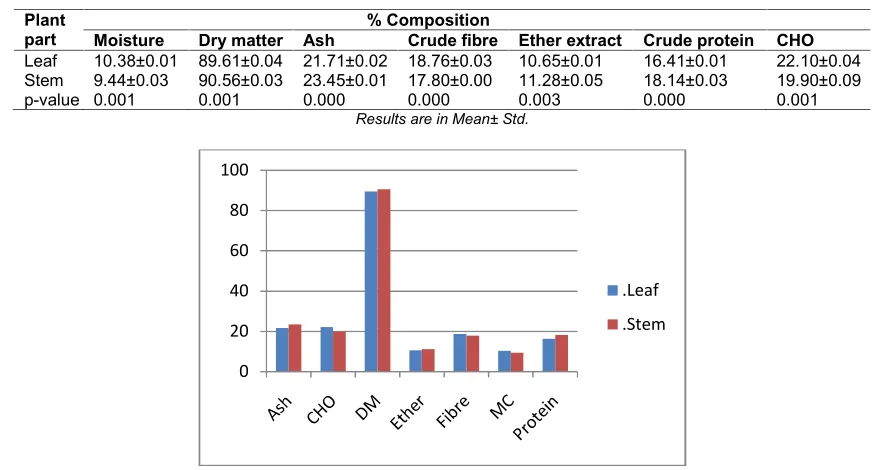
Result showed that the nutrients were present in all the parts investigated but in varied compositions. The leaf contained higher percentage of moisture (10.38±0.01%), crude
fibre (18.76±0.03%) and carbohydrate
(22.10±0.04%), while the stem contained higher percentage of dry matter (90.56±0.03%), ash (23.45±0.01%), ether extract (11.28±0.050%) and crude protein (18.14±0.03%). There was a significant difference in the composition of all the proximate assayed between the leaf and stem of
D. velutinum (p<0.05) (Table 1) (Fig. 1). The result indicated that D. velutinum has some nutritional potential that can be exploited in diet. The result has shown the leaf to be a better source of moisture, crude fibre and carbohydrate while stem will serve as a better source of dry matter, ash, ether extract and crude protein in human diets and drug production. This is in line with the earlier report by [14] who reported that primary metabolites (carbohydrate, proteins and fats) are synthesized by plants which are used as drug production and provides nutrition. These nutrients provide energy for work and warmth, provide materials for growth and repairs of worn out tissues, aid excretion and keep the organism healthy so that it can fight against diseases [15]. The result is also in line with the works of [16a and b] who reported that the leaf and stem of C. argentea and the leaf, stem and root of Vitex chrysocarpa has some nutritional potential that can be exploited in diet.
Table 1. Percent proximate composition of the leaf and stem ofD. velutinum
Plant
part Moisture Dry matter Ash % CompositionCrude fibre Ether extract Crude protein CHO
Leaf 10.38±0.01 89.61±0.04 21.71±0.02 18.76±0.03 10.65±0.01 16.41±0.01 22.10±0.04
Stem 9.44±0.03 90.56±0.03 23.45±0.01 17.80±0.00 11.28±0.05 18.14±0.03 19.90±0.09
p-value 0.001 0.001 0.000 0.000 0.003 0.000 0.001
Results are in Mean± Std.
Fig. 1. Proximate composition (%) of the leaf and stem ofD. velutinum
0 20 40 60 80 100
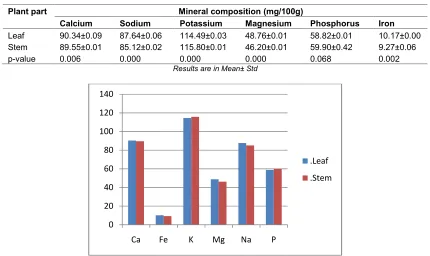
The minerals were present in all parts of D. velutinum investigated but in varied proportions. The leaf contained higher composition of calcium (90.34±0.09 mg/100 g), sodium (87.64±0.06 mg/100 g), magnesium (48.76±0.01 mg/100 g) and iron (10.17±0.00 mg/100 g), while the stem contained higher composition of potassium (115.80±0.01 mg/100 g) and phosphorus (59.90±0.42 mg/100 g). There was a significant difference in the composition of all the minerals assayed with the exception phosphorus between the leaf and stem of D. velutinum
(p<0.05) (Table 2) (Fig. 2). The result has shown the leaf to be a better source of calcium, sodium, magnesium and iron needed for human body metabolic functioning. However, the stem of
D. velutinum was found to have significantly higher potassium and phosphorus than leaf signifying that the stem will be a better source of potassium and phosphorus for mineral supplements than the leaf. These minerals are essential nutrients that the body needs to survive and carry out daily functions and processes. They keep the organism healthy so that it can fight against diseases [15]. The result is also in line with the works of [16a and b] who reported that the leaf and stem of C. argentea and the leaf, stem and root of Vitex chrysocarpa has
some nutritional potential that can be exploited in diet.
Result of the vitamin analysis revealed higher composition of vitamin A (9.38±0.01 IU/100 g) and vitamin B1 (27.61±0.01 mg/100 g) in the leaf, while the stem contained higher composition of vitamin B2 (1.78±0.03 mg/100 g), vitamin B3 (6.08±0.01 mg/100g), vitamin C (19.25±0.00 mg/100g) and vitamin E (2.43±0.04 mg/100 g) (Table 3) (Fig. 3). There was a significant difference in all the vitamins assayed between the leaf and stem of D.velutinum(Table 3) (Fig. 3). This shows the leaf as a better source of vitamins A and B1 while the stem will serve as a better source of vitamins B2, B3, C and E supplements. This is in line with the findings of [3] who reported that D. velutinumcontains high nutrient composition. Vitamins allow the body to grow and develop. They also play important roles in bodily functions such as metabolism; immunity and digestion thus keep the organism healthy so that it can fight against diseases [15]. The result is also in line with the works of [16a and b] who reported that the leaf and stem of C. argentea
and the leaf, stem and root ofVitex chrysocarpa
has some nutritional potential that can be exploited in diet.
Table 2. Percent mineral composition of the leaf and stem ofD. velutinum
Plant part Mineral composition (mg/100g)
Calcium Sodium Potassium Magnesium Phosphorus Iron
Leaf 90.34±0.09 87.64±0.06 114.49±0.03 48.76±0.01 58.82±0.01 10.17±0.00
Stem 89.55±0.01 85.12±0.02 115.80±0.01 46.20±0.01 59.90±0.42 9.27±0.06
p-value 0.006 0.000 0.000 0.000 0.068 0.002
Results are in Mean± Std
Fig. 2. Mineral composition (mg/100 g) of the leaf and stem ofD. velutinum
0 20 40 60 80 100 120 140
Ca Fe K Mg Na P
Table 3. Percent vitamin composition of the leaf and stem ofD. velutinum
Plant part Vitamin A
(IU/100g) Vitamin B1 Vitamin B2 (mg/100 g)Vitamin B3 Vitamin C Vitamin E
Leaf 9.38±0.01 27.61±0.014 0.05±0.00 1.05±0.01 14.78±0.02 0.29±0.02
Stem 4.07±0.02 11.40±0.028 1.78±0.03 6.08±0.01 19.25±0.00 2.43±0.04
p-value 0.000 0.000 0.000 0.000 0.000 0.000
Results are in Mean ± Std
’
Fig. 3. Vitamin composition (mg/100 g) of the leaf and stem ofD. velutinum
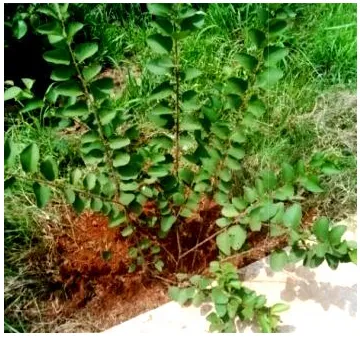
Fig. 4.D. velutinumin its natural habitat
4. CONCLUSION
The study has demonstrated thatD. velutinumis a power house of nutrients. The parts (leaf and stem) could be used as food and in the manufacture of food supplements. The high compositions of investigated nutrients (proximate, vitamin and mineral) indicated thatD. velutinum couldcontribute significantly to human health requirements.
Malnourished people could be advised to eat the leaves of D. velutinum in relatively high amount as food supplement, since it is rich in proteins, minerals and vitamins.
COMPETING INTERESTS
Author has declared that no competing interests exist.
REFERENCES
1. Prajapati ND, Prajapati T. Sustainable cultivation of medicinal plants; Multi Tier Agriculture System-A New Concept; 2002.
Available:www.techno-preneur.net/timeis/technology (Accessed, 06/08/2016)
2. Latif A, Ahmad H, Begum S, Adnan M, Hussian S, Waseem M. Medicinal and other economic plants as substitute to forest logging in Miandam and Sulatanr valleys, Swat. Proceedings of International
Workshop on Conservation and
Sustainable Use of Medicinal and Aromatic Plants in Pakistan. 2003;101-105.
3. Shinwari ZK, Rehman M, Watanabe T, Yoshikawa T. A Pictorial guide to medicinal 0 5 10 15 20 25 30 A B1
Table 3. Percent vitamin composition of the leaf and stem ofD. velutinum
Plant part Vitamin A
(IU/100g) Vitamin B1 Vitamin B2 (mg/100 g)Vitamin B3 Vitamin C Vitamin E
Leaf 9.38±0.01 27.61±0.014 0.05±0.00 1.05±0.01 14.78±0.02 0.29±0.02
Stem 4.07±0.02 11.40±0.028 1.78±0.03 6.08±0.01 19.25±0.00 2.43±0.04
p-value 0.000 0.000 0.000 0.000 0.000 0.000
Results are in Mean ± Std
’
Fig. 3. Vitamin composition (mg/100 g) of the leaf and stem ofD. velutinum
Fig. 4.D. velutinumin its natural habitat
4. CONCLUSION
The study has demonstrated thatD. velutinumis a power house of nutrients. The parts (leaf and stem) could be used as food and in the manufacture of food supplements. The high compositions of investigated nutrients (proximate, vitamin and mineral) indicated thatD. velutinum couldcontribute significantly to human health requirements.
Malnourished people could be advised to eat the leaves of D. velutinum in relatively high amount as food supplement, since it is rich in proteins, minerals and vitamins.
COMPETING INTERESTS
Author has declared that no competing interests exist.
REFERENCES
1. Prajapati ND, Prajapati T. Sustainable cultivation of medicinal plants; Multi Tier Agriculture System-A New Concept; 2002.
Available:www.techno-preneur.net/timeis/technology (Accessed, 06/08/2016)
2. Latif A, Ahmad H, Begum S, Adnan M, Hussian S, Waseem M. Medicinal and other economic plants as substitute to forest logging in Miandam and Sulatanr valleys, Swat. Proceedings of International
Workshop on Conservation and
Sustainable Use of Medicinal and Aromatic Plants in Pakistan. 2003;101-105.
3. Shinwari ZK, Rehman M, Watanabe T, Yoshikawa T. A Pictorial guide to medicinal
B1 B2 B3 C E
.Leaf .Stem
Table 3. Percent vitamin composition of the leaf and stem ofD. velutinum
Plant part Vitamin A
(IU/100g) Vitamin B1 Vitamin B2 (mg/100 g)Vitamin B3 Vitamin C Vitamin E
Leaf 9.38±0.01 27.61±0.014 0.05±0.00 1.05±0.01 14.78±0.02 0.29±0.02
Stem 4.07±0.02 11.40±0.028 1.78±0.03 6.08±0.01 19.25±0.00 2.43±0.04
p-value 0.000 0.000 0.000 0.000 0.000 0.000
Results are in Mean ± Std
’
Fig. 3. Vitamin composition (mg/100 g) of the leaf and stem ofD. velutinum
Fig. 4.D. velutinumin its natural habitat
4. CONCLUSION
The study has demonstrated thatD. velutinumis a power house of nutrients. The parts (leaf and stem) could be used as food and in the manufacture of food supplements. The high compositions of investigated nutrients (proximate, vitamin and mineral) indicated thatD. velutinum couldcontribute significantly to human health requirements.
Malnourished people could be advised to eat the leaves of D. velutinum in relatively high amount as food supplement, since it is rich in proteins, minerals and vitamins.
COMPETING INTERESTS
Author has declared that no competing interests exist.
REFERENCES
1. Prajapati ND, Prajapati T. Sustainable cultivation of medicinal plants; Multi Tier Agriculture System-A New Concept; 2002.
Available:www.techno-preneur.net/timeis/technology (Accessed, 06/08/2016)
2. Latif A, Ahmad H, Begum S, Adnan M, Hussian S, Waseem M. Medicinal and other economic plants as substitute to forest logging in Miandam and Sulatanr valleys, Swat. Proceedings of International
Workshop on Conservation and
Sustainable Use of Medicinal and Aromatic Plants in Pakistan. 2003;101-105.
plants of Pakistan. Kohat University of Science and Technology Pakistan; 2006. 4. Hoffman PC, Combs DK, Casler MD.
Performance of lactating dairy cows fed alfalfa silage or perennial ryegrass silage. Journal of Dairy Science. 1998;81:162-168.
5. Dingman SL. Water in soils: Infiltration and redistribution. Physical hydrology, Second edition, Upper Saddle River, New Jersey: Prentice-Hall, Incorporation; 2002.
6. Albers JJ, Koschinsky ML, Marcovina SM. Evidence Mounts for a role of the kidney in Lipoprotein Catabolism’. Kidney Intersection. 2007;71(10):961-962.
7. Latham P. Useful plants of Bas-Congo province, Democratic Republic of the Congo. DFID, London, United Kingdom; 2004.
8. Arkinstall GU. Antipyretic and
phytochemical evaluation of the ethanol extract of the leaves of D. velutinum
(Willd). Asian Journal of Pharmacy Life Science. 2001;2:135-143.
9. Davey MW, Montagu MU, Inze D,
Sanmartin M, Kanellis A, Smirnoff N, Benzie IF, Strain JJ, Favell D, Fletcher J. Plant ascorbic acid: Chemistry, function, metabolism, bioavailability and effects of processing. Journal on Food Agriculture. 2000;80:825-860.
10. AOAC. Official Method of Analytical Chemistry, Washington DC; 1990.
11. Kirk H, Sawyer R. Frait pearson chemical analysis of food (8th ed). Longman Scientific and Technical, Edinburgh; 1998.
12. Onwuka GI. Food analysis and
instrumentation; Theory and practice. (2nd Edition). Naphthali Prints, Lagos; 2005. 13. Trease GE, Evans WC. A textbook of
pharmacoygnos (14th edn). Bailliere Tindal ltd, London; 1996.
14. Sukumar D, Manoj K, Kumar A, Sinha MP. Therapeutic efficacy and nutritional potentiality of Indian bay leaf (Cinnamomum Tamala Buch.-Hem.). International Journal of Pharmacy. 2013; 3(4):779-785.
15. Ilodibia CV, Igboabuchi NA. Evaluation of phytochemical and nutritional potential of
Talinum triangulare (Jacq) leaf, stem and root on human health. International Journal of Biological Research. 2017;5(1):6-9. 16. (A) Ilodibia CV, Chukwuka C, Akachukwu
EE, Adimonyemma, RN, Igboabuchi NA, Chukwuma MU. Anatomical, proximate, mineral and vitamin studies on Celosia argentea (Linn). British Biotechnology Journal. 2016a;15(4):1-7.
(B) Ilodibia CV, Eze E, Akachukwu EE, Adimonyemma RN, Igboabuchi NA, Chukwuma MU. Proximate, vitamin, mineral and anatomical studies on Vitex chrysocarpa Planch Ex Benth. (Verbenaceae) Journal of Advances in Biology and Biotechnology. 2016b;9(1):1-5.
_________________________________________________________________________________
© 2017 Igboabuchi; This is an Open Access article distributed under the terms of the Creative Commons Attribution License (http://creativecommons.org/licenses/by/4.0), which permits unrestricted use, distribution, and reproduction in any medium, provided the original work is properly cited.
Peer-review history: