R E S E A R C H
Open Access
A hybrid iterative method for common
solutions of variational inequality problems
and fixed point problems for single-valued
and multi-valued mappings with applications
Nawitcha Onjai-uea
1and Withun Phuengrattana
1,2**Correspondence:
1Department of Mathematics,
Faculty of Science and Technology, Nakhon Pathom Rajabhat University, Nakhon Pathom, 73000, Thailand
2Research Center for Pure and
Applied Mathematics, Research and Development Institute, Nakhon Pathom Rajabhat University, Nakhon Pathom, 73000, Thailand
Abstract
In this article, we propose a new iterative method for approximating a common element of the set of common fixed points of a finite family ofk-strictly
pseudononspreading single-valued mappings, the set of common fixed points of a finite family of quasi-nonexpansive multi-valued mappings, and the set of common solutions of a finite family of variational inequality problems in Hilbert spaces. Furthermore, we prove that the proposed iterative method converges strongly to a common element of the above three sets, and we also apply our results to
complementarity problems. Finally, we give two numerical examples to support our main result.
MSC: 46C05; 47H09; 47H10
Keywords: fixed point; strictly pseudononspreading mappings; multi-valued mappings; variational inequality problems; Hilbert spaces
1 Introduction
LetDbe a nonempty subset of a real Hilbert spaceX. LetCB(D) denote the families of nonempty closed bounded subsets ofD. TheHausdorff metriconCB(D) is defined by
H(A,B) =max
sup x∈A
dist(x,B),sup y∈B
dist(y,A)
forA,B∈CB(D),
wheredist(x,D) =inf{x–y:y∈D}. LetT:D→CB(D) be a multi-valued mapping. An elementx∈Dis said to be afixed pointofTifx∈Tx. The set of fixed points ofTwill be denoted byF(T). A multi-valued mappingT:D→CB(D) is called
(i) nonexpansiveif
H(Tx,Ty)≤ x–y for allx,y∈D;
(ii) quasi-nonexpansiveifF(T)=∅and
H(Tx,Tp)≤ x–p for allx∈Dandp∈F(T);
(iii) L-Lipschitzianif there existsL> such that
H(Tx,Ty)≤Lx–y for allx,y∈D.
It is clear that every nonexpansive multi-valued mappingT with F(T)=∅ is quasi-nonexpansive. It is known that ifTis a quasi-nonexpansive multi-valued mapping, then
F(T) is closed. In general, the fixed point set of a quasi-nonexpansive multi-valued map-pingT is not necessary to be convex. In the next lemma, we show thatF(T) is convex under the assumption that Tp={p}for all p∈F(T). The proof of this fact is very easy, therefore we omit it.
Lemma . Let D be a nonempty closed convex subset of a real Hilbert space X.Assume that T :D→CB(D)is a quasi-nonexpansive multi-valued mapping.If Tp={p}for all p∈F(T),then F(T)is convex.
The fixed point theory of multi-valued mappings is much more complicated and harder than the corresponding theory of single-valued mappings. However, some classical fixed point theorems for single-valued mappings have already been extended to multi-valued mappings; see [, ]. The recent fixed point results for multi-valued mappings can be found in [–] and the references cited therein.
For a single-valued case, a mappingt:D→Dis callednonexpansiveiftx–ty ≤ x–y
for allx,y∈D. An elementx∈Dis called afixed pointoftifx=tx. Recall that a single-valued mappingt:D→Dis said to benonspreading[, ] if
tx–ty≤ x–y+ x–tx,y–ty for allx,y∈D.
In , Kurokawa and Takahashi [] obtained a weak mean ergodic theorem of Bail-lon’s type for nonspreading single-valued mappings in Hilbert spaces. They also proved a strong convergence theorem for this class of single-valued mappings using an idea of mean convergence in Hilbert spaces. Later in , Osilike and Isiogugu [] introduced a new class of nonspreading type of mappings, which is more general than the class studied in [], as follows: A single-valued mappingt:D→Dis calledk-strictly pseudononspreading
if there existsk∈[, ) such that
tx–ty≤ x–y+k(I–t)x– (I–t)y+ x–tx,y–ty for allx,y∈D.
Obviously, every nonspreading mapping is k-strictly pseudononspreading. Osilike and Isiogugu proved weak and strong convergence theorems for this mapping in Hilbert spaces. They also provided a property of ak-strictly pseudononspreading mapping as fol-lows.
Lemma .([]) Let D be a nonempty closed convex subset of a real Hilbert space X,and let t:D→D be a k-strictly pseudononspreading mapping.If F(t)=∅,then it is closed and convex.
The problem of finding common fixed points has been extensively studied by mathe-maticians. To deal with a fixed point problem of a family of nonlinear mappings, several ways have appeared in the literature. For example, in , Atsushiba and Takahashi [] introduced a new mapping, calledW -mapping, for finding a common fixed point of a fi-nite family of nonexpansive mappings. This mapping is defined as follows. Let{ti}Ni=be a finite family of nonexpansive mappings ofDinto itself. LetW :D→Dbe a mapping defined by
U=βt+ ( –β)I,
U=βtU+ ( –β)I,
U=βtU+ ( –β)I, ..
.
UN–=βN–tN–UN–+ ( –βN–)I,
W=UN=βNtNUN–+ ( –βN)I,
whereI is the identity mapping ofDand{βi}Ni= is a sequence in (, ). This mapping is called theW -mappinggenerated byt,t, . . . ,tN andβ,β, . . . ,βN. They also proved that ifXis a strictly convex Banach space, thenF(W) =Ni=F(ti).
In , Kangtunyakarn and Suantai [] introduced a new concept of theS-mapping for finding a common fixed point of a finite family of nonexpansive mappings as follows: Let{ti}Ni=be a finite family of nonexpansive mappings ofDinto itself. LetS:D→Dbe a mapping defined by
V=δt+δI+δI,
V=δtV+δV+δI,
V=δtV+δV+δI, ..
.
VN–=δN–tN–VN–+δN–VN–+δN–I,
S=VN =δNtNVN–+δNVN–+δNI,
whereIis the identity mapping ofDandδj= (δj,δ j ,δ
j
)∈[, ]×[, ]×[, ],j= , , . . . ,N, whereδj+δj +δj = for allj= , , . . . ,N. This mapping is called theS-mapping gener-ated byt,t, . . . ,tN andδ,δ, . . . ,δN. They proved the following lemma important for our results.
Lemma . Let D be a nonempty closed convex subset of a strictly convex Banach space X.
Let{ti}Ni=be a finite family of nonexpansive mappings of D into itself with N
i=F(ti)=∅,
and letδj= (δj,δ j ,δ
j
)∈[, ]×[, ]×[, ],j= , , . . . ,N,whereδ j +δ
j +δ
j = ,δ
j ∈(, )
for all j= , , . . . ,N– ,δN ∈(, ],andδj,δj ∈[, )for all j= , , . . . ,N.Let S be the S-mapping generated by t,t, . . . ,tNandδ,δ, . . . ,δN.Then S is a nonexpansive mapping and
Applications ofW-mappings andS-mappings for fixed point problems can be found in [–].
LetB:D→Xbe a nonlinear mapping. Thevariational inequality problemis to find a pointu∈Dsuch that
Bu,v–u ≥ for allv∈D. (.)
The set of solutions of (.) is denoted byVI(D,B).
A mappingB:D→Xis calledφ-inverse strongly monotone[] if there exists a positive real numberφsuch that
x–y,Bx–By ≥φBx–By for allx,y∈D.
Variational inequality theory, which was first introduced by Stampacchia [] in , emerged as an interesting and fascinating branch of applicable mathematics with a wide range of applications in economics, industry, network analysis, optimizations, pure and applied sciencesetc.In recent years, much attention has been given to developing efficient iterative methods for treating solution problems of variational inequalities (e.g., see [– ]).
In , Takahashi and Toyoda [] introduced an iterative method for finding a com-mon element of the set of fixed points of nonexpansive single-valued mappings and the set of solutions of variational inequalities forφ-inverse strongly monotone mappings in Hilbert spaces. Recently, by using the concept ofS-mapping, Kangtunyakarn [] intro-duced a new method for finding a common element of the set of fixed points ofk-strictly pseudononspreading single-valued mappings and the set of solutions of variational in-equality problems in Hilbert spaces.
Question A How can we construct an iteration process for finding a common element of the set of common fixed points of a finite family ofk-strictly pseudononspreading single-valued mappings, the set of common fixed points of a finite family of quasi-nonexpansive multi-valued mappings, and the set of common solutions of a finite family of variational inequality problems?
In the recent years, the problem of finding a common element of the set of fixed points of single-valued mappings and multi-valued mappings in the framework of Hilbert spaces and Banach spaces has been intensively studied by many researchers. However, no re-searchers have studied the problem of finding a common element of three sets,i.e., the set of common fixed points of a finite family of single-valued mappings, the set of common fixed points of a finite family of multi-valued mappings, and the set of common solutions of a finite family of variational inequality problems.
2 Preliminaries
In this section, we give some useful lemmas for proving our main results. Let Dbe a nonempty closed convex subset of a real Hilbert spaceX. LetPD be the metric projec-tion ofXontoD,i.e., forx∈X,PDxsatisfies the propertyx–PDx=miny∈Dx–y. It is well known thatPDis a nonexpansive mapping ofXontoD.
Lemma .([]) Let X be a Hilbert space,let D be a nonempty closed convex subset of X,
and let B be a mapping of D into X.Let u∈D.Then,forλ> ,
u=PD(I–λB)u ⇐⇒ u∈VI(D,B).
Lemma .([]) Let D be a nonempty closed convex subset of a real Hilbert space X,and let PD:X→D be the metric projection.Given x∈X and z∈D,then z=PDx if and only if
the following holds:
x–z,y–z ≤ for all y∈D.
Lemma .([]) Let D be a nonempty closed convex subset of a real Hilbert space X,and let PD:X→D be the metric projection.Then the following inequality holds:
y–PDx+x–PDx≤ x–y for all x∈X and y∈D.
Lemma .([]) Let X be a real Hilbert space.Then
x–y=x– x,y +y for all x,y∈X.
Lemma .([]) Let X be a Hilbert space.Let x,x, . . . ,xN∈X andα,α, . . . ,αNbe real
numbers such thatNi=αi= .Then
N
i=
αixi
= N
i=
αixi–
≤i,j≤N
αiαjxi–xj.
Lemma .([]) Let D be a nonempty closed convex subset of a real Hilbert space X.
Given x,y,z∈X and b∈R,the set
u∈D:y–u≤ x–u+z,u +b
is closed and convex.
Lemma .([]) In a strictly convex Banach space X,if
x=y=λx+ ( –λ)y
for all x,y∈X andλ∈(, ),then x=y.
Lemma . Let D be a nonempty closed convex subset of a Hilbert space X.Let t:D→D be a k-strictly pseudononspreading mapping with F(t)=∅.Then F(t) =VI(D,I–t).
Remark .([]) From Lemmas . and ., we have
F(t) =FPD
I–λ(I–t) for allλ> . 3 Main results
In this section, we prove a strong convergence theorem which solves the problem of find-ing a common element of the set of common fixed points of a finite family ofk-strictly pseudononspreading single-valued mappings, the set of common fixed points of a finite family of quasi-nonexpansive multi-valued mappings, and the set of common solutions of a finite family of variational inequality problems in Hilbert spaces. Before starting the main theorem of this section, we need to prove the following useful lemma in Hilbert spaces.
Lemma . Let D be a nonempty closed convex subset of a real Hilbert space X,and let
{ti}Ni=be a finite family of k-strictly pseudononspreading single-valued mappings of D into
itself such thatNi=F(ti)=∅.Let Ri:D→D be defined by Rix=PD(I–λ(I–ti))x for all
x∈D,λ∈(, –k),and i= , , . . . ,N.Suppose thatβ,β, . . . ,βN are real numbers such
that <βi< for all i= , , . . . ,N– and <βN≤.Let W be the W -mapping generated
by R,R, . . . ,RN andβ,β, . . . ,βN.Then the following hold:
(i) W is quasi-nonexpansive; (ii) F(W) =Ni=F(ti) =Ni=F(Ri).
Proof (i) For eachx∈Dandz∈Ni=F(ti),
Rix–z=PD
I–λ(I–ti)
x–z
≤I–λ(I–ti)
x–z
=(x–z) –λ(I–ti)x
=x–z– λx–z, (I–ti)x
+λI–ti. (.)
Bytiisk-strictly pseudononspreading, we have
tix–tiz≤ x–z+k(I–ti)x– (I–ti)z
+ (I–ti)x, (I–ti)z
=x–z+k(I–ti)x
. (.)
Since
tix–tiz=I– (I–ti)
x–I– (I–ti)
z
=(x–z) –(I–ti)x– (I–ti)z =x–z– x–z, (I–ti)x
+(I–ti)x, (.)
it follows by (.) that
( –k)(I–ti)x
≤x–z, (I–ti)x
Therefore, by (.), we have
Rix–z≤ x–z– ( –k)λ(I–ti)x+λ(I–ti)x =x–z–λ( –k–λ)(I–ti)x
≤ x–z.
This implies that
Rix–z ≤ x–z for alli= , , . . . ,N. (.)
Letj∈ {, , . . . ,N}, we get
Ujx–z=βjRjUj–x+ ( –βj)x–z
≤βjRjUj–x–z+ ( –βj)x–z
≤βjUj–x–z+ ( –βj)x–z.
So, we have
Wx–z=UNx–z
≤βNUN–x–z+ ( –βN)x–z
≤βN
βN–UN–x–z+ ( –βN–)x–z
+ ( –βN)x–z =βNβN–UN–x–z+ ( –βNβN–)x–z
.. .
≤βNβN–· · ·βUx–z+ ( –βNβN–· · ·β)x–z
≤βNβN–· · ·β
βx–z+ ( –β)x–z
+ ( –βNβN–· · ·β)x–z =x–z.
Thus,Wis a quasi-nonexpansive mapping.
(ii) SinceNi=F(ti)⊂F(W) is trivial, it suffices to show thatF(W)⊂Ni=F(ti). To show this, we suppose thatp∈F(W) andz∈Ni=F(ti). Then we have
p–z=Wp–z
=βN(RNUN–p–z) + ( –βN)(p–z)
≤βNRNUN–p–z+ ( –βN)p–z
≤βNUN–p–z+ ( –βN)p–z
≤βNβN–RN–UN–p–z+ ( –βNβN–)p–z ..
≤βNβN–· · ·βRUp–z+ ( –βNβN–· · ·β)p–z
≤βNβN–· · ·βUp–z+ ( –βNβN–· · ·β)p–z
≤βNβN–· · ·ββRUp–z+ ( –βNβN–· · ·ββ)p–z
≤βNβN–· · ·ββUp–z+ ( –βNβN–· · ·ββ)p–z
≤βNβN–· · ·βββRp–z+ ( –βNβN–· · ·βββ)p–z
≤ p–z. (.)
This shows that
p–z=βNβN–· · ·ββ(Rp–z) + ( –β)(p–z)+ ( –βNβN–· · ·β)p–z.
Thus,
p–z=β(Rp–z) + ( –β)(p–z).
Again by (.), we have
p–z=Rp–z=β(Rp–z) + ( –β)(p–z).
This implies by Lemma . thatRp=pand henceUp=p. Again by (.), we get
p–z=βNβN–· · ·ββ(RUp–z) + ( –β)(p–z)+ ( –βNβN–· · ·β)p–z,
and hence
p–z=β(RUp–z) + ( –β)(p–z). (.)
By (.), we get
p–z=RUp–z.
FromUp=pand (.), we have
p–z=Rp–z=β(RUp–z) + ( –β)(p–z).
This implies by Lemma . thatRp=pand henceUp=p.
By continuing this process, we can conclude that Rip=p and Uip=p for all i= , , . . . ,N– . Since
which yields thatp=RNpsincep∈F(W). Hencep=Ripfor alli= , , . . . ,N and thus
p∈Ni=F(Ri). From Remark ., we have
F(ti) =F
PD
I–λ(I–ti)
=F(Ri) for alli= , , . . . ,N.
This implies that Ni=F(Ri) = N
i=F(ti), and hence p∈ N
i=F(ti). Therefore, F(W) = N
i=F(ti). This completes the proof.
We now prove our main theorem.
Theorem . Let D be a nonempty closed convex subset of a real Hilbert space X. Let
{ti}Ni= be a finite family of continuous and k-strictly pseudononspreading mappings of D
into itself,let{Ti}Ni=be a finite family of quasi-nonexpansive and L-Lipschitzian mappings
from D into CB(D)with Tip={p}for all i= , , . . . ,N,p∈ N
i=F(Ti),and let{Bi}Ni=be a
finite family ofφi-inverse strongly monotone mappings from D into X.Let Ri:D→D be
defined by Rix=PD(I–λ(I–ti))x for all x∈D,λ∈(, ),and i= , , . . . ,N.Suppose that
β,β, . . . ,βN are real numbers such that <βi< for all i= , , . . . ,N– and <βN≤.
Let W : D→D be the W -mapping generated by R,R, . . . ,RN and β,β, . . . ,βN. Let
Gi:D→D be defined by Gix=PD(I–ηBi)x for all x∈D,η∈(, φi),and i= , , . . . ,N.
Supposeδj= (δj,δ j ,δ
j
)∈[, ]×[, ]×[, ],j= , , . . . ,N,whereδ j +δ
j +δ
j = ,δ
j ∈ (, ) for all j= , , . . . ,N– , δN ∈ (, ], and δj,δj ∈[, ) for all j= , , . . . ,N. Let S:D→D be the S-mapping generated by G,G, . . . ,GN andδ,δ, . . . ,δN.Assume that F:=Ni=F(ti)∩
N
i=F(Ti)∩ N
i=VI(D,Bi)=∅.Let x∈D with C=D,and let{xn},{yn},
and{zn}be sequences defined by
yn=αn()xn+α()n Wxn+αn()Sxn,
zn=γn()yn+ N
i=
γn(i)q(i) n, q
(i) n ∈Tiyn,
Cn+=
p∈Cn:zn–p ≤ yn–p ≤ xn–p ,
xn+=PCn+x, n∈N,
(.)
where{αn()},{α()n },{αn()},{γn(i)}(i= , , . . . ,N)are sequences in(, )satisfying the following
conditions:
(i) α()n +α()n +α()n = ,limn→∞αn()= ,and <a≤αn(),αn()< ;
(ii) <b≤γn(i)< for alli= , , . . . ,Nand N
i=γ (i) n = .
Then{xn},{yn},and{zn}converge strongly to u=PFx.
Proof We shall divide our proof into steps.
Step. We show thatPCn+xis well defined for everyx∈X.
Letx,y∈X. SinceBi is aφi-inverse strongly monotone mapping andη∈(, φi), for
i= , , . . . ,N, we get that
Gix–Giy=PC(I–ηBi)x–PC(I–ηBi)y
≤ x–y– ηx–y,Bix–Biy +ηBix–Biy
≤ x–y– ηφiBix–Biy+ηBix–Biy =x–y–η(φi–η)Bix–Biy
≤ x–y.
This shows that Gi =PD(I –ηBi) is a nonexpansive mapping for all i= , , . . . ,N. By Lemma ., the closedness and convexity ofF(Gi), we have thatVI(D,Bi) =F(PD(I–ηBi)) =
F(Gi) is closed and convex for alli= , , . . . ,N. So, N
i=VI(D,Bi) is closed and convex. By Lemmas . and ., we also know thatNi=F(Ti) and
N
i=F(ti) are closed and con-vex. Hence, F :=Ni=F(ti)∩
N
i=F(Ti)∩ N
i=VI(D,Bi) is also closed and convex. By Lemma ., we observe thatCnis closed and convex. Letp∈F. SinceGiis nonexpan-sive andtiisk-strictly pseudononspreading for alli= , , . . . ,N, it implies by Lemmas . and . thatp∈F(S) andp∈F(W). So, we have
zn–p= γn()yn+
N
i=
γn(i)qn(i)–p
≤γn()yn–p+ N
i=
γn(i)q(ni)–p
≤γn()yn–p+ N
i=
γn(i)H(Tiyn,Tip)
≤γn()yn–p+ N
i=
γn(i)yn–p
=yn–p
=α()n xn+αn()Wxn+α()n Sxn–p
≤αn()xn–p+α()n Wxn–p+αn()Sxn–p
≤ xn–p.
This shows thatp∈Cn+and henceF⊂Cn+⊂Cn. Therefore,PCn+xis well defined.
Step. We show thatlimn→∞xn=qfor someq∈D.
SinceF is a nonempty closed convex subset of a real Hilbert spaceX, there exists a uniqueν∈Fsuch thatν=PFx. Fromxn=PCnxandxn+∈Cn+⊂Cn, for alln∈N, we get that
xn–x ≤ xn+–x for alln∈N.
On the other hand, byF⊂Cn, we obtain that
This implies that{xn} is bounded and nondecreasing. So,limn→∞xn–xexists. For
m>n∈N, we havexm=PCmx∈Cm⊂Cn. It implies by Lemma . that xm–xn≤ xm–x–xn–x for alln∈N.
Sincelimn→∞xn–xexists, it implies that{xn}is a Cauchy sequence. Hence, there exists an elementq∈Dsuch thatlimn→∞xn=q.
Step. We show thatq∈Ni=F(Ti). From Step , we have
lim
n→∞xn+–xn= . (.)
Sincexn+∈Cn+, we get that
zn–xn ≤ zn–xn++xn+–xn
≤ xn–xn++xn+–xn = xn+–xn
and
yn–xn ≤ yn–xn++xn+–xn
≤ xn–xn++xn+–xn
≤xn+–xn.
This implies by (.) that
lim
n→∞zn–xn= (.)
and
lim
n→∞yn–xn= . (.)
Thus,limn→∞zn=qandlimn→∞yn=q.
Letp∈F. By Lemma . and the definition ofzn, for eachj= , , . . . ,N, we have
zn–p= γn()yn+
N
i=
γn(i)qn(i)–p
=
γn()(yn–p) + N
i=
γn(i)q(ni)–p
≤γn()yn–p+ N
i=
γn(i)q(i) n –p
–γn()γn(j)q(j) n –yn
≤γn()yn–p+ N
i=
γn(i)H(Tiyn,Tip)
≤γn()yn–p+ N
i=
γn(i)yn–p–γn()γn(j)q(nj)–yn
=yn–p–γn()γn(j)q(nj)–yn
≤ xn–p–γn()γn(j)q(nj)–yn
.
By condition (ii), it implies that
bq(nj)–yn
≤γn()γn(j)q(nj)–yn
≤ xn–p–zn–p
≤ xn–zn
xn–zn+zn–p
.
Thus, by (.), we have
lim n→∞q
(j)
n –yn= for allj= , , . . . ,N. (.)
For eachi= , , . . . ,N, we get
dist(q,Tiq)≤ q–yn+yn–q(ni)+dist
q(ni),Tiq
≤ q–yn+yn–qn(i)+H(Tiyn,Tiq)
≤ q–yn+yn–qn(i)+Lyn–q = ( +L)q–yn+yn–q(ni). Sincelimn→∞yn=q, it implies by (.) that
dist(q,Tiq) = for alli= , , . . . ,N.
This shows thatq∈Tiqfor alli= , , . . . ,N, and henceq∈ N
i=F(Ti).
Step. We show thatq∈Ni=VI(D,Bi). Forp∈F, we have
yn–p≤αn()xn–p+α()n Wxn–p+αn()Sxn–p –αn()α()n Wxn–Sxn
≤ xn–p–αn()αn()Wxn–Sxn.
This implies by condition (i) that
aWxn–Sxn≤αn()αn()Wxn–Sxn
≤ xn–p–yn–p
≤ xn–yn
xn–p+yn–p
.
Then, by (.), we have
lim
Since
yn–Wxn=α()n xn+αn()Wxn+α()n Sxn–Wxn =α()n (xn–Wxn) +αn()(Sxn–Wxn)
≤αn()xn–Wxn+α()n Sxn–Wxn,
it follows by condition (i) and (.) that
lim
n→∞yn–Wxn= . (.)
From (.) and (.), we obtain that
xn–Wxn ≤ xn–yn+yn–Wxn → asn→ ∞. (.)
Sinceyn–xn=α()n (Wxn–xn) +α()n (Sxn–xn) and <a<αn()< , we get
aSxn–xn ≤αn()Sxn–xn ≤ yn–xn+αn()Wxn–xn.
This implies by (.) and (.) that
lim
n→∞Sxn–xn= . (.)
Sincexn→q∈Dasn→ ∞, it follows by (.) and the nonexpansiveness ofSthat
Sq–q ≤ Sq–Sxn+Sxn–xn+xn–q
≤xn–q+Sxn–xn → asn→ ∞.
This shows that q∈F(S). Since PD(I–ηBi)x=Gix for all x∈Dandi= , , . . . ,N, by Lemma ., we haveVI(D,Bi) =F(PD(I–ηBi)) =F(Gi) for alli= , , . . . ,N. By Lemma ., we obtain
F(S) = N
i=
F(Gi) = N
i=
VI(D,Bi).
Thus,q∈Ni=VI(D,Bi).
Step. We show thatq∈Ni=F(ti).
Sincetiis continuous for alli= , , . . . ,N, it follows thatPD(I–λ(I–ti)) is continuous for alli= , , . . . ,N. So,Wis continuous. This implies byxn→qthatWxn→Wqasn→ ∞. Then, by (.), we have
Wq–q ≤ Wq–Wxn+Wxn–xn+xn–q → asn→ ∞.
This shows thatq∈F(W). By Lemma ., we haveq∈Ni=F(ti).
Sincexn=PCnxandF⊂Cn, we obtain
x–xn,xn–p ≥ for allp∈F. (.)
Taking limits in the above inequality, we get
x–q,q–p ≥ for allp∈F.
This shows thatq=PFx=u.
By Step to Step , we conclude that{xn},{yn}, and{zn}converge strongly tou=PFx.
This completes the proof.
As a direct consequence of Theorem ., we have the following two corollaries.
Corollary . Let D be a nonempty closed convex subset of a real Hilbert space X.Let
{ti}Ni=be a finite family of continuous and k-strictly pseudononspreading mappings of D into
itself,and let{Ti}Ni=be a finite family of quasi-nonexpansive and L-Lipschitzian mappings
from D into CB(D)with Tip={p}for all i= , , . . . ,N,p∈ N
i=F(Ti).Let Ri:D→D be
defined by Rix=PD(I–λ(I–ti))x for all x∈D,λ∈(, ),and i= , , . . . ,N.Suppose that
β,β, . . . ,βN are real numbers such that <βi< for all i= , , . . . ,N– and <βN≤.
Let W :D→D be the W -mapping generated by R,R, . . . ,RN andβ,β, . . . ,βN.Assume
thatF:=Ni=F(ti)∩ N
i=F(Ti)=∅.Let x∈D with C=D,and let{xn},{yn},and{zn}be
sequences defined by yn=
αn()+αn()xn+αn()Wxn,
zn=γn()yn+ N
i=
γn(i)q(i)
n, q(ni)∈Tiyn,
Cn+=
p∈Cn:zn–p ≤ yn–p ≤ xn–p ,
xn+=PCn+x, n∈N,
where{αn()},{α()n },{αn()},{γn(i)}(i= , , . . . ,N)are sequences in(, )satisfying the following
conditions:
(i) α()n +α()n +α()n = ,limn→∞αn()= ,and <a≤αn(),αn()< ;
(ii) <b≤γn(i)< for alli= , , . . . ,Nand N
i=γ (i) n = .
Then{xn},{yn},and{zn}converge strongly to u=PFx.
Proof LetBix= for allx∈Dandi= , , . . . ,N in Theorem .. Then we obtain that
Sxn=xnfor alln∈N. Therefore the conclusion follows.
Corollary . Let D be a nonempty closed convex subset of a real Hilbert space X.Let t:D→D be a continuous and k-strictly pseudononspreading mapping,let T:D→CB(D)
be a quasi-nonexpansive and L-Lipschitzian mapping with Tp={p}for all p∈F(T),and let B:D→X be aφ-inverse strongly monotone mapping.Assume thatF:=F(t)∩F(T)∩
VI(D,B)=∅.Let x∈D with C=D,and let{xn},{yn},and{zn}be sequences defined by
yn=αn()xn+α()n PD
zn=γn()yn+γn()qn, qn∈Tyn,
Cn+=
p∈Cn:zn–p ≤ yn–p ≤ xn–p ,
xn+=PCn+x, n∈N,
whereλ∈(, ),η∈(, φ),and{α()n },{α()n },{α()n },{γn()}, {γn()}are sequences in(, )
satisfying the following conditions:
(i) α()n +α()n +α()n = ,limn→∞αn()= ,and <a≤αn(),αn()< ;
(ii) <b≤γn(),γn()< andγn()+γn()= .
Then{xn},{yn},and{zn}converge strongly to u=PFx.
Proof In Theorem ., putN = ,t=t,T=T,B=B, β= , and δ= . ThenW =
PD(I–λ(I–t)) andS=PD(I–ηB). Hence, we obtain the desired result from Theorem ..
Remark . It is known that the class of k-strictly pseudononspreading mappings contains the classes of nonexpansive mappings and nonspreading mappings. Thus, Lemma ., Theorem ., Corollaries . and . can be applied to these classes of map-pings.
4 Applications to complementarity problems
In this section, we apply our results to complementarity problems in Hilbert spaces. Let
Dbe a nonemptyclosed convex conein a real Hilbert spaceX,i.e., a nonempty closed set withrD+sD⊂Dfor allr,s∈[,∞). ThepolarofDis the set
D∗=y∈X:x,y ≥,∀x∈D .
LetB:D→Xbe a nonlinear mapping. Thecomplementarity problemis to find an element
u∈Dsuch that
Bu∈D∗ and u,Bu = . (.)
The set of solutions of (.) is denoted byCP(D,B).
A complementarity problem is a special case of a variational inequality problem. The following lemma indicates the equivalence between the complementarity problem and the variational inequality problem. The proof of this fact can be found in []; for convenience of the readers, we include the details.
Lemma . Let D be a nonempty closed convex cone in a real Hilbert space X,and let D∗ be the polar of D.Let B be a mapping of D into X.Then VI(D,B) =CP(D,B).
Proof Letx∈VI(D,B). Then we have
u–x,Bx ≥ for allu∈D. (.)
To show this, suppose not. Then there existsu∈Dsuch thatu,Bx < . By (.), we obtain
u–x,Bx ≥.
So, we get
>u,Bx ≥ x,Bx = .
This is a contradiction. Thus,Bx∈D∗. So,x∈CP(D,B). Conversely, letx∈CP(D,B). Then we have
Bx∈D∗ and x,Bx = . For anyu∈D, we get
u–x,Bx =u,Bx –x,Bx
=u,Bx ≥.
Thus,x∈VI(D,B). This completes the proof.
Theorem . Let D be a nonempty closed convex cone in a real Hilbert space X. Let
{ti}Ni= be a finite family of continuous and k-strictly pseudononspreading mappings of D
into itself,let{Ti}Ni=be a finite family of quasi-nonexpansive and L-Lipschitzian mappings
from D into CB(D)with Tip={p}for all i= , , . . . ,N,p∈Ni=F(Ti),and let{Bi}Ni= be
a finite family ofφi-inverse strongly monotone mappings from D into X.Let Ri:D→D
be defined by Rix=PD(I–λ(I –ti))x for all x∈D, λ∈(, ),and i= , , . . . ,N.
Sup-pose that β,β, . . . ,βN are real numbers such that <βi< for all i= , , . . . ,N–
and < βN ≤. Let W : D→ D be the W -mapping generated by R,R, . . . ,RN and
β,β, . . . ,βN.Let Gi:D→D be defined by Gix=PD(I–ηBi)x for all x∈D,η∈(, φi),
and i= , , . . . ,N. Suppose δj= (δj,δ j ,δ
j
)∈[, ]×[, ]×[, ],j= , , . . . ,N, where
δj+δj+δj= ,δj ∈(, ) for all j= , , . . . ,N– ,δN ∈(, ],andδj,δj ∈[, )for all j= , , . . . ,N.Let S:D→D be the S-mapping generated by G,G, . . . ,GNandδ,δ, . . . ,δN.
Assume thatF:=Ni=F(ti)∩ N
i=F(Ti)∩ N
i=CP(D,Bi)=∅.Let x∈D with C=D,and
let{xn},{yn},and{zn}be sequences defined by
yn=αn()xn+α()n Wxn+αn()Sxn,
zn=γn()yn+ N
i=
γn(i)q(ni), q(ni)∈Tiyn,
Cn+=
p∈Cn:zn–p ≤ yn–p ≤ xn–p ,
xn+=PCn+x, n∈N,
where{αn()},{α()n },{αn()},{γn(i)}(i= , , . . . ,N)are sequences in(, )satisfying the following
(i) α()n +α()n +α()n = ,limn→∞αn()= ,and <a≤αn(),αn()< ;
(ii) <b≤γn(i)< for alli= , , . . . ,Nand N
i=γ (i) n = .
Then{xn},{yn},and{zn}converge strongly to u=PFx.
Proof By Lemma ., we get that
VI(D,Bi) =CP(D,Bi) for alli= , , . . . ,N.
Then we obtain the result.
5 Numerical results
In this section, we give two numerical examples to support our main result.
Example . We consider the nonempty closed convex subsetD= [, ] of the real Hilbert spaceR. Define two single-valued mappingstandton [, ] as follows:
tx= –
x, tx= – x.
Also we define two multi-valued mappingsTandTon [, ] as follows:
Tx=
x
,
x
, Tx=
,x
.
Fori= , , letBi: [, ]→[, ]⊂Rbe defined by
Bix=
x
i.
LetWbe theW-mapping generated byR,Randβ,β, whereRix=P[,](I–(I–ti))x for alli= , , andβ=β= . LetSbe theS-mapping generated byG,G andδ,δ, whereGix=P[,](I–Bi)xfor alli= , , andδ=δ= (,,). Let{xn},{yn}, and{zn} be generated by (.), whereαn()=n,α()n =n–n ,α()n =nn–,γn()=+n,γn()=n–n ,
γn()=n–n for alln∈N. Then the sequences{xn},{yn}, and{zn}converge strongly to , where{}=i=F(ti)∩
i=F(Ti)∩
i=VI([, ],Bi).
Solution. It is easy to see thatt,tarek-strictly pseudononspreading,T,Tare quasi-nonexpansive and Lipschitzian, and B, B are inverse strongly monotone. Obviously,
{Ti}i=satisfies the conditionTip={p}for alli= , ,p∈
i=F(Ti) since
i=F(Ti) ={}. From the definitions of these mappings, we get that
i=
F(ti)∩
i=
F(Ti)∩
i=
VI[, ],Bi
={}.
For everyn∈N,α()n =n,αn()=n–n ,αn()=n–n ,γn()=+n,γn()=n–n ,γn()=n–n . Then the sequences{αn()},{αn()},{α()n },{γn()},{γn()}, and{γn()}satisfy all the conditions of Theorem .. For any arbitraryx∈C= [, ], it follows by (.) that ≤z≤y≤x≤. Then we have
C=
p∈C:|z–p| ≤ |y–p| ≤ |x–p| =
,z+y
Sincez+y
≤x, we get
x=PCx=
z+y .
By continuing this process, we obtain that
Cn+=
p∈Cn:|zn–p| ≤ |yn–p| ≤ |xn–p| =
,zn+yn
,
and hence
xn+=PCn+x=
zn+yn .
Now, we have the following algorithm:
x∈[, ],
yn= nxn+
n– n Wxn+
n– n Sxn, zn=
+
n
yn+ n–
n q
() n +
n– n q
()
n , q(ni)∈Tiyn,i= , ,
xn+=
zn+yn
, n∈N.
(.)
SinceWis theW-mapping generated byR,Randβ,β, whereRix=P[,](I–(I–ti))x for alli= , andβ=β=, andSis theS-mapping generated byG,Gandδ,δ, where
Gix=P[,](I–Bi)xfor alli= , andδ=δ= (,,), we obtain that
Wx=
x, Sx= ,
,x for allx∈[, ]. Putqn()=yn andq()n =yn. Then we rewrite (.) as follows:
x∈[, ],
yn=
, ,+
, ,,n
xn,
zn=
+
,n
yn,
xn+=
zn+yn
, n∈N.
(.)
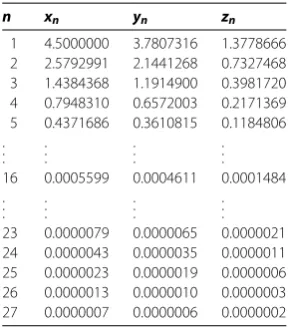
Using algorithm (.) with the initial pointx= ., we have numerical results in Table . From Table , we see that the sequences {xn}, {yn}, and {zn} converge to . We ob-serve thatx= . is an approximation of the common element in
i=F(ti)∩
i=F(Ti)∩
i=VI([, ],Bi) with accuracy at significant digits.
Table 1 The values of the sequences{xn},{yn}, and{zn}in Example 5.1
n xn yn zn
1 4.5000000 3.7807316 1.3778666 2 2.5792991 2.1441268 0.7327468 3 1.4384368 1.1914900 0.3981720 4 0.7948310 0.6572003 0.2171369 5 0.4371686 0.3610815 0.1184806 . . . . . . . . . . . . 16 0.0005599 0.0004611 0.0001484 . . . . . . . . . . . . 23 0.0000079 0.0000065 0.0000021 24 0.0000043 0.0000035 0.0000011 25 0.0000023 0.0000019 0.0000006 26 0.0000013 0.0000010 0.0000003 27 0.0000007 0.0000006 0.0000002
Example . Let x = (x(),x()), y = (y(),y())∈R, and let the inner product·,· :R× R→Rbe defined byx, y =x()y()+x()y()and the usual norm · :R→Rbe defined byx=(x())+ (x()). We consider the nonempty closed convex subsetD= [, ]× [, ] of the real Hilbert spaceR. Define three single-valued mappingst
,t, andton
Das follows:
tx= – x (), – x ()
, tx= – x (), – x ()
, tx= – x (), – x () .
Define three multi-valued mappingsT,T, andTonDas follows:
Tx= x , x
, Tx=
,x
, Tx= x , x .
Fori= , , , letBi:D→D⊂Rbe defined by
Bix= ix() , ix() .
LetWbe theW-mapping generated byR,R,Randβ,β,β, whereRix=PD(I–(I–
ti))x for alli= , , , andβ=β=β=. LetSbe theS-mapping generated byG,G,
Gandδ,δ,δ, whereGix=PD(I–Bi)x for alli= , , , andδ=δ=δ= (,,). Let
xn= (x()n ,x()n ), yn= (y()n,y()n ), and zn= (zn(),z()n ) and the sequences{xn},{yn}, and{zn}be generated by (.), whereαn()= n,αn()=n–n ,αn()=nn–,γn()= +n,γn()=n–n ,
γn()=γn()=n–n for alln∈N. Then the sequences{xn},{yn}, and{zn}converge strongly to (, ), where{(, )}=i=F(ti)∩
i=F(Ti)∩
i=VI(D,Bi).
Solution. It is obvious thatt,t,t arek-strictly pseudononspreading,T,T,T are quasi-nonexpansive and Lipschitzian, andB,B,Bare inverse strongly monotone. Also,
{Ti}i= satisfies the conditionTip={p}for alli= , , , p∈
i=F(Ti) since
i=F(Ti) =
{(, )}. Obviously, i=F(ti)∩
i=F(Ti)∩
i=VI(D,Bi) ={(, )}. For every n∈N,
α()n = n,α()n = n–n ,αn()=nn–, γn() = +n,γn()= nn–, γn()=γn()=n–n . Then
of Theorem .. Now, we get the following algorithm:
x∈D,
yn= nxn+
n– n Wxn+
n– n Sxn,
zn= + n
yn+ n–
n q
() n +
n– n q
() n +
n– n q
() n ,
q(ni)∈Tiyn,i= , , ,
Cn+=
p=p(),p()∈Cn:
z()n –y()n p()+ zn()–y()n p()+y()n
+y()n –zn()–z()n ≤, z()n –x()np()+ z()n –x()n p()
+x()n +x()n –z()n –z()n ≤, y()n –x()n p()
+ y()n –x()n p()+x()n +x()n –y()n –y()n ≤ ,
xn+=PCn+x, n∈N.
(.)
SinceW is theW-mapping generated byR, R,R andβ,β,β, whereRix=PD(I–
(I–ti))x for alli= , , andβ=β=β=
, andSis theS-mapping generated byG,
G,Gandδ,δ,δ, whereGix=PD(I–Bi)x for alli= , , andδ=δ=δ= (,,), we obtain that
Wx= x (),, ,x ()
, Sx= , ,x (), , ,x ()
for all x∈D.
Put q()n =yn, q()n =yn, and q()n =yn. Then algorithm (.) becomes
x∈D,
yn= ,, ,,+ , ,,n
x()n , ,, ,,+ ,, ,,,n
x()n
,
zn= + ,n
y()n , + ,n
y()n
,
Cn+=
p=p(),p()∈Cn:
z()n –y()n p()+ zn()–y()n p()+y()n
+y()n –zn()–z()n ≤, z()n –x()np()+ z()n –x()n p()
+x()n +x()n –z()n –z()n ≤, y()n –x()n p()
+ y()n –x()n p()+x()n +x()n –y()n –y()n ≤ ,
xn+=PCn+x, n∈N.
(.)
For any arbitrary (x()n ,x()n )∈D, by algorithm (.), we see that ≤z(ni)≤y(ni)≤xn(i)≤x(i)≤ for alli= , , andn∈N.
Table 2 The values of the sequences{xn},{yn}, and{zn}with the initial pointx1= (7.5, 9.1) in Example 5.2
n xn yn zn
1 (7.5000000,9.1000000) (6.3029396,7.6067234) (3.0687437,3.7035235) 2 (4.6619648,5.6749079) (3.8840555,4.7013476) (1.7741233,2.1474385) 3 (2.8183693,3.4332496) (2.3412722,2.8357215) (1.0459308,1.2668192) 4 (1.6857031,2.0577916) (1.3983068,1.6970922) (0.6176583,0.7496374) 5 (1.0092457,1.2223240) (0.8364468,1.0071576) (0.3669562,0.4418484) 6 (0.5676300,0.7527995) (0.4701681,0.6199094) (0.2053231,0.2707153) 7 (0.7174567,0.1573218) (0.5940218,0.1294942) (0.2585586,0.0563647) 8 (0.3517952,0.4346565) (0.2911794,0.3576574) (0.1264280,0.1552922) 9 (0.4298726,0.0764960) (0.3557172,0.0629290) (0.1541523,0.0272707) . . . . . . . . . . . .
45 (0.0000963,0.0000292) (0.0000795,0.0000240) (0.0000340,0.0000103) . . . . . . . . . . . .
55 (0.0000088,0.0000042) (0.0000072,0.0000034) (0.0000031,0.0000015) 56 (0.0000033,0.0000065) (0.0000027,0.0000053) (0.0000012,0.0000023) 57 (0.0000054,0.0000020) (0.0000044,0.0000017) (0.0000019,0.0000007) 58 (0.0000022,0.0000036) (0.0000018,0.0000030) (0.0000008,0.0000013) 59 (0.0000033,0.0000009) (0.0000030,0.0000008) (0.0000012,0.0000003) 60 (0.0000015,0.0000020) (0.0000012,0.0000017) (0.0000005,0.0000007) 61 (0.0000020,0.0000004) (0.0000016,0.0000003) (0.0000007,0.0000001) 62 (0.0000010,0.0000011) (0.0000008,0.0000009) (0.0000004,0.0000004)
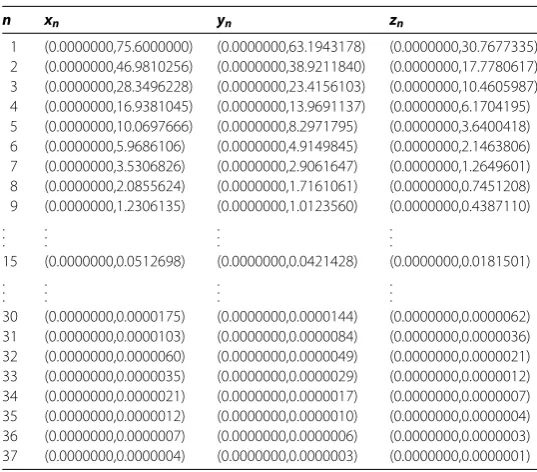
Table 3 The values of the sequences{xn},{yn}, and{zn}with the initial pointx1= (0, 75.6) in Example 5.2
n xn yn zn
1 (0.0000000,75.6000000) (0.0000000,63.1943178) (0.0000000,30.7677335) 2 (0.0000000,46.9810256) (0.0000000,38.9211840) (0.0000000,17.7780617) 3 (0.0000000,28.3496228) (0.0000000,23.4156103) (0.0000000,10.4605987) 4 (0.0000000,16.9381045) (0.0000000,13.9691137) (0.0000000,6.1704195) 5 (0.0000000,10.0697666) (0.0000000,8.2971795) (0.0000000,3.6400418) 6 (0.0000000,5.9686106) (0.0000000,4.9149845) (0.0000000,2.1463806) 7 (0.0000000,3.5306826) (0.0000000,2.9061647) (0.0000000,1.2649601) 8 (0.0000000,2.0855624) (0.0000000,1.7161061) (0.0000000,0.7451208) 9 (0.0000000,1.2306135) (0.0000000,1.0123560) (0.0000000,0.4387110) . . . . . . . . . . . .
15 (0.0000000,0.0512698) (0.0000000,0.0421428) (0.0000000,0.0181501) . . . . . . . . . . . .
30 (0.0000000,0.0000175) (0.0000000,0.0000144) (0.0000000,0.0000062) 31 (0.0000000,0.0000103) (0.0000000,0.0000084) (0.0000000,0.0000036) 32 (0.0000000,0.0000060) (0.0000000,0.0000049) (0.0000000,0.0000021) 33 (0.0000000,0.0000035) (0.0000000,0.0000029) (0.0000000,0.0000012) 34 (0.0000000,0.0000021) (0.0000000,0.0000017) (0.0000000,0.0000007) 35 (0.0000000,0.0000012) (0.0000000,0.0000010) (0.0000000,0.0000004) 36 (0.0000000,0.0000007) (0.0000000,0.0000006) (0.0000000,0.0000003) 37 (0.0000000,0.0000004) (0.0000000,0.0000003) (0.0000000,0.0000001)
Competing interests
The authors declare that they have no competing interests.
Authors’ contributions
All authors contributed equally to the writing of this paper. All authors read and approved the final manuscript.
Acknowledgements
The authors would like to thank the referees for valuable suggestions on the research paper.