Journal of Applied Linguistics and Language Research Volume 4, Issue 4, 2017, pp. 210-223
Available online at www.jallr.com ISSN: 2376-760X
* Correspondence: Rezvan Narimani, Email: irantour297 gmail.com © 2017 Journal of Applied Linguistics and Language Research
The Effects of Cross Cultural Background Knowledge on
Iranian EFL Learners' Reading Comprehension at Two Levels
of Language Proficiency
Rezvan Narimani *
Islamic Azad University, Isfahan (khorasgan) Branch, Isfahan, Iran
Abstract
The aim of the present study was to examine the effects of cross cultural background knowledge on Iranian EFL learners' reading comprehension at low and advanced levels of language proficiency. The present study was done in two phases: Treatment and evaluation. Sixty students at low and advanced levels of language proficiency took part in the present study. After administering the proficiency test, a pretest of reading comprehension, including 30 multiple choice questions, was administered for each group for comparison to post test scores. During the treatment, the researcher made the low and advanced students familiar with target cultural values and norms. After treatment, all participants took the posttests. The researcher compared the scores of pre and posttests of each group to consider the effects of cross cultural background knowledge on reading comprehension of learners at low and advanced levels. The results of Paired sample t test indicated that cross cultural background knowledge had significant effects on the learners' reading comprehension at higher levels of language proficiency, but low level learners did not show significant development on their reading comprehension.
Keywords: Cross cultural background knowledge, reading comprehension, proficiency level
BACKGROUND OF THE STUDY
Specialists, for example, Carrell (1988) asserted that there are two explanations behind considering reading as the most imperative aptitude in language learning. To start with, most foreign language students regularly have reading as one of their most essential objectives. Second, various instructive procedures served by composed writings help reading to get this uncommon core interest.
In Accordance with Chen (2008), an impressive rate of English language learners get low ratings and they stamp underneath their local speaking partners on institutionalized reading understanding tests. Littlemore (2003) expresses that the route in which students can utilize pieces of information in the topic to interpret the setting is influenced by their social foundation learning. Students are most likely more take care of hints that adjust to their social desires than the ones that don't. Moreover, Ruthemsley (2011) remembered us that social information helps readers to recreate the content leading to all the more actually and socially pertinent prints. To have particular social setting that is integrated in the composed language, the learners utilize data held in the memory to recollect and think, as well as to interpret and understand meaning.
Albeit most specialists concede to the significance of foundation information in reading comprehension, there are still many issues. To begin with, for the part of foundation information at various capability levels, a disputable circumstance existed in studies. Chan (2003) recommended that the relative significance of foundation information and language capability in L2 (second language) reading cognizance ought to be considered. Rahman and Bisanz (1986) trusted that weak readers' composition did not create and in addition was not adequately utilized as great readers. They trusted that the part of foundation learning was more critical in great readers than in poor readers. Nonetheless, in Hudson's (1982) and Carrell's (1984) examines, they both proposed that there was no huge background impact on learners' reading appreciation in advanced readers. Likewise, Chan (2003) suggested that foundation information was more helpful to low capability learners. Therefore, the part of foundation at readers with various capability levels appears to wind up noticeably an unsolved issue. Second, Chan (2003) and Alptekin (2006) prescribed that the members ought to have more extensive scope of language capability levels. That is on the grounds that in their reviews, they every single utilized learner of advanced English capability level as the participants(Pei-shi, 2012).Thus, in light of above various recommendations and issues, this review picked members with more extensive scope of language capability levels to discover foundation impact on those members with various language capability levels. According to research goal of this study, there are two major research questions involved in this study:
1) Does cross cultural background knowledge have any significant effect on Iranian EFL learners' reading comprehension at low level of language proficiency?
2) Does cross cultural background knowledge have any significant effect on Iranian EFL learners' reading comprehension at advanced level of language proficiency? REVIEW OF LITERATURE
Language versus Culture
Key reviews on the connections amongst language and culture were attempted by Sapir (1949); Hoijer (1953); Hymes (1972); Geertz (1975); Halliday (1978); and Wierzbicka (1986). All around, the examination of these creators confirms the connection amongst language and culture. The vast majority of their findings affirm, unexpectedly, that one doesn't exist completely without the other.
Truly, one can't talk a dialect; settle on a specific decision of vocabulary, without disclosing a social and social angle. Frequently, truth be told, the language is straightforward and inconspicuous. In a working class environment, there may be a particularly working class dialect, which is not regularly a cognizant decision by the speaker. In a middle class environment, the working class accent may well go astray from the original and in so doing indicate certain qualities, with the end goal that it is interpreted as an announcement of social loyalty. In this way language above everything else involves the qualities and meanings of a culture, and alludes to social antiquities and signs individuals' social personality (Al-Hassan, 1992). Byram (1989, p. 41) concludes that:
Language can stand alone and represent the rest of a culture's phenomena because of its symbolic and transparent nature. Therefore, language cannot be used without carrying meaning and referring beyond itself, even in the most boring environment of the foreign language class.
Then he goes on:
The meanings of a particular language point to the culture of a particular social grouping, and the analysis of these meanings - their comprehension by learners and other speakers involves - the analysis and comprehension of that culture (p. 41).
Taken a gander at in this light, if language is isolated from culture, the partition can't be supported in light of the fact that the way of language itself is then dismissed (Al-Hassan, 1992)
Reading Comprehension
(Cain & Oakhill, 2007). Reading cognizance (understanding/gaining meaning and interpreting the content) relies on upon an assortment of reader-related, content related, and situational (De Corte, Verschaffel, & Van de Ven, 2001) meaning is shaped in the reader's head, that is, a man's earlier learning influences the kinds of meaning built from the content information (Fukkink & de Glopper, 1998). From this viewpoint an individual's existing learning is a noteworthy determinant in acquiring new data. Besides, the reader's cognizance of the content is thought to be connected to the reader's capacity to develop theories, guidelines, plans and mental models (Withers & Vipond, 1980). Alderson (2000) trusts that reading understanding is to process content meaning through a few procedures of interaction with print. Not just looking at the print, the reader additionally "deciding" what they "signify" and how they identify with each other. Identified with reading perception, Richards and Schmidt (2002) express that reading is an action of perceiving a composed content in order to comprehend its contents. This should be possible noiselessly (quiet reading). The understanding that outcomes is called reading appreciation. A reading master, Katharine Maria in Arietta (2010) defines reading appreciation as: all encompassing procedure of constructing meaning from composed content through the interaction of:
1. The learning the reader brings to the content, i.e., word acknowledgment capacity, world information, and information of linguistic traditions.
2. The reader's interpretation of the language that essayist utilized as a part of constructing the content; and
3. The circumstance in which the content is perused.
In light of a few definitions above, it can be concluded that reading understanding is a procedure of constructing a meaning from a composed content that includes the interaction of the reader's earlier learning with the new given information (Khoshsima & Pourjam, 2014).
The Role of Cultural Knowledge in Reading Comprehension
Alongside the improvement of Applied Linguistics and Psycholinguistics, the American researcher, Goodman (1982) discredited the conventional reading hypothesis and represented a "psycholinguistic reading model", which analyzes that reading is not the procedure of uninvolved decoding and reading literally any longer. Or maybe it is the procedure of dynamic "guessing – confirming" and interaction between the readers and the reading substance (Lin, n. d.).
assistance of foundation information of culture, in light of the fact that the meanings of words are obtained in a certain condition of culture. In this manner, if an EFL student does not think about the English culture, for example, histories, values, method of thinking, traditions, religion and way of life, he may neglect to comprehend the correct meaning of the writings (Lin, n. d.).
Empirical Studies on the Topic
Ghorbandordinejad and Bayat (2014) considered the impact of cross-cultural foundation information on Iranian EFL learners' reading perception capacity. To aim this goal, sixty female EFL learners in the vicinity of 17 and 19 years old were chosen at a private language institute in Sabzevar in view of their scores in language capability test and were arbitrarily appointed to two gatherings of thirty. The educator gave ten reading sections the social substance in both control and experimental groups. During the investigation, the educator made her students comfortable with target culture. Then again, the students in Control group did not appreciate any of the benefits of social warm-up exercises which were intended to actuate the multifaceted foundation data of students in Experimental gathering. Toward the finish of this treatment, the two groups took a post-test to see whether the treatment had any effect on their reading cognizance capacity. The consequences of the post-test demonstrated that the groups performed contrastingly on the post-test, which showed that commonality with particular culturally-oriented language reading content would enhance Iranian EFL learners' reading perception capacity.
The main concentration of theYousef, Karimi and Janfeshan's (2014) study was to consider the connection between social foundation of Iranian EFL learners and reading understanding. 45 Iranian language learners majoring in TEFL and English language interpretation from three distinct ethnicities in various provinces were chosen through deliberate selecting. All members got three distinctive reading cognizance sub-tests: a reading sub-test involving socially recognizable points and two reading sub-tests with socially new themes. The outcomes demonstrated that the means of all gatherings on socially natural reading tests were more noteworthy than their means on reading tests with new contents. On the premise of the results, it could be reasoned that foundation learning was truly instrumental in relating the relevant meanings with EFL readers' perception. The capacity to comprehend content was construct not just in light of the reader's linguistic information, additionally on general learning of the world and the degree to which that information was actuated during processing. With socially pertinent information, EFL students' earlier and recognizable encounters were profitable to their reading understanding.
METHOD
Design
Design of the present study was quantitative as it followed a process of deductive research to determine statistical relations of variables. In the present study, Paired Sample t tests were used in order to find out the effects of cross cultural background knowledge on Iranian EFL learners reading comprehension at two levels of language proficiency. The variables of the present research were cross cultural background knowledge and reading comprehension as the independent and dependent variables respectively.
Participants
The participants of the present study were 60 students at low and advanced levels of language proficiency. They were selected based on their scores on proficiency test. 30 students whose scores were 50 or higher were considered as advanced and those who scored 40 or lower were in the low group. The Participants studied English as a foreign language at the same language institute located in Isfahan, Iran, and their ages ranged from 17 to 28 years old. Participants were all female learners representing Persian as their first language.
Instruments
The main instruments of the present study were oxford placement test and reading comprehension test.
Oxford Placement Test (OPT)
At first, Oxford Placement Test (OPT) was applied in order to select the participants at low and advanced levels of language proficiency. The OPT consists of 60 multiple choice questions and each questions worth one point. OPT has been pretested and validated by more than 19,000 students in 6 countries (Oxford Online Placement Test) to determine proficiency levels of English learners. The participants of the present study were selected by considering one standard deviation above and below the mean. That is, those students who scored 50 or higher were considered as advanced and those whose scores were 40 or lower were in the low group.
Reading Comprehension Test
The second instrument of the present study was reading comprehension test. Two authentic and valid reading passages as pre and posttests were used for students at low and advanced levels of language proficiency. The tests were subjected to pilot test and the Cronbach alpha indexes of reliability were found.
Procedure
evaluation. Sixty students at low and advanced levels of language proficiency took part in the present study. Each group consisted of 30 learners (the mean scores of two groups' proficiency test showed that their proficiency levels were not equal and they were properly classified into low and advanced groups). After administering the proficiency test, a pre-test of reading comprehension including 30 multiple choice questions was administered for each group to check homogeneity and for comparison to post-test scores. During the treatment, the researcher made the students in two groups familiar with target culture. On the other hand, the learners in low and advanced groups enjoyed the advantages of cultural warm-up tasks which were used to activate the cross-cultural background knowledge of learners at two levels. Treatment was lasted eight sessions for each group. After treatment, participants took the posttests. The researcher compared the scores of pre and posttests of each group to consider the effects of cross cultural background knowledge on reading comprehension of each group. This comparison was done by using SPSS software.
Data Analysis
Having collected the required data, data analyses were carried out. First of all, descriptive statistics and Independent Sample t test for performances of participants on proficiency test were utilized. Then 'mean' and 'standard deviation' were obtained for performances of all learners on pre and posttests. For the first and second research questions of the study Paired Sample t test was conducted in order to find out if providing cross cultural background knowledge had the significant effects on Iranian EFL learners' reading comprehension at two levels of language proficiency.
RESULTS
In order to select the learners at low and advanced levels of language proficiency, EFL students at language institute took a proficiency test. Thirty low and thirty advanced level students were selected based on their scores on proficiency test. Taking each learner's score, 30 learners at low and 30 learners at advanced levels of language proficiency were selected by considering one standard deviation above and below the mean. Table 1 shows the descriptive statistics of the low and advanced students' scores on proficiency test.
Table 1. Descriptive Statistics on the Low and Advanced Learners’ Scores on Proficiency Test
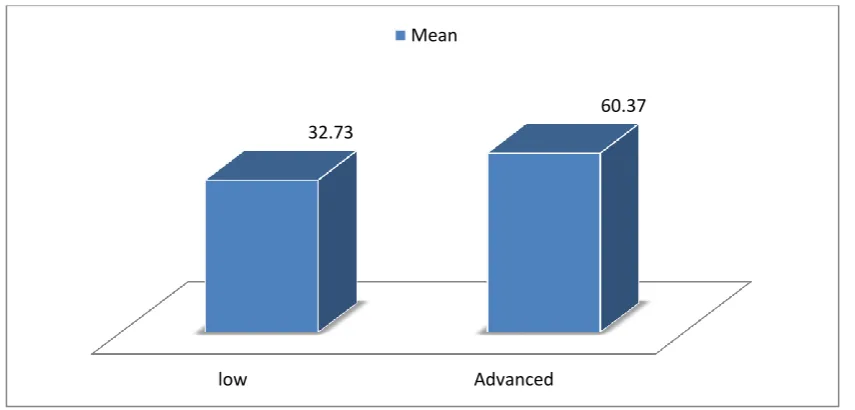
As Table 1 indicates, the mean scores of the low and advanced learners are 32.73 and 60.37 respectively which are not the same. In addition to this, an Independent Samples t test was run in order to see if the difference between the mean scores of two groups
Group N Mean Std. Deviation Std. Error Mean
Placement Test
Low 30 32.73 6.242 1.140
was statistically significant or not. Table 2 indicates the results of the Independent Samples t test for the performances of two groups.
Table 2. The Results of Independent Samples t Test for Performances of Low and Advanced Learners on Placement Test
Levene's Test for Equality
of Variances
t-test for Equality of Means
F Sig. t df Sig.
(2-tailed)
Mean Difference
Std. Error Difference
95% Confidence Interval of the
Difference Lower Upper
Placemen t
Equal variance
s assumed
.771 .384 16.782 - 58 .000 -27.633 1.647 30.929 - 24.337
-Equal variance
s not assumed
-16.782 57.898 .000 -27.633 1.647 30.929 - 24.337
-According to Table 2, there was a significant difference between the performances of low and advanced learners on proficiency test, as Sig<0.05. Figure 1 shows the representation of the performances of two groups on proficiency test.
Figure 1. The Representation of the Performances of Low and Advanced Learner on Proficiency Test
In addition to these, it also was needed to test the normality of scores dispersion of low and advanced learners. In order to do this, one-Sample Kolmogorov-Smirnov Test was run. Table 3 indicates the result of the one-Sample Kolmogorov-Smirnov Test for scores dispersion normality.
low Advanced
32.73
Table 3. The Results of One-Sample Kolmogorov-Smirnov Test for Scores Normality Placement pretest posttest pretest posttest
N 60 30 30 30 30
Kolmogorov-Smirnov Z 1.284 .870 .968 1.236 .930
Asymp. Sig. (2-tailed) .074 .435 .306 .094 .352
According to Table 3, the normality of the scores of low and advanced learners was assured, as Sig>0.05.
The First Research Question
The first research question was: Does cross cultural background knowledge have any significant effect on Iranian EFL learners' reading comprehension at low level of language proficiency? To answer the first research question, a Paired Samples t test was run to find out if there was any significant difference in the performances of low learners on their pre and posttests. Table 4 indicates the descriptive statistics of the pre and post test scores of learners at low level of language proficiency.
Table 4. Descriptive Statistics of the Low Level Learners' Performances on Pre and Posttests
Mean N Std. Deviation Std. Error Mean
Pair 1 Pretest 13.2000 30 1.34933 .24635
Posttest 12.9333 30 1.14269 .20863
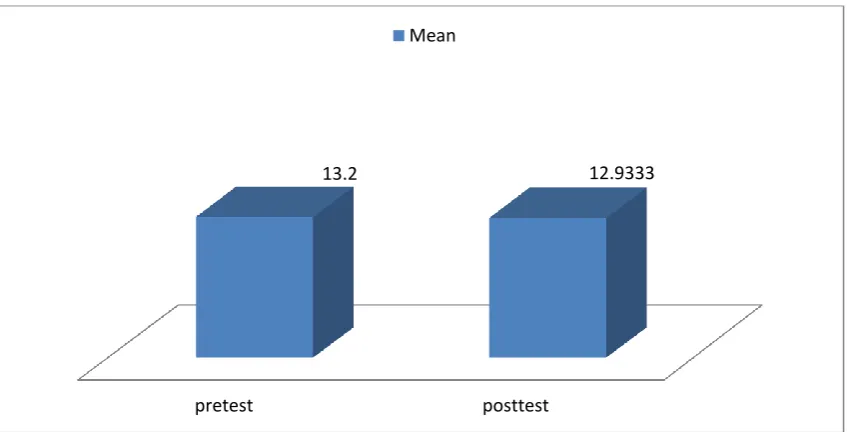
According to Table 4, there was not a significant difference between the mean scores of pre and posttests of low level learners. Table 5 shows the results of the Paired Samples t test for the performances of low level learners on reading comprehension tests.
Table 5. The Results of the Paired Samples t Teat for the Performances of Low Level Learners on Pre and Posttests
Paired Differences
t df Sig. (2-tailed) Mean Deviation Std. Std. Error Mean
95% Confidence Interval of the Difference
Lower Upper
Pair 1
Pretest
posttest .26667 1.17248 .21406 -.17115 .70448 1.246 29 .223
Figure 2. The Representation of the Low Level Learners' Performances on Pre and Posttests
The Second Research Question
The second research question was: Does cross cultural background knowledge have any significant effect on Iranian EFL learners' reading comprehension at advanced level of language proficiency? To answer the second research question, in addition to descriptive statistics, a Paired Sample t test was run. Table 6 indicates the descriptive statistics of the pre and post test scores of learners at advanced level of language proficiency.
Table 6. Descriptive Statistics of the Advanced Level Learners' Performances on Pre and Posttests
Mean N Std. Deviation Std. Error Mean
Pair 1 Pretest 13.20 30 1.349 .246
Posttest 16.37 30 1.402 .256
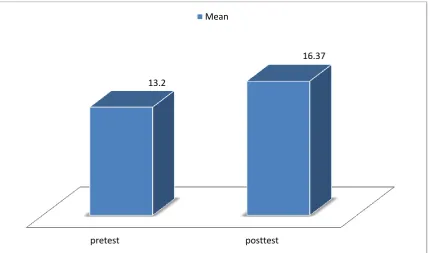
According to Table 6, there was a difference between the mean scores of pre and posttests of advanced learners. Table 7 shows the results of the Paired Sample t test for the performances of advanced level learners on reading comprehension tests.
Table 7. The Results of the Paired Sample t Teat for the Performances of Advanced Level Learners on Pre and Posttests
Paired Differences
t df Sig. (2-tailed) Mean Deviation Std. Std. Error Mean
95% Confidence Interval of the Difference
Lower Upper
Pair
1 Posttest Pretest 3.167 - 1.416 .259 -3.696 -2.638 12.247 29 - .000
pretest posttest
13.2 12.9333
According to Table 7, the significant level was smaller than 0.05 (t (29) =-12.247, p=.000), so it can be concluded that providing cross cultural background knowledge had a significant effect on the EFL learners' reading comprehension at advanced level of language proficiency. Figure 3 shows the performances of advanced level learners' on pre and posttests.
Figure 3. The Representation of the Advanced Level Learners' Performances on Pre and Posttests
DISCUSSION
The results of the research questions indicated that cross cultural background knowledge did not have significant impact on EFL learners' reading comprehension at low level of language proficiency, but learners at advanced level showed a significant development on their reading comprehension ability.
The results of the present study indicated that the effect of cultural familiarity may be related to proficiency level, although studies in this area are few. Several researches have reported significant impacts of cultural familiarity on reading comprehension (Steffensen, Joag-Dev, & Anderson, 1979; Alptekin, 2006). Steffensen et al. (1979), for example, reported that when learners are familiar with cultural values, they comprehend the target text better than when they are not. Further, in cases of unfamiliar cultural values, learners want to refer to their own cultural norms, which results in poor comprehension of the target text.
More recently, Alptekin (2006) reported that when cultural norms of a short story are nativized to make the story culturally more familiar, learners can make better interpretations than when they read the original but culturally-remote story (cited in Erten & Razı, 2009). In the case of the role of cross cultural background knowledge at readers with different levels of language proficiency, it seems to become an unsolved
pretest posttest
13.2
problem (shi, 2012). In this study, the results were different from the study of Pei-shi (2012). The researcher explored that topic familiarity was more significant in learners at lower levels of language proficiency.
The results were in line with the Rahman and Bisanz's (1986) study. They reported that poor readers' schema did not enhance as well as was not efficiently used as good readers. They reported that the role of background knowledge was more important in good readers than in poor readers.
The results were not supported by the Hudson's (1982) and Carrell's (1984) studies. They both believed that there was no important cross cultural background impact on students' reading comprehension that were at advanced levels. Also, Chan (2003) suggested that background knowledge was more effective to learners at lower levels of language proficiency (cited in Pei-shi, 2012).
In general, the findings of the present study supported the role of language proficiency and proposed that compared with proficiency levels, higher level learners comprehended reading passages with cultural warm-up activities, better than learners at lower levels of proficiency. In support of this finding, Alptekin (2006) suggested that the learners should have wider range of language proficiency levels to be more successful learners.
CONCLUSION
As a conclusion, the focus of the present study was to explore the effects of cross cultural background knowledge on Iranian EFL learners' rereading comprehension at two levels of language proficiency. It was found that cross cultural background knowledge had significant effects on the learners' reading comprehension at higher levels of language proficiency but low level learners did not show significant development on their reading comprehension ability.
In general, the experimental results of this study support the effects of cross cultural background knowledge on Iranian EFL learners' reading comprehension at higher levels of language proficiency. In the present study, advanced learners, who were made familiar with cultural norms and values, did better on their posttests.
REFERENCE
Alderson, J. (2000). Assessing reading. New York: Cambridge University Press.
Al-Hassan, A. M. S. (1992). The effects of culture and schemata on reading comprehension of university readers. Retrieved from epubs.surrey.ac.uk/960/1/fulltext, on 1 May, 2017. Alptekin, C. (2006). Cultural familiarity in inferential and literal comprehension in L2 reading. System, 34, 494-508.
Anderson, R. C. (1997). Frame works for comprehending discourse. American Educational Research Journal, 14, 369-378.
Arieta, C. (2010). Reading comprehension overview. The Landmark College Guide.
Byram, M. (1989). Cultural studies in foreign language teaching. Clevedon: Multilingual Matters Ltd.
Cain, K., & Oakhill, J. (2007). Language, children's comprehension problem in oral and written. New York: A division of Guilford publications.
Carrell, P. L. (1984). Schema theory and ESL reading: Classroom implications and applications. The Modern Language Journal, 68, 332-342.
Carrell, P. L. (1988). Content and formal schemata in ESL reading. TESOL Quarterly, 21, 461-481.
Chan, C. Y. H. (2003). Cultural content and reading proficiency: A comparison of Mainland Chinese and Hong Kong learners of English. Language, Culture and Curriculum, 16 (1), 60-69.
Chen, C. (2008). The effects of computer-assisted concept mapping on EFL students' English reading. Proceedings of World Conference on Educational Multimedia, Hypermedia and Telecommunications. Chesapeake, VA: AACE.
De Corte, E., Verschaffel, L., & Van de Ven, A. (2001). Improving text comprehension strategies in upper primary school children: A design experiment. British Journal of Educational Psychology, 2 (3), 531-559.
Erten, I. H., & Razı, S. (2009). The effects of cultural familiarity on reading comprehension. Reading in a Foreign Language, 21 (1), 60-77.
Fukkink, R. G., & de Glopper, K. (1998). Effects of instruction in deriving word meaning from context: A meta-analysis. Review of Educational Research 68, 450-469.
Ghorbandordinejad, F., & Bayat, Z. (2014). The effect of cross-cultural background knowledge instruction on Iranian EFL learners' reading comprehension ability. Theory and Practice in Language Studies, 4 (11), 2373-2383.
Goodman, K. S. (1982). Reading: A psycholinguistic guessing game. Journal of Reading, 2 (3), 1-18.
Geertz, C. (1975). The interpretation of cultures. London: Hutchinson.
Grellet, F. (1981). A practical guide to reading comprehension exercises. London: Cambridge University Press.
Halliday, M. A. K. (1978). Language as social semiotic: The social interpretation of language and meaning. London: Edward Arnold.
Hudson, T. (1982). The effects of induced schemata on the "short circuit" in L2 reading: Non-decoding factors in L2 reading performance. In P. L. Carrell, J. Devine, & D. E. Eskey (Eds.). Interactive approaches to second language reading. Cambridge: Cambridge University Press.
Hymes, D. H. (1972). On communicative competence. In J. B. Pride, & J. Holmes (Eds.), Sociolinguistics. Harmondsworth: Penguin.
Khoshsima, H., & Pourjam, F. (2014). A comparative study on the effects of cloze tests and open-ended questions on reading comprehension of Iranian intermediate EFL learners. International Journal on Studies in English Language and Literature (IJSELL), 2 (7), 17-27.
Lin, W. (n. d.). A study on cross-cultural barriers in reading of English. Retrieved from www.asian-efl-journal.com/.../a-study-on-cross-cultural-barriers-in-r., on 6 May, 2017. Littlemore, J. (2003). The communicative effectiveness of different types of communication strategy. System, 31, 331-347.
Paynter, M., Bodrova, L., & Doty, F. (2005). For the love of words: Vocabulary instruction that works. San Francisco: Jossey-Bass.
Pei-shi, W. (2012). The effect of background knowledge on EFL learners' reading comprehension. Sino-US English Teaching, 9 (9), 1516-1523
Rahman, T., & Bisanz, G. L. (1986). Reading ability and use of a story schema in recalling and reconstructing information. Journal of Educational Psychology, 78 (5), 323-333. Richards, J. C., & Schmidt, R. (2002). Longman dictionary of language teaching and applied linguistics. London: Pearson Education.
Sapir, E. (1949). Selected writings of Edward Sapir in language, culture and personality. Berkley: University of California Press.
Steffensen, M. S., Joag-Dev, C., & Anderson, R. (1979). A cross-cultural perspective on reading comprehension. Reading Research Quarterly, 15, 10–29.
Wierzbicka, A. (1986). Does language reflect culture? Evidence for Australian English. Language in Society, 15, 349-74.
Withers, B., & Vipond, S. (1980). Irrigation: Design and practice. New York: Cornell University Press.
Yang, S. (2010). The influence of schema and cultural difference on L1 and L2 reading. English Language Teaching, 3 (4), 175-180.