Journal of Applied Linguistics and Language Research Volume 4, Issue 2, 2017, pp. 150-168
Available online at www.jallr.com ISSN: 2376-760X
* Correspondence: Neda Tavanpour, Email: neda_tavanpour yahoo.com © 2017 Journal of Applied Linguistics and Language Research
Impact of Breadth and Depth of Lexical Knowledge on
Iranian Advanced/Intermediate EFL Learners’ Reading
Comprehension:
The Case of Gender and Proficiency
Neda Tavanpour *
Amin Institute of Higher Education, Isfahan, Iran Reza Biria
Department of Foreign Languages, Islamic Azad University, Isfahan (Khorasgan) Branch, Isfahan, Iran
Abstract
The current study is an attempt to investigate the relationship between the breadth and the depth of lexical knowledge and reading comprehension of Iranian EFL learners. The current study also tries to find the effect of gender and language proficiency level of learners on the breadth and the depth of lexical knowledge and reading comprehension of Iranian EFL learners. The participants of the study were fifty-two intermediate and advanced level in males and females majoring in English Translation at Pazhuhesh University of Isfahan. The level of language proficiency of participants had been checked through an OPT by the university in advance. Data collection was carried out in two sessions. In the first session, two vocabulary knowledge tests, that is, the breadth and the depth were administered to the participants. In the second session, the reading comprehension test was administered to the participants. The results of the data analysis revealed that there is a significant relationship between breadth and depth of vocabulary knowledge and Iranian advanced/intermediate EFL learner’s reading comprehension performance totally. The results further showed that gender and language proficiency level of learners have an effect on Iranian EFL learners’ reading performance and vocabulary knowledge. The findings can have implications for EFL learners, teachers and material developers.
Keywords: breadth of vocabulary knowledge, depth of vocabulary knowledge, lexical knowledge, reading comprehension, Iranian EFL learners, gender, proficiency
INTRODUCTION
knowledge. They proposed that vocabulary knowledge is assessed as a number of words known, or breadth of vocabulary, it is now clear that the richness of the demonstration of the words known is also a major aspect of variability. This aspect refers to vocabulary depth. Reading is one of the important skills to be learned in any language. It is used as a means of consolidating and extending knowledge of the language.
Reading is the construction of the meaning of the text. It is an active and strategic process, in which the reader's skill and knowledge interact with the characteristics of the text such as genre, the wording and structure of the text. )Schellings, Aarnoutse, & Leeuwe, 2006, p. 550).
Harris and Hodges (1995) believe that comprehension can be considered as an intentional thinking during which meaning is constructed through interactions between reader and text. Laufer (1997) stated that reading comprehension (both in L1 and L2) is affected by the vocabulary knowledge in a text, textually related background knowledge and the application of general reading strategies, such as predicting the content of the context, guessing unknown words in text, making inferences, recognizing the type of text, and grasping the main idea of the text. However, knowledge of vocabulary has been considered as the most significant element of reading.
According to Nassaji (2004), one type of knowledge source that is related to the learner's ability to read texts is knowledge of vocabulary. It is definite that vocabulary is necessary for reading comprehension. Nevertheless, what it means to know a word. Therefore, Beck, McKeown, and Kucan (2002) believe that a large and rich vocabulary is the hallmark of an individual. Definitely, a large vocabulary collection facilitates becoming an educated person as far as vocabulary knowledge is strongly related to reading proficiency in particular and school achievement in general. Sunderland (2010) stated that the relationships between vocabulary and gender are not enduring, but may be context and test type-specific with other “third factors” such as L1, age or proficiency level of learners, influencing them. Therefore, gender is acknowledged as a complex and nuanced issue. Reading is one of the main ways to get information. According to Brudice (2009), reading success depends on some factors such as the levels of readers' language proficiency, types of text, text difficulty, and task demands.
Researchers have suggested several models to describe the relationship between lexical knowledge and reading comprehension. According to Hu and Nation (2000), the factors involved in these models contain language knowledge, knowledge of the world, and skill in language use.
outcomes. Other outcomes include skill at non-verbal puzzles and the ability to understand oral explanations. The third view, the knowledge view, describes vocabulary as an indicator of good world knowledge. Actually, this world knowledge or background knowledge supports reading comprehension because the reader need to bring as much information to the text as the reader expects to get from it. It is difficult to read about astrophysics if you do not know anything about it.
Mezynski (1983) proposed a fourth “access” hypothesis. The access view of the relationship between vocabulary knowledge and reading comprehension describes vocabulary as having a causal relationship with comprehension provided that the vocabulary can be easily accessed. Access can be improved through practice. This access can include some factors such as fluency of lexical access, speed of coping with affixed forms, and speed of word recognition. Taken into consideration the complex nature of vocabulary knowledge as a multi-dimension construct, L2 learners do need both quantity and quality of vocabulary knowledge to understand and express meaning in the interaction.
Second language (L2) vocabulary researchers have suggested various but complementary frameworks for vocabulary knowledge. Most researchers reached agreement that vocabulary knowledge is not an all-or-nothing phenomenon, but includes degrees of knowledge. In these frameworks (Richards, 1976; Henriksen, 1999; Qian, 2002), there is a common agreement that knowledge of vocabulary should be regarded as a multi-dimensional construct. Consequently, they suggested it should be constructed as a continuum, or continua, consisting of several levels and dimensions of knowledge.
Much of what is written in word knowledge goes back to the vocabulary knowledge framework of Richards (1976). He recognized seven aspects of word knowledge (e.g. syntactic behavior, associations, semantic value, different meanings, underlying form and derivations). According to the continuum perspective, Henriksen (1999) proposed three dimensions to look at vocabulary knowledge: (i) a partial-to-precise knowledge dimension that levels of knowledge are operationalized as degrees of understanding; (ii) a depth-of-knowledge dimension which indicates the multi-aspect nature of word knowledge, and extends to a word’s syntagmatic and paradigmatic relationships with other words; and (iii) a receptive-productive dimension that refers to the mastery levels of vocabulary knowledge revealed in the learners’ comprehension and production abilities. Henriksen (1999) believed that the first two dimensions are related to comprehension of word knowledge while the third dimension is associated with the ability to access and use a word.
of learners; and finally; (4) automaticity of receptive-productive knowledge, that refers to all the fundamental processes to access the word knowledge for receptive and productive purposes, containing of phonological and orthographic encoding and decoding, access to structural and semantic characteristics from the mental lexicon, lexical-semantic integration and representation, and morphological parsing and composing.
The importance of different factors in these dimensions will vary according to the specific purpose of language use. In all the frameworks reviewed, there is an agreement that vocabulary knowledge should at least comprise two dimensions that are vocabulary breadth, and depth of vocabulary knowledge. Therefore, the present study attempts to explore the relationship between breadth and depth of vocabulary knowledge and reading comprehension of Iranian EFL learners. It also examines the effect of gender and language proficiency level of learners on vocabulary knowledge and reading comprehension of Iranian EFL learners.
Statement of the problem
The relationship between vocabulary knowledge and reading comprehension is dynamic and difficult. Investigating the relationship between knowledge of vocabulary and reading comprehension has had a long history in the research of English as a Second Language (ESL/EFL) or English as a Foreign Language reading. Without knowledge of words, understanding sentences or texts is not possible. According to several researches, it has been recognized that knowledge of words is multidimensional and includes various types of knowledge. For EFL/ESL learners, the relationships between vocabulary knowledge and reading comprehension are complex. These difficulties and complications can stem from the learners are able to read in their first language and the common situation of beginning to read the target language with almost no vocabulary knowledge in their target language. That shows that for EFL/ESL learners, the vocabulary knowledge plays a key role in reading comprehension. Therefore, the present study attempts to explore the relationship between breadth and depth of vocabulary knowledge and reading comprehension of Iranian EFL learners. It also investigates the effect of gender and language proficiency level of learners on vocabulary knowledge and reading comprehension of Iranian EFL learners.
LITERATURE REVIEW
Vocabulary Knowledge and Reading Comprehension
There are some studies conducted to examine the relationship between vocabulary knowledge and reading comprehension.
Huang (1999) measured the effects of vocabulary knowledge and content knowledge on reading comprehension of students. The participants were 246 university juniors who were non-English majors. The participants of the study took several tests. Nation’s (1990) Vocabulary Levels Test, an English passage, a recall protocol, and the Inventory of Content Knowledge and Interest Questionnaire. The results revealed that university students' comprehension of English text depends on vocabulary knowledge and content knowledge, but their comprehension depends more on knowledge of vocabulary. Undoubtedly, L2 reading comprehension depends strongly on knowledge of vocabulary. Gelderen, Schoonen, Glooper, Hulstijn, Simis, Snellings, and Steven (2004) run English vocabulary knowledge and reading comprehension tests to 397 Dutch students from Grade 8 to Grade 10 in secondary education. As a result, they found out a correlation of .63.
Rouhi and Mousapour Negari (2013) explored the role of the breadth and depth of vocabulary knowledge in reading comprehension of Iranian EFL students. The participants were 50 EFL students. Three tests, namely, VLA, WAT and RCT were administered. The findings revealed that breadth, depth of vocabulary knowledge and reading comprehension were positively correlated to each other, both the breadth and depth were of equal importance in Iranian EFL learners' success in reading comprehension performance, and breadth of vocabulary knowledge correlated more strongly to the success of Iranian EFL learners' in reading comprehension performance than depth of vocabulary knowledge.
Vocabulary Breadth and Reading Comprehension
In L2 research, the importance of vocabulary breadth in reading comprehension has been highlighted (Liu & Nation, 1985). Laufer (1996, 1992) concluded that there are high interrelations between the vocabulary breadth and reading comprehension.
Laufer (1992) conducted a study on 92 university students whose native language was either Hebrew or Arabic. She administered two tests of vocabulary, namely, the Vocabulary Levels Test (Nation, 1983)and Eurocentric Vocabulary Test (Meara & Jones,1990) which needed the participants to say ‘yes’ or ‘no’ to show whether they knew the meaning of a target word. Reading comprehension was also measured by two standardized reading tests: the reading comprehension section of Examen Hoger Algermeen Vortgzet Onderwijs, comprising of two texts with 20 multiple-choice questions, and an English sub-test of the Israel university psychometric entrance test with 40 multiple-choice questions. The correlation between VLT and the reading comprehension was .50 (P<.0001) and that between the Eurocentres Vocabulary Test on reading comprehension was .75 (p< .0001).
vocabulary breadth and reading comprehension. Therefore, he stated that there were stronger correlations in the study of 44 Korean learners and 33 Chinese learners using version A of the VLT and the Reading Comprehension section of the TOEFL. The relationship between the two VLT and reading comprehension test was .78.
Sen and Kuleli (2015) determined the effects of vocabulary breadth and vocabulary depth on reading performance in EFL context. Therefore, a Vocabulary Size Test by Nation and Beglar (2007), Words Associate Test by Read (1998), and a reading comprehension test were run with 361 university students. The findings revealed that vocabulary breadth and depth of vocabulary were both significantly correlated with reading comprehension, but depth of vocabulary knowledge predicted reading comprehension better.
Vocabulary Depth and Reading Comprehension
There are some studies conducted to examine the relationship between depth of vocabulary knowledge and reading comprehension. Qian (1999, 2002) concluded that in reading comprehension, both depth and breadth of vocabulary knowledge play a key role, and some features of depth of vocabulary knowledge, synonymy and polysemy and collocation, are main variables.
Qian (2002) examined the depth and breadth of vocabulary knowledge in reading for basic comprehension in university-level academic settings. He assessed the usefulness of the Depth of Vocabulary Knowledge (DVK) test. Participants of his study were 217 international learners speaking 19 different native languages. Findings from this study supported Qian’s earlier outcomes that (1) scores on depth of vocabulary knowledge were correlated with reading comprehension (r= .77, p< .01) and (2) the DVK was a reliable measure, that has contributed significantly to the assessment of reading comprehension. Therefore, Qian (2002) stated that scores gained from this instrument explained close to 60% of the variance in the reading scores.
Qian and Schedle (2004) conducted a study to realize whether depth of vocabulary knowledge could be used as a basis to design useful item types for assessing test takers’ reading comprehension. It was done on 207 international students attending an ESL program in a major Canadian University. Thus, the results of the study indicated that depth of vocabulary knowledge and reading comprehension had the similar difficulty levels and both had similar relations with reading comprehension. They also found out that the new measure had the same difficulty level compared to existing TOEFL vocabulary measures, and provided a similar amount of prediction of ESL learners’ reading performance.
Gender and Reading Comprehension
were taken from the textbooks applied at the course levels of the learners. Text topics of the passages were economics, the presence of foreign cultures in work, leisure, and history. The results showed no significant differences by gender in recall scores for all text topics. There were no differences by gender in the familiarity with passage topics of any of the passages.
Brantmeier (2002) used the same passages utilized to Young and Oxford's (1997) study with comprehension assessment tasks with two groups of learners from advanced university grammar and literature courses (23 males and 53 females in grammar courses and 9 males and 47 females in literature courses). Male participants were more familiar with the topic of boxing than the females did, and female participants were more familiar with the topic of a frustrated housewife than the males did. Furthermore, findings revealed no gender differences in comprehension of the gender-oriented passages at the more advanced stages of acquisition. The findings showed that although differences in topic familiarity are continued across instruction levels, the effects of passage content on reading comprehension by gender are not continued when the intermediate level texts are read by more advanced learners.
Pae (2004) considered the effect of gender on English reading comprehension for Korean EFL learners. The gender effect was measured by using a DIF (Differential Item Functioning) methodology. Gender DIF was investigated in a random sample of 14,000 Korean participants (7,000 males and 7,000 females) who took the English sub-test of the 1998 Korean National Entrance Exam for Colleges and Universities. The findings reveal that items categorized as Mood/Impression/Tone are easier for females, while items classified as Logical Inference are more likely to favor males without considering the item content. Further content analysis indicates that passage content cannot be considered as a reliable factor that predicts relations between gender and performance in reading comprehension, therefore suggesting that further studies about gender effect on second language reading comprehension should consider the item type as well as item content.
Sallabas (2008) determined the effect of gender in the process of reading comprehension performance and developing attitude towards reading. The findings show that there is a significant difference between the two genders over reading comprehension. Indeed, girls are better at reading comprehension than boys. Furthermore, it reveals that gender affects attitude towards reading.
Agustín and Gallego(2012) examined the relationship between gender differences and vocabulary knowledge. They reported that female learners showed higher vocabulary gains than males in receptive vocabulary size acquisition.
The objectives of the study can be expressed in the following research questions:
Is there any relationship between depth of lexical knowledge and Iranian advanced/intermediate EFL learners’ reading comprehension performance? Dose gender have any effect on Iranian advanced/intermediate EFL learners’
reading performance and vocabulary knowledge?
Dose language proficiency level have any effect on Iranian advanced/intermediate EFL learners’ reading performance and vocabulary knowledge?
METHODOLOGY
Participants
The participants of the study were 52 male and female university students (26 male and 26 female) with an age range of 20 to 30, majoring in English language Translation at Pazhuhesh University of Isfahan, Iran. They were the students of two classes (advanced and intermediate). All of them had the same language background, Persian. Their proficiency level had been checked through a standardized proficiency test (Objective Placement Test, Lesley, Hanson, & Zukowski-Faust, 2005) by the university in advance, and they were grouped in advanced, intermediate, and lower level learners in three classes in advance by the university. Consequently, for the purpose of this study, only advanced and intermediate level learners were chosen. Thus, in the advanced class, there were 26 learners who were 13 males and 13 females. In the intermediate class, there were 26 learners who were 13 males and 13 females too.
Instruments
For the purpose of data collection, four kinds of tests were utilized as delineated below:
Objective Placement Test
The proficiency level of participants had been checked through an Objective Placement Test by the university in advance, and they were grouped in advanced, intermediate, and lower level learners in three classes in advance by the university.
Vocabulary Levels Test (VLT)
This is a test of knowledge of English vocabulary used to measure the breadth of learners’ vocabulary knowledge. It was developed by Nation (1983) and validated by Schmitt, Schmitt, and Clapham (2001). The vocabulary size test used in this study was a revised and expanded version of the Vocabulary Levels Tests (Schmitt et al., 2001). In the present study, Version 1 of the test was administered (see Schmitt et al. for the test), which had five word frequency levels: the 2,000-word level, the 3,000-word level, the 5,000- word level, and the 10,000-word level. Furthermore, it contained a section for academic vocabulary.
vocabulary level in English ranging from high-frequency to low-frequency words. Each level had 10 test items, each containing six words on the left and three short definitions on the right. Test takers must match the three short definitions with three of the six words on the left. The items were decontextualized so that no clues to the meaning were provided. A sample test item is illustrated below.
1 business 2 clock
3 horse … 6 … part of a house
4 pencil … 3 … animal with four legs 5 shoe … 4 … something used for writing 6 wall
As it is displayed, participants should match each meaning to the appropriate number of the correct word. In relation to the test scoring procedure, each word correctly chosen was awarded one point, the maximum possible score being 150 for the same number of words. In scoring, Nation (1983) announces that a score of 12 or less out of 18 (66.67%) at a vocabulary size level signals that this level has not been mastered well. Based on Nation's scoring, the researchers supposed that a score of 20 out of 30 at each level reveals level's mastery. Since the VLT in this study comprised five levels, the highest possible score was 150 (1 point x 30 items x 5 levels). The reliability of the test with a time interval of two weeks was 0.95.
Word Associates Test (WAT)
Depth of vocabulary knowledge was measured by Word Associates Test (WAT) which was developed by Read (1993, 1998, and 2000). The WAT tried to measure the learner’s depth of vocabulary knowledge through word associations, that is, the different semantic and collocational relationships that a word had with other words in the language. The test consisted of 40 items. Each item consisted of one word, which was an adjective and two boxes, each containing four words which were mostly nouns. Among the four words in the left box, one to three words could be synonymous to one aspect of, or the whole meaning of the stimulus word, but among the four words in the right box, there could be one to three words that collocate with the stimulus word. The instruction sheet for the test taken was explained that there were four correct answers in each item. Three situations were possible:
1) The left and right boxes both contained two correct answers;
2) The left box consisted of one correct answer and the right box contained three correct answers;
3) The left box contained three correct answers and the right box consisted of only one correct answer.
Sound:
A) Logical, B) healthy, C) bold, D) solid, E) snow, F) temperature, G) sleep, H) dance. In this item, sound was synonymous with logical, healthy and solid. Furthermore, it collocated with sleep, consequently, the correct choices were A, B, D, and G. Participants received a point for each correctly answered item. In scoring, each option chosen correctly was awarded one point. The maximum possible score, therefore, was 160 for the 40 items. The WAT had been administered in anumber of lexical studies to measure depth of vocabulary knowledge (Nassaji, 2004; Qian, 1999, 2002). The split-half reliability of the test in the study by Qian (2002) was reported 0.89. The reliability indices (Cronbach’s alpha) for this test was high (i.e., 0.92) as reported by Read (1993, 1998, and 2000). However, to further ensure the reliability of the test, after the data collection, it was run with participants randomly selected from among the ones who had taken part in the study, with a time interval of two weeks was 0.91.
Reading comprehension test (RCT)
As the last data collection instrument, and in order to investigate the learners’ comprehension ability, an academic reading section of IELTS test was chosen to measure the learners reading comprehension performance. The academic reading comprehension test contained four passages with 30 multiple choice questions in total. Participants had 60 minutes to complete the test. In scoring, one point was allocated to each correct answer given to a multiple choice question. The maximum possible score was 30. The test-retest reliability index was 0.88.
Procedures
In this study the tests were administered in two sessions at the Pazhuhesh University of Isfahan. During session 1, the two tests measuring the breadth and depth of vocabulary knowledge, namely, the Vocabulary Levels Test and the Word-Associates Test were run consecutively with a short break in between to all participants. During session two, the reading comprehension test was administered to all participants. They had been told not to make a random choice but rather decide carefully. Before taking the tests, the general purpose of the study had been explained to the students. They had been given detailed instructions on how to take the tests and had been assured of the confidentiality of the results. Therefore, they had been told that their performance on the test had not affected their course outcome. Participants had been asked to write down their genders and proficiency levels on their sheets for the purpose of the study. Data Analysis
correlation was run to measure the breadth and depth of lexical knowledge and their relationships on reading comprehension of Iranian EFL learners. Six separate independent Sample t-tests were run to determine whether the differences between the vocabulary knowledge (breadth and depth) and reading comprehension of the two proficiency levels of the participants (advanced and intermediate) and gender were statistically significant or not.
RESULTS
In this section the results of the present study presented.
Descriptive Statistics of Participants' Performance on the Instruments
After the collection of the data through the instruments described above, the data were analyzed. Table 1 presents the descriptive statistics of the participants' performance on the instruments.
Table1. Descriptive Statistics of Vocabulary Depth, Breadth and Reading Comprehension
Variables N Minimum Maximum Mean Std. Deviation
Breadth 52 75.00 125.00 94.63 12.96
Depth 52 80.00 145.00 109.71 17.81
Reading 52 15.00 28.00 20.71 3.01
As the table shows, the mean scores of breadth of vocabulary knowledge, vocabulary depth and reading comprehension are 94.63, 109.71, and 20.71 respectively.
The Relationship between Breadth and Reading Comprehension
Hypothesis 1: There is no relationship between breadth of vocabulary knowledge and Iranian advanced/intermediate EFL learner’s reading comprehension performance. In order to calculate the relationship between breadth of vocabulary knowledge and Iranian EFL learner’s reading comprehension performance, Pearson correlation coefficients were calculated at .01 level of significance. The results obtained from these computations are presented in the following matrix of correlations.
Table2. Pearson Correlations between the Vocabulary Breadth, and Reading Comprehension
Correlations
Reading Breadth
Reading
Pearson Correlation 1 .642**
Sig. (2-tailed) .000
N 52 52
Breadth
Pearson Correlation .642** 1
Sig. (2-tailed) .000
N 52 52
Table 2 shows the correlations between the vocabulary breadth, and reading comprehension scores to reveal the strength of association between them. Therefore, one can see that the learners' reading comprehension performance was considerably correlated with their breadth of vocabulary that was observed at the level of one percent error (r = .64, p < .01), indicating that a larger vocabulary enabled students to remember more information from the text they read. So, there is a direct and significant relationship between breadth test scores and reading test scores of students, and by increasing breadth test scores, reading test scores had been increased and vice versa. So, the H01 was rejected.
The Relationship between Depth and Reading Comprehension
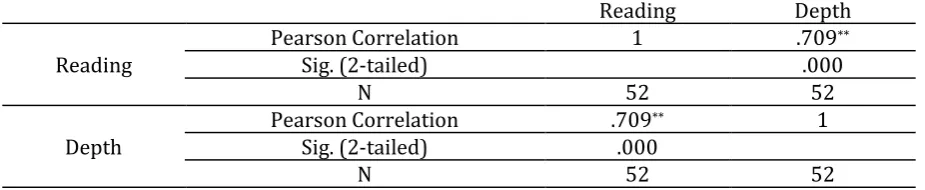
Hypothesis 2: There is no relationship between depth of vocabulary knowledge and Iranian advanced/intermediate EFL learner’s reading comprehension performance. In order to determine the relationship between depth of vocabulary knowledge and Iranian EFL learner’s reading comprehension performance, their correlation coefficients were calculated at .01 level of significance. The results obtained from these computations are presented in the following matrix of correlations.
Table 3. Pearson Correlations between the Vocabulary Depth, and Reading Comprehension
Reading Depth
Reading
Pearson Correlation 1 .709**
Sig. (2-tailed) .000
N 52 52
Depth
Pearson Correlation .709** 1
Sig. (2-tailed) .000
N 52 52
**. Correlation is significant at the 0.01 level (2-tailed).
Table 3 shows the correlations between the vocabulary depth, and reading comprehension scores to elucidate the strength of association between them. With regard to the depth of vocabulary knowledge as another variable of the study, as far as the results of the above statistical analysis reveal, there was a high and significant correlation between this variable and reading comprehension (r = .70, p < .01) which suggests that deeper knowledge of words help learners comprehend the text better. Furthermore, there is a direct and significant relationship between depth test scores and reading test scores of students, and by increasing depth test scores, reading test scores had been increased and vice versa. So, H02 was rejected.
The Effect of Gender on Vocabulary Knowledge and Reading Comprehension
In order to determine whether the variable gender can have an effect on reading comprehension, and vocabulary knowledge, some further analyses of the data were performed. To make sure whether the variable gender can have an effect on the other variables of the study, three independent Samples t-tests were performed. The results obtained from these analyses are depicted in the following tables.
Table 4 summarizes the results of the t-test for the males and females’ scores and the vocabulary breadth test.
Table 4. Independent Sample t-test for Gender and Vocabulary Breadth
t df Sig.
(2-tailed)
Mean Difference
Std. Error Difference
95% Confidence Interval of the Difference
Lower Upper
Breadth -2.308 50 .025 -7.962 3.450 -14.891 -1.032
As the table shows, there is statistically significant difference between males and females’ performance on the vocabulary breadth test either (t= -2.308, df=50 p<0.05(.In other words, gender had effect on learners' vocabulary breadth. To compare the test scores between males and females under equal variances, t test was used in both groups.
Table 5 summarizes the results of the t-test for the males and females’ scores and the vocabulary depth test.
Table 5. Independent Sample t-test for Gender and Vocabulary Depth
t df Sig.
(2-tailed)
Mean Difference
Std. Error Difference
95% Confidence Interval of the Difference
Lower Upper
Depth -2.831 42.341 .007 -13.115 4.632 -22.461 -3.770
As the results of the above analysis shows, there is statistically significant difference between the males and females' scores on vocabulary depth test (t= -2.831,df=42.3, p<0.05). In other words, both male and female learners performed differently in their vocabulary depth test. To compare the test scores between males and females under the assumption of not equal variance, t test was used in both groups.
Table 6.Independent Sample t-test for Gender and Reading Comprehension
t df Sig.
(2-tailed)
Mean Difference
Std. Error Difference
95% Confidence Interval of the Difference
Lower Upper
Reading -2.354 50 .023 -1.885 .800 -3.492 -.277
the results of the above analyses, the variable gender has statistically significant effect on the performance of the participants either on the breadth and depth of vocabulary knowledge of the study or on the reading comprehension. Such being the case, it can be claimed that the variable gender has effect on participants' performance on reading comprehension or on the two aspects of vocabulary knowledge. So, H03 was rejected. The Effect of Proficiency Level on Vocabulary Knowledge and Reading Comprehension
Hypothesis 4: The proficiency level does not have any effect on Iranian advanced/intermediate EFL learners’ reading performance and vocabulary knowledge. In order to determine whether the variable proficiency level can have an effect on reading comprehension, and vocabulary knowledge, some further analyses of the data were performed. To make sure whether the variable proficiency level can have an effect on the other variables of the study, three independent Samples t-tests were performed. The result obtained from this analysis is depicted in the following tables.
Table 7 summarizes the results of the t-test for proficiency level and the vocabulary breadth test.
Table 7.Independent Sample t-test for Proficiency Level and Vocabulary Breadth
t df (2-tailed) Sig. Difference Mean Difference Std. Error
95% Confidence Interval of the Difference
Lower Upper
Breadth -3.115 50 .003 -10.346 3.321 -17.016 -3.676
As the table shows, there is statistically significant difference between intermediate and advanced proficiency levels on the vocabulary breadth test either (t=-3.115, df=50, p<0.05). In other words, proficiency level had effect on learners' vocabulary breadth. To compare the test scores between the two groups, intermediate and advanced, independent test of equal variances was used. Table 8 summarizes the results of the t-test for proficiency level and the vocabulary depth t-test.
Table 8.Independent Sample t-test for Proficiency Level and Vocabulary Depth
t df Sig.
(2-tailed)
Mean Difference
Std. Error Difference
95% Confidence Interval of the Difference
Lower Upper
Depth -3.786 50 .000 -16.654 4.399 -25.489 -7.819
Table 9.Independent Sample t-test for Proficiency Level and Reading Comprehension
t df Sig.
(2-tailed)
Mean Difference
Std. Error Difference
95% Confidence Interval of the Difference
Lower Upper
Reading -3.512 50 .001 -2.654 .756 -4.172 -1.136
As the table shows, there is statistically significant difference between intermediate and advanced proficiency levels on reading comprehension test either (t= -3.512, df =50, p<0.05). In other words, proficiency level had an effect on reading comprehension. To compare the test scores between the two groups, the intermediate and advanced, independent t-test of equal variances was used. With regard to the results of the above analyses, the variable proficiency level has statistically significant effect on the performance of the participants either on the breadth and depth of vocabulary knowledge of the study or on the reading comprehension. Such being the case, it can be claimed that the variable proficiency level has an effect on participants' performance on reading comprehension or on the two aspects of vocabulary knowledge. So, the fourth null hypothesis was rejected.
DISCUSSION
As seen above, the results obtained from the analysis of the data revealed that there is a relationship between vocabulary breadth and reading comprehension. There is also a relationship between vocabulary depth and reading comprehension. The results of the present study are directly in line with those of studies carried out by Huang (1999), Gelderen (2004), and Rouhi et al. (2013), who indicated that there is a positive relationship between vocabulary knowledge and reading comprehension performance. In connection with the relationship between breadth of vocabulary knowledge and reading comprehension, the results of VLT revealed that there is a positive interrelation between these two variables .These outcomes support the results of studies carried out by Laufer (1996), and Sen and Kuleli (2015).
With regard to the relationship between depth of vocabulary knowledge and reading comprehension, the results of WAT , representing the meaning and collocation components of depth of vocabulary knowledge, were highly and positively inter correlated with the learners' reading comprehension test. These results are in line with the studies done by Qian (2002), and Qian and Schedle (2004).
between two genders over reading comprehension and that females are better at reading comprehension than males. Agustín and Gallego(2012) reported that female learners showed higher vocabulary gains than males in receptive vocabulary size acquisition. But these results are in contrast with Young and Oxford’s (1997) study. The findings reveal showed no significant differences by gender in recall scores for all text topics. There were no differences by gender in the familiarity with passage topics of any of the passages.
With regard to the variable proficiency level, as the results indicate, it has a significant effect on the two dimensions of vocabulary knowledge and reading comprehension of the study. In connection with the effect of proficiency level of participants' reading comprehension performance, and vocabulary knowledge, the results of the present study indicated that there is a significant difference between the intermediate and advanced level learners and reading comprehension performance, and vocabulary knowledge. The results of the present study revealed that advanced level learners are better at reading comprehension test and vocabulary knowledge tests than intermediate level learners. The results should therefore be regarded with caution, especially if one agrees that students at the intermediate levels are more likely to have more limited English language ability.
CONCLUSION
The findings of the present study show that there is a strong and positive correlation between breadth and depth of vocabulary knowledge and reading comprehension performance of the learners. Regarding the relationship between breadth of vocabulary knowledge and reading comprehension, a positive correlation was found which indicated that by increasing the number of words that a learner knows, the learner can comprehend the text better. Respecting the relationship between vocabulary depth and reading comprehension, the results indicated that they are correlated which shows that the more a learner knows about the depth of vocabulary knowledge, the better a learner can recall the information from the text.
With respect to the effect of gender on the learners' reading comprehension performance and breadth and depth of vocabulary knowledge, the results showed that there were significant differences between males and females. Females were better at doing vocabulary knowledge tests and reading comprehension test than males. Therefore, according to the results of the present study, gender differences play important roles in the learners' vocabulary knowledge and reading comprehension performance of Iranian EFL learners.
proficiency of learners, vocabulary knowledge and reading comprehension performance will be improved. The more proficient the learners are, the better they can perform on tests. Therefore, according to the results of the current study, proficiency level differences play a key role in the learners' vocabulary knowledge and reading comprehension performance.
Consequently, breadth and depth of vocabulary knowledge are two interrelated dimensions of vocabulary knowledge. Knowing rich vocabulary cannot assist learners a great deal if their comprehension is shallow. The findings of the current study revealed that breadth and depth of vocabulary knowledge, and reading comprehension are positively correlated.
IMPLICATIONS OF THE STUDY
In this part, pedagogical implications of the present study with regard to EFL learners and teachers and material developers will be discussed.
English teachers should encourage their students to read storybooks, magazines, and newspapers in English. Hwang and Nation (1989) believed that storybooks, magazines and newspapers repeat some common words and technological terms related to a topic. Many repetitions reduce the lexical burden of the readers and actually help them to better extract information from the text they read.
EFL teachers and material developers should consider vocabulary depth and breadth as two vital components of an EFL syllabus to improve reading comprehension of students. Teachers should also introduce synonymy and polysemy of vocabularies, their primary meaning, and the collocations of words with each other due to the important roles that they play in comprehension of English texts. Teachers and material developers should consider the proficiency level of learners, help them to improve their proficiency level, and design activities based on learners’ proficiency level. The results of the present study also will help learners who intend to increase their vocabulary knowledge and improve their reading comprehension. An important point is that they must know that achieving their objectives depends on their own efforts. Therefore, students must start to develop the habit of independent reading as a source of entertainment and information. The results will help textbooks writers for developing English textbooks. Textbooks developers can select or write suitable texts and materials. They can also design activities after reading comprehension tests to help readers improve the depth and breadth of their knowledge of vocabulary.
REFERENCES
Agustín, A., & Gallego, C. (2012). Word families. International Journal of Lexicography, 6, 1- 27.
Anderson, R. C., & Freebody, P. (1981). Vocabulary Knowledge. In J. T.Guthrie (Ed.),
Comprehension and teaching: Research reviews (pp. 77-81).
Beck, I. L., McKeown, M. G., & Kucan, L. (2002). Bringing words to life: Robust vocabulary
Beck, I. L., Perfetti, C. A., & McKeown, M. G. (1982). The Effects of Long Term Vocabulary Instruction on Lexical Access and Reading Comprehension. Journal of Educational
Psychology, 74, 506-521.
Brantmeier, C. (2002). The effects of passage content on second language reading
comprehension by gender across instruction levels. In J. Hammadou Sullivan (Ed.),
Research in second language learning. Greenwich, CT: Information Age Publishing. Brudice, B. (2009). Gender Differences in Reading Comprehension Ability. UKESSAYS. Cameron, L. (2002). Measuring vocabulary size in English as an additional language.
Language Teaching Research, 6, 73-145.
Gelderen, A. V., Schoonen, R., Glooper, K. D., Hulstijn, J., Simis, A., Snellings, P., & Steven, M. (2004). Linguistic knowledge, processing speed, and metacognitive knowledge in first and second language reading comprehension: A componential analysis.
Journal of Educational Psychology, 1, 19-30.
Harris, T., & Hodges, R. (Eds.). (1995). The Literacy of dictionary: The vocabulary of
reading and writing. Network, DE: International Reading Association.
Henriksen, B. (1999). Three dimensions of vocabulary development. Studies in Second
Language Acquisition, 21, 303-317.
Huang, C. (1999). The effects of vocabulary knowledge and prior knowledge on reading comprehension of EFL students in Taiwan. Retrieved from hhtp: //contentdm.lib.byu.edu/ETD/image/etd2508, February 5, 2008.
Hu, M., & Nation, I. S. P. (2000). Vocabulary density and reading comprehension.
Reading in a Foreign Language, 13(1), 403-430.
Huyen, N. T. T. (2003). Learning vocabulary through games: The effect of learning vocabulary through Games. Asian EFL Journal. 2, 3. Retrieved April 21, 2009 from www.asian-efl urnal.com/dec_03_sub.Vn.php.
Hwang, K., & Nation, P. (1999). Reducing the Vocabulary Load and Encouraging Vocabulary Learning through Reading Newspapers. Reading in a Foreign
Language, 6(1), 323-335.
Koda, K. (1989). The effects of transferred vocabulary knowledge on the development of L2 reading proficiency. Foreign Language Annals, 22, 529-540.
Laufer, B. (1992). How much lexis is necessary for reading comprehension? In H. Béjoint & P. Arnaud (Eds.), Vocabulary and applied linguistics, 126-132.
Laufer, B. (1996). The lexical threshold of second language reading comprehension: what it is and how it relates to L1 reading ability. In K. Sajavaara & C. Fairweather (Eds.). Approaches to second language acquisition. Jyväskylä: University of Jyväskylä, 55-62.
Laufer, B. (1997). The lexical plight in second language reading: Words you don't know, words you think you know, and words you can't guess. In J. Coady & T. Huckin (Eds.), Second language vocabulary acquisition, 20-34.
Lesley, T., Hanson, C., & Zukowski-Faust, J. (2005). Interchange Passage Placement and
Evaluation Package. Cambridge: Cambridge University Press.
Liu, N., & Nation, I.S.P. (1985). Factors affecting guessing vocabulary in context. RELC
Journal, 16(1), 33-42.
Meara, P., & Jones, G. (1990). The Eurocentres Vocabulary Size Tests 10KA. Zurich: Eurocentres.
Nassaji, H. (2004). The relationship between depth of vocabulary knowledge and L2 learners, lexical inferencing strategy use and success. The Canadian Modern
Language Review, 61(1), 107-134.
Nation, I.S.P. (1983). Teaching and learning vocabulary. New York: Newbury House. Nation, I.S.P. (1983). Vocabulary size and use. Cambridge, UK: Cambridge University
Press.
Nation, I.S.P. (1990). Teaching and learning vocabulary. New York: Newbury House. Nation, I.S.P., & Beglar, D. (2007). A vocabulary size test. The language teacher, 31(7),
9-13.
Ordonez, C. L., Carlo, M. S., Snow. C. E., & Mclaughiin, B. (2002). Depth and breadth of vocabulary knowledge in two languages: Which vocabulary skills transfer? Journal
of Educational Psychology, 94, 719-728.
Pae, T. (2004). Gender effect on reading comprehension with Korean EFL learners. System, 32(3), 265-281.
Qian, D. (1999). Assessing the roles of depth and breadth of vocabulary knowledge in reading comprehension. The Canadian Modern Language Review, 56, 282-308. Qian, D. (2002). Investigating the relationship between vocabulary knowledge and
academic reading performance: An assessment perspective. Language Learning, 52, 513-536.
Qian, D., & Schedl, M. (2004). Evaluation of an in-depth vocabulary knowledge measure for assessing reading performance. Language Testing, 21(1), 28-52.
Read, J. (1998). Measuring the vocabulary knowledge of second language learners. RELC
Journal, 19(1), 12-25.
Read, J. (1993). The Development of a new measure of L2 vocabulary knowledge.
Language Testing, 10(3), 355-71.
Read, J. (1998). Validating a test to measure depth of vocabulary knowledge. Validation in language assessment, 41-60.
Read, J. (2000). Assessing vocabulary. Cambridge: Cambridge University Press. Richards, J. C. (1976). The role of vocabulary learning. TESOL Quarterly, 20, 47-79.
Rouhi, M., & Mousapour Negari, G. (2013). EFL Learners' Vocabulary Knowledge and its Role in their reading Comprehension Performance. Journal of Second and Multiple
Language Acquisition – JSMULA, 1(2), 39-48.
Sallabas, M. E. (2008). Relationship between 8th grade secondary school students’ reading attitudes and reading comprehension skills. Journal of the Faculty of
Education, 9(16), 141-155.
Schelling, G., Aarnoutse, C., & Leeuwe, J. V. (2006). Third-grader's think aloud protocols: Types of reading activities in reading an expository text. Learning and Instruction, 16(6), 549-568.
Schmitt, N., Schmitt, D., & Clapham, C. (2001). Developing and exploring the behavior of two new version of the Vocabulary Levels Test. Language Testing, 18(1), 55-88. Sen, Y., & Kuleli, M. (2015). The effect of vocabulary size and vocabulary depth on
reading in EFL context. Procedia - Social and Behavioral Sciences, 199, 555 – 562. Sunderland, J. (2010). Theorizing gender perspectives in foreign and second language
learning. In R. M. Jiménez Catalán (Ed.), Gender perspectives on vocabulary in
foreign and second languages, 1-22.