H. Sakai et al. (Eds.): RSFDGrC 2009, LNAI 5908, pp. 352–360, 2009. © Springer-Verlag Berlin Heidelberg 2009
Using Pattern Growth Method
Upasna Singh, Kevindra Pal Singh, and G.C. Nandi
Indian Institute of Information Technology, Allahabad
{upasnasingh,gcnandi}@iiita.ac.in, [email protected]
Abstract. In this paper, we have projected an efficient mining method for a tem-poral dataset of humanoid robot HOAP-2 (Humanoid Open Architecture Plat-form). This method is adequate to discover knowledge of intermediate patterns which are hidden inside different existing patterns of motion of HOAP-2 joints. Pattern-growth method such as FP (Frequent Pattern) growth, unfolds many un-predictable associations among different joint trajectories of HOAP-2 that can depict various kinds of motion. In addition, we have cross-checked our method-ology over Webots, a simulation platform for HOAP-2, and found that our investigation is adjuvant to predict new patterns of motion in terms of temporal association rules for HOAP-2.
Keywords: Temporal Association Rules, HOAP-2, Pattern growth method, FP-Growth, Webots.
1 Introduction
Since late 90’s, the field of data mining is emerging very fast and till today it has exploded many research areas by merging itself in various areas[1]. As day-by-day size of the databases increases, data analysis takes higher domain of complexity. If the data is real-time and containing many unknown hidden patterns inside it, which are almost impossible to extract manually due to its increased volume, the major need arises to develop some technique which can automatically figure out the pattern in the data and also comprehend some meaning from it. For such purpose data mining pro-vides various statistical and intelligent paradigms which can handle large and bulky databases. Some of its major capabilities are: associations, classifications, clustering etc [2].
Through past researches in [3, 4, 5], association rule mining has proved itself to be most prominent technique to disclose effective hidden patterns from bulky databases. One of the complex category of dataset is temporal dataset which contains time unit as one of its attribute and some associations w.r.t. time. Thus, it would be interesting if those associations can be captured and then further be used purposefully.
basically an event at a particular instant of time. Since the dataset is temporal, the associations should be in terms of several kinds of rules such as: calendar association rules[8], sequential association rules[9], episode or periodic association rules[10], cyclic association rules [11] etc. and thus the ruleset is called temporal association rules or simply temporal patterns. It generally depends on the nature of dataset that which kind of rule is to be generated.
Till today, various researches like [12, 13] follow apriori-based method for gener-ating temporal association rules. In our method we have proposed pattern-growth-based association rules which have used FP(Frequent Pattern) Growth algorithm, an esteemed pattern-growth method, to overcome the limitations of apriori-based method by avoiding candidate generations for impenetrable datasets [4]. Section 2 demon-strates various steps necessitated for applying the proposed method and then Section 3 explained the experimental application of the method over the real time dataset. Sec-tion 4 concludes the objective of the investigaSec-tion followed by future perspectives.
2 Temporal Association Rule Mining
For mining temporal association rule in temporal datasets we have divided our method into following parts which can be shown in fig. 1. Step-by-step functioning of each part is explained as:
Input in the form
of text files
Preprocessed Data
Pattern Growth Methods
Frequent Patterns
Output in the form of temporal association
[image:2.513.50.368.314.370.2]rules
Fig. 1. Temporal Association Rule Mining method
Step 1. Take the input dataset in .txt format.
Step 2. Preprocess the data to convert it into readable form. It means that if some attributes are not contributing in associations then those attributes are eliminated and also if the attribute is numeric then it should be converted into string so as to generate some meaningful information in terms of association rule.
Step 3. Apply any pattern growth method to it in order to obtain frequent patterns. This is the vital part of the method as it contains one of the fastest algorithm of data mining such as FP-growth or H-Mine for mining frequent pattern. According to [4, 5] these algorithms are found to be quickest w.r.t. time and space efficient for generating frequent patterns.
Step 5. This step holds the final phase of temporal association rule mining which is to mine that association rule from frequent patterns which is based on certain measures: minimum temporal support and minimum temporal confidence threshold.
3 Experimental Results and Discussion
3.1 Data Description
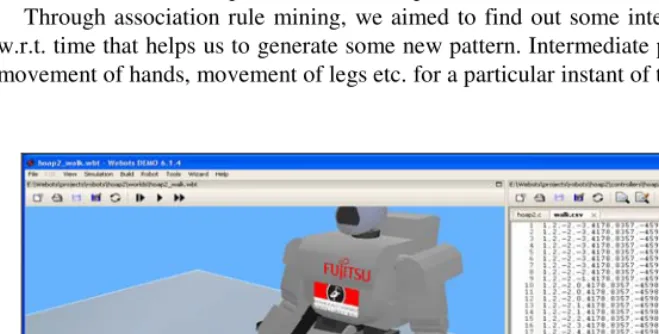
We have tested aforesaid methodology over the temporal dataset of Humanoid Robot HOAP-2. In this dataset we have several files for several motions of HOAP-2. These files contain 25 attributes. These attributes store the value of 25 joints of HOAP-2. Each value has certain maximum and minimum range. Their values and other infor-mations are taken from [14]. In the dataset, one transaction (or record) represents the movement of 25 joints in 1 millisecond. We are considering the dataset of Walk pat-tern which contains 26000 records. It means, it is representing a walk patpat-tern for 26 seconds. All this information is gathered from [14] and Webots [15], a simulated platform for HOAP-2. This platform provides various user-friendly frameworks of robotics. The walk pattern in Webots for HOAP-2 is shown as in fig. 2. In this figure three windows are cascaded. The leftmost window shows the simulated HOAP-2 which is programmed in C taking .csv (comma separated value) file as an input. That csv file is shown in the rightmost window. It contains decimal value of 25 joints. At the bottom window, the position of sensors per movement of HOAP-2 is displayed.
[image:3.513.52.382.387.554.2]Through association rule mining, we aimed to find out some intermediate pattern w.r.t. time that helps us to generate some new pattern. Intermediate patterns could be movement of hands, movement of legs etc. for a particular instant of time.
3.2 Implementation
The method given in section 3 can be implemented for HOAP-2 dataset as:
3.2.1 Input
Initially the dataset was in terms of .csv format. But since for pattern-growth methods, text formats are most feasible, so we have converted that data into .txt formats.
3.2.2 Preprocessing
The input file contains 27 attribute from which we have analysed that 6 attributes are of no use as those values remained constant, thuswe have eliminated those attributes from the dataset as they would not be contributing in associations. The remaining attribute set is
{rleg _joint_1, rleg _joint_2, rleg _joint_3, rleg _joint_4, rleg _joint_5, rleg _joint_6, rarm_joint_1, rarm_joint_2, rarm_joint_3, rarm_joint_4, lleg _joint_1, lleg _joint_2, lleg _joint_3, lleg _joint_4, lleg _joint_5, lleg _joint_6, larm_joint_1, larm_joint_2, larm_joint_3, larm_joint_4, body_joint_1}
Also the data is in the form of numeric values. Seeing the raw data one couldn’t find any meaning in its associations and thus we have converted it into meaningful form by appending attribute name with its value. The resulting input file for finding pat-terns is given in fig. 3. In this file we have 21 attributes, but for applying FP-growth algorithm we have appended transaction ID and time attribute in the transactional dataset.
The finalized input file will be taken as given in table 1. It has 23 attributes which includes 21 attributes (mentioned above), transaction ID and time respectively.
In this dataset, the time factor is taken on the basis of timestamps. We have consid-ered two files for capturing different patterns, Walk-pattern and Sumo-pattern. For walk-pattern, one interval is of 50 timestamps i.e. 50 transactions. The time attribute
-90 -90
2
-60 -60
1
-30 -30
0
rleg_joint_3_-90 rleg_joint_2_-90
rleg_joint_1_2
rleg_joint_3_-60 rleg_joint_2_-60
rleg_joint_1_1
rleg_joint_3_-30 rleg_joint_2_-30
[image:4.513.51.388.411.445.2]rleg_joint_1_0
Fig. 3. Data Transformation
Table 1. Input Transactional dataset
T1 time1 rleg_joint_1_0 rleg_joint_2_0 rarm_joint_1_0 ….
T2 time1 rleg_joint_1_1 rleg_joint_2_0 rarm_joint_1_0 ….
T3 time1 rleg_joint_1_2 rleg_joint_2_0 rarm_joint_1_0 ….
T4 time1 rleg_joint_1_3 rleg_joint_2_0 rarm_joint_1_0 ….
T5 time1 rleg_joint_1_4 rleg_joint_2_0 rarm_joint_1_0 ….
-30 -20 -10 0 10 20 30 1
1001 2001 3001 4001 5001 6001 7001 8001 9001 100 01 110 01 120 01 130 01 140 01 150 01 160 01
17001 18001 190 01
20001 21001 220 01 230 01 240 01 250 01 260 01
Tim e (m s )
T h e ta (d e g re e s )
[image:5.513.46.388.57.157.2]Le ft Thigh Right Thigh
Fig. 4. Thigh-joint (Leg Joint 4) trajectory for walk-pattern
35 45 55 65 75
1 2001 4001 6001 8001 10001 12001 14001 16001 18001 20001 22001 24001 26001
Tim e(m s)
[image:5.513.46.388.200.311.2]The ta (r a di a ns ) Right Knee Lef t Knee
Fig. 5. Knee-joint (Leg Joint 2) trajectory for walk-pattern
-80 -60 -40 -20 0 20 40 60 80 1
501 1001
1501 2001 2501 3001 3501 4001 4501 5001 5501 6001 6501 7001 7501 8001
Tim e (m s )
Th
et
a(
deg
rees)
Right Shoulde r tw is t Le ft Shoulde r tw is t
Fig. 6. Shoulder-twist-joint (Arm Joint 3) trajectory for Sumo-pattern
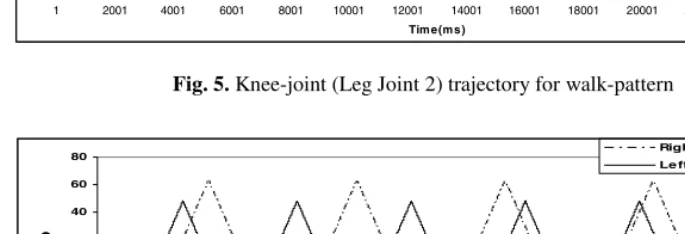
[image:5.513.45.388.349.466.2]associated with each other with some repeated sequences of their joint values. By seeing figure only one cannot judge that what values of joints are responsible to create this pattern and up to what time a particular association is being repeated so as to follow this pattern. Similar queries are there for fig.5 and fig.6 respectively. Thus, in order to see the repeated sequences for each association of joints for particular instant of time, there is a need to generate some frequent pattern which tells most frequently occurred sequence w.r.t. time in terms of temporal association rule.
3.2.3 Pattern Growth Methods
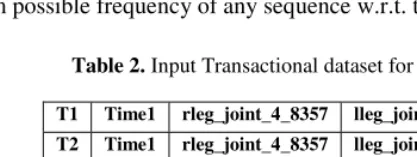
[image:6.513.111.320.255.333.2]One of the most important aspect of the overall method is to apply pattern-growth method. In order to dredge frequently occurred association of sequences we have applied FP growth method over the dataset given in Table 2. This method finds fre-quent patterns on the basis of minimum support threshold which usually represents the minimum possible frequency of any sequence w.r.t. time.
Table 2. Input Transactional dataset for leg-Joint 4
T1 Time1 rleg_joint_4_8357 lleg_joint_4_-8360
T2 Time1 rleg_joint_4_8357 lleg_joint_4_-8360
T3 Time1 rleg_joint_4_8357 lleg_joint_4_-8360
T4 Time1 rleg_joint_4_8357 lleg_joint_4_-8360 T5 Time1 rleg_joint_4_8357 lleg_joint_4_-8360
. . . .
Thus, for the dataset given in Table 2, we have defined any temporal sequence as
Definition 1: A sequence is said to be a temporal sequence iff:
For Sequence S1:(A,B,T)
If ((Support(A)>= Minimum Support Threshold)>(Support(B)>= Minimum Support Threshold)>(Support(T)>= Minimum Support Threshold))
Then Support(S1)=P(AUBUT)
where Support(A)=n(A), Support(B)=n(B), Support(T)=n(T) since for every attribute value the support of that value is its frequency in that dataset; Minimum Support threshold is provided by the user.
Following above definition we have temporal sequences as frequent patterns which are generated after applying FP-growth algorithm. In the resultant format the frequent pattern is represented as:
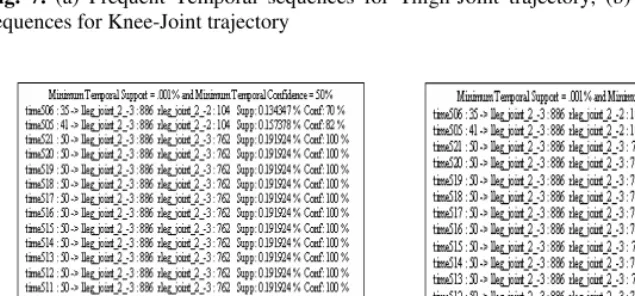
lleg_joint_2_-3 : 886 rleg_joint_2_-3 : 762 time521 : 50 *
(a) (b)
Fig. 7. (a) Frequent Temporal sequences for Thigh-Joint trajectory, (b) Frequent Temporal sequences for Knee-Joint trajectory
(a) (b)
Fig. 8. (a) Temporal Association Rules for Thigh-Joint trajectory, (b) Temporal Association Rules for Knee-Joint trajectory
3.2.4 Temporal Association Rule Generation
Finalized output of Hoap-2 dataset is in terms of temporal association rule which is generated by taking frequent temporal sequences as an input. For our dataset, we can define temporal rules as:
Definition 2: A rule R is said to be temporal association rule iff:
For any frequent temporal sequence SF:(A, B, T) when
Support(SF )=P(TUAUB)
Conf(SF )= P((TUAUB)/T)*100
If (Support(SF) ≥ Minimum temporal support & Conf(SF) ≥ Minimum temporal
confi-dence )
Then Rule R : T → (A,B) is a Temporal association Rule
where T is a time interval in which the sequence (A,B) is occurred. Minimum tempo-ral support and Minimum tempotempo-ral confidence is provided by the user.
Thus following aforesaid, the temporal association rule is formatted as:
[image:7.513.58.376.191.339.2]It means that for time interval 520 which has support 50, the sequence (lleg_joint_2_-3, rleg_joint_2_-3) is frequent temporal sequence in that time interval with support 0.191924% and confidence 100%. Here the minimum temporal support is .001% and minimum temporal confidence is 50%. Similarly we can generate similar kind of rules for all the frequent temporal sequences of every trajectory. Some of the rules for walk-pattern trajectories are shown in Fig. 8 (a) and (b) respectively. Due to space construct we have not shown sumo-pattern results here, but the criteria of dredging frequent temporal sequences and then generating temporal association rules remains same for every joint-trajectories.
4 Conclusion and Future Work
The proposed demonstration highlights key features of pattern growth method for real-time temporal datasets. Observational analysis show that the contribution of FP-growth algorithm is very useful and productive for Hoap-2 dataset as it generates temporal sequence associations of joints in terms of temporal association rules. In furtherance these rules can be used to classify variety of patterns in terms of associa-tion based temporal classificaassocia-tions.
Acknowledgments. We thank our summer trainee Anuj Singh, pursuing B.Tech from Manipal Institute of Technology, Manipal, for assisting us in various experimental analysis throughout the research.
References
1. Han, J., Kamber, M.: Book: Data Mining Concept & Technique (2001)
2. Dunham, M.: Data Mining: Introductory and Advanced Topics. Prentice Hall, Englewood Cliffs (2003)
3. Agrawal, R., Imielienski, T., Swami, A.: Mining Association Rules between Sets of Items in Large Databases. In: Proc. Conf. on Management of Data, pp. 207–216. ACM Press, New York (1993)
4. Han, J., Pei, J., Yin, Y.: Mining Frequent Patterns without Candidate Generation. In: Intl. Conference on Management of Data, ACM SIGMOD (2000)
5. Pei, J., Han, J., Lu, H., Nishio, S., Tang, S., Yang, D.: H-mine: hyper-structure mining of frequent patterns in large database. In: Proceedings of the IEEE International Conference on Data Mining, San Jose, CA (November 2001)
6. Tansel, A.U., Ayan, N.F.: Discovery of Association Rules in Temporal Databases. In: Fourth lnt’l Conference on KDD Workshop on Distributed Data Mining (August 1998) 7. Bettini, C., Sean Wang, X., Jajodia, S., Lin, J.-L.: Discovering Frequent Event Patterns
with Multiple Granularities in Time Sequences. IEEE TOKDE 10, 222–237 (1998)
8. Vyas, O.P., Verma, K.: Efficient Calendar Based Temporal Association Rule. ACM SIGMOD 34(3), 63–71 (2005)
9. Agrawal, Srikant: Mining sequential patterns. In: Proc.11th Int. Conf. Data Engineering, Taipei, Taiwan, R.O.C., September 1995, pp. 3–14 (1995)
11. Ozden, B., Ramaswamy, S., Silberschatz, A.: Cyclic association rules. In: Proc. 15th Int. Conf. Data Engineering, Orlando, February 1998, pp. 412–421 (1998)
12. Alie, J.M., Rossi, G.H.: An approach to discovering temporal association rules. In: Proc. of the 2000 ACM symposium on Applied computing, Come, Italy, vol. 1, pp. 294–300 (2000) 13. Lee, C.-H., Lin, C.-R., Chen, M.-S.: On Mining General Temporal Association Rules in a Publication Database. In: Proc. IEEE International Conference on Data Mining, pp. 337– 344 (2001)
14. Fujitsu Automation, Humanoid Robot HOAP-2 Specification, Fujitsu Corporation, http://jp.fujitsu.com/group/automation/downloads/en/ services/humanoidrobot/hoap2/spec.pdf