Introduction
Stress has been defined by Cox as stimulus response on the result of an interaction between the two with interaction described in terms of some imbalance between the person and the environment (Cox, 1978).[1] Atkinson et al. stated that the term stress describes external demands (physical or mental) as an individual physical and psychological well-being.[2] Stress plays an important role in dental anxiety, especially in procedures which are painful. The most common dental procedure is tooth extraction often associated with stress and anxiety in relation to the patient. Even though local anesthesia is meant to make it a painless procedure, intervention is often necessary to reduce stress.[3]
ABSTRACT
Pain, anxiety, and stress are different terms of the same entity, which makes the patient restless and uncooperative during any dental procedures. There are different kinds of techniques which were proposed to reduced stress and thereby pain during the procedures. The aim of this study was to compare the efficacy of these alternative techniques in the reduction of stress during dental extraction. Hundred patients, both male and female, in the age group of 15–50 years, were taken as a sample that had to undergo extraction. They were randomly assigned into four groups. Group 1 underwent extraction with no measures of explanation or reduction in anxiety; group 2 underwent extraction where explanation regarding the procedure was given but no aviation methods; group 3 in which patient who underwent extraction was explained about the procedure in music was added as an aviation method; group 4 in which patient who underwent extraction was explained about the procedure and alternative hypnosis using distraction is used. All four groups were subjected to questionnaire before and after extraction procedure, and results of pain levels were recorded in a scales from 1 to 10. Results showed that the group with music showed a good decreased level of anxiety post-operatively, followed by distraction and explanation with a mean value of 8.48, 8.24, and 7.68, respectively. The anxiety levels are higher in males when compared with females. Within the limits of the study, the results show that music reduces pain perception by aviation anxiety in patients undergoing extraction. To the lesser extent, extraction had distraction and instruction may also be used to reduce anxiety in patients. This study helps to understand that reducing anxiety through any one of the technique might be an effective way of pain reduction during the dental surgical procedure.
Keywords: Stress, relaxation, music, distraction, explanation, psychological stress
To compare the efficacy of alternative techniques in reduction
of stress during dental extraction
Avinash Kavarthapu
1, Hussain Sharmila
2, Santhoshini Reddy
31Department of Periodontology, Saveetha Dental College, Saveetha University, Chennai, Tamil Nadu, India, 2Department of Prosthodontics, Saveetha Dental College, Saveetha
University, Chennai, Tamil Nadu, India, 3Department of Conservative Dentistry, Saveetha Dental College, Saveetha University, Chennai, Tamil Nadu, India
Correspondence: Kavarthapu Avinash, Department of Periodontology, Saveetha Dental College, Saveetha University, Chennai, Tamil Nadu, India. Phone: +91-9840379213. E-mail: [email protected]
It becomes vital to manage stress in patients undergoing dental extraction as an apprehensive patient can be uncooperative during the surgery and may complicate the operational procedure. The type of anxiety during extraction is state anxiety felt as a transitory emotional condition of human body characterized by subjective and consciously perceived strain and apprehensive feeling by hyperactivity of autonomous nervous system.[4] As dental anxiety is a known phenomenon, this study was designed to determine their own methods to reduce anxiety during extraction.
Materials and Methods
A clinical study was done including the sample of 100 patients, who never had a tooth extracted earlier and who fall in the age group of 15–50 years both men and women. The inclusion criteria were patients with no systemic diseases or any kind of medical history and who were willing to be included in the study. The teeth extracted were firm, with no periodontal diseases.
The sample size of 100 was divided into four groups, with 25 patients in each group. The groups were divided depending on the type of anxiety-relieving factors applied during the procedures. The patients
How to cite this article:Kavarthapu A, Sharmila H, Reddy S. To compare the efficacy of alternative techniques in reduction of stress during dental extraction. J Adv Pharm Edu Res 2017;7(2):120-124.
Source of Support: Nil, Conflict of Interest: None declared.
Access this article online
in three groups were explained about the types of anxiety-relieving factors which can be applied to reduce stress during the procedures, and the forth group was not aware of the factors though they were aware of the study in which they were included.
Group 1 underwent extraction with no measures of explanation or reduction in anxiety; group 2 underwent extraction where explanation regarding the procedure was given but no aviation methods; group 3 in which patient who underwent extraction was explained about the procedure in music was added as an aviation method; group 4 in which patient who underwent extraction was explained about the procedure and alternative hypnosis using distraction is used.
Surgical procedure
The surgical procedure was performed by different operators. The method of extraction was same in all cases, which was performed under local anesthesia, and extraction was with forceps only making as less traumatic as possible. After the procedure, the patients were given post-extraction instructions and were prescribed antibiotics and an anti-inflammatory/analgesic.
Evaluation of the procedure
The questionnaire for evaluating the anxiety level during extraction procedure was modified and adopted for the topic perceptions of dentists, dentistry undergraduate students, and the lay public about dental sedation by Eli et al.[4]
The questionnaire contained questions which evaluated the patients from anxiety levels before and after extraction. All four groups were subjected to questionnaire before and after extraction procedure, and results of anxiety levels were recorded in a scales from 1-10. The questionnaire for this study was taken based on the study done by Lucaine et al. on perceptions of dentists, dentistry undergraduate students, and the lay public about dental sedation.[5]
Results
Descriptive statistics were obtained for all the variables of interest. Of the 100 patients, 55% were males and 45% were females within
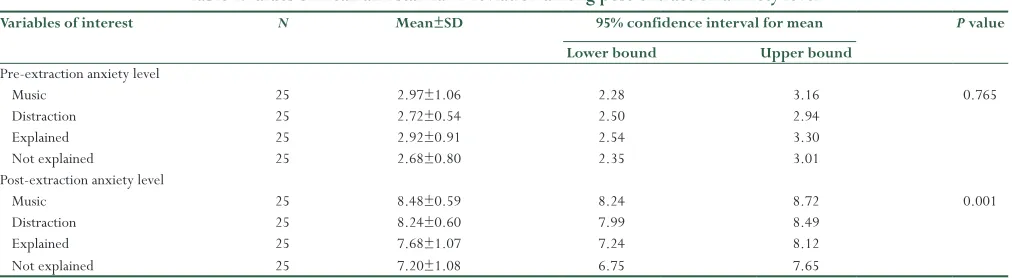
a range of 15–50 years of age. Values of mean and standard deviation among post-extraction anxiety level are highest and significant for music 8.40 and 0.59, respectively, followed by distraction groups with mean value as 8.24 ± 0.60. Both groups showed statistically significant (P < 0.001) [Table 1]. Among all the four groups categorized, the group with music showed most statistically significant decrease level of anxiety.
One-way ANOVA was done to compare pre- and post-extraction anxiety levels between and within groups. The results showed a highly significant P < 0.001 with the post-extraction anxiety level which is shown in Table 2.
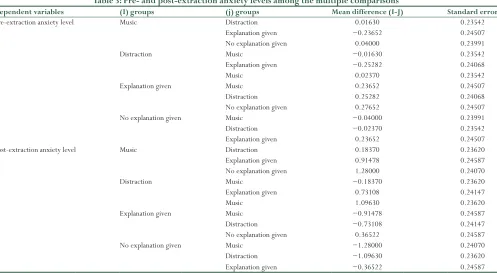
Multiple comparisons between the groups were done with Tukey honest significant difference statistical analysis. When pre- and post-extraction anxiety levels among the multiple comparisons, the group in which music was used showed a reduction of anxiety (P < 0.001) which is shown in Table 3.
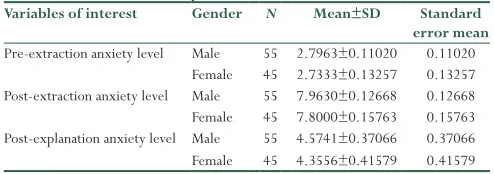
There was a statistically significant relationship between gender and depression, anxiety, or stress. The anxiety levels are higher in males before extraction with a mean value of 2.7963 ± 0.80984, and the anxiety levels decreased in males with a mean value of 7.9630 ± 0.93087 after explanation compared to females with a mean value of 7.8261 ± 1.06049 which is shown in Table 4.
The results showed that there is a significant difference in the post-extraction anxiety level among the different groups. More specifically post-extraction group (P < 0.001) showed significance level of decrease in anxiety compared to pre-extraction group (0.765).
Discussion
Tooth extraction is one of the most common dental procedures that are often associated with dental anxiety. Dental anxiety can exert and influence on the perceived pain threshold resulting in more discomfort and establishes a cycle of anxiety and pain.[6] Psychological stress during the extraction procedure may be perceived as increased pain and will affect the post-surgical recovery of the patient. However, not many studies had been done to find the effect of reducing stress before tooth extraction and its effect on pain perception.
Table 1: Values of mean and standard deviation among post‑extraction anxiety level
Variables of interest N Mean±SD 95% confidence interval for mean P value Lower bound Upper bound
Pre-extraction anxiety level
Music 25 2.97±1.06 2.28 3.16 0.765
Distraction 25 2.72±0.54 2.50 2.94
Explained 25 2.92±0.91 2.54 3.30
Not explained 25 2.68±0.80 2.35 3.01
Post-extraction anxiety level
Music 25 8.48±0.59 8.24 8.72 0.001
Distraction 25 8.24±0.60 7.99 8.49
Explained 25 7.68±1.07 7.24 8.12
Not explained 25 7.20±1.08 6.75 7.65
In this study, three techniques were followed to reduce anxiety in the patient, and a questionnaire was given to quantify the pain they experienced before and after the extraction procedure. One group was kept as a control group without any explanation of procedure for the sake of comparison with the experimental group. The result of the study shows that there was a significant reduction of pain in all the three groups where some measure was taken to reduce the anxiety.
It has been shown that psychological stress as in the case of dental anxiety can have many physical effects ranging from increased sympathetic-adrenergic activity to illness susceptibility.[7]
Studies have shown that anxiety can interfere in the pain perception and post-operative recovery of patients. Anxiety associated with dental extraction is a type of state anxiety which in fact a transitory emotional condition of the human body characterized by subjective
and consciously perceived strain and apprehension feelings and by hyperactivity of autonomous nervous system.
In one of the recent studies by Myriam et al., the use of music was compared with acoustic control condition (rippling water) in the reduction of stress relief before the procedure, rippling water showed a better reduction of stress when compared to music. The reason could be that music is only able to reduce psychological stress /anxiety depends on the intensity of the stress, if it is mild or severe. The mild stress probably could show significance than severe. The other significant factor which could limit this study was that the interventions were received before the stress conditions that they were exposed to.[8]
Demographic variables such as age and sex were considered in this study. The results showed that males had a lower threshold for pain compared to female patients. The reason could be that there were a larger number of younger male patients who tended to be more vulnerable to anxiety. As far as age distribution is concerned, younger patients were more prone to pain compared to older individuals which could be due to lack of experience of procedures associated with pain and anxiety.
In this study, one group of patients were allowed to listen to the music of their choice during the dental procedure. The results showed that there was a considerable decrease in pain perception in these patients compared to control group. Research had shown that listening to music had an ability to decrease sympathetic activity.[9-11] The experience of stress and subsequent pain during extraction procedure is regulated by the central nervous system through neuronal pathways to the central control system and hypothalamus.[12] The hypothalamus is associated with the hypothalamo-pituitary adrenal (HPA) axis and sympathetic nervous system leading to a combined endocrine and
Table 3: Pre‑ and post‑extraction anxiety levels among the multiple comparisons
Dependent variables (I) groups (j) groups Mean difference (I‑J) Standard error
Pre-extraction anxiety level Music Distraction 0.01630 0.23542 Explanation given −0.23652 0.24507 No explanation given 0.04000 0.23991
Distraction Music −0.01630 0.23542
Explanation given −0.25282 0.24068
Music 0.02370 0.23542
Explanation given Music 0.23652 0.24507
Distraction 0.25282 0.24068
No explanation given 0.27652 0.24507 No explanation given Music −0.04000 0.23991
Distraction −0.02370 0.23542
Explanation given 0.23652 0.24507 Post-extraction anxiety level Music Distraction 0.18370 0.23620 Explanation given 0.91478 0.24587 No explanation given 1.28000 0.24070
Distraction Music −0.18370 0.23620
Explanation given 0.73108 0.24147
Music 1.09630 0.23620
Explanation given Music −0.91478 0.24587
Distraction −0.73108 0.24147
No explanation given 0.36522 0.24587 No explanation given Music −1.28000 0.24070
Distraction −1.09630 0.23620
Explanation given −0.36522 0.24587
Table 2: Comparison pre‑ and post‑extraction anxiety levels between and within groups
Variables of interest F P value
Pre-extraction anxiety level Between groups Within groups Total
0.544 0.653
Post-extraction anxiety level Between groups Within groups Total
12.648 0.001
Post-explanation anxiety level Between groups Within groups Total
autonomous nervous system. Listening to the music has the capacity to initiate a multitude of cognitive process in the brain, and stress relative cognitive process could be one of them.[13] The previous studies have found a reduction in psychological stress, increased coping abilities, or altered levels in perceived relaxation after listening to music in the context of stressful situation.[14,15] It is also been found that listening to music and reduction in anxiety has been most consistent with hospital-based patients and laboratory-based studies.[16-20]
Another reason for the reduction in anxiety related to music could be adaptive reasons with the experience of stress.[11,21-24] It appears that music listening before experience of stress may add to facilitate or increased subsequent HPA axis activation. However, positive sympathetic nervous system stimulation effects on listening to music are not consistently reported.[8]
There have also been studies where there has been no reduction in anxiety levels through music listening. The reason for this variation could be that response to acute stress could be modified by an individual experience such as chronic stress.[25,26]
Another limiting factor in this study was a sample size which prevented drawing a final conclusion on the effect of music and anxiety. In this study, patients were asked to choose the type of music they wanted to listen. It might be argued that not the music itself but the positive memories associated with it may have cause this effect.[8] The result, however, after being investigated further to find the exact relationship between pain perception and music.
The second group of patients in this study were subjected to distraction as an anxiety control technique. The results showed that these patients experienced lesser pain compared to the control group. Distraction is a safe and inexpensive procedure that gives rise to an effective way to patients who lacks experience in painful dental procedure.[27] Distraction is based on assumption that pain perception has a large psychological component, in that the amount of attention directed to noxious stimuli modulated to perceived pain.[28]
McCaul and Mallet developed the existing theory by placing emphasis on the fact that the capacity of humans to pay attention is limited. In the distraction technique, the patient is made to concentrate on the tip of toes so that they were not able to perceive the painful stimuli.[29]
The previous studies have shown that distraction captures the individual senses such as vision, hearing, and touch such that actively engage the
individual emotions. Ideal distraction would involve multiple sensory modalities, active emotional involvement, and participation of patient to compete with the signals from noxious stimuli.[30,31] The effect of distraction during a pain phenomenon has shown that cortical areas associated with attentional process and pain modulation are more active, whereas areas associated with pain perception are less active.[32]
Hoffman et al. reported that patients undergo emotional and nervous states during the procedure[33] that could lead to the variation in the response during distraction. The emotional states can hinder to deviate their concentration over another object, as in our study, that could be one of the reasons that distraction could not give good results when compared to the music.
In the study conducted by Asl et al., which was on virtual reality, it was stated that the visual field is of great importance when considering distraction, as the distracting image should occupy more of the visual field to actually create an impact on the subject, the tip of the toe does not occupy the visual field completely, and the distraction could have been bias, resulting in lesser reduction of stress. By diverting attention from an unpleasant stimuli, distraction engages higher cognitive and emotional senses of the nervous system which can markedly dominate patients subjective pain experience.[34]
In a study by Asl et al., it was found that there was a decrease in pain perception and state anxiety in children during dental treatment when virtual reality was used as a distraction technique. The results of this study may not be finally conclusive as individuals have different pain threshold and distraction largely works on the psychological component of anxiety. It has been demonstrating that distraction technique is less effective in individuals who have bitter pain experience.[31] In this study, this variable was not taken into account during the selection of patients.
Explanation of the surgical procedure was done as a method of reducing anxiety in one group of patients. Vassend[35] has shown that anxiety has the consequence of pain expectation or dental procedure expected to be painful in an obstacle to seeking treatment. Based on this, it is found that fear of pain is manifested more in patients with high dental anxiety.[36] In this present study, it was found that patients who had given explanation were psychologically comforted and had lesser experience of pain. There seems to be a correlation between anxiety and pain and patients who were more anxious experienced greater amount of pain. The results of group which had no explanation showed greater level of pain experience. A simple procedure such as explanation could be helpful in aviation anxiety and thereby reducing pain threshold or pain perception.
From a psychological point of view, it is important to give patients the technique that will help them deal the type of surgery, especially when anxiety is involved so that the intervention takes place with a minimum of discomfort and recovery is as fast and complete as possible.[3]
Limitations of the study include the small sample size. Considering the fact that extraction as a very common procedure and the population size is large, it may be presumed that larger sample size would be a better predictor as to the choice of technique for reduction in anxiety. Most of the patients in this study had undergone extraction for the Table 4: Anxiety evaluated at different levels
Variables of interest Gender N Mean±SD Standard error mean
Pre-extraction anxiety level Male 55 2.7963±0.11020 0.11020 Female 45 2.7333±0.13257 0.13257 Post-extraction anxiety level Male 55 7.9630±0.12668 0.12668 Female 45 7.8000±0.15763 0.15763 Post-explanation anxiety level Male 55 4.5741±0.37066 0.37066 Female 45 4.3556±0.41579 0.41579
first time. A crossover studies with greater variables may be considered to prove the validity of techniques in reducing the anxiety. Pain is a subjective phenomenon and may show variability. This limitation, however, may be minimized if any biomarker associated was evaluated with the technique used.
Conclusion
Within the limits of the study, the results show that music reduces pain perception by aviation anxiety in patients undergoing extraction. To the lesser extent, distraction and instruction may also be used to reduce anxiety in patients. This study helps to understand that reducing anxiety through any one of the technique might be a effective way of pain reduction during dental surgical procedure.
References
1. Mackay C, Cox T, Burrows G, Lazzerini T. An inventory for the measurement of self-reported stress and arousal. Br J Soc Clin Psychol 1978;17:283-4. 2. Atkinson JM, Millar K, Kay EJ, Blinkhorn AS. Stress in dental practice. Dent
Update 1991;18:60-4.
3. Lago-Méndez L, Diniz-Freitas M, Senra-Rivera C, Seoane-Pesqueira G, Gándara-Rey JM, García-García A. Postoperative recovery after removal of a lower third molar: Role of trait and dental anxiety. Oral Surg Oral Med Oral Pathol Oral Radiol Endod 2009;108:855-60.
4. Ohrbach RK. Oral psychophysiology: Stress, pain, and behavior in dental care. J Prosthet Dent 1994;71:40.
5. Costa LR, Dias AD, Pinheiro LS, Chaves ME, Ferreira Rde A, Almeida RB, et al.
Perceptions of dentists, dentistry undergraduate students, and the lay public about dental sedation. J Appl Oral Sci 2004;12:182-8.
6. Cramer EH, Szmyd L. Identifying the overly anxious patient in impacted third molar surgery. Tech Doc Rep SAMTDR USAF Sch Aerosp Med 1962;62-90:1-5. 7. Holmes TH, Masuda M. Life change and illness susceptibility. In:
Dohrenwend BS, Dohrenwend BP, editors. Stressful Life Events: Their Nature and Effects. New York: Wiley; 1974.
8. Thoma MV, La Marca R, Brönnimann R, Finkel L, Ehlert U, Nater UM. The effect of music on the human stress response. PLoS One 2013;8:e70156. 9. Bartlett DL. Physiological responses to music and sound stimuli. In: Hodges
DA, editor. Handbook of Music Psychology. San Antonio: University of Texas; 1996. p. 343-85.
10. Standley JM. Meta-analysis of research in music and medical treatment: Effective size as a basis for comparison across multiple dependent and independent variables. In: Spintge R, Droh R, editor. St. Louis: MMB; 1992. p. 105-33. 11. Hodges DA. Psychophysiological responses to music. In: Juslin JA, Sloboda JA,
editor. Handbook of Music and Emotion: Theory, Research, Applications. New York: Oxford University Press; 2010. p. 279-311.
12. Tsigos C, Chrousos GP. Hypothalamic-pituitary-adrenal axis, neuroendocrine factors and stress. J Psychosom Res 2002;53:865-71.
13. Peretz I, Zatorre RJ. Brain organization for music processing. Annu Rev Psychol 2005;56:89-114.
14. Burns J, Labbé E, Williams K, McCall J. Perceived and physiological indicators of relaxation: As different as Mozart and Alice in chains. Appl Psychophysiol Biofeedback 1999;24:197-202.
15. Allen K, Golden LH, Izzo JL Jr, Ching MI, Forrest A, Niles CR, et al.
Normalization of hypertensive responses during ambulatory surgical stress by perioperative music. Psychosom Med 2001;63:487-92.
16. Rohleder N, Nater UM. Determinants of salivary alpha-amylase in humans and methodological considerations. Psychoneuroendocrinology 2009;34:469-85. 17. Ventura T, Gomes MC, Carreira T. Cortisol and anxiety response to
a relaxing intervention on pregnant women awaiting amniocentesis. Psychoneuroendocrinology 2012;37:148-56.
18. Wang SM, Kulkarni L, Dolev J, Kain ZN. Music and preoperative anxiety: A randomized, controlled study. Anesth Analg 2002;94:1489-94.
19. Voss JA, Good M, Yates B, Baun MM, Thompson A, Hertzog M. Sedative music reduces anxiety and pain during chair rest after open-heart surgery. Pain 2004;112:197-203.
20. Knight WE, Rickard PhD NS. Relaxing music prevents stress-induced increases in subjective anxiety, systolic blood pressure, and heart rate in healthy males and females. J Music Ther 2001;38:254-72.
21. Labbé E, Schmidt N, Babin J, Pharr M. Coping with stress: The effectiveness of different types of music. Appl Psychophysiol Biofeedback 2007;32:163-8. 22. Ellis RJ, Thayer JF. Music and autonomic nervous system (Dys)function. Music
Percept 2010;27:317-326.
23. Evans D. The effectiveness of music as an intervention for hospital patients: A systematic review. J Adv Nurs 2002;37:8-18.
24. Richards T, Johnson J, Sparks A, Emerson H. The effect of music therapy on patients’ perception and manifestation of pain, anxiety, and patient satisfaction. Medsurg Nurs 2007;16:7-14.
25. Thoma MV, Joksimovic L, Kirschbaum C, Wolf JM, Rohleder N. Altered salivary alpha-amylase awakening response in Bosnian War refugees with posttraumatic stress disorder. Psychoneuroendocrinology 2012;37:810-7. 26. Heim C, Newport DJ, Bonsall R, Miller AH, Nemeroff CB. Altered
pituitary-adrenal axis responses to provocative challenge tests in adult survivors of childhood abuse. Am J Psychiatry 2001;158:575-81.
27. Prabhakar AR, Marwah N, Raju OS. A comparison between audio and audiovisual distraction techniques in managing anxious pediatric dental patients. J Indian Soc Pedod Prev Dent 2007;25:177-82.
28. Asl Aminabadi N, Erfanparast L, Sohrabi A, Ghertasi Oskouei S, Naghili A. The Impact of Virtual Reality Distraction on Pain and Anxiety during Dental Treatment in 4-6 Year-Old Children: A Randomized Controlled Clinical Trial. J Dent Res Dent Clin Dent Prospects 2012;6:117-24.
29. McCaul KD, Malott JM. Distraction and coping with pain. Psychol Bull 1984;95:516-33.
30. Wismeijer AA, Vingerhoets AJ. The use of virtual reality and audiovisual eyeglass systems as adjunct analgesic techniques: A review of the literature. Ann Behav Med 2005;30:268-78.
31. Slifer KJ, Tucker CL, Dahlquist LM. Helping children and caregivers cope with repeated invasive procedures: How are we doing? J Clin Psychol 2002;9:131-52. 32. Gold JI, Belmont KA, Thomas DA. The neurobiology of virtual reality pain
attenuation. Cyberpsychol Behav 2007;10:536-44.
33. Hoffman HG, Patterson DR, Carrougher GJ. Use of virtual reality for adjunctive treatment of adult burn pain during physical therapy: A controlled study. Clin J Pain 2000;16:244-50.
34. Morris LD, Louw QA, Grimmer-Somers K. The effectiveness of virtual reality on reducing pain and anxiety in burn injury patients: A systematic review. Clin J Pain 2009;25:815-26.
35. Vassend O. Anxiety, pain and discomfort associated with dental treatment. Behav Res Ther 1993;31:659-66.
36. Van Wijk J, Hoogstraten J. Experience with dental pain and fearof dental pain. J Dent Res 2005;84:947-50.