201
Nano-medicine based drug delivery system
Akash Yadav*, Meenal Ghune, Dinesh Kumar Jain
College of Pharmacy, Indore Professional Studies (IPS) Academy, Knowledge Village,
Agra-Bombay Road, Rajendra Nagar, Indore (Madhya Pradesh), India.
*Corresponding author: [email protected]
ABSTRACT:
Nanomedicine is the medical application of nanotechnology. Nanomedicine is defined as
the monitoring, repair, construction and control of human biological systems at the
molecular level, using engineered nanodevices and nanostructures. Nanomedicine
ranges from the medical applications of nanomaterials to nanoelectronic biosensors and
even possible future applications of molecular nanotechnology. The aim of
nanomedicine is the improvement of healthcare for the benefit of the patient.
Nanomedicine is an important and rapidly growing field, which is emerging from the
application of nanotechnology to healthcare. The generally recognized categories include
diagnostics, imaging, medical devices, drug discovery, drug delivery and regenerative
medicine. Nanomedicine can offer impressive resolutions for various life threatening
diseases. Disease areas which can be expected to benefit most from nanotechnology
within the next few years are cancer, diseases of the cardiovascular system, the lungs,
blood, neurological (especially neurodegenerative) diseases, diabetes,
inflammatory/infectious diseases, Parkinson’s or Alzheimer’s disease and orthopedic
problems.
Keywords: Nanomedicine, nanoparticles, nanotubes, nanobiosensor, nanorobotics.
INTRODUCTION:
Nanomedicine, an offshoot of nanotechnology, refers to highly specific medical
intervention at the molecular scale for curing disease or repairing damaged tissues,
such as bone, muscle, or nerve. Nanotechnology is a collective term referring to
technological developments on the nanometer scale, usually 0.1-100 nm. A nanometer
is one-billionth of a meter, too small to be seen with a conventional laboratory
microscope. It is at this size scale - about 100 nanometers or less that biological
molecules and structures inside living cells operate. Therefore, nanotechnology is
202
Nanomedicine is the process of diagnosing, treating, and preventing disease and
traumatic injury, of relieving pain and of preserving and improving human health,
using molecular tools and molecular knowledge of the human body. It is the application
of nanotechnology (engineering of tiny machines) to the prevention and treatment of
disease in the human body. The most elementary of nanomedical devices will be used in
the diagnosis of illnesses. In the relatively near term, nanomedicine can address many
important medical problems by using nanoscale structured materials and simple
nanodevices that can be manufactured today. This includes the interaction of
nanostructured materials with biological systems. Nanomedicine seeks to deliver a
valuable set of research tools and clinically useful devices in the near future. [1,2]
Nanomedicine increase the localization of therapeutic compounds, including imaging
agents, radio sensitizers, small molecule therapeutics and gene medicines such as
siRNA, to target tissues such as site of infection or inflammation or solid tumors
through a passive targeting mechanism also called the enhanced permeability and
retention (EPR) effect.
Key goals for nanomedicine:
The main objective for nanomedicine is to develop cure for traditionally incurable
diseases like cancer through the utilization of nanotechnology and also to provide more
effective cure with fewer side effects by means of targeted drug delivery systems.
Advantages and disadvantages of nanomedicine:
With the help of nanomedicine diseases can be easily cured with no side effects and no
surgery is required. Its detection is also very easy. The disadvantage appeared with
nanomedicine is its implementation difficulties and high cost.
Applications of nanomedicine:
1. Diagnosis using nanomedicine: Diagnostic nanoapparatus could be attached to keep
check of the internal chemistry of the body. Mobile nanorobots with wireless
transmitters could easily circulate in the blood and lymph systems and can send out
alerts when chemical imbalances appear within the blood.
2. Nervous system tracking: Nanomedicine also helps in better understanding the
203
inserted in the nervous system of the human body to monitor pulse rate, brain activity,
and other important functions.
3. Drugs dispersion: Live saving drugs are one of the important ingredients in the latest
medicines but its unusual and its excess usage could cause death. Nanomedicine also
has successful applications for the reduction of extra drugs from human body.
4. Heart and ECG machine: Advanced and fully equipped nanomedical heart trackers
are present to accurately track the heart beat and it’s down falls and also for treating it
as needed in the body. In human heart defibrillators and pacemakers, nanodevices
could influence the behavior of individual cells.
5. Artificial antibodies: Nanomedicine was the first to conceptualize the artificial red and
white blood cells and later on it successfully showed the positive results. Cancer
patients are now treated by injecting artificial red blood cells to balance the human
body blood level. Artificial antibodies, white and red blood cells and antiviral nanorobots
could be considered as successful applications of nanomedicine.
Medical nanomaterials and nanodevices:
Nanoparticles:
Nanospheres and nanocapsules that can be either amorphous or crystalline.
Nanopowders are agglomerates of ultrafine particles, nanoparticles or nanoclusters.
They are specifically designed to absorb or encapsulate a drug, thereby protecting it
against chemical and enzymatic degradation, for targeting particular organs/tissue and
also as carriers of DNA in gene therapy, to deliver proteins, peptides and genes by oral
route.
It focuses in the production of nanoscale particles or molecules to enhance the
bioavailability of a drug. It also focuses on maximizing bioavailability and for prolonged
period of time. The advantage is that cells can take up the nanoparticles because of
204
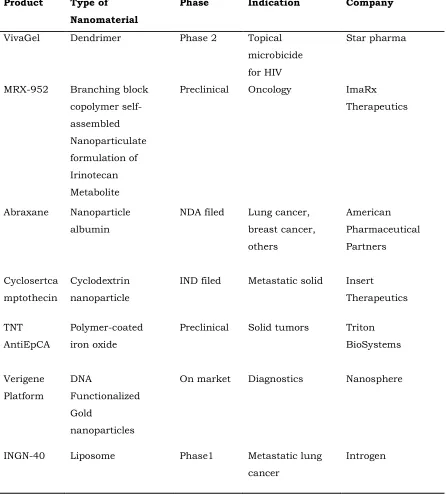
Table 1: Basic information of some nanomaterials moving to market
Product Type of
Nanomaterial
Phase Indication Company
VivaGel Dendrimer Phase 2 Topical
microbicide
for HIV
Star pharma
MRX-952 Branching block
copolymer self-
assembled
Nanoparticulate
formulation of
Irinotecan
Metabolite
Preclinical Oncology ImaRx
Therapeutics
Abraxane Nanoparticle
albumin
NDA filed Lung cancer,
breast cancer,
others
American
Pharmaceutical
Partners
Cyclosertca
mptothecin
Cyclodextrin
nanoparticle
IND filed Metastatic solid Insert
Therapeutics
TNT
AntiEpCA
Polymer-coated
iron oxide
Preclinical Solid tumors Triton
BioSystems
Verigene
Platform
DNA
Functionalized
Gold
nanoparticles
On market Diagnostics Nanosphere
INGN-40 Liposome Phase1 Metastatic lung
cancer
205
Biomedical application of nanoparticles:
• Iron oxide nanoparticles can used to improve MRI images of cancer tumors. The
nanoparticles are coated with a peptide that binds to a cancer tumor once the
nanoparticles are attached to the tumor the magnetic property of the iron oxide
enhances the images from the Magnetic Resonance Imagining scan.
• Nanoparticles coated with proteins that attach to damaged portions of arteries. This
could allow delivery of drugs to the damaged regions of arteries to fight
cardiovascular disease.
• Quantum Dots (crystalline nanoparticles) that identify the location of cancer cells in
the body.
• Gold nanoparticles that allow heat from infrared lasers to be targeted on cancer
tumors.
• Porous silica nanoparticles used to deliver chemotherapy drugs to cancer cells.
• Nanoparticles, when activated by x-rays that generate electrons that cause the
destruction of cancer cells to which they have attached themselves. This is intended
to be used in place radiation therapy with much less damage to healthy tissue.
• A nanoparticle cream that releases nitric oxide gas to fight staph infections.
Nanopores:
One of the earliest therapeutically useful nanomedical devices, employing bulk
micromachining to fabricate tiny cell-containing chambers within single crystalline
silicon wafers. The chambers interface with the surrounding biological environment
through polycrystalline silicon filter membranes which are micro machined to present a
high density of uniform nanopores as small as 20 nanometers in diameter. These pores
are large enough to allow small molecules such as oxygen, glucose, and insulin to
pass, but are small enough to impede the passage of much larger immune
system molecules such as immunoglobulin and graft-borne virus particles.
Quantum dot:
These dots are tiny particles measuring only a few nanometers across, about the same
size as a protein molecule or a short sequence of DNA. They come in a nearly unlimited
palette of sharply-defined colors which can be customized by changing particle size or
composition. Particles can be excited to fluorescence with white light, can be linked to
206
thousand times brighter than conventional dyes used in many biological tests, and can
track biological events by simultaneously tagging each biological component (e.g.,
different proteins or DNA sequences) with nanodots of a specific color.
Nanotube:
A nanotube is a nanometer-scale tube-like structure. It may be of following types:
• Carbon nanotube
• Inorganic nanotube
• DNA nanotube
• Membrane nanotube
Fullerenes:
One nanometer buckyballs made from just a few dozen carbon atoms. Nanoparticles
such as C60 have many properties which make them attractive candidates for many
therapies. These are of extremely small molecular size with high physiological and
radiation stability. These are metabolically inert (negligible toxicity).
Soluble derivatives of fullerenes such as C60 have shown great utility as
pharmaceutical agents. Fullerene compounds may serve as antiviral agents (most
notably against HIV, where they have also been investigated computationally,
antibacterial agents (E. coli, Streptococcus, Mycobacterium tuberculosis),
photodynamic antitumor and anticancer therapies, antioxidants and anti-apoptosis
agents which may include treatments for amyotrophic lateral sclerosis (ALS or Lou
Gehrig’s disease) and Parkinson’s disease. Single-walled and multi-walled carbon
nanotubes are being investigated as biosensors, for example to detect glucose, ethanol
[3], hydrogen peroxide, selected proteins such as immunoglobulin and as an
electrochemical DNA hybridization biosensor.
Application of nanotubes:
• One of the important properties of nanotubes is that they can easily penetrate
membranes such as cell walls. In fact, long and narrow shape makes them look like
miniature needles, so it makes sense that they can function like a needle at the
cellular level. Using this property by attaching molecules that are attracted to
207
• Nanotubes bound to an antibody that is produced by chickens have been shown to
be useful in lab tests to destroy breast cancer tumors. The antibody carrying
nanotubes are attracted to proteins produced by a one type of breast cancer cell.
Then the nanotubes absorb light from an infrared laser, incinerating the nanotubes
and the tumor they are attached to.
• Improve the healing process for broken bones by providing a carbon nanotube
scaffold for new bone material to grow on.
Nanovaccines:
Nanovaccines are created which in reality are specialized nanoemulsions made up of
tiny Soya bean oil droplets suspended in water and studded with bits of pathogenic
organisms. These can be ingested by swabbing in to the nose. Since they are swabbed
they produce immunity not only in the blood stream but also in mucous lining making
them relevant for varied disease. They have potential to change small pox vaccination
process.
Nanobiosensor:
A biosensor [4] is a measurement system for the detection of an analyte that combines a
biological component with a physicochemical detector and a nanobiosensor is a
biosensor that on the nanoscale size.
Types of Nanobiosensor:
• Optical Biosensors
• Nanotube Based Biosensors
• Electrical Biosensors
• Viral Nanosensors
• Electrochemical Biosensors
• Nanoshell Biosensors
• Nanowire Biosensors
Applications of Nanobiosensor:
Medicinal uses of nanosensors mainly revolve around the potential of nanosensors to
accurately identify particular cells or places in the body in need. By measuring changes
208
forces, pressure or temperature of cells in a body, nanosensors may be able to
distinguish between and recognize certain cells, most notably those of cancer, at the
molecular level in order to deliver medicine or monitor development to specific places in
the body. In addition, they may be able to detect macroscopic variations from outside
the body and communicate these changes to other nanoproducts working within the
body.
Nanoshell:
Nanoshells are extremely small beads of glass coated with gold. They can be fashioned
to absorb light of almost any wavelength, but nanoshells that capture energy in the
near-infrared, which can easily penetrate several centimeters of tissue.
Unlike carbon fullerenes, the slightly larger nanoshells are dielectric-metal nanospheres
with a core of silica and a gold coating, whose optical resonance is a function of the
relative size of the constituent layers. The nanoshells are embedded in a
drug-containing tumor targeted hydrogel polymer and injected into the body. The shells
circulate through the body until they accumulate near tumor cells. When heated with
an infrared laser, the nanoshells (each slightly larger than a polio virus) selectively
absorb the IR frequencies, melt the polymer and release their drug payload at a specific
209
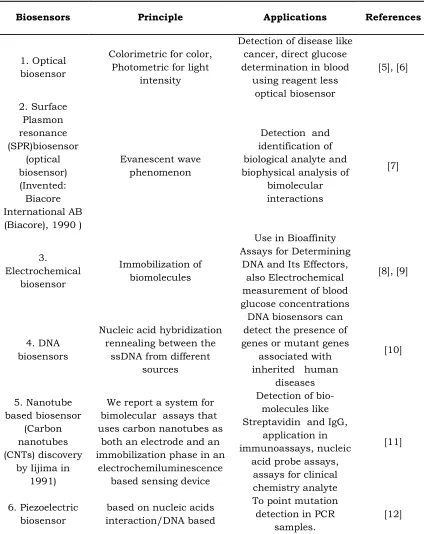
Table 2: Different biosensors, principal, applications and relevant references
Biosensors Principle Applications References
1. Optical biosensor
Colorimetric for color, Photometric for light
intensity
Detection of disease like cancer, direct glucose determination in blood
using reagent less optical biosensor [5], [6] 2. Surface Plasmon resonance (SPR)biosensor (optical biosensor) (Invented: Biacore International AB (Biacore), 1990 )
Evanescent wave phenomenon
Detection and identification of biological analyte and biophysical analysis of
bimolecular interactions [7] 3. Electrochemical biosensor Immobilization of biomolecules
Use in Bioaffinity Assays for Determining
DNA and Its Effectors, also Electrochemical measurement of blood glucose concentrations
[8], [9]
4. DNA biosensors
Nucleic acid hybridization rennealing between the
ssDNA from different sources
DNA biosensors can detect the presence of genes or mutant genes
associated with inherited human
diseases [10] 5. Nanotube based biosensor (Carbon nanotubes (CNTs) discovery
by Iijima in 1991)
We report a system for bimolecular assays that uses carbon nanotubes as
both an electrode and an immobilization phase in an
electrochemiluminescence based sensing device
Detection of bio- molecules like Streptavidin and IgG,
application in immunoassays, nucleic
acid probe assays, assays for clinical chemistry analyte
[11]
6. Piezoelectric biosensor
based on nucleic acids interaction/DNA based
To point mutation detection in PCR
samples.
[12]
Nanoshells offer advantages over traditional cancer treatments: earlier detection, more
detailed imaging, fast noninvasive imaging and integrated detection and treatment. This
210
insulin, a patient would use a ballpoint-pen-size infrared laser to heat the skin where
the nanoshell polymer had been injected. The heat from nanoshells would cause the
polymer to release a pulse of insulin. Unlike injections, which are taken several times a
day, the nanoshell-polymer system could remain in the body for months. A
point-of-care whole blood immunoassay using antibody-nanoparticle conjugates of gold
nanoshells [13] was developed. Varying the thickness of the metal shell allow precise
tuning of the color of light to which the nanoshells respond near-infrared light
penetrates whole blood very well, so it is an optimal wavelength for whole blood
immunoassay. Successful detection of sub-nanogram-per-milliliter quantities of
immunoglobulin was achieved in saline, serum and whole blood in 10–30 minutes.
Iron nanoparticles and monoclonal antibodies are bond into nanobioprobes about 40
nanometers long. The chemically inert probes are injected and circulate inside the body,
whereupon the antibodies selectively bind to tumor cell membranes. Once the tumor
(whether visible or micro metastases) is covered with bioprobes after several hours, a
magnetic field generated from a portable alternating magnetic field machine (similar to a
miniaturized MRI machine) heats the iron particles to more than 170 degrees, killing
the tumor cells in a few seconds. Once the cells are destroyed, the body’s excretion
system removes cellular residue and nanoparticles alike. Test subjects feel no pain from
the heat generated.
Nanococktail to target and kill tumor:
Nanococktail is defined as a "cocktail" of different nanometer-sized particles that work
in concert within the bloodstream to locate, adhere to and kill cancerous tumors. It is a
system containing two different nanomaterials the size of only a few nanometers, or a
thousand times smaller than the diameter of a human hair, that can be injected into
the bloodstream. One nanomaterial was designed to find and adhere to tumors, while
the second nanomaterial was fabricated to kill those tumors.
When a single drug does not work in a patient, it is preferred to administer a cocktail
containing several drug molecules. That strategy can be very effective in the treatment
of cancer, where the rationale is to attack the disease on as many fronts as possible.
Drugs may sometimes work together on a single aspect of the disease or they may
attack separate functions. In either case, drug combinations can provide a greater effect
211
While one type of nanoparticle improves detection of the tumor, the other is designed to
kill the tumor. One type of responder particle was designed with strings of iron oxide,
which they called "nanoworms," that show up brightly in a medical magnetic resonance
imaging or MRI system. The second type is a hollow nanoparticle loaded with the
anti-cancer drug doxorubicin. The nanoworms would be useful to identify the size and shape
of a tumor in a patient before surgery, while the hollow nanoparticles might be used to
kill the tumor without the need for surgery.
Nanorobotics:
Nanorobotics is the emerging technology field of creating machines or robots whose
components are at or close to the microscopic scale of a nanometer (10−9 meters) [14].
More specifically, nanorobotics refers to the nanotechnology engineering discipline of
designing and building nanorobots with devices ranging in size from 0.1-10
micrometers and constructed of nanoscale or molecular components. The names
nanobots, nanoids, nanites, nanomachines or nanomites have also been used to
describe these devices currently under research and development.
Applications of Nanorobotics:
Potential applications for nanorobotics in medicine include early diagnosis and targeted
drug-delivery for cancer [15] biomedical instrumentation, surgery, pharmacokinetics
monitoring of diabetes and health care. It offers targeted drug delivery with lesser side
effects and improved bioavailability. It is also used to cure skin diseases via cream
containing nanorobots which removes right amount of dead skin and excess oil.
Conclusion:
Nanomedicine, one of the important applications of the nanotechnology has made a
revolutionary development in the medical field. The evolution is what will lead us to our
new future and as in our past with medicine and how we were able to make certain
disease obsolete like Typhoid Mary, T.B., smallpox, chicken pox and mononucleosis.
This evolution will possibly be the end of cancer and aids which will greatly increase our
chances for survival as well as our children.
Over the next 10–20 years, new nanotechnologies may revolutionize science, technology
and society. However, if medical nanotechnology wants to realize its full potential, major
impediments blocking serious steps forward have to be removed. The future of
nanomedicine is undermined by the lack of financial profitability, consumer distrust,
ineffective regulation of new and generic products, weak patent protection and
212
take form. It will be our future because of the possibility's that are currently becoming
available.
ACKNOWLEDGEMENT:
The authors are thankful to College of Pharmacy, IPS Academy, Indore for providing the
necessary facilities for successfully completion of the present work.
REFERENCES:
1. Wagner V., Dullaart A., Bock A.K., Zweck A. The emerging nanomedicine landscape.
Nat. Biotechnol. 2006; 24: 1211–1217.
2. Freitas R.A. What is Nanomedicine? : Nanomedicine. Nanotech. Biol. Med. 2005; 1:
2–9.
3. Wang J., Musameh M. Carbon nanotube/teflon composite electrochemical sensors
and biosensors. Anal. Chem. 2003; 75: 2075–2079.
4. Rogers K. Recent advances in biosensor techniques for environmental monitoring.
Analitica. Chimica. Acta. 2006; 568: 599-624.
5. Schmidt P.M., Lehmann C., Matthes E., Bier F.F. Detection of activity of telomerase
in tumor cells using fiber optical Biosensors. Biosensors and Bioelectronics 2002;
17: 1081-1087.
6. Sanz V., Marcos S. de, Galb´an J. Direct glucose determination in blood using a
reagentless optical biosensor. Biosensors and Bioelectronics 2007; 22: 2876-2883.
7. Homola J. Present and future of surface plasmon resonance biosensors. Anal.
Bioanal. Chem. 2003; 377: 528-539.
8. Babkina S.S., Budnikov G.K. Electrochemical Biosensors Based on Nucleic Acids
and Their Use in Bioffinity Assays for Determining DNA and Its Effectors. Journal of
analytical Chemistry 2006; 61: 728-739.
9. Rasooly A., Jacobson J. Development of biosensors for cancer clinical testing.
Biosensors and Bioelectronics 2006; 21: 1851-1858.
10.Mascini M., Palchetti I., Marrazza G. DNA electrochemical biosensors. Fresenius J.
Anal. Chem. 2001; 369: 15-22.
11.Wohlstadter J.N., Wilbur J.L., Sigal G.B., Biebuyck H.A., Billadeau M.A., Dong L.W.,
Fischer A.B., Gudibande S.R., Jamieson S.H., Kenten J.H., Leginus J., Leland J.K.,
Massey R.J., Wohlstadter S.J. Carbon nanotube-based biosensor. Adv. Mater. 2003;
15: 1184-1187.
12.Tombelli S., Minunni M., Mascini M. Piezoelectric biosensors: Strategies for coupling
213
13.Hirsch L.R., Jackson J.B., Lee A., Halas N.J., West J.L. A Whole Blood
Immunoassay Using Gold Nanoshells. Anal. Chem. 2003; 75: 2377-2381.
14.Ghosh A.,Fischer P. Controlled Propulsion of Artificial Magnetic Nanostructured
Propellers. Nano Letters 2009; 9: 2243–2245.
15. LaVan D.A., McGuire T., Langer R. Small-scale systems for in vivo drug delivery.