Masoud Javadi
1, a, b, d–f, Nima Hafezi-Nejad
2, 3, a, c, d–f, alexander R. Vaccaro
4, a, c, d–f,
Vafa Rahimi-Movaghar
2, 5, a–fMedical Complications and Patient Outcomes
in Iranian Veterans with Spinal Cord Injury
1 Janbazan Medical and Engineering Research center (JMERc), Tehran, Iran2 Sina Trauma and Surgery Research center, department of Neurosurgery, Tehran University of Medical Sciences, Iran
3 Student’s Scientific Research center (SSRc), Tehran University of Medical Sciences, Iran
4 departments of Orthopedic Surgery and Neurological Surgery, Thomas Jefferson University and Rothman Institute, Philadelphia, Pennsylvania, USa
5 Research center for Neural Repair, University of Tehran, Iran
A – research concept and design; B – collection and/or assembly of data; C – data analysis and interpretation;
D – writing the article; E – critical revision of the article; F – final approval of article; G – other
Abstract
Background. Spinal cord injury [ScI] occurring in military veterans is a disabling and highly morbid event. Often the victims are young active males who sustain these injuries during military conflict and suffer from the complica-tions of the ScI for the rest of their lives.
Objectives. The aim of the study is to report the epidemiology of Iranian ScI veterans and their health related quality of life, medical complications and patient associated outcomes.
Material and Methods. a cohort of 1984 patients was examined to investigate the epidemiology of Iranian ScI veterans of the Iraq-Iran War (1980–1988);1803 out of the total number of ScI records were includ-ed. Health monitoring was carried out through scheduled monthly visits by general physicians, followed by interviews with specialists from March 20, 2007, to March 19, 2010. additional follow-up was conducted by telephone survey.
Results. In all, 174 patients (8.77%) had incomplete injury and the rest had complete injury. the most frequent level of injury was the thoracic level (1256 patients – 63.30%). Pressure ulcers were the most frequent complica-tion (up to 14.7% annual prevalence), followed by reaccomplica-tions to severe stress and adjustment disorders (up to 13.6%) and diabetes (up to 10.1%). In the telephone surveys, kidney and/or urologic disorders were the most frequent reported complaints (21.6%). a total of 101 out of the 1984 ScI veterans died between 2000 and 2010 (~0.5% per year).
Conclusions. In veterans with spinal cord injury, pressure area ulcers (Icd10:L89), reactions to severe stress and adjustment disorders (Icd10:f43), diabetes mellitus (Icd10:E10-E14) and kidney and/or urologic disorders are common and should be addressed aggressively in healthcare planning and management programs for patients with spinal cord injuries (Adv Clin Exp Med 2014, 23, 2, 269–275).
Key words: spinal cord injury, complications, epidemiology, veterans.
adv clin Exp Med 2014, 23, 2, 269–275 ISSN 1899–5276
ORIGINaL PaPERS
© copyright by Wroclaw Medical University
Spinal cord injury [ScI] is often a disabling and highly morbid injury that military veterans are faced with. Many are young active males who were injured during a war and suffer from ScI compli-cations for the rest of their lives [1]. despite vari-ous experiments, from trials of early surgical inter-ventions to implantation of Schwann cell cultures
in chronic ScIs, no proven treatment for ScI has been established to date [2–6].
in Tehran, Iran [7]. The prevalence and incidence of ScI was recently assessed in an article review-ing literature published since 1995. although not necessarily representative of the world popula-tion, the results of that study found an incidence of 29.5 and a prevalence of 485 per million inhabit-ants [8, 9]. Studies of ScI epidemiology during the last 30 years show an increase in incidence in Eu-rope and North america, with constant prevalence and higher rates of tetraplegia and complete inju-ries [8]. Using clustered sampling and household interviews, the domestic prevalence of ScI in Teh-ran was estimated to be 4.4 per 10,000 people [10].
ScI results in various problems that compro-mise veterans’ physical condition and their health-related quality of life (HRQOL) [11]. These com-plications may vary by the level of the spinal cord injury and the type and timing of the intervention after the ScI [3, 5, 6, 12]. Reports indicate that dur-ing 8 years of war between Iraq and Iran (1980– 1988), more than 400,000 people sustained inju-ry; among them, a total of 1984 Iranian veterans suffered from ScI. These veterans’ health status is monitored by various methods, including sched-uled physician visits along with laboratory tests, imaging procedures and further treatments when needed. all of these are performed as a free ser-vice [11].
ScI veterans are prone to a spectrum of com-plications and the present study sought to de-termine the rates of complications and common complaints among Iranian veterans. Understand-ing this epidemiology may help answer questions regarding the long-term outcomes of ScI [1]. The objective of this study was to elucidate the epide-miology of Iranian ScI veterans of the Iraq-Iran War and their health related complaints, medical complications and need for care in order to pro-vide a basis for further studies and related decision making.
Material and Methods
a three-year prospective monitoring study of Iranian veterans with ScI was conducted from March 20, 2007, to March 19, 2010. Internation-al StatisticInternation-al classification of diseases and Relat-ed Health Problems – Tenth Revision (Icd-10) codes were used throughout the study and were recorded by the physicians. The exclusion criteria were those patients who were physicians or resid-ed in health-care facilities and whose health sta-tus was therefore monitored according to a differ-ent protocol.
Routine Monitoring Process
In the present system of veteran care, each vet-eran has a corresponding general physician. Each general physician is responsible for five veter-ans, and oversees their health surveys according to Icd-10 coding. The survey includes the gener-al physician’s visits, specigener-alist referrgener-als and consul-tation information (when referred by the general physician), as well as laboratory tests and imaging in order to confirm a suspected diagnosis. Routine monitoring was done each month by the general physicians. Telephone calls were also used to fol-low up on medical complications as reported by the patients. The results of the routine month-ly scheduled visits by the general physicians were recorded. The visits included 20- to 30-min inter-views, including a physical examination, followed by laboratory assessment, distribution of prescrip-tions and individualized specialist consultaprescrip-tions for each patient. To ensure complete care for all veterans, routine visits were conducted in the pa-tient’s living quarters in cases of limited mobility or the veteran’s preference. The annual incidence of certain Icd-10-defined medical conditions was derived from the records of the corresponding general physician for each veteran.
Telephone Survey
a telephone survey was performed to assess patients’ health-related complaints and any new diagnoses during January and february of 2010. Successful calls were made to 125 veterans based on randomization of their Id numbers. during the calls veterans were asked about complaints re-garding their health status via open-ended ques-tions. Patients were asked what their major health complaints are; then they were asked if addition-al medicaddition-al problems or concerns had developed since their most recent follow-up with their pri-mary care physician.
Additional Data-Gathering
Outings
Statistical Analysis
a descriptive statistical analysis was per-formed, including evaluations of the level of inju-ry, medical complications (as Icd-10 codes), sub-jectively reported medical complaints, mortality statistics and causes of death. Microsoft Excel (Mi-crosoft Office – 2007) and SPSS software (Version 13 – 2004) were used for the analysis.
In conducting this study the applicable insti-tutional or governmental regulations concerning the ethical use of human volunteers were followed during the course of this research.
Results
The total number of Iranian ScI veterans of the Iraq-Iran war was 1984: 34 females (1.71%) and 1950 males (98.29%), according to the Ira-nian national database. In the health-monitoring study complete records were available for 1506, 1684 and 1803 ScI patients for the years 2007, 2008 and 2009 respectively. The median year of birth of the ScI veterans was 1964. The mean age was 46 ± 6.68 by the year 2010. a total of 1873 pa-tients (94.40%) were married. The causes of inju-ry were bullets and shrapnel, road traffic accidents and city bombardments. Table 1 reveals the dis-tribution of the spinal cord injury levels. classify-ing the participants usclassify-ing the american Spinal In-jury association (aSIa) Impairment Scale (aIS), the majority were aSIa a (complete SPI with no motor or sensory function preserved in the sacral segment). Only 174 (8.77%) had incomplete inju-ries (not separately defined on other aSIa impair-ment scales).
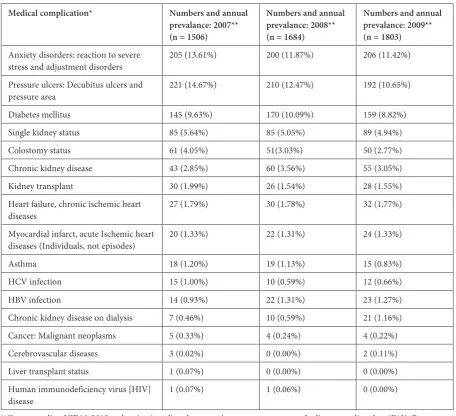
Monitoring was carried out for three consecu-tive years, from March 20, 2007, to March 19, 2010. Table 2 shows descriptive data on the health-re-lated status of the participants, obtained from the general physicians’ monthly visits. Table 3 pres-ents the data from successful telephone calls ad-dressing the self-reported complaints of ScI veter-ans. The most frequent complaint in the telephone survey was related to kidney and/or urologic disor-ders, while pressure ulcers were the most frequent
problem reported in interviews during the physi-cians’ monitoring process.
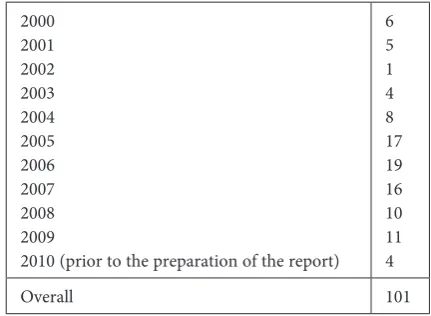
The monitoring and follow-up were carried out with veterans who suffered ScI during the eight-year period of the Iraq-Iran War (1980–1988) abd whose injuries had lasted between 23 to 31 years (median of 27 years). a total of 101 ScI veter-ans among the 1984 records died between 2000 and 2010, prior to the conclusion of this study. by March 2010, out of a total of 1984 veterans, 1803 (90.88%) were included in follow-up monitoring, 101 (5.09%) had died, and 77 (3.88%) were lost to follow up. The causes and numbers of death are shown in Tables 4 and 5. among the deceased vet-erans, the mean duration of injury (in years) was 16.27 for cervical-level injuries, 24.71 for thoracic-level injuries and 22.00 for lumbar-thoracic-level injuries.
Discussion
In the three-year follow-up of the 1803 ScI veterans, pressure ulcers were the most frequent complication, followed by psychiatric disorders (anxiety disorders, reaction to severe stress and adjustment disorders) and diabetes. This objec-tive data was accompanied by a subjecobjec-tive tele-phone survey asking the participants about their health complaints; this survey indicated that kid-ney and/or urologic disorders were the complaints most frequently reported by patients. This differ-ence between the interview and telephone survey findings is due to the discrepancy between patient perception and physician assessment of a defined complication.
In the data available for review it was noted that even though such complaints are not those most commonly noted in the medical records, the patients most commonly complain of urologic dis-orders, including urinary tract infections (UTI), chronic renal failure (cRf), hydronephrosis, kid-ney stones and anatomically-related sexual disor-ders such as erectile dysfunction, priapism and in-fertility. These complications of spinal cord injury are of great concern to the patients in the present study population, and have more negative effects on their health-related quality of life (HRQOL)
Table 1. Level of injury in Iranian ScI veterans
Level of injury Total number of veterans Number of veterans with incomplete injuries
cervical Thoracic Lumbar Sacral Overall
219 (11.04%) 1256 (63.30%) 472 (23.79%) 37 (1.86%) 1984
Table 2. descriptive major health-related situations of the study group, derived from monthly physicians’ visits during each year (International Statistical classification of diseases and Related Health Problems 10th Revision (Icd-10) Version for 2010)
Medical complication* Numbers and annual
prevalance: 2007** (n = 1506)
Numbers and annual prevalance: 2008** (n = 1684)
Numbers and annual prevalance: 2009** (n = 1803)
anxiety disorders: reaction to severe
stress and adjustment disorders 205 (13.61%) 200 (11.87%) 206 (11.42%) Pressure ulcers: decubitus ulcers and
pressure area 221 (14.67%) 210 (12.47%) 192 (10.65%) diabetes mellitus 145 (9.63%) 170 (10.09%) 159 (8.82%) Single kidney status 85 (5.64%) 85 (5.05%) 89 (4.94%) colostomy status 61 (4.05%) 51(3.03%) 50 (2.77%) chronic kidney disease 43 (2.85%) 60 (3.56%) 55 (3.05%) Kidney transplant 30 (1.99%) 26 (1.54%) 28 (1.55%) Heart failure, chronic ischemic heart
diseases 27 (1.79%) 30 (1.78%) 32 (1.77%)
Myocardial infarct, acute Ischemic heart
diseases (Individuals, not episodes) 20 (1.33%) 22 (1.31%) 24 (1.33%)
asthma 18 (1.20%) 19 (1.13%) 15 (0.83%)
HcV infection 15 (1.00%) 10 (0.59%) 12 (0.66%) HbV infection 14 (0.93%) 22 (1.31%) 23 (1.27%) chronic kidney disease on dialysis 7 (0.46%) 10 (0.59%) 21 (1.16%) cancer: Malignant neoplasms 5 (0.33%) 4 (0.24%) 4 (0.22%) cerebrovascular diseases 3 (0.02%) 0 (0.00%) 2 (0.11%) Liver transplant status 1 (0.07%) 0 (0.00%) 0 (0.00%) Human immunodeficiency virus [HIV]
disease 1 (0.07%) 1 (0.06%) 0 (0.00%)
* corresponding Icd10-2012 codes: anxiety disorders: reaction to severe stress, and adjustment disorders (f43); Pressure ulcer: decubitus ulcer and pressure area (L89); diabetes mellitus (E10-E14); colostomy status (Z93.3); chronic kidney disease (N18); Kidney transplant (Z94.0); Heart failure, chronic ischemic heart diseases (I25); Myocardial infarct, acute isch-emic heart diseases (I20-I24); asthma (J45); HcV infection (b18.2); HbV infection (b18.1); chronic kidney disease on dialy-sis (N18.5); cancer, malignant neoplasms (c00-c97); cerebrovascular diseases (I60-I69); Liver transplant status (Z94.4); Human immunodeficiency virus [HIV] disease (b20-b24).
**from March 20 of the mentioned year to March 19 of the next year.
Table 3. Veterans’ main self-reported complaints during the past month (telephone survey)
Number of veterans Percentage (%)
No complaint
Kidney and/or urologic disorders Hypertension
Pressure ulcers Hyperlipidemia diabetes fatty liver Overall
53 27 15 9 9 7 5 125
[11]. disparities are also noted when the patients do not consider some disease processes or milder complaints to be noteworthy complications. In an-other study of veterans, under-reporting was ob-served in telephone conversations about health complaints even in comparison to email inter-views, which tended to elicit more minor com-plaints [13].
Level of Injury
for a precise diagnosis and a better assessment of the completeness of ScI and the likelihood of recovery, extensive physical examination including sensory anal examination and assessment of the bulbocavernous reflex are important [14]. all of the participants in the current study were aSIa a except 174 (8.77%), who had incomplete injury. among these participants, thoracic-level injury was the most frequent, followed by lumbar-level injury (around half the number of thoracic cases). This distribution is similar to that reported by oth-er studies showing a high prevalence of thoraco-lumbar injuries in Iran, which is likely due to the
high mortality of cervical level injuries in a devel-oping country [3, 5, 6, 12]. This is in contrast to studies in other regions describing cervical spine injuries as the most frequent [9]. Moreover, the outcome may be affected by the completeness of the injury and whether the patient is quadriplegic or paraplegic [7]. ScI patients with different levels of injury have differing challenges to their quality of life because of the nature of the complications they are faced with. Previous reports show a low-er HRQOL in complete ScI male vetlow-erans in con-trast to complete ScI non-veteran males, which is thought to be related to higher patient expectations among veterans, more consistent access to medical care, and education related to self-care following spinal cord injuries. although veterans have well-structured support from the government, it is pos-sible that psychological factors and the younger age of military personnel compared to the general population play a role. as with other patient pop-ulations with spinal cord injury, these patients re-port higher levels of psychological conditions than the general population [11]. according to a recent unpublished qualitative study, complete ScI male veterans believe that their HRQOL is not worse than complete ScI non-veteran males.
Diabetes Mellitus
(ICD10 Codes: E10-E14)
More than 145 of the study participants (up to 10.09% annual prevalence) had diabetes. Previous studies have suggested a greater prevalence of diabe-tes among ScI veterans compared to the general pop-ulation [15]. a previous study of ScI patients with diabetes found a higher prevalence of diabetes but a similar history. The same study suggested a higher frequency of complications related to diabetes, such as slow healing of foot ulcers and lower HRQOL. In the current three-year study, annual complaints of pres-sure ulcers were made by up to 14.67% of individuals and 145, 170 and 159 veterans were diagnosed with diabetes each year. The same previous study showed an increase in the prevalence of diabetes in ScI pa-tients with longer follow-up after ScI. all the papa-tients in the current study cohort were veterans of the war between Iraq and Iran, which ended 23 years prior to completion of this study. The presence of diabetes in a patient with prior ScI increases the risk of develop-ing conditions includdevelop-ing chronic ischemic heart dis-ease, asthma and hepatitis, all of which are listed in the current study group as other complications, with the highest annual prevalence of 1.79%, 1.20%, and 1.94%, respectively. These comorbidities are likely to reflect the indirect long-term health impact of diabe-tes in ScI patients.
Table 4. causes of death from 2000 to 2010
Cause Actual deaths
Heart failure
Kidney and/or urologic disorders Internal organ failure
Septicemia
Motor vehicle accident Respiratory failure cerebrovascular accidents cancer
complicated pressure ulcers all other causes including unknown
31 15 10 6 6 5 4 3 1 20
Total 101
Table 5. Number of ScI veterans who died during each year
2000 2001 2002 2003 2004 2005 2006 2007 2008 2009
2010 (prior to the preparation of the report) 6 5 1 4 8 17 19 16 10 11 4
Decubitus and Pressure Area
Ulcers (ICD10 Code: L89)
Pressure ulcers [PU] are common complica-tions among ScI patients, including the veteran co-hort in the current study (192 – 221, with an annual incidence of up to 14.67% in the three-year moni-toring period). ScI can cause PU both in direct ways (i.e., when patients are bedridden) and indirect ways. Risk factors for PU in ScI patients are trau-matic causes, older age and male sex; all of which are characteristics of the current study population [16]. another study of veterans emphasized the pre-vention of PU to improve both the financial and so-cial resources of caretaking organizations, a valu-able lesson for the state welfare organization of Iran (SWOI). This study found a higher recurrence of PU in patients with risk factors that include pover-ty, a low level of education, unemployment and hos-pitalized aSIa a and traumatic ScI patients. The incidence of PU can be used as indicators of quality of care for healthcare providers [17].
Cancer, Malignant Neoplasms
(ICD10 Codes: C00-C97)
cancer is one of the delayed complications that ScI patients are faced with, especially close to the end of their lives. cancer incurred the highest cost in a cohort study of american veterans [18]. among cancers, bladder cancer is more frequent among ScI patients, particularly ScI patients with indwelling catheters, as well as those with multiple
risk factors like kidney and/or urologic disorders [19]. Kidney and/or urologic disorders are among the most frequent complications in the veterans in the current study group, among whom four to five cancer diagnoses were reported annually, which means up to 0.33% of the participants are living with malignancy.
Limitations of the Study
assessment of other health-related issues, in-cluding musculoskeletal problems, with more details on specific disorders of the participants, would lead to more precise conclusions. detailed causes of injury were not defined separately, due to overlaps as well as a lack of approved data. an-other limitation of the current study is the fact that the objectives were limited and concentrated on revealing medical complications and complaints of ScI veterans. Previous investigations on psycho-logical issues affecting the ScI veterans’ HRQOL are also available [11].
decubitus and pressure area ulcers (Icd10 codes: L89), reactions to severe stress and adjust-ment disorders (Icd10 codes: f43) and diabe-tes mellitus (Icd10 codes: E10-E14) are the main health-related conditions of ScI veterans. Uro-logical disorders represent the main self-reported complication among ScI patients. close follow-up of ScI veterans for the described conditions can identify the risk factors for adverse outcomes and may be useful as an aid for national health care institutions.
Acknowledgements. The database was provided by the Janbazan Medical and Engineering Research center (JMERc), Tehran, Iran. The authors thank Mrs. bita Pourmand for her careful editing of the manuscript.
References
Franceschini M, Di Clemente B, Rampello A, Nora M, Spizzichino L:
[1] Longitudinal outcome 6 years after spinal cord injury. Spinal cord 2003, 41, 280–285.
Rahimi-Movaghar V:
[2] clinical trials for the treatment of spinal cord injury: cervical and lumbar enlargements versus thoracic area. brain 2009, 132, 115; author reply e116.
Rahimi-Movaghar V, Saadat S, Vaccaro AR:
[3] The efficacy of surgical decompression before 24 hours versus 24 to 72 hours in patients with spinal cord injury from T1 to L1-with specific consideration on ethics: a randomized controlled trial. Trials 2009, 10, 77.
Saberi H, Moshayedi P, Aghayan HR:
[4] Treatment of chronic thoracic spinal cord injury patients with autologous Schwann cell transplantation: an interim report on safety considerations and possible outcomes. Neurosci Lett 2008, 443, 46–50.
Rahimi-Movaghar V, Vaccaro AR, Mohammadi M:
[5] Efficacy of surgical decompression in regard to motor recov-ery in the setting of conus medullaris injury. J Spinal cord Med 2006, 29, 32–38.
Rahimi-Movaghar V:
[6] Efficacy of surgical decompression in the setting of complete thoracic spinal cord injury. J Spinal cord Med 2005, 28, 415–420.
Rahimi-Movaghar V, Moradi-Lakeh M, Rasouli MR, Vaccaro AR:
[7] burden of spinal cord injury in Tehran, Iran. Spinal cord 2009, 48, 492–497.
Wyndaele M, Wyndaele JJ:
[8] Incidence, prevalence and epidemiology of spinal cord injury: what learns a worldwide literature survey? Spinal cord 2006, 44, 523–529.
O’Connor RJ, Murray PC:
[9] Review of spinal cord injuries in Ireland. Spinal cord 2006, 44, 445–448
Rahimi-Movaghar V, Saadat S, Rasouli MR:
Saadat S, Javadi M, Divshali BS:
[11] Health-related quality of life among individuals with long-standing spinal cord injury: a comparative study of veterans and non-veterans. bMc Public Health 2010, 10, 6.
Rahimi-Movaghar V, Vaccaro AR, Mohammadi M:
[12] The Efficacy of Non-operative and Operative Intervention in Regards to Motor Recovery in the Setting of cervical Spinal cord Injury Iranian Journal of Psychiatry 2009, 4, 131–136.
Brewer NT, Hallman WK, Fiedler N, Kipen HM:
[13] Why do people report better health by phone than by mail? Med care 2004, 42, 875–883.
Rahimi-Movaghar V:
[14] Sensory anal examination in spinal cord injury. Spinal cord 2009, 47, 901.
Lavela SL, Weaver FM, Goldstein B:
[15] diabetes mellitus in individuals with spinal cord injury or disorder. J Spinal cord Med 2006, 29, 387–395.
Taghipoor KD, Arejan RH, Rasouli MR:
[16] factors associated with pressure ulcers in patients with complete or sensory-only preserved spinal cord injury: is there any difference between traumatic and nontraumatic causes? J Neurosurg Spine 2009, 11, 438–444.
[17] Garber SL, Rintala DH: Pressure ulcers in veterans with spinal cord injury: a retrospective study. J Rehabil Res dev 2003, 40, 433–441.
[18] Yu W, Smith B, Kim S, Chow A, Weaver FM: Major medical conditions and Va healthcare costs near end of life for veterans with spinal cord injuries and disorders. J Rehabil Res dev 2008, 45, 831–839.
[19] Hess MJ, Zhan EH, Foo DK, Yalla SV: bladder cancer in patients with spinal cord injury. J Spinal cord Med 2003, 26, 335–338.
Address for correspondence:
Vafa Rahimi-Movaghar
Sina Trauma and Surgery Research center
Sina Hospital, Hassan-abad Square, Imam Khomeini ave. Tehran University of Medical Sciences
Tehran, 11365-3876 Iran
Tel.: +98 915 342 2682
E-mail: [email protected]
The authors declare no conflict of interest except for alexander R Vaccaro, who is consulting/Independent contractor: Gerson Lehrman Group; Guidepoint Global, Medacorp; Receipt of Royalty Payments: aesculap, Globus, dePuy, Medtronics, Stryker Spine, biomet Spine; Stock/ Stock Option; Ownership Interests: K-2 Medical, Paradigm Spine, Stout Medical; Spine Medica, computational biodynamics, Progressive Spinal Technologies; Spinology, Orthovita, Vertiflex, Small bone Innovations; disk Motion Technology, Neucore, cross current; Syndicom, In Vivo, flagship Surgical; advanced Spinal Intellectual Properties, cytonics; bonovo Orthopaedics, Electrolux; Gamma Spine, Location based Intelligence, flowPharma; R.I.S.; Institutional Educational Grant: Stryker Spine.