Volume 01, No.6, June, 2015
P
age
43
Filtered Segmentation
S. Selvi
Associate Professor, Department of Electronics and Communication Engineering,
Dr. Sivanthi Aditanar College of Engineering, Tamilnadu, India.
ABSTRACT:
Segmentation process is the heart of the image analysis. The effective segmentation rarely fails to lead to a successful solution. This paper suggests the segmentation algorithm based on similarity property. The principal approach used is called Region Splitting and Merging. In the proposed scheme, noise is eliminated from the input image through median filter. The filtered image is segmented by the above mentioned approach. The proposed scheme has been successfully applied for different images. The result shows the promising potential of segmentation.
Key words:Region splitting, Merging, Segmentation, Median filter
1. INTRODUCTION
The aim of image segmentation is to recognize homogeneous regions within an image[1]. The most common segmentation techniques are based on one of two basic properties of intensity values such as detection of discontinuity and similarity[2-4]. In this paper, the image segmentation using similarity approach is applied for segmenting various images. This paper makes use of the algorithm, “SPLIT AND MERGE”. The mentioned algorithm gives a better approximation in segmenting various regions in an image[5]. To increase the performance of segmentation, preprocessing activities are performed.
This paper is organized as follows. Section 2 deals about the preprocessing technique. Section 3 discusses about segmentation of algorithm, experiment results, comparison with other methods and Conclusion are presented in section 4,5,6&7 respectively.
2. PREPROCESSING:
Generally all images contain noise. The noise should be removed before any further processing is done. There are several standard algorithms available, which can be used in several applications for removing the noise. One of the methods is median filter, used for the removal of salt and pepper noise.
Volume 01, No.6, June, 2015
P
age
44
123 125 126 130 140
122 124 126 127 135
118 120 150 125 134
119 115 119 123 133
111 116 110 120 130
Figure 1. Calculating the median value of a neighbourhood
As can be seen, the central pixel value of 150 is rather unrepresentative of the surrounding pixels and is replaced with the median value 124. A 3X 3 square neighbourhood is used here. The median filter has two main advantages over the mean filter. The median is a more robust average than the mean and so a single very unrepresentative pixel in a neighbourhood will not affect the median value actually. Since the median value must actually be the value of one of the pixels in the neighbourhood, the median filter does not create new unrealistic pixel values when the filter straddles an edge. For this reason, the median filter is much better at preserving sharp edges than the mean filter.
3. SEGMENTATION MODEL
In this section, fundamental characteristics of the segmentation problem are described.
3.1 Basic Formulation
Let R represents the entire image region. we may view segmentation as a process that partitions R into n sub regions R1,R2,R3,- - - -, Rn such that
a) Ui=1 to n Ri = R.
b) Ri is a connected region, i=1,2,...n.
c) P(Ri) = TRUE ,i-1,2,....n. d) P(RiURj) = FALSE for i and j.
Here P(Ri) is a logical predicate defined over the points in set Ri. Condition (a) indicates that
the segmentation must be complete, that is, every pixel must be in a region. Condition (b) requires that points in a region must be connected in some predefined sense. Condition (c) deals with the property that must be satisfied by the pixels in a segmented region. Finally Condition (d) indicates that the regions Ri and Rj are different in the sense of predicate.
3.2 Quad Tree Representation:
One approach for segmenting R is to sub divide it successively in to smaller and smaller quadrant regions so that for any region Ri, P(Ri)=TRUE. If P(Ri) =FALSE, the image is
divided into quadrants. If P is False for any quadrant into sub quadrants and so on. This splitting technique is represented by the Quadtree as shown in Fig.2. Quadtree is a tree in which nodes have exactly four descendants Fig.2.
R1 R2
R3 R41 R42
Volume 01, No.6, June, 2015
P
age
45
1. R1 5. R41 2. R2 6. R42
3. R3 7. R43
4. R4 8. R44
Figure.2 Quad tree representation
Here the root of the tree corresponds to the entire image and that each node corresponds to a subdivision. In this case only R4 was subdivided further. If only splitting were used, the final partition likely would contain adjacent regions with identical properties. Thus merging process is also included satisfying the constraints (a) to (d). The adjacent regions can be merged only if P(Rj U Rk) = TRUE.
4. IMPLEMENTATION:
The split and merge algorithm has been experimented for the image of dimension NxN [5].
1. The square region is split into four quads if homogeneity predicate is false.
2. Merging is allowed for the neighbouring regions, if the homogeneity predicate is true. 3. The algorithm stops when splitting and merging is possible.
4. The homogeneity predicate, which is followed in this paper,which is given by |zj-mj|≤
2σj, where Zj is the gray level of the jth pixel Ri, mj is the mean gray level of that
region and σj is the standard deviation of the gray levels in Ri.
5. If 80% of the pixels satisfy the above property, then P(Ri)= TRUE. If P(Ri)=TRUE,
the values of all the pixels in Ri were set equal to mj while merging.
This implementation involves the splitting of the image into four quads until the image of dimension 3x3 is encountered. Merging is limited to groups of four quads that are descendants in the quad tree representation.
5. EXPERIMENTAL RESULTS
The mentioned algorithm is experimented for various bitmap images. The performance of median filter is very nice especially for the salt and pepper noise. For the analysis, various images were experimented. Among that two images are discussed here.
Leaf image
Checker Board Image
5.1 Leaf image:
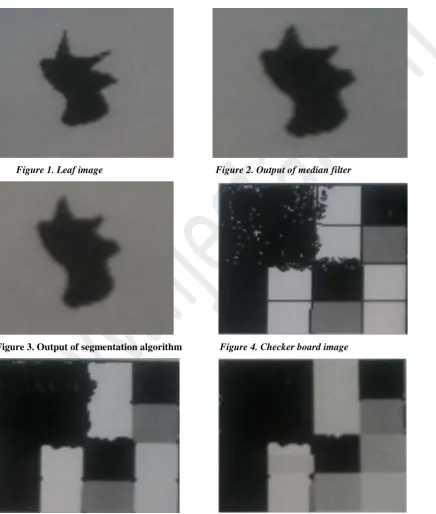
The leaf image is shown in Figure 1. The output of the median filter and the output of the segmentation algorithm are shown in figures 2 and 3 respectively. Here more than 80% of the pixels satisfy the predicate. Thus the image will not be split into four.
R
1 2 3 4
Volume 01, No.6, June, 2015
P
age
46
5.2. Checker board image:
This algorithm is more effective for the checker board image as shown in the figure.6. The proposed algorithm is tried for the various values of rejection parameters, such as 80%, 90% and 98%. It was found that more number of segments is produced for the higher values of rejection ratio. The number of nodes (quads) produced while splitting process will be the greatest number for the large dimension image. Thus the size of the image is limited upto 256x256.
Figure 1. Leaf image Figure 2. Output of median filter
Figure 3. Output of segmentation algorithm Figure 4. Checker board image
Volume 01, No.6, June, 2015
P
age
47
6. COMPARISON WITH OTHER METHODS
Since obtaining the ground truth is difficult in image segmentation, comparing segmentation result is not trivial. The split and merge method is compared with the other well known similarity based algorithm namely,“Region growing Technique”. The Region Growing technique been implemented. But the mentioned algorithm is compared with the Region Growing algorithm by considering the theoretical knowledge.
1. Proper selection of seed points and similarity criteria are the most.
2. The connectivity factor has to be considered perfectly. Otherwise this will yield the meaningless result.
But the above two problems are not involved in the split and merge algorithm.
7. CONCLUSION
1. The Quads that are descendants in the quadtree representation are only taken for the merging process. If this task is carried out, the split and merge algorithm may yield the good result.
2. The split and merge algorithm can be studied by increasing the size of the image.
8. REFERENCES
i Andrzej J, Alaa M.Hamdy, Segmentation based on homomorphic filtering and
improved seeded region growing for mobile robots tracking in image sequences, Source machine graphics & Vision , International Journal archive, 10(4): 2001, 447-466
ii Barlaud M, Jehan Besson S, Gastaud M, Region based active contours using geometrical and statistical features for Image segmentation, International Conference on Image Processing, 2003, II - 643-6 vol.3.
iii Jong Bae, Hang Joon, Efficient region based motion segmentation for a video monitoring system, Pattern Recognition Letters 24(1-3), 2003, 113-128
iv Stephanie Jehan Besson, Michel Barlaud, Video object segmentation using Eulerian region based active contours, International Conference in Computer Vision, Vancouver, Canada, juillet 2001