Cloud Service Framework for Multimedia Applications
Sujata Bhavikatti
*and R. M. Banakar
Date of publication (dd/mm/yyyy): 06/01/2019
Abstract – In the state of art technology multimedia application have been largely utilized. The cloud services introduced in 2008 have brought a new dimension of information delivery from source to target. Multimedia consists of video processing, which follow predefined standards for data transmission. There is a need to apply video adaptation according to the end device that is used. This paper presents the various cloud video processes required at the cloud side. The discussion focuses on the sequential process involved, once the client requests for multimedia application. Finally a complete cloud framework for video applications is presented. The need for designing appropriate video transcoders for various IEEE standards is arrived at.
Keywords – Multimedia, Cloud Service Providers, Network Service Providers, Video Transcoding.
I.
I
NTRODUCTIONEarlier processing devices (desktop PC, laptops, TVs etc) were restricted to serve the application from a single place. The innovation of mobile devices (cell phones, tabs, iPods etc.) and technological developments in multimedia processing have made access of multimedia data anywhere anytime. Due to easy access to the information on handheld mobile devices, the number of users is increasing at a greater pace. Use of devices for music, social media, entertainment, education purpose and even purchasing decisions are made available instantly by the mobile devices. Survey states that the personnel use of mobile devices with social network is expected to increase from 2.4 billion in 2017 to 3.02 billion till 2021. Easy data access has increased the multimedia data user’s and in turn mobile device users. Multimedia applications require digital media, computing power, improved speed and storage capacity. The increased demand of multimedia data communication requires efficient algorithms to improve the data quality and increase the speed of data transfer with reduced power consumption and cost. To render the multimedia applications with improved quality different approaches are adapted at network end or at device end.
At user device side the standalone devices and mobile devices supporting multimedia applications are defined with resolution, power consumption, audio and video compression standards etc. International standards are defined for video and audio data communication. The device specifications vary based on manufacturer and purpose they serve. Developments in mobile technology are individual to devices of a particular company. The coexistence of diversified devices for exchange of multimedia data, demand for necessary arrangements in the form of hardware or software is to be provided. Deployment of hardware or software at device end, leads
to increased battery usage and device size. Hence multimedia applications require sufficient battery backup. Usage of application in the mobile devices consumes more power. As the mobile devices are constrained by limited battery capacity, the backend compute intensive processes are done by the cloud services. This eases the challenge of more power consumption by the mobile users.
At the network end, the technology developments at processor level and advanced algorithms when brought to market are adapted in network devices and multimedia systems. Accordingly end devices, adapt to these changes. Networks provide flexibility of adding system level changes. The cloud network provides various processes that are involved right from enquiry, connectivity, user identification to deliver the information that is sought.
To provide the required client services some cost is involved. Another major requirement in this scenario is a single window service namely the cloud framework to provide hardware and software platform. Since networks, provide resources on pay as you go basis, the application is easily lent as a service by the network. The performance of multimedia applications at system level is improved by optimizing the processor hardware level algorithms. Nevertheless the processor has to be made compatible with user device specifications and network protocols. The technological developments to improve the system performance affect the above stages. The challenge in this is at which stage “It is more flexible and efficient for introducing system level changes?” The feasible solution is providing resources and applications as centralized services over cloud computing center.
II.
L
ITERATURES
URVEYThe media cloud can be implemented using grid computing, content delivery networks; server based computing and peer-2-peer multimedia computing.
In [1] the author describes an ecosystem of mobile networks and use of cloud for lending various applications to mobile devices. A framework is elaborated which runs a private cloud computing unit according to service demand, which varies with time. The cost analytics in the form of web businesses are detailed considering time, demand and profit.
Various architectures used to spread computation utilities and their timelines are explained in [2] [3]. The authors also discuss cloud computing architecture for business purpose model. Ideas about managing of resources based on customer requirements and creating dynamic computing resources for various IT requirements are given. Methodology of providing cloud based multimedia applications to mobile devices on wireless networks using cloud and client connection, bandwidth and energy are dealt here. Issues of communication ecosystem specifically QoS and QoE are outlined.
In [4] [5] [6], report on likelihood of distributed computing and appropriate milestones in technology developments is discussed. In particular, use of Distributed Hash Tables (DHTs) to take routing decisions in peer-to-peer network is explained. The future of application development at enterprise level using cloud is detailed. They describe use of multi cloud concepts for managing the increasing data load in an efficient manner. The security issues of data handling and resiliency of cloud application are dealt.
A solution is given to optimize the power and data rate by using modulation technique in wireless networks. Energy is of major concern in video transfer applications over wireless networks. A method of using buffer for storing the repeatedly used data to minimize the power utilization is proposed. Concepts are proved with simulation results.
In [7] [8] [9] the authors provide a simple software framework used to automate all the operations involved in setting up and managing the cloud environment and strengthen the proposal with simulation results. Analysis is done on cost–performance tradeoff using simulation examples taken from the video communication research area. They also describe multimedia cloud computing from multimedia aware cloud (media cloud) and cloud aware multimedia (cloud media) perspectives for multimedia applications. Solutions to improve the QoS for multimedia applications and services over wired internet and mobile internet are given.
On cloud media the multimedia applications and services are partially or completely implemented on cloud. Specifically the authors give solution to the problem of allocating multimedia computing resources between client and cloud. Architecture to improve the efficiency is proposed. Improvements in QoS of media cloud are proved using simulation results.
It says one of future work is to study how Media Edge Cloud assist mobile phones on rendering computation resources since mobile devices have limited battery life,
memory size and computation capability. Work is done to reduce the cost of cloud computing service by locating the cloud near the end user. Large storage space, computation resources, computing power, network, network bandwidth according to user device specifications are the challenges of multimedia applications. The media cloud gives better solutions to these challenges.
The authors in [12] [13] propose a method of cloud based image coding. In this method, images are defined with typical description and using this description images are reconstructed from large scale image database. The new compression standards are complex and the internet database volume is increased. They provide solution to solve for complexity and increased database volume, hence avoiding the frequent upgrading of individual user device. The video in internet database is browsed by devices of variable bit rate, network and bandwidth. To improve the quality of experience of end user it provides cloud based data center.
During video browsing to reduce the latency, the cloud based data centers [14] provide data storage space along with cache memory. Cache memory store most frequently browsed video. For new requests cache memory search is done first respond is given for near match with certain threshold. The algorithms are written to give better results during search and manage the cache memory.
The literature in [16] explains method to improve the battery life of smartphones. The Mobile Cloud Computing (MCC) performs heavy multimedia applications, hence offloading the smartphones from such applications. Thus MCC provide Energy as a Service (EaaS) to smartphones. Experimental results show 30% of energy saving on smartphones. Health applications include multimedia processing. This is a sensitive area which need highly secured and accurate processing of data. Continuous research and developments are taking place in biomedical data processing. Even e-health management mechanism needs attention. The health care services require remote data access to serve the remote area people and also the emergency cases which do not have hospital access. In [17] the authors give a framework for efficient rendering of health care services. Cloud computing centers even serve to manage database of hospitals and monitoring applications over limited bandwidth. Even for secured database management of industries and banks etc. cloud computing provides efficient solutions.
The authors in [18] give algorithmic solutions to increase the video streaming speed. This improves user experience of video browsing. The hardware implementa- -tion of any algorithm increases the speed. Cloud architectures, using reconfigurable hardware for example FPGAs, give better performance in video delivery services.
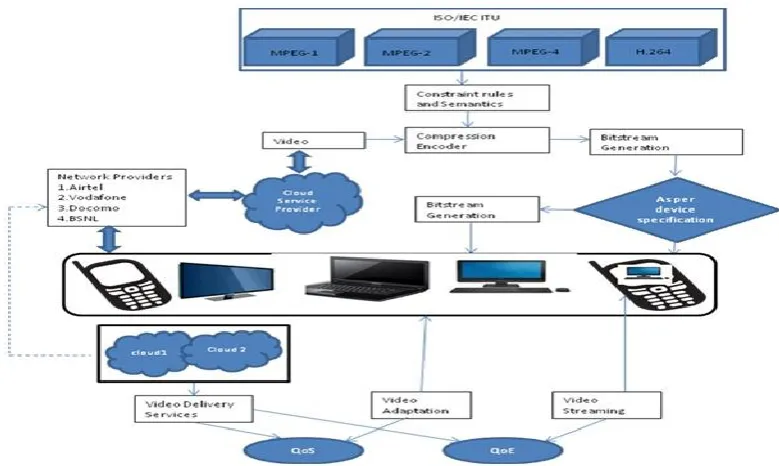
Fig. 1. Cloud Video Framework
III.
C
LOUDV
IDEOF
RAMEWORKThese applications are rendered as a service by cloud service provider. Main services are in the form of Computation as a Service (CaaS), Infrastructure as a Service (IaaS), Monitoring as a Service (MaaS), Platform as a Service (PaaS) and Software as a service (SaaS). Mobile cloud computing is an efficient solution for multimedia applications and it overcome limitations of mobile phones.
The cloud frame to deliver services for mobile device users is illustrated in Fig.1. Infrastructure as a Service (IaaS) provides computation instances used for analysis or `automation purposes. Video processing applications use IaaS for database, computing and monitoring purposes. Software as a Service (SaaS) Cloud provides software service model to the distance users over the internet. Using this, organization and any other users need not install the software over their computation set up. The purchase of software license technical support for installation is avoided. The updates in software are adapted easily.
Google apps, Office 365, Cisco WebEx are few examples of SaaS.
Platform as a Service (PaaS) PaaS is more complex as it involves complete infrastructure for any application. Computing infrastructure for particular application is provided to customers. Infrastructure includes computatio- -nal units, software for program execution, database management, operating system, and web server. Only through web browser the customer gets connected to cloud platform. So users are relieved of construction and maintenance of infrastructure. Irrespective of location development team can work together using Paas. So PaaS is gaining more popularity in business, educational media, and medicinal applications. Vidyo, Sightcall, Sinch are few vendors of PaaS for video applications.
Survey says 70% of video traffic is dominated by video traffic. Video viewer and audio listeners of Youtube,
watching TV programs on cell phone, e-learning are some of the video applications drawing large number of video users. In order to improve the Quality of Service (QoS) and Quality of Experience (QoE) new innovative algorithms were provided as solutions to various video applications. For example remote operation of patient, video processing in bio medical applications, hard decisions in live programs etc. were minute observations required along with video service Modified algorithms are also used. Video applications require large computation resources and hardware components. These computing resources are provided by the cloud.
Video Delivery Services
The request for applications comes from users in the form URL link. User devices are uniquely identified by the network. Networks verify the user internet connection and provide the service. Network forward the request to cloud service providers. Various cloud service providers of market, their details and services they provide are to be known. Cloud services providers to Cloud computing is a resource sharing method through which different servers and service units get connected by internet to the user devices which works same as Service Oriented Architecture (SOA).
In SOA the data move between application and user. IT companies found an innovative way of using its computing resources through virtualization. In late 90’s, Salesforce was the first one to Amazon provided web facility through EC2 and virtual computation resources. Writely and Spreadsheets are two different services of Google introduced in 2005 for document storage and develop the documents. In 2007 huge progress was observed in resource sharing by collaborative work of IBM and Google and renowned universities. Private clouds started in year 2008 by Eucalyptus. From then continuous and revolutionary developments are observed in cloud computing.
serves. The applications of cloud computing can be classified as broadcasting applications (High Definition Television, Radio, online news etc.) and interactive applications (video conference, video chat, e-health monitor, e-banking etc.). Most of these applications include multimedia processing improve the QoS and in turn QoE.When the cloud service providers are not in the situation to manage the request load of the network, the part of load is transferred to the other cloud network without any involvement of user or the network. The process of load sharing is managed by cloud service provider and the process is called video delivery services. Load sharing improves the QoS and QoE. The end user devices are serving more than one purpose, along with what purpose the devices are intended to serve. Other facilities are made available in the form of application. This competency of network is due to the collaboration work of network providers and cloud service providers.
Video Streaming
Video streaming is a cloud based service that provides movies, TV programs and other entertainment media as per user request. The interest of audience with respect to TV programs varies as per their age. It is not feasible to install more TVs at a home. Instead the number of mobile users is increasing at a greater pace; and hence TV programs are made available on smart phone. This application is called video streaming. Video streaming improves the user experience by delivering TV shows at any time. This is made possible by the network. By providing storage at TV broadcast unit. It follows a store and forward principle. The server at network manages to identify the device and store the corresponding requests using suitable algorithms.
The server does not put any restriction on the file size. One more advantage of video streaming is that the end user device plays the data before downloading it completely. Table 1. Shows the cloud video processes. Survey says in a family 90% of family members own a smartphone. In view of this improving the QoE of TV viewers, video streaming is becoming more popular. The TV viewer can watch TV when he has time. Due to its large demand, there exist video stream service providers like Netflix, Huluplus, PBS, iTunes etc. According to the report video streaming through internet accounts for 46 percentage of internet traffic and 36 percentage of HTTP traffic.
TableI.Cloud Video Applications
Cloud service Compute requiremnts Application
Cloud video
service providers
Ownership of hardware infrastructure, software storage. IaaS, PaaS
Microsoft Azure, IBM Bluemix, Amazon web services EC2, Cisco networking etc. Cloud storage Owned providers. by service Servers
Video delivery services
New technique to provide better QoS and hence QoE to the user.
Cloud provider
resources when
insufficient other cloud share the load.
Bitstreaming Technique which convert video data to binary form.
ISO/IEC 13818 defines
compression and
encoding standard for MPEG-2
Cloud video Latest technique used to Runout scene in cricket.
Cloud service Compute requiremnts Application
adaptation enhance specific video
clips. Video
straming Enables TV watching on mobile devices.
TV serials, movies, news etc on mobile phones.
It is found that video files are delivered by the cloud service at greater speed, so as to improve the user experience. Larger bandwidth improves QoE. Data rate is a problem in video streaming and not data size.
Video Adaptation
TV, camera for different purposes are sources of video. The video is delivered to the end devices through network. When video is streamlined to the devices, the data is continuously delivered. The devices can watch the video without downloading. Nowadays reality shows and sports are attracting more audiences. In such shows at particular
ISO/IEC and ITU provide IEEE standards for video formats. All video devices follow these formats. New devices introduced in market follow latest video format. The challenge is to provide a common platform for the coexistence of new devices along with previously introduced devices. As discussed previously new algorithms to make video format adaptable to end devices are provided as centralized computation services in the form of cloud computing called cloud video transcoder. The video transcoder application is used to convert one standard format to other as per end device specifications.
MPEG-1 was the first video standard introduced in 1995, after which MPEG - 2, H.264, H.265 various video standards are introduced by ISO/ IEC and ITU inter- -national committees at intervals to meet the market demands in terms of quality network bandwidth and data rate. The standards defines a common format to compress and store digital form on storage devices like CD, DVD etc. IEEE standards does not define encoder and decoder architecture, instead the syntactic and semantic details of bitstream are defined in the form of documents. Standard documents define the object types, profiles and range of picture parameters supported. The standards explain the compression methods and encoding algorithms. So the output of encoder is bitstream with spatial and temporal redundancy data. Bitstream also contains block details and necessary information for the decoder architecture. Thus IEEE standards define the expected size of video picture.
ISO/IEC and ITU are the international committees that define standard formats for video and audio. Standard does not define the encoder and decoder architectures. Instead defines the constraint rules, syntactic and semantic rules of the bistream. The contents of bitstream and its structure are defined. This makes a common format of data on storage devices like CD and DVD, and communication devices defined for particular standard. The decoder architecture is designed to decode the bistream. The IEEE standards of video data perform compression and encoding to reduce the bandwidth requirement.
Compression and Encoder
data to greater extent. Discrete Cosine Transform is used to represent spatial information in frequency domain. Quantization is used to restrict the values to be transmitted. Motion estimation is lossy compression techniques that use temporal redundancy. Huffman encoding method is used in MPEG standards. It is lossless type of compression and also represents the data in binary form. H. 264 and other latest formats use run length encoding methods.
Video Transcoders
All end user devices receive the bitstream as input. Decoding is inverse operation of encoding and process the bitstream. Decoder extracts the actual data using the constraint rules and semantic details of bitstream. Since various communication devices with different specifica- -tions exchange the information over internet. Only if the received data and user devices are compatible with respect to video formats, data can be decoded. Else an algorithm is necessary to convert video so that it is compatible as per end device specifications. The method of converting video data from one standard format to other standard format is called transcoder. Transcoder in general, is cascade connection of decoder and encoder. Different transcoder architectures are defined for different combination standards.
Transcoders are mainly classified as homogeneous type and heterogeneous type. The transcoder designed for converting the resolution of the same standard then it is called homogeneous type transcoder. For example H.264 supports resolution ranging from QCIF 176x144 to 1920x1080. In order to make the video supported by end device specifications up or down converting transcoders are defined. In case of heterogeneous type transcoders, the video format is converted from one standard format to other. For example MPEG-2 to H.264 video transcoder converts video in MPEG-2 format to H.264 format.
QoS and QoE
Network connects dissimilar devices through internet to provide various applications in the form of services. The form of connection and type of service the communication applications are defined by QoS and QoE. QoS is defined with respect to network performance the mechanism at network and communication protocols defined for network functioning, decides its performance. The service providers consider the available resources of network, bandwidth specifications to provide better quality service and reduce congestion. Specifically in real time applications the quality and data rate issues are optimized to improve QoS.
QoE is derived from QoS and it is measure with respect to the user satisfaction considering their interest and needs. For a particular network application, QoE assess the user expectations, experiences during application usage, and user satisfaction. QoE measures the users of video application of a network. It makes the network operator to understand the perception of users accordingly do modifications if necessary.
IV.
E
NDU
SERC
ONNECTIVITYWhen the end device request for a cloud video service, it
is acknowledged by the cloud service provider. This request is sent through the network service, Airtel, Vodafone, Tata Docomo. The end user may or may not have compatible supporting video format. Thus two cases arise here. Case 1 is if the video format is compatible. Case 2 is if the video format is not compatible. The details are as follows:
case1: the end device for example a smart phone supports MP2 standard. So the request is for a MP2 video. The request is communicated in the URL format. If the cloud infrastructure has MP2 encoder bitstream, then this is directly fed to the smart phone media decoder unit. Then the video obtained with better QoS and QoE using better compression and optimized video coder design unit.
Case 2: suppose the user device supports MP2 standard and request for a video, the request is communicated to the network. If video available in network is in H.264 format, then the format is incompatible as per device specifica- -tions. The cloud service provider use an arrangement called transcoder to make the video format compatible as per device.
V.
D
ISCUSSIONVideo processing is a complex signal processing architecture that demands large computational hardware and software resources. These resources are used from cloud. Cloud provides a large platform for video applications to render service to diversified end users through internet. The end device specifications and the purpose they serve are different. Technology develop- -ments made end devices to serve multiple applications. For example cell phone function as radio, telephone, video call and even TV applications. Provision of multiple applications to the devices is due to the interoperation of network providers and cloud service providers.
Cloud service providers own a cloud infrastructure for different applications. The various cloud video services are listed in Table 1 in a hierarchical order. Among these services video delivery service operate in cooperation with service providers to improve QoS and QoE. The video streaming and video adaptation are to benefit the end user by improving experience of the end user. Video encoding and video transcoders are shown at next level to provide bitstream as per the end user format. All the video delivery services follow particular IEEE video standards.
VI. C
ONCLUSIONThe cloud framework for multimedia processing is discussed in detail. The video streaming is one of the major processing unit which interacts with the video ISO IEEE standards to obtain the relevant format. The rules and the semantics are available from the ISO standards for bit streaming. Video streaming is a unit which provides the TV broadcasting services on demand to the mobile devices. Hotstar app is an example of video streaming.
particular techniques to enhance QoS and QoE should be designed and also assist in reducing network congestion. Video coding reduces the bandwidth required for transmitting video data. The quality of the video after reconstruction should give a pleasing appearance to the user retaining the originality. Video adaptation is a process which depends on the users request for better service. These services include better clarity in minute details for eg. During cricket broadcast the scene of run out video clipping. In video adaptation the basic design principle aims at improving the QoS and QoE. Video transcoder design keep dynamically changing according to the new image format standards introduced by IEEE ISO committees.
R
EFERENCES[1] M. Armbrust, A. Fox, R. Griffith, A.D. Joseph, R. Katz, A. Konwinski, G. Lee, D. Patterson, A. Rabkin, I. Stoica, and M. Zaharia., “Above the clouds: A Berkeley view of cloud computing.” EECS Dept., Univ. California, Berkeley, No. UCB/ EECS-2009-28 (2009, Feb. 10). [Online]. Available: http://radlab.cs.berkeley.edu/
[2] R. Buyya, C. S. Yeo, and S. Venugopal, “Market-oriented cloud computing: Vision, hype, and reality for delivering it services as computing utilities,” in Proc.10th IEEE Int. Conf. High Performance Computing and Communications, 2008, pp. 5–13. [3] K. Kilkki, “Quality of experience in communications ecosystem,”
J. Universal Comput. Sci., vol. 14, no. 5,, 2008, pp. 615–624. [4] P. Maymounkov and D. Mazieres, “Kademlia: A peer-to-peer
information system based on the XOR metric,” in Proc. IPTPS02, Cambridge, Mar. 2002, pp. 53–65.
[5] I. Trajkovska, J. Salvachúa, and A. M. Velasco, “A novel P2P and cloudcomputing hybrid architecture for multimedia streaming with QoS cost functions,” in Proc. ACM Multimedia, 2010, pp. 1227–1230.
[6] Dengyu Qiao, Ye Li, Yuwei Zhang,” Energy Efficient Video Transmission Over Fast fading Channels”, Hindawi Publishing Corporation, EURASIP Journal on wireless Communication and Networking, Volume 2010,Article ID 486302,12 pages [7] Q. Zhang, Z. Ji, W. Zhu, and Y.-Q. Zhang, “Power-minimized
bit allocation for video communication over wireless channels,” IEEE Trans. Circuits Syst. Video Technol., vol. 12, no. 6 2002. , pp. 398–410, June
[8] B. Aljaber, T. Jacobs, K. Nadiminti, and R. Buyya, “Multimedia on global grids: A case study in distributed ray tracing,” Malays. J. Comput. Sci., vol. 20, no. 1,, June 2007, pp. 1–11.
[9] J. Nieh and S. J. Yang, “Measuring the multimedia performance of server based computing,” in Proc. 10th Int. Workshop on Network and Operating System Support for Digital Audio and Video, 2000, pp. 55–64.
[10] D. Wu, Y.T. Hou, W. Zhu, Y.-Q. Zhang, and J.M. Peha, “Streaming video over the Internet: Approaches and directions,” IEEE Trans. Circuits Syst. Video Technol., vol. 11, no. 3, Mar. 2001, pp. 282–300,
[11] X.-S. Hua and S. Li., “Personal media sharing and authoring on the web,” in Proc. ACM Int. Conf. Multimedia, Nov. 2005, pp. 375–378.
[12] X.-S. Hua and S. Li, “Interactive video authoring and sharing based on two layer templates,” in Proc. 1st ACM Int. Workshop on Human-Centered MM 2006(HCM’06), pp. 65–74.
[13] S.F. Chang and A. Vetro, “Video adaptation: Concepts, technologies, and open issues,” Proc. IEEE, vol. 93, no. 1,2005, pp. 148–158.
[14] J. Xin, C-W. Lin, and M-T. S “Digital video transcoding,” Proc. IEEE, vol.93, no. 1, Jan. 2005, pp. 84–94.
[15] Origin Digital. “Video services provider to reduce transcoding costs up to half “(2009, Nov. 17). [Online]. Available: http: // www.microsoft.com/ casestudies/ Case_Study_Detail.aspx? CaseStudyID=4000005952
[16] A. Kubota, A. Smolic, M. Magnor, M. Tanimoto, T. Chen, and
C. Zhang, “Multiview imaging and 3DTV,” IEEE Signal Processing Mag., vol. 24, no. 6, Nov. 2007, pp. 10–21.