• No results found

An evaluation of the management of integrated township development in Ogun state

N/A
N/A
Protected

Academic year: 2020

Share "An evaluation of the management of integrated township development in Ogun state"

Copied!
9
0
0

Loading.... (view fulltext now)

Full text

(1)

An evaluation of the management of intergrated township development in

ogun state

Bello, I.K. and Olatubara, C.O.

Department of Estate Management,

Moshood Abiola Polytechnic, Abeokuta,

Ogun State, Nigeria

Drpartment Of Urban And Rrgional Planning, University Of Ibadan

Phone No. 08053852865, E-mail:[email protected]

Phone No. 08033559708, E-mail:[email protected]

ABSTRACT

This theoretical paper examines the contribution of Ogun State government in the provision of an enabling environment in the management of integrated emerging urban centers. The rebuilding policy of the government on the access to land and social infrastructural development were ex-ray with a view to examine so called dividend of democracy as the new slogan of the present civilian government. The paper accordingly examined the role played by various housing agencies and the benefit derived by mobilising the masses for an integrated urban development. The paper therefore recommended that government should improve on the existing policy of provision of housing and social infrastructure so as to improve the quality of life of people in the emerging urban centers.

Keywoerds: Environment, Land policy, Property, infrastructure.

INTRODUCTION

One of the major features of the contemporary urban centers is the ever increasing inflow of people and resources from the rural areas. These urban centers are usually preferred destinations because of their lopsided share of facilities and opportunities and the rural areas are generally backwashed, especially in developing countries.

There are the general efforts by governments and their agencies to stem the tide of migration from the rural areas by making them more attractive and receptive to the rural out-migrants by providing the rural areas with infrastructure and facilities that pull people to the urban centers (Olatubara, 2012).There are various levels of successes of these efforts and best practices are usually adopted to reverse the trend of urbanization and its attendant consequences in developing countries (Mabogunje, 2006).

Human environment is dominated by various uses to which a particular land is put. There is a great variety and complexity of land use depending on the age of development and the effectiveness of any regulatory policy or mechanism put in place in a particular area.

The need to have a good grasp of the tempo and pattern of spatial development brought the profession of physical or urban and regional planning. Agbola and Olatubara (2004) noted that the allocation of land to various uses was initially done by the economic forces of the invisible hands of the market mechanism, which was essentially an allocation of land to various uses without government intervention. Land under this mechanism goes to the highest bidder. It was later observed that this process of land allocation is largely unpredictable, difficult to control and might jeopardize public interest. This is one of the major reasons that governments, through their agencies and planners, are saddled with the responsibility of planning and managing both the urban and rural areas.

(2)

65 environment and general socio-economic development of these areas. Land use changes over time are based on human needs. According to Prasanth and Saramma, (2010), for the survival of the human inhabitant they depend on the physical environment.

UN- Habitat (2009) noted that future urban planning needs to take place within an understanding of the factors which are shaping the socio-spatial aspects of cities and the institutional structures which attempt to manage them. It is also noted that it needs to recognize the significant demographic and environmental challenges that lie ahead. In the new dimension of urban planning, according to UN- Habitat (2009), the issue ofenvironmentally sustainable urbanization requires that:

1. Greenhouse gas emissions are reduced and serious climate change mitigation and adaptation actions are implemented;

2. Urban sprawl is minimized and more compact towns and cities served by public transport are developed;

3. Non-renewable resources are sensibly used and conserved;

4. Renewable resources are not depleted;

5. The energy used and the waste produced per unit of output or consumption is reduced.

6. The waste produced is recycled or disposed of in ways that do not change the wider environment; and

7. The ecological footprint of towns and cities is reduced.

It was observed that these requirements can only be achieved by dealing with urbanization within regional, national and even international planning and policy framework. It is further noted that urban areas are now highly complex, rapidly changing entities, shaped by a range of local and global forces often beyond the control of local plans and planners.

Due to the absence of the provision of social housing or the housing for the poorer section of the society they encroach on the public land. This has often led to the formation of slum and squatter settlements. There is, therefore, a great demand of serviced land in the urban area for the construction of houses to reduce the increase in unplanned neighbourhoods. Scarcity of land is always an issue in the urban area. Land speculation is a characteristic of urban

development and this trend is detrimental to the planned growth of the city and proper expansion of basic services to the people. Land brokers and housing development companies hold huge parcels of land in urban fringe areas for speculative purpose.

Urbanization and urban housing problems:

According to Prasanth and Saramma, (2010), it is now widely accepted that urbanization is as much a social process as it is an economic and territorial process. It transforms societal organizations, the role of the family, demographic structures, the nature of work, and the way we choose to live and with whom. It also modifies domestic roles and relations within the family, and redefines concepts of individual and social responsibility. Major change is occurring in the ways cities are controlled, suggesting a new era of neoliberal segregation. They observed that this is evident in four ways: (a) the growing fear of insecurity in cities (b) increasingly class-based residential segregation (c) the contraction of public space through commercialization and surveillance (d) increasing privatization of urban management, services and amenities.

Olatubara (2007) noted that the problem of urbanization in Nigeria, for example, is not necessarily that of the level but that of the rate. The level of urbanization is the share itself, and the rate of urbanization is the rate at which that share is changing. For example, while the level of urbanization in Nigeria is put at 36%, that of South Korea is 79%, Mexico 74% and Colombia 71% (Population Reference Bureau, 2001). However, while the rate of urbanization in Seoul is 7.8%, Mexico City 5.5% and Bogotá 5.4%, that of Lagos is 15% per annum (FGN, 1991). This rapidity in the rate of urbanization is so overwhelming that it generally far exceeds the speed with which urban managers are able to respond to the dynamics of urbanization due to inadequate facilities, resources and capabilities at their disposal.

(3)

66 settlements, i.e. where vacant state-owned or private land is occupied illegally and is used for illegal slum housing. In sub-Saharan Africa, it is noted that 90% of new urban settlements are taking the form of slums. These are especially vulnerable to climate change impacts as they are usually built on hazardous sites in high-risk locations. Even in developed countries unplanned or informal urban development is a major issue. Urbanisation is also contributing significantly to climate change. The 20 largest cities are observed to consume 80% of the world’s energy and urban areas generate 80% of greenhouse gas emissions worldwide. Cities are where climate change measures will either succeed or fail (FIG, 2010).

Wyly, (2012) noted that the annual urban population growth rate of the poorest countries is 4.6 percent, more than seven times the growth rate of urban populations in wealthy, industrialized countries. In the State of the World’s Cities 2012/2013 Report, Un-Habitat(2012a) observed that in the more advanced nations, urban population growth is next to stagnant (0.67 per cent on an annual average basis since 2010), which represents an additional six million or so every year. In Europe, the annual increase is only two million. Population in North American cities was the least slow of all those in the developed world between 2005 and 2010, particularly in the United States (one per cent on average). In the last decade, the urban population in the developing world was noted to grow an average 1.2 million people per week, or slightly less than one full year’s demographic growth in Europe’s urban areas. Asia dominated the picture, adding 0.88 million new urban dwellers every week. Africa was the second largest contributor with an additional 0.23 million per week, dwarfing Latin America and the Caribbean’s 0.15 million weekly increment

Globally, the level of urbanization is expected to rise from 52 per cent in 2011 to 67 per cent in 2050.The more developed regions are expected to see their level of urbanization increase from 78 per cent to 86 per cent over the same period. In the less developed regions, the proportion of urban population will likely increase from 47 per cent in 2011 to 64 per cent in 2050 (UN, 2012).

Tacoli(2012) noted that most of the world’s population now lives in urban centres, a proportion that is expected to increase in the next four decades, especially in low- and middle income nations in Africa and Asia. It is observed that urbanization reflects transformations in national economies, with growing

numbers of people moving out of agriculture and into industry and services sectors. It goes hand in hand with economic growth, and with the potential for more efficient use of natural resources and greater environmental sustainability through technological innovation. At the same time, this shift in the distribution of the world’s population means that poverty is increasingly concentrated in towns and cities.

Housing sector is, perhaps, the first to be hit by the influx of people to the urban centers (Onibokun, 1985; Aina, 1989; Hamdi, 1991). Of particular significance is the observation that the rate of housing delivery falls short of the rate of urban growth and housing need. Agbola (1998) also notes that prevailing housing problems in Nigeria include the following: acute housing shortage, overcrowding and unsanitary living conditions; exorbitant rent relative to income and the exploitative tendency of shylock landlords; the high rate of homelessness especially in the urban areas and the high rate of substandard housing both in the rural and urban areas.

Sustainable public housing: UN- Habitat (2012b) observed that housing is one of those basic social conditions that determine the quality of life and welfare of people and places. Where homes are located, how well designed and built, and how well they are weaved into the environmental, social, cultural and economic fabric of communities are factors that, in a very real way, influence the daily lives of people, their health, security and wellbeing, and which, given the long life of dwellings as physical structures, affect both the present and future generations. Housing is therefore central to sustainable development.

(4)

67 slums, poverty, climate change, lack of access to sustainable energy, and economic uncertainty.

Olotuahand Bobadoye(2009) observed that sustainable housing provision is the gradual, continual and replicable process of meeting the housing needs of the populace, the vast majority of who are poor and are incapable of providing adequately for themselves. It ensures housing strategies that are stable and are not subject to vagaries in the political circumstances of the country. Sustainable housing provision requires proper definition of housing needs, and the participation of the end users to ensure their satisfaction. The general goal of sustainable development is to meet the essential needs of the world’s poor while ensuring that future generations have an adequate resources base to meet theirs. Aribigbola (2011) observed that in housing provision, sustainable development explicitly relates to discussion of affordability, housing quality and issues of social equity and justice in terms of accessibility. This perspective requires the enumeration of provision over the life cycle of housing. Therefore, to be able to determine the challenges of affordable housing vis- a- vis sustainable urban development, three basic concepts require clarification and elaboration. These are housing affordability, housing quality and equity with regards to accessibility to housing.

Achieving sustainability in housing provision requires major societal changes, restructuring of institutions and management approaches. It requires the appropriate political will based on the conviction of the responsibility of government to its citizens, and the need to create humane and decent environment for dignified living. According to Olotuah and Bobadoye (2009), in order to realize sustainable housing provision the housing needs of the population have to be put into proper focus, and a coordinated programme to achieve this should be thoroughly worked out. Sustainable housing provision is thus contingent on such underlying factors as policy formulation and decision making, policy execution and monitoring, and social acceptability and economic feasibility. These factors must take into cognizance the bottom-up participatory approach in housing provision involving genuine local participation by people at the grassroots level.

It has been noted that in many countries, especially in developing countries, the social, cultural, environmental, and economic facets of housing are not usually addressed in an integrated fashion. For example, affordable housing is commonly considered

on a cost basis, while environmental and social issues (including people preferences, lifestyles, and cultural aspirations), as well as economic impacts are thought to be addressed separately or totally ignored. However, ignoring one or another dimension of sustainability only leads to the accumulation of vulnerabilities and precarious housing situations. Planned and built within an integrated sustainability framework, housing will not only be more accessible to low-income households, but will also respond to their diverse social and cultural needs and will have multiple positive outcomes for people’s physical and mental health and safety, for economy, and for the built and natural environments. Besides, sustainable houses hold up for a longer time, making them a smart investment for government and other stakeholders.

Integrated township development/ satellite towns:

Integrated township development concept is among the latest in real estate and planning in the cities across the world and it has caught up so fast in the last few decades and it is gaining a high level of acceptance. A project ideally has to be self-sustained in most aspects and be able to address at least the basic needs of residents and come up with infrastructure on education, health care and shopping. Integrated townships are generally located in the suburbs or outskirts of the city where lands are easily available. Land is cheaper at these locations thereby making the cost of units in these townships to be comparatively lower on the outskirts of the cities. Furthermore, there is a high propensity of economies of scale due to huge project size that has a large number of units constructed on mass scale. It is the norm that associated basic social infrastructure features should include educational facilities, crèche/day care, good healthcare facility and an emergency care, recreation, green and open spaces, entertainment, cinema or multiplex, well-stocked grocery stores, professional services for beauty, laundry, banks and food courts.

(5)

68 consideration all the needs of the end-user. They are sustainable both environmentally and with respect to the fabric of the society. The concept of integrated townships integrates their different aspect of life ‘work, live and leisure’. A well planned development with wide roads, lots of green spaces, parks, entertainment centers etc. It promises a good quality habitat in short. It offers a micro quantum of qualities and facilities of a developed city. At the same time it eliminates all sort of detrimental issues of a city. Everything in an integrated township is self-sustainable and environmental friendly.

An urban influx and the growing size of a prosperous middle class are provoking inflated aspirations. It is noted that there is a chance that the life style of the current as well as future generations can change dramatically due to the development in science and technology. A shift from the apartment cluster culture of today where shopping options are not exactly within the neighbourhood, and the workplace, medical facilities and schools could be as much as an hour away; to a culture where they could walk to work, our children at most cycle to school, and retail spaces are within the walk able distance. To put it simply, according to Prasanth and Saramma, (2010) an integrated township is a community living platform where the concept of walk-to-work can be implemented, everything that families’ needs is in close proximity from their homes — shopping malls, entertainment options, hotels, hospitals, schools, offices and whatever we need.

In an extensive work on Integrated Townships Shaikh (2011) identified the merits and demerits of IntegratedTownship development to include the following:

Merits of Integrated Township development include:

 It is self-sufficient, they provide good living standard along with the facilities like shopping malls, cinema hall, schools, hospital, good connecting roads, restaurants, recreational facilities, etc.

 Integrated townships provide solutions to increasing pressure on existing urban infrastructure and rapid urbanization,

 Townships help to end the housing shortage, and provide a better standard of living to all sections of the society. Staying in townships gives the residents a feeling of living in the countryside, with all the benefits of the city.

 The cost of entry is low compared to investing in the city.

 Townships also offer the prospect of higher appreciation, as these projects adhere to a pre-set development plan with regard to open spaces, communal amenities and common areas. This means the overall value of the location does not take a hit because of unrestricted developments that may crop up later.

 Integrated Township has low-risk investment due to its diversification and low entry cost with larger upside potential and a great place to stay, excellent infrastructure, and more.  It provides a lot of employment to both

unskilled and skilled labor which help to support the economy as a whole.

Demerits of Integrated townships include:

 Securing the required multiple clearances for the project is a major hurdle in the development of integrated townships due to which it is a major reason for the developers not to enter into such kind of projects.

 Finance required for such projects is very high, raising finance is expensive due to which this cost is transferred to the customers who have to pay higher amount for the flats.

 They have high entry barriers due to which there are very few developers who control this segment leading to monopolistic competition.  Generally the maintenance cost of such

townships is high compared to single residential apartments which are to be paid by the residents of the township.

 Such projects sometimes face delays in delivery because of their scale due to which customers may not get their possession of their flats on the stipulated time.

(6)

69 area of 3,577 kilometres square out of which 21% are lagoons and waterways. This translates to 0.4% of Nigeria’s total land area. The state has a disproportionate share of the nation’s population With a population of 5.7 million in 1991, the state’s share of the nation’s population is about 6.4% (of the total national population of 88.99 million people. This pattern is maintained in the 2006 population census. The state has a population density of 1,000.54 people per square kilometre in 1991 and rose to 2,519.85 people per kilometre square in 2006. This is higher than the national population densities of 96.34 and 151.56 people per square kilometre in 1991 and 2006 respectively. Lagos State is highly urbanized with about 95% of the state’s population living in the major settlements of Lagos metropolis and with only 5% living in the rural areas. The cumulative effect of this dominance is that the state performs above the national average in most indicators of development. Olokesusi (2011) observed that Lagos state constitutes the highest concentration of human beings in the smallest landmass in Africa. Also, Lagos is an important commercial centre in West Africa and the number and size of markets both organized and unorganized continues to increase.

The State of the Environment Report of Lagos State further identifies Lagos as the nerve center of the nation’s economy, habouring about 60% of the nation’s industrial and commercial establishments and accounts for 80% of total value added of manufacturing activity in the country. The state is the hub of Nigeria’s external trade. The seaports in the state handle the major share of the nation’s imports and non-oil exports, with the seaports handling 78.35% of the incoming freights in 2006. The influence of Lagos as a gateway to the country is further demonstrated by its contributions to Nigeria’s international trade through the airports and landports. For instance, in the year 2000, Lagos State accounted for 52.12% and 88.16% of Nigeria’s total import value by air and land respectively. Besides, 91.79% of cargo handled at international airports in Nigeria between 2006 and 2007 was at the MurtalaMuhammed Airport in Lagos. The dominance of Lagos is also noticeable in aircrafts movements at international and local airports as it accounts for 78.10% of aircrafts movements at Nigerian international airports in 2007.

Olokesusi (2011) extracted the following indicators about Lagos:

 One of 7 New Economic Partnership for African Development (NEPAD) Cities

 HQ of Trans-national Corporations and National Conglomerates

 Largest Stock Exchange in West Africa; over 200 financial institutions

 Informal Sector Size: 65% of working population

 3 Lighter Terminals and 3 of Nation’s 8 major seaports (50% of Nation’s PortsRevenue)  Telecoms/Media Hub: 50% of 30m

PTO/GSM subscribers

 Public Transportation = 75,000 low capacity buses

 Vehicular Density = 224 vehicles/km (country average = 15)

 Waste Generation = 10,000 Metric Tons / day

Lagos has been expanding and spilling over into the neighbouring Ogun State. Due to this expansion, the Federal Government set up the Lagos Mega City Region Development Authority to manage the emerging status of Lagos as a mega city. This region covers practically the whole of Lagos State and four local government areas in the neighbouring Ogun State: Ado-Odo/Ota, Ifo, ObafemiOwode and Sagamu. The project attempts to address various developmental problems including power generation, fire prevention, security, geographical restructuring to leave ample parks and open gardens available as recreational facilities; potable water provision, pollution prevention and flood control by preventing blockage of drainages.

(7)

70 The importance of the emerging settlement pattern and growth corridors is that they show a fairly clear concentrated development in the state, separated by scantily populated sub-regions then bound by two relatively more developed sub-regions to the north west and east respectively.Oyesiku (2010) noted that in terms of physical development planning, virtually all the corridors and around the lagging regions, there are shantytowns and settlements growing laterally along lines of transportation and rather amorphous. It is also important to note that development in the direction of Ojodu, Ibafo and Mowe corridor line would soon extend to Ofada, Owode and to Sagamu and if the present trend of development is allowed to continue, the two distinct corridors would merge within the next two decades.

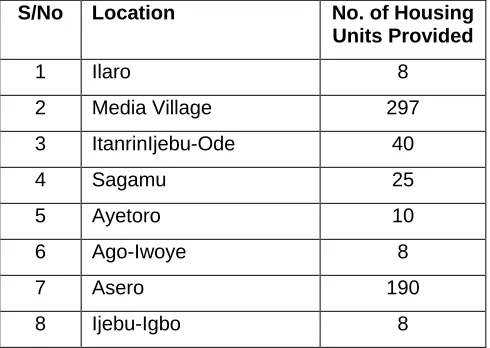
Several private estate developers have taken advantage of the rapid expansion of Lagos to acquire and develop housing estates in Ogun State especially along the major development axes that also service Lagos.On its part, Ogun State government has housing estates distributed across the state with varying number of housing units, provided by the Ministry of Housing (834 housing units), Ogun State Housing Corporation (351 housing units) and Ogun State Property and Investment Corporation (OPIC) (344 housing units).There are over 40 private real estate companies in Ogun State with an average of over 50 housing units at strategic locations to Lagos especially along Ibafo, Mowe, Shagamu road axis into Ofada along Sagamu – Papalanto road.Many of these estates developed by real estate developers are dominantly housing estate while some could be classified as integrated townships/satellite towns.

Table 1: Housing Developed by the Ogun State Ministry of Housing

S/No Location No. of Housing Units Provided

1 Ilaro 8

2 Media Village 297

3 ItanrinIjebu-Ode 40

4 Sagamu 25

5 Ayetoro 10

6 Ago-Iwoye 8

7 Asero 190

8 Ijebu-Igbo 8

9 Ikenne 8

10 Oru/Awa 58

11 Workers Estate Laderin 272

Total 834

(Source: Ogun State Ministry of Housing, 2012)

Table 2: Housing Developed by the Ogun State Housing Corporation

S/No Location No. of Housing Units Provided

1 Ajebo 100

2 Kemta 81

3 Ota 66

4 Ikangba 6

5 Idiroko 15

6 Ayetoro 5

7 Ago-Iwoye 10

8 Sapade 7

9 Ado Odo 7

10 Erinko 5

11 Lagos Road 5

12 Igbena 42

13 Ilaro 2

Total 351

(Source: Ogun State Ministry of Housing, 2012)

(8)

71 either of Lagos or Ibadan, nor to serve as a residential dormitory settlement for any city in particular. The aim was to utilize the land area in the perhaps slow developing regions of Ogun State. In fact, based on the regional development strategies of Ogun State, GPC is expected to be a growth pole and primarily a city development effort that will create a liveable environment that is self-sustaining. The 750 hectares was divided into 4 residential districts (about 73%), industrial (about 13%) and business/commercial districts (about 13%). The residential district was made for secondary facilities such as schools, commercial centers, recreation and entertainment facilities, library and security posts.The progress in the GPC is encouraging. Most of the housing units had already been sold while commercial and industrial plots were oversubscribed.

CONCLUSION

Over the years, cities have been developing to earn for themselves indignation of diverse variety.Cities now form a major source of environmental problems which have effects not only within their vicinity but, oftentimes, of global significance. The city as a center of human agglomeration has a fascinating way of luring people. The city has brought together, within relatively narrow compass, the diversity of special cultures and all races and cultures can be found here, along with their languages, customs, costumes, and typical cuisines. Unsustainable urbanization is the current bane of cities especially in the developing countries.Current global efforts are directed at making the rural areas attractive to stem rural-urban migration.

The latest in the real estate in the cities is the concept of integrated township that has caught up so fast in the last couple of years. The situation of urban management in Nigeria as in many developing countries is still confronted with difficulties in the area of policy and implementation.Development along Lagos Mega City axis into Ogun State is still fraught with difficulties.While spirited efforts are being made by both governments and private development agencies, most developments are still along the line of the old strategy of housing estates.Integrated Townships development strategy is still in its infancy in Nigeria, but gradually picking up.

REFERENCES

Agbola, S.B. and C.O. Olatubara (2004): “Land Use Planning”, in Agbola, S.B. (ed.) Elements of Urban and Regional Planning, Ibadan: Macmillan Nigeria Publishers Ltd

Agbola, T. (1998).The Housing of Nigerians: A Review of Policy Development and Implementation. DPC, Ibadan.

Aina, T.A. (1989). “The commercialization of Housing Tenure in low income settlements in metropolitan Lagos, Nigeria”, African Urban Quarterly,Vol. 4 Nos. 1 and 2, pp. 98-103.

Aribigbila A. (2011): “Housing Affordability as a Factor in the Creation of Sustainable Environment in Developing World: The example of Akure, Nigeria”, Journal of Human Ecology, 35 (2), 121 – 131.

Federal Government of Nigeria (1991).National Housing Policy, FGN.

Hamdi, N. (1991).Housing without Houses, New York: Van Nostrand Reinhold.

International Federation of Surveyors (FIG), (2010): Rapid Urbanization and Mega Cities: The Need for Spatial Information Management. FIG Publication 48. Copenhagen: Denmark.

Ogunleye M. and B. Alo (eds) (2010): State of the Environment Report – Lagos 2010. Lagos: Ministry of Environment, Lagos State / Beachland Resources Limited.

Olatubara C. O. (2007):”Fundamentals of Housing”, in Agbola S.B, Egunjobi T. O and C. O. Olatubara (eds)

Housing Development and Management: A Book of Readings, Ibadan: Department of Urban and Regional Planning, University of Ibadan.

Olatubara, C.O. (2000). “The Need for Effective Integration of Industries into Rural Development strategy in Nigeria” ODU No. 40, Jan/July, pp. 123-147.

Olokesusi F. (2011): “Lagos: The Challenges and Opportunities of an Emergent African Mega City”Paper Presented at the NISER Seminar Series on 5 July. Olotuah A. O and S. A Bobadoye (2009): “Sustainable

Housing Provision for the Urban Poor: A Review of Public Sector Intervention in Nigeria”, The Built and Human Environment Review, 2, 51 – 63.

Onibokun, A.G. (1985). Urban Housing in Nigeria, Ibadan, NISER.

Oyesiku K. (2010): New Cities in Urban and Regional Development Planning. Ikeja: Longman Nigeria PLC.

Population Reference Bureau (2001).2001 World Population Data Sheet, PRB, Washington, D.C.

Prasanth, G. and M. Saramma (2010): “Integrated Townships: Its Relevance in Contemporary Housing

Sector of Kerala”,

(117.211.100.42.8180/jspui/bitstream

(9)

72

Satterthwaite, D McGranahan G. and C. Tacoli (2010): “Urbanization and its Implication for Food and Farming”, Philosophical Transactions of the Royal Society B, 365, 2,809 – 2,820.

ShaikhAmmaar (2011):Integrated Township Planning, Symbiosis Centre for Management and Human Resources, Symbiosis International University.

Tacoli C. (2012): Urbanization, Gender and Poverty, UNFPA Technical Briefing, March.

UN-Habitat (2009): Planning Sustainable Cities: Policy Directions. United Nations Human Settlements Programmes (UN-Habitat). Nairobi: Kenya.

UN-Habitat (2012a): State of the World’s Cities 2012/2013. United Nations Human Settlements Programmes (UN-Habitat). Nairobi: Kenya.

UN-Habitat (2012b): Sustainable Housing for Sustainable Cities: A Policy Framework for Developing Countries. United Nations Human Settlements Programmes (UN-Habitat). Nairobi: Kenya.

United Nations (2012): World Urbanization Prospects: The 2011 Revision. United Nations Department of Economic and Social Affairs (Population Division).

Figure

Table 1: Housing Developed by the Ogun State Ministry of Housing

References

Related documents

Not surprisingly, regardless of the experience and the sample entry definitions used, the standard potential experience measure overestimates accumulated actual experience

This study tries to analyze the preferences and behavior of criteria for selection of Islamic banks in Indonesia through the Analytical Network Process (ANP) approach.The

The QUALMAT study seeks to improve the performance and motivation of rural health workers and ultimately quality of primary maternal health care services in three African

Book your place today at the Social Casino Gaming Summit (19-20 June, Las Vegas) to meet Rich, Josh and Vicenç alongside the other leading games developers and land based

Transmission electron microscopy (TEM) images of the samples at incubation times longer than 100 h con- firmed the presence of abundant quantities of amyloid fibrils in the

Sialidases on surface of apoptotic cell (not secreted to intracellular medium) contribute to desialylation of dying cells and appearance of galactose residues, while

Отже, нами встановлено, що відсутність вітаміну А в організмі з пухлиною, порівняно з онкогенезом за нормальної забезпеченості цим есенціальним нутрієнтом,