World Maritime University
The Maritime Commons: Digital Repository of the World
Maritime University
World Maritime University Dissertations Dissertations
2002
Improving the function of vessel traffic services in
China through costs and benefits analysis
Dan Yang
World Maritime University
Follow this and additional works at:http://commons.wmu.se/all_dissertations Part of theEconomics Commons
This Dissertation is brought to you courtesy of Maritime Commons. Open Access items may be downloaded for non-commercial, fair use academic
Recommended Citation
Yang, Dan, "Improving the function of vessel traffic services in China through costs and benefits analysis" (2002).World Maritime University Dissertations. 248.
WORLD MARITIME UNIVERSITY
Malmö, Sweden
IMPROVING THE FUNCTION OF
VESSEL TRAFFIC SERVICES IN CHINA
THROUGH COSTS AND BENEFITS ANALYSIS
By
Yang, Dan
The People’s Republic of China
A dissertation submitted to the World Maritime University in partial Fulfilment of the requirements for the award of the degree of
MASTER OF SCIENCE
in
MARITIME AFFAIRS (Maritime Administration)
2002
DECLARATION
I certify that all the material in this dissertation that is not my own work has been identified, and that no material is included for which a degree has previously been conferred on me.
The contents of this dissertation reflect my own personal views, and are not necessarily endorsed by the University.
(Signature:) ………..
(Date:) ………..
Supervised by:
Doctor Proshanto K. Mukherjee ITF Professor of Maritime Safety
Course Professor, Maritime Administration and MSEP World Maritime University
Assessor:
Doctor Shuo Ma
Professor, Port Management and Shipping Management Vice Rector and Academic Dean
World Maritime University
Co-assessor:
ACKNOWLEDGEMENTS
This paper cannot be finished without the help of a lot of people and organizations.
Here I extend my sincere appreciation to all of them.
I would like to express my gratitude to Dalian Maritime University, the Department
of Science and Education of the Ministry of Communication and the Department of
International Cooperation of the Ministry of Communication of People’s Republic of
China, which nominated me to pursue the studies in World Maritime University.
I am most grateful for Sasakawa Fundation, Japan, for having awarded me a
scholarship, which made my study in World Maritime University possible.
My heartfelt gratitude goes to my supervisor in World Maritime University,
Professor P.K. Mukherjee, who not only gives me many invaluable recommendations
and comments on my work but also corrects various mistakes in my dissertation.
My profound thanks also go to Professor Wu Zhaolin, my supervisor in China, who
has given me many valued advices and assistance in the writing of this dissertation.
I also want to extend my gratitude to Professor Fang Xianglin in Dalian Maritime
University, who has initiated my inspiration on the issue studied in this dissertation,
and Mr. Shao Changfeng, who has helped me a lot in collecting materials.
Deeply thanks also go to Mr. Clive Cole for having read my dissertation and
corrected the grammar and spelling mistakes in it.
My sincere appreciation also extend to all the staff of World Maritime University,
Wangeci Eklöw and Cecilia Denne. Without their great help in providing idea and
information, this dissertation could not have been completed.
I would also like to thank my colleague students, especially Mr. Li Yang and Li
Wenhua for their providing information and materials.
My particular gratitude goes to all my colleagues and friends in China for their firm
support and great help to me.
Last but by no means least, I would like to express my heartfelt gratitude to my
family, my husband Sun Kai and my lovely daughter Sun Jiayue. Without their
support, encouragement and sacrifice, I could not study in World Maritime
University and finish this work.
ABSTRACT
Title of Dissertation: Improving the Function of Vessel Traffic Services
in China through Costs and Benefits Analysis
Degree: MSc
This dissertation is a study of cost-benefit analysis of vessel traffic services in China
with the purpose of improving the function of vessel traffic services.
A general introduction to vessel traffic services is given, including its definition,
purpose and categories. It also describes the factors needed to be considered in
establishing a VTS and how the levels of VTS are divided.
The description of cost-benefit analysis methods is provided and various costs and
benefits of vessel traffic services are examined and the framework to compare the
costs and benefits that aims to make certain whether the VTS is justified, is
introduced.
After providing an introduction to the VTS development in China, two VTS centres
are evaluated in detail to see whether they are justified or not. Their costs and
benefits are listed and calculated and then they are compared. Some other VTS
centres in China are also evaluated using the same method, but only the evaluation
results are given.
Having finished the evaluations of VTS centres, measures that should be taken by the
China Maritime Safety Administration to improve the function of VTS in promoting
maritime safety, increasing traffic efficiency and protecting the marine environment
In conclusion, the results of the evaluation of the VTS centres in China are examined.
KEYWORDS: Vessel Traffic Services, Cost-Benefit Analysis, Maritime Safety,
Traffic Efficiency, Environmental Protection
TABLE OF CONTENTS
Declaration
Acknowledgements
Abstract
Table of Contents
List of Tables
List of Figures
List of Abbreviation
1 Introduction
2 Vessel Traffic Services
2.1 Vessel Traffic Services as a Concept
2.1.1 VTS Services
2.2 Categories of Vessel Traffic Services
2.2.1 Categories of VTS in accordance with Location
2.2.2 Categories of VTS in accordance with Funding
Resources
2.3 Factors to be considered in Establishing a VTS
2.4 Levels of Vessel Traffic Services
3 Using Cost-Benefit Analysis in VTS
3.1 Introduction to Cost-Benefit Analysis
3.1.1 Cost-Benefit Analysis as a Concept
3.1.2 Function of Cost-Benefit Analysis
3.2 Analysis of the Costs and Benefits of VTS
3.2.1 Costs of VTS
3.2.2 Benefits of VTS
3.3 Framework for Cost-Benefit Analysis of VTS
3.3.1 Calculation of Costs and Benefits
3.3.1.1 Step 1: Expressing Costs and Benefits in
Numeraire
3.3.1.2 Step 2: Converting Costs and Benefits into
Constant Dollars
3.3.1.3 Step 3: Expressing Costs and Benefits in Present
Value
3.3.1.4 Merging of Step 2 and Step 3
3.3.2 Decision Rules of Cost-Benefit Analysis
3.3.2.1 Net Present Value
3.3.2.2 The Internal Rate of Return
3.3.2.3 The Benefit-Cost Ratio
3.3.2.4 Payback Period
4 VTS in China
4.1 VTS Development in China
4.2 Utilizing CBA Method to Evaluate Some Chinese VTS
Centres
4.2.1 VTS Centre A
4.2.1.1 General Introduction to VTS Centre A
4.2.1.2 Identification of Parameters
4.2.1.3 Calculation of Costs
4.2.1.4 Calculation of Benefits
4.2.1.5 Decision Rules
4.2.2 VTS Centre B
4.2.2.1 General Introduction to VTS Centre B
4.2.2.2 Identification of Parameters
4.2.2.3 Calculation of Costs
4.2.2.4 Calculation of Benefits
4.2.2.5 Decision Rules
4.2.3 Other VTSs
5 Observations and Recommendations for VTS in China
5.1 More VTSs are Needed
5.2 VTS must be Established in accordance with its Needs
5.3 A Good Plan is the Key to Success
5.4 VTS Services Need to be Paid for
5.5 The Quality of VTS Operators Needs to be Improved
5.6 Developing VTIMS
5.7 Quality Management for VTS
6 Conclusions
References
42
44
45
46
46
47
48
50
52
55
57
59
LIST OF TABLES
Table 4.1 Table 4.2 Table 4.3 Table 4.4 Table 4.5 Table 4.6
Table 5.1
Types and Scales of VTS in China Costs Calculation of VTS Centre A Benefits Calculation of VTS Centre A Costs Calculation of VTS Centre B Benefits Calculation of VTS Centre B Out Come of the Evaluation of Some Other VTS Centres
List of Educational Background of VTS Operators
30 35 37 41 43 45
LIST OF FIGURES
Figure 4.1 Figure 4.2
Figure 4.3 Figure 4.4
Costs and Benefits Cash Flow of VTS Centre A Cumulative Value of Costs and Benefits of VTS centre A
Costs and Benefits Cash Flow of VTS Centre B Cumulative Value of Costs and Benefits of VTS centre B
33 38
LIST OF ABBREVIATIONS
CA CBA CEC CMSA COST EC EDI IALA IMO IRR m NPV O&M R&D RMB SAR TI VHF VTMIS VTS Concerted Action Cost-Benefit AnalysisCommission of the European Communities
China Maritime Safety Administration
European Concerted Action in the field of Shore-based
navigation aids systems
European Commissions
Electronic Data Interchange
International Association of Marine Aids to Navigation and
Lighthouse Authorities
International Maritime Organization
Internal Rate of Return
million
Net Present Value
Operation and Maintenance
Research and technical Development
RenMinBi
Search And Rescue
Traffic Image
Very High Frequency
Vessel Traffic Management and Information Services
Chapter 1
Introduction
The evolution of Vessel Traffic Services (VTS) can be said to have its origins in the
establishment of the first shore based radar station in Liverpool in 1948. Today
VTSs are so costly that millions dollars will be needed to establish it. The costs of
operation and maintenance (O&M) are also very high. Thus the necessity of
conducting a cost benefit analyse of VTS has been recognized by the international
maritime industry.
The benefits of VTS must be offset against the investment and O&M costs of the
VTS. Both the benefit and the combined costs depend, to a large extent, on the type
of VTS and the level of services provided. A cost benefit analysis can provide a
rational framework for evaluation of a project at three levels: • Contributing to a fundamental implementation decision; • Assisting in selection of the optimum design and lay-out; and • As a tool to evaluate performance.
VTS will play an increasingly important role in the maritime industry because it
absorbs advanced technologies in order to improve the safety, and efficiency of
navigation and protect the marine environment. Thus, it will be very helpful to
consider the costs and benefits generated by this service.
China expedites its development of VTS projects these years, especially since the
1980’s. Many main ports have established VTS to improve maritime safety, increase
traffic efficiency and protect the marine environment. Some VTS projects are still
under development, while others may need to replenish or upgrade their equipment.
Up to now, some research has been done on this subject, such as the European
concerted action in the field of shore-based navigation aids systems, know as COST
301, conducted by the Commission of the European Communities which aimed at
assessing potential benefits of shore-based marine traffic systems in aspect of safety
and efficiency of traffic in European waters, Canadian Coast Guard Vessel Traffic
Services final report, International Association of Marine Aids to Navigation and
Lighthouse Authorities (IALA) vessel traffic services manual, etc. In China, some
institutes have also done some research on this subject, but most of them are still at
an elementary stage.
The objectives of this dissertation are as follows:
− To establish a cost beneficial analysis framework for Vessel Traffic Service (VTS).
− To examine the current status of VTS in China
− To evaluate several Chinese VTS centres in terms of their costs and benefits
and conclude about their justification.
− To recommend on how to improve the functions of the current VTS in
maritime safety, marine environmental protection and shipping efficiency in
China.
In Chapter 1 the background of the subject and the objectives of the dissertation are
set out. Chapter 2 gives the definition, purpose, categories and levels of vessel traffic
services. Factors to be considered in establishing a VTS are also discussed in Chapter
2. In Chapter 3 the cost-benefit analysis method is first introduced and then a
framework for cost-benefit analysis of VTS is established after analysing the cost
and benefit of VTS. Chapter 4 provides an introduction to the development of VTS
in China. After that, the cost-benefit analysis method is used to evaluate some
Chinese VTS centres in the same Chapter. Chapter 5 consists of the observations and
functions of VTS in China is discussed. Chapter 6 is the last Chapter of this
Chapter 2
Vessel Traffic Services
2.1 Vessel Traffic Services as a Concept
The International Association of Marine Aids to Navigation and Lighthouse
Authorities (IALA, 1993) provides a definition in its Vessel Traffic Services Manual,
which is as follows:
A VTS is a service implemented by a Competent Authority,
designed to improve the safety and efficiency of vessel traffic and to
protect the environment. The service should have the capability to
interact with the traffic and respond to traffic situations developing
in the VTS area.
The International Maritime Organization (IMO, 1997) adopts this definition in its
Assembly Resolution A.857(19) named “Guidelines for Vessel Traffic Services”.
In the same guideline, IMO (1997) gives the purpose of a VTS as follows:
The purpose of VTS is to improve the safety and efficiency of
navigation, safety of life at sea and the protection of the marine
environment and/or the adjacent shore area, worksites and offshore
installations from possible adverse effects of maritime traffic.
The Commission of the European Communities (CEC) (1988) conducted a research
and technical development (R&D) project entitled the European Concerted Action in
the Field of Shore-based Navigation Aids Systems, known as COST 301, which
a VTS are: efficiency of traffic flow (65%), traffic density (59%), pollution risks
(58%), narrow waters (55%) and co-ordination of services (50). The aims of VTS are:
safety of traffic and environment (82%), efficient flow of traffic (78%) and aid to
navigation (68%). These data show a consistency with the definition and purpose
given in the two documents.
2.1.1 VTS Services
There are three kinds of services that a VTS can provide, namely information service,
navigational assistance service and traffic organization service (IALA, 1998).
IALA (1998) gives the definition of information service as indicated bellow:
An information service is a service to ensure that essential
information is available in good time to assist the shipboard
navigational decision making process.
For this service, VTS broadcast information regarding waterways and weather
condition, hazards, the position, identity and intentions of other traffic, etc. at fixed
times and intervals or when deemed necessary by the VTS or at the request of a
vessel.
Navigational assistance service as defined in the VTS manual is (IALA,
1998):
A navigational assistance service is a service to assist the
navigational decision making process on board and to monitor the
When requested by a vessel or deemed necessary by the VTS, a navigational
assistance service will be rendered especially in difficult navigational or
meteorological circumstances or in case of defects or deficiencies.
The VTS manual defines traffic organization service as follows (IALA,
1998):
A traffic organization service is a service to prevent the development
of dangerous situation and to provide for the safe and efficient
movement of traffic within the VTS area.
The traffic organization service concerns the operational management of the traffic
and forward planning of vessel movements to prevent congestion and dangerous
situations. It may also include establishing and operating a system of traffic
clearances, ma ndatory reporting of movements, routes to be followed, speed limits to
be observed, etc.
VTS can also play a very important role in allied services, port operation, emergency
services, etc. This is a supporting activity of VTS. The purpose is to increase the
safety and efficiency of the traffic, protection of the marine environment and the
effectiveness of the VTS itself. At the same time, VTS, if preparing implemented,
can reduce the reporting burden of the vessel.
2.2 Categories of Vessel Traffic Services
2.2.1 Categories of VTS in accordance with Location
According to the location of a VTS, it can be characterized as a port or harbour VTS,
a coastal VTS or a river or fairway VTS. A port or harbour VTS is mainly concerned
or a river port. A coastal VTS involves vessel traffic passing through the coastal area.
A river or fairway VTS, on the other hand, regulates vessel traffic passing through a
specific area of a river or fairway. There can also be combinations of any of the VTS
categories described above.
Usually, a port or harbour VTS and a river or fairway VTS will provide navigational
assistance services or a traffic organization service, but a coastal VTS will normally
only provide an information service.
According to COST 301 (CEC, 1998), among the 152 VTS centres in Europe, 67%
are port or harbour VTS, 18% are river or fairway VTS and 8% are coastal VTS.
2.2.2 Categories of VTS in accordance with Funding Resources
A VTS can be funded by public or private capital. A publicly funded VTS is usually
supported by a municipal or national government. The main purpose of this kind of
VTS is safety of traffic and protection of the environment. Sometimes a VTS fee
may be charged but mostly the service is provided free. A privately funded VTS is
usually operated by the port itself or a corporation. The operating mechanism is
similar to a pilot station and its main purpose is to increase the efficiency of traffic,
so that less turn around time will be needed and more vessels can be regulated within
the same time period. This is of considerable benefit to vessels. Thus, in such cases a
VTS fee is usually charged. At any rate, whatever may be the purposes, they cannot
be mutually exclusive and can function together. So the outcome of all kinds of VTS
is that safety is improved, the marine environment is protected and traffic efficiency
is increased.
In the United States, VTS and related information systems are federal, federal/private,
private, or port authority operations. The U.S. Coast Guard has installed and operated
federal funds. In some other ports, private entities have deployed VTS-like systems,
such as in the ports of Los Angeles and Long Beach (LA/LB) and the Delaware
River and Bay. The LA/LB system, authorized by state legislation, is managed by the
local Marine Exchange and is manned by both the Marine Exchange and the Coast
Guard, both of which have agreements with the state. The Delaware Bay system is
operated by local pilots, and costs are recovered through increased pilot charges to
vessels. This system is fully private and does not have the legal authority to mandate
participation or to direct traffic. (National Research Council, 1996)
2.3 Factors to be Considered in Establishing a VTS
While planning to establish a VTS in the port area or costal area or on a river, the
responsible agency should consider certain factors in order to decide the nature of the
VTS.
According to IALA (1998), these factors fall into three categories and are as follows:
l Physical Factors:
− Local Geography: This is the determining influence on the size of the area to be covered by a VTS.
− Local Conditions: This refers to the prevailing weather, especially the visibility, wind, tidal range and direction and strength of tidal stream.
l Vessel Traffic:
− Numbers of vessels and types: The number, size, type, equipment, manoeuvrability and cargo of the vessel need to be considered.
− Other activities: Naval operations, oil and gas production and
recreational activities that may take place within the area should also
be taken into account.
l Environmental Aspects:
− The areas that are environmentally sensitive need to be identified and suitable measures need to be developed, e.g. routeing vessels clear of
these areas and carefully organizing traffic flow so as to limit the
numbers of vessels.
− Mandatory ship reporting systems which have been adopted by the IMO and are partly or completely within the VTS area must also be
taken into account.
A VTS must be suitable for the prevailing conditions of the area intended to be
covered. Regardless of its purpose, a VTS will have a two-fold function, namely, the
facilitation of commercial efficiency and maritime safety including environmental
protection on the other hand. Thus, the responsible agency must find the balance
between these two needs; i.e., to organize traffic so that efficiency is increased, and
at the same time, improve maritime safety and protection of the marine environment.
VTS is undoubtedly a capital-incentive undertaking. It costs a significant amount of
money to build a VTS, which can be to the turn of millions of dollars. So in order to
make it fully functional, a VTS must be established to adapt the service to the
prevailing conditions of the port. If it is over functional, there will be some wastage
of function and capital. A VTS can have maximum benefit only when it is
2.4 Levels of Vessel Traffic Services
Different VTSs have different purposes and priorities. They provide different kinds
of services and are equipped with various facilities. Also, the investment of VTS
differs widely. VTS can thus operate at different levels. There is no unified
classification of a VTS levels in the world until now, but some regions have
determined their own classification.
In the COST 301 project (CEC, 1988), four levels of VTS are considered that carry
out functions typical of a coastal VTS. These are as follows:
l Level 0: No VTS, used as a datum level
l Level 1: VTS with VHF communications
l Level 2: VTS with VHF communications and a single radar
l Level 2A: As for Level 2, but with five radar stations linked by
microwave and with automatic radar processing.
These levels were defined in terms of implementation features. The area covered,
external functions and quality of services provided were implied from these
parameters, rather than being explicitly stated.
Chinese researchers (Yu & Wu, 1989) also provide a classification of VTS levels,
but from a different perspective. Unlike CEC’s classification, which divides VTS
levels in accordance with their equipment, Chinese classification is based on division
of VTS levels according to the services provided. There are 5 levels in Chinese
classification which are explained below.
Level 0 is the lowest level, which by its very character is not a VTS. It only provides
services that any port or harbour will provide, such as pilotage service, security and
Level 1 is a traffic information service, which entails communications between shore
and on-board stations, exchanges of meteorological and hydrographic information
related to navigational safety and broadcasting of other information as and when it is
necessary.
Level 2 is a traffic monitoring and danger warning service. At this level, a VTS
centre is established. The centre will monitor the traffic situation within the VTS area
and analyse and evaluate various data. The VTS centre should broadcast periodically
or when it is deemed necessary, the information on ships’ movement, hazards or
dangers, etc.
Level 3 is a traffic advisory service. A VTS centre can provide position, course, etc.
of other traffic to a ship when it is required by the ship because of encountering
difficulty in navigating or due to equipment breakdown or any other reason. Advice
or proposals will also be given when a ship faces collision or any other navigational
danger.
The highest level is level 4, which is a traffic organization service. The VTS centre at
this level will organize the traffic and carry out forward planning of vessel
movements to prevent congestion and dangerous situations. This may include
arranging the order of passage through a specific area or one-way waterway,
designating anchorages, or requiring vessels to sail to safe area or take any other
safety measure.
Usually, the more adverse the natural conditions, the more is the traffic flow,
consequently the level of VTS needed is higher. Thus, the scale and the level of
service are determined by the natural and traffic situations of the area that the VTS is
Chapter 3
Using Cost-Benefit Analysis in VTS
3.1 Introduction to Cost-Benefit Analysis
3.1.1 Cost-Benefit Analysis as a Concept
Cost-benefit analysis (CBA), also know as benefit-cost analysis (BCA), is a widely
used tool in public service and policy analysis, e.g. in project and policy analysis,
especially for major capital projects. As the name implies, CBA helps the
decision-maker to select the best choice of decision through analysis of the cost and benefit in
the same monetary units of the project or policy and comparing the different costs
and benefits of various solutions.
Cost-benefit analysis (CBA) is a method of measuring and
evaluating the relative merits of public investment projects in
support of sound economic decisions. It takes into consideration all
of the effects of a project on members of society, irrespective of who
is affected or whether the effect is captured in financial accounts.
(Transport Canada, 1994)
CBA is useful in planning and decision-making as it provides a
common framework in which all of the important effects of
investment choices can be made visible and, to the extent possible,
quantified. It is a key tool in the quest for value for money.
3.1.2 Function of Cost-Benefit Analysis
Cost-benefit analysis has often been used as a primary tool in
evaluating large-scale capital projects. It can be used to address
several questions, such as:
• Whether a project should be undertaken;
• Which of several alternatives should be selected;
• Choosing the appropriate scale of the project or projects. (Duncombe, 2001)
As Henry (1979) points out, there are really two different goals for using CBA:
• To provide answers to which choice to select (the traditional view of CBA); • To provide a process to assist in decision-making.
Nowadays, the second function is becoming increasingly important.
3.2 Analysis of the Costs and Benefits of VTS
Before starting a project, it must be decided that an act should not be undertaken
unless its benefits outweigh its costs. In order to determine whether whether that
happens, all benefits and costs should be expressed in a common scale to enable
comparison with each other. Therefore, while planning the establishment of a VTS, a
cost-benefit analysis must be used to decide where the VTS should be established,
what kind of services are needed, at which level the VTS should be, how much the
cost will be and what the benefits will be. Only when the benefits outweighs the
costs, should a VTS be established.
Since there will always be some difference for cost & benefit evaluation between the
design stage and when a project has been established and is in operation, CBA
The purpose of this is to minimize the cost and maximize the benefit by fixing the
items of cost and benefit. Also, it will be clear to the decision-maker how to adjust
the policy and priority and avoid making similar mistakes if it proves that going
ahead with the project was a wrong decision. In the case of VTS, which is usually a
public service, if the decision-maker wants to charge for the service, the fee to be
charged can be based on the result of the cost-benefit analysis.
The methods used in the above-mentioned two stages are the same. However, the
costs and benefits to be analysed at the project operation stage are the real costs and
benefits while those at the design stage are only forecasts and therefore are not so
accurate.
3.2.1 Costs of VTS
“Cost is a measure of the value of the inputs to a process. It is the sum of the
economic prices paid for those inputs” (Wu, 1999). The inputs can be classified as
labour, capital, and resources. They are in the forms of design costs, equipment costs,
building costs, maintenance costs, wages, etc. Like all other projects, costs of VTS
can be divided into two categories, namely, capital costs and operational and
maintenance (O&M) costs (Canadian Coast Guard, 1984). Capital costs are also
known as initial costs, which constitutes the costs for land, building, equipment,
staff-training, etc. These kinds of costs are mainly involved in the construction or
development phase. While a VTS is in operation phase, the costs will be the O&M
costs, which are also often referred to as running costs, which includes the costs for
personnel and maintenance.
The costs associated with VTS development include the following:
• Construction costs, including all such costs, whether incurred for the
construction of a new facility or for the modernization or refurbishment of an
existing facility;
• Equipment purchase and/or lease, including spares;
• Vehicle purchase and/or lease;
• Project-related training, including initial training costs for staff, for example,
to learn how to operate new equipment. This should include not only the
costs of the training programmes but also related travel, accommodation and
productivity lost due to the absence of staff being or training;
• Other capital expenditures, including all capital not elsewhere accounted for
such as general furnishings;
• Other start-up costs;
• Transition costs, including those resulting from disruptions during the
implementation of the project;
• Decommissioning costs, if any, for facilities to be closed down or material to
be discarded;
• Construction manage ment;
• Contingencies; and
• Costs to other parties, including capital and training necessary to implement
the project and accrue the benefits (e.g., access roads to expanded or new
facilities, special equipment required by users).
For a CBA, capital costs are measured by the cash expenditures required in future
years - not by depreciation. To include depreciation, as well as cash expenditures,
would result in double counting of capital costs.
When a VTS is in operation, the O&M costs generated would include:
• Direct operating costs. The labour component would include regular salaries
• Maintenance costs;
• Overhead and other supporting costs;
• On-going training;
• Periodic capital outlays, such as to mid-life refits over and above regular
maintenance; and
• Operating and maintenance costs incurred by other parties, such as
construction of new access roads, cleaning of grounds, etc.
3.2.2 Benefits of VTS
“A benefit is something that promotes well being or value received. There are many
types of benefits, which can be divided into intangible and tangible benefits” (Wu,
1999). As to VTS, the benefits are safety, environmental protection, improvements
and efficiency among other things.
IMO (1997) resolution A.857 states:
The benefits of implementing a VTS are that it allows identification
and monitoring of vessels, strategic planning of vessel movements
and provision of navigational information and assistance. It can also
assist in prevention of pollution and co-operation of pollution
response.
There are several benefits accrued to safety of traffic through the establishment of
VTS. Such benefits can be summarized in the following words:
Safety of traffic can be improved by foreseeing and preventing situations of an
unacceptable risk, by contributing to safe encounters from previously perceived
safety of traffic depend on the type, i.e. the services provided and the functions
performed.
A good information service ensures that information that is essential is available in a
timely manner to the shipboard decision making process, either by broadcast at fixed
times or whenever it is considered necessary by the VTS authorities, and is normally
provided to the general traffic. The benefits may be limited by a lower update rate
and the fact that certain information may also be available from other sources such as
wind and tide indicators, weather forecasts, signals, etc. In any case, the ships may be
better able to adapt their behaviour to the prevailing conditions and thus achieve a
safer flow of traffic.
A traffic organization service deals with forward planning of movements to prevent
the development of dangerous situations. Enforcement is an integral part of such a
service. The principal benefits are reduction of risk from situations which ships even
with careful observations cannot foresee. They depend on the knowledge of not only
the positions of ships’, but also their identities, sizes, cargoes, movements and
destinations. The benefits also depend on the range and reliability of traffic
extrapolations, because as a strategic measure this service is based on assumed future
conditions.
Navigational assistance service, as the name implies, assists the decision making
process on board relating to navigation. The assistance provided is in the form of
information and advice. As a tactical measure, such information and advice reduces
the risk of actual movements. The actual benefits depend on resolution and accuracy
of the displays, availability of ship data including the identity of the ship, and a
permanently available communication link. If information on position, adjacent
traffic and course advice when requested is provided on a continuous basis, this
Co-operation with allied services and other interested parties results in a supporting
service through exchange of information, use of common data bases and agreements
relating to actions to be taken. Benefits are achieved by taking into account the
availability of resources of the related services when establishing sailing plans. Also,
benefits can be derived from giving assistance in emergencies according to
pre-established contingency plans, to adjacent VTSs with advance information and by
interacting on the traffic in accordance with agreed actions. In this way, the
probability or the consequences of accidents are reduced and adverse interactions on
the traffic can be reduced (IALA, 1998).
According to IALA (1998), the benefit of VTS to efficiency of traffic is achieved
through avoiding delays and optimising traffic flow. These depend on the type of
VTSs, especially the services they provide and the functions they perform.
An information service ensures that essential information is available in a timely
manner on board the ships. It may confirm the ships’ decision making relating to
continuing its voyage in certain cases and thus unnecessary delays are avoided.
A traffic organization service can set the sailing plan of ships by foresighted planning
in order to adapt to the space facilities of the VTS area such as the availability of
anchorages, berthing or locks. Thus, the benefit that ships reduce unnecessary high
speeds with following waiting times may be achieved.
Since a navigational assistance service provides continuously updated navigational
information and, if needed, navigational advice, the benefits of this service is
achieved by helping ships to continue their voyage even in difficult situations such as
fog or storm and withdrawn pilot cutter. Navigational assistance service may also
reduce delays of ships that otherwise might have occurred due to not entering a VTS
The benefits of co-operation with allied services, emergency services and adjacent
VTSs and supporting and data exchanging service may be achieved by providing
allied services with advance information. Through providing ship data and
navigational assistance to shore and ship based emergency services, the co-operation
optimises their resource planning, the traffic throughput and the use of available
facilities. The efficiency of their actions when needed is also increased. Furthermo re,
the co-operation services make better use of available data by exchanging ship data
with adjacent VTSs, and thus unnecessary VHF occupation is avoided and the
reporting burden of ships is reduced.
All the benefits resulting from the improvement of efficiency are partly referred to
the ships, partly to the shore side (IALA, 1998).
VTS can also achieve a lot of benefits in marine environmental protection since the
services and functions that enhance safety of traffic have already contributed
potentially to marine environmental protection. However, a VTS has certain
additional functions to improve the protection of marine environment. These can be
found in the following area:
− Amplified traffic organization and navigational assistance for ships with dangerous or noxious cargo to prevent accidents;
− Information to competent authorities about movements of ships with dangerous or noxious cargo to assist their check
planning by port control;
− Co-operation with emergency and clean-up services,
assistance to their ships, action agreement and corresponding
measures to limit the consequences of pollution and to protect
the other traffic;
− Identification of the potential sources of pollution, thus
The benefits in marine environment protection depend on the VTS knowledge
of ship movements, cargo, data exchange, communication networks, trained
procedures and information or sensors concerning pollution (IALA, 1998).
As we can see from the above, contrary to the costs of VTS, most of the benefits of
VTS are not easily quantifiable. Therefore, a method must be found to quantify the
benefits of VTS into comparable values, i.e. monetary values, so that comparisons
can be made with the cost of VTS. In order to achieve this, benefits can be calculated
by the costs that are avoided by the operation of the VTS. These include the
accidents and the losses that have been decreased, the time that has been saved, and
the damage to the environment that has been decreased.
Therefore, in order to quantify the benefits of a specific VTS, first, the following
items must be recorded:
− the navigational accidents happened within the VTS area before the
VTS was in operation. The data should include the types of accidents,
e.g. collision, stranding; probable reasons that led to the accident and
the circumstances during accident, e.g. visibility, tide, storm,
behaviour of affected ships;
− amount, composition and behaviour of traffic within the VTS area to be considered, including categories of ships;
− specific conditions that may impair the traffic;
− accidents relating to environmental pollution, especially those relating
to hazardous substances. (IALA, 1998)
After getting all of these data, the benefits of VTS can be calculated. The calculation
− the probability of accidents if the VTS is not established and in
operation, resulting from the registered ship movements, taking into
account fairway layout and width, amount of encounters and sizes of
concerned ships, distribution of traffic all day around, dependent on
visibility;
− the cost caused by the accidents probably happened if the VTS is not established and in operation, taking into account ships and cargo,
human life, remedial actions, potential consequences for the traffic
flow and pote ntial environmental consequences;
− the time lost because of waiting or reduction of speed and the costs per unit of time for ships (according to category) and harbours and finally
the resulting costs due to the loss of time of all ships and harbours if
the VTS is not established and in operation within the VTS area
(IALA, 1998).
3.3 Framework for Cost-Benefit Analysis of VTS
3.3.1 Calculation of Costs and Benefits
As mentioned previously, both the costs and the benefits of VTS must be put into
standard units so tha t they can be compared directly. This involves three main things:
expressed in a common numeraire (e.g. dollars, euros, etc.); adjusting for inflation
where necessary, i.e., converting from nominal dollars to constant dollars; and
expressing all of them in present values (adjusting for differences in the time of
occurrence of costs and benefits). (Treasury Board of Canada Secretariat, 1998)
3.3.1.1 Step 1: Expressing Costs and Benefits in Numeraire
Having identified all the costs and benefits, the next step is to express them all in
CBA. However, a dollar of consumption or a dollar of foreign exchange may also be
used as the numeraire while evaluating the costs and benefits of VTS. All of these
are acceptable, but clarity and consistency are essential. If price distortions are
widespread in a particular economy, the cost-benefit analysis of VTS may be
calculated by the use of border prices or world prices as the numeraire, that is, as the
best measure of true value of costs and benefits. Since the interest costs payable on
the capital funds required to implement a project are implicitly taken into account in
the computation of net present value, they should not be included in a CBA. The
interest costs are taken into account by means of the discount rate. (Treasury Board
of Canada Secretariat, 1998)
3.3.1.2 Step 2: Converting Costs and Benefits into Constant Dollars
All the costs and benefits identified and expressed in the previous step are in nominal
dollars, which do not have standard purchasing power because the value of the unit
of measurement itself changes over time due to inflation leading to a loss in the
purchasing power of the currency and therefore cannot be aggregated if they occur at
different times. They can only be added or subtracted when they occur within the
same period as long as the period is short, which is usually one year.
Nominal dollars are simply the face value of the currency and need to be converted
to constant dollars, which have constant purchasing power. In doing so, a base point
of time at which to express the constant dollar value must be selected, which is often
convenient to use (t0). Any point is acceptable, but the most frequent choices for t0
are the times when the analysis is being done, the start of the project, or the start of a
new fiscal year.
If a nominal dollar amount at time tn is to be converted to a constant dollar at t0, the
) 1 ( i N
C n
+
= (3-1)
where C is the amount in constant dollars; N is the amount in constant dollars; i is the
annual rate of inflation (%); and n is the number of periods between t0 and the actual
occurrence of the cost of benefit at tn. (Treasury Board of Canada Secretariat, 1998)
However, this step is not always necessary because sometimes all the costs and
benefits are estimated and expressed in value at time t0 and thus there is no need to
convert. It is also not necessary when there is no inflation or the inflation is so little
that it can be ignored.
3.3.1.3 Step 3: Expressing Costs and Benefits in Present Value
“$1 today is worth more (even without inflation) than $1 tomorrow
due to the risk and the ability to invest the funds.” (Duncombe, 2001)
The figures of costs and benefits of VTS are not yet in a standard unit even when
they are expressed in constant dollars because constant dollars make a difference
whether they are in terms of current purchasing power or future purchasing power
although they have standard purchasing power. The values of costs and benefits at
various times must be converted to values at a single point in time in order to make
them fully comparable. Thus, the value must be converted to present values.
The formula to convert a future value of the costs and benefits of VTS into the
present value is similar to the adjustment for inflation, which is as follows:
) 1 ( k FV
PV n
+
where PV is the present value at time t0; FV is the future value at tn; k is the discount
rate (%); and n is the number of periods between t0 and tn. (Treasury Board of
Canada Secretariat, 1998)
There are two kinds of discount rates, namely, the fiscal discount rate and the social
discount rate. The fiscal discount rate is only appropriate when the project has few, if
any, social implications (Wu & Zhang, 1998). Since VTS always has numerous
social implications, the social discount rate shall be used while calculating the costs
and benefits of a VTS project.
3.3.1.4 Merging of Step 2 and Step 3
As we can see, the formulas used to calculate constant dollars and present value
separately are almost the same. Therefore, in order to simplify the calculation, step 2
and step 3 are merged into one step. Because of the outcome of step 2, constant
dollars is used in step 3 as future value, the merging can be done as the following
formula shows: )) 1 )( 1 (( ) 1 ( ) 1 ( 1 ) 1 ( 1 ) 1
( k i
N i N k FV k k FV
PV n n n n n
+ + = + × + = + = +
= (3-3)
where PV, FV, k, N, I, n have the same meanings of formula (3-1) and (3-2).
Furthermore,
(1+k)(1+i)=1+k+i+ik (3-4)
If we introduce:
Then, formula (3-4) is as follows:
(1+k)(1+i)=1+r
and formula (3-3) can be rewritten as follows:
)) 1 ( ) 1 ( ) 1 ( 1 ) 1 ( 1 ) 1 ( r N i N k FV k k FV
PV n n n n n
+ = + × + = + = +
= (3-6)
Here, r is in fact the real interest rate while k is called nominal interest or discount
rate as mentioned before and i is the inflation rate. It should be noted that many
analysts simply refer r to the discounting rate or interest rate.
By using this formula, analysts only need to determine r, the real interest rate, and
then use it to calculate. The calculation is simplified considerably and therefore, this
formula is used by most analysts to calculate the present value of costs and benefits
of VTS which can be compared directly afterwards.
IALA (1998) gives the similar discounting formula to calculate the cash values of
costs and benefits, which is as follows:
)
1
(
i
V
V
n y x+
= (3-7)
where Vx is the value of costs and benefits at time x; Vyis the value at time y; n is the
time difference between y and x; and i is the interest.
This formula will be used in Chapter 4 to calculate the present value of the costs and
3.3.2 Decision Rules of Cost-Benefit Analysis
3.3.2.1 Net Present Value
The Net present value (NPV) is the present value of all benefits minus the present
value of all costs. Both the present value of benefits and costs must be discounted at
the appropriate discount rate. An NPV is always specific to a particular point in time,
which is generally expressed as t0. t0 can be the start of the project or the time when
the analysis is made. (Wu & Zhang, 1998)
The Net present value is simply the present value of benefits minus the present value
of costs, which can be expressed by the following formula:
)
1
(
1 ) (
1
B
C
i
NPV
n t ti t
+
∑
−=
=
(3-8)
where NPV is the net present value of a specific VTS project, n is the life-span of the
VTS project; Bt is the total benefits of year t; Ct is the total costs of year t; and i is the
discounting rate.
If the result comes out that NPV is positive, then the project is justified in the case of
an established VTS. For a VTS in planning, the one option with highest NPV should
be selected.
3.3.2.2 The Internal Rate of Return
The internal rate of return (IRR) is the discount rate (or interest rate) that makes the
then it means this VTS project is well justified. If the CBA is attempting to select one
among the alternatives, the one with the higher IRR is preferred.
Usually, IRR will produce the same result with the NPV decision rule, but it is not
always like that. Therefore, when the IRR decision rule is used, the analyst must
interpret it with care.
3.3.2.3 The Benefit-Cost Ratio
The benefit-cost ratio is the ratio of the present value of benefits to the present value
of costs. If the benefit-cost ratio is greater than 1, presumably the VTS is justified.
On the other hand, the alternatives of VTS in design with a benefit-cost ratio of less
than 1 should be rejected. Also, the alternative with higher benefit-cost ratio has
higher priority most of the time.
The formula to calculate the benefit-cost ratio is as follows:
∑
∑
= = + + = n i t n i t i i t tC
B
BCR
1 1 ) 1 ( 1 ) 1 ( 1 (3-9)where BCR is benefit-cost ratio of a specific VTS project; n is the life-span of the
VTS project; Bt is the total benefits of year t; Ct is the total costs of year t; and i is the
discounting rate.
The problem with this decision rule is that it is sensitive to how costs and benefits are
recorded and it does not take into account the scale of the project. Thus, similar to
3.3.2.4 Payback Period
The payback period is the time that the project takes for the cumulative present value
of benefit to become equal to the cumulative present value of costs.
Generally, the shorter payback period the VTS needs, the better it is. However, it can
be misleading sometimes because it ignores everything that happens after the
Chapter 4
VTS in China
4.1 VTS Development in China
VTS development in China came relatively recent. The first VTS centre was
constructed in the port of Ningbo in 1978. However, since then, the development has
been quite rapid. At present, twenty VTS centres and forty-nine radar stations are
dotted along the Chinese coast and inland rivers (including Hong Kong). These cover
most of the significant sea ports, important coastal waterways and fairways in rivers.
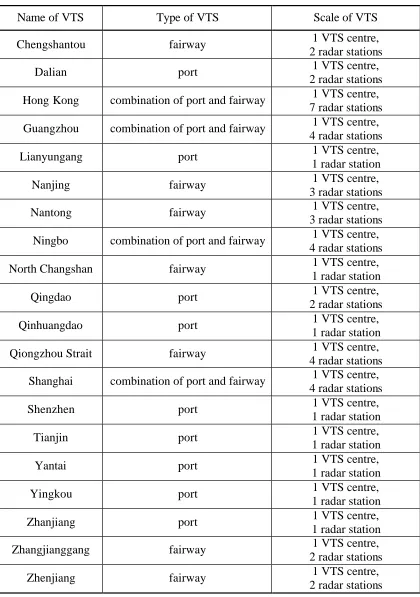
Table 4.1 Types and Scales of VTS in China
Name of VTS Type of VTS Scale of VTS
Chengshantou fairway 1 VTS centre,
2 radar stations
Dalian port 1 VTS centre,
2 radar stations
Hong Kong combination of port and fairway 1 VTS centre,
7 radar stations
Guangzhou combination of port and fairway 1 VTS centre,
4 radar stations
Lianyungang port 1 VTS centre,
1 radar station
Nanjing fairway 1 VTS centre,
3 radar stations
Nantong fairway 1 VTS centre,
3 radar stations
Ningbo combination of port and fairway 1 VTS centre,
4 radar stations
North Changshan fairway 1 VTS centre,
1 radar station
Qingdao port 1 VTS centre,
2 radar stations
Qinhuangdao port 1 VTS centre,
1 radar station
Qiongzhou Strait fairway 1 VTS centre,
4 radar stations
Shanghai combination of port and fairway 1 VTS centre,
4 radar stations
Shenzhen port 1 VTS centre,
1 radar station
Tianjin port 1 VTS centre,
1 radar station
Yantai port 1 VTS centre,
1 radar station
Yingkou port 1 VTS centre,
1 radar station
Zhanjiang port 1 VTS centre,
1 radar station
Zhangjianggang fairway 1 VTS centre,
2 radar stations
Zhenjiang fairway 1 VTS centre,
Among the twenty VTS centres, 2 VTSs are with capital costs of less than 1 million
RMB, 11 VTSs between 5-10 million, 3 VTSs between 30-70 million and Hong
Kong is more than 70 million.
As the main purpose of VTSs in China is to promote safety of navigation, and at the
same time to protect the marine environment and improve traffic efficiency, most
VTSs in China provide an information service and navigational assistance service.
They broadcast information about waterways and weather conditions, hazards, traffic
situation, etc. to all of the vessels in the VTS area at fixed times. If a ship is involved
in difficult navigational or meteorological circumstances for whatever reason, the
VTS will render assistance to help the ship overcome the difficulties. In 1998, some
1265 accidents were avoided with the assistance of VTS and 5078 violations of
regulations were corrected. In the port of Dalian, the number of violations of
regulations dropped sharply from an average of 1200 per year before the VTS was
established to an average of 36 per year after the VTS came into operation (Liu, etc.
1999). The benefits are obvious.
A few VTSs also provide a traffic organization service. Through operational
management of the traffic and the forward planning of vessel movements, these
VTSs prevent congestion and dangerous situations and increase the transit capacity
considerably. For example, the original transit capacity of Shanghai Beicao fairway
was 16 vessels at every high water. However, it has now increased to 27 vessels
since the VTS has been in operation. The increase is 69%. In another entrance route
of Shanghai port, the transit speed has increased from 9 knots to 11 knots (Wang, etc.
1999).
VTS plays an important role in co-operation with allied services and emergency
services. Some VTS centres are incorporated with Search and Rescue (SAR) centres.
All the VTSs in China today have been established and funded by the China
Maritime Safety Administration (CMSA), which is under the leadership of the
Ministry of Communications. CMSA and its branches are also responsible for the
operation and maintenance of VTS all over the country. There is no VTS fee
currently charged in China.
4.2 Utilizing the CBA Method to Evaluate Some Chinese VTS
Centres
Here, the cost-benefit analysis method is used to evaluate two Chinese VTS centres
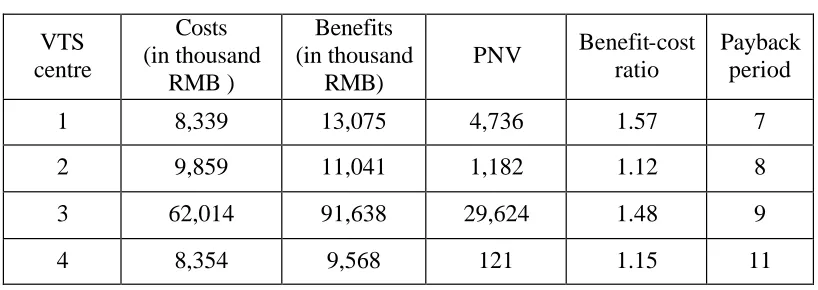
in detail and give the results of the evaluation of some other VTS centres.
4.2.1 VTS Centre A
4.2.1.1 General Introduction to VTS Centre A
The construction of VTS centre A was started in 1989 and was put into operation in
1994. It consists of a radar surveillance system, VHF communication system, VHF
direction finding system, ship data processing system and a hydrometeorology
system.
VTS centre A provides traffic safety information service on request, traffic
organization service, safety information transmitting service, hydrometeorology
information service on request, navigational assistance service on request, anchorage
arrangement on request and supports allied activities on request. (China Maritime
4.2.1.2 Identification of Parameters
Since the VTS started construction in 1989, that time is chosen as the base point of
time in reference to which all the costs and benefits are calculated.
The social discount rate is usually decided by individual countries. For example, it is
10% in Canada. In China, it is recommended as 12%. So that is used as the social
discount rate here.
A VTS usually has a life-span of 15 to 20 years. Here 15 years is chosen.
The costs and benefits cash flow is shown in figure 4.1.
Figure 4.1 Costs and Benefits Cash Flow of VTS Centre A
BENEFIT
Benefits of VTS
1989 1994 2008 t0
Operational and Maintenance Costs
Capital Costs
4.2.1.3 Calculation of Costs
The capital cost is 60.53m (million) Renminbi (RMB). As this was spent in 1989,
there is no need to convert. As the O&M costs occurred after 1994, all of them must
be converted to the 1989 value. The formula (3-7) is used here to calculate the value
at year 1989.
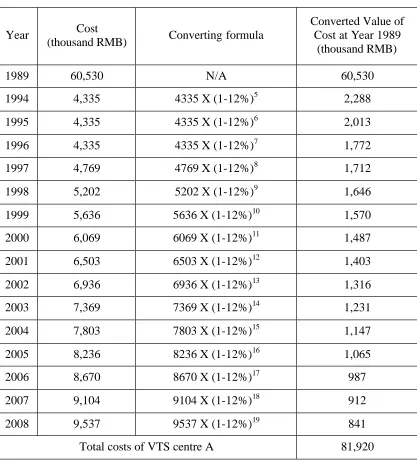
Table 4.2 Costs Calculation of VTS Centre A
Year Cost
(thousand RMB) Converting formula
Converted Value of Cost at Year 1989
(thousand RMB)
1989 60,530 N/A 60,530
1994 4,335 4335 X (1-12%)5 2,288
1995 4,335 4335 X (1-12%)6 2,013
1996 4,335 4335 X (1-12%)7 1,772
1997 4,769 4769 X (1-12%)8 1,712
1998 5,202 5202 X (1-12%)9 1,646
1999 5,636 5636 X (1-12%)10 1,570
2000 6,069 6069 X (1-12%)11 1,487
2001 6,503 6503 X (1-12%)12 1,403
2002 6,936 6936 X (1-12%)13 1,316
2003 7,369 7369 X (1-12%)14 1,231
2004 7,803 7803 X (1-12%)15 1,147
2005 8,236 8236 X (1-12%)16 1,065
2006 8,670 8670 X (1-12%)17 987
2007 9,104 9104 X (1-12%)18 912
2008 9,537 9537 X (1-12%)19 841
Total costs of VTS centre A 81,920
Note: the original data of costs are from “VTS Benefits Evaluation” (Fang & Zhuao,
1997).
Finally, the total converted cost of VTS centre A is 81,920,000 RMB.
4.2.1.4 Calculation of Benefits
As the benefits of VTS centre A could only be gained after the VTS was put into
operation, which was in 1994, the benefits were estimated yearly after the year 1994.
It is mentioned in Chapter 2, the benefits of VTS are the costs that VTS saves.
Therefore, all the benefits are estimated here.
The benefits of VTS centre A can be divided into several categories, which are
benefits due to a decrease in maritime accidents; benefits due to an increase in
passing capacity; benefits due to a decrease in waiting periods for high tide; benefits
from environmental protection and other benefits that do not belong to the previous
categories. As for the case of O&M costs, all the benefits must be converted to the
value of year 1989.
Table 4.3 Benefits Calculation of VTS Centre A
(All the figures are in thousands of RMB)
Year Benefit due to decrease in maritime accidents Benefit due to increase in passing capacity Benefit due to decrease in waiting for high tide Benefits from environment protection Other benefit Converted value of benefit in 1989
1994 5,476 20,562 18,251 600 270 23,831.8
1995 5,561 22,508 18,251 600 270 21,915.2
1996 5,678 24,455 18,251 600 270 20,128.9
1997 5,814 26,402 18,251 600 270 18,462.6
1998 5,923 28,348 18,251 600 270 16,897.4
1999 6,085 30,295 18,251 600 270 15,457.1
2000 6,207 32,242 18,251 600 270 14,109.3
2001 6,354 34,188 18,251 600 270 12,867.6
2002 6,498 36,135 18,251 600 270 11,720.3
2003 6,642 38,082 18,251 600 270 10,663.1
2004 6,800 40,028 18,251 600 270 9,692.8
2005 6,965 41,975 18,251 600 270 8,800.5
2006 7,012 43,922 18,251 600 270 7,973.4
2007 7,134 45,868 18,251 600 270 7,223.7
2008 7,278 47,815 18,251 600 270 6,541.2
Total benefits of VTS centre A 206,284.8
Note: the original data of costs are from “VTS Benefits Evaluation” (Fang & Zhuao,
1997).
4.2.1.5 Decision Rules
Having identified and converted all the costs and benefits into standard units that can
be compared directly, what is now necessary is to calculate the net present value
(NPV), benefit-cost ratios and payback period. The calculation method has been
explained in Chapter 3. As to the other decision rule, internal rate of return, since it is
rather complicated, is not used here.
− NPV=206,284,800-81,920,000=124,364,800>0, therefore VTS project A is justified.
− Benefit-cost ratio=206284800/81920000=2.5>1, means that VTS project A is justified.
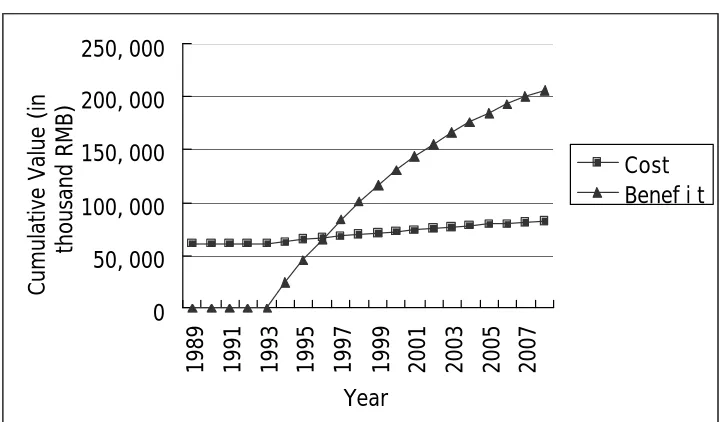
− As figure 4.2 shows the benefits and costs are equal in 1996, which is 7 years after the commencement of the project. This is the payback period.
Figure 4.2 Cumulative Value of Costs and Benefits of VTS centre A
0 50, 000 100, 000 150, 000 200, 000 250, 000
1989 1991 1993 1995 1997 1999 2001 2003 2005 2007
Year
Cumulative Value (in
thousand RMB)
Cost Benef i t
4.2.2 VTS Centre B
4.2.2.1 General Introduction to VTS Centre B
VTS centre B also started construction in 1989 and was put into operation in 1994.
As for VTS centre A, the components of VTS centre B are radar surveillance system,
VHF communication system, VHF direction finding system, ship data processing
system and hydro-meteorology system.
The services provided by VTS centre B are: navigational warning services,
consulting services, traffic organization services, navigational assistance services,
anchorage arrangement and support of allied activities. (China Maritime Safety
Administration (CMSA), 1999)
4.2.2.2 Identification of Parameters
All the parameters are identical to those of VTS centre A, which are:
− The base point of time at which all the costs and benefits are calculated is 1989. − The social discount rate is 12%.
− The life-span of VTS centre B is 15 years.
Figure 4.3 Costs and Benefits Cash Flow of VTS Centre B
BENEFIT
Benefits of VTS
1989 1994 2008 t0
Operational and Maintenance Costs
Capital Costs
COST
4.2.2.3 Calculation of Costs
The capital cost of VTS centre B is 15.86million Renminbi. This does not need to be
converted.
As the O&M costs occurred after 1994, all of them must be converted to the 1989
value. The formula 3-7 is used here to calculate the value for 1989.
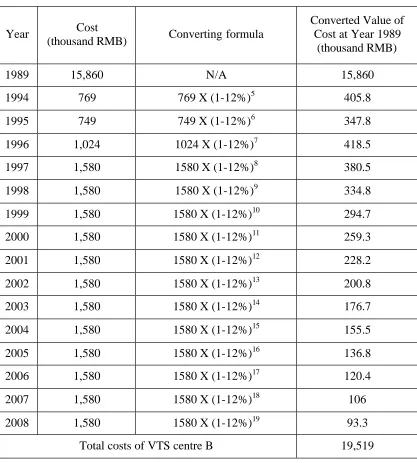
Table 4.4 Costs Calculation of VTS Centre B
Year Cost
(thousand RMB) Converting formula
Converted Value of Cost at Year 1989
(thousand RMB)
1989 15,860 N/A 15,860
1994 769 769 X (1-12%)5 405.8
1995 749 749 X (1-12%)6 347.8
1996 1,024 1024 X (1-12%)7 418.5
1997 1,580 1580 X (1-12%)8 380.5
1998 1,580 1580 X (1-12%)9 334.8
1999 1,580 1580 X (1-12%)10 294.7
2000 1,580 1580 X (1-12%)11 259.3
2001 1,580 1580 X (1-12%)12 228.2
2002 1,580 1580 X (1-12%)13 200.8
2003 1,580 1580 X (1-12%)14 176.7
2004 1,580 1580 X (1-12%)15 155.5
2005 1,580 1580 X (1-12%)16 136.8
2006 1,580 1580 X (1-12%)17 120.4
2007 1,580 1580 X (1-12%)18 106
2008 1,580 1580 X (1-12%)19 93.3
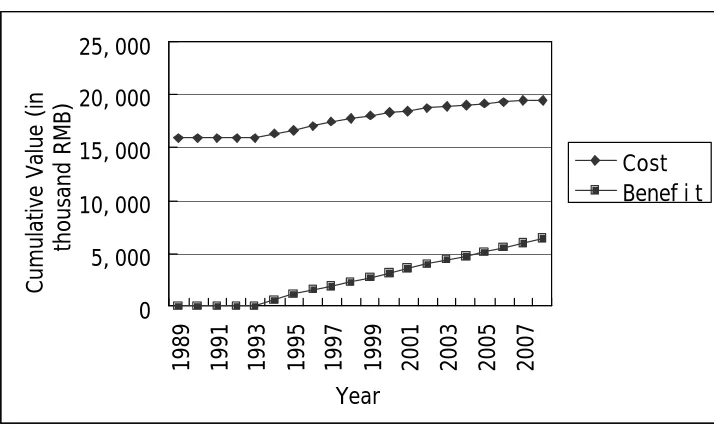
Total costs of VTS centre B 19,519
Note: the original data of costs are from “VTS Benefits Evaluation” (Fang & Zhuao,
1997).
Finally, the total converted cost of VTS centre B is 19,519,000 RMB.
4.2.2.4 Calculation of Benefits
As the benefits of VTS centre B could only be gained after the VTS was put into
operation in 1994, the benefits were estimated yearly after the year 1994. It is stated
in Chapter 2, the benefits of VTS are the costs that VTS saves. Therefore, all the
benefits are estimated here.
The benefits of VTS centre B can be divided into several categories, which are
benefits due to the decrease in maritime accidents; benefits due to an increase in
passing capacity; benefits due to a decrease of stopping navigation in fog; benefits
from environmental protection and other benefits that do not belong to the previous
categories. All the benefits must be converted to the value for 1989.
Table 4.5 Benefits Calculation of VTS Centre B
(All the figures are in thousands of RMB)
Year Benefit due to decrease in maritime accidents Benefit due to increase in passing capacity Benefit due to stopping navigation in fog Benefits from environment protection Other benefit Converted value of benefit in 1989
1994 170 737 60 0 38 530.4
1995 170 890 60 0 38 537.8
1996 170 778 60 0 38 427.5
1997 170 899 60 0 38 419.7
1998 170 1,038 60 0 38 413.3
1999 170 1,199 60 0 38 408.6
2000 170 1,384 60 0 38 404.9
2001 170 1,599 60 0 38 402.7
2002 170 1,847 60 0 38 401.4
2003 170 2,134 60 0 38 401.2
2004 170 2,464 60 0 38 401.5
2005 170 2,846 60 0 38 402.8
2006 170 3,288 60 0 38 404.7
2007 170 3,797 60 0 38 407.1
2008 170 4,386 60 0 38 410.2
Total benefits of VTS centre B 6373.8
Note: the original data of costs are from “VTS Benefits Evaluation” (Fang & Zhuao,
1997).