USF Scholarship: a digital repository @ Gleeson Library | Geschke
USF Scholarship: a digital repository @ Gleeson Library | Geschke
Center
Center
Master's Theses Theses, Dissertations, Capstones and Projects
1999
The Impact of Sexual Orientation on the Process of Identity
The Impact of Sexual Orientation on the Process of Identity
Formation in Adolescence as Measured Through Imaginary
Formation in Adolescence as Measured Through Imaginary
Audience and Personal Fable Ideation
Audience and Personal Fable Ideation
William Wasko Macatee
Follow this and additional works at: https://repository.usfca.edu/thes
THE IMPACT OF SEXUAL ORIENTATION ON THE PROCESS OF IDENTITY FORMATION IN ADOLESCENCE AS MEASURED
THROUGH IMAGINARY AUDIENCE AND PERSONAL FABLE IDEATION
A Dissertation
Presented to
The Faculty of the School of Education
Private School Administration
In Partial Fulfillment
Of the Requirements for the Degree of
Doctor of Education
by
William Wasko Macatee
direction of the candidate's dissertation
committee and approved by the members of
the committee, has been presented to and
accepted by the Faculty of the School of
Education in partial fulfillment of the
requirements for the degree of Doctor of
Education. The content and research
methodologies presented in this work
represent the work of the candidate alone .
. J
~----f-1
---.. ..
William Wasko Macatee
I
8',
/911
Dissertation Committee
111_~~~
S. Mary eter Trav1ss, O.P.TABLE OF CONTENTS ... .I
LIST OF TABLES ... vi
APPROVAL ... x
ACKNOWLEDGEMENTS ... xi
DEDICATION ... xii
CHAPTER I THE RESEARCH PROBLEM... 1
The Statement of the Problem ... 1
Background and Need for the Study ... 7
Purpose of the Study ... 16
Rationale for the Study ... 17
Research Questions ... 20
Significance ... 21
Limitations ... 21
Summary ... 24
Definition of Terms ... 25
CHAPTER II THE REVIEW OF THE LITERATURE ... 33
Research Overview ... 33
Identity Formation: The Contributions of Erikson and Bios ... 34
Adolescent Development: Intrapsychic Defenses and
Homosexual Identity Formation: Differences and Difficulties ... .47
Self-Identified Homosexuals: Intrapsychic Challenges to Identity Development ... 52
Self-Identified Homosexuals: Interpersonal Challenges to Identity Development ... 57
Summary ... 62
CHAPTER III METHODOLOGY ... 67
Restatement of the Study's Purpose ... 67
Research Methodology and Design.. . . 68
Population ... 68
Instrumentation ... 69
Validity ... 69
Reliability ... 70
Data Collection ... 75
Data Analysis ... 76
CHAPTER IV FINDINGS ... 79
Introduction ... 79
Research Question 1 ... 83
Research Question 2 ... 85
Research Question 4
Research Question 5
Research Question 6
Research Question 7
Research Question 8
Follow-Up Interviews
... 65
... 87
... 101
... 103
··· ... ··· ··· .105
... •.• ... 113
Question 1 . . . 115
Question 2 . . . 11 7 Question 3 ... 120
Question 4 ... 122
Question 5 ... 123
Question 6 ... 124
Question 7 ... 125
Question 8 ... 127
Summary of Findings ... 128
Research Question 1 ... 128
Research Question 2 Research Question 3 Research Question 4 Research Question 5 Research Question 6 ··· ... ··· ... 130
... 133
... ··· ... 134
.. ··· ... ··· ··· ... 136
... 138
Research Question 8 ... 139
CHAPTERV CONCLUSIONS, IMPLECATIONS AND RECOMMENDATIONS ... 142
Statement of Purpose ... 142
Conclusions and Implications ... 143
Recommendations for Professional Practice ... 155
Recommendations for Future Research ... 158
APPENDICES Appendix A Appendix B Appendix C Appendix D Appendix E Appendix F Appendix G Appendix H Appendix I Appendix J Appendix K Appendix L Demographic Questionnaire ... 161
New Imaginary Audience Scale... 163
New Personal Fable Scale ... 166
New Personal Fable Scoring Grid ... 169
California Psychological Inventory ... 171
Follow-Up Questionnaire ... 173
University Release Form ... 175
Parental Consent Form ... 179
Student Consent Form ... 182
Cover Letter ... 184
Abstract of Research ... 186
University Notice ofiRB Approval ... 189
Appendix N
Appendix 0
Appendix P
REFERENCES
to Grade, Sexual Orientation,
Age,Gender ... 191
Demographic Data ... 194
Correlation Tables ... 199
Correlation Matrix Grade 9 Heterosexual. ... 200
Correlation Matrix Grade 9 Homosexual ... 202
Correlation Matrix Grade 10 Heterosexual ... 204
Correlation Matrix Grade 10 Homosexual ... 205
Correlation Matrix Grade 11 Heterosexual ... 208
Correlation Matrix Grade 11 Homosexual.. ... 210
Correlation Matrix Grade 12 Heterosexual.. ... 212
Correlation Matrix Grade 12 Homosexual ... 214
Follow-Up Interviews ... 216
Response Sheet 1: M12-1 ... 217
Response Sheet 2: M9-2 ... 222
Response Sheet 3: M11-3 ... 227
Response Sheet 4: F12-4 ... 231
Response Sheet 5: F11-5 ... 234
Response Sheet 6: M12-6 ... 238
Response Sheet 7:M9-7 ... 241
Response Sheet 8: F 1 0-8. . . 244
··· 247
Table# Table Name Page
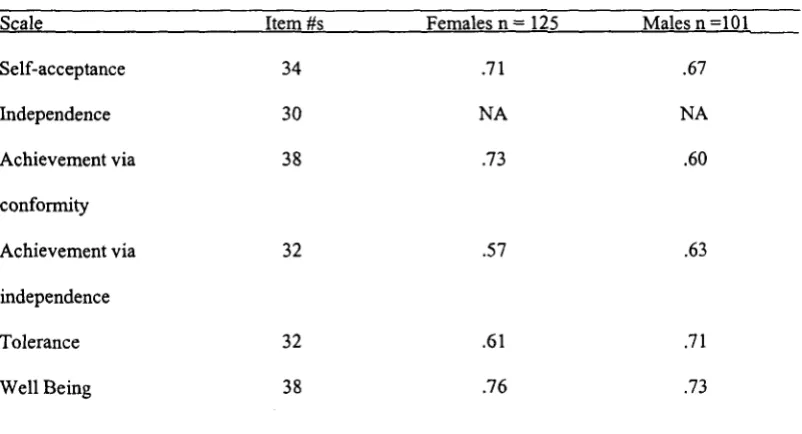
1 Internal Consistency- California Psychological Inventory- Self- 72
Acceptance, Independence, Achievement via Conformity,
2 3 4 5 6 7 8 9 10 11 12 13
Achievement via Independence, Tolerance, and Well being
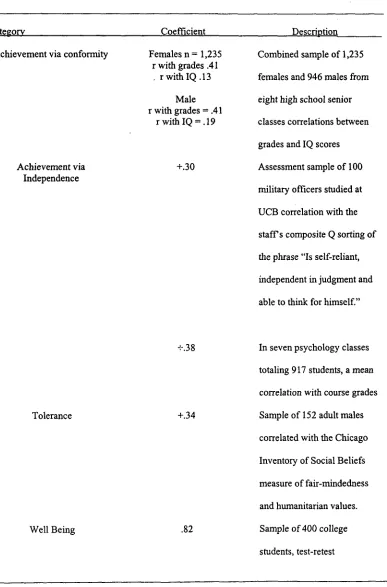
Coefficients of Reliability- California Psychological
Inventory-Self-Acceptance, Independence, Achievement via Conformity,
Achievement via Independence, Tolerance, and Well Being
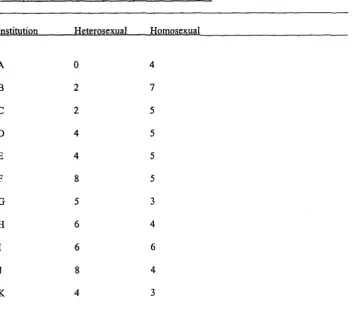
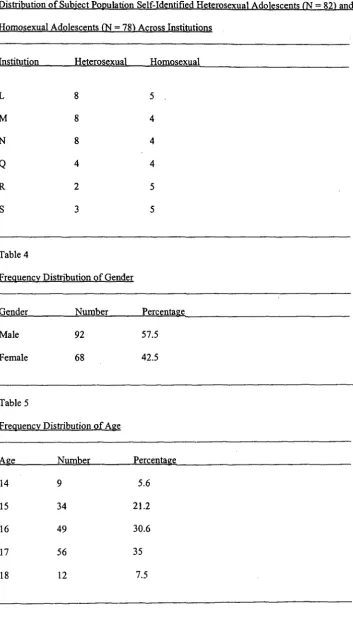
Distribution of Subject Population- Across Institution
Distribution of Subject Population - Gender
Distribution of Subject Population - Age
Distribution of Subject Population - Grade
Distribution of Subject Population - Orientation
ANOV A New Imaginary Audience Scale
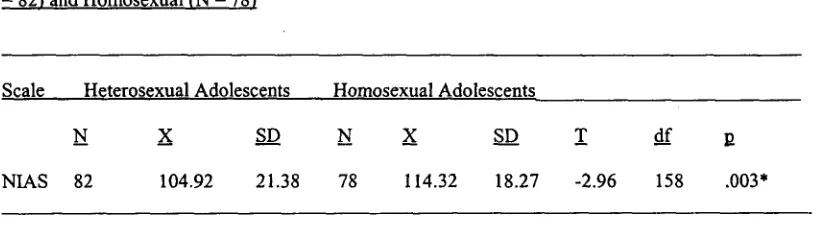
Comparison of Means and Standard Deviation ofNAIS Reported
by Orientation
Comparison of Means and Standard Deviation ofNAIS Reported
by Grade Level and Orientation
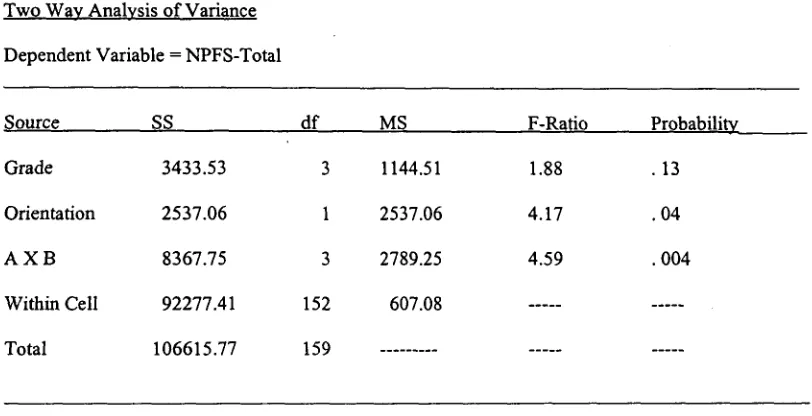
ANOV A New personal Fable Scale- Total Score
Comparison ofMeans and Standard Deviation ofNPFS-T Reported
by Orientation
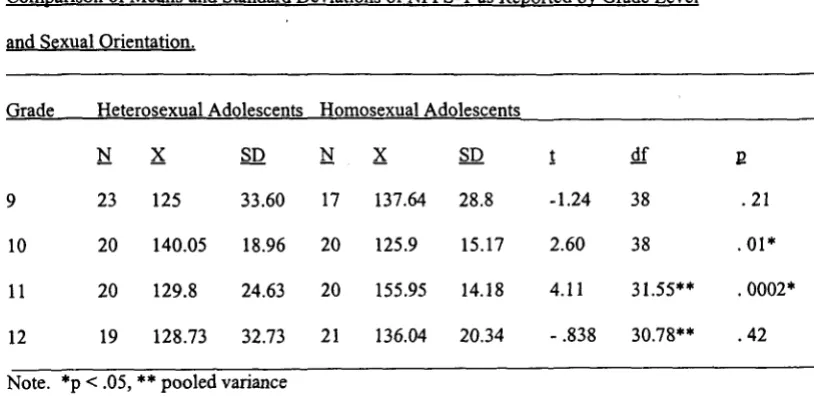
Comparison ofMeans and Standard Deviation ofNPFS-T Reported
by Grade Level and Orientation
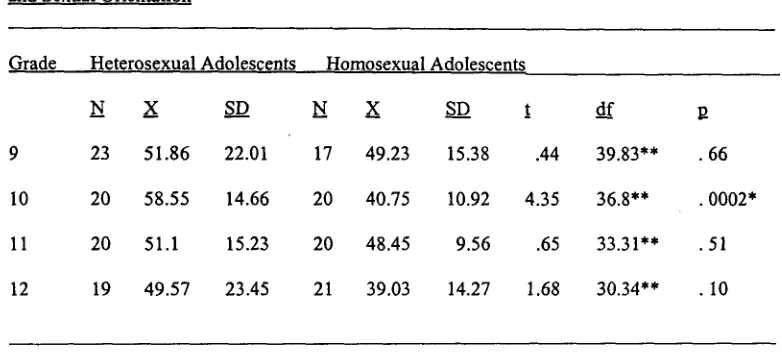
15 Comparison of Means and Standard Deviation ofNPFS-0 Reported 90
by Grade Level and Orientation
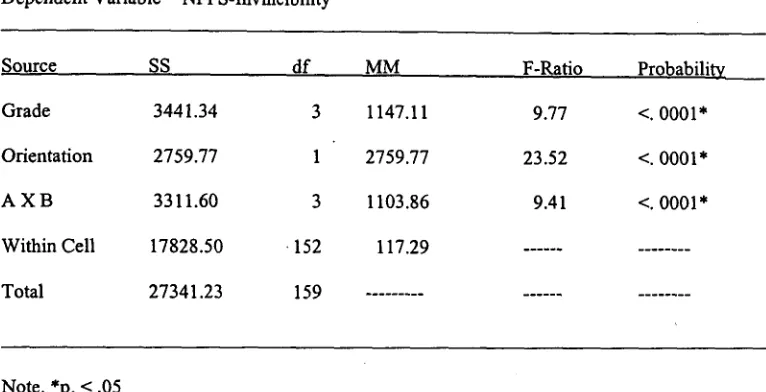
16 ANOV A New Personal Fable Scale - Invulnerability 91
17 Comparison of Means and Standard Deviation ofNPFS-I Reported 92
by Grade Level and Orientation
18 ANOV A New Personal Fable Scale - Personal Uniqueness 92
19 Comparison of Means and Standard Deviation ofNPFS-PU 93
Reported by Grade Level and Orientation
20 ANOV A Achievement via Conformity 94
21 Comparison of Means and Standard Deviation of Achievement via 94
Conformity Reported by Orientation
22 Comparison ofMeans and Standard Deviation of Achievement via 95
Conformity Reported by Grade Level and Orientation
23 ANOV A Achievement via Independence 96
24 Comparison of Means and Standard Deviation of Achievement via 97
Independence Reported by Orientation
25 Comparison of Means and Standard Deviation of Achievement via 98
Independence Reported by Grade Level and Orientation
26 ANOVA Well Being 99
27 Comparison ofMeans and Standard Deviation of Well Being 99
Reported by Orientation
Reported by Grade Level and Orientation
29 ANOV A Independence 101
30 Comparison ofMeans and Standard Deviation of Independence 102
Reported by Orientation
31 Comparison ofMeans and Standard Deviation of Independence 102
Reported by Grade Level and Orientation
32 ANOV A Self Acceptance 103
33 Comparison ofMeans and Standard Deviation of Self-Acceptance 104
Reported by Orientation
34 Comparison ofMeans and Standard Deviation of Self-Acceptance 104
Reported by Grade Level and Orientation
35 ANOV A Tolerance 105
36 Comparison ofMeans and Standard Deviation of Tolerance 106
Reported by Orientation
37 Comparison ofMeans and Standard Deviation ofTolerance 107
Reported by Grade Level and Orientation
38 Chi Square Values- Orientation, NIAS, NPFS, and 6 Subscales of 108
the CPI: Achievement via Conformity, Achievement via
Independence, Well being, Independence, Self-Acceptance, and
Tolerance
39 Comparison ofMeans ofNIAS, NPFS, and 6 Subscales of the CPI 109
by Orientation: Achievement via Conformity, Achievement via
40
41
42
Tolerance
Statistical Significance and Effect Size ofNIAS, NPFS, and 6
Subscales of the CPI by Orientation: Achievement via Conformity,
Achievement via Independence, Well being, Independence,
Self-Acceptance, and Tolerance
Summary Table of Statistically Significant Results
Demographic Data - Follow-Up Interview Respondents
ix
110
111
direction of the candidate's dissertation
committee and approved by the members of
the committee, has been presented to and
accepted by the Faculty of the School of
Education in partial fulfillment of the
requirements for the degree of Doctor of
Education. The content and research
methodologies presented in this work
represent the work of the candidate alone.
. ,J
~----f-/---"2-William Wasko Macatee
I
8 ,
/'111
Dissertation Committee
~~--..-?.-:..
9=
(Rev.) MicMetGaranzin: S.J.
I wish to thank the members of my dissertation committee for their
encouragement and unwavering support of this project. S. Mary Peter Traviss, O.P.,
Ph.D., and Virginia Shimaboukuro, Ed.D., ofthe Institute of Catholic Educational
Leadership and the Rev. Michael Garanzini, S.J., Ph.D., of Saint Louis University,
provided me a community of reflective scholars. Their insights, questions, observations,
and corrections have made this document a more valuable contribution to scholarship. To
them I owe my unending thanks.
Those adolescents who were willing to participate in this study made all the
difference in the world. Their willingness to open their lives to investigation provided a
glimpse into the developmental world of the homosexual and heterosexual adolescent
without which this study would have been impossible.
Without the assistance of my colleagues in the educational and counseling fields,
this study would have had a sample population of far fewer individuals and therefore,
quite possibly, have far less meaning and value. Thank you for your help.
Lastly, without the community ofiCEL and their challenges, questions,
reflections, prayers and companionship, I would not have dared to undertake this work
and quite possibly never have finished it.
The search for truth and justice never comes to an end and the value of a loving
and supportive community to assist in this search cannot be underestimated. I wish to
dedicate this work to those men and women who have shed light upon my life enabling
me to grow personally and academically.
This work is dedicated to the Fathers and Brothers of the Society of Jesus and the
Dominican Sisters of Mission San Jose. Their undying faith in the light of truth, and their
commitment to justice for all, will always be an inspiration to me. What these men and
women have given to me I can never repay. Thank you. I will pray for your works
always and seek truth and justice in line with Saint Ignatius' admonition to think
carefully within the Church.
Finally, I wish to thank two men who have brought light and happiness to my life.
J. Edward Macatee, Jr., by your example you teach me still that each day oflife can be
lived in honesty and with integrity. Love, freedom, faith and a passion for justice are
your gifts to me. Your presence has graced my life for 42 years; and I will cherish each
and every additional year to come and your memory forever. Mark Wasko Macatee,
without your love and support I would find life far less enchanting. You have enriched
me and our shared life as you gently call us to truth, honesty, faith, and love. You
continue to show me that there is no shame in being afraid, so long as one can share this
fear with another. You reflect God's love in my life most fully! I can think of no greater
gift than this.
THE RESEARCH PROBLEM
Statement of the Problem
For many children about to enter adolescence, there is the happy expectation of
increased freedom accompanied by dreams and fantasies of success in the classroom, on
the athletic field, and in social encounters. Yet, as adolescence proper begins, it quickly
becomes obvious to the adolescent himself, his peers, teachers and family that many of
his dreams and fantasies of success have taken on a nightmarish quality1• Where
certainty and self-confidence once filled his days, now the smallest questions fill him
with doubt and anxiety. His every experience is magnified by his acute awareness of
himself and the belief that he is the complete focus of everyone's attention.
At no time other than the earliest stages of infancy is there a more volatile and confusing
developmental leap than during adolescence. "During this period of
growth--comprising roughly the first two decades of life -- there is a progressive personality
differentiation and integration" (Bios, 1962, p. 3). It is during this dynamic period that
the young person renegotiates her position in the family establishing a new perspective
from which to view her many relationships. Occupying this newly found place among
family and friends, the adolescent faces a multiplicity of challenges brought to light by
her changing perspective. The once simple task of being part of the family dinner, to cite
one obvious locus ofinteraction in the family, often takes on the character of an obstacle
1
course where relationships have become complex and often unfamiliar. Family intimacy,
once easily obtained now requires a serious effort to maintain.
The family table serves as a metaphor for a developmental plateau in adolescence
where greater intimacy may be fostered and the potential to form healthy intimate
relationships discovered, practiced and mastered. At this time the success or failure of
the adolescent's attempts at forming affectionate and meaningful relationships is
dependent upon both her ability to skillfully and honestly maneuver her way through
complex relationships as well as upon the degree of social maturity present in her family
and passed on to her through her interactions with and observations of her parents,
siblings, peers, and significant adult mentors.
As Blos (1962) stated, "We witness at adolescence a second step in individuation
which leads in its final step to a sense of identity" (p. 12). According to Erikson (1968),
many of the crises first faced during infancy and childhood will now resurface and again
the adolescent will need to discover pathways that foster continued development. Yet, if
these crises were never successfully addressed at their first appearance, this second
appearance may overwhelm the adolescent, resulting in emotional withdrawal and
physical isolation as a protection against the surrounding society.
To navigate this difficult developmental period, adolescents develop defense
mechanisms that are aimed at maintaining a balance between their need for individuation,
assertion and personal identity development, and their need for connection, support and
socialization. Maintaining this balance is crucial for success in psychosocial
development. As Mahler (1968) pointed out, the adolescent's ability to participate in
of support received as a teenager. For those adolescents who are members of a minority
or cultural sub-group, the vicissitudes of this developmental stage are further complicated
by their isolation from the overall population. The isolation of the homosexual
adolescent from her parents, siblings, peers and other significant adults may create an
environment hostile rather than nurturing to her identity development and socialization.
This isolation may result in a teenager who experiences the anxieties of this period
without the support of any nurturing community. Isolated from both her family and peer
group she is confronted with images promoting self-doubt or even self-hatred. The
homophobia and heterosexism of the larger society may all but extinguish what little
self-acceptance and self-esteem she may have once possessed. "The one-in-ten gay and
lesbian children who absorb these attitudes and [come to] realize their sexual orientation
during preadolescence and adolescent years become victims ofthe[ir] parents'
homophobia" (Besner, & Spungin, 1995, p. 47).
Researchers (Malyon, 1981; Remafeidi, 1987; Troiden, 1989; Besner, & Spungin,
1995) have observed that both the emotional and psychological developmental processes
of self-identified homosexual adolescents differ from heterosexual adolescents in that the
self-identified homosexual adolescents are directly affected by the hostility of the greater
society. The degree of cultural stereotyping present in the media alone draws negative
attention to these self-identified adolescents. As a result of this negative attention the
self-identified homosexual adolescent's needs for defensive protection may be greater
than those ofhis heterosexual counterparts.
Since Kinsey's (1948) landmark survey of male sexual practice there has been
Institute study reported in the journal, Science (1990), estimated that 1.4 percent ofthe
adult male population had frequent homosexual contacts. An additional 1. 9 percent of
men had adult homosexual experiences whose frequency was characterized as
"occasional." Taken together, these two groups represent 3.3 percent of the adult male
population (Fay, 1990).
Not only is the percentage of the population who may be homosexual brought into
question by these research findings, additionally, developmental psychologists are not
unanimous in their assertion of the age at which one comes to "know" one's sexual
identity. These are significant questions, yet they need not preclude our examination of
the internal dynamics ofthose adolescents who self-identify as homosexual. For
purposes of this study and for the sake of greater understanding of this population, the
fact of an adolescent's self-identification as homosexual renders less urgent the
conversation of the percentage of the population who is homosexual as well as sets aside
the search for the etiology of homosexuality. More importantly, the self-identified
homosexual teenager lives in a world of negative stereotypes and misconceptions, which
color the behaviors and attitudes of others. The behaviors and attitudes of others effect
the self-identified homosexual's struggle for health and wholeness. The adolescent, who
believes that she is homosexual, exhibits the anxiety and stress that accompany some who
are alienated from society and this anxiety and stress may require intervention if she is to
remain a healthy and productive participant in society.
If an adolescent believes that he is homosexual, this conscious act of
self-identification may bring him to the attention of those opposed to his presence at home, in
serious problem, for it is the act of conscious identification itself that potentially brings
the adolescent face to face with the humiliation, stigma, homophobia, and violence of his
own and others' reactions. Whether or not he is homosexual is not the most pressing
issue. What deserves immediate attention is the adolescent's act of self-identification, for
by this action he becomes a victim of the homophobia and heterosexism of the
surrounding culture. On the one hand, the self-identified homosexual adolescent may
benefit from his identification with the homosexual community where he may find
like-minded individuals with whom to share his concerns. Yet, on the other, he may suffer as
a result of this identification being open to the homophobia of the general culture. What
mental and physical health services, curricular programs, and community supports are
available to help this individual navigate the remaining years of adolescent development?
Whether the percentage of the population who is homosexual is 10 percent, 5.4 percent, 2
percent, or even 1 percent, these individual members of our community are poorly
understood and often the victims of ignorance and prejudice.
Homosexual adolescents generally find themselves isolated from positive
relationship role models. They live in a society frequently hostile to their
self-identification and relationships and, therefore, are often unable to seek out other openly
homosexual people to develop a support structure, which may provide some familiarity
and comfort (Cates, 1987; Herdt, 1989; Herdt, & Boxer, 1993). According to researchers
(Malyon, 1981; McFarland, 1993), self-identified homosexual adolescents remain
isolated as they attempt to develop relationships that are socially satisfying,
psychologically healthy, and emotionally fulfilling. Besner and Spungin (1995)
from society and become isolated. Becoming aggressive, they may release their
frustrations on other homosexuals while also internalizing this aggression resulting in
devastation to self-concept and in the adoption of self-destructive behaviors.
It is possible that, as a result of the intense social pressure to conform to the
heterosexual framework of adolescent relationships, the interpersonal and intrapsychic
defense mechanisms adopted by self-identified homosexual adolescents may be more
difficult to abandon. This prolonged defensive stance adopted by the self-identified
homosexual adolescent may contribute to her inability to more fully participate in
intimate and affectional interpersonal peer relationships during a developmental period
when interpersonal experimentation is a vital part of the developmental process.
In an attempt to push back boundaries of isolation, society has created institutions
that support those in need. These institutions frequently assist adolescents to deal with
issues of isolation and intimacy. Yet, to the extent that schools and community
organizations are preoccupied with helping adolescents deal with heterosexual boundary
issues, they serve homosexual adolescents little, if at all. To the extent that community
services are informed by the larger cultural prejudices against homosexual behavior, they
negatively impact the development ofhealthy self-acceptance and self-esteem. To the
extent that the social surroundings presume a heterosexual orientation, those teens
struggling with issues of sexual identity may remain confused and doubtful. Defensive
internal structures help all adolescents deal with the stress and anxiety of socialization.
For homosexual adolescents these defensive structures may have been developed
specifically to ward off overwhelmingly negative images resulting in increased stress and
overcome and leave behind. In sum, then, the self-identified homosexual adolescents are
little understood and poorly assisted by these institutions- family, school, social
agencies, etc., - and run the risk of internalizing the anti-gay prejudices which surround
them. More accurate knowledge of the internal dynamics surrounding the formation of
self-identity in gay adolescents would lead, potentially, to better assistance and support.
Background and Need for the Study
Human psychological development involves reactions to and interactions with, as
well as appropriation and assimilation ofthe environment in its complexity (Bios, 1962;
Erikson, 1963, 1968; Troiden 1985, 1988, 1989; Cass, 1983, 1984). As development
continues, an ever-widening circle of persons, beyond family and playmates, begin to
impact the formation of a coherent sense of self.
Crucial to the successful development of the human person is the establishment
of a personal identity. Erikson (1968) pointed out that the human person's identity is
"never established as an achievement in the form of a personality armor, or of anything
static and unchangeable" (p. 24). Rather, human identity is the result of constant
interaction with the environment. Messages presented in various forms act as catalysts in
the formation ofhuman personality and identity. Experiences of the consistency of
mother's or father's voice and touch carry within them the cues which call forth the
emergent identity giving the infant its first "sense" of self related to some other
individual. Erikson saw this process of personal identity formation taking place as a
result of"two simultaneous observations: The perception of the selfsameness and
recognize one's selfsameness and continuity" (p. 50). This exchange is central to the
development ofhuman identity.
Adolescence is a critical developmental period, but it has been preceded by
significant developmental challenges during the first years of life. The infant,
experiencing mother or father as constant and experiencing her needs being met, begins
to develop a basic sense oftrust that can be outwardly observed in her reactions to the
environment. This developing sense of trust forms the ground upon which her further
development takes place.
It is this sense of trust that allows the infant to reach out in experimentation to the
world around him. He may initiate interaction and discover that the world can and will
provide a means of satisfaction and support for his actions. Through these experiences
the infant gains a deepened sense of his autonomous self and a sense of satisfaction that
will later result in an ability to regulate the sense of guilt that rises out of his experience
of his parents as objects ofboth love and hatred.
As the infant continues to grow gaining more and more use of her physical body,
this sense of trust infuses her whole life. As her ability to move about grows, she
separates from her parent and develops a sense of autonomy without which she might
never initiate action leaving her an unproductive member of society adrift in every
shifting current and trend. If she is unsuccessful in establishing herself as an active
member of society, she will remain at the mercy of the other more active and productive
members of her peer group (Erikson, 1968). The development of a sense of autonomy
and the resulting potential for personal initiative rest squarely upon that all-pervasive
child progresses in development becoming more and more a socialized "individual", she
will begin to seek out additional companions with whom she may accomplish tasks. Play
takes on a deeper meaning for the child at this time as she works out the rules and comes
to understand the expectations of others with whom she plays. Kegan (1980) described
this developmental step as an evolutionary motion, a "pool" of ideas, feelings,
expressions, and sounds which are constitutive of the formation process ofhuman
identity.
The distinction of self from others sets the stage for the continued formation of
identity which Mahler (1968) and Erikson (1963, 1968) saw as the central psychological
achievement of the infant. The infant now has a sense ofbeing more than his feelings.
Prior to this achievement the infant did not distinguish between feelings and self, now the
distinction is impossible to ignore. The process once begun continues throughout life
(Kegan, 1980). As the infant continues to develop physically, his experience ofthe world
begins to deepen. He now stands alone developing a new sense of autonomy, of being
separate from the object of his experience. For this developmental journey to continue,
the child needs an environment that is supportive, one that protects him from
overpowering shame and doubt. The constant support of his caregiver shields him in his
vulnerability from the world (Erikson, 1963, 1968).
Individuation and identity formation are ongoing processes. They are the
stepping stones along the pathway linking adolescence with later psychosocial
developmental stages. Individuation and identity formation lead to a sustained sense of
personal identity. The adolescent's continued identity development and separation from
In order to progress developmentally, each individual must successfully undertake an age-appropriate resolution of the ongoing dialectic of separateness and
connectedness which ideally results in an optimal balance between individuation (self as individual) and interdependence (self as related to other). (Allison, &
Sabatelli, 1988, p. 3)
Adolescent development is not restricted to the interpersonal level and, as the
adolescent develops interpersonally, shifts in perspective and awareness of the self also
occur on the intrapsychic level as one attempts to find a comfort zone with oneself.
An important dynamic involved in the intrapsychic process of development as
outlined by Bios (1962, 1967), Elkind (1967, 1979, 1985), and Lapsley (1985, 1985b,
1988, 1989, 1993), is the experience of adolescent egocentricism. Elkind (1967) defined
egocentricism "as a lack of differentiation in some areas of subject-object interaction"
(p.l 025). In other words, egocentricism signifies an inability to de-center, to attune
oneself to the other, and is, therefore, a sign of immaturity and a stumbling block to
interpersonal connectivity. As the individual moves through the developmental process,
each successive stage acts as the catalyst moving the adolescent from one egocentric
behavior to the next that is specific to age and developmental position. Adolescents
living in an environment rich with models of relationship and intimacy do have a
developmental advantage over adolescents who are either unaware of these relationships
and intimacies or who live in an environment empty of them. These models help the
adolescent internalize attitudes and behaviors, which are, hopefully, less self-centered
and self-serving, thus allowing for a gradual abandonment of the "egocentric" position in
early adulthood.
Adolescent egocentric ism is apparent in the social interactions of teens.
center of each and every other person's attention and anticipate the reactions of other
people to themselves. Elkind (1967) himself referred to this as a characteristic "failure of
thought" leaving the adolescent with the belief that he is indeed the very center and focus
of the attention of others. At the same time, "while the adolescent fails to distinguish
between his own concern for himself, he tends to over-differentiate his feelings from
those of others and he comes to regard himself, and particularly his feelings, as
something special and unique" (p. 1030). The over-differentiation ofhis feelings from
those of others may be seen as an ego defense where the separation and exultation of his
feelings as more intense and completely different allows him to develop a "mythology"
or "fable". "This complex ofbeliefs in the uniqueness of his feelings and ofhis
immortality might be called a personal fable, a story which he tells himself and which is
not true" (p. 1029). These dynamics of egocentricism as exhibited in imaginary audience
and personal fable ideation seem to diminish with the continued experience of the real
audience, and a growing appreciation of one's similarities with others.
Whereas Elkind (1967) described adolescent egocentricism as a differentiation
failure or "lamentable feature," characteristic of adolescent development and needing to
be overcome, Daniel Lapsley ( 1993) recognized the value that this concept held for the
study of adolescent development. He described this egocentricism not as a differentiation
failure but as a necessary and potentially helpful aspect of identity formation. Elkind
( 1967) described imaginary audience as the tendency of the adolescent to see the self as
the center and focus of others' attention leading to a tendency to anticipate the reactions
of others to the self in real or imagined situations. Lapsley (1993) recognized this as a
differentiation process and vital to the successful completion of identity development. A
working definition of this ideation based upon Lapsley's work may be a defensive and
restive concomitant of adolescent ego development that is constructed during the
separation-individuation process that functions as an important coping mechanism
contributing to the resilience of the adolescent as one faces the trials and crises of
growing up. For this research, adolescent egocentricism is seen as a means to further
differentiation and healthy development and is vital to the continued socialization of the
adolescent. These so-called "defensive structures" serve the useful purpose of helping
the adolescents adjust to the perceptions of others- to see themselves as they are seen.
These mechanisms also begin the process of creating a history, or sense of oneself as
shaped by unique personal forces, circumstances, and conformity to one's uniqueness as
an individual.
Identity formation includes numerous elements and hurdles. Elkind (1967) has
identified two intrapsychic phenomena or aspects called imaginary audience [IA] ideation
and personal fable [PF] ideation, which give us a window on the psychic life of the
teenager. By imaginary audience, Elkind (1967) is referring to the common experience
of adolescence where teenagers construct an attentive and judgmental audience. This
audience serves to reinforce the ego strength of the adolescent as she moves through the
process of individuation in an attempt to establish a greater sense of independence. Up to
this time in development, the adolescent's parents had provided the necessary ego
support. Yet, as she continues to progress developmentally, the adolescent creates greater
distance between herself and her parents in an attempt to forge a new and deepening
relationship. Where the parent once provided the support necessary for her experiments
in peer relationship, perhaps pushing the adolescent into new social roles, the imaginary
audience now provides the opportunity and catalyst that allow the adolescent to continue
to experiment with social role playing. Were it not for the presence of the imagined
audience and its approval and disapproval, Lapsley proposes, the adolescent would have
no one upon whom to rely for support and would therefore be forced to retain parents as
the primary means of ego support and social relationship. It is the adolescent's imagined
relationships and imagined intimacy that provide the necessary practice for future
relationships and intimacies with real members of a peer society.
By personal fable ideation Elkind (1967) is referring to those fantasies and
thoughts regarding self-identification and self-awareness of personal strength,
uniqueness, invulnerability and importance. These ideations allow the adolescent to
establish and maintain both real and imagined relationships while at the same time
maintaining an emotional stance that elevates feelings to a place of importance all their
own. The intensity of these imagined peer relationships can be maintained only if there
remains a belief that one is unique and invulnerable to the criticisms and attacks of
others. This belief acts as a buffer shielding the adolescent from the continual awareness
that he is being judged by those with whom he is in relationship therefore allowing him to
further experiment with personal relationships. Thus, through the mechanism of
imaginary audience, the adolescent surrounds himself with a critical and supportive peer
culture, and through personal fable is able to forge a unique sense of self and deal with
disapproval and criticism. By focusing on these aspects of development in homosexual
identity formation of self-identified homosexual youth from their self-identified
heterosexual counterparts.
The imaginary audience created by the adolescent as a defense against the erosion
of other ego supports plays a positive and central role in the continued integrity ofthe
adolescent ego. Consideration of how others view him helps the adolescent appreciate the
larger social milieu in which he must necessarily operate. As the adolescent becomes
increasingly aware that others are not solely focused upon him as the object of their
attention, and is increasingly able to take the perspective of these others, imaginary
audience begins to fade leaving the adolescent with a new sense of belonging to a
community of real individuals. It is within this community of real individuals that the
adolescent first discovers that the feelings and beliefs of others are in many ways similar
to his own. Sharing feelings and beliefs allows for the capacity for intimacy in human
relationships, gradually removing the need for imaginary audience. Both internal
defenses and external supports are necessary, then, for the adolescent to develop
successfully.
Homosexual adolescents face their developmental hurdle with two challenges: a
potentially more hostile environment and more harsh, punitive intrapsychic ideations. In
other words, if the developmental process of adolescence is difficult for the heterosexual
individual whose models, cues, conscience, and ego identity are all in tune with the
dominant culture's attitudes and beliefs regarding sexual intimacy, how much more
difficult might it be for the adolescent who is unsure of sexual orientation and thus a
well as self-identified homosexual adolescents, face a dual problem not shared with their
heterosexual counterparts.
In sum, Lapsley (1993) maintained that, imaginary audience is diminished on the
cognitive plane by the gradual differentiation between one's own preoccupation with
oneself and the thoughts of others. On the affective plane, he maintains that one's
personal fable is overcome by the gradual recognition of similarity and integration of the
feelings of others with one's own feelings. One might then ask oneself how do
homosexual adolescents fare in their struggle to achieve a healthy differentiation and
integration of personal identity? Certainly, the homosexual adolescent's preoccupation
with the attention of others and the feeling that one is the center of and the object of
others' attention is a strong perception. In this case the imaginary audience and the real
audience may merge to become a threatening and judgmental audience whose hostility is
in evidence in the daily experiences of these adolescents. Derogatory remarks and slurs
about homosexuals are common among adolescents as anyone working with teens will
attest.
Additionally, if personal fable ideation is diminished by a growing capacity for
intimacy, then adolescents who are unsure of their sexual orientation as well as
self-identified homosexual adolescents may harbor some confusion and doubt and remain
largely unable to experiment with intimacy. Many, if not most, live in communities
where intimacy between same-gender parties is considered taboo and unacceptable and
may even be illegal.
For all adolescents, the socialization experiences of this developmental period
critical, negative voices "on the outside" contribute to a poor and debilitating sense of
self unless the adolescent has opportunities to critique these voices. Those opportunities
come most often from supportive peers and adults. Homosexual adolescents without the
support and love of peers and adults run the risk of a truncated or distorted identity.
Their ability to participate in life-giving intimate relationships as adults, theoretically,
depends largely upon the degree and kind of support they receive as teenagers through
healthy models of relationship and through words of encouragement and acceptance. The
homosexual teen faces greater hurdles and obstacles in negotiating the path to maturity.
PUipose of the Study
The purpose of this study was to identify and compare developmental differences
in the way self-identified homosexual adolescents and self-identified heterosexual
adolescents use imaginary audience and personal fable ideation in the process of identity
formation. Furthermore, correlations between the levels of imaginary audience and
personal fable ideation and the responses to the subscales on the California Psychological
Inventory [CPI] were obtained to identify key areas and the degree of difference in
identity development for self-identified homosexual adolescents as compared with the
development of self-identified heterosexual adolescents in general maturity as measured
by the CPl.
It is hypothesized that if differences exist between the developmental processes of
individuation and identity formation in self-identified homosexual adolescents and that of
self-identified heterosexual adolescents, these differences could negatively impact the
ability of the self-identified homosexual adolescents in a variety of ways affecting such
comfort with issues of vulnerability, self-acceptance and intimacy. Again, these
differences may ultimately make the self-identified homosexual's experience of
adolescence a more complex developmental process than the experience of the
self-identified heterosexual adolescent. In light of this possibility, research is needed in this
area to identify developmental differences faced by self-identified homosexual
adolescents.
Rationale for the Study
The conceptual framework for this study was based upon Erik Erikson's (1963,
1968) stage theory of identity development, David Elkind's (1967) theory of adolescent
egocentricism and upon Daniel Lapsley's (1993) "new look" or integrative theory of
adolescent ego development. Erikson's theory was outlined previously in the
"Background and Needs" section of this study. At this point a brief review of the work of
Elkind (1967) and Lapsley (1993), dealing with adolescent stage theory, will be helpful.
Elkind's (1967) theory rests upon the work ofPiaget and other Cognitive
Developmentalists. It relies upon progressive cognitive development to move beyond the
egocentricism specific to one's current cognitive developmental stage. He refers to the
specific result of each stage as "characteristic differentiation failures which are
lamentable features of development" (p. 1 028).
Lapsley (1993) stated that, as the adolescent goes through each successive stage,
he is more capable oftaking the perspective or role of the "object other" with which he is
relating. Selman ( 1990) has defined this process as "the child's capacity to differentiate
and integrate the selfs and other's points of view through an understanding ofthe
In adolescence, youth experience both cognitive and affective dissonance
resulting from these progressive moves. According to Lapsley (1993), during the
developmental process both imaginary audience and personal fable ideation play a
constructive role. Unlike Elkind (1967), Lapsley's (1993) "new look" suggests that these
ideations are "not merely unfortunate and lamentable features of adolescent
development, but are, in fact, important coping mechanisms that contribute to the
resilience of adolescents as they face the travails of growing up" (p. 567). Lapsley posits
that the diminution of these two ideations results from the adolescent's continued
exposure to the reality of others' ideas and perceptions in the social cognitive setting.
This diminution allows for the movement to the next level of "perspective taking" where
the adolescent is now capable of seeing the difference between what she holds as object,
and what is held as object by others. As the perceptions of others are seen to be different
from her own perceptions, the reality of the subjectivity of the other becomes a more
permanent factor in her conscious life.
As the adolescent becomes more comfortable with his new status, he becomes
more satisfied with himself and with his social interactions in general. Yet, the
adolescent who is faced with an ever-growing awareness that he is unlike others will be
plagued with questions regarding the "rightness" or "wrongness" of these differences.
Additionally, as Lapsley has pointed out, if further healthy development is dependent
upon the diminution of imaginary audience and personal fable ideation allowing for a
greater awareness of the reality of intrapsychic and interpersonal relationships, then the
developmental path of the self-identified homosexual adolescent may be less easily
ever, include acceptance and ease of identification. On the contrary, homosexual
adolescents are forced to hide from their friends, family, and peers in order to maintain a
place in society (Herdt, 1989; Malyon, 1981). On the other hand, if the adolescent has
found that he has been supported and accepted by his peers, he may be more inclined to
acceptance as well. Those adolescents living with social acceptance will find
self-acceptance is enhanced. Conversely, those adolescents who believe they must not share
their feelings and desires will .continue to doubt their own "acceptability" in their social
surroundings and in their intrapsychic world as well.
Over time, the self-identified homosexual adolescent may very well find herself
less able to deal with questions of difference. Unable to honestly approach society in the
communities of her peers, teachers, and family members, self-identified homosexual
adolescents may be ill equipped to reflect upon diversity as a rich and vital source for
creativity and expression. Unlike her peers who have self-identified as heterosexual, and
therefore may be more likely to find acceptance, the self-identified homosexual may find
at times that she is intolerant even of herself. This intolerance may lead directly to a
serious lack of self-acceptance and additionally to an inability to share herself with
others, further crippling her in her attempts to discover and deepen her sense of
self-acceptance as well as her tentative approaches at intimacy with others.
Lacking a capacity for intimacy with herself as well as with others, the
self-identified homosexual adolescent may find it more difficult to approach society as a
productive member since she lacks the capacity for self-acceptance and self-confidence
necessary for deep and meaningful membership in society. It is easy to see how such
less able to find the support and assistance necessary for continued healthy psychological
growth. The reciprocal relationship of these developmental challenges on the road to
intimacy and identity make the study of adolescent intrapsychic and interpersonal life
both urgent and complex.
Research Questions
This study examined the developmental differences and difficulties faced by
self-identified homosexual adolescents as compared with self-self-identified heterosexual
adolescents through an investigation ofthe following questions:
1. Is the measure of imaginary audience ideation greater for self-identified homosexual
adolescents than it is for self-identified heterosexual adolescents?
2. Is the degree of personal fable ideation greater for self-identified homosexual
adolescents than it is for self-identified heterosexual adolescents?
3. Is the degree of achievement via conformity greater for self-identified heterosexual
adolescents than for self-identified homosexual adolescents?
4. Is the degree of achievement via independence greater for self-identified homosexual
adolescents than it is for self-identified heterosexual adolescents?
5. Is the degree of well being greater for self-identified heterosexual adolescents than it
is for self-identified homosexual adolescents?
6. Is the degree of independence greater for the self-identified homosexual adolescent
than it is for self-identified heterosexual adolescents?
7. Is the degree of self-acceptance greater for the self-identified heterosexual adolescent
8. Is the degree of tolerance greater for the self-identified homosexual adolescent than it
is for self-identified heterosexual adolescents?
Significance
This study investigated the relationship between identity development and social
maturation in self-identified heterosexual and homosexual adolescents and aspects of the
relationship between identity development and sexual orientation. Its purpose was to
provide information concerning the differences and difficulties faced by self-identified
homosexual adolescents possibly showing differences in degree of intensity and duration
of this process for the self-identified homosexual.
It has been shown that self-identified homosexual adolescents may differ from
self-identified heterosexual adolescents in the degree of intensity oftheir experiences of
imaginary audience and personal fable ideation. There is narrative evidence and evidence
from the assessment of personality characteristics further confirming this difference in
object relational concerns, and in light of these findings a more sustained and intensive
effort to understand the developmental differences of homosexual teenagers is needed.
Limitations
The population for this study consisted of and was limited to self-identified
homosexual adolescents and self-identified heterosexual adolescents currently enrolled in
private, public or Roman Catholic high schools in the City and County of San Francisco,
Contra Costa, Alameda, and San Mateo counties (Table 3). Tolerance among students in
the San Francisco Bay Area may be greater than in many other areas of the nation. Since
the early 1960s, in the San Francisco Bay Area, there has been a highly visible and
attention to itself and its needs and in so doing has raised the consciousness of the larger
community to its presence. This community has also been very politically active in
education and other programs designed to reach out to minority students. As a result of
this activity, most public and many private and Catholic schools in the area have formal
or informal programs in place to deal with issues of sexual orientation, cultural diversity
and tolerance. As part ofthese formal or informal programs, issues of importance to the
homosexual community are addressed. This has led to the creation of a more visible
adolescent homosexual community, which has also become increasingly politically
active. The degree of visibility brought to the homosexual community as a result of their
political and civic involvement alone has helped create an environment that may be more
tolerant of differences among its membership. This tolerance may have affected the
results of this study and therefore the results may not be generalizable beyond the
geographic population studied. To the extent that difficulties and hurdles in development
have been found however, we might hypothesize that less open and less tolerant
environments may lead to even greater struggles for those teens who are dealing with the
issues of sexual orientation. Also, one may hypothesize that, regardless of the level of
public tolerance, adolescents who identify as homosexual will face similar issues,
concerns and intrapsychic hurdles.
The power of any statistical analysis will be limited by the volunteer nature of the
sample ofboth the homosexual and heterosexual adolescents. Generally, those persons
willing to volunteer to participate in research such as this are highly motivated and
therefore may come to the research with opinions, ideas, beliefs, and agenda that will
There remain many areas of influence that are beyond the control of any
investigation like this such as the home environment and the practice and belief structures
ofthe religions of the subject. Parental, familial, and religious influences have been
shown to influence the belief structures of adolescents (Cates, 1987; Erikson, 1963,
1968;Levy-Warren, 1996; Savin-Williams, 1989). Adolescents growing up in an
environment that is intolerant of others may have a tendency to exhibit the same
intolerance toward people who are in any way different from themselves.
Because of the nature of any study dealing with issues of sexual orientation and
identity development, there is a possibility that only those adolescents who have
previously "come out" would have been available to the researcher. The process of
coming out and the sense of empowerment that this brings may also have had an effect
upon both the statistical and narrative outcomes of the study. Just how heterosexual and
homosexual adolescents differ in the ways they negotiate these intrapsychic mechanisms
of defense, is potentially helpful in our efforts to understand the developmental process of
Summary
The experience of adolescent development brings a renewed movement forward
in the development of identity. This experience for the self-identified homosexual
adolescent may be more complex than it is for self-identified heterosexual adolescents
resulting in developmental differences. This study proposed to examine the
developmental differences and difficulties faced by self-identified homosexual
adolescents as they progressed through the process of identity development and
compared it to the development of self-identified heterosexual adolescents.
Hypothetically, the intrapsychic and personality trait differences between these two sets
of adolescents will lead to a greater understanding of the process of identity development
for homosexuals and, furthermore to the development of curricular and counseling
Definition of Terms
Adolescence
A period between puberty and maturity as well as a state of mind. Approximate ages are
12-21 for females who mature earlier than males, and 13-22 for males. Adolescence is
a time marked by rapid change both physically and emotionally often referred to as the
most turbulent period in the development of the human person from dependencies to
independence, from psychological enrichment in the family of origin to emergent
independence the family of origin.
Autonomy
The state of self-regulation. Erikson (1963, 1968) saw autonomy as having a vital role in
the processes of socialization for the adolescent allowing him to move out on his own
into society. Autonomy is a necessary quality for an adolescent to possess if he is to
experiment, develop, and maintain healthy intimate relationships with his peers.
Assumption of Heteroeeneity
The assumption held by many persons that all persons are the same having similar
psychological, emotional, sexual, and affective needs and whose actions, choices, and
behaviors are similar (Herdt, 1989).
Assumption of Heterosexuality
The assumption held by many persons that all other persons they meet are heterosexual
having similar psychological, emotional, sexual, and affective needs and whose actions,
choices, and behaviors are similar unless this is otherwise stated in words or actions
Comine Out
A process whereby an individual comes to recognize his/her sexual orientation as
homosexual or heterosexual. Troiden (1989) identified four basic steps in the process of
coming out: sensitization, identity confusion, identity assumption and commitment. The
adolescent first becomes aware that there is a difference in his awareness of others and
develops a sensitivity to this difference. A result ofthis sensitivity is confusion. The
adolescent sees other members of his peer group experimenting with opposite gender
play and relationships and begins to wonder just "what is wrong" with his own attraction.
He is aware that he is somehow "different". When and ifhe becomes more socialized
and develops friendships with other adolescents with whom he may trust his same-sex
attraction, he begins to develop an identity that is in line with his feelings and attractions.
As this identity becomes more present he eventually reaches a point in development
when he may own or acknowledge his same-sex attraction and bring this awareness to the
attention of others as he sees a need for this knowledge to be shared.
Differentiation
The process by which an individual gains a sense of uniqueness, a separateness from
other persons. In the family system, a process by which individuals separate while
maintaining some connection within the family system leading to greater autonomous
Eeocentricism
A Piagetian concept having to do with speech and thought centered upon the self. In
Elkind's (1967) work, a differentiation failure leading to excessive self-centered thought.
In the adolescent, a characteristic failure of thought leaving the adolescent with the belief
that he is the center and focus of the attention of others.
Formal Operation Thoueht
A Piagetian stage of thought beginning around 12 years of age characterized by the
capacity for logical thinking, abstract reasoning, and conceptualization.
Heterosexism
Prejudice, antagonism and intolerance shown by heterosexual persons toward
homosexuals; a form of discrimination. Heterosexism designates, in particular, those
critical social structures which proscribe heterosexuality as the only "natural" sexual
interest.
Homoerotic
Relating to same-sex attraction, both emotional and physical characterized by a tendency
for erotic emotions to be centered on a person of the same sex.
Homophobia
General term referring to the fear and discomfort one experience in certain situations
when confronted by homosexual persons. Homophobia may be expressed in actions or in
attitudes arising out of the fear and discomfort experienced when homosexual persons or
Homosexual Identity
Homosexual identity refers to a perception of self as homosexual in relation to a social
setting (imagined or real). A perception of self as homosexual assumes the form of an
attitude, a potential line of action toward self, that is mobilized in relation to social
settings, especially those defined as romantic or sexual (Troiden, 1985, 1989).
Identity
"A subjective sense of an invigorating sameness and continuity" (Erikson, 1968, p. 19).
A resulting sense of continuity brought about by successive "conversations" with others,
through which one comes face to face with oneself as reflected by one's corespondents.
Identity Formation
The process by which one achieves acceptance of self and acceptance of others. This
process is most frequently seen as a developmental stage process through which one must
move successfully mastering age-appropriate tasks as one moves through the various
stages.
lma~:inary Audience Ideation
A working definition based upon Lapsley's work for this ideation may be a defensive and
restive concomitant of adolescent ego development that is constructed during the
separation-individuation process that functions as an important coping mechanism
contributing to the resilience of the adolescent as one faces the trials and crises of
Individuation
The process by which a person becomes increasingly differentiated from a present or past
relational context opening the individual to greater clarity and awareness of the self and
the object-other.
Internalized Sti2ma
Feelings of shame, guilt, and moral weakness resulting from the internalization of
judgments about the selfbased upon societal perceptions alone (Herdt, 1989).
Introjection
A term referring to the formation of a subjective image of an object and the transfer to it
of emotional energy previously given to the object itself leading to the reformation and
revision of one's attitudes and behaviors, with values and expectations to be more in line
with that group by whom one wishes to be accepted.
Invulnerability
One of the three subscales measured by the New Personal Fable Scale. This subscale
measures the adolescent's sense of safety and is indicative of the formation of a personal
mythology and fantasy life. This ideation is a defense mechanism that helps protect the
adolescent ego at a time when the individuation process as eliminated the parents as
primary ego supports. Theoretically, the level of this measure should diminish as a result
Latency
Term designating that period of development between the genital stage and early
adolescence when there appears to be a diminution of sexual drives allowing for the
focusing of energies toward other important developmental tasks. Blos (1962) pointed
out that all sexual fantasies are not eliminated during this time, but that the vast majority
of sexual fantasies are overcome by a heightened sublimatory activity.
Object Relational Ideation
Object relational ideation describes the private interpersonal fantasies that prepare the
adolescent for true interpersonal relationships. They are make-believe ideations and act
as prepar~tions for actual interpersonal experiences (Lapsley & Rice, 1988). Object
relational ideations are "trial actions" or "visions of the self' (Josselson, 1980), allowing
the adolescent a safe stage upon which to act out his possible role in interpersonal
relations.
Omnipotence
One of the three subscales measured by the New Personal Fable Scale. This subscale
measures the adolescent's sense of power and is indicative of the personal energy and
strength of the mythology and fantasy life created by the adolescent. This ideation is
considered a defense mechanism that helps protect the adolescent ego at a time when the
individuation process has eliminated the parents as primary ego supports. Theoretically,
the level ofthis measure should diminish as a result of the adolescent's continued
Personal Fable Ideation
Elkind (1967) describes personal fable as a psychological ideation that results from a
characteristic differentiation failure of adolescence and is characterized as a lamentable
feature needing to be overcome. The adolescent experiences his feelings and interprets
them as being unique and separate from those of his peers. He is removed from the
experience of others and unable to share his feelings with them. In this sense he is
invulnerable. Lapsley (1993)saw this ideation as a defensive and restive concomitant of
adolescent ego development that is constructed during the separation-individuation
process that functions as an important coping mechanism contributing to the resilience of
the adolescent as one faces the trials and crises of growing up. Adolescents construct
fables about themselves stressing the themes of personal uniqueness, omnipotence, and
invulnerability.
Personal Uniqueness
One of the three subscales measured by the New Personal Fable Scale. This subscale
measures the adolescent's sense of permanence and individuality and is indicative ofthe
degree to which the adolescent believes his or her personal reality to be unlike any other
individual's personal reality. This ideation is a defense mechanism that helps protect the
adolescent ego at a time when the individuation process has eliminated the parents as
primary ego supports. Theoretically, the level of this measure should diminish as a result
Self-identified Gay. Self-identified Homosexual, Self-identified Lesbian:
These terms refer to those whose affectional orientation is toward persons of the same
gender. None are pejorative and all refer to those who consciously see themselves as
homosexual.
Self-identified Heterosexual, Self-identified Straieht
A person whose affectional orientation is toward persons of the opposite gender. This
term may refer to both male and female persons. It is used for identification and labeling
by those who consciously accept their identity as heterosexual.
Sexual Identity
A cognitive construct, a subset of self-concept referring to sexual ideation, behavior, and
THE REVIEW OF THE LITERATURE
Research Overview
This study examines an important aspect of adolescent identity formation. In
particular, it attempts to discover differences in the process between self-identified
heterosexual and self-identified homosexual adolescents. A critical component of
identity formation for all adolescents is the abandonment of certain defense mechanisms.
Specifically, this study hopes to shed light on the question: are the intrapsychic and
interpersonal defense mechanisms of self-identified homosexual adolescents more
resistant to development and abandonment than those ofheterosexual adolescents as
these adolescents search for relationship integrity, maturity and healthy peer
relationships?
Psychosocial and ego psychologists have made important contributions to our
appreciation of these processes. Erik Erikson (1963, 1968) and Peter Bios (1962, 1967)
are foundational in that they have outlined the dynamic processes involved in identity
formation. Both Erikson and Bios have made seminal contributions to the study of
identity development in their classic works of adolescent identity formation, Identity,
Youth and Crisis (Erikson, 1968) and On Adolescence: A Psychoanalytic Interpretation
(Bios, 1962). Others have explored their work and contributed to our understanding of
the process of identity formation in adolescents (Elkind; 1967, 1970, 1979, 1985,
Gilligan; 1982, 1988, Isay, 1996, Kegan; 1982, 1994, Lapsley; 1985, 1993, Lapsley et al;
1985, 1989, Selman, 1980).