www.ijper.org
The Potential Role of Antigen Priming In Increasing
the Overall Antimicrobial Resistance in Captive
Silver Foxes
Spînu Marina*, Niculae Mihaela, Pall Emoke, Brudaşcă Florinel, Vasiu Aurel, Cerbu Constantin, Giupana Radu, Șandru Carmen Dana
Department of Clinical Sciences - Infectious diseases, University of Agricultural Sciences and Veterinary Medicine, Str. Manastur no.3-5, Cluj-Napoca, ROMANIA
ABSTRACT
Objective: We hypothesized antigenic priming should stimulate the humoral and cell-mediated adaptive immunity, further improved by vegetal extracts, alleviating the immune suppression induced by captivity stress in silver foxes. Material and Methods: One of two groups of adult silver foxes was sc primed and boosted 7 days later with a 5% SRBC suspension. Serum antibody titers (hemagglutination test) and circulating immune complexes levels (4.2% PEG precipitation) were quantified and ln of the antibody titers were calculated seven days later. An in vitro blast transformation test was carried out on blood samples using alcoholic extracts of C. officinalis, A. montana, S.officinale, Echinaceea spp. and immune stimulating compounds and glucose consumption was evaluated. The significance of the differences was interpreted by Student’s t-test. Results: Cells grew better in primed foxes versus the unprimed individuals (68.8±9.88 and 17.49±22.9). The primed animals reacted significantly (p< 0.001-p< 0.01) better to vegetal extracts (C. officinalis, E. angustifolia) and to thymus extract, selenium salts and bovine tuberculin. Anti-SRBC antibodies were highly variable (0.69 - 5.54). Conclusion: SRBC exerted a positive effect on both humoral and cell-mediated immune responses in silver foxes, supporting the enhancement of antimicrobial defense by booster vaccination and immune stimulating therapy.
Keywords:Silver Foxes, Antigenic Stimulation, Adaptive Immunity, Vegetal Extracts.
DOI: 10.5530/ijper.51.3s.37
Correspondence:
Spînu Marina, Department of Clinical Sciences – Infectious diseases, University of Agricultural Sciences and Veterinary Medicine, Str. Ma-nastur no.3-5, Cluj-Napoca, ROMANIA
Contact: +40 264 596384/173
E-mail: marina.spinu@gmail. com
INTRODUCTION
The immune system links the individual to its microbial environment and the outcome of this interaction is vital for the survival. Environmental factors, including farming technology, act as stressors on the immune system, and the timeframe and degree of adaptation is highly dependant on the inten-sity and duration of the stressors’ action. The impaired immune response in individuals subjected to various stress factors can cause: low protective responses following vaccina-tion or concurrent infecvaccina-tions/diseases due to lower protection, as well as economic losses. Modern immunology is seeking for alternative immune stimulating compounds for which plants could represent a source.
Scientific data support the healing activity
of plants indicating that, unlike conventi-onal drugs, which sometimes aleviate the symptoms without removing the cause, natural remedies eliminate the cause.1-8-13,14
diminishing the degree of immune suppression induced by captivity stress in silver foxes.
MATERIALS AND METHODS
The research was carried out on two groups of adult, antigen primed (n=16) and unprimed (n=14) silver foxes. The priming was performed by s.c. injection (day 0) and booster (day 7) with 0.5 ml a 5% SRBC suspension. On day 14, blood was sampled for serum and on heparin (50 IU/ml) from all animals.
The anti-SRBC antibody titers were assessed by a hem agglutination test according to the OIE16 protocol, in
96 “U” shaped well plates, performing two fold dilution of the serum (1/2, ¼,…) in saline and adding 0.025 ml of a 5% SRBC suspension/well. After 2 h of incubation at37oC, the last dilutions with positive results were
cal-culated as ln of the titers.
To establish the circulating immune complexes levels (CIC) a 4.2% PEG precipitation test was applied, mixing 196.7µl of PEG and 3.3µl serum in 96 flat bottom plates, and
followed by spectrophotometric reading at 450 nm, d=0.5 cm after 60 min of incubation. The CIC values in units (U) were calculated according to the formula: (U) CIC = (sample E- control E) x 1000.
Leukocyte blast transformation test.6 The leukocyte blast
transformation test measures the in vitro reactivity of mononuclear cells to sensitizing antigens. Commercial alcoholic extracts for human use of Calendula officinalis, Arnica montana, Symphytum officinale, Echinaceea purpureea, Echinaceea angustifolia (Plantextract, Romania) produced according to the German Homeophatic Pharmacopeia, were used to treat the cultures. Similarly, an aqeous thymus extract, commercial Seleretard, balsam of Peru and bovine tuberculin, as immunstimulators.
One ml of each blood sample was diluted with four times the amount of RPMI 1640 supplemented with 5% FCS and antibiotics, at pH 7.4 (Sigma-Aldrich, USA). The mixture was distributed in duplicate, in 96-sterile-well plate (200 µl per well). Twelve in vitro experimental variants were tested for each individual animal, namely (1) untreated control culture, (10) phytohaemagglutinin-M (PHA)(1µ per well), (3) thymus extract, (4) 70° alcohol and (5–9) alcoholic vegetal extracts of Calendula officinalis, Arnica montana, Symphytum officinale, Echinacea purpurea and Echinaceea angustifolia, Balsam of Peru (11), bovine tuber-culin (12) and Seleretard (1.5 µl/well).
The aliquots for all additions were established when using the same technique during preliminary studies as being the most effective in vitro. Subsequent to an incubation of 48 h at 37.5°C in a 5% CO2 atmosphere, glucose consumption was evaluated.11,12 For this, 12.5 µl
of the cultural supernatant were transferred to 0.5 ml of orto-toluidine reagent, boiled for 8 min, cooled suddenly in cold water and read in a spectrophotometer at 610 nm wavelength (SUMAL PE2, Karl Zeiss, Jena, Germany), using the reagent as a blank. The stimulation/ inhibition index (S/I) was calculated as: S/I %=[(IG–GR) /IG]´100, where S/I =blast transformation index, IG= the initial glucose concentration in the culture medium and GR=glucose residue in the sample after incubation. Statistical analyses
Average values and standard error were calculated by use of Excel program. Student’s t test was applied to
evaluate the statistical significance of the differences.
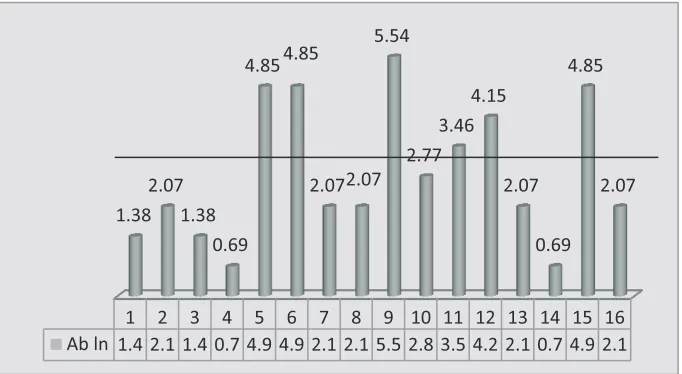
The black line indicates the average value of the group, showing that 62.5% of the animals have antibody values lower than the average (Figure 1).
RESULTS & DISCUSSION
The main mechanisms of defense against microbes involve antibodies directly blocking the pathogenic agent before it takes action against the host, promoting phagocytosis by micro- and macrophages and also involving T lymphocytes in the process. These mechanisms could be induced by microbial challenge by either natural infection or vaccination, as part of disease prevention measures. Effects of antigen priming in Silver foxes were less studies.2-7-9
Farmed animals of wild origin are even more exposed to stress factors that interfere with their immune responses leaving them exposed to disease. All factors connected to farming lead to stress and subsequent failure of immunization.
Extracts from numerous plants were tested for their therapeutic and disease preventing potential. Plant extracts, as products with increased bioavailability and little or no side effects, could provide maximal stimu-lating and adjuvant activity;3 thus, vegetal extracts that
could enhance the immune response to vaccines or during therapy are of utmost importance.15 Economic
aspects on investments in vegetal adjuvants and drugs should be evaluated based on their therapeutic and immune active potential.4,5-10
The results of the Student t-test indicated significance
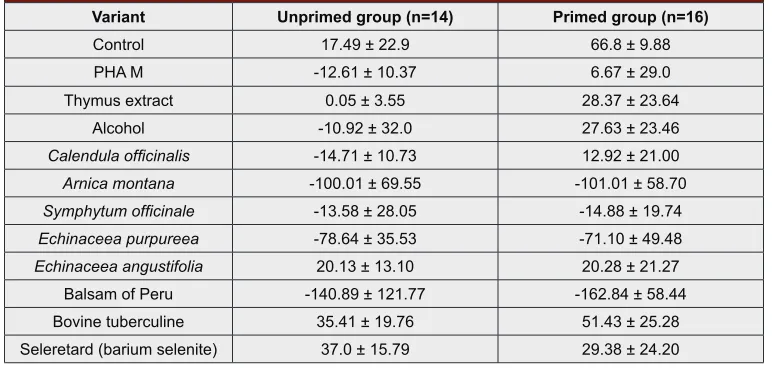
of the differences between primed and unprimed groups for the blast transformation test at different levels (p < 0.001-p < 0.010), only for the control, thymus extract and C. officinalis extract. The test also indicated that the effect of the extracts are strongly dependant on the plant genus, but also differ from
species to species (Table1) Calendula officinalis and Echinaceea angustifolia leading to positive results.
The antibody synthesis induced by antigen priming did not lead to expected results. The antibody levels were highly variable, standing for the individual differences in the immune reactivity but also for the different per-ception of stress by these animals. In order to better protect these animals, antigen priming combined with plant extracts that positively acted in vitro could be of use. Necessarily, individualized protocols are required. The increased concentration of anti-SRBC antibodies
also led to a non-significantly increased complexation
(109 ± 4U and 41 ± 1U, t= 1.709) in primed versus unprimed foxes.
CONCLUSION
SRBC exerted a positive effect on both humoral and cell-mediated immune responses in Silver foxes, sup-porting the enhancement of antimicrobial defense by booster vaccination and immune stimulating therapy, represented by vegetal extracts selected by host and plant species.
ACKNOWLEDGEMENT
This research was supported by grant PNII PNCD 61/2012 of MEN Romania.
CONFLICT OF INTEREST
The authors certify that they have no affiliations with
or involvement in any organization or entity with any
financial interest, or non-financial interest in the subject
matter or materials discussed in this manuscript. Table 1: Stimulation/inhibition indices in the leukocyte blast transformationtest (x±s)
Variant Unprimed group (n=14) Primed group (n=16)
Control 17.49 ± 22.9 66.8 ± 9.88
PHA M -12.61 ± 10.37 6.67 ± 29.0
Thymus extract 0.05 ± 3.55 28.37 ± 23.64
Alcohol -10.92 ± 32.0 27.63 ± 23.46
Calendula officinalis -14.71 ± 10.73 12.92 ± 21.00 Arnica montana -100.01 ± 69.55 -101.01 ± 58.70 Symphytum officinale -13.58 ± 28.05 -14.88 ± 19.74 Echinaceea purpureea -78.64 ± 35.53 -71.10 ± 49.48 Echinaceea angustifolia 20.13 ± 13.10 20.28 ± 21.27
Balsam of Peru -140.89 ± 121.77 -162.84 ± 58.44
Bovine tuberculine 35.41 ± 19.76 51.43 ± 25.28
SUMMARY
• This study investigated the influence of several ethanolic vegetal extracts and 5% SRBC priming on in vitro cell-mediated reactivity, circulating immune complexes and antibody levels in farmed foxes (n=16 primed and n=14 unprimed).
• The in vitro leukocytes blast transformation test was carried out using blood samples from foxes, while for antibody titers and circulating immune complexes sera were used.
• The effect of the vegetal extracts were strongly dependant on the plant genus, but also differed from species to species. Calendula officinalis (12.92 ± 21.00%) and Echinaceea angustifolia (20.28 ± 21.27%) lead to stimulation of the cellular immunity in the SRBC-primed group. • The antibody levels were highly variable (from ln 0.69 to ln 5.54), standing for the individual
dif-ferences in the immune reactivity in these animals.
• SRBC and vegetal extracts, selected by plant species, exerted a positive effect on both humoral and cell-mediated immune responses in Silver foxes, supporting the enhancement of antimicrobial defence by booster vaccination and immune stimulating therapy.
PICTORIAL ABSTRACT
REFERENCES
1. Badescu M, Badulescu O, Badescu L, Ciocoiu M. Effects of Sambucus
nigra and Aronia melanocarpa extracts on immune system disorders within diabetes mellitus. Pharm Biol. 2015;53(4):533-9.
2. Black JG, Lawson KF. Sylvatic rabies studies in the silver fox (Vulpes vulpes).
Susceptibility and immune response. Can J Comp Med. 1970;34(4):309-11.
3. Hilton LS, Bean AG, Lowenthal JW. The emerging role of avian cytokines
as immuno-therapeutics and vaccine adjuvants. Vet Immunol Immunopathol. 2002;85(3-4):119-28
4. Jiang ZH, Koganty RR. Synthetic vaccines: the role of adjuvants in immune
targeting. Curr Med Chem. 2003;10(15):1423-39.
5. Kaufman PB, Cseke LJ, Warber S, Duke JA, Brielmann HL. Natural Products
from Plants. CRC Press, Boca Raton, FL, 1999
6. Khokhlova IS, Spinu M, Krasnov BR, Degen AA. Immune response to
fleas in a wild desert rodent: effect of parasite species, parasite burden,
sex of host and host parasitological experience. The J of Experim Biol. 2004;207(16):2725-33
7. Nastoiu I. Fauna de interes medical, Bucharest, Editura All, 1994
8. Pádua TA, de Abreu BS, Costa TE, Nakamura MJ, Valente LMD, Siani AC,
et al. Anti-inflammatory effects of methyl ursolate obtained from a chemically
derived crude extract of apple peels: potential use in rheumatoid arthritis. Arch Pharm Res. 2014; 37(11):1487-95.
9. Rikula U, Pänkälä L, Jalkanen L, Sihvonen L. Distemper vaccination of
farmed fur animals in Finland. Prev Vet Med. 2001;49(1-2):125-33.
10. Spînu Marina, Niculae Mihaela, Paştiu Anamaria Ioana, Şandru Carmen
Dana, Pall Emoke, Vasiu A. Vegetal extracts influence in vitro on the cell-mediated immunity in carnivores depending on health status, target species and plant taxonomy, Ind. Crops and Products. 2016;88:44-7.
11. Spînu M, Brudaşcă GHF, Şandru CD, Niculae M, Rindt K. Influences on
the Cell-Mediated Response Following Hippophae rhamnoides Treatment,
Analele SNBC Vol. XIII, CAP. IV – Imunologie. 2008;255-260
12. Spînu M, Brudaşcă GhF, Şandru CD, Niculae M, Ştefan R, Karolyi S.
The immunological activity of non-conventional adjuvants, Clujul Medical Veterinar, 2008;(13-14):16-24.
13. Swain SS, Paidesetty SK, PadhyRN, Singh PK. Computational approach
for locating effective cyanobacterial compounds against Mycobacterium
tuberculosis, Indian Journal of Pharmaceutical Education and Research. 2017;51(2):302-11
14. Valcheva-Kuzmanova SV, Belcheva A. Current knowledge of Aronia
melanocarpa as a medicinal plant. Folia Med (Plovdiv). 2006;48(2):11-7. 15. Vogel F.R. Improving vaccine performance with adjuvants; Clinical Infectious
Diseases. 2000;30(suppl 3);266-70.
Marina Spinu, DVM, PhD: currently as Professor of Infectious diseases, Head of Department of Clinical Sciences, USAMV, Faculty of Veterinary Medicine, Cluj-Napoca, Romania. Areas of interest: immunology, infectious diseases, antibiotic resistance, alternative therapies (over 500 national and international publications). Under her guidance 17 scholars have been awarded with their PhD degree.
Carmen Dana Sandru, DVM, PhD: currently Associate Professor of Preventive medicine and Veterinary Legislation and ethics, at the USAMV, Faculty of Veterinary Medicine, Cluj-Napoca, Romania. Areas of interest: infectious diseases, preventive medicine, alternative therapies, environment health (over 250 national and international publications).
About Authors
Florinel Brudasca, DVM, PhD: currently as Professor of Infectious diseases, USAMV, Faculty of Veterinary Medicine, Cluj-Napoca, Romania. Areas of interest: game and exotic animals pathology, infectious diseases, immune stimulation, vaccinology (over 250 national and international publications). Under his guidance 2 scholars have been awarded with their PhD degree, and another one submitted his thesis.
Mihaela Niculae, DVM, PhD: currently Lecturer in Infectious diseases, at the USAMV, Faculty of Veterinary Medicine, Cluj-Napoca, Romania. Areas of interest: infectious diseases, alternative therapies, microbiology, environment health (over 170 national and international publications).
Emoke Pall, DVM, PhD: currently researcher with 11 years of experience, at the USAMV, Faculty of Veterinary Medicine, Cluj-Napoca, Romania. Areas of interest: infectious diseases, cell cultures, stem cells, microbiology/PCR (over 170 national and international publications).
Aurel Vasiu, DVM, PhD: currently Lecturer in Infectious diseases, at the USAMV, Faculty of Veterinary Medicine, Cluj-Napoca, Romania. Areas of interest: infectious diseases, farmed animal pathology, microbiology (over 100 national and international publications).
Constantin Cerbu, DVM, PhD student: currently Assistant with 3 years of teaching experience in Infectious diseases, at the USAMV, Faculty of Veterinary Medicine, Cluj-Napoca, Romania. Areas of interest: infectious diseases, microbiology of the environment, farm animal/fish pathology.
Radu Giupana, DVM: currently PhD student at the USAMV, Faculty of Veterinary Medicine, Cluj-Napoca, Romania. Areas of interest: infectious diseases, microbiology, bovine pathology, alternative therapies.