DEVELOPMENT OF KNOWLEDGE REPOSITORY SYSTEM
AT DIVISION OF INFORMATION TECHNOLOGY IN PT XYZ
(A CASE STUDY APPROACH)
YOHANNES KURNIAWAN, FLORENCIA IRENA, FELICIA RATNA CHANDRA DEWI, IRENE STEPHANI
Bina Nusantara University, Department of Information Systems, Jakarta – 11480, Indonesia E-mail: [email protected], [email protected], [email protected],
ABSTRACT
PT. XYZ realizes that knowledge is one of the truly valuable asset for the company. Therefore, PT. XYZ wants to build knowledge repository system as a tool to support the knowledge capture process and management, also the knowledge sharing between employees. The purpose of this writing is to design a knowledge repository system at PT. XYZ so we can recommend the concept and design of knowledge repository system that will be developed in the future. Design methods used here are data collection method from interview, literature study, and also system analysis and design method based on object according to Bennett. Results to be achieved are the concept and design, also the prototype of knowledge repository system. From this writing we can summarize that with the automated storage and search structure, it is expected to bring ease for the employees in searching the required knowledge. This recommendation of storage system is useful to keep all knowledge from every PT. XYZ employee. Nevertheless, the content management is required to ensure the accuracy of the stored knowledge.
Keywords: Knowledge Management, Application, Information Technology
1. INTRODUCTION
Knowledge Management is an important field for an organizational learning process. The existence of knowledge repositories within an organization becomes an important element of knowledge management activities that must be managed within the organization to support the ongoing process of learning itself. PT. XYZ is the IT solution provider company which has handled many clients. One IT Solution offered by this company is the implementation of an ERP system based on SAP Business One. The major problem of SAP Operations Division at PT. XYZ is the difficulty in doing the tracking problem, because they don’t have a specific standard, so the storage of existing documents are not structured and stored properly. In providing its services, XYZ requires a knowledge repository that helps in the management of information and knowledge documentation. The development of knowledge repository can be used by organizations as a solution to capture and empower the knowledge of its members (knowledge workers). Knowledge workers can also improve their knowledge by exploring the
knowledge that is stored in the knowledge repository.
2. LITERATURE REVIEW
Wiig [1] emphasize that, given the importance of knowledge in virtually all areas of daily and commercial life, two knowledge related aspects are vital for viability and success at any level. Knowledge management make use of a mixture of techniques from knowledge based system design, such as structured knowledge acquisition strategies from subject matter expert [2]. Knowledge management consist of “Leveraging intellectual assets to enhace the organizational performance” [3].
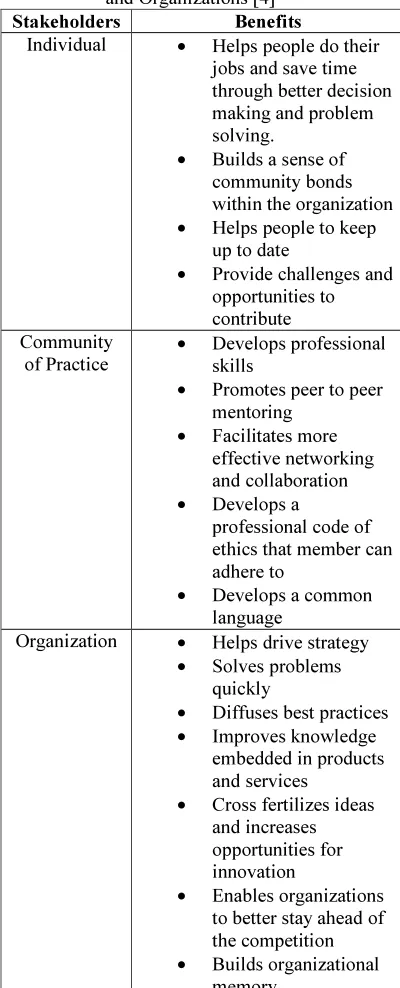
Table 1. KM for Individuals, Communities, and Organizations [4]
Stakeholders Benefits
Individual • Helps people do their
jobs and save time through better decision making and problem solving.
• Builds a sense of
community bonds within the organization
• Helps people to keep
up to date
• Provide challenges and
opportunities to contribute Community
of Practice
• Develops professional
skills
• Promotes peer to peer
mentoring
• Facilitates more
effective networking and collaboration
• Develops a
professional code of ethics that member can adhere to
• Develops a common
language
Organization • Helps drive strategy
• Solves problems
quickly
• Diffuses best practices • Improves knowledge
embedded in products and services
• Cross fertilizes ideas
and increases opportunities for innovation
• Enables organizations
to better stay ahead of the competition
• Builds organizational
memory
KM is essentially a process for optimizing the effective application of intellectual capital to achieve objective [5]. In other words, KM concentrates on the processes and people involved in any area and aims to distil the most relevant information necessary to solve a problem or integrate processes [6].
Kuo [7] further emphasized the trend and necessity of using information technology to conduct knowledge management in schools and believed that school members should gain a deeper understanding of knowledge management. Therefore, schools should continue to improve their existing operating models and should understand the appropriate procedures of searching, storage, duplication, and application in order to gather necessary knowledge [8].
4. RESEARCH METHOD
The writing method for this paper is qualitative. The method used in data collection was reviews from the literature and direct observation at PT XYZ. Reference sources used are a variety of books and journals. Another source of internet is includes supporting sites. The form of paper will be presented in descriptive format. The method of analysis will be used for the construction of a knowledge repository system is using the activity diagram of Unified Modeling Language [9] to describe the business processes that are running in the PT. XYZ. The limitation of this study is to discuss only the aspects of the analysis and design of KM systems.
5. RESULTS AND DISCUSSION
1. Identify Core Business and Its Knowledge Requirements
SAP division business focus as a service provider of IT Solutions and as a support to a variety of client problems.
The finding that there is a problem in the SAP division of PT. XYZ, namely:
• In analyzing the problem, employees
have difficulty in tracking problems. For example, employees need information whether the problem had happened before this is an issue or problem that is appearing for the first time. The reason is that existing documents are not currently structured or stored properly (does not have specific standards in the conduct of storage).
• All documentation of activities is
complete and always has been documented, but PT. XYX just used a simple file server for storage. Error in determining the storage location is also very large because the lack of standardization of document storage. So it’s difficult for disseminating information and knowledge sharing among fellow employees.
2. Define Knowledge Domain
Based on the core processes of knowledge identification and knowledge requirements, knowledge domain owned by SAP division currently includes :
- Operational Knowledge, that all knowledge is related to the need for incident, change, and release management , which will facilitate the process of extracting information and problem tracking problems that occur in the SAP system in the client companies. - Technical Knowledge, which is
useful knowledge to guide the employee , such as:
• Standard Operation Procedure, all
forms of SAP division (such as: New Change Request Procedure, Procedure Change Management, Release Management Policy). Knowledge of SOP (Standard Operating Procedure) is necessary so that the employee is able to perform the work in accordance with predetermined rules.
• User Guide, a guide for users of
the system / application easyCMDB. Knowledge of the use of the system to be controlled easyCMDB, employee requests for all incidents are reported and resolved through the system.
• Training Materials, a training
material for trainers and trainees. Training materials can be a basic knowledge of SAP and basic knowledge about the client's SAP division. It is very important for the employee to be master in the existing business area on each client.
3. Review Knowledge Capabilities
SAP division employees have a good understanding of the focus of activity and division of their obligations in carrying out business activities. As described in the first phase, the search problems have important knowledge and data storage. Each employee has a definitely different knowledge based on their work experience. The work experience must be distributed to other employees so that they can broaden their knowledge. Constraints that current processes are the data storage does not have a specific standard, so that only the files stored in the server manually. The impacted for employees are difficulties to search the knowledge of employees needed.
4. Define Core Knowledge
As the division that is responsible for handling client requests, a division of SAP has a core of knowledge that can be categorized as follows: a) Knowledge of the basic core for the employee
- The process of handling requests that have been documented. All requests are ongoing or have been completed documented both physical (paper) as well as the file server. The purpose of this document is for reference and learning for the future requests.
- Training Materials, a training material for trainers and trainees. Training materials can be a basic knowledge of SAP and basic knowledge about the client's SAP division. It is very important for the employee to be as master for the existing business area on each client.
- Improvement Proposal, a proposal that contains a company's business process improvement proposal or proposed systems to be developed.
- To Be Design, a document to describe the system design view, process flow, and the functional specification of the proposed system.
5. Develop Core Knowledge Policy
After learning the core knowledge possessed today, we need a policy that the core knowledge can be shared by all employees of SAP division. The Inukshuk KM model used to develop policy guidelines in the core knowledge.
a) Inukshuk Knowledge Management Model - Culture
Creating a work culture for the consultant, who have handled a client request to always make a summary of documentation request handling. All documentation is placed on the file server for the sharing of information among consultants. The contents of the file server is not limited to operational documentation, but it can contain other documents that support the company's activities, such as training documents SAP Development Program. In addition, sharing culture is also carried out with various activities such as meetings and training on a regular basis by the company, so much new knowledge that can be acquired by the employees.
- Technology
The technology used in the SAP division currently includes:
a. The use of the file server with the limited access.
b. Email, Miscrosoft Outlook to assist the dissemination of information or important agenda.
c. Application easyCMDB in handling client requests.
- Leadership
Leadership style of the director of the company is a hierarchy. All ideas, opinions, minutes of meetings of each employee must be discussed and approved in advance by the supervisor. Documentation handling client requests, as well as other standard documents stored in the file server with limited access. The access right to the file server is according to the employee's role. Only managers can add and modify folders on the file server. Another employee can insert the document in the file server, but the manager still monitoring the contents of the document.
- Socialization (Tacit – Tacit)
Frequently the employee and the employer conduct meetings, either meetings scheduled and impromptu meetings. Based on the discussion during the meeting, a lot of knowledge that can be obtained. In addition, the employees are also given training on a regular basis by the company. But not all employees can attend training. So the knowledge during training or meeting can be an asset for other employees, especially if there is a new employee.
- Externalization (Tacit – Explicit)
When the employees are finished handling requests or problems, then they will make a conclusion or summary to be documented to enable the sharing of information that will assist other employees in dealing with similar client request. Results documentation will be accommodated on a file server, but the obstacles faced is the lack of content management on the file server so that complicate the process of knowledge sharing as many files or documentation that is not grouped according to certain criteria. Another constraint is the storage file server that is still manual, so it is likely to save the file in a location that is not exactly. - Combination (Explicit – Explicit)
Combination process is done when employees make changes to the client's request. In making changes / service / client request, the employee must have a basic knowledge and experience to support the changes made. They will combine knowledge from books or other written documentation or documentation and make conclusions in a summary or article. The process also occurs when there is a combination of the impact of changes in development or service that is done, then the employee will analyze the problem solving alternatives, and documenting changes again. The results of such documentation kept on file in the file server. So it will form a new knowledge becomes more corporate assets.
- Internalization (Explicit – Tacit)
efficient because they have to do the search manually.
- Tacit Knowledge
Each employee has different abilities and experience in handling reports / client request. Knowledge every employee can continue to grow, PT. XYZ hold meetings and training. Knowledge that comes with every employee can be given to other employees by sharing. However, it is hampered by the absence of workload, time owned by each employee, as well as a means of sharing the existing knowledge so that knowledge can not be optimized. Tacit Knowledge on the SAP division included:
- Training of company. - Seminar.
- Meetings.
- Handling client requests by phone. - The result of the discussion / briefing. - Experience (assignments) for employees working in the company.
- Explicit Knowledge
Every job that has been completed will be documented by recording the results of a conclusion or summary handling client requests. In addition, PT. XYZ also have materials SAP Training Development Program as initial training for new employees. The obstacles, these documents are stored manually in file server, so it is likely to save the file in a location that is not exactly. In addition, the unstructured storage make a difficulty for employees for the reference search. the explicit knowledge of the company are:
Operational Knowledge:
- Request For Change Form, is to make the change request form.
- Improvement Proposal, a proposal that contains a company's business process improvement proposal or proposals that the system will be developed.
- To Be Design, a document to describe the system design view, process flow, and the functional specification of the proposed system.
- Functional Specification, a specification or a logical solution for the incident or change request. Functional Specification contains logic made by the employee, will then be passed on to ABAPER codified. - The process of handling requests that have
been documented.
- Business Scenario, scenario is a collection of events that are used to test and verify that the system can work properly for a variety of business conditions.
Technical Knowledge:
- The basic material to support operations, can be the basis of SAP materials, basic materials about the client's business area, as well as the basic material of the project. - Procedure for guidance in conducting
operations.
- All documentation templates used in operating activities.
- All kinds of reports are generated to measure and evaluate the operations that have been carried out.
- Measurement
The process of knowledge management activities in PT. XYZ does not have specific measurements to generate knowledge that can be used as learning for employees.
6. Map Core Knowledge
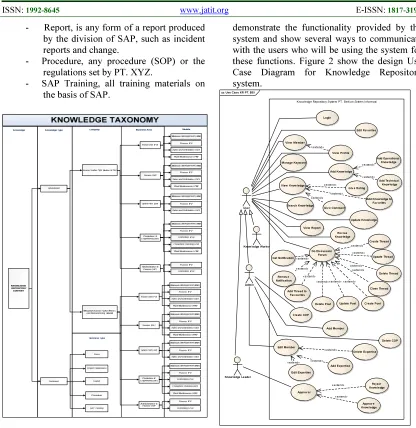
After learning division of SAP knowledge possessed today, the knowledge to perform the categorization. Results categorization knowledge will then be referred to as the Knowledge Taxonomy.
Designing Knowledge Taxonomy divided by two types of knowledge that are owned division of SAP, namely Operational Knowledge and Technical Knowledge. Operational Knowledge is all knowledge relating to the operations of the company, for example, documentation handling client requests. While Technical Knowledge related to the knowledge that support operations, such as SOP, form templates, and basic material SAP.
Operational activities closely linked to the client companies held by the SAP division of PT. XYZ. Each company has their respective business areas. Each business area also has different modules. To Technically, only divided by type only.
- Form, containing all the basic template or framework document, among other things: Change Request Form, To Be Design Document, and Improvement Proposal.
- Report, is any form of a report produced by the division of SAP, such as incident reports and change.
- Procedure, any procedure (SOP) or the regulations set by PT. XYZ.
- SAP Training, all training materials on the basis of SAP.
Figure 1 Proposed Knowledge Taxonomy at SAP Division, PT. XYZ
7. Build Knowledge Repository
Based on the analysis above, we can make a knowledge repository to solve the problems. Knowledge Repository Systems are designed to provide solutions to solve the problems. The design was created with UML diagrams, namely:
A. UseCaseDiagram
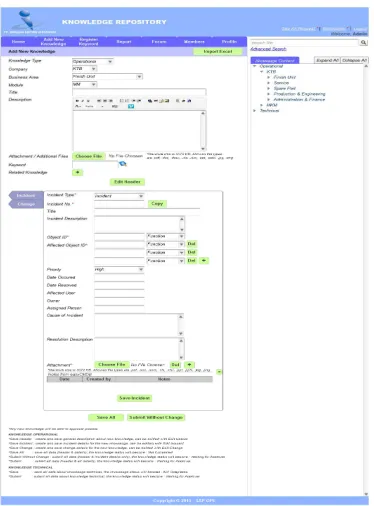
According to Bennett, McRobb, and Farmer (2006: 145) use case is a diagram that describes a set of related transactions from the perspective of the user, which is usually done on an ongoing basis so as to produce a useful value of early users. Use case diagrams are used to
demonstrate the functionality provided by the system and show several ways to communicate with the users who will be using the system for these functions. Figure 2 show the design Use Case Diagram for Knowledge Repository system.
uc Use Case KR PT. BSI
Knowledge Repository System PT . Berlian Sistem Informasi
User
Login
View Member
View Profile
Add Know ledge
View Know ledge
Do Discussion Forum Manage Keyw ord
Search Know ledge
View Report
Edit Member
Knowledge Leader
Approv al Admin
Add Member Update Knowledge
Approv e Know ledge Rej ect Knowledge Rev ise
Knowledge
Add Operational Knowledge
Add Technical Knowledge Giv e Rating
Giv e Comment
Create Thread
Update Thread
Close Thread Get Notification
Remov e Notification
Create Post Update Post Add Thread to
Fav ourites
Add Knowledge to Fav orites
Add Expertise Edit Expertise
Delete Expertise Create COP
Delete Post
Edit Fav orites
Know ledge Worker
Delete Thread
Delete COP «extend»
«extend» «extend»
«extend»
«extend»
«extend» «extend» «extend»
«extend» «extend» «extend»
«extend» «extend» «extend» «extend» «extend»
«extend»
«extend» «extend»
«extend»
[image:6.595.86.502.105.533.2]«extend»
Figure 2 Use Case Diagram Knowledge Repository System
B. Class Diagram
Know l ed ge - K nowl ed geI D: ch ar - S APM od ule ID : in t - K nowl ed geT y peI D: i nt - T ech ni cal T y peI D: i nt - S ta tu sI D: in t - T it l e: St ri ng - D esc ript i on: S trin g - A pprov edDa te : Dat e - C re at edBy : cha r - L astM od if ed By: c har - L astM od if i edD ate : Dat e - A pprov edBy : cha r - T ot al Vot es: i nt - A verag eRat i ng: f l oat - T ot al Docu m ent : i nt - F ol derPat h: S trin g - Ob je ct T yp eI D: in t - Ob je ct : cha r
+ a dd_ kno wl edg e() + g et _knowl ed ge(St at usI D)() + u pda te _kn owl edg e(N)() + g et _ne w_knowl ed ge(da te)() + g et _knowl ed ge(B)() + g et _knowl ed ge(N)() + g et _av erage Rat in g() + u pda te _av erageR at in g() + g ene ra te _new _kn owl ed geI D()
Kn ow l edg eType - Kno wl edg eT yp eI D: in t - Kno wl edg eT yp eNa me : St ri ng - Kno wl edg eT yp eDe scri pt io n: St ri ng
+ ge t_ kno wl edge T yp e(G)()
Co mpan y - Com pa nyI D: i nt - Com pa nyN am e: St rin g - Descrip ti on : Stri ng
+ get _Co m pan y()
In ci den t - I nc id ent No: c har - K nowl ed geI D: ch ar - I nc id ent T y pe: St rin g - T it le : St ri ng - I nc id ent Descri pt io n: St ri ng - Ob je ct : cha r - A ff ec te dObj ec t: St rin g - Ob je ct T yp eI D: in t - P ri orit y : S tri ng - D ate Occ ured: Da te - D ate Resol ved : Dat e - A ff ec te dUser: S tri ng - Ow ner: St ri ng - A ssig nedP erson : St ri ng - C auseOf In ci den t: St rin g - R eso lu ti on Descrip ti on: S tri ng - C rea te dBy : cha r - L ast M od if i edBy : ch ar - L ast M od if i edDa te : Dat e
+ a dd_ in ci dent () + g et _i nci de nt(N)() + u pda te _in ci den t(N)()
Chan ge - C han geNo : cha r - K nowl ed geI D: ch ar - T it l e: St ri ng - C han geDe sc ri pt io n: St ring - Ob je ct : cha r - Ob je ct T yp eI D: in t - T ype : Stri ng - P ri ori ty : Stri ng - S ta rt Dat e: Da te - E ndDa te : Dat e - A ssig ned Perso n: St ri ng - R el easeT y pe: St rin g - R el easePl anD at e: Dat e - R und ownSc en ari o: S tri ng - R ol lb ackSce nari o: St ri ng - C re at edBy : cha r - L astM od if i edB y: ch ar - L astM od if i edD ate : Dat e
+ a dd_ cha nge () + g et _ch ang e(N)() + u pda te _ch ang e(N )()
Bus ine ssA rea - Busi nessA rea ID : in t - Com p any ID : int - Busi nessA rea Nam e : S tri ng - Descri pt io n: St ri ng
+ ge t_ busin essArea(c om pan yI D)()
SAPM o dul e - S APM odu le ID : int - B usi ne ssAreaI D: i nt - M o dul eNa m e: St ri ng - D esc ri pt i on: St rin g
+ g et _m odu le (B usi ne ssAreaI D)()
Tech ni cal Type - T ec hni ca lT y peI D: i nt - T ec hni ca lT y peN am e: St rin g - Descrip ti on : Stri ng
+ get _t ec hni ca lT y pe(R)()
O bj e ctTyp e - Obj ect T y peI D: i nt - Obj ect T y peN am e: St ring
+ get _o bj ect T y pe(F)()
Affected Obj e ct - A ff ec te dObj ec tI D: c har - I nc id ent No : c ha r - O bje ct T yp eI D: i nt
+ a dd_ af fe ct edOb je ct (F ,L )() + u pda te _af f ect ed Obj ect (F, L)() + g et _af f ect ed Obj ect (L)()
K eyw o rd - Keyw ordI D: cha r - SubC ate goryI D: c har - Keyw ordNam e : Stri ng
+ get _keyw ord (P )() + add_ ke yword() + ren am e_ key word() + del et e_key word() + get _keyw ord (C )() + gene ra te _ne w_Ke ywordI D()
Kno w le dgeK eyw o rd - Kno wle dge ID: c har - Key wordI D: ch ar
+ add _knowl ed ge_key word() + get _key wordI D(N)() + upd at e_know le dge_ ke yword(N)()
S ubCa te gor y - Sub Cat ego ry ID : cha r - Cat eg oryI D: cha r - Sub Cat ego ry Nam e : S tri ng
+ get _sub Cat ego ry (O)() + add _subCa te gory() + re nam e _su bCa te gory() + del et e_ sub Cat eg ory() + gen erat e_n ew_sub Cat ego ry ID()
Ca teg or y - C at egory ID: c har - C at egory Nam e: St rin g
+ g et _ca te gory()
Rel atedK now l edg e - Kno wl edg eID : cha r - Rel at ed Know le dge ID: c har
+ ad d_rel at edK nowl ed ge(N)() + ge t_ rel at ed Know le dge (N)() + up dat e_rel at ed Know le dge(N)()
No te s - N ot esI D: c har - R equ est No : c ha r - C re at edBy : St ri ng - D at e: Dat e - N ot es: S tri ng - N ot esT ype : in t
+ a dd_ not es(R equ est No )() + u pda te _no tes(Requ estNo )() + g et _no te s(Req uestN o)()
F oru m - Fo ru m ID: c har - Fo ru m Cat ego ry ID : i nt - Fo ru m Nam e: St rin g - Fo ru m Descrip ti on : S tri ng - T o tal T h re ad: i nt - T o tal Po st : in t - La st PostB y: ch ar - La st PostD at e: Dat e
+ ge t_ fo rum (f orum Cat eg oryI D)() + ad d_f orum (fo ru m Cat ego ry ID )() + de le te _fo ru m (f orum I D)() + ge nerat e_n ew_ Forum I D()
Thr ea d - T hrea dID : cha r - Forum I D: c har - T hrea dT i tl e: St rin g - T hrea dCon te nt : S tri ng - Creat edB y: ch ar - Last M odi fi ed Dat e: Da te - Creat edD at e: Dat e - Last PostBy : ch ar - Last PostDa te : Dat e - T ot al Post : int - T ot al Vi ew: i nt
+ get _t hrea d(Forum I D)() + get _t hrea d(sea rc h)() + add _t hread (Fo ru m ID )() + upd at e_t hread (Q)() + cl ose_t hrea d(Q )() + del et e_ th re ad(Q)() + get _n ew_t hrea d(dat e)() + get _t hrea d(B)() + get _t hrea d(Q)() + gen erat e_n ew_T h re adI D()
Po st - Post ID: c har - T hrea dI D: cha r - Post Cont en t: St rin g - Post By: c har - Post Dat e: Dat e - La st M odi f ie dDat e: Da te
+ ad d_po st (T hread ID)() + up dat e_p ost(post ID)() + de let e_ post (po st I D)() + ge t_n ew_ post(da te )() + ge t_p ost(T hrea dI D)() + ge nerat e_n ew_P ost I D()
Fav ori tes - F avo ri t eI D: cha r - R ela te dFa vI D: ch ar - B SII D: c har
+ a dd_ fa vori tes(Rel at edF avI D)() + g et _f avo ri t e(B )() + d el et e_f av ori t e()
Fo rumC ategor y - Forum Ca te goryI D: i nt - Forum Ca te goryN am e: St rin g - Forum Ca te goryD esc ript i on: S trin g
+ get _f orum Ca te gory()
Attach ment - At t ach m ent I D: cha r - Re la te dI D: cha r - At t ach m ent Nam e : Stri ng - Lo cat i on: S trin g - Si ze : St ri ng - At t ach m ent Cat eg ory: i nt
+ ad d_a tt ac hm en t(Rel at ed ID)() + ge t_ at ta chm e nt (Re la te dI D)() + up dat e_ at ta chm e nt(Re la te dID )()
Rev i si on - Rev isio nI D: ch ar - Kno wle dge ID: c har - Rev isedB y: ch ar - Rev isio nRe quest By: c har - Rev isio nNo te : t ex t - Rev isio nDa te : D at e - Rev isio nRe quest Dat e: Da te
+ sa ve_ re vi si on(N)() + get _rev isio n_d at a(N)()
C omment - B SII D: c har - C om m ent I D: ch ar - K nowl ed geI D: ch ar - C om m ent Co nt ent : St ri ng - C om m ent Da te : D at e
+ g et _co m m ent (N)() + a dd_ com m e nt ()
Kno w le dge Ratin g - Kno wl edge ID : cha r - BSI I D: cha r - Rat i ngI D: i nt
+ ad d_rat in g()
Ratin g - Ra ti ng ID: i nt - Ra ti ng Sco re: f l oat - Ra ti ng M in : f l oat - Ra ti ng M ax: f l oat - Ra ti ng Nam e: S trin g - Ra ti ng Descrip it on : Stri ng
+ g et_ ra ti ng ()
E xper tis e - Exp ert i se ID: c har - SAPM od ul eI D: in t - Exp ert i se Nam e: St rin g
+ get _ex pert ise(J)()
Exp er ti se Posi tio n - Exp erti se ID: c har - Posit i onI D: i nt - BSI ID : c har - YearFrom : Ye ar - YearUn ti l : Y ear
+ get _e xpe rt ise_ posit i on(B, J, K)() + add _ex perti se_p osi t io n(B,J , K)() + upd at e_ex pert ise_ posit i on(B, J, K)()
M e mber - BSI I D: ch ar - Ro leI D: i nt - Pa ssword: ch ar - Na me : St ri ng - Ph oto : St ri ng - Da teJ oi ned : Dat e - Em ai l : St ri ng - WorkP hon e: St ri ng - Jo bT i t le: S tri ng - De partm e nt : Stri ng - Bu si nessU ni t: St rin g - Ad dre ss: St ri ng - St at us: in t - T o tal Fo ru m Post: i nt - T o tal Kn owl edg ePost : in t
+ ge t_ m em ber_d et ai ls(B )() + ad d_m em b er() + up dat e_m e m ber(B)() + va li da te _m em be r() + ge t_ to tal _kno wle dge _po st () + up dat e_p asswo rd ()
Ro le - Rol eI D: in t - Rol eNam e : St ri ng
+ get _rol e(B)()
P osi tion - Posit i onI D: i nt - Posit i onN am e: St rin g
+ get _p osi t io n(K)()
Status - Sta tu sI D: i nt - Sta tu sNa m e: St ri ng
+ get _sta tu s()
Thr ead Subs cri pti on - Sub sc ri pt io nI D: ch ar - T hrea dID : cha r - BSI ID : cha r
+ add _t hread Subscri pt ion (B ,Q)() + del et e_ th re adSu bsc ript i on(B, Q)() + get _t hrea d(B,Q)()
A = SAP M odul eI D B = BSI I D C = Ke ywordI D D = rel at edKn owl ede gI D E = St at usID F = ob je ct T yp eI D G = Kno wl edge T yp eI D H = T o ta lKn owl edg ePo st I = T ot al Forum Po st J = Ex pe rt iseI D K = Po si ti on ID L = I nc id ent No M = Cha nge No N = Kn owl edg eI D O = Cat eg oryI D P = subCa te goryI D Q = T hrea dI D R = T e chn ic al T yp eID
1 0 .. *
1 0. . *
10. .* 0. .* 1 1
1. .* 1 1 .. *
1 1.. *
1 1. .*
1
0 .. * 0 .. 1
0 .. *
0. . *
1
1 0. . *
0. . * 0. .1
1 0. . * 11. .*
1 1. . * 0. .*
0 .. 1
1
0 .. 1
1 0. . *
0 .. *
0 .. 1 1 0 .. *
1
0. . * 1 1 .. *
1. . * 1 1 1 .. *
1 1 .. *
1 1. .* 1
0. . * 1
0. .* 1
0. .*
1 1 .. * 1
0. . * 1
0. .* 1
0. . * 1
0.. * 1 0 .. *
1 .. *
1
0. . * 0. . 1
0. . * 1
0. . * 1
0. . * 1
0. . 1 1
0. .* 1
0. . *
1
0. . 1 1
0. . 1 1
1 1. .*
[image:7.595.86.509.72.353.2]1 0. .* 1 .. * 1
Figure 3 Class Diagram for Knowledge Repository System
[image:7.595.89.304.106.353.2]From the results of the design above, the following is an example of the user interface (Figure 4 and 5):
Figure 4 Add New Knowledge – Operational
Figure 5 Knowledge Content – Operational (Tab Details)
6. CONCLUSIONS
From the analysis activities, the major problem of SAP Operations Division at PT. XYZ is the difficulty in doing the tracking problem, because they don’t have a specific standards, so the storage of existing documents are not structured and stored properly. Storage and retrieval structure that has automated expected to provide facilities for employees to seek knowledge required. Proposed design of the storage system is also expected to be useful for storing knowledge of any employee of PT. XYZ. However, content management is also needed to ensure the accuracy of the knowledge that has been stored, for which we propose the existence of knowledge approval.
[image:7.595.88.275.415.668.2]knowledge management system in the other organizations.
REFERENCES:
[1] K. Wiig, “Knowledge Management Foundations”. Arlington, TX: Schema Press, 1993.
[2] K. McGraw, and K. Harrison-Briggs,” Knowledge Acquisition: Principle and Guideline”. Englewood Cliffs, NJ: Prentice Hall, 1989.
[3] M. Stankosky, Keynote address to ICICKM (International Conference on Intellectual Capital, Knowledge Management and Organisational Learning), 2008, pp. 9-10.
[4] K. Dalkir, “Knowledge Management in Theory and Practice”. Cambridge, MA: Massachusetts Institute of Technology, 2011.
[5] A. Bennet and D. Bennet, “Organizational survival in the new world: the intelligent complex adaptive system”. Boston: Elsevier, 2004.
[6] Learning for Sustainability, 2010, “Knowledge management and information”. Available from
http://learningforsustainability.net/social_
learning/knowledgemanagement.php,
2014.
[7] Y. F. Kuo, A study on service quality of virtual community. Total QualityManagement & Business Excellence, Vol. 14, No. 4, 2003, pp. 461-473.
[8] D.R. Richard, Technology: Where students learn. American School & University, Vol. 47, No. 3, 2001, pp. 360-363.
[9] S. Bennett, S. McRobb, & R. Farmer, “Object-Oriented Systems Analysis And Design Using UML”. New York: McGraw-Hill, 2006.