ISSN: 1992-8645 www.jatit.org E-ISSN: 1817-3195
METHODOLOGICAL FRAMEWORK FOR ANALYSIS AND
SYNTHESIS OF A SET OF SECURE SOFTWARE
DEVELOPMENT CONTROLS
1
ALEXANDER VLADIMIROVICH BARABANOV, 2ALEXEY SERGEEVICH MARKOV,
2
VALENTIN LEONIDOVICH TSIRLOV
1
NPO Echelon, Elektrozavodskaya str., 24, Moscow, 107023, Russia
2
Bauman Moscow State Technical University, 2-nd Baumanskaya, 5, 1, Moscow, 105005, Russia
ABSTRACT
This article discusses the issues of standardizing commercial production of secure software products. It studies administrative and technical controls for minimizing the number of vulnerabilities during development and operational support of secure automated systems software. We classified standards and guidelines on secure software development. We analysed applicability of the available methodological approaches to secure software development during evaluation of conformance to the information security requirements, including during certification of the software products. The article proves feasibility of harmonizing the developed regulatory requirements and practical measures with the methods stipulated in ISO 15408 and ISO 12207 international standards. We introduced the notion of secure software and developed a basic set of requirements that allows, among other things, evaluating the conformance of the software development processes to secure software requirements. We prove that the set of requirements shall rest, first of all, on the accepted security policies and up-to-date threats. Sample requirements under development are provided. We developed an original conceptual model for analysis and synthesis of a set of controls for secure software development that rests on a set of generated requirements. The article shows that the conceptual model gives the software developers an opportunity to make a science-based choice of software development controls. We developed general methods for selecting a set of secure software development controls. We provide indirect proof of efficiency of the suggested approach. It should be noted that the suggested approach was used as a basis for the national standard on development and production of secure software.
Keywords: Software Security, Secure Software Development Lifecycle, Certification, Information Security,
Vulnerabilities
1. INTRODUCTION
Information security (IS) of computer systems is currently exposed to threats that are mainly related to known unclosed vulnerabilities and unknown vulnerabilities. In addition, our country has virtually no regulations on secure software products development, which would be aimed at minimizing the number of IS vulnerabilities that are generated at various stages of software lifecycle. Therefore, there is an unsolved issue of special inspections (licensing) of companies, and inspection of production process (conformance evaluation) of serial software products as to information security requirements [1, 2].
This defines the target of this study, which consists in analysis and synthesis of a set of secure
software development controls. This article explains how this target can be achieved.
2. ANALYSIS OF SECURE SOFTWARE
DEVELOPMENTSTANDARDS
The software development industry currently has a set of corporate, industry and international standards that describe controls and mechanisms aimed at secure software development, for instance [3-12]:
- ISO 15408;
- ISO 27034-1;
ISSN: 1992-8645 www.jatit.org E-ISSN: 1817-3195
- Microsoft Security Development Life
Cycle;
- Cisco Security Development Life Cycle;
- OpenSAMM;
- OWASP CLASP.
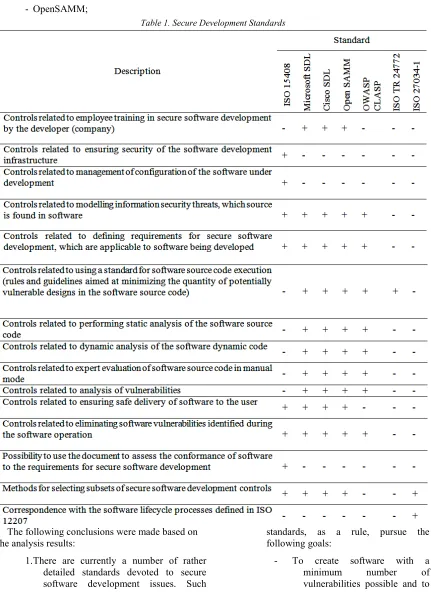
[image:2.612.93.524.137.732.2]The results of comparative analysis of the above standards are specified in Table 1.
Table 1. Secure Development Standards
The following conclusions were made based on the analysis results:
1.There are currently a number of rather
detailed standards devoted to secure software development issues. Such
standards, as a rule, pursue the following goals:
- To create software with a
minimum number of
ISSN: 1992-8645 www.jatit.org E-ISSN: 1817-3195 generate an environment for
quick elimination of software
problems (software
vulnerabilities) identified by the users;
- To implement software elements
of security policy for the environment (location) of the software application (IS policy for an organization or country, where software is used).
2.The reviewed documents suggest using a
set of secure software development controls at various stages of the software lifecycle to achieve the goal of creating software with the minimum number of vulnerabilities and creating an environment for elimination of the identified problems. The suggested list of secure software development controls is standard, as a rule, and contains controls, related to, for example, modelling threats, static and dynamic analysis, penetration testing [12-17].
3.The above documents do not describe a
clear framework, which may be used to assess the conformance of the software
development processes to the
requirements to the secure software development, for instance, within the framework of the software certification. It should be noted that international standard ISO 15408 is currently widely used during the software certification as to information security requirements, but the use of provisions of this document alone during development and further assessment of compliance of software security is not sufficient, because:
- The standard applies only to
software with security functions, in other words, the security target required by the standard may not be written for the software without implemented security functions, neither can the conformance assessment be performed accordingly;
- The list of controls for software
development suggested in the third part of the standard is not comprehensive: particularly, there are no controls
related to static or dynamic analysis, employee training etc.
3.BASICSETOFREQUIREMENTS
It is a well-known fact that the current development of the certification system for information security tools as to information security requirements is related to assessment of Common Criteria (ISO 15408) [3, 4, 9, 15, 18]. That is why we made a decision to use ISO 15408 methods in this study for development of a conceptual model for analysis and synthesis of secure software development controls.
When defining the software security environment we describe the following security aspects of the environment, where the software is going to be used:
- Security assumptions that contain
security aspects of the environment, where the software is going to be used;
- Information security threats that are
related to the assets, which require protection by means of software or its environment;
- Security policies of the company,
which identify, and, if necessary, explain the provisions of the company security policy or the rules the software should conform to.
The security goals reflect the stated intention to withstand all established IS threats, and to cover all
security assumptions and the established
information security policy of the company. The description of the software security requirements shall define the functional requirements (for
instance, requirements to identification/
ISSN: 1992-8645 www.jatit.org E-ISSN: 1817-3195 To adapt the procedure for generating and
substantiating the list of software security functions and software development controls and to achieve the goal of this study we developed a basic set of requirements for secure software development. The following specifics were taken into account, when forming a basic set of requirements for secure software development:
1. To ensure practical application and effective
fulfilment of requirements the set being
developed shall be correlated with
International Standard ISO 12207, which describes the processes of the software life cycle [13].
2. It is a well-known fact that it is more
expensive to eliminate software
vulnerabilities during later stages of software lifecycle (for instance, during software testing or support), therefore the set of
requirements under development shall
ensure implementation of the required measures at the earliest stages of the software development [8, 9].
3. To meet the target for development of
framework for assessment of software conformance to the requirements being developed during generation of certain requirements we took into account the aspects related to:
- Generating requirements to
documented evidence of the requirement fulfilment;
- Generating requirement to the
actions of the assessor (for
instance, test laboratory
expert), that are met during assessment of the software compliance with the secure software requirements.
- In the course of the study we
decided to use the following
parameters to describe a
requirement for secure
software development to
account for the identified specifics:
- Name of the requirement;
- Unique requirement ID;
- Reference to software lifecycle
process, which is established by ISO 12207, during which
the requirement may be
fulfilled [22];
- Goal related to secure software
development that is achieved
by the developer during
fulfilment of this requirement;
- Elements of the developer’s
actions, which describe the
actions of the software
developer aimed at meeting the requirement;
- Elements of the content and
provision of the documented evidence of the requirement fulfilment;
- Elements of the assessors’
actions, which describe the actions of the assessor aimed at independent verification of the requirement fulfilment by the software developer;
- Explanatory notes.
In the course of the study we designed a set of requirements for secure software development based on existing standards and methods of secure software development [10, 18-20]. Table 2 briefly describes the developed basic set of requirements for secure software
ISSN: 1992-8645 www.jatit.org E-ISSN: 1817-3195
Table 2. Suggested Basic Set of Requirements for Secure Software Development
Brief description of the requirement
The software developer shall define the requirements to secure software development, which are imposed on the software being developed
The software developer shall model information security threats that originate in the software to identify potential threats to information security and substantiate software requirements The software architecture (software logic structure, which identifies components, their interfaces and the concept of interaction between them) shall be updated with account for the need to neutralize potential threats to information security, which are identified at the stage of information security threats modelling, and performance of the requirements to secure software development, which are established during analysis of software requirement
The software developer shall identify each tool used to develop the software
The software developer shall create a program based on the software architecture, defined during the process of designing and detailed designing of the software architecture
The software developer shall create or select a standard, which contains a list of rules and recommendations, aimed at minimizing the number of potentially vulnerable structures in the source code, for the source code execution
The software developer shall perform static analysis of the source code to detect potentially vulnerable structures in the source code.
The software developer shall regularly perform expert evaluation of the source code to identify potentially vulnerable structures in the source code
The software developer shall perform functional testing of the software to determine whether the requirements, which have been identified during analysis of the software requirements, are met
The software developer shall perform a penetration testing of the program to identify software vulnerabilities
The software developer shall perform dynamic analysis of the software code to identify software vulnerabilities
The software developer shall use technical and administrative controls, required for identifying software modifications or any discrepancies between the original and the version, received by the user
The delivered software shall have operating instructions within the scope sufficient for correct setting up and safe use of the software
The software developer shall implement the procedure that allows for tracing and eliminating the detected software vulnerabilities
The software developer shall be able to offer the user a solution to the problem in the situation, when previously unknown software vulnerability is used for computer or network attack on the user’s information system
The software developer shall implement the procedure that allows for unique marking of each software version
The software developer shall use the system for software configuration management, which allows for unique identification of the elements of configuration that are related to the software being developed
The system for software configuration management shall identify the elements of configuration, which are related to implementation of the secure software functions
The system for software configuration management shall provide tools for identifying all elements of the configuration, which are affected by the modification of this element of configuration
The software developer shall use technical and administrative controls that ensure protection from unsanctioned access to the elements of configuration
The software developer shall use technical and administrative controls that ensure data back-up and restoration of the configuration elements
ISSN: 1992-8645 www.jatit.org E-ISSN: 1817-3195 Brief description of the requirement
The software developer shall provide regular training to the employees to increase their awareness in the area of secure software development
The software developer shall regularly analyse the employee training programs to establish their feasibility, adequacy and efficiency in helping to achieve the goals of secure software development
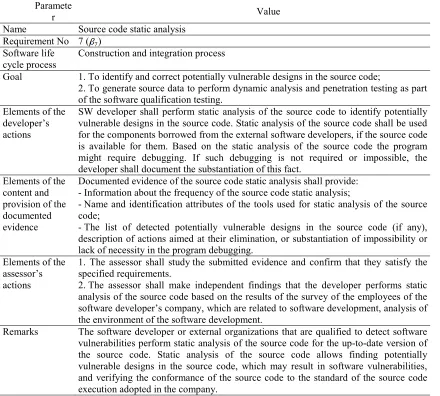
Static analysis of the software security is the most effective (unfortunately, it is rather time consuming [15]), therefore in this article we found
[image:6.612.91.531.246.642.2]it appropriate to give an example of the developed requirement ( ) (Table 3).
Table 3. Requirement for Statistic Analysis of the Software Source Code
Paramete
r Value
Name Source code static analysis
Requirement No 7 ( ) Software life
cycle process
Construction and integration process
Goal 1. To identify and correct potentially vulnerable designs in the source code;
2. To generate source data to perform dynamic analysis and penetration testing as part of the software qualification testing.
Elements of the developer’s actions
SW developer shall perform static analysis of the source code to identify potentially vulnerable designs in the source code. Static analysis of the source code shall be used for the components borrowed from the external software developers, if the source code is available for them. Based on the static analysis of the source code the program might require debugging. If such debugging is not required or impossible, the developer shall document the substantiation of this fact.
Elements of the content and provision of the documented evidence
Documented evidence of the source code static analysis shall provide: - Information about the frequency of the source code static analysis;
- Name and identification attributes of the tools used for static analysis of the source code;
- The list of detected potentially vulnerable designs in the source code (if any), description of actions aimed at their elimination, or substantiation of impossibility or lack of necessity in the program debugging.
Elements of the assessor’s actions
1. The assessor shall study the submitted evidence and confirm that they satisfy the specified requirements.
2. The assessor shall make independent findings that the developer performs static analysis of the source code based on the results of the survey of the employees of the software developer’s company, which are related to software development, analysis of the environment of the software development.
Remarks The software developer or external organizations that are qualified to detect software
ISSN: 1992-8645 www.jatit.org E-ISSN: 1817-3195 The developed basic set of requirements for
secure software development was used to create a conceptual model for analysis and synthesis of a set of secure software development controls, which can be found below.
4. THERESULTSOFDEVELOPMENT OFA
CONCEPTUALMODEL
Let us introduce the following sets for description of the conceptual model for analysis and synthesis of measures for the secure software development. The following sets should be defined to describe the software development environment:
- is a set of
information security threats, which are relevant for the
software development
environment;
- is a set of
identified provisions of the security policy, which the
software development
environment should comply with.
Information security threats are described informally using the following parameters:
- Description of the information
security threat;
- Source of the information security
threat;
- Implementation method of the
information security threat;
- Vulnerabilities used;
- Type of information resources in
the software development
environment that are
potentially subject to the
information security threat;
- Violated security property of the
information resources in the
software development
environment;
- Possible consequences of the
information security threat
implementation.
The provisions of the security policies are described informally (in the natural language). It
should be noted that the traditional approach described in the Common Criteria includes the description of the secure environment using an additional set – the set of secure usage assumptions.
During the analysis and synthesis of the secure software development measures the software development environment is clearly identified and defined, therefore, the formation of the assumption list is redundant.
A set of secure software development goals is formed to achieve identified security policies and to neutralize the identified information security threats.
Based on the established goals for secure software development a subset of requirements is selected from the basic requirements for secure software development.
To fulfil identified requirements, a software developer generates and implements a set of
measures for secure software development
in the software development environment.
The following mappings were introduced:
- is a procedure for
generating goals for secure software development;
- is a procedure for
selecting secure software
development requirements;
- is a procedure for
synthesis of measures for secure software development.
The developed model is characterized by tuple .
ISSN: 1992-8645 www.jatit.org E-ISSN: 1817-3195
Figure 1. Generation Of A Set Of Controls.
In the course of the study, we developed general methods for analysis and synthesis of secure software development controls, which consist in implementation of the following stages and steps:
Stage 1. Identify and describe the aspects of secure environment for software development.
- Step 1. Form a set of information
security threats
, which are
relevant for software
development environment.
- Step 2. Form a set of guidelines
of security policies
, to which the
software development
environment should conform. The sources for generating sets of the security policies can be
represented by the
requirements of laws,
regulatory legal acts, industrial standards, a list of the user’s requirements, and software use scenario.
Stage 2. Form and substantiate sets of goals for secure software development.
- Step 3 Form sets of goals for
secure software development: .
- Step 4. Substantiate the
completeness and sufficiency
of the formed set of goals for secure software development. The substantiation of the goals
for secure software
development shall show that
the set goals cover all
identified security aspects (sets of information security threats and guidelines of security
policies) of software
development environment.
This should be demonstrated as follows:
a. Substantiate completeness using cross
references: goals related to development of secure software aimed at accounting for identified sets of information security threats and provisions of the security policies, should be represented as a table that should demonstrate that:
- - Each goal covers at least one
information security threat or
provision of the security
policy;
- - Each information security threat
or provision of the security policy is covered by at least one goal for development of secure software.
b. Substantiate sufficiency of the set of goals
related to secure software development: it is necessary to demonstrate that the set of goals related to development of secure software is sufficient to account for all aspects of the software development. For this purpose, the Table of Software Development Environment Goals and
Aspects Conformance shall be
supplemented with the following informal explanation:
- - It is necessary to demonstrate
for each information security threat that the specified goals will allow neutralizing this information security threat;
- - It is necessary to show for each
provision of the security policy in which way the specified goals ensure its performance.
ISSN: 1992-8645 www.jatit.org E-ISSN: 1817-3195
- Step 5. For a set of requirements
for secure software
development on the basis of the basic requirements with account for the need to achieve
the identified goals:
.
- Step 6. Substantiate the
completeness and sufficiency
of the selected set of
requirements for secure
software development. The substantiation shall be made in
the same way as the
substantiation described in
Step 4 using cross references and informal explanatory test.
Stage 4. Synthesize and substantiate measures for secure software development.
- Step 7. On the basis of the set of
the identified requirements for secure software development and information about the specific software development environment, technologies and tools used during development, it is necessary to form sets of measures for development of secure software, which are going to be applied in the
software development
environment: .
- Step 8. Substantiate the
completeness and sufficiency of the synthesized sets of measures for secure software
development. The
substantiation shall be made in
the same way as the
substantiation described in
Step 4 using cross references and informal explanatory test.
5.TRANSITIONTOMATHEMATICAL
MODELS
The suggested conceptual model may also be used as the basis for developing mathematical models of secure development, for instance, multifactorial model:
,
where: ki – coefficient of i- th control; -
number of controls.
It should be noted that we did not aim to receive the values for the above mathematical indicators, however, the efficiency of the suggested conceptual approach was confirmed by the results of comparison of the vulnerability level of the software products, developed in companies with
recognised international certificates for IS
management systems, and products, developed by other software developers. The analysis of statistics for 2008-2015 showed that the total number of vulnerabilities in the products of the first category is 5 times lower than the similar indicator in the products of the second category [23].
6.DISCUSSION
The drafted basic set of requirements for secure software development and the conceptual model for secure software development analysis/synthesis received approval during the discussions that involved the leading Russian experts in secure software development. They were also approved by the Technical Committee for Standardization when discussing the national standard GOST R “Software protection. Development of secure software. General requirements”. In the course of discussions, the experts underscored the following positive aspects of the developed basic set and the analysis/synthesis model:
1. Wide scope of application of the obtained results:
- Both software developers and
evaluators (when evaluating designer-implemented
processes for meeting the requirements specified) can take advantage of the results offered in the work;
- The basic set of requirements
offered in the work applies to all software types, not only to those with security functions;
- The set of requirements applies to
ISSN: 1992-8645 www.jatit.org E-ISSN: 1817-3195
operating systems unless
drastically modified.
1. The designed conceptual model for secure
software development analysis/synthesis helps, in a deterministic and well-founded manner, to identify a package of measures for secure software development based on threat analysis and the provisions of security policies.
2. Easy integration of the secure software
development measures into the designer’s
current software development lifecycle
processes by tracing the basic set of ISO 12207 lifecycle process requirements.
The following limitations of the developed basic set of requirements and the conceptual model were defined in the research data approval process:
1. The proposed requirements were not classified,
for example, by the software scope, size and other characteristics that may potentially affect the range of measures applied in designing secure software.
2. The proposed basic set of requirements is
static; no formal mechanism was offered for adding new requirements to the basic set.
3. The phase of generating the conceptual model
for secure software development
analysis/synthesis did not involve reviewing the issues of developing the basic information security threat model and the basic set of security policies specific to the secure software development infrastructure. This fact may diminish the determinancy of the secure
software development analysis/synthesis
process.
7. RELATEDWORK
In the work [8], the authors proposed the secure software development lifecycle model applied by Microsoft. The key difference between the set of requirements proposed in this work and the one proposed in the work [8] is that the latter’s results apply to a restricted software class (operating systems and database management system). Furthermore, the set of requirements offered in the work [8] is not traced to software lifecycle processes as per ISO 12207, making it somewhat difficult to implement software in the designer’s current processes.
The work [3] offers software development requirements expressed in the form of confidence requirements and applied in information safety certification of software. The principal differences between the basic set of requirements proposed in
this work and those proposed in the work [3] lie in the following:
- The set proposed in the work [3]
is only applicable to software with security functions; the required security assignment cannot be written for software in which security functions have not been implemented;
- The set proposed in the work [3]
has no completeness property: in particular, no provision is made for measures associated
with static and dynamic
analyses and personnel
training.
In the works [11, 17], the authors offer a secure software development lifecycle model. The principal differences between the basic set of requirements proposed in this work and the one proposed in the work [11, 17] lie in that account is taken not only of development actions, but also of a valuator’s potential actions to check designer-implemented processes for compliance with the specified requirements. Besides, the basic set of requirements offered in the works [11, 17] is not traced to software lifecycle processes as per ISO 12207, making it somewhat difficult to implement software in the already existing processes.
In the works [10], the authors offer measures to be carried out in a software development lifecycle,
considering the need to conduct software
certification in information security requirements and minimize the amount of software architecture-related vulnerabilities (for example, deficiencies in the subject identification and authentication mechanism). The results offered in this work can supplement the work [10] in updating the set of measures and requirements for valuators’ actions.
8. CONCLUSION
We received the following main results in the course of the study:
1. We analysed the available controls and approaches aimed at minimizing the number of vulnerabilities in the software being developed, and their applicability during assessment of the software
conformance to the information security
ISSN: 1992-8645 www.jatit.org E-ISSN: 1817-3195 development. However, there is no universal
approach in a form of a regulatory document that ensures:
- Integration with the current
standards that define the
processes of the software lifecycle, for instance, defined by ISO 12207;
- Substantiated selection of a
complex of secure software development controls;
- Assessment of conformance of
the processes for creating
software products to the
requirements of secure
software development, firstly,
within the framework of
mandatory certification of
commercial information
security software (during
accreditation of production) and mandatory licensing of such types of activity as
production of information
security software.
2. Based on analysis, classification and summary of standards on secure software development we developed a basic set of 24 requirements for secure software development. The distinctive features of the developed basic set of requirements are:
- Cross references to the processes
of the software lifecycle
defined in ISO 12207, which ensures a simpler integration in
the software development
processes that already exist in
the software developer
(company);
- There are requirements to
documented evidence of the
requirement fulfilment and
actions of the independent appraiser, which helps to
determine the process of
independent assessment of
conformance of the software development processes to the
requirements to secure
software development, for
instance, within the framework of the software certification.
3. We suggested a conceptual model for analysis and synthesis of secure software development
controls, which ensures a possibility for
substantiated selection of secure software
development controls and is consistent with the Common Criteria standards. This allows for implementing the methods for analysis and synthesis of secure software development controls suggested within the framework of the model in companies that already have experience in certification of the developed software in accordance with ISO 15408 guidelines. The conceptual model for analysis and synthesis of secure software development controls was used during the development of the draft national standard GOST R that passed expert assessment within the framework of the Russian Technical Committee on Standardization (which includes 105 expert organizations).
REFERENCES:
[1] Duncan, B., Whittington, M. (2014).
Compliance with standards, assurance and
audit: does this equal security? In Proceedings
of the 7th International Conference on Security
of Information and Networks (Glasgow, UK,
September 09-11, 2014). SIN '14. ACM, New
York, NY, USA, (pp. 77-84).
DOI:10.1145/2659651.2659711.
[2] Tillman, R.A. (2010). Exploring Security
Certification and Accreditation Using the Agile
Software Development Lifecycle Process. Ph.D.
Dissertation. Capella University. AAI3402069.
[3] Merkow, M. S., Breithaupt, J. (2005). Computer
Security Assurance Using the Common Criteria.
Thomson Delmar Learning.
[4] Biró, M., Molnár, B. (2007). Synergies Between the Common Criteria and Process Improvement.
LNCS. 4764 (31-45).
DOI:10.1007/978-3-540-75381-0_4.
[5] De Win, B., Scandariato, R., Buyens, K., Grégoire, J., Joosen, W. (2009). On the Secure Software Development Process: CLASP, SDL
and Touchpoints Compared. Information and
Software Technology. 51, 7 (Jul. 2009),
1152-1171. DOI:10.1016/j.infsof.2008.01.010. [6] Denning, P. J. (2012). Writing secure programs:
an interview with Steve Lipner. Ubiquity. 2012,
May, 1-10.
DOI=http://dx.doi.org/10.1145/2213616.221361 7.
[7] Geer, D. (2010). Are Companies Actually Using
Secure Development Life Cycles? Computer.
43, 6 (Jun. 2010), 12-16.
ISSN: 1992-8645 www.jatit.org E-ISSN: 1817-3195
[8] Howard, M., Lipner, S. (2006). The Security
Development Lifecycle: A Process for
Developing Demonstrably More Secure
Software. Microsoft Press.
[9] Kara, M. (2012). Review on Common Criteria as a Secure Software Development Model.
IJCSIT. 4, 2 (Apr. 2012), 83-94.
DOI:10.5121/ijcsit.2012.4207.
[10] Lee, M.-G., Sohn, H.-J., Kim, B.-M., Kim, J. B. (2015). A Study on Secure SDLC Specialized in
Common Criteria. ASTL. 93 (11-23).
[11] McGraw, G. (2015). Software security and the building security in maturity model (BSIMM).
Journal of Computing Sciences in Colleges. 30,
3 (Jan. 2015), 7-8.
[12] Mellado, D., Fernández-Medina, E., Piattini, M.
(2008). Towards security requirements
management for software product lines: A security domain requirements engineering
process. Comput. Stand. Interfaces. 30, 6 (Aug.
2008), 361-371. DOI:10.1016/j.csi.2008.03.004. [13] Essafi, M., Ghezala, H.B. 2014. Meta-Modeling Based Secure Software Development Processes.
IJSSE. 5, 3 (Jul.-Sep. 2014), 56-74.
DOI:10.4018/ijsse.2014070104.
[14] Fal', A.M. 2010. Standardization in information
security management. Cybernetics and Systems
Analysis. 46, 3 (May 2010), 512-515.
DOI:10.1007/s10559-010-9227-9.
[15] Markov, A., Luchin, D., Rautkin, Y., Tsirlov,
V. (2015). Evolution of a Radio
Telecommunication Hardware-Software
Certification Paradigm in Accordance with
Information Security Requirements, In
Proceedings of the 11th International Siberian Conference on Control and Communications
(Omsk, Russia, May 21-23, 2015).
SIBCON-2015. IEEE, 1-4.
DOI:10.1109/SIBCON.2015.7147139.
[16] Shahriar, H. (2013). Security vulnerabilities and mitigation techniques of web applications.
In Proceedings of the 6th International
Conference on Security of Information and
Networks (Aksaray, Turkey, November 26-28,
2013). SIN '13. ACM, New York, NY, USA, 459-459. DOI:10.1145/2523514.2523589.
[17] Viega, J., McGraw, G. (2011). Building Secure
Software: How to Avoid Security Problems the
Right Way. Addison-Wesley Professional.
[18] Ardi, S., Shahmehri, N. (2009). Introducing Vulnerability Awareness to Common Criteria's
Security Targets. In Proceedings of 4th
International Conference on Software
Engineering Advances (Porto, Portugal,
September 20-25, 2009). ICSEA '09. IEEE, 419-424. DOI:10.1109/ICSEA.2009.67.
[19] Buccafurri, F., Fotia, L., Furfaro, A., Garro, A., Giacalone, M., Tundis, A. (2015). An analytical processing approach to supporting cyber
security compliance assessment. In Proceedings
of the 8th International Conference on Security
of Information and Networks (Sochi, Russia,
September 8-10, 2015). SIN '15. ACM, New
York, NY, USA, 46-53.
DOI:10.1145/2799979.2800007.
[20] Seacord, R.C. (2014). The Cert C Coding
Standard: 98 Rules for Developing Safe, Reliable, and Secure Systems (2nd ed.).
Addison-Wesley Professional.
[21] Barabanov, A., Markov, A., Fadin, A., Tsirlov, V., Shakhalov, I. (2015). Synthesis of Secure
Software Development Controls. In
Proceedings of the 8th International Conference
on Security of Information and Networks (Sochi,
Russia, September 8-10, 2015). SIN '15. ACM,
New York, NY, USA, 93-97.
DOI:10.1145/2799979.2799998.
[22] Stallinger, F., Neumann, R. (2012). From Software to Software System Products: An Add-on Process Reference Model for Enhancing ISO/IEC 12207 with Product Management and
System-Level Reuse. In Proceedings of the
2012 38th Euromicro Conference on Software
Engineering and Advanced Applications
(Cesme, Izmir, Turkey, September 5-8, 2012).
SEAA '12. IEEE Computer Society,
Washington, DC, USA, 307-314.
DOI:10.1109/SEAA.2012.41.
[23] Markov A.S., Tsirlov V.L. (2013). Opyt vyyavleniya uyazvimostey v zarubezhnykh
programmnykh produktakh, Voprosy
kiberbezopasnosti [Cybersecurity Issues]. 2013,