NOV-DEC, 2015, VOL-3/21 www.srjis.com Page 1338 A SURVEY OF DIFFERENT AUTHENTICATION TECHNIQUE FOR
WATERMARKING
Mr. Chaudhari Manoj A.
Due to large number of transmission of digital image over non-secure internet, image authentication techniques have recently gained great importance. Digital watermarking is used for copy write protection and ownership detection. However as techniques are get improved more focus is given to authentication. Because of authentication digital image become secure and protected to transfer the information over internet. To protect the authenticity of multimedia images different technique has been proposed. These approaches include conventional cryptography, fragile & semi fragile watermarking and digital signature that are based on image content. This paper presents the overview of techniques used for authentication. The different techniques are summarized and compare with each other by considering experimental results.
Keywords: Watermark Lifecycle, Robust Watermarking Schemes, Fragile Watermarking Schemes, HVS, ICA.
1. Introduction:
The large growth in the digital technology, image processing and Internet has made the
reproduction of digitally created information simple and easy. The advancement in World
Wide Web, MMS communication has made it possible to transmit and distribute this digitally
created information in a fast and easy manner without any quality degradation. Due to this we
are having advantages live low cost , flexibility. Along with some advantage it have
important disadvantage of authenticity and protection. Because of this several academicians
and researcher work on security of digital image[3]. In schemes have been proposed in the
last decade, where a small amount of imperceptible secret information is embedded into the
digital content, which can be extracted at a later stage for copyright assertion, copy control,
broadcasting, authentication, content integrity verification, etc [2].
The work on digital Image watermarking is basically done in regular photo
image[6],video[5],audio[4]and the printed material[6],etc by considering its technical and
Scholarly Research Journal's is licensed Based on a work at www.srjis.com
NOV-DEC, 2015, VOL-3/21 www.srjis.com Page 1339
commercial feasibility. It is a proven method for reducing content piracy and improving the
ability to identify, tract and manage digital media [7]. It is widely used in applications of
rights management, remote triggering, filtering/classification, e-commerce, etc. It is a
technique that is used to balance the need for content security with best possible consumer
experience to enable media and entertainment industries to adapt the advanced facilities of
the modern digital revolution while reducing the threat of content theft.
In [1] watermarking is defined as a technique which embeds data into digital
contents such as text, still images, video and audio data without degrading the overall quality
of the digital media. A watermark is the information to be hidden and also indicates that the
hidden information is transparent, while the term cover media indicates the media used for
carrying the watermark. The watermarked data is the media which contains the watermark. In
digital watermarking technology, the phrase embedding and extraction means the procedures
used for inserting the watermark into the cover media and extracting the embedded
watermark from the watermarked data respectively. Detection is an important process that is
used for detecting whether the given media containing a particular watermark. Digital
watermarking techniques originally focused on copyright protection, but have been exploited
in wide range of applications
[8]. There are number of watermarking schemes that are designed for different applications.
Among them, robust watermarks are generally used for copyright protection and ownership
identification because they are designed to withstand attacks such as common image
processing operations. In contrast, fragile or semi-fragile watermarks are mainly applied to
content authentication and integrity attestation because they are fragile to attacks, i.e., it can
detect any changes in an image as well as localizing the areas that have been changed. Both
these techniques are to be treated separately and this paper deals with content based
watermarking system for authentication In the given paper is organized as below. Section 1
provides an general watermarking systems, Section 2 describes the different types of
watermarking. Section 3 shows content based watermarking watermarking . A brief
conclusion with future direction is presented in Section 4.
2. General watermarking system:
The general watermarking system is based on three basic things Watermark
embedding, Watermark Extraction and watermark detection. All these three stages are used in
NOV-DEC, 2015, VOL-3/21 www.srjis.com Page 1340
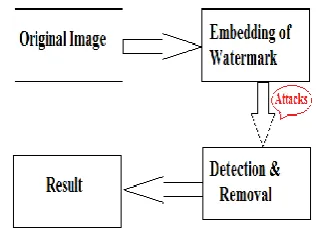
Figure 1: General Watermarking system
The given digital watermarking model consist of an embedder and a detector. The embedder
takes two inputs. One is the payload we want to embed (the watermark ), and the other is the
cover work in which we want to embed the payload. The output of the embedder is typically
transmitted or recorded. Later, that Work (or some other Work that has not been through the
embedder) is presented as an input to the detector. Most detectors try to determine whether a
payload is present, and if so, output the message encoded by it. The watermarking model is
analogous to a communication model in which sender encode a message before transmitting
it over communication channel and on receiving, receiver decode the encoded message. Here
in between the given embedding and detection more chances of attack on the give image.
These attacks are of different types shown below:
a) Scrambling Attacks:
A scrambling attack is a system-level attack in which the samples of a Work are
scrambled prior to presentation to a watermark detector and then subsequently descrambled.
b) Pathological Distortions:
For a watermark to be secure against unauthorized removal, it must be robust to any
process that maintains the fidelity of the Work. This process may be a normal process, in
which case we are requiring that a secure watermark be robust. However, it may also be a
process unlikely to occur during the normal processing of the Work. Any process that
maintains the fidelity of the Work could be used by an adversary to circumvent the detector
by masking or eliminating the watermark. The two most common categories of such
pathological distortions, geometric/temporal distortions (attacks on synchronization) and
noise removal distortions:
- Synchronization Attacks:
Many watermarking techniques are sensitive to synchronization. By disturbing this
synchronization, an adversary attempts to mask the watermark signal. Examples of simple
NOV-DEC, 2015, VOL-3/21 www.srjis.com Page 1341
scaling, and translation for images and video. These simple distortions can be implemented
such that they vary over time or space. More complex distortions include pitch-preserving
scaling and sample removal in audio, and shearing, horizontal reflection, and column or line
removal in images. Even more complex distortions are possible, such as nonlinear warping of
images.
- Linear filtering and noise removal attack:
Linear filtering also can be used by an adversary in an attempt to remove a
watermark. For example, a watermark with significant energy in the high frequencies might
be degraded by the application of a low-pass filter. In addition, any watermarking system for
which the added pattern is “noiselike” is susceptible to noise-removal techniques.
c) Copy Attacks:
A copy attack occurs when an adversary copies a watermark from one Work to another. As
such, it is a form of unauthorized embedding.
d) Ambiguity Attacks:
Ambiguity attacks create the appearance that a watermark has been embedded in a Work
when in fact no such embedding has taken place. An adversary can use this attack to claim
ownership of a distributed Work. He or she may even be able to make an ownership claim on
the original Work. As such, ambiguity attacks can be considered a form of unauthorized
embedding. However, they are usually considered system attacks.
Detection is the process of extraction of given image i.e. we have to separate the original
image and watermarked image. In this we have to consider the following characteristics so as
to find whether any attack is happen or not.
(i) Storage: authentication data should be embedded in the image, such as a watermark,
rather than in a separate file, as is the case with an external signature.
(ii) Mode of extraction: depending on whether authentication data is dependent or not on the
image, a full-blind or a semi blind mode of extraction is required. It is quite obvious
that a nonblind mode of extraction does not make sense for an authentication service, since
the original image is necessary.
(iii) Asymmetrical algorithm: contrary to classical security services such as copyright
protection, an authentication service requires an asymmetrical watermarking (or encryption)
algorithm (i.e., only the author of an image can secure it, but any user must be able to check
NOV-DEC, 2015, VOL-3/21 www.srjis.com Page 1342
(iv) Visibility: authentication data should be invisible under normal observation. It is a
question of making sure that the visual impact of watermarking is as weak as possible so that
the watermarked image remains faithful to the original.
(v) Robustness and security: it must not be possible for authentication data to be forged or
manipulated.
(vi) Protocols: protocols are an important aspect of any image authentication system, in
particular avoid protecting a corrupted picture.
The perfect system should have high capacity, low distortion and high robustness to given
attack.
3.Different technique for watermarking:
The watermarking techniques are classified into following categories, namely, Robust
watermarking , Fragile watermarking and Semi-fragile watermarking. For each technique
low embedding space and secu rity is required, each different category of scheme has
different characteristics and, thus, is suitable for different applications. For example,
robustness is an essential requirement for copyright applications, it has no role in most
authentication applications. In this section it gives the different technique given below
3.1. Robust Watermarking
Robust watermarking algorithm aims at mixing a non perceptible communication
channel with image data, in such a way that the capacity of this extra channel degrades
smoothly with the distortion the watermarked content undergoes. This class of schemes has
found its applications in many areas. The number of different attacks happen on the digital
image are:
-JPEG Compression.
- Geometric transform: horizontal flip, rotation, cropping, scaling, deletion of lines or
columns,
generalized geometrical transformations, random geometric distortions, geometric distortions
with JPEG
- Enhancement techniques: low pass filtering, sharpening, histogram modification, gamma
correction, color quantization, restoration
- Noise addition
- Printing-scanning
- Statistical averaging and collusion
NOV-DEC, 2015, VOL-3/21 www.srjis.com Page 1343 3.2. Fragile Watermarking Schemes
Most methods currently proposed for providing image authentication are based on a
fragile watermark in opposition to robust watermark classically used for copyright protection
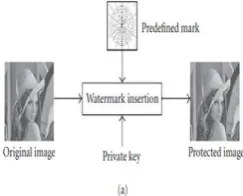
The basic idea underlying these techniques is to insert a specific watermark (generally
independent of the image data [9]) so that any attempt to alter the content of an image will
also alter the watermark itself (Figure 2). Therefore, the authentication process consists of
locating watermark distortions in order to locate the regions of the image that have been
tampered with. The major drawback of these approaches is that it is difficult to distinguish
between malicious and nonmalicious attacks (e.g., most fragile methods consider a lossy
[image:6.595.236.358.288.386.2]compressed image as a tampered image, whereas the semantic of the image is unchanged).
Figure 2 : Fragile Watermarking schemes
o Authentication
o Content-integrity verification.
3.3. Semi-Fragile Watermarking Schemes
A semifragile watermark is another type of authentication watermark. Semifragile
watermarks are more robust than fragile watermarks and less sensitive to classical user
modifications such as JPEG compression. The aim of these methods is to discriminate
between malicious manipulations, such as
the addition or removal of a significant element of the image, and global operations
preserving the semantic content of the image.
The use of such methods is mainly justified by the fact that images are
generally transmitted and stored in a compressed form. Moreover, for the majority of the
applications, the losses due to the compression process do not affect the integrity of the image
within the meaning of its interpretation.
NOV-DEC, 2015, VOL-3/21 www.srjis.com Page 1344
There are number of techniques available for watermarking for image and video. But we can
again have the problem of authentication. Here we can use the technique of content based
watermarking.
4.1. Human Visual System (HVS)
Kay and Izquierdo in [10] used a content based estimation of Just Noticeable
Distortion (JND) in frequency domain. To estimate the JND three image characteristics were
considered, namely, texture, edgeness and smoothness. Their results proved that this
technique was resilient to most common attacks like geometric image transformations.
The development and improvement of accurate human vision models
helps in the design and growth of perceptual masks that can be used to better hide the
watermark information thereby increasing its security. Similarly, in the work proposed by
[11], the noise sensitivity of each pixel based on the local region image content such as
texture, edge and luminance information was used to obtain the JND mask for the image to
be watermarked. Then each bit of the watermark is spread spatially and shaped by
pseudo-noise sequence such that its amplitude is kept below the pseudo-noise sensitive of the pixel into
which it is inserted. Experimental results proved that the technique was resistant to
compression, cropping and noise attacks.
4.2. Independent Component Analysis (ICA)
DCT and DWT are the two transformation techniques that are widely used in the
watermark embedding process. Recently, researchers have started using ICA for
watermarking. In [12], ICA was applied to the blocks of the host image and that becomes the
watermark. The least-energy independent components of the host were replaced by the
high-energy independent components of the watermark image. The drawback of this scheme is
that, for watermark extraction both the watermark and the host images are required. This was
followed by the work of [13], where the host image, the key image, and the watermark image
as the independent sources. Embedding was done by weighted addition of the key and the
NOV-DEC, 2015, VOL-3/21 www.srjis.com Page 1345 5. Conclusion
The above survey gives us the new and innovative techniques of watermarking. Now
research is oriented towards content-based watermarking schemes. Most of the proposed
watermarking schemes are based on Human Visual System (HVS) using Just Noticeable
Distortion (JND) for the selection of watermark positions. ICA a more recent technique is
being mainly used for copyright protection.
Users expect that robust solutions will ensure copyright protection and also guarantee
the authenticity of multimedia documents. There is such a strong demand for image
manipulation techniques and applications that they are becoming more and more
sophisticated and are accessible to a greater number of people. In the current state of
research, it is difficult to affirm which approach seems mo suitable to ensure an integrity
service adapted to images and in a more general way to multimedia documents. There does
not exist, for the moment, any solution perfectly answering this problem.
6. References
Steineback, M., Dittann, J. and Neuhold, E. (2009) Digital Watermarking - Common watermarking techniques, Important
Parameters, Applied mechanisms, Applications, Invertible watermarking, Content-fragile watermarking, Online Encyclopedia, Contributed Article, http://encyclopedia.jrank.org/articles/ pages/6725/Digital- Watermarking.html#ixzz0Zoj226VL
[55] Ye, J. and Tan, G. (2008) An Improved Digital Watermarking Algorithm for Meaningful Image, International Conference on Computer Science and Software Engineering, vol. 2, Pp.822-825.
[32] Lin, S.D., Kuo, Y. and Huang, Y. (2006) An Image Watermarking Scheme with Tamper Detection and
Recovery, First International Conference on Innovative Computing, Information and Control (ICICIC'06), Vol. 3,
Pp.74-77.
Sachs, D., Anand, R. and Ramchandran, K. (2000) Wireless image transmission using multiple-description based concatenated codes,Proceedings Data Compression Conference DCC 2000, P. 569.
Hussein, J. and Mohammed, A. (2009) Robust Video Watermarking using Multi-Band Wavelet Transform, IJCSI
International Journal of Computer Science Issues, Vol. 6, No. 1,Pp. 44-49.
Kim, Y., Moon, K. and Oh, I. (2003) A text watermarking algorithm based on word classification and inter-word
space statistics, Proceedings Seventh International Conference on Document Analysis and Recognition, Pp.
NOV-DEC, 2015, VOL-3/21 www.srjis.com Page 1346 Eskicioglu, A. and Delp, E.(2001) An overview of multimedia content protection in consumer electronics devices, Proceedings Signal Processing Image Communication, Vol. 16 Ppp. 681-699.
Wang, F., Pan, J. and Jain, L.C. (2009) Digital watermarking techniques, Studies in Computational Intelligence, Springer Berlin / Heidelberg, Vol. 232/2009, Pp. 11-26
De Strycker, L., Termont, P., Vandewege, J., Haitsma, J., Kalker, A., Maes, M. and Depovere, G. (2000) Implementation of a real-time digital watermarking process for broadcast monitoring on a TriMedia VLIW processor, IEE Proceedings - Vision, Image and Signal Processing, Vol. 147, No.4, Pp.371-376.
Kay, S. and Izquierdo, E. (2001) Robust content based image watermarking, Proc. Workshop on Image Analysis
for Multimedia Interactive Services, WIAMIS’ 2001, Tampere, Finland.
Kay, S. and Izquierdo, E. (2001) Robust content based image watermarking, Proc. Workshop on Image Analysis
for Multimedia Interactive Services, WIAMIS’ 2001, Tampere, Finland.
Gonzalez-Serrano, F.J., Molina-Bulla, H.Y. and Murillo- Fuentes, J.J. (2001) Independent component analysis
applied to digital image watermarking, International Conference on Acoustic, Speech and Signal Processing (ICASSP), Vol. 3, Pp. 1997-2000.
Zhang, X. and Wang, S. (2009) Fragile watermarking scheme using a hierarchical mechanism, Signal Processing,