S T U D Y P R O T O C O L
Open Access
The use of volatile anesthetic agents for
long-term critical care sedation (VALTS):
study protocol for a pilot randomized
controlled trial
Angela Jerath
1*, Niall D. Ferguson
2, Andrew Steel
3, Duminda Wijeysundera
1, John Macdonald
4and Marcin Wasowicz
1Abstract
Background:Sedatives are administered to 85 % of intensive care unit (ICU) patients. The most commonly used sedatives are intravenous benzodiazepines and propofol. These agents are associated with over-sedation in 40 to 60 % of patients, which can lead to prolonged intubation, delirium and drug-induced hypotension. Evidence is increasing that volatile anesthetic agents are associated with faster extubation times, improved cardiovascular stability with no end-organ toxicity in comparison to our standard intravenous agents for short-term critical care sedation. Use of volatile agents within the ICU is a novel technique using a specialized delivery and scavenging system, which requires staff training and cultural acceptance. This pilot randomized controlled trial aims to assess the safety and feasibility of delivering volatile agents for long-term patient sedation in the ICU with limited or no experience of this technique.
Methods/Design:This is a prospective multicenter pragmatic pilot RCT that is blinded to the data analyst. This study aims to recruit 60 adult ICU patients requiring mechanical ventilation and sedation for more than 48 h. Patients will be randomized 2:1 to receive inhaled isoflurane (40 patients) or intravenous midazolam and/or propofol (20 patients) sedation. Sedation is titrated to a targeted Sedation Analgesia Score (SAS) using an explicit sedation-analgesia algorithm until extubation or tracheostomy. Primary safety and feasibility outcomes will assess atmospheric volatile concentration levels and adherence to our sedation-analgesia protocol. Secondary outcomes include time to extubation, duration of ventilation, quality of sedation, delirium, vasoactive drug support, length of stay, serum fluoride levels and mortality.
Discussion: This pilot project will serve as the basis for a larger RCT that will be powered for important clinical outcomes.
Trial Registration: ClinicalTrials.gov, NCT01983800 (registration date 2 July 2013).
Keywords: Volatile anesthetics, sedation, critical care, safety, randomized controlled trial
* Correspondence:[email protected]
1
Department Anesthesia and Pain Medicine, Toronto General Hospital, 200 Elizabeth St, Toronto, Ontario M5G 2C4, Canada
Full list of author information is available at the end of the article
Background
Sedation is a cornerstone of patient care within intensive care units (ICU). Sedative and analgesic medications are administered to 85 % of ICU patients to assist tolerance of mechanical ventilation and invasive procedures and to treat anxiety and pain [1]. Current national and inter-national sedation practice predominantly uses systemic opioids to provide analgesia combined with intravenous benzodiazepines (BDZ) in 60 % and propofol in 20 % of patients [2, 3]. Suboptimal sedation is a commonly seen phenomenon in 75 % patients [4]. Under-sedation oc-curs in 30 % of patients, resulting in agitated patients demonstrating hypercatabolism and hemodynamic in-stability with a risk of self-harm and accidental extuba-tion. More commonly, over-sedation from high doses is seen in 40 to 60 % of patients [4]. Over-sedation is linked to slow emergence with a delay in the return of airway reflexes, which prolongs the duration of intub-ation and mechanical ventilintub-ation, thereby increasing the risk of acquiring ventilator-associated pneumonia [4, 5]. Elimination of BDZ, propofol, and opioids rely on good synthetic liver and renal function [5]. Deep sedation is compounded by slow clearance of these agents and sys-temic drug accumulation among ICU patients who are advancing in age and commonly have liver and renal dysfunction. The daily cost of a ventilated patient ranges $ 3500 to 6000, and thus, the economic impact of add-itional ventilation days attributable to over-sedation is significant [6].
Sedatives that are currently used are also associated with delirium, which affects up to 80 % of ICU patients [7]. This syndrome is characterized by an acute onset, change or fluctuation in mental status plus inattention, and disorganized thinking or an altered level of consciousness. It is diagnosed at the bedside using the highly reliable tools of the Confusion Assessment Method (CAM-ICU) or Intensive Care Delirium Screening Checklist (ICDSC) [7]. Delirium is associ-ated with a prolonged hospital stay, increased ICU and hospital costs (39 and 31 %, respectively) and contributes to long-term cognitive dysfunction [7–11]. The etiology is multifactorial, but deep sedation (coma) with heavy and prolonged use of BDZ is a well-established risk factor (odds ratio 3.0, 95 % con-fidence interval 1.3 to 6.8) for its development [8].
Additional concerns surrounding currently used agents include the association of BDZ with the increased long-term risk of developing psychiatric disorders such as anx-iety, depression, and post-traumatic stress disorder, which affects more than one-quarter of ICU survivors [12, 13]. The duration of sedation and the use of BDZ are con-firmed risk factors for developing all three disorders (mean difference 6.73, 95 % confidence interval 1.42 to 12.06) [12]. Prolonged use of propofol is associated with
hypertriglyceridemia, pancreatitis, myoclonus and the rare condition of propofol infusion syndrome, which causes cardiac and renal failure [5, 14]. Over-sedation from these agents, particularly with propofol, also promotes drug-induced hypotension necessitating the use of vasoactive drug support. [5] In 2013, the Soci-ety of Critical Care Medicine revised and updated guidelines for the combined management of pain, agi-tation, delirium (PAD) and recommended the routine assessment of these three interrelated variables, use of lighter sedation regimes, and non-BDZ sedative drugs [5].
The use of volatile anesthetic agents is routinely applied within the operating room to provide general anesthesia. Their use as an ICU sedative appears attract-ive gattract-iven these agents are simple to titrate, produce no active metabolites, and are predominantly cleared un-changed by pulmonary exhalation [15]. There are several trials demonstrating these agents promote faster extuba-tion times and better hemodynamic stability with no renal or hepatic toxicity when used for short-term post-operative sedation in comparison to propofol or BDZ sedation [16–18]. Within a RCT of 139 cardiac surgical patients, our group demonstrated that those who re-ceived volatile-based anesthesia and postoperative sed-ation extubated significantly faster by approximately 100 min in comparison to patients who received intravenous propofol [19]. In 2011, Mesnil et al. dem-onstrated that these agents not only provide faster extubation times but also provide analgesia with a re-duction in morphine use and a superior quality of sedation with fewer dose titrations per day when used for up to 96 h [20].
Volatile agents are attractive and theoretically ideal ICU sedatives. However, there is limited experience with the use of these agents for several days. Further-more, use of these agents and the AnaConDa™ system in critical care units requires staff training and cultural acceptance of this novel modality. Prior to undertaking a large RCT to determine whether these agents provide superior clinical outcomes to our current standard of care, several safety and feasibility issues must be ad-dressed. These issues form the focus of this pilot trial.
Methods/design
Study setting
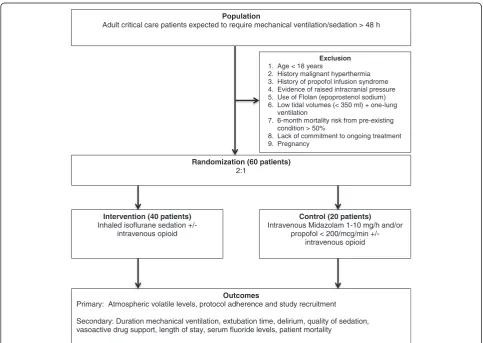
This is a two-arm prospective multicenter pragmatic pilot RCT comparing the safety and feasibility outcomes of conducting long-term ICU sedation using inhaled iso-flurane to standard intravenous propofol and/or midazo-lam (Fig. 1). This trial was approval by the ethical committee of the Toronto General Hospital, University Health Network (protocol number 13-5845) and Uni-versity of Ottawa Heart Institute (protocol number 201402500 01H). This clinical trial was originally reg-istered (NCT01983800) on 2 July 2013.
Eligibility
Patients eligible to be enrolled in this trial are adult ICU patients (>18 years) within 72 h of critical care admis-sion and who are expected to require mechanical venti-lation and sedation for longer than 48 h. The following criteria exclude patients from participation in this study: (1) age <18 years; (2) history or family history of ma-lignant hyperthermia; (3) history of propofol infusion syndrome; (4) evidence of raised intracranial pres-sure; (5) 6-month mortality risk from pre-existing condition >50 %; (6) use of inhaled Flolan (prostacyc-lin), which is incompatible with the AnaConDa™ de-vice; (7) low tidal volumes (<350 ml) and one-lung ventilation; (8) lack of commitment to ongoing crit-ical care treatment; and (9) pregnancy.
Recruitment
The study coordinator will assess patients daily for study eligibility within the medical-surgical (MSICU), cardio-vascular (CVICU) and coronary (CICU) at TGH and CVICU at Ottawa. Either patient or surrogate decision-maker consent will be obtained prior to study enroll-ment. Because most patients will be sedated and not
Population
Adult critical care patients expected to require mechanical ventilation/sedation > 48 h
Randomization (60 patients) 2:1
Intervention (40 patients) Inhaled isoflurane sedation
+/-intravenous opioid
Control (20 patients) Intravenous Midazolam 1-10 mg/h and/or
propofol < 200/mcg/min +/-intravenous opioid
Outcomes
Primary: Atmospheric volatile levels, protocol adherence and study recruitment
Secondary: Duration mechanical ventilation, extubation time, delirium, quality of sedation, vasoactive drug support, length of stay, serum fluoride levels, patient mortality
Exclusion
1. Age < 18 years 2. History malignant hyperthermia 3. History of propofol infusion syndrome 4. Evidence of raised intracranial pressure 5. Use of Flolan (epoprostenol sodium) 6. Low tidal volumes (< 350 ml) + one-lung
ventilation
7. 6-month mortality risk from pre-existing condition > 50%
8. Lack of commitment to ongoing treatment 9. Pregnancy
[image:3.595.56.540.371.714.2]have the capacity to provide informed consent, the major-ity of patients will be consented using surrogate decision-maker consent from the patient’s legal representative.
Randomization and allocation concealment
This two-arm RCT will randomize 60 patients to the intervention arm, where patients will receive inhaled isoflurane volatile-based sedation, or to the control arm, where the patients will receive standard intraven-ous midazolam and/or propofol. To further strengthen assessment of the safety of administering volatile agents, patients are allocated 2:1 within the interven-tion:control groups. Patients will be randomized using a computer sequence generator with permutated blocks (www.randomization.com). To maximize con-cealment, the size of the block will not be revealed, and randomization will only be performed after pa-tient recruitment. Papa-tients are randomized by the study coordinator, and allocation concealment is maintained by using sequentially numbered, opaque, sealed envelopes.
Study intervention
Sedation within the two arms of this RCT consists of the following:
Intervention - Inhaled isoflurane (0 to 5 ml/h) Control - Intravenous midazolam (1 to 10 mg/h) and/ or propofol (<200 mcg/kg/min)
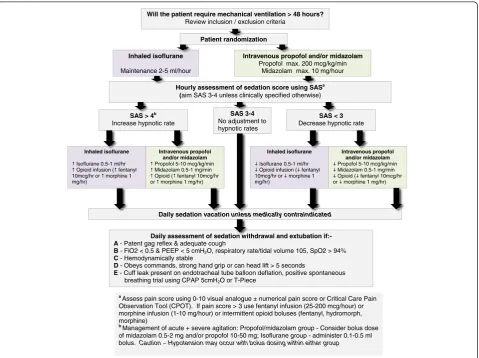
Sedation and pain management in both arms will be guided using an explicit bedside sedation-analgesia algorithm (Fig. 2). Sedation in both arms will be ti-trated every hour to target a Riker Sedation-Agitation Score (SAS) of 3 to 4 (or as clinically indicated) until extubation or tracheostomy. Patients will be reviewed daily for assessment of withdrawing sedation to assist ventilator weaning (resolving the underlying pathology that led to mechanical ventilation; patient capable of mak-ing respiratory effort; PaO2/FiO2> 150 to 200 mmHg;
PEEP 5 to 8 cm H2O; satisfactory hemodynamic stability
with mean arterial pressure >60 mmHg, which maybe assisted with stable doses of vasoactive drug support; and
a Assess pain score using 0-10 visual analogue ± numerical pain score or Critical Care Pain
Observation Tool (CPOT). If pain score > 3 use fentanyl infusion (25-200 mcg/hour) or morphine infusion (1-10 mg/hour) or intermittent opioid boluses (fentanyl, hydromorph, morphine)
b Management of acute + severe agitation: Propofol/midazolam group - Consider bolus dose
of midazolam 0.5-2 mg and/or propofol 10-50 mg; Isoflurane group - administer 0.1-0.5 ml bolus. Caution Hypotension may occur with bolus dosing within either group
Will the patient require mechanical ventilation > 48 hours?
Review inclusion / exclusion criteria
Patient randomization
Inhaled isoflurane
Maintenance 2-5 ml/hour
Intravenous propofol and/or midazolam
Propofol max. 200 mcg/kg/min Midazolam max. 10 mg/hour
Hourly assessment of sedation score using SASa
(aim SAS 3-4 unless clinically specified otherwise)
SAS 3-4
No adjustment to hypnotic rates
SAS > 4b
Increase hypnotic rate
SAS < 3
Decrease hypnotic rate
Daily assessment of sedation withdrawal and extubation if:-A- Patent gag reflex & adequate cough
B- FiO2 < 0.5 & PEEP < 5 cmH2O, respiratory rate/tidal volume 105, SpO2 > 94% C- Hemodynamically stable
D- Obeys commands, strong hand grip or can head lift > 5 seconds
E - Cuff leak present on endotracheal tube balloon deflation, positive spontaneous breathing trial using CPAP 5cmH2O or T-Piece
Daily sedation vacation unless medically contraindicated
Intravenous propofol and/or midazolam Propofol 5-10 mcg/kg/min Midazolam 0.5-1 mg/min Opioid ( fentanyl 10mcg/hr or morphine 1 mg/hr) Inhaled isoflurane
Isoflurane 0.5-1 ml/hr Opioid infusion ( fentanyl 10mcg/hr or morphine 1 mg/hr)
Inhaled isoflurane
Isoflurane 0.5-1 ml/hr Opioid infusion ( fentanyl 10mcg/hr or morphine 1 mg/hr)
Intravenous propofol and/or midazolam Propofol 5-10 mcg/kg/min Midazolam 0.5-1 mg/min Opioid ( fentanyl 10mcg/hr or morphine 1 mg/hr)
[image:4.595.60.540.359.717.2]no evidence of acute myocardial ischemia) and extubated according to the criteria outlined in Fig. 2. Pain scores will be monitored hourly in both groups using the critical care pain observation tool (CPOT) and numerical pain score [5]. Pain will be managed in both arms using intravenous opioids (fentanyl, hydromorphone, or morphine) aiming for pain scores below 3.
Specialized equipment set-up for volatile sedation
Isoflurane is infused into the AnaConDa™ device, which is placed between the endotracheal tube and the ventilator breathing circuit. The device is changed every 24 h. Isoflurane volatile agent is infused into the device using the Medfusion 3500™ syringe pump driver (Smith Medical, St. Paul, Minnesota, US). A unique and simple syringe driver program for isoflur-ane has been designed to improve safety of adminis-tration. This program includes infusion rate limits in accordance with the sedation protocol, dose range for rapid bolus administration and a keypad automated lock system. Scavenging within the ICU will be per-formed by standard room air exchanges and active vola-tile scavenging using our previously described and tested system [21]. This consists of two canisters of Delta-sorb™ (Blue-Zone, Concord, Ontario, Canada) assem-bled in a series from the ventilator expiratory port to the wall outlet suction, which prevents any venting to the atmosphere. Deltasorb™ contains a lattice matrix of silica zeolite, which adsorbs volatile agents. Capno-graphy and end-tidal gas monitoring will be per-formed at the bedside using the Datex AS/3™ monitor (DRE Inc, Lousiville, Kentucky, US) or Vamos™ monitor (Draeger, Ontario, Canada) monitors. When patients are being prepared for extubation, study sedation drugs will be discontinued, and the AnaConDa™ device will be re-moved from the breathing circuit, given its high recycling properties, to facilitate a quick drug washout.
Staff education and training
This trial involves the use of a new mediation and delivery system for ICUs staffed by non-anesthesiologists. Thus, education of medical, nursing and respiratory therapy staff regarding sedation practice and the use of volatile agents is supported by the development of a formal written and lecture-based teaching program. A practical bedside hand-book and in-depth teaching manual was specifically de-signed for this study for critical care teams with limited or no anesthesia experience.1Training sessions include infor-mation regarding the roles of the multidisciplinary team, use of the AnaConDa™device, equipment set-up, trouble-shooting, nebulization of drugs, transport of the critical care patient and safety monitoring. Participants finishing the training session will be completing a confidential questionnaire using a 1 to 5 Likert scale, which will assess
the quality of the education. A pre- and post-study ques-tionnaire will be performed to assess staff experience, knowledge, and opinions on using inhalational and intra-venous sedation before and after this pilot trial. Nursing and respiratory therapy staff actively involved in the care of enrolled patients will be asked to record their daily sat-isfaction score regarding both sedation modalities.
Blinding
Blinding of this study to the healthcare team, patient family and data collectors is not possible given the sig-nificant differences in the equipment and bedside moni-toring. The data will be blinded to the data analyst.
Equipment licensing and approvals
The AnaConDa™ device is licensed for use in Canada and Health Canada approval has been granted for the use of isoflurane for critical care sedation (control number 164474).
Study outcomes
Primary outcomes
This pilot trial will primarily assess the sedation-analgesia protocol feasibility and safety by measuring atmospheric volatile concentration levels; see the Project evaluation and data collection for details.
Secondary outcomes
The following secondary clinical endpoints will be recorded:
1. Time to extubation (time between discontinuing sedation and tracheal extubation)
2. Duration of mechanical ventilation 3. Quality of sedation assessed by
a) Number hours per day target SAS achieved daily b) Number of sedation boluses administered per day c) Opioid requirement
d) Additional sedative and anti-psychotic drugs, for example, morphine BDZ, haloperidol
4. Incidence of delirium
5. Vasopressor/inotropic support 6. Serum fluoride levels (μmol/L) 7. ICU and hospital length of stay 8. ICU and hospital mortality
Project evaluation and data collection
being measured and calibrated prior to use. Measure-ment will be performed at four points along the breath-ing circuit: (1) expiratory limb of the ventilator, (2) post 1st Deltasorb, (3) post 2nd Deltasorb and (4) room levels around the patient’s head [21]. These measure-ments will be performed by the study coordinator who is trained to use the InfraRan analyzer™. Room levels above 2 ppm indicate high levels of atmospheric pollu-tion, which require immediate equipment assessment for leaks and inadequate room scavenging.
Adherence and violations of the sedation protocol will be assessed by inappropriate equipment set-up and fail-ure to titrate sedation to the target SAS score. This will be assessed by daily equipment checks by a member of the study team. The bedside nurse will record hourly ac-tual and target SAS scores. Protocol violations include no attempt in change in sedative-analgesic regime by the bedside nurse when the actual sedation score fails to meet the target sedation score for more than 2 h. In addition, we will seek feedback and document satisfac-tion scores from the bedside nurse and respiratory ther-apist regarding the protocol using a 1 to 5 Likert scale. A screening log of eligible non-randomized patients will also be kept. This will be reviewed to explore reasons for non-enrollment, for example, the study exclusion criteria or refusal by patient’s legal representative or attending physician.
Serum fluoride levels will be measured at 24 h after commencing sedation, followed by further samples every 48 h during sedation with two additional levels mea-sured after discontinuing sedation to assess fluoride washout. Serum fluoride levels will be measured in both treatment groups in order to understand the difference in fluoride levels from volatile sedation; many patients within our two sites have undergone recent surgery where anesthesia is often maintained using volatile agents. The study coordinator will collect 3 to 5 ml of blood in an EDTA tube, which is centrifuged at 2000 g at −30 °C. The plasma is collected and immediately fro-zen at −70 °C and subsequently fluoride levels are ana-lyzed at a specialized laboratory. Serum fluoride levels will be correlated with the patient’s renal function as assessed using serum creatinine and glomerular filtration rate to look for any associated nephrotoxicity.
Patient demographics, APACHE (Acute Physiology and Chronic Health Evaluation) score, hemodynamic variables and vasoactive drug support, ventilation me-chanics, laboratory investigations, clinical ICU compli-cations, length of stay, and mortality will be recorded by daily patient assessment and review of paper and electronic health records. Delirium will be assessed twice daily using the Confusion Assessment Method (CAM-ICU) or Intensive Care Delirium Screening Checklist (ICDSC) [5].
Sample size and time line
This pilot study will recruit 60 patients over 2 years. Be-cause this pilot trial is designed to mainly assess the feasibility of our protocol and the safety of running vola-tile agents for ICU sedation, we believe 60 patients will be adequate and in keeping with other pilot studies [25]. This will adequately assess the initial feasibility and safety of using volatile agents for long-term sedation. A total of 66 patients will be recruited to accommodate a 10 % attrition rate. We calculated the sample size for a larger trial based on logarithmic transformation of our preliminary analysis of our short-term sedation results, which demonstrated median extubation times of 178 and 285 min within the volatile and propofol groups, respectively [19]. To demonstrate a moderate Cohen’s effect size with a two-sided α of 0.05 and 90 % power, 170 patients will be required. With an attrition rate of 10 %, the final sample size for randomization is 188 (94 patients per arm).
Statistical analysis
Continuous parametric variables such as atmospheric volatile levels, serum fluoride levels will be recorded as mean (standard deviation) and analyzed using a two-sample independent t-test. All nonparametric data such as satisfaction scores will be recorded as median (interquartile range) and analyzed using the Mann Whitney U test. Binary data such as gender, comorbidities will be recorded as proportions and an-alyzed using the chi-squared or Fishers exact test (if samples <5). Data will be analyzed by an independent statistician using SAS version 9.4 software (Cary, NC, USA). Data analysis will be based on the intention-to-treat principle.
Discussion
Volatile anesthetics have many pharmacological proper-ties, making it the ideal sedative agent for prolonged duration of use in the ICU. Data from this trial will help us understand the feasibility, acceptance and technical issues associated with conducting volatile sedation in ICUs with little or no experience of this technique. Furthermore, this study will answer important questions regarding fluoride levels during prolonged volatile-based sedation and assess the efficacy of our scavenging system.
Trial status
This trial is actively enrolling patients. Currently, we have recruited 50 % patients and aim to complete this pilot trial by June 2016.
Endnotes
1
Abbreviations
AnaConDa™:Anesthesia Conserving Device; BDZ: benzodiazepines; CAM-ICU: Confusion Assessment Method; ICDSC: Intensive Care Delirium Screening Checklist; ICU: intensive care unit; RCT: randomized controlled trial; SAS: sedation agitation score.
Competing interest
None of the authors have any financial or non-financial competing interests.
Authors’contributions
Study concept and design was performed by AJ, MW, NDF, and DW. Staff training and daily conduct of the study has been carried out by AJ, MW, NDF, AS, and JM. The manuscript has been prepared by AJ and has been read and approved by all authors.
Acknowledgments
We would like to thank the respiratory therapy and nursing staff in our ICUs for their support during the conduct of this study. This research study is funded by the Alternative Funding Plan, Academic Medical Organization (AMO), Ontario, and a Merit award from the University of Toronto.
Author details
1Department Anesthesia and Pain Medicine, Toronto General Hospital, 200
Elizabeth St, Toronto, Ontario M5G 2C4, Canada.2Department Critical Care Medicine, Toronto General Hospital, 200 Elizabeth St, Toronto, Ontario M5G 2C4, Canada.3Department Critical Care Medicine and Anesthesia, Toronto General Hospital, 200 Elizabeth St, Toronto, Ontario M5G 2C4, Canada.
4
Department Anesthesia, University of Ottawa Heart Institute, 40 Ruskin St, Ottawa, Ontario K1Y 4W7, Canada.
Received: 13 January 2015 Accepted: 24 November 2015
References
1. Weinert CR, Calvin AD. Epidemiology of sedation and sedation adequacy for mechanically ventilated patients in a medical and surgical intensive care unit. Crit Care Med. 2007;35:393–401.
2. Mehta S, Burry L, Fischer S, Martinez-Motta JC, Hallett D, Wong C, et al. Canadian survey of the use of sedatives, analgesics and neuromuscular blocking agents in critically ill patients. Crit Care Med. 2006;34:374–80. 3. Payen JF, Chanques G, Mantz J, Hercule C, Auriant I, Leguillou JL, et al.
Current practices in sedation and analgesia for mechanically ventilated critically ill patients. Anesthesiology. 2007;106:687–95.
4. Jackson DL, Proudfoot CW, Cann KF, Walsh TS. The incidence of sub-optimal sedation in the ICU: a systematic review. Crit Care. 2009;13:R204.
5. Barr J, Fraser GL, Puntillo K, Ely EW, Gélinas C, Dasta JF, et al. Clinical practice guidelines for the management of pain, agitation, and delirium in adult patients in the intensive care unit. Crit Care Med. 2013;41:263–306. 6. Devlin JW. The pharmacology of oversedation in mechanically ventilated
adults. Curr Opin Crit Care. 2008;14:403–7.
7. Ely EW, Shintani A, Truman B, Speroff T, Gordon SM, Harrell Jr FE, et al. Delirium as a predictor of mortality in mechanically Ventilated patients in the intensive care unit. JAMA. 2004;291:1753–62.
8. Ouimet S, Kavanagh BP, Gottfried SB, Skrobik Y. Incidence, risk factors and consequences of ICU delirium. Intensive Care Med. 2007;33:66–73. 9. Milbrandt EB, Deppen S, Harrison PL, Shintani AK, Stiles RA, Truman B, et al.
Costs associated with delirium in mechanically ventilated patients. Crit Care Med. 2004;32:955–62.
10. Pandharipande PP, Girard TD, Jackson JC, Morandi A, Thompson JL, Pun BT, et al. Long-term cognitive impairment after critical illness. New Engl J Med. 2013;369:1306–16.
11. Girard TD, Pandharipande PP, Ely EW. Delirium in the intensive care unit. Crit Care. 2008;12 Suppl 3:S3.
12. Wade DM, Howell DC, Weinman JA, Hardy RJ, Mythen MG, Brewin CR, et al. Investigating risk factors for psychological morbidity three months after intensive care: a prospective cohort study. Crit Care. 2012;16:R192. 13. Griffiths J, Fortune G, Barber V, Young JD. The prevalence of post traumatic
stress disorder in survivors of ICU treatment: a systemic review. Intensive Care Med. 2007;33:1506–18.
14. Vasile B, Rasulo F, Candiani A, Latronico N. The pathophysiology of propofol infusion syndrome: a simple name for a complex syndrome. Intensive Care Med. 2003;29:1417–25.
15. Sockup J, Scharff K, Kubosch K, Pohl C, Bomplitz M, Kompardt J. State of the art: sedation concepts with volatile anesthetics in critically ill patients. J Crit Care. 2009;24:535–44.
16. Rohm KD, Wolf MW, Schollhorn T, Schellhaass A, Boldt J, Piper SN. Short-term sevoflurane sedation using the anesthesia conserving device after cardiothoracic surgery. Intensive Care Med. 2008;34:1683–9.
17. Hellstrom J, Owall A, Sackey PV. Wake up times following sedation with sevoflurane versus propofol after cardiac surgery. Scand Cardiovasc J. 2012;46:262–8.
18. Meiser A, Bellgardt M, Sirtl C, Lohmann S, Garthoff J, Kaiser P, et al. Desflurane compared with propofol for postoperative sedation in the intensive care unit. Br J Anaesth. 2003;90:273–80.
19. Wasowicz M, Jerath A, Djaiani G, Katznelson R, Karski J. Expanding an anesthesiologist role beyond an operating room. Volatile based sedation in cardiac surgical patients (abstract). Brit J Anesth. 2012;108:paper 1003. 20. Mesnil M, Capdevila X, Bringuier S, Trine PO, Falquet Y, Charbit J, et al. Long-term sedation in intensive care unit: a randomized comparison between inhaled sevoflurane and intravenous propofol and midazolam. Intensive Care Med. 2011;37:933–41.
21. Pickworth T, Jerath A, DeVine R, Kherani N, Wasowicz M. The scavenging of volatile anesthetic agents in the cardiovascular intensive care unit environment. Can J Anesth. 2013;60:38–43.
22. Sackey PV, Martling CR, Granath F, Radell PJ. Prolonged isoflurane sedation of intensive care unit patients with the anesthesia conserving device. Crit Care Med. 2004;32:2241–6.
23. Cousins MJ, Mazze RI. Methoxyflurane nephrotoxicity: A study of dose response in man. JAMA. 1973;225:1611–6.
24. Osborne MA, Eddleston JM, McNicoll W. Inorganic fluoride concentration after long-term sedation with isoflurane. Intensive Care Med. 1996;22:677–82. 25. Lancaster GA, Dodd S, Williamson PR. Design and analysis of pilot studies:
recommendations for good practice. J Eval Clin Pract. 2002;10:307–12.
• We accept pre-submission inquiries
• Our selector tool helps you to find the most relevant journal
• We provide round the clock customer support
• Convenient online submission
• Thorough peer review
• Inclusion in PubMed and all major indexing services
• Maximum visibility for your research
Submit your manuscript at www.biomedcentral.com/submit