
International Journal of Emerging Technology and Advanced Engineering
Website: www.ijetae.com (ISSN 2250-2459, ISO 9001:2008 Certified Journal, Volume 6, Issue 3, March 2016)
Effective Fault Tolerance Management in Cloud Computing
Dr. Chandralekha
1, Satish Kumar Suman
2, Anupriya
31Prof. Dept. of CSE, DRIEMS College, Cuttack, Odisha, India 2,3Student, Dept. of CSE, DRIEMS College, Cuttack, Odisha, India
Abstract- Cloud computing is an adoptable technology as
it provides integration of software and hardware resources which are dynamically scalable. The dynamic environment of cloud results in various unexpected faults and failures. Fault tolerance enables a system to react gracefully to an unexpected equipment or programming malfunction. This paper explores the significance relationship between fault tolerance and system performance and develops metrics to measure fault tolerance within the context of system performance. We show the utility of designed metrics such as robustness by applying them to a sample mobile cloud computing environment consisting of multiple numbers of mobile nodes. Further robustness has been optimized using genetic algorithm and effective fault tolerance exhibited by the system has been evaluated.
Keywords- Cloud computing, reactive/proactive fault
tolerance, robustness, performance parameters, checks point.
I. INTRODUCTION
The increasing demand for flexibility and scalability in dynamically obtaining and releasing computing resources in a cost-effective and device-dependent manner and in hosting applications without the burden of installation and maintenance has resulted in a wide adoption of the cloud computing paradigm. The increasing popularity of this paradigm as an attractive alternative to classic information processing systems has increased the importance of its correct and continuous operation even in the presence of faulty components. Among the many addressable issues [22] of cloud computing such as fault tolerance, workflow scheduling, workflow management, security etc, fault tolerance is one of the important issues which the researchers are supposed to look forward. Cloud computing is still vulnerable to a large number of system failures and in effect and there is an increasing concern among users regarding the reliability and availability of cloud computing services. In order to minimize the failure impact on system and application execution, failures should be anticipated and proactively handled. Fault tolerance techniques are used to predict these failures and take an appropriate action before failures actually occur.
Fault tolerance is concerned with all the techniques necessary to enable a system to tolerate different software faults remaining in the system after its development. It is carried out by error processing which have two constituent phases.
The phases are “effective error processing” which aimed at bringing the effective error back to a latent state, if possible before occurrence of a failure and “latent error processing” aimed at ensuring that the error does not become effective again. When a fault occurs, these techniques provide mechanisms to the system to prevent system failure occurrence .The main benefits of implementing fault tolerance in cloud computing include failure recovery, lower cost, improved performance metrics [1] etc. This paper aims to provide a better understanding of fault tolerance challenges and identifies various tools and techniques used for fault tolerance. When multiple instances of an application are running on several virtual machines (VM) and one of the server goes down, there is a need to implement an autonomic fault tolerance technique that can handle these types of faults.
Fault tolerance management in cloud platform can be analyzed in two different visions. The first one consists of giving both the detection and repair responsibilities to one cloud participant (exclusively) while the second is to harness the skills of the two types of participant. According to these two visions, different fault tolerance techniques have been presented [2] for the three types of failure namely hardware, VM and application.
II.
FAULT TOLERANCE TECHNIQUESFault tolerance can be classified either as proactive or reactive in cloud computing. The proactive fault tolerance policy tries to[17] avoid recovery from fault, errors and failure by predicting them and proactively replace the suspected component means to detect the problem before it actually come. Reactive fault tolerance aims to remove the fault after it occurs and reduce the effort of failures when the failure effectively occurs. These can be further classified into two sub-techniques error processing and fault treatment. Error processing aims at removing errors from the computational state. Fault treatment aims at preventing faults from being re-activated.
A. Reactive Fault Tolerance Techniques
International Journal of Emerging Technology and Advanced Engineering
Website: www.ijetae.com (ISSN 2250-2459, ISO 9001:2008 Certified Journal, Volume 6, Issue 3, March 2016) 1) Check pointing/ Restart: In this scenario after doing
every change in system a check pointing is done. When a task fails, rather than from the [21] beginning it is allowed to be restarted that job from the recently .It is an efficient task level fault tolerance technique for long running applications.
2) Replication: Various task replicas are run on different resources, for the execution to succeed till the entire replicated task is not crashed. It can be implemented using tools like HAProxy, Hadoop and Amazon Ec2 etc.
3) Job Migration: During failure of any task, it can be migrated to another machine. This technique can be implemented by using HAProxy.
4) SGuard: It is less disruptive [20] to normal stream processing and makes more resources available. It is based on rollback recovery and can be implemented in HADOOP, Amazon EC2.
5) Retry: It is the simplest task level technique that retries the failed task on the same cloud resource.
6) Task Resubmission: It is the most widely used fault tolerance technique in current scientific workflow systems. Whenever a failed task is detected, it is resubmitted either to the same or to a different resource at runtime.
7) User defined exception handling: In this user specifies the particular treatment of a task failure for workflows.
8) Rescue workflow: This technique allows the workflow to continue even if the task fails until it becomes impossible to move forward without catering the failed task.
B. Proactive Fault Tolerance
The principle of proactive fault tolerance policies is to avoid recovery from faults, errors and failures by predicting them and proactively replacing the suspected components from other working components. These techniques are based on these policies:
1) Software Rejuvenation: It is a technique that designs the system for periodic reboots. It restarts the system with clean state .
2) Proactive Fault Tolerance using self-healing: When multiple instances of an application are running on multiple virtual machines, it automatically handles failure of application instances.
3) Proactive Fault Tolerance using Pre-emptive Migration: Pre-emptive Migration relies on a feedback-loop control mechanism where application is constantly monitored and analyzed.
The fault tolerance techniques [12] can be measured by the parameters like, network load for delay and throughput, optimum resource utilization, response time and overload, job allocation, load balancing, scalability and security.
QoS in cloud is often characterized by using fault detection latency, replica launch latency and failure recovery latency, and other application-dependent metrics such as bandwidth, reliability, robustness, and loss rate etc.
III. FAULT TOLERANCE MODELS
A failure represents the condition in which the system deviates from fulfilling its intended functionality or the expected behaviour. A failure happens due to an error that is, due to reaching an invalid system state. The hypothesized cause for an error is a fault which represents a fundamental impairment in the system. The notion of faults, errors and failures can be [4] represented using the following chain [S.2004, HH.1997]:
Fault → Error → Failure → Fault → Error → Failure
Several models that are [3] implemented based on previously defined fault tolerance techniques are as follows:
A. AFTRC
It is an Adaptive Fault Tolerance model in Real time Cloud Computing. In this proposed model system tolerates fault proactively and makes decisions on the basis of the reliability of the processing nodes.
B. LLFT
A propose model which contains a low latency fault tolerance (LLFT) middleware for providing fault tolerance for distributed applications deployed within the
cloud computing environment. This middleware
replicates application by the use of semi-active replication or semi-passive replication process to protect the application against various types of faults.
C. FTM
It is a model to overcome the limitation of existing methodologies and achieve the reliability and flexibility. An inventive is proposed perspective on creating and managing fault tolerance. By this particular methodology user can specify and apply the desire level of fault tolerance. FTM architecture can primarily be viewed as an assemblage of several web services components, each with a specific functionality.
D. FTWS
It is a Fault [19] Tolerant Work flow Scheduling
International Journal of Emerging Technology and Advanced Engineering
Website: www.ijetae.com (ISSN 2250-2459, ISO 9001:2008 Certified Journal, Volume 6, Issue 3, March 2016) E. Candy
Candy is a component based availability model. It is based on the high availability assurance of cloud service is one of the main characteristic of cloud service and also one of the main critical and challenging issue for cloud.
F. FT-Cloud
A component ranking based framework and its architecture for building cloud application. FT Cloud occupies the component invocation structure and frequency for identifying the component. Also, there is an algorithm to automatically govern fault tolerance safely.
IV. FAULT TOLERANT STRATEGIES
There are many strategies in which three are exclusively included here.
A. Recovery Blocks (RB)
RB [3] is a means of structuring redundant program modules, where standby components will be invoked sequentially.
Failure probability f of a recovery block can be calculated by:
f = π
ni=1f
i (1)Where n is the number of redundant components and fi is
the failure probability of the ith component.
B. N- Version Programming (NVP)
NVP [11] is multi-version programming where versions are independently generated. Failure probability f of a recovery block can be calculated by:
f = ∑
ni=n+1/2F(i)
(2)Where n is the number of functionally equivalent components (n is odd) and F(i) is the probability that I alternative components from all the n components fail.
C.Parallel Strategy
Invokes all the n functional equivalent components in parallel and the first returned response will be employed as the final result. Failure probability f of a recovery block can be calculated by:
f = π
ni=1f
i (3)Where n is the number of redundant components and fi is
the failure probability of the ith component.
D. ACO
Ant colony optimization algorithm (ACO) is a probabilistic technique and is a member of the ant colony algorithms family, in swarm intelligence methods, and it constitutes some metaheuristic optimizations. It can be reduced to finding good paths through graphs.
In general, the ant moves from state to state with probability Where is the amount of pheromone deposited for transition, 0 ≤ α is a parameter to control the
influence of ,is the desirability of state transition xy (a
priori knowledge, typically , where d is the distance) , and represent the attractiveness and trail level for the other possible state transitions.
E. BC Strategy
The Artificial Bee Colony (ABC) [11] is an optimization algorithm based on the intelligent foraging behaviour of honey bee swarm. The main steps of the algorithm are given below:
1) Initial Food:
Initial food sources are produced for all employed bees.
2) Repeat:
a) Each employed bee goes to a food source and then evaluates its nectar amount and dances in the hive. b) Each onlooker watches the dance of employed bees
and chooses one of their sources depending on the dances, and then goes to that source.
V. CHALLENGES FOR IMPLEMENTATION OF FAULT
TOLERANCE IN CLOUD COMPUTING
Providing fault tolerance [1] requires careful consideration and analysis because of their complexity, inter-dependability and the following reasons:
There is a need to implement autonomic fault
tolerance technique for multiple instances of an application running on several virtual machines [5].
The new approach needs to be developed that
integrate these fault tolerance techniques with existing workflow scheduling algorithms [6].
Different technologies from competing vendors of
cloud infrastructure need to be integrated for establishing a reliable system [7].
Autonomic fault tolerance must react to
synchronization among various clouds [7].
A benchmark based method can be developed in
cloud environment for evaluating the performances of fault tolerance component in comparison with similar ones [8].
To ensure high reliability and availability multiple
clouds computing providers with independent software stacks should be used [9] [10].
VI. RELATED WORK
International Journal of Emerging Technology and Advanced Engineering
Website: www.ijetae.com (ISSN 2250-2459, ISO 9001:2008 Certified Journal, Volume 6, Issue 3, March 2016)
ABFT uses matrix or vector level checksum in row and column to detect a faulty processor in multiple processor systems. The method can be used to detect and correct errors in matrix operations such as addition, multiplication, scalar product, and LU-decomposition performed in multiple processor systems which may have one failed processor. In our work, however, we focus on the problem of achieving a certain reliability with the minimum cost in potentially faulty clouds. In [14], Mei et al. investigated the problems of dynamic computing service registration, large data storage and access, adaptability, and quality discovery in cloud computing. A comprehensive [15] high-level approach to shading the implementation details of the fault tolerance techniques to application developers and users by means of a dedicated service layer has been proposed. In particular, the service layer allows the user to specify and apply the desired level of fault tolerance, and does not require knowledge about the fault tolerance techniques that are
available in the envisioned Cloud and their
implementations. The proposed algorithm in [16] works for reactive fault tolerance among the servers and reallocating the faulty servers task to the new server which has minimum load at the instant of the fault.
VII. PROPOSED WORK
Executing sophisticated applications like video, image and storage processing in personal mobile devices remains challenging due to their limited resources (e.g. computation, memory, energy etc.). As a result many applications rely on offloading all or part of their works to remote servers such as clouds and mobile devices. In a dynamic network, e.g. mobile cloud for disaster respose or military operations, when selecting remote servers they are often inaccessible because of node failures, unstable links or node mobility which raises reliability issue. The natures of these operating environments are such that faults often develop during the course of regular action. A fault can cause the node to lose functionality, which in turn may lead to drop the overall performance of the system.
In our proposed work, we evaluate the system performance based on the following terms:
A. Efficiency
Ability of the system to best utilize the available resources.
B. Robustness
Ability of the system to identify and recover from faults, Formally the problem can be defined as follows:
Given: A set of mobile nodes in cloud environment R = {R1, R2, R3... Rn}.
A pre-defined set of tasks to be executed by the mobile
nodes T = {T1, T2, T3, ..., Tm}, where each task Tj is
executed by a separate mobile node Ri.
We assume that the task assignment is pre-defined by
means of a vector < Ri, Tj >. An individual task Tj is
executed by the specific mobile node Ri. Faults can occur naturally during task execution or can be artificially introduced into the system. Faults are broadly categorized into three types: known, which are faults the designer can anticipate based on experience, application type and operating environment unknown, which are faults not anticipated by the designer, but which can be diagnosed by the system based on experience and sparse
information available during execution and
undiagnosable, which are faults that cannot be classified autonomously and need specific techniques to handle. The number of faults in each category is represented as fknown, funknown, and fundiagnosable. The mobile nodes have three functionally significant operating states: Normal state, in which a mobile node focuses all its system resources and operating time towards completing the assigned task. Fault state, in which a mobile node spends all available time and resources in attempting to identify the source of the encountered fault and Recovery state, in which a mobile node spends its resources and operating time in executing the recovery action for the diagnosed fault. Once assigned to a mobile node, a task can have two possible outcomes: task success or task failure. Task success is defined as the ability of the robot to successfully complete its assigned task in the presence of faults. A task failure is defined as the inability of the mobile node to complete its assigned task in the presence
of faults. If a mobile node (Ri) fails to complete a task
(Tj) , then based on the system design, the system can
either assign task Tj to a different mobile node Ri,
re-assign Tj to the task queue of Rj , remove task Tj from the
system task list. Every task assignment <Ri,Tj>, is
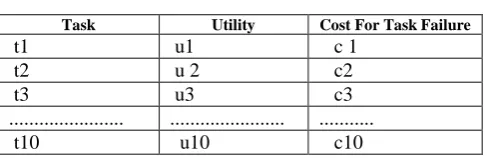
considered a task attempt and is evaluated separately towards overall system performance. Based on the importance of the task the designer builds a task-utility table, such as that shown in Table I, in which the summation of the terms ( ∑u and ∑c) are normalized between ranges of [0, 1].
VIII. MEASURING SYSTEM PERFORMANCE
We first define the total number of faults for the ith
attempt of task Tj as the summation [18] of all
encountered faults during the course of task execution.
That is, Fij = fi knownj+ fi unknownj+ fi undiagnosablej.
Successful completion of task Tj is measured by means
of a success metric, Aj. An award is associated with
every successfully completed task, given by the utility component uj.
Aj = uj (1)
Then, the system level measure of success (A) is calculated as:
International Journal of Emerging Technology and Advanced Engineering
Website: www.ijetae.com (ISSN 2250-2459, ISO 9001:2008 Certified Journal, Volume 6, Issue 3, March 2016)
Where X = {Tj | Task Tj € T was successfully
completed}, Similarly, we associate a task failure metric,
Bij ,for each unsuccessful attempt of task Tj by a mobile
node. The punishment associated with a failed task
attempt is given by the cost component for task failure cj
. On the other hand, as the performance is closely tied with the mobile node’s ability to recover from faults, every failed task has a robustness component associated with it. The effect of the task failure metric towards performance is discounted by the extent of the robustness in the task, i.e., the higher the robustness, the lower is the
value of the task failure. We define ρij as the measure of
robustness for the ith attempt of task Tj and is given by
ρi
j = (f i known j+ f i unknown j ) / Fji (3)
Based on “(3)”, the task failure metric for the ith
attempt of task Tj is:
B ij = cj * (1 – ρij) (4)
Grouping all failed attempts of a task T j ,we get task
failure metric Bj for a task T j.
qj
Bj = (c j* q j ) * ∑ (1 – ρij) (5)
i=1
where qj is total number of failed attempts of task Tj.
The upper bound of q is application specific and needs to be determined by the designer before implementation.
Simplifying,
qj
Bj = (c j* q j ) * (qj-∑ ρij) (6) i=1
Extending equation “(3)” across all task failures, gives:
qj
B = ∑(cj* qj) * (qj-∑ ρij) (7)
J:Tj€X i=1
Where Y= {Tj | Task Tj € T failed}.
Now the measure of performance can be obtained by subtracting the cost associated with a task failure from the utility for successful task completion.
P = A – B (8)
P provides the designer with a measure of the system’s effective performance whose value will be in the range of [-∞,1].If P=1, then the system performs optimally and if P approaches -∞ then it indicates a total system failure.
IX. MEASURING FAULT-TOLERANCE
By combining individual task robustness measures, system robustness can be represented as
qj
ρs = ∑ ∑ ρji (1)
J:Tj€Y i=1
A high value of ρ s indicates a highly robust system
and a ρ s value 0 indicates a system with no robustness to
faults. In order to define the system efficiency metric (e),
we need to measure the total time (tj ) spent by a mobile
node on a successfully completed task, Tj . This is given
by the summation of time spent in Normal (tNormal), Fault
(tFault) and Recovery (tRecovery) states for that attempt,
i.e.,
t j = tNormal j + t Fault j + t Recoveryj (2)
Then, we can define e as:
e = ∑ ( t Normalj) /t j (3)
j:Tj€X
[image:5.595.311.555.366.445.2]Similar to the robustness measure, a more efficient system has a higher value of e and an inefficient system has e near 0. The influence of learning towards system performance can be measured as an empirical quantity.
Table I UTILITY-COST TABLE
Task Utility Cost For Task Failure
t1 u1 c 1
t2 u 2 c2
t3 u3 c3
... ... ...
t10 u10 c10
Consider a sample multi-node application comprised of 10 individual tasks to be completed by a team of 10 functionally similar mobile application.. We make the assumptions that the robots encounters one failure per task and the task/utility weights are evenly distributed. Then we define these measures as follows:
For all i, u i = c i
10 10
∑ui ∑ci = 1 (4)
i=1 i=1
The time spent by a mobile node in normal operation mode is assumed to be t secs. Also, as it takes a very small fraction of time to diagnose task failure from the time a fault is discovered, we assume this time to be negligible and ignore it.
The variations in the values can be evaluated by considering the following three cases:
A.Best cases, where the system encounters no failures.
B.Average case, where the system encounters at least
one failure in half the number of executed task.
C.Worst-case, where there is at least one failure in all
cases.
International Journal of Emerging Technology and Advanced Engineering
Website: www.ijetae.com (ISSN 2250-2459, ISO 9001:2008 Certified Journal, Volume 6, Issue 3, March 2016)
When a fault is encountered during task execution in the first architecture, mobile nodes do not have the capability to recover and report a failed task. In case of the second architecture, if and when a failure occurs, the task is assumed to have failed and is reassigned to another team member for execution. The task reassignment continues until all mobile nodes in the team have had an opportunity to complete the task. We further make the assumption that at an average it takes n /2 attempts to successfully recover from an encountered fault. Finally, we assume there is 50% probability of the system successfully recovering from an encountered error.
X. RESULT ANALYSIS
[image:6.595.66.261.441.527.2]Firstly the performance of the system is measured in a system with faults. We inferred that on average, the performance of the system with zero fault-tolerance (F1) is better than that of the system with some fault-tolerance (F2) which is represented in Table II. However, with increasing number of faults in the system increases, F2 edges F1 in terms of performance. On the other hand, a system with a higher task completion rate will have a higher value for efficiency, which is reflected in Table II.
Table II EVALUATION TABLE
System Case P ρ e
F1 Best case 1 0 10
Average case 0.5 0 5
Worst Case -1 0 0
F2 Best case 1 0 10
Average case 0.4 0 7.5
Worst Case -4.5 0 5
Secondly, robustness of the system is optimized using Genetic algorithm which is reflected in Fig1.
0 10 20 30 40 50 60 70 80 90 100
-0.3 -0.2 -0.1 0 0.1
Generation
F
it
n
e
s
s
v
a
lu
e
Best: -0.23248 Mean: -0.2323
1 -30
-20 -10 0
Robustness
C
u
rr
e
n
t
b
e
s
t
in
d
iv
id
u
a
l
Current Best Individual
Best fitness Mean fitness
Fig 1
XI. CONCLUSION AND FUTURE WORK
Fault tolerance is concerned with all the techniques which are necessary to enable a system to tolerate system faults remaining in the system after its development. This paper discussed the fault tolerance techniques covering its research challenges, used for implementing fault tolerance techniques in cloud computing. In this paper, we present an evaluation metric to measure the extent of fault-tolerance towards system improvement over a period of time .Specifically this research provides a qualitative measure for identifying system fault-tolerance in terms of efficiency, robustness. However we have not considered some parameters like availability, reliability and extent of fault management in dynamic environment for measuring the system performance which we will evaluate in our future research work.
REFERENCES
[1] Anju Bala, Inderveer Chana,” Fault Tolerance- Challenges,
Techniques and Implementation in Cloud Computing” IJCSI International Journal of Computer Science Issues, Vol. 9, Issue 1, No 1, January 2012.
[2] Alain Tchana, Laurent Broto, Daniel Hagimont,”Fault Tolerant
Approaches in Cloud Computing Infrastructures ,ICAS 2012 : The Eighth International Conference on Autonomic and Autonomous Systems.
[3] Virendra Singh Kushwahi, Sandip Kumar, Priyush Narwariya, “A
Survey on various Fault Tolerant Approaches for cloud Environment during Load Balancing, International Journal of Computer Networking.
[4] Ravi Jhawar and Vincenzo Piuri, “Fault Tolerance and Resilience
in Cloud Computing Environments”, in Computer and
Information Seurity handbook, 2nd Edition.
[5] Gang Chen, Hai Jin, Deqing Zou, Bing Bing Zhou,Weizhong
Qiang, Gang Hu, “SHelp: Automatic Selfhealing for Multiple Application Instances in a Virtual Machine Environment”, IEEE International Conference on Cluster Computing, 2010.
[6] [6] Yang Zhang1, Anirban Mandal2, Charles Koelbel1 and Keith
Cooper, “Combined Fault Tolerance and Scheduling Techniques for Workflow Applications on Computational Grids” in 9th IEEE/ACM international symposium on clustering and grid, 2010.
[7] Imad M. Abbadi, “Self-Managed Services Conceptual Model in
Trustworthy Clouds' Infrastructure”, 2010.
[8] S. Hwang, C. Kesselman, “Grid Workflow: A Flexible Failure
Handling Framework for the Grid”,12th IEEE International Symposium on High Performance Distributed Computing (HPDC’03), Seattle, Washington,USA. IEEE CS Press, Los Alamitos, CA, USA, June 22 - 24, 2003.
[9] Michael Armbrust, Armando Fox, Rean Griffith, “Above the
Clouds: A Berkeley View of Cloud Computing”, Electrical Engineering and Computer Sciences University of California at Berkeley, 2009.
[10] Wenbing Zhao, P. M. Melliar-Smith and L. E. Moser, “Fault
Tolerance Middleware for Cloud Computing”, 2010 IEEE 3rd International Conference on Cloud Computing.
[image:6.595.64.252.566.726.2]International Journal of Emerging Technology and Advanced Engineering
Website: www.ijetae.com (ISSN 2250-2459, ISO 9001:2008 Certified Journal, Volume 6, Issue 3, March 2016)
[12] Seyyed Mansur Hosseini and Mostafa Ghobaei Arani, “Fault
Tolerance Techniques in Cloud Storage: A Survey”, International Journal of Database Theory and Application Vol.8, No.4 (2015), pp.183-190.
[13] K.-H. Huang and J. A. Abraham, “Algorithm-based fault tolerance
for matrix operations,” IEEE Transactions on Computer, vol. 33, no. 6, pp. 518–528, 1984.
[14] L. Mei, W. Chan, and T. Tse, “A tale of clouds: Paradigm
comparisons and some thoughts on research issues,” Asia-Pacific Conference on Services Computing. 2006 IEEE, vol. 0, pp. 464– 469, 2008.
[15] R. Jhawar , Univ. degli Studi di Milano, Crema, Italy , V. Piuri
,M. Santambrogio, “Fault Tolerance Management in Cloud
Computing: A System-Level Perspective”, IEEE System Journal,
Volume 7 Issue 2,2013.
[16] Jasbir Kaur, Supriya Kinger , “Efficient Algorithm for Fault
Tolerance in Cloud Computing”,International Journal of Computer Science and Information Technologies, Vol. 5 (5) , 2014, 6278-6281.
[17] T.K. Singh, G.T. RaviTeja, P.S.Pappala,” Fault Tolerance-
Challenges, Techniques and Implementation in Cloud
Computing” International Journal of Scientific and Research
Publications, Volume 3, Issue 6, June 2013.
[18] Balajee Kannan and Lynne E. Parker,” Fault-Tolerance Based
Metrics for Evaluating System Performance in Multi-Robot Teams”, Proc. of Performance Metrics for Intelligent Systems Workshop, 2006.
[19] Sweta Patel, Ajaya Kumar Singh,” Fault Tolerance Mechanisms
and its Implementation in Cloud Computing –A
Review”,IJARCSSE, Volume 3, Issue 12,December 2013.
[20] Sonal Rana ,Aditi Sharma,Amandeep Kaur,” Fault Tolerance in
Cloud Computing by Efficient Load Balancing Mechanism Based
on Ant Colony”,IJARCSSE,Volume 5, Issue 1,January 2015 .
[21] Vikas Kumar,Shiva Prakash,” A Load Balancing Based Cloud
Computing Techniques and Challenges”, IJSRM,Volume,Issue 5, May 2014
[22] K.Ganga,,Dr S.Karthik,, A.Christopher Paul, “A Survey on Fault
![Fig 1 [11]](https://thumb-us.123doks.com/thumbv2/123dok_us/8693209.877655/6.595.66.261.441.527/fig.webp)
