International Journal of Emerging Technology and Advanced Engineering
Website: www.ijetae.com (ISSN 2250-2459, ISO 9001:2008 Certified Journal, Volume 9, Issue 5, May 2019)
93
Design, Development and Characterization of Wood Plastic
Composites
Professor (Dr.) Ashish Thakur
1, Redae Sibhatu
21Professor, Solid Mechanics and Design Chair, Ethiopian Institute of Technology,School of Mechanical and Industrial Engineering, Mekelle University, Mekelle
2
PG students, EIT-M, Mekelle University, Mekelle
Abstract-- In this study, the effect of virginity of plastics on the mechanical properties of wood plastic composites was investigated. This paper focuses on determination of physical and mechanical properties of wood–plastic composites, which were made using either recycled or virgin high-density polyethylene (HDPE) with wood flour as filler. Composite panels were made from virgin HDPE or recycled HDPE through compression molding process. During the preparation of composites the Virgin HDPE/RHDPE and wood flour was taken 80%VHDPE: 20%WF, 70%VHDPE: 30%WFand60%VHDPE: 40%WF and 80%RHDPE: 20%WF, 70%RHDPE: 30%WF and 60%RHDPE: 40%WF respectively. The prepared composite sample was then taken for various physical and mechanical tests for as example the mechanical tests are water absorption test, tensile test, flexural test and impact test. The composites based on recycled HDPE were somewhat equivalent but not accurately equal to those based on virgin HDPE composites. Water absorption and strength properties of the composites can be improved by increasing the polymer content. The mechanical properties of VHDPE: WF and RHDPE: WF composites were compared and it was found that both VHDPE: WF and RHDPE: WFhave the good characteristics for engineering materials.
Keywords: HDPE, WPC, plastic wastes, wood flour, recycled
I. INTRODUCTION &BACKGROUND
With growing production and consumption, plastic worldwide is a currently resulting in a significant contribution to the municipal solid waste. In a similar way as for virgin plastics, any recycle plastics that can melt and be processed below the degradation point of wood can be used for manufacturing of wood plastic composites (WPCs). Recycling of the waste plastics has benefits of minimizing solid waste disposal problem, reducing the virgin plastic consumption and lowering the production cost.
Wood plastic composite (WPC) is a product which could be obtained from plastic and wood. WPC is a composite with a rapid growing usage consisting of a mixture of wood waste and polymeric material [2].
Wood Plastic Composites (WPCs) are emerging as one of the dynamic growth materials in building industry. WPC is manufactured by dispersing wood particles into molten plastics with coupling agent or additives to form composite material through various techniques of processing extrusion, compression or injection molding. Use of wood as the filler in WPCs has advantage such as low cost, renewable, biodegradability, low specific gravity and low abrasion to equipment as compared to the inorganic fillers [1-4].
WPC has become currently an important address of research that gained popularity over the last decade especially with its properties and advantages that attracted researchers such as: high durability, Low maintenance, acceptable relative strength and stiffness, fewer prices relative to other competing materials, and the fact that it is a natural resource [5]. Other advantages have been strength points including[6]:the resistance in opposition to biological deterioration especially for outdoor applications where untreated timber products are not suitable, the high availability of fine particles of wood waste is a main point of attraction which guarantees sustainability, improved thermal and creep performance relative to unfilled plastics where It can be produced to obtain structural building applicationsincluding: profiles, sheathings, decking, roof tiles, and window trims. On the other hand, WPCs are not nearly as stiff as solid wood; however, they are stiffer than unfilled plastics. In addition, they do not require special fasteners or design changes in application as they perform like conventional wood [7].
International Journal of Emerging Technology and Advanced Engineering
Website: www.ijetae.com (ISSN 2250-2459, ISO 9001:2008 Certified Journal, Volume 9, Issue 5, May 2019)
94
In WPC manufacturing, virgin plastics such as low and high density polythene, polypropylene and polyvinyl chloride are used.1.1. Problem statement
The significant increment of plastic wastes due to urbanization, population growth, and industrialization is one of the main environmental issues all over the nations of the world. Plastic wastes are becoming dangerous to the Mekelle city; reducing beauty of city, sanitationproblems (by blocking water tubes), since they are not insolubels they are not giving as a fertilizer to the farm land around the city, creates environmental pollution during burning, may cause animal health problems
1.2. Objectives of the study
The primary objective of this study was to design, develop and to analyze the physico-mechanical properties of WPC made from test samples of plastic waste products.
1.3. Scope of the study
Scope of the research are manufacturing the mold,
preparation of tensile test specimen dimension, developing
the product from plastic wastes and analysis of mechanical
properties of recycled product from the plastic
wastesanalyzing and characterization.
II. LITERATURE REVIEW
Significant increase of plastic wastes is one of the main environmental issues in both of developed and developing
countries. Urbanization, population growth and
industrialization are the causes of increasing plastic wastes. Plastic wastes that are not disposed properly will cause water and air pollution as well as it affects the city neatness and it is also the main issue of causing global warming.
The main use of WPCs currently is in the building and construction to replace impregnated wood in outdoor application sure as decking, railings and window and door frames. The initial growth of WPCs as a building material was in the decking market, other profile products for example siding, fencing, and piling also exits to a lesser extent.
In WPC the polymer matrix forms a continuous phase which surrounds the wood component. Wood has low thermal stability and as such only polymers with
processing temperatures below 200oC are used in WPCs.
Mostly low cost commodity thermoplastics which flow easily when melted are used. Examples are polyethylene (PE), polypropylene (PP), and polyvinyl Chloride (PVC) [8].
The properties of WPC vary considerably. The individual properties of the wood and the plastic determine the properties of a WPC. Stiffness is influenced by the form, size, dispersion and content of the wood. The interfacial adhesion between the wood and matrix determines the strength, moisture uptake and long-term properties of the WPC.
Most studies concerned with the evaluation of mechanical behavior of fiber reinforced composites use what is called a "rule-of-mixtures"(ROM) to predict and/or to compare the strength properties of the composite. The ROM is nothing but an operational tool that uses weighted volume average of the component properties in isolation to obtain the magnitude of the property for the composite.
[9] Mentions the obvious fact that industries are always on the lookout for innovative materials and improved processes to produce better products to increase their profit margin and keep their technological edge. Therefore, it is not surprising to see WPC being used in large applications from aerospace to electronics.
Marine use and railroad crossties are major applications of WPCs in infrastructure sector. As WPCs do not contain toxic preservatives that may leak into seawater and cause no, environmental problems, the WPCs can replace the preservative-treated lumber for marine use.
According to [10] admitted that there are challenges that need to be addressed before WPC can reach its full potential. A major source for these challenges is the fact that WPC involves two different types of industries. The plastic industry is accustomed to high flowing, high temperature processing conditions, something that the wood/agricultural industry is not really familiar with. Also, shrinkage and swelling in the plastic industry is normally due to temperature; while the biomass in the WPC shrinks and swells due to moisture.
Improvements in mechanical strength can enable WPC to gain more ground in structural applications, which can dramatically alter the nature of materials used in such applications. The mechanical properties of composites are dependent on the interface and inter phase interactions between the wood flour and polymer matrix [11].
International Journal of Emerging Technology and Advanced Engineering
Website: www.ijetae.com (ISSN 2250-2459, ISO 9001:2008 Certified Journal, Volume 9, Issue 5, May 2019)
95
The everyday bad habits of most people on littering plastics after use to the environment give result in increased pollution and other negative environmental. In addition, burning plastic can sometimes result in toxic fumes. Recycling infrastructures are characterized by the requirement of economy of scale. This means that large amounts of material have to be recovered in order to sustain the system for recycling. A plastic product is consequently not in practice recyclable unless there is enough discarded material of the same kind to make recycling worthwhile.2.1. Separation techniques for plastic waste
Mechanical recycling of plastics usually requires separating different plastic types (e.g. PVC, PET and polyethylene, PEEK, Polypropylene etc) is considered worthwhile to recycle is separated from other materials.
2.1.1. Manual sorting
To sort collected plastic waste manually is very labor-intensive. It can be facilitated by material identification codes but the possibility of human error should not be neglected.
2.1.2. Sorting by density
Separation of materials by density in float-sink tanks or hydro cyclones is commonly applied to ground waste plastics. The polyolefin’s most commonly used in packaging applications, PP, LDPE and HDPE, are notoriously difficult to separate efficiently because of the small difference between their densities.
2.1.3. WPC manufacturing
WPCs started being produced by the plastics industry which had prior expertise in Processing and manufacturing of plastic products [13]. This industry had used filler materials in the past and when wood became a viable option; it was integrated into their existing production lines. While other wood-based composites are typically made in a panel or beam like geometry.
2.1.3.1. Compounding
Mixing or compounding is the act of combining the wood and polymer components together. During the compounding procedure it is critical to evenly disperse the wood particles throughout the molten polymer. This dispersion is especially important with highly filled WPCs [14].
2.1.3.2. Extrusion
The majority of WPCs are extruded into long linear profiles to use as decking planks, siding, fences, etc. Extruders serve the two main purposes of compounding the wood and filler, and then forming the shape of the extruded profile. The wood and polymer components are metered and fed into the extruder and mixed using single or twin-screw configurations. The twin-screws act to mix and move the material forward. Throughout the barrel of the extruder, the mix is heated through friction between the barrel, screw, and wood–polymer mix as well as by heated zones along the length. At the end of the extruder is a die through which the material is fed, forming the desired profile. Twin screw extruders are sometimes used as compounding units for producing pre-blended pellets.
2.1.3.3. Injection molding
Injection molding is used much less for WPCs, but can be used to make more complex shapes for a variety of products. The first steps in injection molding are similar to extrusion, but instead of being forced through a die, the mixed material is injected into a mold. The wood-plastic mixture fills the mold, is cooled, and is then ejected in the preparation for the next piece to be formed.
2.1.3.4. Wet processes for sheet formation
Sheets of WPC, which are often used in the automotive industry (e.g. doors or\ shelving applications), either extruded or formed by a wet process. In wet process fabrication, slurry of water and wood is created and mixed with chemical additives before being hot pressed into sheets. These sheets may use a plastic scrim to help holding the board together [15].
III. METHODOLOGY
Plastic wastes to be recycled are found throughout in Mekelle Town. Sampling and data collection were followed by primary and secondary resource to carry out in progress of valuable research.
3.1. Process flow diagram
International Journal of Emerging Technology and Advanced Engineering
Website: www.ijetae.com (ISSN 2250-2459, ISO 9001:2008 Certified Journal, Volume 9, Issue 5, May 2019)
[image:4.612.53.280.132.436.2]
96
Fig. 1. Visual flow chart representation of the methodology survey
3.2. Research methodology stages
Researches were followed by five important stages and they are namely assessment of market demand, mould design, specimen preparation, material processing and samples testing.
3.2.1. Assessment of market demand
First of all before design and manufacturing of the product from plastic wastes; it is necessary to study the availability and demand of the users in the current markets for the product.
3.2.2. Mould design
3.2.2.1. Manufacturing of mold for preparation of WPC slab/sheet
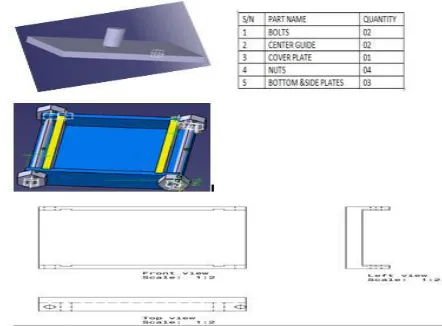
To prepare WPCs lumber; metal mold was critical factor. The mold was first designed in 2D drawing by using CATIA V5 shown in Fig. 2 given below. After confirming the design and the dimensions, the mould was machined through few machining operations, such as smoothing, cutting, and filleting and other operations.
[image:4.612.339.560.232.395.2]Next, the mould plates were assembled manually. The composite slab materials were manufactured by melting the pure or recycled HDPE and then mixed with wood flour and molded using c-clamp compression molding. For tensile, flexural, impact and water absorption specimens were prepared from the manufactured lumber composite plate by cutting to get the desired dimensions.
Fig.2. 3D mold cavity views and its part drawings using CATIA V5
3.3. Materials processing and specimen preparation 3.3.1. Raw Material (100% Virgin HDPE)
One of the materials selected for this research was virgin high density polyethylene (HDPE). High Density Polyethylene (HDPE) material was supplied by BiruhTesfa Irrigation and Water technology PLC Bought from International known company SABIC and BOROUGE that
it contains carbon black 2.5 + 0.5% by mass in accordance
specifications with ISO 6964. Composite slabs/plates were made by measuring the weight and melting 100% virgin HDPE and then mixing was followed by relevant percentage of (80%, 70%& 60%) 100% virgin HDPE and (20%, 30%, 40%) wood flour respectively that had been determined for experimentation purpose.
3.3.2. Mixing
International Journal of Emerging Technology and Advanced Engineering
Website: www.ijetae.com (ISSN 2250-2459, ISO 9001:2008 Certified Journal, Volume 9, Issue 5, May 2019)
[image:5.612.342.546.189.279.2]
97
After that, the recycled materials of HDPE were weighed and melted with ratio of 80%, 70%& 60% then mixed with varying content of wood flour (20%,30%,40%) respectively that had been determined for experimentation purpose. The RHDPE products were crushed with manual cutting tools in order to get the materials in smaller 50 mm particles form. Raw virgin and recycle HDPE materials are shown in Fig. 3 (a) and 3(b) given below.Fig. 3. Recycled HDPE material (a) HDPE and (b) RHDPE
3.3.3. Collecting and processing of input materials (Wood flour collecting and processing flow diagram)
The wood flour was collected from the wood shops of Mekelle town and processed it by using physical methods like sieving and shaking. Initially the wood flour sample was shaken on a large shaker and separated large particle such as stone, concrete, bark etc. Then sieving for removing all undesirable particles and confirmed these are 100% wood flour. This 100% sawdust exists in many particle sizes so it this experiment the specific meshes of 500 micro meters was used [17]. Processing flow diagram of wood flour is given in Figure 10 below. Wood flour refers to the small sized or powdery wood waste produced by sawing/by milling of wood. Based on literature, the common adopted sizes of wood utilized for the production of WPC range from 50 to 700 μm; where increasing particle size results in better flow of molten composite, lower mold shrinkage, and higher flexural modulus [17].This type of wood waste generally is a by-product of wood sawing which ranges from 10 to 5000 μm. The weight was measured by the electronic balance for the purpose of suitable ratio material composition of HDPE and wood flour.
[image:5.612.93.239.232.410.2]The capacity of the mold and the crucible for wood plastic composite was 0.531k.g for each slab composite. Schematic processing flow diagram of wood flour(WF) is shown in Fig. 4.
Fig. 4. Schematic processing flow diagram of wood flour (WF)
3.3.4. Wood flour drying procedure
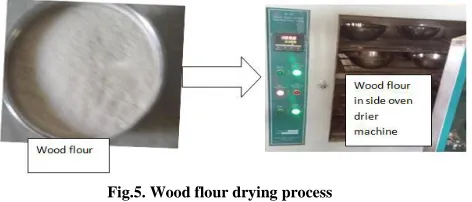
The sawdust wood was then dried in the oven at 100oC
for 24 hours to remove moisture and other volatile impurities present [17]. Because, if the sawdust wood contains a moisture there is an increasing of incompatible between the two materials, wood flour is hydrophilic and HDPE is hydrophobic. The prepared wood flour and when placed in an oven for drying is shown in Fig. 5 given below.
Fig.5. Wood flour drying process
3.3.5. Melting procedures for VHDPE and RHDPE
The melting processes of VHDPE/RHDPE were using open furnace that contains an automatic blower with pull and push button on fan or limit control for manual override testing of lighting a fire using charcoal. It can increase or decrease the temperature by controlling the regulator of the fan, as the melting temperature of VHDPE or RHDPE was
reached 149oC immediately wood flour from the hopper is
[image:5.612.334.570.418.519.2]International Journal of Emerging Technology and Advanced Engineering
Website: www.ijetae.com (ISSN 2250-2459, ISO 9001:2008 Certified Journal, Volume 9, Issue 5, May 2019)
98
Fig. 6. (A) Open furnace and, (B) temperature controller thermocouple
3.3.6. Mass content formulations and mixing of composite requirements
The Critical processing stage in WPC manufacturing for characterization is mixing of the two composites. Mixing was done using electric motor mixer by adding some design modification around the tip in order to mix melted VHDPE or RHDPE with wood flour homogenously. During the formulation process it was critical to evenly disperse the wood particles throughout the molten polymer. Each amount of the WPC was calculated depending on the mold cavity as the following procedure. The thermocouple measuring melting temperature of VHDPE and RHDPE was used. Electric motor used for mixing WPCs is shown in Fig. 7 given below.
i. Mass content calculations for WPCs
Volume of mold cavity= 160*140*25=560,000mm3
Total mass of composite= =0.948g/cm3*560
cm3=530.88g=0.53088kg
Total mass= (Mass of fiber) + (Mass of matrix)
For respective ratios of (VHDPE: WF and RHDPE: WF) of (80:20, 70:30, 60:40)
ii. Mass content calculation
X Mass content of matrix
Y Mass content of fiber
0.53088*0.8=0.425kg 0.7*0.53088=0.372kg 0.6*0.53088=0.319kg 0.2*0.53088=0.106kg 0.3*0.53088=0.159 kg 0.4*0.53088=0.212 kg
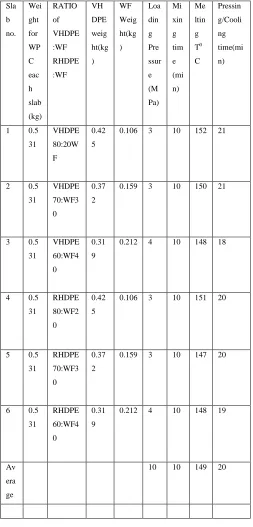
[image:6.612.63.275.109.253.2]Mass Content formulations and mixing requirements of composite details are depicted in Table 1 given below.
Table 1:
Mass Content Formulations and Mixing of Composite Requirements
Sla b no. Wei ght for WP C eac h slab (kg) RATIO of VHDPE :WF RHDPE :WF VH DPE weig ht(kg ) WF Weig ht(kg ) Loa din g Pre ssur e (M Pa) Mi xin g tim e (mi n) Me ltin g T0 C Pressin g/Cooli ng time(mi n)
1 0.5 31 VHDPE 80:20W F 0.42 5
0.106 3 10 152 21
2 0.5 31 VHDPE 70:WF3 0 0.37 2
0.159 3 10 150 21
3 0.5 31 VHDPE 60:WF4 0 0.31 9
0.212 4 10 148 18
4 0.5 31 RHDPE 80:WF2 0 0.42 5
0.106 3 10 151 20
5 0.5 31 RHDPE 70:WF3 0 0.37 2
0.159 3 10 147 20
6 0.5 31 RHDPE 60:WF4 0 0.31 9
0.212 4 10 148 19
Av era ge
[image:6.612.319.572.160.687.2]International Journal of Emerging Technology and Advanced Engineering
Website: www.ijetae.com (ISSN 2250-2459, ISO 9001:2008 Certified Journal, Volume 9, Issue 5, May 2019)
[image:7.612.48.310.134.241.2]
99
Fig. 7. Electrical motor used for mixing WPC (source: Photograph taken by mobile camera)
3.3.7. WPC manufacturing and specimen preparation
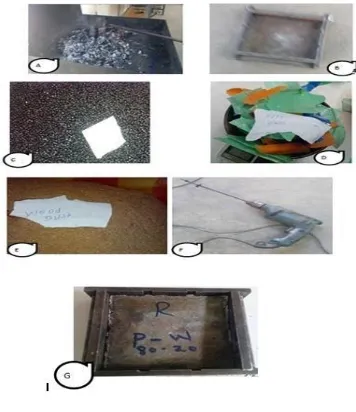
The VHDPE, RHDPE and wood flour of WPC composite slab were manufactured at school of Mechanical and Industrial Engineering foundry Workshop. WPC lumber was manufactured processed by melting with an open furnace from VHDPE, RHDPE and wood flour with ratio ranging from 60%, 70% and 80% VHDPE, RHDPE with varying content of 40%, 30% and 20% WF by weight percentage respectively. In this, WPC manufacturing, two crucible equipment’s‟ were used to melt the plastic and one rotary drill machine was used for mixing the composite and the temperature was controlled by thermocouple sensor tip until it reaches at suitable structure at the room temperature. Then, immediately wood flour were added to the hopper and it mixed homogenously by manual rotary drill machine and pours the WPC composite in to the steel mold and pressed by C clamp compression molding technique. The pressing times and pressure varied with the amount of fiber loading. As the percentage of WF loading increased, the melt-flow index decreased requiring additional pressure and pressing time properly forms the WPC slab. In all cases, the mixture was heated to 149°C and cooled before the slab was removed from the compressed mold. Cooling time was 20 minutes. WPC slab manufacturing process is shown in Fig. 8 given below.
Fig. 8.WPC slab manufacturing process
3.3.8. Preparation of test specimens
The composites granules were molded according to ISO standards using C clamp compression molding technique at a melting temperature of 149°C. In order to prepare tensile, flexural, impact and water absorption test specimens ASTM and ISO standards were followed. Molds with single cavity were used during the process is shown in Fig. 9 given below.
The dog bone specimens produced earlier are crushed via crushing machine. The polymer specimens are dog-bone shaped. They were injection molded, and its
dimensions were determined according to the ASTMD 638.
[image:7.612.347.525.322.528.2]Measure the thickness, width and gage length of polymer samples using a pair vernier calipers. These dimensions should be approximately the same for each sample.
Fig. 9.Mold used for manufacturing sampling process
3.3.9. Composite specimens testing methods
Fabricated composite specimens were tested for physical and mechanical properties followed by methods are listed below.
(a) Testing methods for physical properties (b) Testing methods for mechanical properties
3.3.9.1 Physical property testing method
3.3.9.1.1. Water absorption test
[image:7.612.63.280.569.662.2]International Journal of Emerging Technology and Advanced Engineering
Website: www.ijetae.com (ISSN 2250-2459, ISO 9001:2008 Certified Journal, Volume 9, Issue 5, May 2019)
100
Firstly, all the dried specimens were weighed using weighing machine. Then, each specimen was immersed in separate boxes containing salt water for 24 hrs at roomtemperature 23.4oC (density of salt water is 10.725kg/m3).
After this all the wetted specimens are weighed. Finally water absorption rate is calculated by using the formula [18].
WA (%) = (W1 – W0)/W0 * 100
Here, W1 is the final weight of composites specimen
(after absorption), W0 is the initial weight of composites
specimen (before absorption).
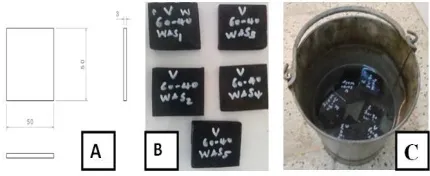
[image:8.612.348.541.257.349.2]Specimen’s dimension for water absorption is Length: 50mm; Width: 50mm; Thickness: 3mm. and water immersion procedures shown in Fig.10 given below.
Fig.10. Dimensions (A), Specimens (B) and Specimens immersed inside water(c) for water absorption testing
3.3.9.2. Mechanical property testing method
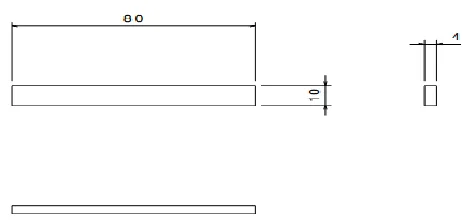
Tensile test input parameters such as thickness (4mm), gauge length L0 (60mm), width (10mm), load 50KN, cross head speed of 5mm/min original cross sectional area A0 of the specimen were put primarily and the gage of specimen were gripped by the jaws of the holder are the input parameters to the computer system in order to get necessary out puts.
Dogbone shaped tensile specimens test was performed according to ISO 527. Five specimens each of wood plastic composite, of high density polyethylene (HDPE) and wood flour sieve of 500 micro meter size were used. Tensile specimens were prepared in EIT-M, Mekelle University at
Mechanical Engineering, Solid Mechanics Testing
lab.Tensile strength testing was conducted at MU- EIT-M
department of Civil Engineering using Zhejiang
geotechnical microcomputer controlled electro hydraulic servo universal testing machine with model of EHC-3100 which has the capacity to test up to 1000 KN shown in Fig. 11 given below.
The tensile test specimen dimension is given as Width of narrow section: 10mm; Length of narrow section: 60mm; Thickness: 4mm; Overall length: 155mm; Overall width: 20mm; Radius of fillet: 60mm.
[image:8.612.62.277.319.407.2]The load was applied uniformly increasing on the specimen and loaded until it fails. Five WPC of dog bone specimens were selected and griped with universal testing machine jaws and tested. Computer system connected to the universal testing machine. The specimens were loaded into the testing machine, and a tensile test was performed. The load-deflection curve showed on the computer screen, data was recorded in text file. The tensile test setup and specimen dimension is shown in Fig. 11 and 12 respectively given below.
Fig. 11. Zhejiang geotechnical electro-hydraulic servo universal testing machine setup (A), dog bone specimens before testing (B) and
broken specimen after testing(C)
Fig. 12. Dimensional schematic views for tensile testing specimen
3.3.9.3. Flexural test
Flexural test is performed according to ISO 178 to determine the flexural strength using universal testing machine. Five specimens each of wood plastic composite, high density polyethylene (HDPE), wood flours are used. Flexural testing machine setup and dimensional views for flexural testing specimens are shown in Figure 13 and 14 given below respectively.
[image:8.612.335.562.375.498.2]International Journal of Emerging Technology and Advanced Engineering
Website: www.ijetae.com (ISSN 2250-2459, ISO 9001:2008 Certified Journal, Volume 9, Issue 5, May 2019)
[image:9.612.324.561.117.242.2]
101
The same experimental setup also used for the three point bending test setup and broken specimen is shown in Fig. 13 given below.Fig. 13. Electro-hydraulic servo universal testing machine setup (A, B&C) before; and after broken specimens (D)
[image:9.612.57.288.179.269.2]Dimension and views for flexural testing specimen is shown in Fig. 14 given below.
Fig. 14.Dimension and views for flexural testing specimen
3.3.9.4. Impact test
Impact test is performed according to ISO 180 to determine the reliability of a material can be determined by measuring its resistance to fracture, either ductile or brittle and fracture toughness [19]. The impact test on the developed composite samples was carried out using a fully instrumented charpy impact testing machine. Charpy impact test was conducted on notched samples using standard square impact test samples measuring 80 x 10 x 4 mm with notch depth of 2 mm and a notch tip radius of 0.
02 mm at angle 450 (ASTM, 2000), and the results was
recorded in Joules (J). “Standard test methods for notched bar impact testing of composite Materials” was used. The testing was performed in Mekelle University at Mechanical Engineering material testing lab by charpy pendulum impact tester machine using 8Kg hammer weight with a capacity of minimum and maximum energy requirement of 1J and 150J respectively. Impact tester machine setup and specimen dimensional view are shown in Fig.15 and 16 given below respectively.
Fig. 15.Impact tester machine setup ((A) testing specimen, (B) specimen under impact testing).
[image:9.612.345.501.294.382.2]Dimension and views for flexural testing specimen is shown in Fig. 16 given below.
Fig. 16.Dimensional view of impact testing specimen
IV. RESULTS AND DISCUSSION
The physico-mechanical properties of raw or recycled HDPE composites reinforced with woodflour were studied in this research. The aim of these tests was to characterize the physical and mechanical properties of WPCsspecimen’s samples.
There are a number of published studies on the reinforcement of VHDPE with wood fiber with regard to resulting mechanical properties, dimensional stability and
interfacial bonding and durability. However, studies on
WPCs based on RHDPE are very limited. Studied RHDPE (simulated milk gallon) and wood fiber composites using extrusion molding and reported that the performance of these composites was at least as good as the composites based on virgin plastic.
The post-consumer recycled polyethylene waste stream
may contain many different grades, colors and
[image:9.612.59.290.329.439.2]International Journal of Emerging Technology and Advanced Engineering
Website: www.ijetae.com (ISSN 2250-2459, ISO 9001:2008 Certified Journal, Volume 9, Issue 5, May 2019)
102
The impact of post-consumer recycled polyethylene inWPCs is still not fully understood, leaving open research opportunities for the optimization of the products and processing. This part of study aims to explore the use of post-consumer recycled polyethylene for the production of the saw-dust-recycled polyethylene composites. The effect of saw-dust loadings and chemical modification of Saw dust mechanical properties and microstructure was investigated. The test results for the raw and chemically treated Saw dust reinforced recycled polyethylene composites were presented anddiscussed [20].4.1. Water absorption tests
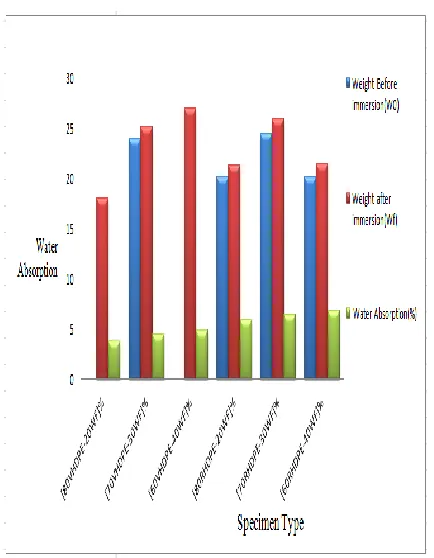
Cool water absorption test results shown in Fig. 17 illustrate the water absorption of the composites based on various virgin/recycled HDPE and WFmixing content after 24 hours of immersion in water and shows that WA of the composites increased with the increase of WF content. The highest water absorption results for the virgin HDPE Versus wood flourwas3.8, 4.5 and 4.8 % with mixing percentage of 80%, 70% and 60% virgin HDPE polymer and 20%, 30% and 40% WF contents respectively. The highest WA is for the recycled HDPE Versus wood flour werealso 5.9, 6.4 and 6.8 % with mixing percentage of 80%, 70% and 60% RHDPE polymer mixed with 20%,30% and 40% WF respectively. These results mainly attributed due to the hydrophilic nature of wood which clearly shows that recycled HDPE mixed with wood flour composite has more water absorption in comparison to virgin HDPE.
[image:10.612.336.553.131.410.2]Wood is a hydrophilic porous composite which consists of cellulose, lignin and hemicelluloses polymers that are rich in functional groups such as hydroxyls, which readily interact with water molecules by hydrogen bonding and due to this reason; the WPCs have the potentiality to uptake water under humid condition. Higher water resistance of composites with the increasing HDPE content can be attributed to the hydrophobic character of HDPE, though it is semi-crystalline in nature [21].Graphical representation of water absorption tests results are shown in Fig. 17.
Fig. 17.Graphical representation of water absorption test results of WPC made of V/RHDPE and WF
4.2. Tensile strength test results
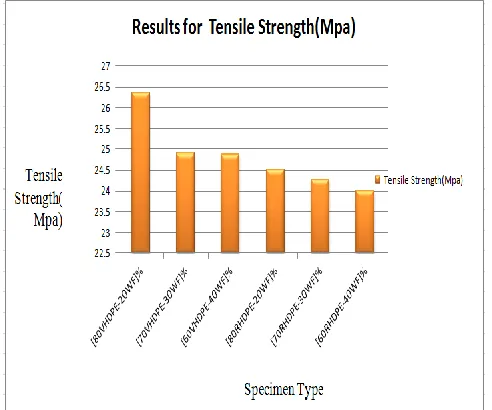
Tensile test results shown in Figure 26 given below depict thetensile strength of HDPE and WFcomposites were based on Virgin/Recycled HDPE and WF Mixing ratio. It is observed that tensile strength of the composites decreased with an increase of wood flour loading content. The highest tensile strength results for the virgin HDPE versus wood flourwas26.35, 24.9 and24.88MPa80%, 70% and 60% VHDPE polymer mixed with 20%, 30% and 40% WF respectively. The tensile strength for the recycled
HDPEversus wood flourwasalso 24.5, 24.3 and
International Journal of Emerging Technology and Advanced Engineering
Website: www.ijetae.com (ISSN 2250-2459, ISO 9001:2008 Certified Journal, Volume 9, Issue 5, May 2019)
[image:11.612.47.293.178.383.2]
103
The reason behind this is due to hydrogen bond in recycled HDPE weak. Graphical representation of tensile tests results are shown in Fig. 18.Fig. 18.Graphical representation of Tensile strength of WPC made of V/R HDPE and WF
4.3. Flexural test results
Three point bend test was carried out and the results are shown in graph Figure 27 given below that depicts flexural strengthof the HDPE: WF composites based on virgin/recycled HDPE and WF Mixing ratio. It is observed that flexural strength of the composites decreased with the increase of WF content. The highest flexural strengthfor the virgin HDPE versus wood flour was 19.5, 17.85 and 17.3MPa with 80%, 70% and 60% VHDPE polymer mixed with 20%, 30% and 40% WF respectively. The highest flexural strength for the Recycled HDPE Versus wood flour composites werealso 15.25, 14.05 and 13.25Mpa80%, 70% and 60% RHDPE polymer mixed with 20%,30% and 40% WF respectively. The results clearly differentiates the flexural strength of virgin HDPE/WF and recycled HDPE /WF composites. It shows that the recycled HDPE /WF composites flexural strength is comparatively lower that is reasonably justified due that wood flour particles enriched in the composite molecules easily mixed with recycled molecules and it enhances the intermittent delinking between recycled HDPE and wood flour as both are more hydrophilic.
Comparatively virgin HDPE has high and less hydrophilic as well to mix with WF and virgin HDPE. It has higher MPa values therefore it needs more time shall be required high flexural strength to break the bond of the specimens. The results are in Fig.19 given below.
Fig. 19. Graphical representation of flexural strength of WPC made of V/R HDPE and WF
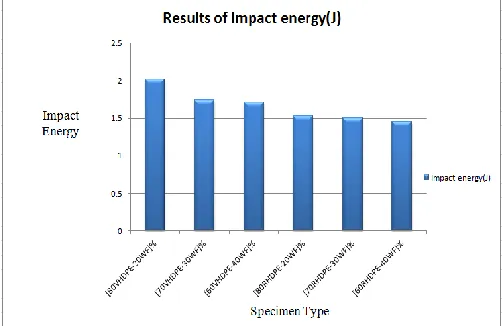
4.4. Impact test results
[image:11.612.330.558.200.347.2]International Journal of Emerging Technology and Advanced Engineering
Website: www.ijetae.com (ISSN 2250-2459, ISO 9001:2008 Certified Journal, Volume 9, Issue 5, May 2019)
[image:12.612.48.299.137.300.2]
104
Fig. 20.Graphical representation of Impact Energy test results of WPC made of V/R HDPE and WF
V. CONCLUSIONS
The primary objective ofthis study was to fabricate WPC and to determine the physico-mechanical property of WPCs made VHDPE, RHDPE reinforced with Wood Flour. The secondary aim is to reduce the environmental pollution by using recycling VHDPE, RHDPE as matrix of WPCs. The experimental characterization and theoretical interpretation of a series of works on “Physico1-Mechanical Properties of VHDPE, RHDPE and WFComposites” was conducted in this experimental researchwork.
Major findings drawn from these studies are explained in subsequent sections. It has been found that the VHDPE/WF composite possesses slightly better mechanical properties than the RHDPE/WF composites. From this study, it was found that wood flour can be successfully reinforced in RHDPE to produce stable and strong WPCs, which have properties similar or comparable to that made from VHDPE.
Therefore, WPCs with improved stability and
mechanical properties have great potential to use as various engineering materials. The physical and mechanical properties of the VHDPE/ RHDPE: WF was studied in this work. Taking all the results and findings, of this study critical points were summarized below
(i). Water absorption:
The water absorption increased with the filler loading. VHDPE: WFComposites absorbed lowest amount of water
ascompared to VHDPE/WF. The trend of the water
absorption test was found to follow the order: RHDPE:
WF>VHDPE/WF.
This in equality indicates that recycled high density polyethylene and wood flour composite has high water absorption than recycled high density polyethylene and wood flour composite. But, it does not mean RHDPE has no use for any applications.
(ii). Tensile strength:
The Tensile strength values of wood flour reinforced VHDPE composites were found to be higher than wood flour reinforced/RHDPE composites. It shows that tensile strength of the composites decreased with an increase in wood flour content in both case of composites from 20% up to 40% WF loading. Therefore, the trend of tensile strength of the two types of WPCs follows the order
comparatively as: VHDPE/WF>RHDPE/WF.Therefore, it
can be concluded even recycled materials have lower tensile strengths than the virgin once, but they are strong enough and can be recommended for anyEngineering applications.
(iii). Flexural properties:
Flexural strength of the developed composites dropped as increased with an increase in filler loading. The trend of the flexural properties of the four types of fabricated
composites was found to follow this order:
VHDPE/WF>RHDPE/WF. It means that the more time
shall be required to breakVHDPE/WF composites as
compared to RHDPE/WF.
(iv). Izode notched impact strength and energy:
Izode notched impact strength and energy decreased with an increase in filler loading. The lowest filler loaded WPC composites showed highest impact strength and impact energy.
Acknowledgement
We would like to express my thank to Department of Mechanical Engineering, Solid Mechanics and Design Chair for allowing us to use their laboratory.
REFERENCES
[1] Winandy,J.E.,Stark,N. M, and Clemons,C. M. 2004. "Consideration In Recycling Of Wood Plastic Composites." 5th Global Wood and Natural Fiber Composites Symposium. Kassel- Germany.
[2] SouryE.,Behravesh,A.H, RouhaniEsfahani,E, and Zolfaghari,A 2009."Design, optimization and manufacturing of wood–plastic composite pallet",Materials and Design, 30.
International Journal of Emerging Technology and Advanced Engineering
Website: www.ijetae.com (ISSN 2250-2459, ISO 9001:2008 Certified Journal, Volume 9, Issue 5, May 2019)
105
[4] Youngquist,J., Myers,G, and HartenT 1992.Lignocellulosic–Plastic Composites from Recycled Materials, American Chemical Society. [5] Bengtsson,M.andOksman,K. 2006."Silanecrosslinked wood plastic
composites:Processing and properties", Composites Science and Technology, 66.
[6] Wechsler,A. and Hiziroglu,S. 2007.Building and Environment,, 42, 2637–2644.
[7] Clemons,C.M. and IbachR.E. 2004. "Effects of processing method and moisture history on laboratory fungal resistance of wood-HDPE composites”, Forest Products Journal, 54(4).
[8] NajafiS.K., Hamidinia,E,Tajvidi,M, 2006.Mechanical properties of composites from sawdust and recycled plastics, .Journal of Applied Polymer Science.
[9] John Youngquist,A., George Myers,E, James Muehl,H,.AndrzeKrzysik,M, Clemens,C.M,and Brown,L 1994c.Composites from Recycled Wood and Plastics.
[10] RowellR.M. andYoungquist,J.A.1991. Composites from Recycled Materials.
[11] Mohammad,A.D, Hassan,Z.T,Hosseinpourpia,R,Nazarnezhad, N, and Shams,M 2012.Investigation of the morphological and thermal properties of waste newsprint / recycled polypropylene/ nanoclay, available from: composite.bioresources.com, 7.
[12] Lu,J.Z., Wu,Q, and Negulescu II 2005. Wood-fiber/high-density-polyethylene composites: coupling agent performance,Journal of Applied Polymer Science.
[13] Calantone, Roger J. and Anthony di Benedetto,C 1988. “An Integrative Model of the New Product Development Process: An Empirical Validation”, Journal of Product Innovation Management, 5, 201-215.
[14] WilliamE. S. 1980 “Promoting an Effective R&D/Marketing Interface,” Research Management,23(4), 4th July, 10-15.
[15] Good shipV. 2007Introduction to plastic recycling, 2, ([e-book] Shawbury, U.K. :SmithersRapra,)
[16] Turgay,O, and. Fatih,M.2008 Some Properties of Composite Panels Made from Wood Flour and Recycled Polyethylene,Int. J. Molecular Science, 9(12).
[17] AshoriA. 2008bWood – plastic composites as promising green-composites for automotive industries,Bioresource Technology. [18] Dr. Sunil,C. C.and. Krishnappa,G. B. 2015 Study Of Mechanical and
Physical Properties of Wood Plastic Composite,Polypropylene, Rose, Teak and Neem Wood
[19] Miller,N.A., Stirling,C.D, and Langford,V.S.M. 1994.Pinusradiatafibre/ thermoplastic composite materials,In: Proceedings of the Second Pacific Rim Bio-based Composite Symposium; Vancouver, Canada.
[20] Bledzki,A. K.., Reihmane,S.and GassanJ. “Thermoplastics reinforced with wood fillers: a literature review”, J Polymer-Plastic Technology and Engineering.