http://dx.doi.org/10.4236/jbcpr.2015.34019
Representing the Knowledge of Public
Construction Project Cost Estimator
by Using Rule-Based Method
Abelrahman Osman Elfaki1,2, Saleh Alatawi1,2 1University of Tabuk, Tabuk, KSA
2Binladen Research Chair of Quality and Productivity Improvement in the Construction Industry, College of Engineering, University of Hail, Hail, KSA
Received 23 November 2015; accepted 8 December 2015; published 11 December 2015
Copyright © 2015 by authors and Scientific Research Publishing Inc.
This work is licensed under the Creative Commons Attribution International License (CC BY).
http://creativecommons.org/licenses/by/4.0/
Abstract
Despite the presence of various construction project cost estimate softwares, human experience and knowledge cannot be disregarded. This fact has been proven in practice, where the success of construction cost estimate process is mainly based on knowledge of human estimator. The main question concerns what human knowledge determines the success of the construction cost esti-mation process. To address this question we have applied Delphi technique and the output is ele-ven factors that are enough to precisely represent construction cost estimator knowledge. Then we have used First Order Logic (FOL) to represent these factors in terms of predicates and rules. These FOL rules could be used for evaluating construction cost estimator knowledge in five classes: fail, pass, acceptable, good, and very good. As a validation process we have done experiments us-ing history data and the results have proved the accuracy of our proposed method.
Keywords
Construction Management, Construction Cost Estimation, Rule-Based System
1. Introduction
cost estimate [2]. The previous discussion reflects the importance and impact of construction cost estimation process.
Although there are a significant number of automated construction cost estimation tools, humans still have the upper hand in estimating the cost of construction projects [3]-[5]. While the cost estimation process depends on human then there must be differences between estimates even in one project. In other words, even in one project and by using the same data and variables, different estimators could provide different cost estimations. This fact is due to variances in human expertise. From the previous fact, it is very clear that the accuracy of construction cost estimation is basically depending on the human estimator expertise, i.e., the good expertise provides accu-rate estimation.
In the literature, there are many works that deal with construction cost estimation by developing expert system. Expert system is a computer program that has an ability to behave in the same way as a human expert [6]. The final aim of creating and developing construction cost estimation expert system is to mimic the human expert by transferring the human expert to the software. Even with the usage of these Artificial Intelligence softwares, human experts stay irreplaceable. However, these artificial expert systems improve the estimation process in different perspectives such as compensating the numerical shortage of human experts, or using expert system as educational tools. The applications of expert systems have the lion’s share among all other intelligent techniques.
Construction project cost estimation is an instance of a knowledge-intensive engineering task [7]. This know-ledge depends on the expertise of the human professional. In fact, engineers require several years to develop the necessary expertise to conduct the cost estimation process. The main issue that arises here is that the engineers’ expertise is often not documented or even authenticated. Hence, this expertise is prone to subjectivity (i.e., de-fined to an extent by one’s personal opinion). According to Shane et al. (2009), accuracy and comprehensive-ness in cost estimation are delicate issues and can be easily affected by many different parameters; furthermore, each parameter must be properly addressed in order to maintain an acceptable level of accuracy during the process [8]. Hence, it is very important to define clearly the factors that make human as an expert in estimating cost of construction project.
According to Akinci and Fischer (1998), the factors that affect cost estimation in construction projects can be clustered into two distinct groups: estimator-specific factors, and design and project-specific factors [9]. The es-timator specific factors are defined as the factors that are related to construction cost eses-timators’ background, experiences, and cognitive skills. On the other hand, design and project-specific factors are defined as factors that are related to construction project itself such as project size, type of project, ground conditions, type of client, material costs, likely design and scope changes, duration, and tendering method. The design and project- specific factors could be easily computerized. In our previous work [10] we have investigated the intelligent techniques that have been developed based on design and project-specific factors. On the contrary, estimator specific factors still not yet have been defined. It is challenging to define precisely the estimator specific factors but it is crucial to understand how human-expert can deal with the process of estimating the cost of construction projects. Estimator specific factors also could be classified in two classes: knowledge and heuristics. Knowledge leads to skills developed over years from reading, learning and/or field experiences. Heuristics are cognitive rules which people often use to form judgments and make decisions [11]. Our target in this paper is human knowledge, not heuristics.
Although there are significant numbers of research papers that have discussed usage of the expert system in construction cost estimation process, there is no work that defined what these human factors are, which make a person be an expert in construction cost estimation, i.e., construction cost estimator. This fact encourages both research and industry to define the human factors that affect the decision in construction cost estimation. The benefits of recognizing the factors that contribute to the building of human experience in the field of estimating cost construction are considered of great help in measuring cost estimation methods.
The aim of this research is to determine, and then verify the human factors that affect estimation of the cost of a construction project as undoubtedly human expertise plays a key role in the success of this process. To the best of our knowledge, this is the first work that deals with the knowledge of construction project cost estimator.
2. The Human Knowledge That Affects Construction Project Cost Estimation:
Construction Cost Estimator Knowledge
knowledge that affects construction project cost estimation a Delphi methodology is used [12]. In the following, the details of our Delphi methodology have been presented. First, we have followed these steps to collect and refine the human factors: select group of target experts, acquire the first feedback from the experts, refine the collected work and redistribute it, and conduct final workshop. Hence, each step is expressed in depth.
Select group of target experts. This step is considered the most significant as the final results are mainly dependent on its selection. Fortunately, our research was carried out in Saudi Arabia due to the huge number of construction projects. Thus, we were able to find a great number of construction experts from different national-ities, backgrounds, ages and sufficient experience. Such a population ensured good sampling.
It is well known that construction projects can be classified into two groups: public and private. Regarding public projects, there are two Saudi ministries in charge: the Ministry of Urban and Rural Affairs and the Minis-try of Transportation. This research used the contractors and consultants databases of the two ministries to target the relevant group of experts. We selected the suitable experts, from these databases of almost 5000 engineers, based on certain criteria developed from the study of Zavadskas et al. (2012) [13] and Dainty and Loosemore (2012) [14].
Refining and redistributing the collected work. In this phase, the suggested factors were collected through a blind process, i.e., the names of experts were hidden and replaced with numbers. All suggested human factors were checked and duplication in any context had been eliminated. Finally, the refined list was distributed to all our experts.
Conducting the final workshop. This was the last phase in our methodology. The experts were invited to participate for three days in workshops held at Tabuk University, Saudi Arabia. The human factors collected and refined from the previous phase were distributed among them. The experts discussed each factor which they voted to accept or reject. At the end, the workshop determined the human factors that affect construction cost es-timation. In other words, these factors are representing knowledge of construction project cost estimator.
The outputs of the workshop are summarized below. The human experts had varying points. The accuracy of the construction cost estimation of the human expert is dependent on his knowledge with respect to these points.
1. Evaluation of the client. Previous experience with the client determines the project’s level. Each client has preferences in terms of specifications. For instance, one client prefers a specific elevator brand regardless of price.
2. Knowledge of the complexity of the design. The content of the project's architectural design in terms of the difficulty or ease of implementation.
3. Knowledge of the competitors. Does the construction expert have appropriate knowledge about competitors? Knowledge can also assist in determining the cost by competitive prices.
4. Knowledge of the consultant. Does the construction expert have appropriate knowledge about the consultant? This knowledge should assist a contractor to determine the cost by competitive prices. For instance, consul-tants have various expectations. Previous knowledge of a consultant’s expectation assists in providing more accurate cost.
5. Appropriate knowledge of the laws and regulations of the contractual process. Knowledge about the regula-tions and rules that are issued by authorities is crucially important. This type of knowledge assists a con-struction expert to estimate accurate cost.
6. Complete knowledge about the project location. A construction expert should be able to have full and in depth answers for questions such as: How difficult is it to transfer construction materials to the project’s site? What is the current security situation? Could the weather cause any difficulties in the implementation of the project?
7. Knowledge of a contractor’s financial situation. How can a construction expert assess a contractor’s finan-cial situation? For instance, does he know whether he has the necessary finanfinan-cial capacity for the project? Or what is the size of the loan which can be obtained from the bank? Would it be sufficient to complete the project? This knowledge assists an expert in providing suitable cost estimation.
8. Knowledge of the relationship between the contractor and subcontractor. A good relationship with subcon-tractors provides consubcon-tractors with greater flexibility in determining the project’s cost.
10.Knowing how to find the skilled employees and technicians who are needed to make the construction project a success.
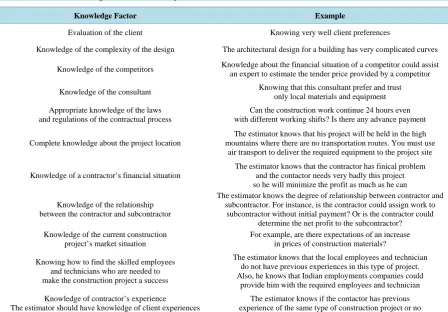
11.Knowledge of contractor’s experience. The estimator should have knowledge of client experiences. Table 1 shows the factors that represent estimator’s knowledge with an instance for each factor. In fact, Ta-ble 1 shows in details what is the best knowledge that the construction cost estimator must have. As to the best of our knowledge, this is the first paper to define precisely what the meaning of construction cost estimation knowledge is.
3. Rule Based Method
In this section, the representation of construction cost estimator knowledge as knowledge based has been dis-cussed. Any knowledge based consists of predicates and rules. We use First Order Logic (FOL) [15] to formal-ize construction cost estimator knowledge and this will allow using Prolog [16] as a reasoning tool. In the fol-lowing, each one of the eleven knowledge factors that has been discussed in section 2 has been represented as a predicate.
As the whole issue it is about the knowledge of estimator, and then we identify the main predicate as “know-ledge”. We have designed the knowledge predicate to have three parameters: s, X, and n. Where the letter “s” represents the construction cost estimator, the capital letter X represent any one of the eleven knowledge factors, and finally the letter “n” represent the knowledge value. We have designed the knowledge value as an integer from 1 to 5 which reflect in order; very good, good, acceptable, pass and fail. As we have mentioned before, the capital letter “X” the knowledge factors hence “X” could be replaced by eleven factors. Table 2 shows the con-stants that represent knowledge factors.
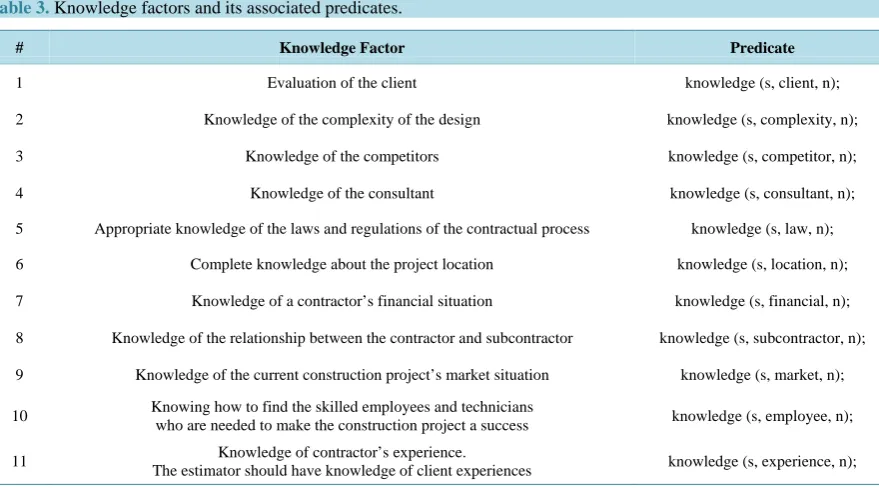
[image:4.595.89.538.403.715.2]Now, we could show the total set of predicates that could be used for representing knowledge of construction cost estimator. Table 3shows the predicates that could be used representing knowledge of construction cost es-timator.
Table 1.Estimator knowledge factors with examples.
Knowledge Factor Example
Evaluation of the client Knowing very well client preferences
Knowledge of the complexity of the design The architectural design for a building has very complicated curves
Knowledge of the competitors Knowledge about the financial situation of a competitor could assist an expert to estimate the tender price provided by a competitor
Knowledge of the consultant Knowing that this consultant prefer and trust only local materials and equipment
Appropriate knowledge of the laws and regulations of the contractual process
Can the construction work continue 24 hours even with different working shifts? Is there any advance payment
Complete knowledge about the project location
The estimator knows that his project will be held in the high mountains where there are no transportation routes. You must use
air transport to deliver the required equipment to the project site
Knowledge of a contractor’s financial situation
The estimator knows that the contractor has finical problem and the contactor needs very badly this project so he will minimize the profit as much as he can
Knowledge of the relationship between the contractor and subcontractor
The estimator knows the degree of relationship between contractor and subcontractor. For instance, is the contractor could assign work to
subcontractor without initial payment? Or is the contractor could determine the net profit to the subcontractor?
Knowledge of the current construction project’s market situation
For example, are there expectations of an increase in prices of construction materials?
Knowing how to find the skilled employees and technicians who are needed to make the construction project a success
The estimator knows that the local employees and technician do not have previous experiences in this type of project. Also, he knows that Indian employments companies could
provide him with the required employees and technician
Knowledge of contractor’s experience The estimator should have knowledge of client experiences
Table 2. The constants that represent knowledge factors.
# Knowledge Factor Representation Constant
1 Evaluation of the client Word: “client”
2 Knowledge of the complexity of the design Word: “complexity”
3 Knowledge of the competitors Word: “competitor”
4 Knowledge of the consultant Word: “consultant”
5 Appropriate knowledge of the laws and regulations of the contractual process Word: “law”
6 Complete knowledge about the project location Word: “location”
7 Knowledge of a contractor’s financial situation Word: “financial”
8 Knowledge of the relationship between the contractor and subcontractor Word: “subcontractor”
9 Knowledge of the current construction project’s market situation Word: “market”
10 Knowing how to find the skilled employees and technicians
who are needed to make the construction project a success Word: “employee”
[image:5.595.93.533.328.573.2]11 Knowledge of contractor’s experience. The estimator should have knowledge of client experiences Word: “experience”
Table 3. Knowledge factors and its associated predicates.
# Knowledge Factor Predicate
1 Evaluation of the client knowledge (s, client, n);
2 Knowledge of the complexity of the design knowledge (s, complexity, n);
3 Knowledge of the competitors knowledge (s, competitor, n);
4 Knowledge of the consultant knowledge (s, consultant, n);
5 Appropriate knowledge of the laws and regulations of the contractual process knowledge (s, law, n);
6 Complete knowledge about the project location knowledge (s, location, n);
7 Knowledge of a contractor’s financial situation knowledge (s, financial, n);
8 Knowledge of the relationship between the contractor and subcontractor knowledge (s, subcontractor, n);
9 Knowledge of the current construction project’s market situation knowledge (s, market, n);
10 Knowing how to find the skilled employees and technicians
who are needed to make the construction project a success knowledge (s, employee, n);
11 Knowledge of contractor’s experience.
The estimator should have knowledge of client experiences knowledge (s, experience, n);
Table 4shows the rules for knowledge (s, client, n) predicate which we presented as an example for the reset of ten predicates. Each factor of the eleven has the same format that has been presented in Table 4, i.e., five rules for each predicate. Generally the rules in Table 4say that: for all estimators and clients there exists an in-teger that illustrates the estimator knowledge about the client. The syntaxes and semantics of our proposed pre-dicates have been presented in Table 4.
4. Validation
Table 4. Rules for knowledge (s, client, n) predicate.
Rule Syntax Rule Semantic
∀s, client,∃n: knowledge (s, client, n) ∧ n = 1 ⟹ fail; If the estimator knowledge about client is equal to 1 then output equal fail.
∀s, client, ∃n: knowledge (s, client, n) ∧ n = 2 ⟹ pass; If the estimator knowledge about client is equal to 2 then output equal pass.
∀s, client, ∃n: knowledge (s, client, n) ∧ n = 3 ⟹ acceptable; If the estimator knowledge about client is equal to 3 then output equal acceptable.
∀s, client, ∃n: knowledge (s, client, n) ∧ n = 4 ⟹ good; If the estimator knowledge about client is equal to 4 then output equal good.
∀s, client, ∃n: knowledge (s, client, n) ∧ n = 5 ⟹ very good; If the estimator knowledge about client is equal to 5 then output equal very good.
1. We have collected a group of 78 construction cost estimator from the data-base of Ministry of Urban and Rural Affairs and the Ministry of Transportation. They join and contribute to this experiment as volunteers. 2. The selected construction cost estimators have been divided into five classes. These five classes were: very
good, good, acceptable, pass and fail.
3. For each project of the selected 25 projects, the classes were divided based on the specific characteristics of each group. For instance, in the first experiment, any expert who satisfied the characteristics of knowledge factors as very good (with respect to the first project) was assigned to the very good class. Any construction cost estimator who satisfied the characteristics of knowledge factors as good (with respect to the first project) was assigned to the good class. This was the same concept for the acceptable, pass and fail classes.
4. The experiment began by distributing information about a project to all our selected construction cost esti-mators. Then, a self-evaluation process allowed each expert to evaluate himself with respect to the 11 know-ledge factors by using the distributed project’s information. The measurement was based on five scales: 100 - 90, 89 - 75, 74 - 60, 59 - 50, 50 - 0. For instance, in regard to the first factor, “Evaluation of the client”, each expert scored himself using the project’s information from 100 - 0. As an example, if an expert felt that he could evaluate correctly the client by 90% then he scored himself 90, or 70 if he could evaluate the client correctly by 70%. The expert should also evaluate his knowledge on each knowledge factor. Finally, the av-erage was used to assign each expert to a suitable class. For instance, an expert with an avav-erage score of 70 would be assigned to acceptable class.
5. After classes were divided, each class could estimate the cost of a project.
From the results of the 25 experiments we found that the estimation accuracy of the very good class was 92%, the good class was 83%, the acceptable class was 61%, the pass class was 49% and the fail class was 20%. These results confirm the accuracy of our proposed method.
5. Conclusions
Our proposed predicates and rules will provide a great advantage for construction cost community. For instance, by using our proposed modeling, the strengths and weakness of any construction cost estimation should be known. In addition, more than one construction cost estimator could be working together to complement each other.
The first contribution of this paper is to introduce knowledge based predicates and rules that could be used for representing knowledge of construction cost estimator.
Experiments have validated and proved the accuracy of our contributions. To the best of our knowledge, this is the first research to tackle this issue.
Acknowledgements
References
[1] Holm, L., Schaufelberger, J.E., Griffin, D. and Cole, T. (2005) Construction Cost Estimating: Process and Practices. Pearson Education, Upper Saddle River.
[2] Ma, Z., Liu, Z. and Wei, Z. (2015) Formalized Representation of Specifications for Construction Cost Estimation by Using Ontology. Computer-Aided Civil and Infrastructure Engineering, Published Online.
http://dx.doi.org/10.1111/mice.12175
[3] Flyvbjerg, B., Holm, M.S. and Buhl, S.L. (2002) Underestimating Costs in Public Works Projects: Error or Lie?
Jour-nal of the American Planning Association, 68, 279-295. http://dx.doi.org/10.1080/01944360208976273
[4] Taroun, A. (2014) Towards a Better Modelling and Assessment of Construction Risk: Insights from a Literature Re-view. International Journal of Project Management, 32, 101-115. http://dx.doi.org/10.1016/j.ijproman.2013.03.004
[5] Jing, D. and El-Gafy, M. (2015) Human Computation Enabled Organizational Learning in the Face of Deep Uncer-tainty: Example of Conceptual Estimating. Journal of Information Technology in Construction, 20, 275.
[6] Peter, J. (1998) Introduction to Expert Systems. 3rd Edition, Addison Wesley, New York, 2.
[7] French, S.S., Martin, F. and John, K. (2003) A Generic Feature Driven Activity-Based Cost Estimation Process.
Ad-vance Engineering Informatics, 17, 23-39. http://dx.doi.org/10.1016/S1474-0346(03)00017-X
[8] Shane, S.J., Molenaar, K.R., Anderson, S. and Schexnayder, C. (2009) Construction Project Cost Escalation Factors.
Journal of Management in Engineering, 25, 221-229. http://dx.doi.org/10.1061/(ASCE)0742-597X(2009)25:4(221)
[9] Akinci, B. and Fischer, M. (1998) Factors Affecting Contractors’ Risk of Cost Overburden. Journal of Management in
Engineering, 14, 67-77. http://dx.doi.org/10.1061/(ASCE)0742-597X(1998)14:1(67)
[10] Elfaki, O.A., Alatawi, S. and Abushandi, E. (2014) Using Intelligent Techniques in Construction Project Cost Estima-tion: 10-Year Survey. Advances in Civil Engineering, 2014, Article ID: 107926. http://dx.doi.org/10.1155/2014/107926
[11] Lewis, A. (2008) The Cambridge Handbook of Psychology and Economic Behaviour. Cambridge University Press, Cambridge. http://dx.doi.org/10.1017/CBO9780511490118
[12] Rowe, G. and Wright, G. (2001) Expert Opinions in Forecasting. Role of the Delphi Technique. In: Armstrong, Ed.,
Principles of Forecasting: A Handbook of Researchers and Practitioners, Kluwer Academic Publishers, Boston.
[13] Zavadskas, E.K., Vainiūnas, P., Turskis, Z. and Tamošaitienė, J. (2012) Multiple Criteria Decision Support System for Assessment of Projects Managers in Construction. International Journal of Information Technology & Decision Mak-ing, 11, 501-520. http://dx.doi.org/10.1142/S0219622012400135
[14] Dainty, A. and Loosemore, M. (2012) Human Resource Management in Construction: Critical Perspectives. 2nd Edi-tion, Routledge, New York.
[15] Walicki, M. (2006) Introduction to Logic. Lecture Notes Online. http://www.econphd.net/notes.htm